

The bootcamp market in 2026 offers tech marketers a unique opportunity to engage with a growing pool of skilled developers. Here’s what you need to know:
- Market Size: By 2026, the bootcamp market is projected to reach $635.8 million, producing 69,000 graduates annually.
- Student Profile: The average graduate is 30 years old, a career changer with 4–7 years of non-tech experience, and seeks practical skills over traditional degrees.
- Popular Skills: JavaScript, Python, React, AI, and cybersecurity dominate bootcamp curricula, aligning with employer demand.
- Regional Trends: North America leads in revenue (47–50%), while Asia-Pacific shows the fastest growth, driven by government initiatives.
- Learning Models: Flexible formats like online, part-time, and self-paced programs are now standard, with tuition averaging $12,570 in North America.
For tech marketers, the bootcamp audience is highly motivated and job-focused. Tailor campaigns to highlight tools and resources that help graduates transition from bootcamp projects to professional roles. Platforms like daily.dev Ads can help you target these developers effectively based on their skills and career goals.
::: @figure 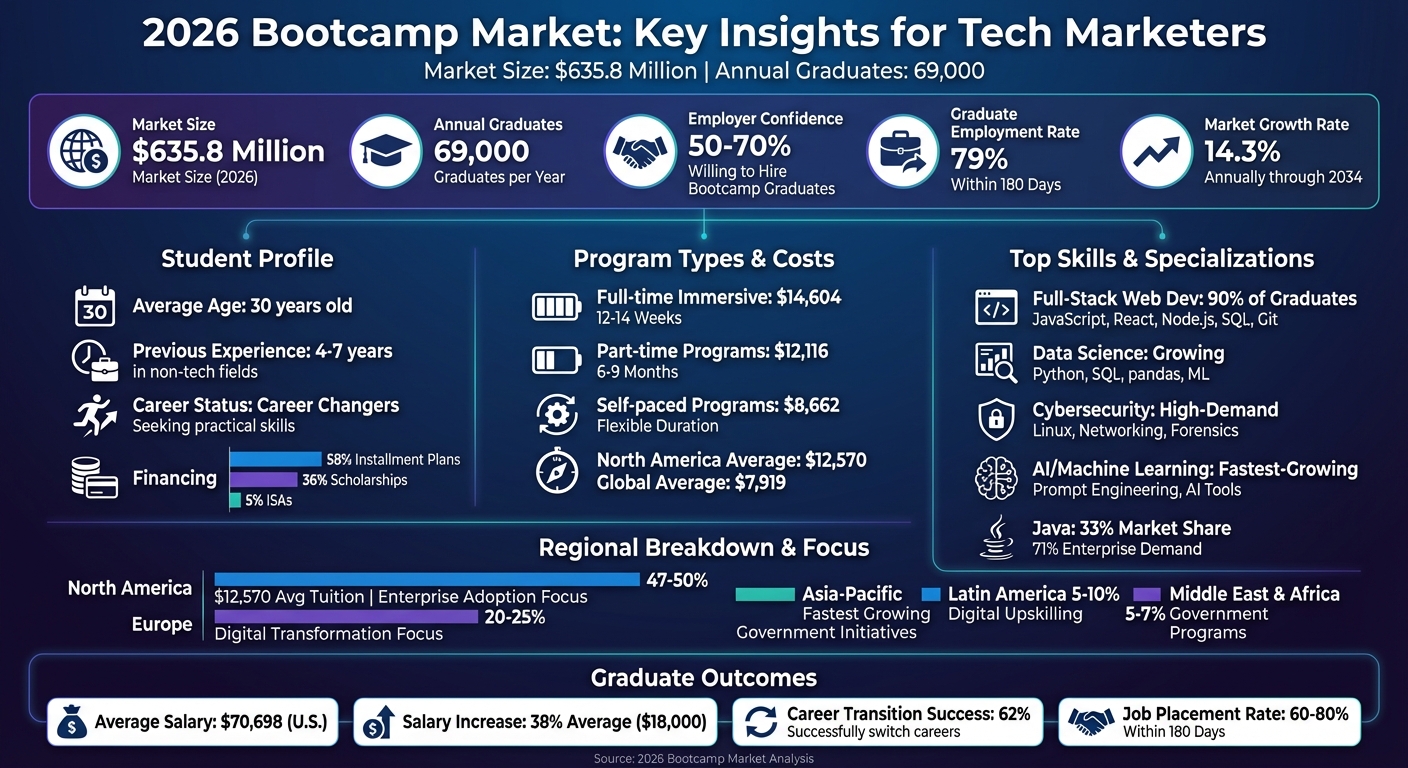 {2026 Bootcamp Market Statistics: Size, Demographics, and Regional Trends}
How the Bootcamp Market Changed: 2026 Trends
The bootcamp market has shifted gears, moving from rapid expansion to a phase that emphasizes verified outcomes and transparency. By 2026, the global market is expected to hit $635.8 million, a more measured forecast compared to earlier projections of $3.8 billion by 2025. This section dives into the latest metrics and trends shaping the industry.
For tech marketers, this growth means a steady influx of talent - about 69,000 graduates annually - all eager for tools and platforms to sharpen their skills. Employers are also on board, with 50% to 70% expressing confidence in hiring bootcamp alumni.
Market Size and Growth Numbers
The demand for developers skilled in AI-related fields continues to push the market forward. Companies are increasingly prioritizing skills-based hiring, and bootcamps are seen as a strong return on investment for students. Employment outcomes for graduates remain a key selling point.
Financing options have also evolved to meet the growing need for accessible education. Currently, 58% of students use installment plans, and 36% rely on scholarships. Meanwhile, Income Share Agreements (ISAs) have dropped to just 5% of the market after regulatory actions, such as the Consumer Financial Protection Bureau's enforcement against BloomTech (formerly Lambda School) over misleading ISA terms.
Most Popular Skills and Program Types
Bootcamps have expanded beyond their traditional focus on full-stack development. While 90% of graduates still pursue full-stack web development, learning tools like JavaScript, React, Node.js, SQL, and Git, new specialized tracks are gaining traction:
- Data Science: Programs teach Python, SQL, pandas, and machine learning basics.
- Cybersecurity: Courses cover networking, Linux, and forensic tools.
- AI and Machine Learning: The fastest-growing area, with an emphasis on prompt engineering and AI coding assistants.
| Program Type | Primary Tools/Languages | Market Focus |
|---|---|---|
| Full-Stack Web Development | JavaScript, React, Node.js, SQL, Git | ~90% of graduates |
| Data Science & Analytics | Python, SQL, pandas, machine learning basics | Growing specialty |
| Cybersecurity | Linux, Networking, Forensics tools | High-demand specialty |
| AI/Machine Learning | Prompt Engineering, AI tool integration | Fastest-growing addition |
These evolving curricula ensure graduates stay current with the latest technologies, making them highly attractive to employers. For tech marketers, targeting bootcamp alumni with resources tailored to these skills is a smart move.
Learning Formats and Access Options
The pandemic reshaped how bootcamps are delivered. Online bootcamps saw a 306% surge during COVID-19, and remote or hybrid models now dominate, offering flexibility and breaking down geographical barriers.
Here’s how programs stack up:
- Part-time programs: Average cost is $12,116, lasting 6 to 9 months. Ideal for working professionals.
- Self-paced programs: Cost around $8,662, providing mentor-led guidance on flexible schedules.
- Full-time immersive courses: The premium option at $14,604 for 12 to 14 weeks.
Partnerships are also expanding access. For example, General Assembly teamed up with Coursera to offer online courses, and Nucamp partnered with community colleges across the U.S. to provide affordable tech education. Additionally, over 120 university-linked bootcamps now operate in the U.S., combining the credibility of established institutions with the agility of bootcamp models.
For marketers, these flexible formats offer plenty of opportunities to connect with a diverse audience. The median bootcamp student is 30 years old, has 4 to 7 years of non-tech work experience, and is often a career switcher focused on mastering practical tools over earning a traditional degree.
sbb-itb-e54ba74
Bootcamp Market Trends by Region
The bootcamp market is shaped by unique trends across regions, reflecting differences in growth rates, revenue shares, and developer needs. North America leads the way, capturing 47% to 50% of global market revenue, while Asia-Pacific is experiencing the fastest growth. Meanwhile, Europe contributes 20% to 25%, and emerging markets in Latin America and the Middle East & Africa are beginning to gain traction with promising potential.
These regional variations underscore the importance of tailoring marketing strategies to local audiences. For instance, the average tuition fee in North America is $12,570, which is nearly 60% higher than the global average of $7,919 in other regions. This pricing difference highlights the varying levels of market maturity and purchasing power, directly influencing developer expectations for tools and resources.
North America: Market Leader
North America remains the dominant force in the bootcamp industry, thanks to its mature ecosystem and strong corporate partnerships. The region is increasingly focused on B2B corporate training as companies prioritize workforce upskilling. For example, BrainStation expanded its presence in early 2026 with new campuses in major cities like New York and London to support hybrid learning models. Similarly, Fullstack Academy formed over 100 partnerships with universities between 2023 and 2024, blending academic credibility with technical training.
For marketers, North America represents a premium market. Developers here expect high-quality, enterprise-ready tools. Campaigns should highlight measurable ROI, career advancement opportunities, and advanced features that cater to professional needs.
Asia-Pacific: Fast-Growing Market
Asia-Pacific is leading global growth in the bootcamp sector, driven by demand for tech talent in countries like India, China, and Southeast Asia. Government-led digital skilling programs play a key role, as nations invest heavily in building tech-savvy workforces.
Responding to this surge, Le Wagon launched hybrid campuses in India and Southeast Asia in January 2025, combining online learning with hands-on local projects. Similarly, Springboard expanded its online offerings for Asia-Pacific learners in February 2025, introducing localized content and income-share agreements (ISAs) to improve accessibility. In this region, affordability and flexibility are critical. Marketing strategies should focus on flexible payment plans, localized learning materials, and clear pathways to career success.
EMEA: Growing Opportunities
The EMEA region is experiencing steady growth, though driven by diverse factors. Europe accounts for 20% to 25% of the global market, fueled by digital transformation efforts in countries like the UK, Germany, and France. Corporate reskilling programs are prominent, often influenced by regulatory and sustainability requirements. Meanwhile, the Middle East and Africa make up 5% to 7% of the market, with growth centered around government-sponsored skilling initiatives in countries such as the UAE, Saudi Arabia, and South Africa.
To meet these demands, General Assembly introduced an AI & Data Science immersive track in March 2025 across its U.S. and UK campuses, integrating industry mentorship and corporate placement partnerships. For marketers targeting EMEA, it’s important to emphasize compliance, sustainability, and professional development. European developers often prioritize tools that meet regulatory standards, while Middle Eastern markets value campaigns aligned with national workforce development goals.
These insights provide a roadmap for effectively engaging developers in each region.
| Region | Market Share | Average Tuition | Key Growth Drivers |
|---|---|---|---|
| North America | 47–50% | $12,570 | Enterprise adoption, corporate training, strong tech ecosystems |
| Europe | 20–25% | Global avg. | Digital transformation, corporate reskilling, regulatory compliance |
| Asia-Pacific | Fastest Growing | Global avg. | Government initiatives, tech employment demand, digital penetration |
| Latin America | 5–10% | Global avg. | Digital upskilling, hybrid models |
| Middle East & Africa | 5–7% | Global avg. | Government skilling programs, smart city initiatives |
Note: The global average tuition outside North America is $7,919 .
How to Use Bootcamp Trends in Your Marketing
Knowing bootcamp trends is only half the battle. To make the most of this knowledge, you need to turn it into campaigns that effectively connect with developers during key career transitions. Let’s dive into some actionable strategies.
Target Learners by Skills and Tools
Bootcamp graduates often focus on specific tech stacks, which makes targeting by skills and tools a no-brainer. For instance, Java bootcamps hold 33% of the market share, driven by 71% enterprise demand . Similarly, full-stack development using JavaScript and the MERN stack is widely popular, alongside Data Science tracks that emphasize Python or R . DevOps skills, including Docker, Kubernetes, and CI/CD pipelines, are also on the rise, with software roles projected to grow by 15% .
Craft your campaigns around these specializations. If you're marketing a cloud infrastructure tool, aim at learners completing AWS or DevOps tracks. For frontend frameworks, focus on JavaScript bootcamp graduates who typically finish their programs in about 12 weeks. Highlight how your DevOps tool can help graduates achieve $70K+ roles: 62% of bootcamp graduates successfully transition careers with an average salary increase of 38% (roughly $18,000), and U.S. graduates start at around $70,698 annually . Showcase how your platform bridges the gap between bootcamp projects and production-ready environments.
Reach Developers with daily.dev Ads
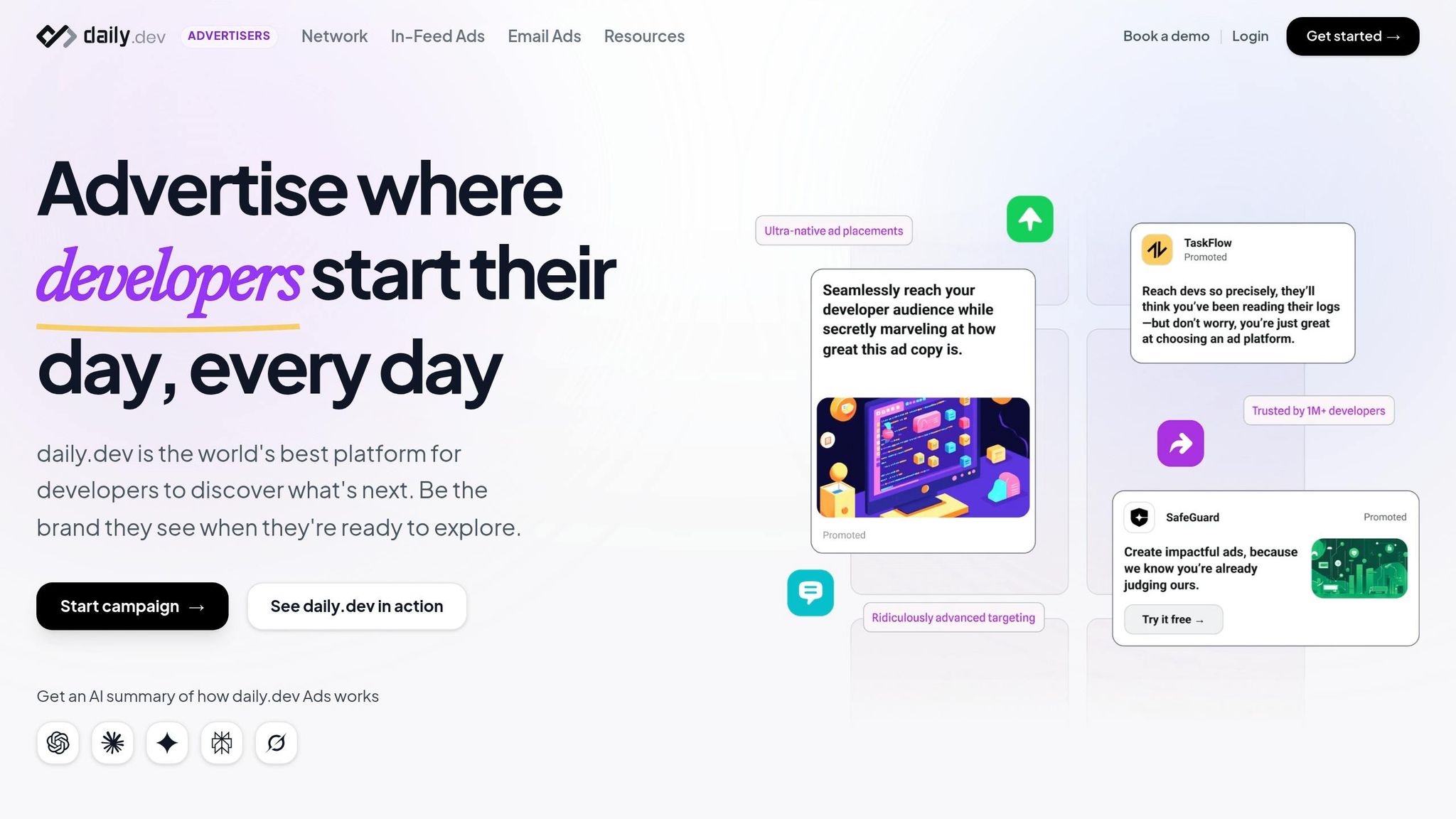
daily.dev Ads is a powerful tool for targeting bootcamp graduates based on their specialized skills. The platform allows you to filter by programming languages (like Python, JavaScript, or R), tools (such as Docker, React, or AWS), and even seniority levels - perfect for reaching junior developers fresh out of bootcamps. With ad placements integrated naturally into content feeds (like in-feed, post-page, and digest ads), your campaigns appear while developers are actively learning.
Use tags to zero in on specific audiences. For example, #webdev can help you reach frontend-focused learners, while #python appeals to data science enthusiasts. With 65% of employers favoring bootcamp graduates for their job-ready skills , these developers are actively looking for tools and resources in trusted spaces. daily.dev’s global reach of over 1 million developers is especially useful for connecting with bootcamp audiences worldwide, including the 37% of new enrollments from the Asia-Pacific region . Plus, real-time performance tracking lets you refine your campaigns to focus on the skills and tools that resonate most with your audience.
Promote Tools and Events to Developers
When marketing tools, use developer-friendly calls to action like "Try for Free", "Read the Guide", or "See the Demo." Emphasize how your tool transitions bootcamp projects into professional-grade work, a top priority for graduates entering the job market.
Events like hackathons and webinars are also highly effective, especially if they align with bootcamp cycles (typically 12–24 weeks long ). For example, you could host a JavaScript-focused hackathon for graduates building their portfolios or a webinar series on AI/ML tools aimed at data science learners.
Collaborating directly with bootcamps can amplify your reach. By 2026, 52% of bootcamps are expected to partner with tech companies for job placement , and over 60% of tech workforce initiatives include funding for coding bootcamps . Co-marketing with well-known providers like General Assembly or Flatiron School positions your tool within an established ecosystem, leveraging the fact that 72% of employers report improved skill readiness from bootcamp graduates .
Measure your campaign success by tracking engagement rates (aim for 2–3% for native developer ads) and conversions, such as tool signups or event registrations . Compare your results against the 79% employment rate for bootcamp graduates to evaluate how well your campaigns support real career outcomes. Tailor your messaging by region: North American audiences often look for premium, enterprise-grade features, while Asia-Pacific markets may prioritize affordability and flexible payment plans.
Conclusion: Making the Most of the 2026 Bootcamp Market
The bootcamp market is evolving rapidly, creating a wealth of opportunities for tech marketers who know how to connect with developers during critical career transitions. With graduates entering the workforce regularly and achieving strong job placement rates, this audience is actively seeking tools and resources to accelerate their career growth.
To effectively engage this group, focus on the skills in highest demand. Tailor your campaigns around the tech stacks dominating bootcamp programs - like JavaScript, React, Python, AI, and cybersecurity. Align your messaging with the outcomes graduates are striving for. With 50% to 70% of employers now valuing portfolios and project work over traditional degrees, highlight how your tools can transform bootcamp projects into polished, production-ready work . This approach not only resonates with developers but also complements regional strategies by addressing localized learning needs.
Understanding regional dynamics is key. North America currently generates 55% of bootcamp revenue, while the Asia-Pacific region is growing the fastest, presenting new opportunities for marketers willing to adapt their strategies for emerging markets . Platforms like daily.dev Ads allow you to turn these insights into actionable campaigns. With the ability to target developers based on programming languages, tools, and experience levels, you can engage with over 1 million developers in a trusted, developer-focused ecosystem.
The typical bootcamp student - a 30-year-old career switcher with 4 to 7 years of experience in non-tech fields - responds well to messaging that bridges their transition from bootcamp projects to professional roles. Use clear calls-to-action such as "Try for Free" or "Read the Guide", and support your messaging with verified data to meet increasing demands for transparent outcome reporting .
Track key metrics like tool signups, event participation, and job placements. Bootcamp graduates typically achieve a 60% to 80% placement rate within 180 days , making them a high-potential audience. With the market expected to grow at an annual rate of 14.3% through 2034 , staying ahead of these trends will help you refine your campaigns and connect with this expanding developer community for years to come.
FAQs
What bootcamp skills should I target in 2026?
By 2026, skills in AI/ML, cloud infrastructure, cybersecurity, and data engineering are projected to stay in high demand. These fields not only offer some of the best-paying opportunities but also represent key areas of growth in the tech industry. Keeping up with these trends will allow you to connect with developers more effectively and design campaigns that resonate with their needs and interests.
How should messaging differ by region?
Tailor your messaging to resonate with regional preferences, cultural expectations, and what developers in each area value most.
In the United States, focus on highlighting practical benefits and providing straightforward technical details. Developers here often appreciate transparency and efficiency. For example, showcase improvements like faster deployment times or peer validation features. Timing matters too - consider that peak activity often falls between 10 AM and 3 PM PST, so align communication efforts accordingly.
Meanwhile, in South Asia, it's essential to emphasize opportunities for growth and community engagement. Developers in this region often value collaboration and trust-building. Framing your message around these principles can help connect with their priorities and create a stronger sense of partnership.
What metrics prove my bootcamp campaigns work?
Metrics such as click-through rate (CTR), conversion rate, cost per click (CPC), and cost per thousand impressions (CPM) are essential for evaluating your campaign's performance. Beyond these, engagement metrics like API calls, documentation views, and lead quality offer deeper insights into how developers are engaging with your campaigns. These metrics help paint a clearer picture of the effectiveness of your efforts.