

Account-based marketing (ABM) is essential for reaching developers effectively. Instead of generic outreach, ABM focuses on specific, high-value accounts, tailoring campaigns to decision-makers and technical users. This approach works especially well for developer tools because developers prefer hands-on evaluation, technical accuracy, and peer recommendations over traditional sales tactics.
Key takeaways:
- Developers evaluate tools differently: They rely on GitHub stars, documentation, and trials rather than sales pitches or cold emails.
- Targeting matters: Use technographics (e.g., Kubernetes, AWS) and developer activity signals (e.g., repository forks, npm downloads) to identify engaged prospects.
- Multi-threaded engagement: Address developers, managers, and executives with tailored messaging for each role.
- Measure real engagement: Track developer actions like GitHub activity, Docker pulls, and documentation views, rather than focusing on MQLs.
ABM for developer tools requires precision, technical depth, and a focus on actionable signals to connect with both developers and decision-makers.
How Developers Buy Tools Differently Than Other B2B Buyers
::: @figure 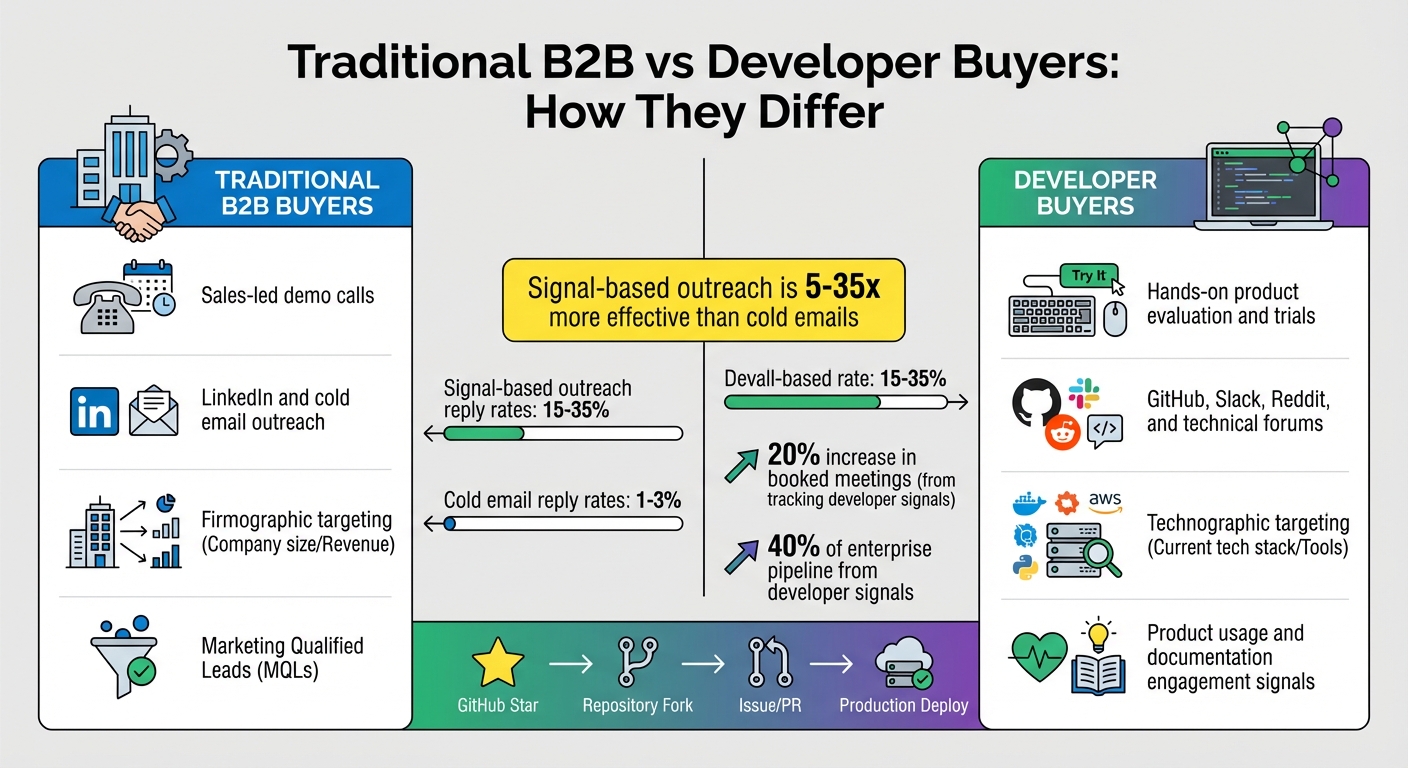 {Traditional B2B vs Developer Buyer Preferences: Key Differences in ABM Strategy}
Developers have little patience for the typical B2B marketing playbook. As Michael, a Pro Developer and n8n Guru, puts it:
"If you're a developer, you hate inefficiency. 'Spray and pray' marketing - blasting the same generic message to thousands of people - is the technical equivalent of a while(true) loop with no break condition."
What sets developers apart is how they approach decision-making. While traditional B2B buyers might sit through lengthy sales pitches or analyze ROI presentations, developers take a hands-on approach. They prefer to test products themselves, dig into documentation, and form their opinions independently. This mindset naturally lends itself to a grassroots, bottom-up adoption process.
Bottom-Up Adoption: How Developers Drive Tool Selection
Developers don’t wait for a top-down directive to explore new tools. They start by evaluating products independently, often using public metrics like GitHub stars or npm downloads as initial signals . A typical scenario might look like this: a developer discovers a tool, experiments with it in a personal project, and validates its usefulness. Only after proving its value does the tool get recommended to the team or escalated to management for procurement. This process can extend the evaluation timeline significantly.
Behavioral signals like repository forks, GitHub stars, and npm downloads often appear months before a formal buying process begins . Outreach efforts that focus on these real usage signals - rather than generic cold emails - see much higher success rates. For example, reply rates for signal-based outreach range from 15% to 35%, compared to just 1% to 3% for cold emails . One technical GTM team shifted their focus to track signals like documentation engagement and CLI configurations, resulting in a 20% increase in booked meetings and 40% of their enterprise pipeline originating from these signals .
The secret lies in identifying the Champion - the developer already using the tool - and enabling them to make the case to the Economic Buyer (often a VP of Engineering or CTO) . Developers are solution-driven and will jump straight into product evaluation rather than sitting through a demo call .
Why Developers Skip Standard B2B Marketing Channels
Developers’ preference for autonomy also influences how they interact with marketing channels. They’re not scrolling LinkedIn or responding to cold emails. Instead, they’re active in GitHub, Reddit, Hacker News, Discord, and Slack communities, where they find peer recommendations and technical validation . Kevin Doubleday, Communications Director at a developer-focused company, highlighted this shift:
"We now know who's looking at our documentation or who's reviewing our Github. That's a much easier and frictionless path to building pipeline versus your traditional approach on outbound."
This behavior isn’t just about where developers hang out - it’s about trust. Developers are skeptical of urgency tactics, flashy logos, and authority-based messaging. What resonates with them is technical credibility and genuine utility. They want to know if a tool aligns with their existing stack - whether it’s Kubernetes, Terraform, or AWS - before they’ll even consider engaging with a vendor .
These preferences are reshaping ABM strategies, moving the focus from shallow engagement metrics to deeper signals of intent, such as Docker pulls, npm installs, or API documentation views.
| Traditional B2B Buyer Preference | Developer Buyer Preference |
|---|---|
| Sales-led demo calls | Hands-on product evaluation and trials |
| LinkedIn and cold email outreach | GitHub, Slack, Reddit, and technical forums |
| Firmographic targeting (Company size/Revenue) | Technographic targeting (Current tech stack/Tools) |
| Marketing Qualified Leads (MQLs) | Product usage and documentation engagement signals |
To adapt ABM campaigns for developers, focus on conversion goals tied to product trials and technical documentation rather than "Book a Demo" forms . Monitor deeper intent signals like Docker pulls or API guide views, and tailor outreach with specific references to technologies the target account already uses, such as "The CI/CD Platform Built for [Company Name] using Kubernetes" .
How to Build Your ABM Target Account List
Crafting an effective ABM list for developers means focusing on technical signals - like GitHub activity, package downloads, and documentation views - rather than just company demographics. These signals come from platforms developers use daily: GitHub, npm registries, Docker Hub, and even your product's documentation. By zeroing in on these, you can align your outreach with ABM’s precision-driven approach, ensuring you’re connecting with developers who are actively engaged.
It’s important to prioritize signals tied directly to individual developers rather than anonymous data points like IP addresses. For example, when a developer stars your repository, forks a competitor’s project, or posts an issue about implementing SSO, these actions are tied to real people. Research shows that 60–70% of GitHub stargazers can be matched with LinkedIn profiles, and 40–55% can be linked to verified work emails . This makes developer signals far more actionable than traditional intent data, allowing you to target high-value accounts with precision.
Developer Activity Signals to Track
To identify developers who are most likely to engage, track activity across key platforms:
- GitHub Engagement: A star indicates initial interest, while a fork or pull request signals deeper involvement. Comments on issues, especially those mentioning terms like "enterprise", "SSO", or "migration", show that a developer may be preparing a business case .
- Competitor Repositories: Developers engaging with competitors’ tools - whether by starring or forking - are already exploring solutions in your space, making them warm leads.
- Package Downloads and Container Pulls: Metrics like npm installs, pip downloads, or Docker pulls reveal developers testing your tools hands-on.
- Documentation Views: When developers dive into API references, authentication guides, or migration tutorials, it’s a strong indicator of integration interest.
- Hiring Trends: Companies recruiting for roles tied to specific technologies (e.g., Kubernetes or DevOps) are likely planning to scale their use of those tools. Combining this with technical signals can help pinpoint accounts that match your ideal customer profile (ICP) .
How to Score and Rank Target Accounts
Scoring developer signals helps you prioritize accounts based on their likelihood to convert. Assign base points to different activities, then apply multipliers for recency to ensure timely follow-ups :
- Recent Activity Multiplier: Signals from the past 24 hours should be prioritized. Outreach within this window can double reply rates compared to messages sent after 72 hours . For example, a developer who forked your repository yesterday (5 points × 2 = 10) is a higher priority than someone who starred it last month (1 point × 1 = 1).
- Signal Clustering: Multiple signals from the same developer or team within a short timeframe indicate a team evaluation. These clusters often reflect bottom-up adoption patterns. For instance, Tim Grassin, CEO of Kubegrade, achieved a 22% response rate by targeting developers active on Kubernetes repositories and focusing on clustered signals . Signal-based outreach typically delivers reply rates of 15–35%, compared to just 2–5% for cold emails .
Filter leads by ICP fit before reaching out. A senior engineer at a well-funded, 500-person SaaS company holds more potential than a student experimenting with your tool. Use firmographic data like company size, funding stage, and job titles to refine your list. Additionally, look for high-value keywords like "migration", "SSO", or "enterprise" in issue and PR descriptions, and boost their scores by 1.3× when these terms appear .
Here’s an example scoring model to guide your prioritization:
| Signal Type | Intent Level | Base Points | Outreach Timing |
|---|---|---|---|
| Pull Request | Highest | 10 | Immediate (within 24h) |
| Issue Opened | Very High | 8 | Immediate (within 24h) |
| Commit Push | High | 6 | Within 24–48 hours |
| Repository Fork | Medium-High | 5 | Monitor & Enrich |
| Watch/Subscribe | Medium | 3 | Queue for Nurture |
| GitHub Star | Low | 1 | Top-of-Funnel Nurture |
Once scored, group accounts into tiers for action:
- Tier 1: High-intent signals and strong ICP fit - send these directly to SDRs for immediate outreach.
- Tier 2: Moderate signals and decent fit - add these to nurture sequences.
- Tier 3: Weak signals or poor fit - monitor for further activity.
With a well-executed developer GTM strategy, you can turn GitHub stars into valuable leads. For every 1,000 stars, expect 120–275 ICP-qualified leads and 1–10 closed deals .
Multi-Threading: Reaching Developers and Managers at the Same Time
When it comes to developer tools, purchasing decisions are rarely made by just one person. A developer might fork your repository on GitHub, but the engineering manager holds the purse strings, and a security lead can block the deal entirely. To succeed with account-based marketing (ABM) in this space, you need to engage all these stakeholders simultaneously, tailoring your message to what each role values most. This requires pinpointing every stakeholder involved in the buying process.
Identifying Key Roles in the Developer Tool Buying Process
Developer tool purchases typically involve four main roles:
- Champion: The person who identifies the problem and advocates for the tool internally.
- Influencer: Developers or technical experts who evaluate the tool's capabilities.
- Decision-Maker: Budget holders, such as a VP of Engineering or CTO.
- Blocker: Security leads or advocates for existing tools who may raise objections .
Start by identifying the Champion - often the developer whose GitHub activity sparked your outreach. From there, map the broader team. Use social media profiles to find other key players, like security leads who might flag compliance concerns. Enrichment tools can help connect GitHub profiles to work emails, streamlining the process of building your contact list.
Creating Messages for Different Roles
Once you've identified the roles, tailor your outreach to align with each stakeholder's priorities. Developers and decision-makers, for instance, require completely different approaches.
Developers tend to disregard authority and social proof. What gets their attention is technical depth and practical value . When reaching out to a developer, reference their specific action, like forking your repository: "Noticed your recent fork of our Terraform provider." Then, offer immediate value - perhaps a configuration pattern or a heads-up on a potential issue they might encounter. Keep your ask minimal, like sharing a helpful code snippet.
For engineering managers, start by acknowledging the developer’s activity, but shift the focus to team-wide benefits. Instead of detailing "how it works", emphasize scalability and cost savings . For example: "As a Lead DevOps Engineer managing a Jenkins pipeline, you might find our tool helps resolve deployment bottlenecks across your team." Highlight how your product addresses operational challenges at scale.
When targeting executives, connect your message to broader company objectives, such as recent funding rounds or industry trends. Executives care about alignment with strategic goals, so frame your pitch in those terms.
To ensure your message reaches everyone effectively, take a "surround-sound" approach. Send a technical email to the developer while running LinkedIn ads aimed at their manager, focusing on business outcomes. Treat marketing and sales as tightly integrated systems, working together to deliver consistent messaging to the entire buying committee .
Content for Each Stage of the Developer Buying Journey
When it comes to developer tools, the buying journey is anything but typical. Developers evaluate products differently than traditional B2B buyers, often prioritizing technical credibility over flashy marketing or ROI calculators. To connect with them effectively, your content strategy needs to align with their specific buying process - starting with trust-building, moving through hands-on evaluation, and finally supporting their case for procurement.
Awareness Stage: Building Trust in Developer Communities
Developers tend to ignore generic marketing. To capture their attention, your content must reflect a deep understanding of their technical environment. A great way to do this is by creating content tailored to their existing tech stacks. For instance, an article like "How to optimize your React and Intercom stack" resonates because it speaks directly to their current challenges.
Targeted campaigns on developer platforms can help establish familiarity. As Michael, a Pro Developer and n8n Guru, explains:
"The goal isn't to get clicks; it's to create familiarity. When your email lands in their inbox, they'll have a vague sense they've seen your company name before. This drastically increases reply rates."
Before starting direct outreach, run ads for about two weeks. Tools like BuiltWith or Wappalyzer can help you identify the technologies your target companies use, allowing you to craft highly relevant messages. Use UTM parameters to track engagement and monitor website traffic from target company IP ranges. This focused approach ensures your efforts are aimed at high-value accounts, paving the way for deeper engagement during the evaluation phase.
Evaluation Stage: Providing Technical Documentation and Trials
Once developers are interested, they’ll want to dive into your product. This is where technical documentation and trials become essential. Actions like navigating documentation or forking a repository are strong indicators of active evaluation .
Timing is critical. Outreach within 24 hours of a behavioral signal - like a repository fork - can double reply rates compared to messages sent later . When reaching out, reference the developer’s specific action. For example, you could say, "I noticed you forked our Terraform provider." Then, add immediate value by sharing a configuration example, pointing out integration challenges, or offering a code snippet. Developers value concise and actionable communication, so keep your message short - three to five sentences is ideal.
Here’s a quick breakdown of developer signals and how to respond:
| Signal Type | Intent Level | Developer Action | Recommended Response |
|---|---|---|---|
| GitHub Star | Low | Bookmarking/Awareness | Start a nurture sequence |
| Repo Fork | Medium | Active technical evaluation | Share integration patterns or highlight pitfalls |
| Issue/PR | High | Active integration/usage | Provide technical support or code fixes |
| Production Deploy | Highest | Committed usage | Shift to a "land and expand" sales strategy |
Developers filing issues or opening pull requests are especially high-intent prospects - they’ve already tested your code in real-world scenarios. These signals allow for precise targeting during this critical stage.
Procurement Stage: Supporting the Business Case
Even though developers often lead the charge, they still need to convince a broader committee to approve the purchase . Procurement-stage content should address the priorities of all stakeholders, from engineering leads to procurement managers.
Focus on how your tool supports key business objectives. For example, highlight how it helps achieve SOC 2 compliance, reduces infrastructure costs, or boosts developer productivity . ROI calculators can demonstrate cost savings, while providing security documentation (like GDPR, CCPA, or SOC 2 certifications) can ease stakeholder concerns .
Internal usage signals - such as GitHub activity, Docker pulls, or documentation engagement - can be powerful evidence of developer adoption. Use these insights to show decision-makers that developers are already finding value in your tool . Additionally, tag campaigns by product features or benefits to track which solutions resonate most with target accounts .
Automate notifications (via Slack or similar tools) to alert sales and management when high-intent content, like pricing pages or security documentation, is accessed . Tailor messaging by role: emphasize developer velocity for engineering leads and focus on ROI and compliance for executives. This ensures that your business case addresses technical, operational, and strategic concerns, making it easier for all stakeholders to say yes.
Where to Run ABM Campaigns for Developers
To effectively implement an ABM strategy for developer tools, you need to focus on channels that align with developers' technical workflows. Unlike traditional B2B marketing, developers tend to overlook generic ads and respond better to content that integrates naturally into their daily routines.
Developer Communities and Discussion Platforms
GitHub is a standout platform for developer ABM. Developers' public actions - like forking repositories, submitting pull requests, or opening issues - can provide early indicators of buying intent, even before formal procurement begins. As the LeadCognition Team puts it:
"The signal provides the context that makes the message feel relevant rather than random" .
For instance, job postings for Kubernetes or Terraform experts often indicate a company is scaling its infrastructure, hinting at potential investments in new tools. Similarly, monitoring competitor repositories for activities like starring or forking SDKs can uncover high-intent prospects. However, since many developers use personal emails on GitHub, tools for resolving identities are crucial for effective targeting. Beyond GitHub, it's essential to engage developers where they naturally consume content.
Advertising Platforms Built for Developers
Native advertising platforms tailored for developers allow you to deliver targeted content without disrupting their workflow. Platforms like daily.dev for Business, for example, integrate ads directly into developers' content streams. With over 1 million developers on the platform, you can target based on criteria like programming languages, seniority, or preferred tools. This approach ensures your message reaches developers as they engage with technical content, helping build familiarity. Running ads a week or two before sending direct emails can also improve recognition and response rates .
Developer Conferences and Events
Developer-focused events - whether in-person or virtual - are another effective channel, but the approach here needs to be different from traditional trade shows. Developers attend these events to learn and explore new technologies, not to endure sales pitches. To make an impact, focus on showcasing technical expertise through workshops, open-source contributions, or talks on advanced topics. These events also offer real-time insights into buying signals. For example, tracking which target accounts visit your booth, attend your sessions, or interact with your demos can help identify prospects actively exploring solutions. Aligning your event efforts with your broader ABM strategy ensures that your team prioritizes meaningful, technical discussions over generic sales presentations.
How to Measure ABM Performance for Developer Tools
Metrics That Matter More Than MQLs
In the world of developer tools, traditional B2B metrics like MQLs just don't cut it. Developers aren't the type to fill out forms or request demos - they’re more likely to fork repositories, download packages, or dive into documentation. Your metrics need to reflect these real-world behaviors.
Account engagement should be at the heart of your measurement strategy. Focus on whether the right people within your target accounts are interacting with your content. This means tracking activity across key roles: the Champion (the developer who will actually use your tool), the Economic Buyer (like a VP of Engineering or CTO who controls the budget), and the Influencers (team members who weigh in on the decision) .
Another key metric is pipeline influence from your target account list. Instead of counting leads, look at the percentage of your pipeline and revenue that comes from pre-qualified target accounts. For example, in March 2026, Unstructured.io reported that 40% of its sales pipeline came from accounts identified through developer-centric intent signals. By focusing on real usage data instead of just community engagement, RevOps Lead Orlando Nieves and his team increased monthly booked meetings by 20% .
Win rates and average contract value (ACV) are also critical indicators of ABM success. As Michael, a Pro Developer and n8n expert, explains:
"ABM deals are often larger because you've engaged the whole buying committee" .
When you simultaneously engage developers and decision-makers, deals tend to close faster and at higher values. These metrics help to connect early developer interactions with tangible pipeline outcomes.
Tracking Engagement Through to Pipeline
To get the most out of these metrics, you need to track developer engagement with precision. The challenge lies in linking early developer actions to closed deals. This requires multi-touch attribution at the account level, providing a single view of every interaction - from the first GitHub star to the final contract signature .
Start by identifying and tracking developer-specific intent signals, assigning weight to each action based on its significance. For instance:
- A GitHub star shows awareness.
- A fork suggests evaluation.
- An opened issue signals engagement.
- A pull request indicates active usage.
- Production commits reflect full adoption .
Make sure to log these signals in your CRM. For example, if a developer from Acme Corp stars your repository, record it along with the date. This allows you to map the journey from initial interest to deal closure. Kubegrade CEO Tim Grassin used this approach with GitHub data to validate interest in Kubernetes tools, achieving a 22% response rate and booking five demos in a single campaign .
Timely outreach is critical. Developer intent can fade quickly - often within 48–72 hours - so prioritize recent activity for follow-ups . Also, pay attention to the "dark funnel", identifying companies engaging with your documentation, pulling Docker images, or downloading packages before they officially sign up. As Michael Ferranti, VP of Marketing, notes:
"The SDRs are logging into Reo.Dev every morning... using it to prioritize their activity for the day and for the week" .
Finally, measure pipeline velocity - how quickly target accounts move from initial awareness to a closed deal . Engaging the right stakeholders with relevant content at each stage accelerates progress, and when combined with higher ACVs and improved win rates, it validates your ABM strategy. By transforming developer actions into clear business outcomes, these metrics ensure your ABM efforts deliver measurable results.
Conclusion
Account-Based Marketing (ABM) for developer tools isn’t about copying standard B2B strategies. It’s about crafting a system that aligns with how technical audiences approach software purchases. As Michael, Pro Developer & n8n Guru, explains:
"Account-Based Marketing isn't magic. It's a logical, data-driven system for winning high-value customers... It's a framework that any developer or engineer can appreciate and implement."
The key to success lies in precision targeting. By combining technographics (like preferred tech stacks such as React, AWS, or Kubernetes) with traditional firmographics, you can zero in on companies that are a natural fit for your product. This flips the usual marketing funnel on its head: instead of attracting a broad audience, you start by identifying high-value accounts and then focus your efforts on winning them over.
Another critical piece is multi-threaded engagement. To succeed, you need to connect with three key roles within your target accounts:
- The Champion: The developer who will actually use your tool.
- The Influencer: The technical expert who evaluates solutions.
- The Decision-Maker: The CTO or VP of Engineering who controls the budget.
Each of these roles requires highly tailored content that addresses their unique technical challenges and decision-making criteria. Generic marketing simply won’t cut it here.
Finally, measurement needs to evolve. Instead of focusing on vanity metrics like individual Marketing Qualified Leads (MQLs), shift to Marketing Qualified Accounts (MQAs) as your primary metric. By tracking account-level engagement across multiple stakeholders, monitoring how your campaigns influence the pipeline, and measuring how quickly target accounts move from awareness to closed deals, ABM becomes more than just a buzzword - it becomes a reliable growth strategy for developer tools.
FAQs
How do I turn developer signals into an ABM target account list?
To build an effective ABM target account list, pay attention to developer behaviors such as GitHub activity - like forks, stars, and pull requests - and product usage signals, including API interactions and telemetry data. Tools that monitor these behaviors or allow CSV uploads can simplify the process of spotting engaged accounts. Focus on accounts that show spikes in activity or recent developer actions, as these often indicate they’re actively exploring your tools.
Which roles should I multi-thread in a developer tool ABM deal?
When working on an ABM deal for developer tools, it's crucial to engage multiple key roles simultaneously, such as developers and engineering managers. This dual approach helps you connect with the technical users who will drive adoption while also addressing the decision-makers responsible for procurement.
What metrics prove ABM impact beyond MQLs?
Metrics that showcase the impact of ABM beyond traditional MQLs focus on developer engagement and technical adoption. Key indicators include API call frequency, documentation views, SDK implementation rates, feature activation, and onboarding completion. Additionally, metrics like technical adoption, community growth, and revenue impact highlight how ABM efforts translate into tangible results for technical audiences. These measurements offer a deeper understanding of how ABM drives meaningful engagement and outcomes.