

Account-Based Marketing (ABM) for developer tools focuses on targeting high-intent accounts using precise signals like GitHub activity, npm downloads, and Docker pulls. Traditional sales approaches often fail with developers, but ABM succeeds by aligning with their preferences for technical proof and minimal disruptions. Key strategies include:
- Identify high-intent accounts: Use technographic and behavioral data (e.g., GitHub forks, job postings) to find teams ready for your tool.
- Tailor messaging: Speak to developers' technical needs and managers' business goals. Avoid buzzwords and focus on measurable results.
- Engage on developer platforms: Prioritize GitHub, Slack, Reddit, and Discord over LinkedIn or cold calls.
- Act fast: Respond to signals within 24 hours to maximize reply rates.
- Measure what matters: Track pipeline influence from developer activity instead of relying on traditional MQLs.
::: @figure 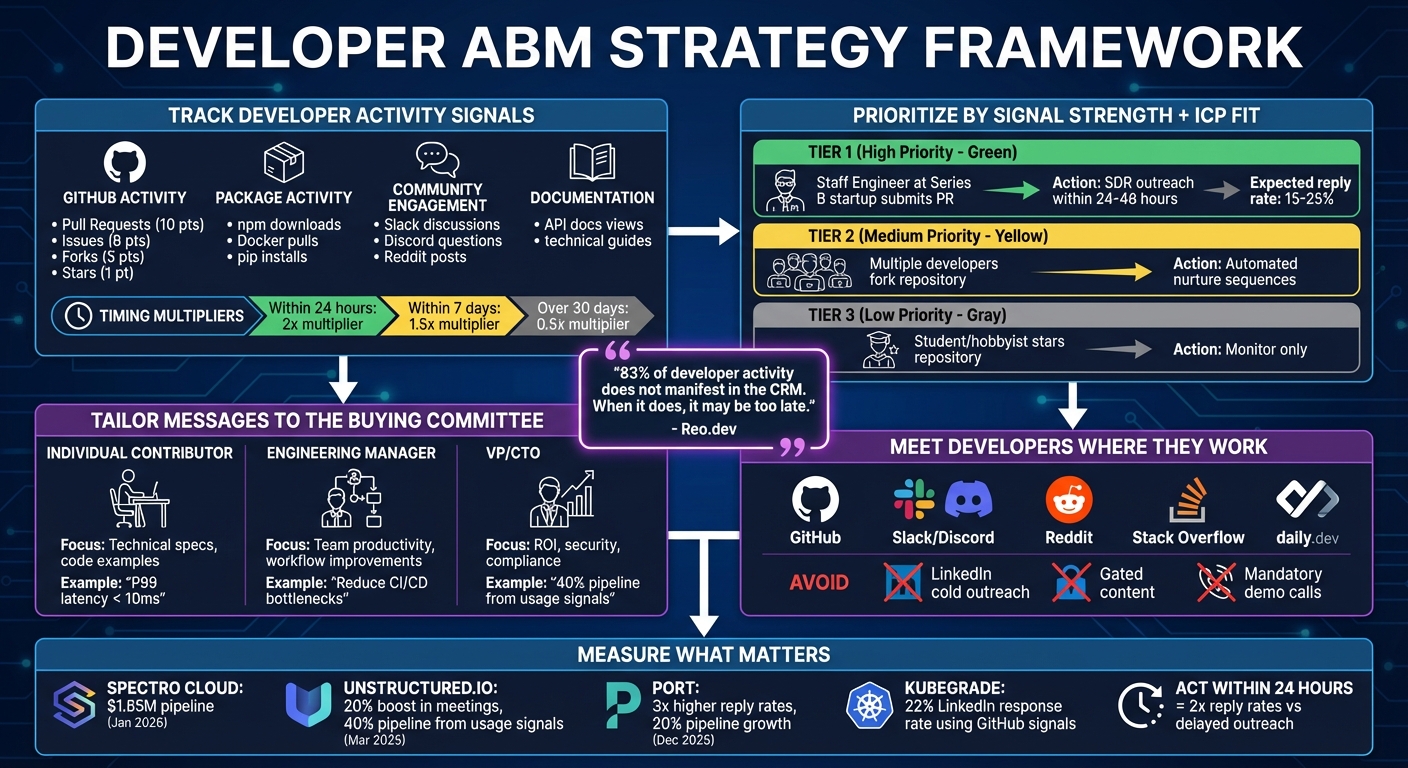 {Developer ABM Strategy Framework: From Signal Detection to Pipeline Growth}
Why ABM for Developers Is Different
Bottom-Up vs. Top-Down Adoption
In traditional B2B sales, the process often starts at the top. An executive watches a demo, gets excited about the vision, and directs their team to implement the solution. But with developer tools, it’s a completely different story. Instead of starting at the top, the adoption process tends to begin at the ground level. A developer encounters a problem, finds a solution, and tests it locally - whether that’s through a simple npm install or pulling a Docker image. This happens long before procurement even gets involved .
Ninad Pathak calls this process a "viral loop of verification" . Developers often adopt tools informally, proving their value through real-world use before advocating for broader adoption. This shift has led to a phenomenon known as "Shadow IT", where 30% to 50% of IT spending now occurs outside official budgets .
In this bottom-up model, developers hold significant sway. They may not sign the purchase orders, but they can make or break a deal. If a tool fails to meet their technical standards, it’s game over. As Pathak puts it:
"Selling soft-skills software to a VP of Sales is a sociological challenge. Selling infrastructure to a Staff Engineer is a physics challenge" .
This dynamic means your messaging must prioritize technical proof over visionary pitches aimed at executives.
Where Traditional ABM Tactics Fail with Developers
Developers tend to ignore traditional marketing tactics. Terms like "scalable", "robust", or "fast" often come across as meaningless buzzwords . Instead, they want precise, measurable claims - think "P99 latency < 10ms" or "compiles to WASM in 50ms." Messaging that works for executives simply doesn’t resonate with technical audiences.
There’s also a disconnect in how developers prefer to engage. Conventional ABM strategies lean heavily on platforms like LinkedIn and scheduled sales calls. But developers spend their time on GitHub, Stack Overflow, Reddit, Discord, and Slack . They follow the "Maker Schedule", where a 30-minute sales call disrupts their workflow and feels more like an intrusion than a conversation . As John Pena, CTO and Co-Founder of Correlated, explains:
"I'm lazy so if a tool sounds like it'll do a tedious job for me then I'm usually keen to try it" .
For developers, the ability to test a tool immediately is far more appealing than sitting through a demo.
Gated content and mandatory demo calls also create friction. Developers want to achieve a quick "time to Hello World" - getting a tool up and running locally with minimal effort. If the process is too cumbersome, they’ll move on to alternatives . These disconnects highlight why ABM strategies need to align with developers' preferences and workflows.
Beyond Company Size and Industry
Relying on firmographic data like company size, industry, or revenue doesn’t tell you much about whether a developer team will benefit from your tool. What matters more is technographic data - not just knowing that a company uses AWS, but understanding which services they rely on, where their gaps are, and what transitions they might be planning . For example, a company hiring Kubernetes engineers or building out a platform team is often signaling upcoming infrastructure changes.
Behavioral intent signals are also critical. Metrics like GitHub stars, Docker pulls, package downloads, documentation views, and community engagement provide clearer indicators of readiness to buy . When Unstructured.io shifted to developer-centric intent signals in March 2025, they saw a 20% boost in meetings and attributed 40% of their pipeline to accounts identified through usage patterns rather than just community activity . Similarly, Spectro Cloud generated $1.65M in new pipeline in January 2026 by focusing on accounts showing active interest via developer-specific signals .
Job titles can also be misleading. A "Staff Engineer" or "Principal Engineer" might wield vastly different levels of influence depending on the company . Instead of relying on titles, it’s more effective to track activity. Who’s opening GitHub issues, contributing to community discussions, or diving into API documentation? These behaviors reveal true influence far better than a title ever could.
sbb-itb-e54ba74
Building Your Developer ABM Target Account List
Setting Your Ideal Customer Profile (ICP)
When building your developer ABM list, technographic data should take center stage over traditional firmographics. Why? Because knowing a company’s size or industry doesn’t tell you much about whether their team will actually adopt your tool. What really matters is technographic precision - details like which AWS services they rely on, the frameworks they’re using (e.g., Prisma or FastAPI), or whether they’re transitioning between tools (like moving from Jenkins to GitHub Actions) .
For example, job postings for Kubernetes engineers or platform teams can be a goldmine of insight, signaling upcoming infrastructure changes . These behavioral cues are far more telling than metrics like revenue or headcount. The goal is to zero in on accounts where developers are actively tackling problems your product can solve, rather than just targeting companies that "look good" on paper.
By refining your criteria this way, you can use real developer activity as actionable buying signals.
Using Developer Activity as Buying Signals
Developer signals are a different beast compared to traditional intent data. Instead of tracking anonymous IPs visiting your site, you’re watching identity-linked technical actions - things like GitHub usernames, npm downloads, or Docker pulls. These data points can often be enriched to connect with verified work emails and LinkedIn profiles .
The strength of these signals can vary. For instance:
- Pull requests and issues are high-intent actions, showing developers are actively engaging with your tool or a competitor’s.
- Repository forks are stronger signals than stars, as they indicate developers are running code in their own environment.
- Stars, on the other hand, often signify basic awareness rather than active interest .
Here’s a real-world example: In March 2026, Unstructured.io shifted its focus to usage-based signals instead of relying solely on community engagement. The result? A 20% boost in meetings booked. Orlando Nieves, their RevOps Lead, shared that 40% of their pipeline came from accounts identified through real usage patterns .
Timing is everything. Acting within 24 hours of spotting a developer signal can double your reply rates compared to delayed outreach . For example, if a developer forks your competitor’s repository or opens an issue asking about SSO or SAML integration, you’ve got a clear buying signal that demands immediate attention.
By understanding and acting on these signals, you’ll be better equipped to prioritize accounts effectively.
Tiering Accounts by Priority
To prioritize accounts, combine signal depth with how well they fit your ICP . For example, if a Staff Engineer at a Series B startup submits a pull request, that’s a Tier 1 account - prime for immediate outreach. In contrast, a star from a student or hobbyist would fall into Tier 3 - something to monitor, but not act on right away.
Here’s how you can structure a scoring model:
- Assign points based on the type of signal: pull requests (10 points), issues (8 points), forks (5 points), and stars (1 point) .
- Factor in recency: apply a 2x multiplier for signals within 24 hours, 1.5x for signals within 7 days, and 0.5x for signals older than 30 days .
- Watch for signal clustering, where multiple developers from the same company take action in a short time frame. This often indicates team-wide interest rather than individual curiosity .
Once accounts are scored, allocate resources accordingly:
- Tier 1 accounts: SDR outreach within 24–48 hours.
- Tier 2 accounts: Place these in automated nurture sequences.
- Tier 3 accounts: Keep an eye on them but save human outreach for later .
This approach ensures your efforts are focused on the accounts showing the strongest and freshest intent, maximizing your chances of success.
Creating Messages for Developers and Their Managers
Understanding the Technical Buying Committee
When it comes to purchasing developer tools, there are three key roles you need to understand, each with distinct priorities. First, there's the Champion - usually a senior engineer or individual contributor who’s already using your tool and wants to introduce it to their team. Next is the Economic Buyer, often the VP of Engineering or CTO, who holds the budget and makes the final decision. Lastly, the Influencer includes individual contributors whose problems align with the solutions your product offers.
Here’s where it gets tricky: the people controlling the budget often aren’t involved in the hands-on evaluation of the tool . For instance, a Staff Engineer might be running a proof-of-concept in production while their VP has no idea the tool is even being tested. This disconnect means your messaging can’t focus on just one group - you need to address both technical users and decision-makers with tailored messages that speak to their unique concerns.
Also, remember that influence isn’t always tied to job titles. A Principal or Staff Engineer can often drive adoption decisions far beyond what their title might suggest . To effectively map out your buying committee, look beyond the org chart and identify the individuals who hold real sway over tool adoption.
Once you’ve identified these roles, the next step is crafting messages that resonate with each stakeholder on a personal level.
Personalizing Content at Scale
With a clear understanding of your audience, the challenge becomes creating personalized messaging without reinventing the wheel for every contact. The trick? Group your audience into cohorts based on factors like company size, industry, or specific use cases . For example, you might create one set of messages for Enterprise FinTech companies focused on payment reliability and another for mid-market SaaS companies struggling with CI/CD bottlenecks.
To make your outreach feel personal, reference a specific technical action or signal that prompted your message. For example, Kubegrade achieved a 22% LinkedIn response rate by using GitHub activity to guide their outreach . This kind of targeted messaging feels responsive and relevant rather than generic.
Another missed opportunity in outreach is LinkedIn headlines. Only 2% of DevTool sales reps use headlines that clearly communicate product benefits . Instead of a generic title like "SDR at Company X", try something like "Helping engineering teams scale faster with automated CI/CD workflows." A clear, benefit-driven headline can significantly improve connection acceptance rates. Similarly, concise and well-crafted messages tend to perform better in driving engagement .
Technical Details vs. Business Value
To successfully reach both developers and their managers, you need to strike a balance between technical specifics and business outcomes. Developers want the nitty-gritty details - code examples, exact integrations, and technical specs - while managers care more about the bigger picture, like ROI, team productivity, and long-term value.
| Role | Primary Concern | Content Focus |
|---|---|---|
| Individual Contributor | Ease of use, technical fit, support | Technical specs, code examples, community support |
| Engineering Manager | Team productivity, reliability, integration | Use-case fit, workflow improvements, reliability |
| VP of Eng / CTO | ROI, security, compliance, scalability | Business value, governance, long-term fit |
When targeting developers, focus on addressing their specific frustrations - like slow deployments, CI/CD bottlenecks, or compatibility issues with their current tech stack. For managers, shift the conversation to how your tool improves team velocity, reduces operational headaches, or ensures compliance and security.
Effective messaging isn’t about superficial personalization, like referencing someone’s alma mater. It’s about showing that you understand their real problems. For instance, Saleor saw a 20% increase in monthly meetings booked by using developer intent signals to shape their outreach strategy . That’s the kind of personalization that makes an impact.
Choosing ABM Channels That Reach Developers
Developer Communities and Platforms
To effectively implement ABM for developers, you need to focus on the platforms where they spend their time solving real-world problems. Unlike traditional B2B audiences, developers often avoid platforms like LinkedIn and are wary of conventional sales tactics. Instead, they are active on platforms like GitHub, Reddit, Slack, Discord, and Stack Overflow. These are the spaces where your ABM efforts should be concentrated.
However, engaging on these platforms comes with a challenge: much of the activity is pseudonymous. A username like "rustdev42" on Reddit or "k8s_enthusiast" in a Slack channel doesn’t directly link to a specific individual at a target account. That’s where identity resolution tools come into play. Solutions like Onfire's Account Intelligence Graph can track over 50 million engineers across more than 100,000 sources, helping connect usernames to target accounts. For example, monitoring GitHub activity at the organization level can reveal buying signals. If a target account’s engineering team starts contributing to monitoring-related repositories, it could indicate they’re exploring observability tools. Similarly, high-intent discussions in Slack or Discord - like questions about alternatives or migration challenges - can signal an opportunity to engage. When reaching out, referencing these specific signals (e.g., "I noticed you asked about alternatives to Datadog in the CloudNative Slack") can make your outreach more relevant and impactful. These insights not only highlight intent but also open doors for broader engagement, such as event sponsorships.
Sponsoring Developer Conferences and Meetups
Live events like developer conferences and meetups are another way to build deeper connections with target accounts. Events such as KubeCon and AWS Re:Invent aren’t just about brand visibility - they’re goldmines for gathering account-level intent data. By monitoring social activity before and after these events, you can identify potential buyers. For instance, engineers tweeting about Kubernetes security sessions or posting about infrastructure challenges might be signaling shifting priorities or evaluating solutions.
To maximize event sponsorships, go beyond just setting up a booth. Consider hosting technical workshops, providing expert speakers, or sponsoring informal gatherings like after-parties where developers naturally network. These activities foster meaningful interactions and establish credibility, rather than pushing immediate product demos. The goal is to create opportunities for real dialogue that resonate with the technical audience.
Account-Level Targeting with daily.dev for Business
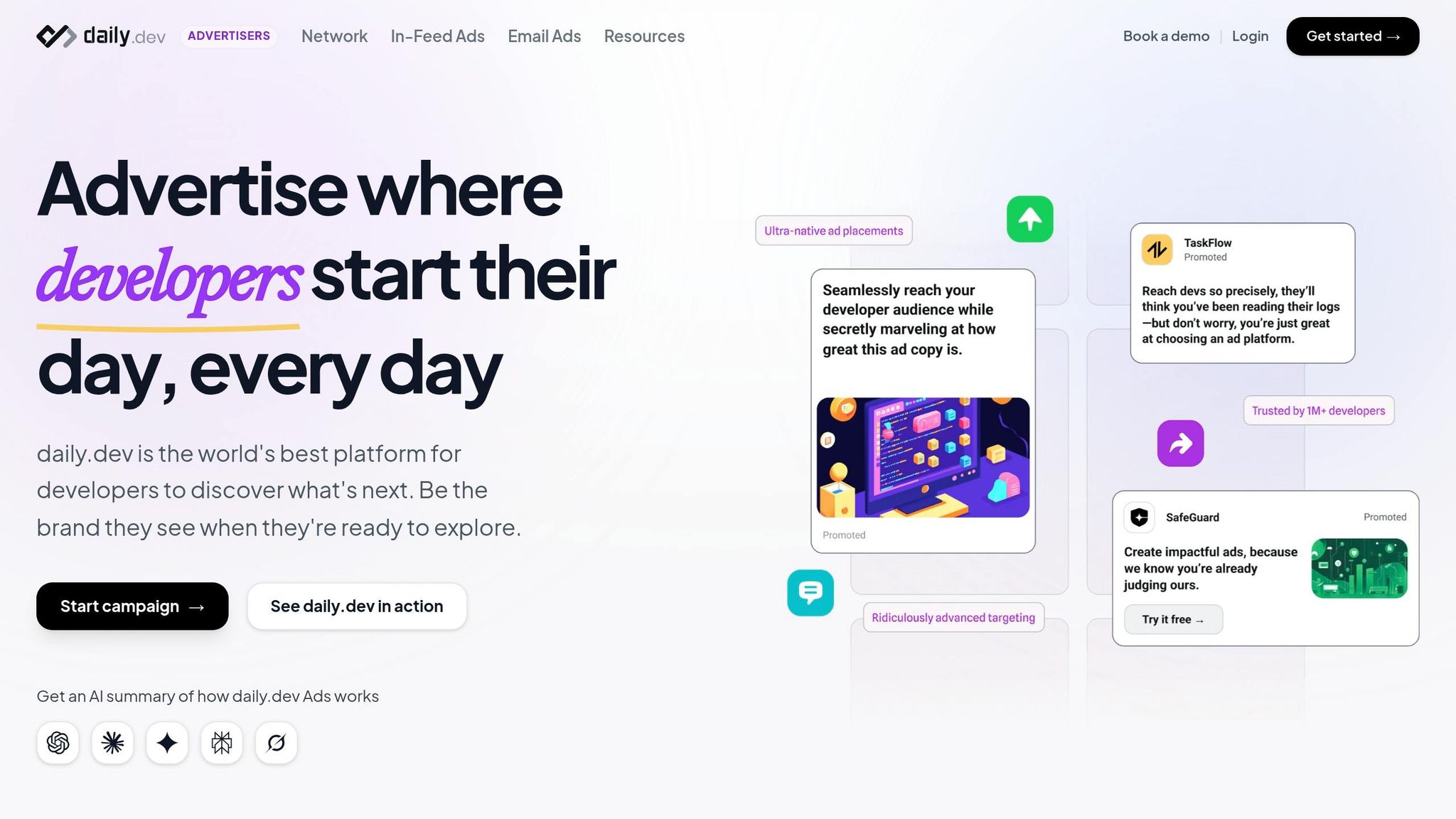
Platforms like daily.dev for Business allow for precise account-level targeting by integrating directly into developers' daily content feeds. You can segment your audience based on factors like seniority, programming languages, or the tools they use.
With native ad placements such as in-feed ads and post page ads, your messaging can seamlessly blend into the developer’s reading experience. For example, you could target senior engineers at Series B SaaS companies who work with Kubernetes and Python. This level of precision ensures your ads reach the right people without wasting impressions.
To make this even more effective, you can combine daily.dev targeting with your product usage data - like tracking free trial sign-ups or API activity. This pairing helps you identify warm leads and engage with developers where they naturally consume technical content, making your outreach more relevant and timely.
Measuring ABM Performance for Developer Tools
Pipeline Influence Over MQLs
Traditional MQLs often fail to capture how developers engage. While actions like visiting a pricing page or downloading a whitepaper may work as signals in standard B2B, developers take a different approach. They might spend months exploring documentation or browsing GitHub repositories before their company even considers making a purchase.
Instead of relying on MQLs, focus on pipeline dollars generated from developer-specific signals. For instance, in January 2026, Spectro Cloud tracked developer intent signals and generated $1.65 million in new pipeline - proving the value of prioritizing these insights over traditional MQLs .
Key metrics to monitor include speed, quality, and coverage:
- Speed: Aim to respond to high-intent signals within 24 hours.
- Quality: Compare reply rates between signal-based outreach (15–25%) and generic cold emails (2–5%).
- Coverage: Track the percentage of target accounts showing any signal within 30, 60, or 90 days to identify potential gaps in your ideal customer profile.
Tracking Engagement Across the Buying Committee
Once you’ve measured pipeline impact, the next step is monitoring engagement across the technical buying committee. Developer ABM requires tracking how different stakeholders interact with your tool - both the engineers testing it and the managers making the final purchase decisions.
Pay attention to clusters of activity, such as multiple developers from the same company downloading your SDK, forking your GitHub repository, or participating in issue threads simultaneously. These patterns often indicate a formal evaluation process rather than isolated curiosity.
Developers typically move through three stages:
- Exploring: Reading documentation and learning about the tool.
- Evaluating: Forking code, running local tests, and experimenting.
- Deploying: Submitting pull requests or opening issues.
By tracking these stages, you can better gauge buying readiness. For example, in December 2025, Port monitored GitHub activity, Docker pulls, and package downloads (npm, pip) to distinguish active testing from casual browsing. This approach led to 3x higher reply rates and a 20% increase in pipeline growth .
Using Data to Improve Campaigns
Once you’ve mapped engagement across roles, refine your campaigns with deeper signal analysis. Assign weight to different signals based on their correlation with win rates. For example, a pull request or GitHub fork typically signals stronger intent than a simple star. Similarly, a developer raising migration concerns in a Slack channel suggests urgency compared to someone passively browsing documentation.
Key metrics to track include:
- Reply rates: Measure how often outreach efforts lead to responses.
- SQL conversion rates: Analyze how signals translate into qualified leads.
- Win rates: Identify which signals are most predictive of closing deals.
Kubegrade’s CEO, Tim Grassin, demonstrated this approach by using GitHub intent data to validate interest in Kubernetes tools. This strategy resulted in a 22% response rate and five booked demos .
Combine third-party intent signals with internal data - like free trial signups, API calls, and CLI commands - to pinpoint accounts most likely to purchase. Set up alerts for spikes in developer activity or interactions with competitors’ repositories. Then, adjust your messaging and channel strategy to focus on what’s driving actual pipeline growth, not just surface-level engagement.
"83% of developer activity does not manifest in the CRM. When it does, it may be too late."
– Reo.dev
To drive pipeline creation, prioritize accounts showing clear technical adoption signals.
Conclusion
This playbook highlights a focused approach to Account-Based Marketing (ABM) tailored specifically for developer tools. Unlike traditional B2B strategies that lean on job titles or LinkedIn campaigns, success in this space comes from tracking behavioral signals on platforms like GitHub, Slack, Discord, and Reddit. The ultimate goal? Shift from outdated metrics like MQLs to prioritizing pipeline influence by connecting developer actions directly to revenue.
The earlier sections emphasized the importance of focusing on technical signals rather than superficial engagement metrics. For instance, accounts demonstrating activity like pull requests, production deployments, or API calls provide far more actionable insights than GitHub stars or other surface-level interactions. Acting on these signals within 24 hours can significantly improve reply rates - doubling them, in fact, according to data.
Specialized tools can further refine this process. By combining external community signals with internal usage data, companies like Port have seen measurable success. In December 2025, Port’s strategy increased reply rates and drove a 20% pipeline growth.
When it comes to channel strategy, the key is meeting developers where they naturally spend their time. Platforms such as daily.dev for Business offer account-level targeting capabilities, leveraging developer network data. This allows precise targeting based on seniority, programming languages, and tool preferences, reaching over 1 million developers effectively.
Above all, relevance trumps volume. As Onfire.ai puts it:
"Your edge is reaching out about problems prospects have already mentioned, not sending better-written cold emails".
To succeed, focus on technical credibility, act swiftly on actionable signals, and craft messaging that aligns with how developers evaluate and adopt tools. By adopting these timely, data-driven practices, you can reshape your ABM approach for developer tools and drive meaningful results.
FAQs
How do I turn GitHub and package activity into an ABM target list?
Keep an eye on key developer activities like stars, forks, issues, and pull requests on repositories tied to your product. Pay special attention to accounts that have interacted with your GitHub repo in the past 180 days. This includes developers raising issues about enterprise-level features or submitting pull requests for integrations.
By analyzing this activity, you can create a scoring system to identify and prioritize high-potential accounts. This ensures your ABM (Account-Based Marketing) list focuses on developer actions that indicate genuine buying intent.
What’s the best way to reach developers without disrupting them?
The most effective way to connect with developers without interrupting them is through outreach that’s based on signals and relevant to their context. Developers tend to avoid cold spam or generic messages, but they’re more open to engagement that fits naturally with their work.
Pay attention to behavioral signals, like their activity on platforms such as GitHub or Docker Hub. Use technical, tailored content - think tutorials or demos - to create a connection that feels genuine and respects their workflow.
How do I measure ABM success without relying on MQLs?
To gauge the success of ABM strategies beyond just tracking MQLs, focus on metrics like pipeline influence, developer engagement (e.g., API calls and documentation views), and indicators of technical adoption and community growth within your target accounts. These metrics offer deeper insights into how your initiatives connect with technical audiences and contribute to impactful results.