

Want to advertise to developers effectively? Here's a quick rundown: Developers value accuracy, technical relevance, and non-intrusive ads. Platforms like Stack Overflow, daily.dev, and Hacker News are great for reaching them. Focus on clear, technical messaging, avoid buzzwords, and highlight practical benefits like code snippets or product screenshots. Use strong CTAs like "View Documentation" or "Start Free Trial" to drive engagement. Track success with metrics like API calls or SDK downloads - not just clicks. Avoid generic ads and respect platform-specific norms to build trust and credibility.
Key tips:
- Where to Advertise: Use developer communities (e.g., Reddit, Stack Overflow), content aggregators (e.g., daily.dev), and newsletters (e.g., JavaScript Weekly).
- How to Advertise: Show real examples, use precise language, and target by tech stack or developer roles.
- What to Track: Focus on API calls, documentation views, and sign-ups over traditional metrics like click-through rates.
To succeed, respect developers’ technical expertise, provide value, and ensure your ads solve real problems. Let’s dive into the details.
Types of Developer Websites for Advertising
::: @figure 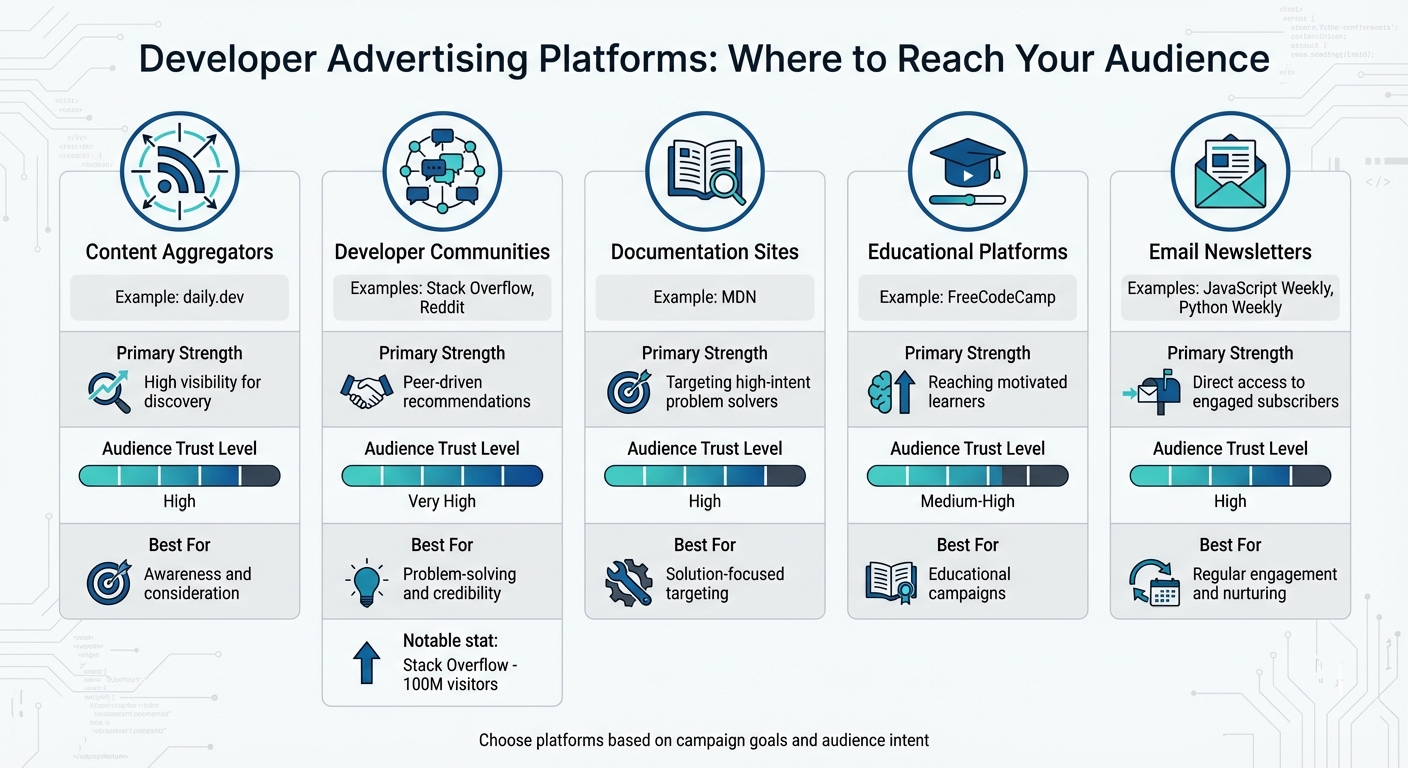 {Developer Advertising Platforms Comparison: Strengths, Trust Levels, and Best Use Cases}
Choosing the right developer website to advertise on can make or break your campaign. Developers frequent different types of websites, each serving a unique role in their work and learning processes. By understanding these categories, you can focus your advertising efforts on platforms that align with your goals and resonate with your target audience.
Developer Communities
Websites like Stack Overflow, Reddit, and Dev.to are go-to spots for developers looking to solve problems, exchange ideas, and discuss industry trends. For example, Stack Overflow draws in a staggering 100 million visitors searching for coding solutions, making it a prime platform to reach developers in moments of high intent. Meanwhile, Reddit’s r/programming community, with its 7 million members, offers opportunities to engage with developers discussing tools and trends. However, advertising on Reddit demands authenticity - developers value genuine, respectful messaging over flashy ad campaigns. These platforms thrive on peer-to-peer trust, where a tool recommendation from another developer often carries more weight than traditional advertising.
Content Aggregators
Platforms like daily.dev and Hacker News specialize in curating technical articles, tool announcements, and industry updates. Developers visit these sites to discover new tools and stay informed, making them ideal for discovery-based advertising. For instance, Hacker News attracts a highly technical audience, with over 6 million developers visiting monthly. Ads that blend seamlessly with the platform’s content - like native tool announcements - tend to perform best here.
Documentation and Reference Sites
When developers need quick answers to syntax questions or API details, they turn to platforms like MDN (Mozilla Developer Network). These sites attract users with high intent, as developers are often actively troubleshooting or evaluating tools. While advertising options on documentation sites are usually limited to display ads, the audience quality is unmatched - your message reaches developers precisely when they’re solving technical challenges.
Educational and Tutorial Platforms
Learning-focused platforms like FreeCodeCamp cater to beginner and intermediate developers honing their skills through structured courses. These sites are a great fit for educational campaigns that promote learning tools, beginner-friendly products, or resources to help developers get started. The audience here is highly engaged, spending extended periods on the platform while actively building their knowledge.
Developer Newsletters and Publications
Newsletters like JavaScript Weekly and Python Weekly offer direct access to developers who’ve opted in to receive curated content. These emails land directly in the inboxes of engaged readers, creating a sense of trust since the audience has explicitly chosen to subscribe. Newsletters work well for ongoing engagement and nurturing campaigns, helping you stay top-of-mind with developers even when they’re not browsing online.
| Platform Type | Primary Strength | Audience Trust Level | Best For |
|---|---|---|---|
| Content Aggregators (daily.dev) | High visibility for discovery | High | Awareness and consideration |
| Developer Communities (Stack Overflow, Reddit) | Peer-driven recommendations | Very High | Problem-solving and credibility |
| Documentation Sites (MDN) | Targeting high-intent problem solvers | High | Solution-focused targeting |
| Educational Platforms (FreeCodeCamp) | Reaching motivated learners | Medium-High | Educational campaigns |
| Email Newsletters | Direct access to engaged subscribers | High | Regular engagement and nurturing |
sbb-itb-e54ba74
Advertising Platforms for Reaching Developers
Once you've pinpointed the types of developer websites that align with your campaign goals, the next step is selecting the right platform to run your ads. To make the most of your budget, it's essential to understand each platform's audience size, ad formats, and targeting options. This ensures you connect with developers where they’re most engaged.
daily.dev Ads
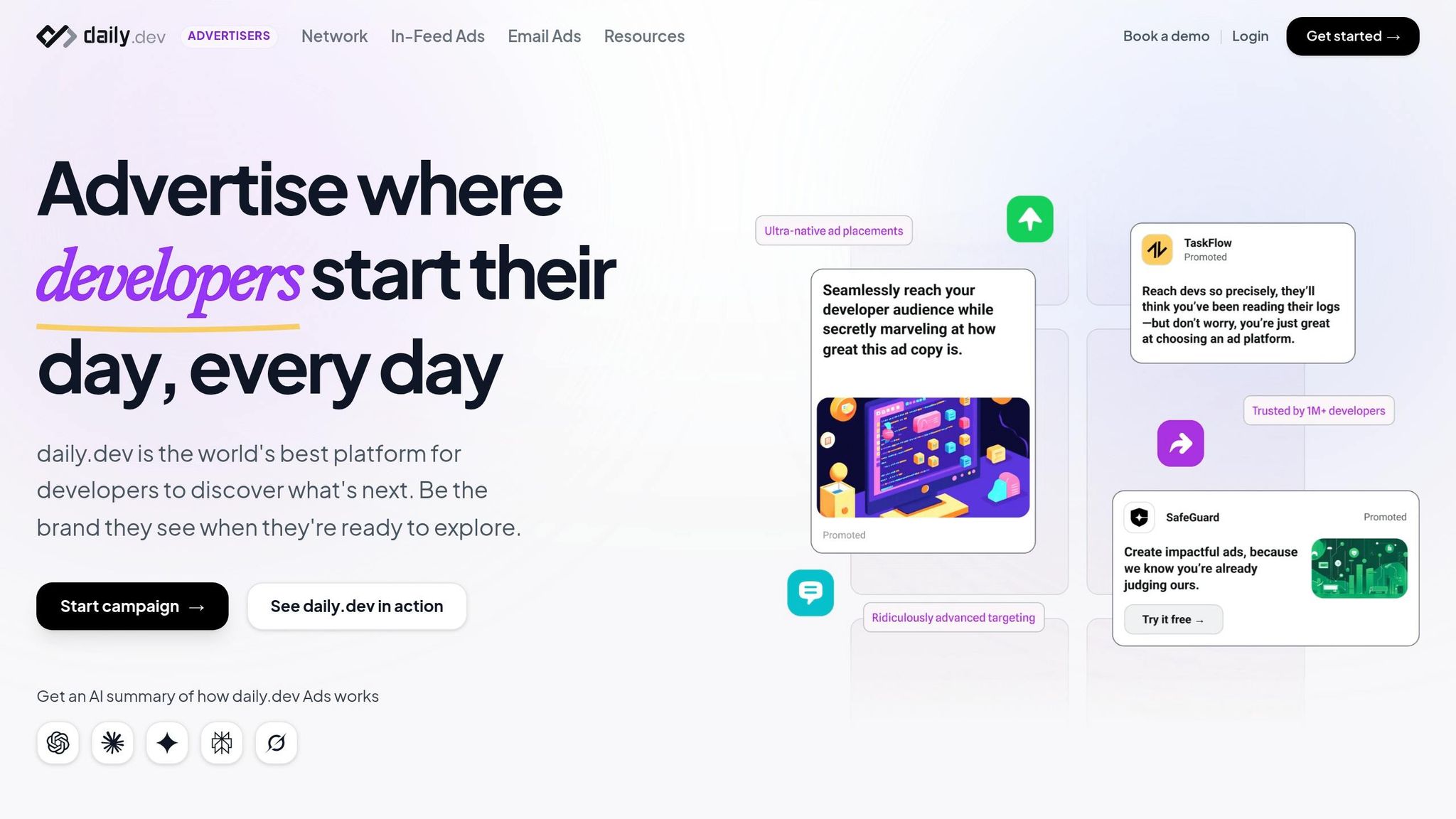
daily.dev offers access to a community of over 1.6 million developers, enabling you to deliver native in-feed ads that integrate smoothly into their content discovery process. These ads appear directly in the feed, alongside curated articles and tool announcements, creating a natural and non-disruptive user experience.
What sets daily.dev apart is its ability to target developers based on their preferred technologies rather than broad demographics. For instance, instead of going after "software engineers aged 25-34", you can focus on specific groups like "Python developers using AWS" or "React developers exploring testing frameworks." This level of precision is crucial because developers are more likely to engage with ads that are directly relevant to their workflows and technical challenges.
The platform supports campaigns at every stage, from building awareness to driving trial signups. Using AI, daily.dev optimizes campaigns in real time to boost conversions, making it an excellent fit for product-led growth strategies. Available ad formats include:
- In-feed placements: Ads that appear as developers scroll through their personalized feeds.
- Post page ads: Displayed alongside individual articles.
- Personalized digest ads (coming soon): Delivered via email to users.
When crafting ads for daily.dev, focus on technical clarity and avoid overused marketing jargon. Skip phrases like "enterprise-grade" or "best-in-class" and instead use precise, actionable language. For example, highlight a specific benefit like "Terraform provider with 5-minute setup" to show real value and demonstrate respect for developers' expertise.
With its targeted approach and developer-friendly ad formats, daily.dev Ads lays a solid groundwork for effective campaigns, which we’ll dive into further in the next section on best practices.
Best Practices for Developer Advertising Campaigns
When it comes to advertising to developers, understanding their mindset is crucial. Developers tend to be skeptical of flashy marketing and prefer straightforward, technical communication. The goal? Showcase real value with substance, not fluff.
Ad Creative and Messaging
Native ads consistently outperform traditional display ads. Forget stock photos of people pointing at screens - developers respond better to visuals that highlight your product in action. For instance, a screenshot of your tool or a short code snippet can communicate functionality far more effectively than a long-winded explanation.
Your messaging should address specific problems with clear, actionable details. For example, "Terraform provider with 5-minute setup" is far more compelling than a vague statement like "streamline your infrastructure." Developers want clarity, not buzzwords.
A low-friction call-to-action (CTA) can make all the difference. Phrases like "Start free trial", "View documentation", or "Try the sandbox" resonate because they let developers explore your tool hands-on. On the other hand, CTAs like "Request a demo" or "Contact sales" often create unnecessary barriers. Always link directly to technical resources like documentation or API references so developers can dive in immediately.
Once your messaging is solid, the next step is fine-tuning your audience targeting.
Targeting Strategies
Tech stack targeting is one of the most effective ways to reach the right developers. Platforms like daily.dev allow you to target users based on the technologies they actively use. For example, you could focus on "Python developers using AWS" or "React developers exploring testing frameworks." This level of precision ensures your ads are shown to developers who are already working with tools relevant to your product.
It's also important to segment your campaigns by developer roles and experience levels. A frontend developer has different needs than a backend engineer, and junior developers face challenges that senior architects don’t. For instance, a React component library would be best marketed to frontend developers who use React, Vue, or similar frameworks. Meanwhile, a database optimization tool should focus on backend engineers working with specific database systems.
Topic-based targeting can also help you connect with developers based on their current interests. If your tool addresses deployment challenges, aim your ads at developers reading about DevOps, CI/CD, or cloud infrastructure. Align your targeting with where developers are in their workflow and the problems they're actively trying to solve.
Once your audience is well-defined, the final step is testing and refining your approach.
Testing and Optimization
A/B testing is essential for finding what resonates. Experiment with different headlines, code snippets, and CTAs. Make sure each variation runs long enough - at least a few hundred impressions - to collect meaningful data.
Compare your campaign's performance against industry-standard click-through rates (CTRs), which typically range from 0.1% to 0.3%. If your results fall below this range, consider revising your ad creative or adjusting your targeting. If you're exceeding these benchmarks, analyze what’s working and apply those insights to other campaigns.
Go beyond simple clicks to measure true engagement. Metrics like technical sign-ups, API calls, SDK downloads, and sandbox usage give you a better sense of whether developers are genuinely interested in your product. These actions are far more telling than a visit to a generic landing page and indicate a higher likelihood of converting users into long-term customers.
How to Measure and Track Campaign Performance
Running developer advertising campaigns without proper measurement is like trying to debug without testing - it just doesn’t work. Tracking performance is what shows you whether your efforts are hitting the mark or missing entirely.
Key Metrics by Campaign Goals
To measure success, start by aligning your metrics with your campaign goals. For awareness campaigns, focus on metrics like impressions and reach - these tell you how many developers are seeing your message. To gauge their interest, keep an eye on engagement metrics such as time spent on your landing page or documentation views.
If your campaign is in the consideration stage, you’ll need a different set of metrics. Here, click-through rate (CTR) becomes crucial. For developer advertising, CTRs typically range between 0.1% and 0.3%. If your campaign falls within or exceeds this range, it’s a good sign that your messaging is resonating. Additionally, track visits to key pages like API documentation or sandbox environments - these visits indicate deeper interest and engagement.
When your goal shifts to activation and conversion, focus on metrics that reflect actual product adoption. For example, sign-ups from technical pages are more meaningful than general landing page conversions because they show developers are taking a closer look at your tool. To go even further, monitor actions like API calls, SDK downloads, and sandbox usage. These activities demonstrate that developers are actively testing your product, not just browsing.
Once your metrics are in place, the next step is ensuring accurate attribution.
Attribution and Analytics
To effectively attribute campaign performance, use UTM parameters for every platform and ad variation. For example, a UTM like utm_source=dailydev&utm_medium=native&utm_campaign=spring2026 allows you to track traffic from specific placements. This level of detail helps you identify which platforms and creative variations drive the best results.
Analytics alone won’t give you the full picture. Complement your data with post-campaign surveys. Ask new sign-ups how they discovered your tool - developers are often happy to share this information, especially if the survey is brief. You might find that many saw your ad across multiple platforms before converting, offering valuable insights into the customer journey.
Cross-platform attribution can be tricky, as developers often interact with your brand in multiple places. For instance, they might see your ad on daily.dev, research your tool on Stack Overflow, and finally convert after reading a Reddit discussion. To piece together these multi-touch journeys, use a mix of UTM tracking, first-party cookies, and survey responses. Compare your results to industry benchmarks - if your CTR is dipping below 0.1%, it’s time to tweak your targeting and creative before scaling up.
Common Mistakes in Developer Advertising
Developer advertising isn't like traditional marketing - it demands a tailored approach. Many campaigns miss the mark because they fail to recognize what developers value or, worse, what turns them off. Missteps can not only hurt your campaign's performance but also damage your brand's reputation within close-knit developer communities. While following best practices is crucial, knowing what to avoid is just as important.
Generic or Buzzword-Laden Messaging
Developers are quick to spot vague or exaggerated claims. Terms like "revolutionary solution", "cutting-edge innovation", or "game-changing platform" often trigger skepticism. These phrases suggest you either don't understand their challenges or haven't made the effort to explain how your product works.
Instead of empty superlatives, focus on specific technical benefits. For example, if you're offering a monitoring tool, say something like, "Track API latency with sub-millisecond precision across 50+ frameworks." This approach demonstrates value through concrete details. Developers want to know how your product fits into their workflows - show them API response times, authentication flows, or integration examples with their existing tools.
The same principle applies to visuals. Stock photos of people pointing at screens won’t resonate. Developers want to see real product interfaces, code snippets, or architecture diagrams. If your ad looks generic, you've already lost their interest.
Ignoring Platform-Specific Guidelines
Each developer platform has its own culture, rules, and expectations. Ignoring these can backfire, especially since developer communities are tightly connected. What works on one platform might fail miserably on another. For instance, Reddit's developer subreddits demand authentic engagement. Simply dropping promotional content without contributing to discussions can lead to backlash - or even account bans.
Adhering to platform guidelines is critical for credibility. For example:
- Reddit: Engage in discussions before sharing your product.
- Stack Overflow: Follow strict advertising rules about ad placement and format.
- daily.dev: Use native ad formats that blend seamlessly into the developer experience.
Flashy banner ads often disrupt the user experience and annoy developers. Worse, if your brand is seen as spamming communities, developers won’t just ignore you - they’ll actively warn others to avoid your product. Before launching on any platform, take time to understand how developers use it and what kind of content they value.
Beyond platform norms, make sure your call-to-action (CTA) aligns with the expectations of the audience.
Unclear or Weak Calls-to-Action
A weak or vague CTA can derail your campaign. Phrases like "Learn More" or "Discover Solutions" don’t work because they lack clarity. Developers want to know exactly what action they'll take and what they’ll get in return. If your CTA is unclear, they may assume your product is equally confusing.
Strong CTAs are specific, actionable, and outcome-driven. For example:
- "Start Free Trial": Offers immediate, no-commitment access.
- "View Benchmark Results": Promises concrete data for evaluation.
- "Clone Repository": Speaks directly to developers, signaling hands-on access.
- "Run Performance Test": Encourages practical, immediate engagement.
Your CTA should match your campaign’s goal:
- Awareness campaigns: Use CTAs like "Explore Docs" or "See Code Examples."
- Consideration campaigns: Opt for "Compare Features" or "Watch Technical Demo."
- Activation campaigns: Go with direct prompts like "Start Building" or "Deploy Now."
Even small tweaks to CTA language can make a big difference. Testing variations like "Get Started" versus "Start Building" can lead to 20-30% performance improvements, as developers appreciate precision and clarity in every interaction. The details matter.
Conclusion
Reaching developers effectively requires a technical and focused strategy. Unlike traditional marketing, advertising to developers demands substance over style. They’re not swayed by flashy visuals or vague promises - they want to see actual product interfaces, code snippets, and solutions tailored to their workflow challenges.
Meeting developers where they already engage is key. Platforms like daily.dev Ads excel at delivering native, context-aware advertising that emphasizes your product's technical strengths. Whether you’re starting with a $5,000 budget for targeted campaigns or scaling up to multi-platform strategies, your approach should align with your goals - whether it’s awareness, consideration, or activation.
Targeting developers effectively means honing in on their specific interests, such as their tech stack, preferred programming languages, or workflow needs. Success can be measured through tangible metrics like API calls, documentation views, SDK downloads, or even product sign-ups. Native ad formats that integrate seamlessly into the developer environment consistently outperform intrusive banner ads, while clear and precise CTAs drive better engagement.
Tracking performance goes beyond click-through rates. Use tools like UTM parameters for attribution, conduct A/B testing to refine messaging, and set realistic benchmarks - CTRs between 0.1-0.3% are a good starting point. These metrics help determine whether your ads are genuinely solving developer problems or just generating superficial clicks.
Avoid common mistakes like generic messaging, ignoring platform guidelines, weak CTAs, or overly broad targeting. Developers are naturally skeptical of marketing, but they’re also eager to discover tools that address their needs. Focus on solving problems rather than promoting features, deliver immediate technical value, and let your product’s capabilities do the talking. Respect their time and intelligence, and you’ll earn their attention, engagement, and ultimately, their trust.
FAQs
Best site?
If you're looking to advertise to developers, daily.dev stands out as the top platform. With access to a community of over 1.6 million developers, it offers native ad formats and detailed targeting options. This combination ensures your campaigns resonate with developers and deliver strong results.
Cost?
Advertising costs on daily.dev vary based on your campaign type and targeting preferences. Budgets can start at under $5,000 for targeted platform placements and go beyond $20,000 for broader, multi-platform campaigns that include newsletters and additional integrations. The pricing structure is designed to be flexible, making it adaptable to a range of goals and campaign sizes.
daily.dev vs Carbon?
When it comes to advertising to developers, daily.dev Ads and Carbon cater to distinct goals and approaches.
daily.dev Ads integrates seamlessly into personalized feeds, offering native ad placements tailored to developers' preferences. This platform enables targeting based on factors like tech stack, programming languages, and seniority. It’s a great choice for campaigns focused on broad visibility and active engagement.
On the other hand, Carbon specializes in subtle, site-level ads displayed on niche developer blogs. These ads blend into the content, making them ideal for campaigns that thrive on context and relevance.
If you’re looking for versatility and reach, daily.dev is the way to go. For smaller, highly integrated placements, Carbon is the better fit.
Target specific types?
To connect with specific types of developers, it's essential to engage on the platforms and in the communities they frequent. Here are a few examples:
- Frontend developers: Platforms like daily.dev, CSS-Tricks, and newsletters such as JS Weekly are great spaces to reach them.
- Backend developers: Communities like daily.dev, the r/programming subreddit on Reddit, and various tech-focused newsletters are ideal.
- AI/ML developers: Look into daily.dev for AI/ML-related topics, Hacker News, and specialized newsletters.
Craft your messaging to resonate with their interests, and leverage platforms like daily.dev to segment your audience based on their technical focus and expertise.
Good creative?
The most effective advertising content for developer websites is focused on technical details, genuine in tone, and centered on problem-solving. Include elements like detailed specifications, practical code examples, and a clear, actionable call to action. Avoid using excessive promotional language, unnecessary filler, or trendy buzzwords. Instead, aim to connect with developers by tackling real-world challenges and clearly demonstrating the value your solution offers.