

Reaching developers with ads requires a unique approach. Developers are skeptical of traditional marketing and demand technical accuracy, transparency, and immediate value. Here’s what you need to know:
- Developers influence purchasing decisions. They act as gatekeepers for tools and platforms adopted by teams or entire companies.
- Targeting developers is data-driven. Platforms like daily.dev generate over 1 billion interactions, enabling precise targeting based on programming languages, tools, and behavior.
- Effective ads fit into their workflow. Ads should focus on solving specific problems, offering technical solutions, and providing clear value.
- Privacy is paramount. Developers expect ethical data practices and transparency in how their information is used.
To succeed, use platforms like daily.dev Ads, which offer tailored campaigns, advanced targeting, and ad formats that align with developer workflows. Focus on creating ads with simple, technical messaging, and measure success using developer-specific metrics like API calls or SDK downloads.
Understanding the Developer Audience
Developer Demographics and Online Behavior
In 2026, developers are highly engaged digital natives who approach online content differently than most other audiences. They dedicate significant time to technical platforms - diving into documentation, exploring code repositories, and staying on top of industry trends. Their online activity is driven by a purpose: problem-solving and continuous learning. They’re not just scrolling aimlessly; they’re actively searching for tools, resources, and solutions that can enhance their work.
This audience gravitates toward trusted technical platforms where credibility is paramount. They prefer environments that prioritize quality content and community-driven curation. A great example is daily.dev, which aggregates 500 carefully selected news sources, categorizing them into 200 tags based on developer community input. This system ensures developers discover highly relevant content . Their deep engagement with such platforms fosters a critical mindset, making them less susceptible to surface-level marketing tactics.
Common Marketing Challenges When Targeting Developers
One of the toughest obstacles for marketers is overcoming developer skepticism. Developers have seen plenty of products fail to live up to their promises, leaving them wary of traditional marketing campaigns. Vague claims or community strategies that lack clear technical value are often dismissed outright . Since developers are actively searching for real solutions, any marketing that feels superficial or overhyped will quickly lose their trust.
To connect with developers, technical accuracy and transparency are non-negotiable. Ads that appear alongside respected developer brands often gain credibility by association . Developers respond to straightforward messaging that focuses on what a product can actually do, rather than overpromising future capabilities. Additionally, privacy and ethical data practices have become critical. In 2026, developers expect transparency about how their information is used for targeting .
What Makes Developers Click on Ads
Despite these challenges, it’s possible to create ads that resonate with developers - if you know what they value. Developers are drawn to ads that deliver immediate and practical utility. They’re more likely to engage with content that follows a clear structure: Problem → Solution → Value . Examples like live coding demos, interactive sandboxes, or realistic use cases that showcase how a product addresses real-world challenges tend to perform far better than generic marketing messages.
Successful ads blend seamlessly into a developer’s workflow, featuring clear and technical headlines. Relevance is key - developers engage with ads that align with their specific tools, technologies, and current needs . When targeting is informed by behavioral data - such as programming language preferences, tech stacks, or content consumption habits - engagement rates improve significantly. Platforms like daily.dev, which connects with over 1 million developers globally and generates over 1 billion interactions based on real behavior signals, allow advertisers to target with an unprecedented level of precision .
sbb-itb-e54ba74
Effective Channels and Tactics for Developer Advertising
Where Developers Spend Their Time Online
Developers gravitate toward platforms designed to help them solve problems, discover tools, and keep up with industry trends. These aren’t places for casual browsing - they’re workspaces where developers actively seek technical solutions and evaluate new technologies.
One standout platform is daily.dev, which connects with over 1 million developers worldwide and facilitates more than 1 billion interactions . By curating content from trusted sources into community-focused categories, daily.dev creates an environment where developers are primed to discover tools and resources. For advertisers, this makes it a prime spot to engage with an audience that’s already focused on technical content.
Ad Formats That Fit Developer Workflows
Knowing where developers spend their time also helps determine which ad formats work best. Ads that blend seamlessly into their workflows tend to perform better because they don’t disrupt the experience. Here are a few examples:
- In-feed ads: These appear within streams of technical content, mimicking editorial content for a natural, non-intrusive experience.
- Post-page ads: These are shown after developers have engaged deeply with specific articles, making them more open to recommendations related to the content they’ve just consumed.
- Personalized digest ads: Delivered based on a developer’s interests, technology stack, and browsing habits, these ads target the right person with the right message at the right time.
On daily.dev, ads are displayed alongside respected developer brands, which adds credibility to the placement . The platform also partners with EthicalAds, offering topic-based targeting that enhances the ad experience while maintaining the trust developers expect .
Targeting by Skills and Technology Preferences
Behavioral data plays a key role in reaching developers with relevant ads. By analyzing tool usage and content engagement, advertisers can align their messaging with a developer’s specific interests and technical stack. For instance, if a developer frequently reads Python-related articles, it’s a clear signal they’re interested in Python tools and libraries.
Customizing ads with language-specific content takes this a step further. Including snippets of code or technical terms unique to a programming language can immediately resonate with the audience. For example, an ad featuring functional Python code can quickly demonstrate the value of a Python-specific tool. As Daphna Giniger from daily.dev explains:
"Developer marketing only works when the product delivers immediate, obvious value. No landing page, brand campaign, or 'community strategy' can cover for a bad product experience" .
Segmentation by experience level adds another layer of precision. A junior JavaScript developer will have different needs than a senior architect working with the same language. Platforms like daily.dev allow advertisers to fine-tune campaigns by targeting specific programming languages, tools, and even seniority levels. This level of detail ensures that campaigns address the unique challenges faced by each group, creating messages that truly connect with developers.
daily.dev Ads: An Advertising Platform for Developer Audiences
What daily.dev Ads Offers Advertisers
daily.dev Ads connects advertisers to a global network of developers, driving engagement through tailored campaigns. Whether the goal is product adoption, event promotion, or lead generation, the platform delivers ads in three native formats: In-Feed Native Ads that blend seamlessly into personalized content feeds, Post Page Ads that appear within active discussions, and Personalized Digest Ads sent directly via email. These ad formats are supported by advanced targeting options and real-time analytics to maximize campaign effectiveness.
Platform Features and Capabilities
daily.dev Ads goes beyond basic demographics with precise targeting tools. Advertisers can segment audiences by seniority levels, from newcomers to experienced engineers, ensuring messages reach the right professionals. Additional filters include programming languages like JavaScript, Python, Java, Swift, and Go, as well as tools such as Docker, Kubernetes, Jenkins, Jupyter Notebook, and Visual Studio Code. By leveraging behavioral data from developer interactions, the platform tracks tool usage and content preferences in real time, allowing for quick adjustments to campaigns. Plus, expert creative support is available to help optimize ad performance.
Advertiser Advantages
With its advanced targeting and deep engagement, daily.dev Ads delivers measurable results. Advertising on this platform enhances credibility by associating your brand with trusted developer content. daily.dev has earned a 4.8/5 rating on Product Hunt, been named "Product of the Year", and accumulated over 20,000 GitHub stars. Its reputation is further strengthened by 2,500+ verified reviews and an active community of 11,000 members. For brands aiming to connect with developers in an era of AI-driven personalization and privacy-focused advertising, daily.dev Ads stands out as a reliable and respected platform.
Creating Effective Developer Ad Campaigns
::: @figure 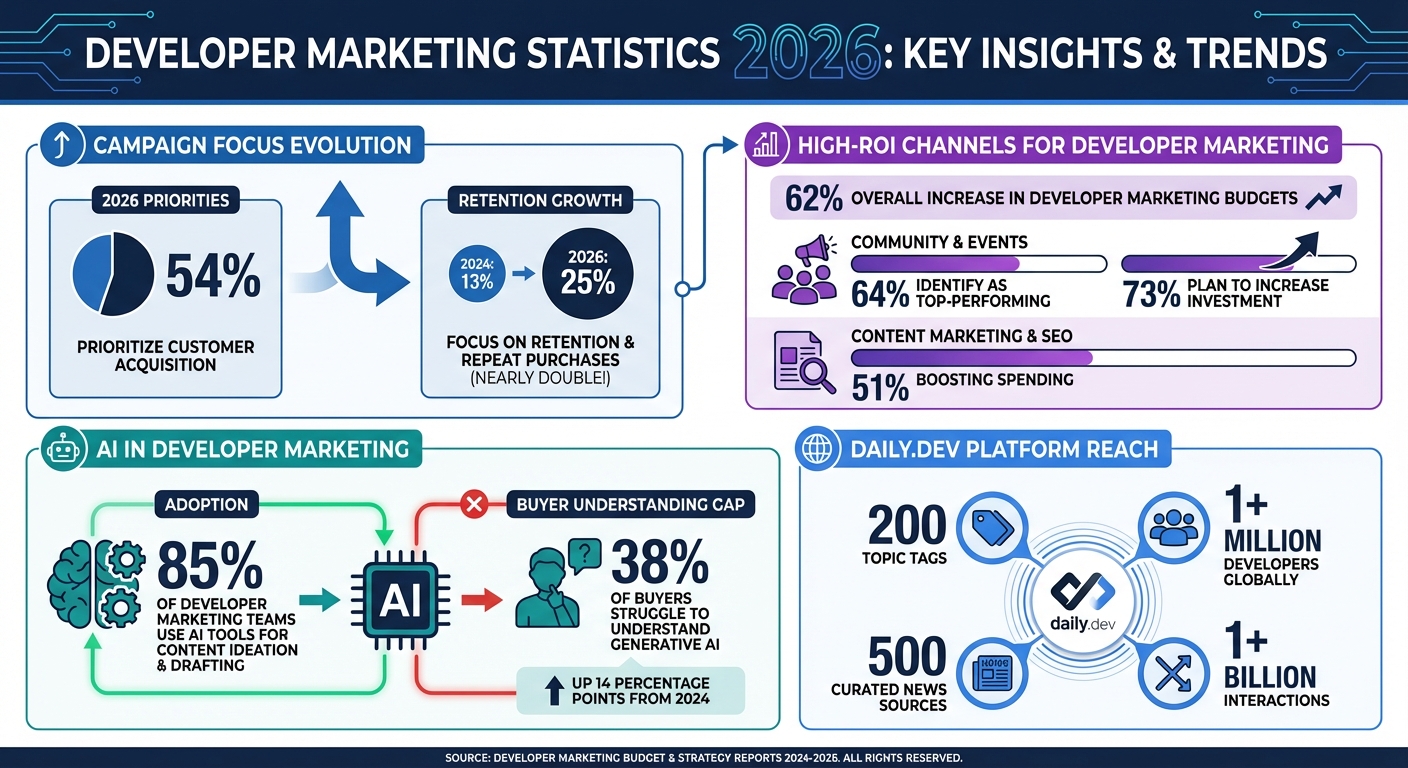 {Developer Marketing Statistics 2026: Budget Allocation and Channel Performance}
Defining Campaign Objectives and Budget Allocation
Start by pinpointing the specific technical problem your product solves. A campaign that focuses too much on brand awareness instead of delivering clear value is likely to fall flat. In 2026, 54% of developer-focused advertisers prioritized customer acquisition, while 25% concentrated on retention and repeat purchases - nearly double the 13% reported in 2024. This shift highlights the growing emphasis on retention-driven strategies, often supported by AI tools.
When it comes to budget allocation, focus on channels with proven ROI: community engagement, events, content marketing, and SEO. Community and events stand out, with 64% of teams identifying them as top-performing channels and 73% planning to increase investment. Content marketing and SEO are also gaining traction, with 51% of teams boosting spending in these areas. As 62% of teams increase their overall developer marketing budgets, smart resource allocation becomes essential. Tools like the Developer Marketing Budget Calculator can help you break down spending by channel and duration, while a tech campaign ROI estimator can provide early insights into potential returns before you launch.
Success should be measured using developer-specific metrics like API calls, SDK downloads, or sign-ups from technical documentation pages - not just generic click-through rates. Set aside part of your budget for A/B testing technical headlines and transparent messaging. Since developers are often skeptical of overly promotional language, focus on creating educational content such as live coding demos, interactive sandboxes, or open-source versions. These approaches can immediately showcase the value your product brings.
These budget strategies directly tie into the creative elements discussed in the next section.
Design and Messaging Guidelines for Developer Ads
With clear objectives in place, the next step is crafting messaging that resonates with developers. This audience values technical accuracy and transparency, so your ads should follow a straightforward "Problem → Solution → Value" structure. Show exactly how your tool addresses a technical challenge. Including realistic code snippets or interactive sandboxes in your ads can help demonstrate utility and keep your content from feeling overly promotional or shallow.
Make sure your ad copy is mobile-friendly, as developers often browse content on their phones. Use clear, technical headlines with transparent messaging, and A/B test specific terms to find what resonates most. Ads should deliver immediate value - like a live coding environment or a direct link to documentation - rather than relying on high-friction lead-generation forms. Interestingly, 85% of developer marketing teams now use AI tools for content ideation and drafting, which can help maintain technical accuracy while speeding up the creative process. Prioritize educational content that builds trust, as developers tend to favor clarity over traditional branding efforts.
Tracking and Improving Campaign Results
To refine your campaign, rely on detailed behavioral metrics to monitor performance. Track tool usage, content engagement, interaction timing, click-through rates, conversions, reach, and ROI. This data will help you fine-tune targeting and ensure your budget reaches the right audience.
Regular A/B testing of technical headlines, transparent messaging, and mobile-friendly copy can help identify the most effective creative variations. Real-time creative testing is another powerful way to optimize ads mid-campaign, improving conversion rates. With 38% of buyers still struggling to understand generative AI - up 14 percentage points from 2024 - start by using AI for brainstorming content ideas, then expand to using AI tools for execution and optimization.
Ensure your tracking complies with privacy regulations. As major APIs continue to restrict session attributes and IP imports, you’ll need to adopt modern solutions like the Data Manager API, which becomes mandatory for new Google Ads API users by February 2, 2026. Tools like the Developer Audience Targeting Planner can help you narrow down audiences by programming language, experience level, and platform. Combine this with tech-focused ROI estimators to forecast conversions before scaling up your spend. Finally, track developer feedback on ad accuracy just as closely as you monitor clicks - technical inaccuracies can quickly erode trust with this audience.
Selecting the Right Developer Advertising Platform
What to Look for in an Advertising Platform
Choosing the right advertising platform is a critical step in ensuring your campaign resonates with developers. Start by prioritizing platforms that provide verified metrics for measuring a quality developer audience. A platform backed by over 1 billion interactions based on actual developer behavior is far more reliable than one that depends solely on self-reported data .
When it comes to targeting, precision beats broad reach. Look for platforms that allow segmentation based on factors like programming languages, experience levels, and specific technologies. The ability to leverage behavioral data for targeting is a must.
Ad format flexibility is another key consideration. Opt for platforms offering interactive tools like live coding environments or sandboxes, as these align well with developer workflows. Additionally, ensure the platform adheres to strict privacy and data protection standards, as developers are often highly conscious of data ethics.
Real-time optimization and testing capabilities can significantly improve campaign performance. Platforms that leverage AI for optimization should clearly explain which metrics influence their decisions. Lastly, transparent pricing and detailed ROI reporting are essential for managing budgets effectively and understanding campaign outcomes.
Platform Selection Checklist
To find the best platform for your developer advertising needs, use this checklist to guide your evaluation process:
- Audience Verification: Ask about the platform’s developer audience size and the methods they use to maintain audience quality. Verified data is key.
- Targeting Capabilities: Can the platform segment audiences beyond basic demographics? Look for options like filtering by GitHub activity, preferred tech stacks, or even regional open-source trends.
- Ad Formats: Confirm the availability of formats that integrate seamlessly into developer workflows, such as interactive coding tools or tutorials.
- AI and Optimization: Understand how their AI systems optimize campaigns. What metrics do they rely on, and how transparent is their process?
- Privacy Standards: Verify that their data protection policies comply with global standards, as this is a major concern for developers.
- Reporting and Analytics: Request access to real-time dashboards and ask for case studies or references from similar campaigns to gauge potential success.
- Support and Guidance: Learn about their advertiser onboarding process and ongoing support. How do they assist with underperforming campaigns?
Before committing to a large budget, consider running small pilot campaigns. These tests allow you to evaluate the platform’s capabilities and see if your messaging resonates with their developer audience. Tools like a Developer Audience Targeting Planner can help you assess whether the platform’s reach aligns with your goals. Additionally, using a Tech Campaign ROI Estimator with your budget parameters can give you a clearer picture of potential returns.
This systematic approach ensures your platform choice aligns with the unique strategies required for reaching developers effectively.
Conclusion
Reaching developers through advertising requires delivering immediate, practical value. As mentioned earlier, no marketing effort can make up for a product that doesn’t meet expectations or solve real problems .
Developers are drawn to ads that fit seamlessly into their workflows, address genuine challenges, and offer clear benefits. In 2026’s AI-powered advertising world, using behavioral targeting based on real tool usage and engagement remains a key tactic.
With these principles in mind, daily.dev Ads offers a platform designed to connect with developers effectively. It provides what leading brands seek: credibility within the developer space, scalable growth from awareness to pipeline, and a secure environment for their messaging .
To get started, consider running pilot campaigns to fine-tune your approach. Leverage the Platform Selection Checklist from earlier to assess features and capabilities. Focus on creating technical headlines, concise mobile-friendly copy, and demos that follow a straightforward "Problem → Solution → Value" framework. Keep a close eye on real-time performance metrics and adjust based on authentic developer interactions - not superficial numbers.
FAQs
What makes developers ignore ads?
Developers tend to steer clear of ads because they interrupt their workflow, break concentration, or fail to provide meaningful or technical content. Many rely on ad blockers to maintain focus and avoid distractions, often viewing traditional ads as irrelevant or untrustworthy.
To capture developers' attention, ads need to be informative, honest, and technically precise. They should deliver real value - whether through tutorials, code snippets, or other relevant content - while being presented on platforms developers already trust.
Which metrics matter most for developer ads?
When it comes to developer-focused ads, the most important metrics revolve around engagement and efficiency. Here are the key performance indicators (KPIs) to keep an eye on:
- Click-Through Rate (CTR): Measures how often people who see your ad actually click on it.
- Conversion Rate: Tracks how many of those clicks lead to desired actions, like sign-ups or downloads.
- Cost Per Click (CPC): Shows how much you're spending for each click on your ad.
- Cost Per Thousand Impressions (CPM): Reflects the cost of reaching 1,000 people with your ad.
Beyond these general metrics, it's also crucial to track developer-specific behaviors. Metrics like API calls, documentation views, and tutorial engagement provide insight into how well your campaign aligns with developers' technical needs and interests. By analyzing these behaviors, you can fine-tune targeting and ensure your ads resonate, ultimately boosting relevance and ROI.
How do I run a small pilot campaign on daily.dev Ads?
To kick off a small pilot campaign on daily.dev Ads, begin by scheduling your campaign through their advertiser onboarding process. This initial step allows you to test your ad targeting and messaging on a smaller scale, helping you gauge how effective your approach is.
Make sure your ads are clear and focused on delivering genuine value to developers by addressing real challenges they face. Keep an eye on key metrics like click-through rates (CTR) and conversion rates. Use the data you gather to fine-tune your strategy, ensuring better performance while keeping the campaign manageable.