

Reaching AI developers requires a direct, technical approach. These engineers value precise, data-driven communication and actionable resources over traditional marketing tactics. Here's how to connect with them effectively:
- Developers demand proof: Share benchmarks, code examples, and clear documentation. Avoid vague claims or overhyped promises.
- Focus on their workflow: Provide tools like sandboxes, runnable code, and integration guides to help them test your product quickly.
- Where to engage them: Platforms like Hugging Face, LangChain communities, and Reddit’s r/MachineLearning are where developers share insights and evaluate tools.
- Content they trust: Technical deep-dives, performance metrics, and real-world examples resonate more than flashy ads.
- Metrics that matter: Developers track inference speed, cost efficiency, and tool accuracy. Ensure your messaging aligns with these priorities.
To succeed, prioritize technical accuracy, transparency, and clear value in your campaigns. Developers are skeptical of marketing but will engage with content that genuinely supports their work.
Who Are AI Developers and What Do They Care About?
AI developers come from varied backgrounds, but they share a common need: precise, data-driven communication. This demand stems from the technical challenges they face and the tools they use daily.
Roles and What They Build
These developers include machine learning engineers, full-stack developers, and data scientists. Together, they work on building systems like RAG (Retrieval-Augmented Generation), AI agents, and vector search implementations. Their work goes beyond theoretical concepts - they tackle real-world challenges such as handling context windows that exceed 100,000 tokens, optimizing routing between different model providers, and designing custom evaluation frameworks to meet specific needs .
Their Tech Stack
AI developers operate within a specialized ecosystem of tools and platforms. For models, they rely on options like OpenAI's GPT-4, Anthropic's Claude, and open-source tools from Hugging Face. Their orchestration often involves frameworks like LangChain, while vector storage solutions include services like Pinecone. For custom model development, PyTorch and TensorFlow are the go-to frameworks.
PyTorch is frequently chosen for research and prototyping due to its dynamic computation graphs, which make experimentation easier. On the other hand, TensorFlow is preferred for production environments, where its static graph optimization offers performance advantages .
Documentation plays a vital role in this ecosystem. It ensures that LLMs (Large Language Models) can accurately generate code that aligns with specific product requirements .
How They Think and Make Decisions
When evaluating tools, AI developers focus on measurable performance, cost efficiency, and flexibility in integration. They don't simply rely on vendor benchmarks; instead, they create their own test suites tailored to their unique workflows . Key metrics they track include:
- Inference speed: Measured in tokens per second.
- Tool-calling accuracy: Models like GPT-4 and Claude achieve over 90% accuracy in complex scenarios.
- Production throughput: Assessed under real-world conditions .
As Guy, CTO of Brunelly, advises:
"Don't rely on vendor benchmarks alone. Build your own test suite that reflects your actual use cases, measure what matters for your application, and iterate based on real data."
Cost efficiency is another major factor. Developers actively route queries to the most cost-effective providers, and smart routing can lead to impressive results - 66% faster response times and a 62% reduction in API costs . Flexibility is equally critical. The ability to switch providers or integrate custom tools without rewriting the entire codebase often determines whether a tool gets adopted .
Understanding these priorities helps clarify where AI developers gather and how best to engage with them.
sbb-itb-e54ba74
Where AI Developers Spend Their Time
AI developers take a different approach when it comes to information sources. Instead of traditional marketing channels, they gravitate toward platforms that offer technical depth, practical examples, and peer-driven insights. Knowing where they spend their time is key to engaging with them effectively.
Developer Platforms and Communities
For many AI developers, platforms like Hugging Face are indispensable. It’s a go-to place for discovering and testing open-source models. Similarly, Replicate is popular for deploying models via APIs, while LangChain's community serves developers working on orchestration layers and Retrieval-Augmented Generation (RAG) systems. Here, developers share integration techniques and troubleshoot challenges together.
On Reddit's r/MachineLearning, conversations are highly technical. Users delve into research papers, debate architecture choices, and exchange benchmark results. These platforms stand out because they prioritize technical accuracy over flashy marketing. Discussions often revolve around concrete metrics like latency and token costs - topics that resonate deeply with developers.
Newsletters and Twitter Influencers
Newsletters such as The Batch and AI Breakfast provide developers with curated updates on technical advancements. These publications build trust by focusing on research updates, tool comparisons, and implementation strategies. Sponsorships in these newsletters work best when they align with clear developer acquisition goals .
On Twitter, AI-focused accounts influence developers through detailed threads, benchmark breakdowns, and architecture analyses. However, with the rise of AI-generated summaries and chat-based answers, developers are turning to concise, actionable content for their needs . These platforms complement advertising efforts by offering direct, technical insights that developers value.
Using daily.dev Ads for AI/ML Targeting
daily.dev Ads offers access to over 1.6 million developers, making it a powerful tool for targeting AI/ML professionals. The platform allows advertisers to fine-tune their outreach based on AI/ML interests, programming languages (like Python, TensorFlow, and PyTorch), and developer seniority. This ensures that your message reaches those actively building LLM applications.
Unlike traditional display ads, daily.dev Ads focuses on technical content and precise placements, avoiding the skepticism developers often have toward overt marketing. As Jan van Musscher puts it:
"The best-marketed product doesn't win. The best product wins. Your marketing's job isn't to convince developers your product is good - it's to help them discover whether it's right for their use case" .
This philosophy aligns with daily.dev's approach, which emphasizes connecting developers to the right tools through contextual and relevant targeting rather than disruptive ads.
Content That AI Developers Actually Read
AI developers are a tough crowd when it comes to marketing. They’re quick to spot overhyped claims or flashy demos that don’t hold up under scrutiny. These are people who can dive into source code, analyze GitHub repositories, and detect inconsistencies in seconds. The moment your content feels like generic marketing, you’ve lost their attention. To connect with them, your content needs to offer real technical value - no fluff, no gimmicks.
So, what works? Developers want content that’s practical and actionable. Think resources they can use right away, like architecture diagrams, performance metrics, code snippets, and trade-off analyses. A good rule of thumb is the 70-20-10 approach: 70% pure technical insights, 20% behind-the-scenes transparency, and just 10% product-specific mentions .
Benchmarks and Technical Details
For developers, performance data beats flashy slogans every time. They’re not interested in vague claims like "faster" or "better." Instead, they want hard numbers: latency, accuracy, and cost. For example, show how you reduced latency from 800 ms to 120 ms or provide a detailed cost comparison of token pricing across different model sizes and scenarios.
Your technical documentation needs to go deep. Share the nitty-gritty details - architecture decisions, fine-tuning techniques, debugging tips - and back everything up with benchmarks, GitHub links, and technical papers. This kind of depth helps developers evaluate your claims and, more importantly, decide if your tool fits their needs. As the demand for AI-focused content grows, this level of transparency and detail is becoming more critical than ever .
Real Examples and Integration Guides
Developers love content that’s ready to use. Code examples, integration guides, and real-world scenarios are essential. For instance, provide actual schemas, cluster setups, and integration-ready snippets they can copy and adapt. Walk through specific optimizations, explaining not just what worked but why it worked - and just as importantly, why other approaches didn’t.
Transparency is key here. Sharing the less polished side of your development process - like failed experiments or pivots - builds trust. For example, say, "We tried X, but it didn’t work because Y", and explain how you adapted. This honesty shows developers you’re not just selling a product but sharing lessons they can learn from .
What to Avoid: Hype and Vague Claims
If you want to lose developers’ trust, throw around words like "revolutionary" or "game-changing." These terms immediately raise red flags. Instead, stick to facts and let the numbers speak for themselves. Developers trust peer recommendations on platforms like Reddit or Hacker News far more than glossy ad campaigns .
Write as if you’re explaining something to a colleague. Use clear, focused language, and avoid overwhelming blocks of text. Include concise code blocks where appropriate, and assume your audience is smart enough to follow along without over-explaining.
"The best-marketed product doesn't win. The best product wins. Your marketing's job isn't to convince developers your product is good - it's to help them discover whether it's right for their use case." - Jan van Musscher, Technical Founder, Postiv AI .
How to Run AI Developer Marketing Campaigns
::: @figure 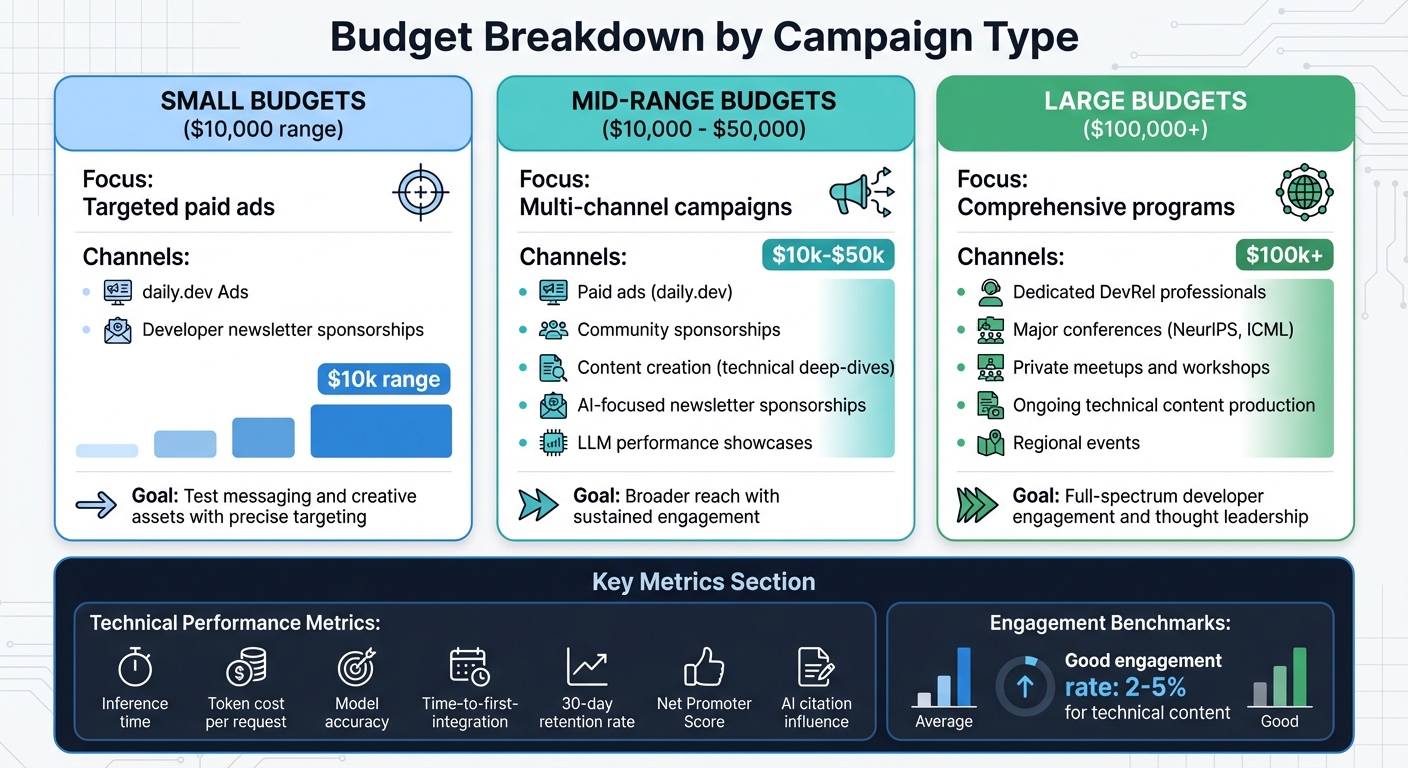 {AI Developer Marketing Budget Allocation Guide by Campaign Size}
Running successful AI developer marketing campaigns requires a sharp focus on ROI and authenticity. By 2025, marketing strategies are shifting away from generic brand awareness to initiatives that deliver measurable results, like product adoption and pipeline growth. AI developers, who often approach flashy campaigns with skepticism, respond better to strategies grounded in technical credibility and clear outcomes .
To succeed, you need a balanced approach that emphasizes both measurable ROI and technical validation. For example, pairing paid ads with retargeting efforts - supported by high-value gated content like benchmarks or whitepapers - can help maintain visibility while driving conversions. As Karl Hughes, Founder of Draft.dev, explains:
"Developer marketing is shifting toward ROI-focused strategies in 2025. Teams face pressure to prove business value beyond awareness" .
By building campaigns around technical content that resonates, you can turn credibility into tangible results.
Budget Breakdown by Campaign Type
Your budget should align with the level of engagement and technical depth needed to reach your audience. Here’s how to allocate resources effectively:
Small budgets ($10,000 range): Focus on targeted paid ads through platforms like daily.dev Ads and sponsor newsletters that cater to developers. This approach allows precise targeting while testing your messaging and creative assets.
Mid-range budgets ($10,000 to $50,000): Invest in multi-channel campaigns that combine paid ads, community sponsorships, and content creation. For example, you might sponsor AI-focused newsletters, run targeted daily.dev campaigns, and produce technical deep-dives showcasing LLM performance .
Large budgets (over $100,000): With a higher budget, you can create comprehensive programs. This might include hiring dedicated DevRel professionals, attending major conferences like NeurIPS and ICML, hosting private meetups, and producing ongoing technical content. While large in-person events can still provide valuable networking opportunities, smaller regional events are becoming harder to justify .
Community Engagement and Conference Presence
Building trust with AI developers requires authentic engagement. Developers often value peer recommendations over traditional branding . To connect meaningfully, participate in technical discussions on platforms like LangChain's Discord or Hugging Face forums. A good engagement rate for technical content typically falls between 2% and 5% .
When it comes to conferences, prioritize quality over quantity. Events like NeurIPS and ICML attract serious AI professionals, making them ideal for technical discussions rather than broad marketing pitches. Additionally, smaller DIY events, such as private meetups or workshops, are growing in popularity for their ability to foster deeper connections .
Targeting Options with daily.dev Ads
daily.dev Ads offers precise targeting options tailored to the AI developer audience. You can filter by programming languages (Python, C++, Mojo) or tools and frameworks (PyTorch, TensorFlow, LangChain), ensuring your ads reach developers already engaged in your ecosystem.
The platform also allows for seniority-level targeting, helping you tailor messages for junior developers, senior architects, or AI researchers with purchasing influence. Combining these filters lets you create specific audience segments, such as senior Python developers interested in LangChain and vector databases.
daily.dev Ads provides native ad placements - like in-feed or post page ads - that integrate seamlessly into the developer experience. With over 1 million developers in its global reach, the platform helps maintain the technical credibility essential for this audience. To maximize results, ensure your landing pages deliver actionable, implementation-ready resources rather than generic marketing content .
Writing Messages and Tracking Results
When crafting messages for AI developers, precision and data-driven insights are key. These developers value the same technical rigor in your communication that they apply to their own work. That means ditching vague claims and focusing on specifics: include real metrics, acknowledge tradeoffs, and be upfront about limitations. Transparency isn't just a nice-to-have - it builds trust. To go the extra mile, offer implementation-ready code examples, complete with schema, cluster configurations, and practical samples they can use right away .
As Draft.dev highlights:
"Search, discovery, and trust have changed. AI overviews and chat answers intercept a growing share of informational queries, while developers expect credible, implementation-ready resources" .
Your content needs to serve two masters: human readers and AI search engines. Generic, uninspired content won't cut it. Developers and search algorithms alike are quick to reject anything that lacks originality or depth .
How to Write for AI Developers
Be specific. Replace vague terms with concrete numbers. For example, instead of saying "fast", specify "95ms p99 latency at 1,000 tokens." Instead of "cost-effective", say "$0.0004 per 1,000 tokens." AI developers are obsessed with benchmarks, so show exactly how your tool stacks up against the competition. Be honest about tradeoffs - if your model prioritizes speed over accuracy, say so.
Another must-have? Ready-to-use code examples. Include API calls, error handling, and clear documentation. And don’t hide limitations - acknowledging them builds credibility and helps developers make informed decisions.
Once your messaging is tight, it’s time to measure its impact.
Metrics That Matter
Forget about page views and click-through rates. In AI developer marketing, success hinges on technical performance and measurable business outcomes. Focus on metrics like inference time, token cost per request, and model accuracy. Track developer-focused indicators such as time-to-first-integration, adoption rates, 30-day retention, and Net Promoter Score. These metrics reveal whether developers find real value in your tool .
Another modern metric to watch is AI citation influence - how often your tool is mentioned in platforms like ChatGPT, Perplexity, or Claude. As Envisionit Agency puts it:
"Citations are the new backlinks. Even without direct traffic, being cited by AI platforms establishes authority" .
Monitor these citations to ensure your tool is accurately represented and recommended. Additionally, track searches that yield no results to uncover content gaps . Pair speed metrics with quality indicators to ensure efficiency doesn’t come at the cost of creating technical debt .
Conclusion
Reaching AI developers effectively demands a blend of technical precision, data-backed content, and smart distribution strategies. These professionals prioritize hands-on results over flashy promises - they want proof, not just words .
Start by offering clear, example-rich documentation paired with seamless onboarding tools like free tiers, sandboxes, or pre-configured code snippets. This "try before you buy" approach aligns perfectly with their need to evaluate solutions firsthand .
But great content alone isn’t enough - it needs to be distributed strategically. With AI summaries and chat-based answers capturing more search traffic, relying solely on traditional search engines won’t cut it. Instead, focus on where developers actually spend their time: specialized platforms, community forums, and niche newsletters. Enhance this approach with retargeting campaigns to keep your brand top of mind . GitHub repositories, SDKs, and well-timed launches - like Supabase's concentrated release cycles - are also critical tools for building awareness and sparking community engagement .
As your efforts evolve, shift your attention to measurable results. Track metrics that matter to developers, such as inference time, token costs, accuracy, integration speed, and retention rates. These numbers speak louder than vanity metrics, building trust through tangible performance. And most importantly, deliver this information on the platforms developers already trust and use regularly.
FAQs
How do I stand out in the crowded AI tools market?
To make a mark in the competitive AI tools market, it's crucial to prioritize technical credibility. Share detailed benchmarks that clearly demonstrate performance, provide real-world use cases that showcase practical applications, and offer open-source resources to back up your claims. Building trust requires active engagement with the community and maintaining open, transparent communication. Highlight your tool's technical strengths, the value it delivers, and any tradeoffs involved - this honesty will resonate with a discerning, detail-focused audience. Steer clear of overhyped or vague claims, as they can undermine your credibility.
Where should I advertise my AI tool to reach developers?
When promoting your AI tool, prioritize platforms where developers are already active and engaged. Think developer-focused channels, industry-specific newsletters, online developer communities, and social media spaces tailored to technical audiences. These places offer a direct line to your target users, making it easier to reach them in ways that resonate with their interests and daily routines.
What content builds trust with AI developers?
Content that resonates with AI developers emphasizes technical depth, accurate information, and practical examples. Developers appreciate transparency, such as access to open-source tools and honest discussions about constraints. The key is to demonstrate value and reliability without resorting to exaggerated claims.