

When marketing your API, your primary focus should be on developer experience (DX). Developers evaluate APIs differently than traditional software buyers - they prioritize clear documentation, ease of use, and functionality over flashy marketing. To stand out, your API must save developers time and be easy to adopt. Here's a quick breakdown:
- Documentation is key: 80% of developers consider clear, detailed documentation the most important factor in adopting an API. Include tutorials, how-to guides, and practical examples.
- Time to First Call: Developers expect to make their first successful API call within minutes. Streamline onboarding with quickstart guides, interactive playgrounds, and pre-filled code snippets.
- Free Tier: Offer a free tier that allows developers to test your API without a credit card. This builds trust and encourages experimentation.
- Discovery: List your API on platforms like RapidAPI, GitHub, and integration marketplaces. Optimize for search engines and developer-specific platforms like Stack Overflow and Reddit.
- Developer Community: Engage developers through forums, Slack/Discord channels, and regular updates. Provide real-time support and reward active contributors.
- Metrics: Track meaningful metrics like Time to First Hello World (TTFHW), API call volume, and free-to-paid conversion rates to refine your strategy.
Focus on solving developer problems, not just promoting features. By prioritizing education, clear communication, and hands-on tools, you can position your API as a trusted solution in a competitive market.
::: @figure 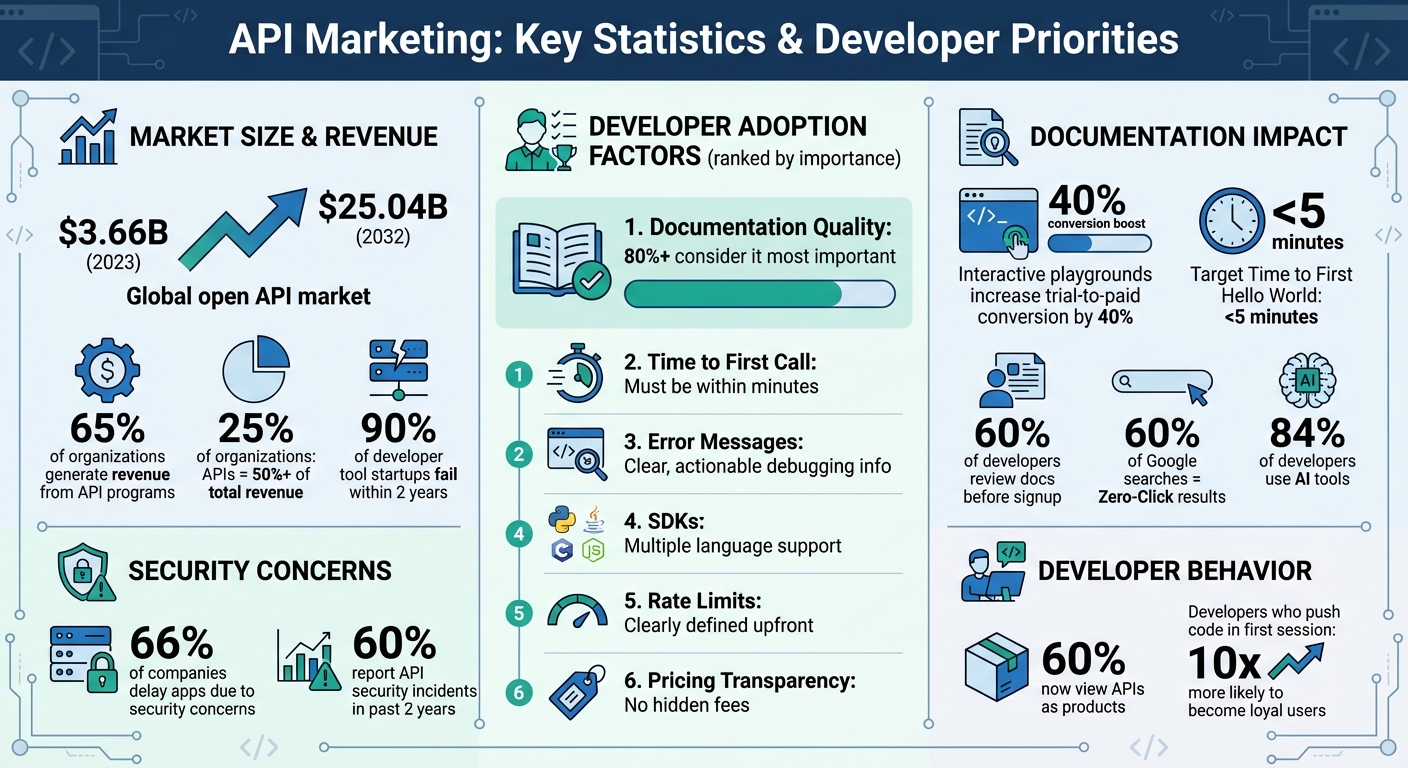 {API Marketing Key Statistics: Developer Adoption Factors and Market Growth}
Treating Your API as a Product
Think of your API as more than just a technical tool - it’s a product, and developers are your customers. They evaluate it with the same scrutiny they would any essential software. The numbers back this up: 65% of organizations generate revenue from their API programs , and for nearly 25% of those, APIs account for more than half of their total revenue .
To succeed, your API needs to deliver a seamless, high-quality experience from the get-go. Derric Gilling, VP & GM of API Platform at WSO2, sums it up well:
"Getting developers to adopt your APIs is hard… They're very opinionated, they have different frameworks they believe in, they don't always like to talk to sales and marketing" .
So, how do you meet these high expectations? It starts with focusing on six key aspects of your API’s design.
Developer Experience as a Competitive Advantage
When developers evaluate an API, they focus on six main factors: documentation quality, getting started speed, error messages, SDKs, rate limits, and pricing transparency. Among these, over 80% of developers say clear documentation is the most important factor when deciding whether to adopt an API . But great documentation is just the beginning - developers also expect to make their first successful API call within minutes, not hours.
Technical details are equally critical. Error messages should provide enough context to help developers debug independently, using standard HTTP status codes and unique identifiers for easier tracking . Rate limits need to be clearly defined upfront, and pricing should be straightforward - no hidden fees or unexpected charges post-integration. Security is another non-negotiable. With 66% of companies delaying new applications due to API security concerns and 60% reporting API-related security incidents in the past two years , developers demand robust measures like OAuth 2.0, secure API key management, and data encryption to protect their applications and users.
Examples: Stripe, Twilio, and Plaid
Some companies have set the gold standard for developer experience, proving that getting these details right can give you a serious edge.
Stripe has built its success on developer-first principles. Their documentation is a standout, offering request/response examples for every endpoint, detailed error handling guides, and a test mode where developers can experiment without affecting production data. The result? Developers can process their first test payment in under 10 minutes.
Twilio takes a similar approach. They provide SDKs in multiple programming languages and a sandbox environment for testing SMS and voice functionality with test credentials. They even sweeten the deal with free credits during the evaluation phase, letting developers see the value before committing to a paid plan .
Plaid excels in simplifying financial data integration. Their API features consistent endpoint naming, logical routing, and detailed guides for securely handling sensitive financial data. What could otherwise be a complex, multi-day process is streamlined into something developers can prototype in just a few hours.
These examples show that investing in developer experience isn’t just about meeting expectations - it’s about creating a product that developers genuinely want to use.
Documentation as a Marketing Channel
Your documentation isn't just a resource - it's a powerful marketing tool. Around 60% of developers review documentation before signing up for a product . If that documentation feels disorganized or unclear, they often assume your code will be the same. This perception matters even more now, as 60% of Google searches result in "Zero-Clicks" , where AI pulls code snippets directly from documentation. That means your docs need to work for both human readers and the AI tools developers increasingly depend on.
High-quality documentation and interactive tools, like playgrounds, can increase trial-to-paid conversion rates by as much as 40% . On the flip side, unclear or incomplete docs can push developers away. Focus on reducing the "Time to First Hello World" (TTFHW) to less than five minutes - this makes a strong first impression and keeps developers engaged. From there, structuring your documentation to meet a variety of developer needs is key.
What to Include in Your Documentation
Great documentation is designed to meet different developer goals. The Diátaxis Framework organizes this into four categories:
- Tutorials: Help developers learn step-by-step.
- How-To Guides: Provide instructions for specific tasks.
- Reference: Offer detailed technical information.
- Explanations: Clarify the "why" behind your product .
Your quick start guide should get developers to their first API call in minutes, not hours. Include ready-to-use code snippets with all necessary headers and authentication details. For API references, show clear request and response examples for every endpoint, use standard HTTP status codes, and provide detailed error messages. Offer SDKs in multiple languages - like Node.js, Python, and Go - that feel natural to use, not like generic wrappers.
Make sure your code examples go beyond basic "hello world" implementations. Show practical use cases that developers might encounter in real projects. Add error code documentation with troubleshooting advice, webhook guides for event-driven setups, and a changelog that tracks updates and breaking changes. For logged-in users, automatically insert their API key into examples to save time and reduce friction. A well-thought-out documentation strategy doesn't just support developers - it strengthens your product's appeal.
Also, optimize your docs for AI tools. With 84% of developers using AI tools (despite 50% questioning their accuracy) , clear heading structures and an llms.txt file can make your documentation easier for AI to process. Strong documentation enhances your API's identity by streamlining onboarding and creating a seamless Developer Experience.
Examples: Stripe, Algolia, and Cloudflare
Some companies set the gold standard for developer documentation.
Stripe approaches documentation as a product in itself. They offer interactive code examples that update in real time based on the programming language you select. Logged-in users see their test API keys included automatically, making the snippets instantly usable. Stripe also provides solution-focused "Hub" guides, like "Building a Secure Checkout", which explain business logic and link to detailed reference pages for individual endpoints .
Algolia makes onboarding frictionless with embedded playgrounds that let developers test search functionality directly in the browser - no local setup required. This feature alone can speed up onboarding by 30% to 50% . Their docs also include performance benchmarks and real-world examples showing how companies use their search API at scale.
Cloudflare organizes its documentation to cater to both beginners and advanced users. They balance comprehensive API references with architectural insights that explain why certain methods work better. Their changelog stands out for its level of detail, showing not only what changed but also the reasoning behind breaking changes and providing clear migration paths for existing users.
How to Get Your API Discovered
If developers can’t find your API, they won’t use it. Unlike traditional SaaS marketing, reaching developers requires a different approach . Developers tend to look for solutions on platforms like Google, GitHub, and Stack Overflow. That means your discovery strategy needs to align with where they already spend their time.
Here’s some good news: 60% of developers now see APIs as products . This growing awareness makes it even more important to have a strong discovery plan. The goal is to meet developers where they’re already searching and make sure your API stands out in the right places.
API Directories and Integration Marketplaces
One of the best ways to get your API noticed is by listing it on directories like RapidAPI, APIlayer, and APIs.guru. These platforms are go-to resources for developers looking for specific solutions . By listing your API here, you’re putting it in front of an audience that already knows what they need and is ready to explore their options. Another great resource is the Public APIs GitHub repository, a high-traffic hub where developers frequently browse for APIs.
Integration marketplaces like Zapier and Make are another excellent option. These platforms cater not only to developers but also to non-technical users who want to connect tools without writing code. This exposure can be a big deal, especially since APIs now account for over 25% of total revenue for 43% of organizations .
To make the most of these listings, create an OpenAPI specification. This step makes it easier to generate documentation and SDKs automatically, simplifying the process of joining directories and marketplaces. Also, keep your profiles updated - an incomplete or outdated listing might drive developers to competitors.
Developer-Focused Channels and SEO
Directories and marketplaces are just the beginning. Optimizing your presence on developer-specific platforms and search engines can take your API’s discoverability even further. Developers often search using precise terms like "payment gateway API" or "real-time search API" , so tailoring your content to these high-intent keywords is key. By optimizing your developer portal and documentation for these phrases, you can attract developers who are already in decision-making mode.
However, there’s a catch: about 60% of Google searches now end in "Zero-Click" results . This means developers might find the answers they need directly on the search results page, thanks to AI-generated summaries. To stay ahead, structure your content with clear headings and include code snippets. This makes it easier for AI tools to pull out the most important information about your API.
Engaging directly with developers on platforms like Hacker News, Reddit (especially r/programming), and Stack Overflow can also boost organic discovery . Tools like F5Bot or Syften can help you monitor relevant keywords, allowing you to jump into conversations where developers are actively seeking solutions. Don’t forget to optimize your GitHub repository, too - refining its name, "About" section, and topics can make it more visible in GitHub searches .
Finally, conferences and developer events still hold value. These in-person opportunities allow you to showcase live demos or host workshops, creating direct engagement with your target audience.
Reaching Developers with daily.dev Ads
While organic channels are powerful, targeted advertising can give your API an extra boost. Platforms like daily.dev Ads are designed specifically for developers, reaching an audience of over 1 million . This is especially useful in a world where "Zero-Click" results make traditional search less effective.
What sets daily.dev Ads apart is its ability to target developers based on their tech stack, programming language, or preferred tools. By placing native ads directly in a developer’s daily content feed, the platform allows your API to blend seamlessly into their workflow. This approach builds trust and awareness without feeling intrusive - a major plus for technical audiences who tend to prefer organic discovery over overt advertising.
Additionally, daily.dev Ads provides real-time tracking and creative support to help you fine-tune your campaigns. With options to target by seniority, programming language, and tools, you can ensure your marketing budget reaches the developers most likely to integrate your API.
Designing Your Free Tier
A free tier is often the first interaction developers have with your API, and it’s your chance to make a strong impression. The goal? Offer enough value for developers to create a proof-of-concept without needing a credit card or a sales call . When done effectively, a free tier reduces barriers and builds trust, turning curious developers into engaged users.
The challenge lies in striking a balance between being generous and staying sustainable. A good free tier should allow developers to test your API in practical scenarios - not just in a limited, demo-like environment. By providing clear usage limits, you can help developers experience your API’s potential while guiding them toward upgrading when they’re ready to scale.
Free Tier Best Practices
Start by removing credit card requirements . For many developers, this is a major trust hurdle. Instead, aim for a fully self-serve onboarding process that enables developers to achieve a "Time to First Hello World" in just a few minutes .
Another effective strategy is delayed registration. Let developers explore your API using a playground or a temporary sandbox key before requiring them to sign up . This approach gives them a chance to build and test first, with the option to register later to save their work. In fact, interactive playgrounds have been shown to boost trial-to-paid conversion rates by as much as 40% .
Be transparent about usage limits and make upgrading to paid plans easy. Usage-based pricing - such as "$X per 1,000 requests" - helps developers estimate costs as they grow . Avoid hiding pricing behind a "Contact Sales" button, as many developers see this as a sign of high costs. Lastly, ensure your sandbox environment mirrors the production experience. If the test environment doesn’t behave the same as the paid version, you risk losing developer trust before they even consider upgrading .
Examples: Stripe, Algolia, and OpenAI
Some companies have set the standard for well-designed free tiers, showcasing how to treat APIs as developer-focused products.
Stripe allows unlimited access to its test mode, enabling developers to simulate payments, refunds, and webhooks without any financial commitment. This frictionless approach simplifies integration and has become a gold standard for API onboarding.
Algolia offers 10,000 free search operations per month, enough for developers to build and test real-world applications. This generous allowance helps demonstrate value while naturally encouraging upgrades as usage increases.
OpenAI uses a credit-based model, giving new users free credits (typically between $5 and $18) . This allows developers to experiment extensively with the API without providing a credit card. Once the free credits are used up, the transition to usage-based pricing feels seamless.
These examples highlight how free tiers can deliver real value while maintaining a clear, frictionless path to paid plans. By removing obstacles and building trust, you encourage developers to dive deeper into your API and explore its full potential.
Marketing with Use Cases and Tutorials
Developers aren't just looking for technical endpoints - they want to see how those endpoints solve real problems. Use case content bridges this gap by showcasing practical applications of your API. By demonstrating how your API addresses specific challenges, you can speed up the time-to-first-call and help developers picture how they can put it to work right away.
The best content takes a solution-first approach. Instead of listing features, focus on creating tutorials like "Build X with Y" that guide developers through complete implementations. For example, instead of simply documenting a /charge endpoint for a payment API, publish a tutorial like "Building a Secure Checkout in Python." This kind of guide explains the business logic and links to detailed reference pages for technical specs . It aligns with how developers search - they’re looking for answers to specific problems, not just feature rundowns.
"Short 'How-to' guides focused on specific problems are key. You want to help people get to why they came here in the first place." – Jakub Czakon, CMO and Dev Marketing Advisor
Creating Use Case Content
Structure your content to meet a variety of developer needs. Frameworks like Diátaxis can help you organize tutorials, how-to guides, references, and explanations . For instance, you might create one tutorial to explain authentication basics and a separate how-to guide for implementing OAuth in a specific programming framework.
Don’t overlook video content. Long-form tutorials on YouTube can be repurposed into shorter clips for social media, blog posts, or even snippets in your documentation . Embedding interactive playgrounds where developers can test your API instantly is another great tool - these can reduce onboarding time by 30–50% .
For use case tutorials, consider personalizing the experience for logged-in users. Pre-fill code snippets with their actual API keys to save them the hassle of manual copying and placeholder replacements . Also, use action-oriented words in your tutorial titles - terms like "Quickstart", "SDK", "Example Code", and "Webhooks" signal immediate value to developers scanning search results .
Once your use case content is ready, the next challenge is getting it in front of developers where they’re already searching for solutions.
Where to Distribute Developer Content
Having great content is only half the battle - developers need to be able to find it. Start by focusing on platforms where developers actively search for solutions. GitHub is a must: optimize your sample repositories with relevant tags and topics so they rank when developers search for "X sample code" . Go beyond SDKs by offering complete example projects for core use cases that developers can clone and run immediately.
Share tutorials on platforms like Dev.to, where technical content thrives, and make use of YouTube for video guides - many developers prefer watching implementations over reading about them. Tools like F5Bot or Syften can help you monitor discussions on Reddit and Hacker News about problems your API solves. Jump into these conversations with helpful solutions and link to your relevant tutorials .
For even more targeted outreach, consider platforms like daily.dev Ads. With access to over 1 million developers, you can fine-tune your targeting based on tech stack, seniority, and programming languages. This ensures your content reaches developers who are already working with tools your API integrates with. Combining this approach with organic strategies ensures your tutorials are both relevant and visible to developers actively working on similar projects.
sbb-itb-e54ba74
When and How to Use Paid Advertising
Paid advertising is a powerful way to boost developer engagement, but it’s not where you start your API marketing journey - it’s a scaling tool. Before diving into ads, ensure your API has achieved product-market fit. If developers can’t get your API running within five minutes, you likely have an onboarding issue, and no ad budget will fix that . Your documentation should be clear, SDKs polished, and the signup process as smooth as possible before you even think about paid campaigns .
The ideal time to launch paid ads is during your expansion phase, once you’ve built a solid user base and organic growth begins to level off . At this stage, focus on demand capture - placing ads where developers are actively searching for solutions. Google Search ads are particularly effective for high-intent queries like "SMS API" or "how to integrate payment gateway in Python" . Retargeting is another smart move, helping you re-engage developers who visited your documentation but didn’t sign up .
One critical mistake? Treating API marketing like traditional SaaS marketing. Nearly 90% of developer tool startups fail within two years, often because they rely on conventional sales tactics . Developers aren’t swayed by flashy pitches; they want immediate, hands-on experiences. Your ads should link directly to quickstart guides, interactive playgrounds, or sample code so developers can dive in and test your API right away. Offering trial-based, self-serve access builds trust and encourages adoption.
Metrics That Matter for Paid Campaigns
Once your campaigns are live, tracking the right metrics is key to refining and improving their performance. Start with top-of-funnel metrics like cost per click (CPC) and click-through rate (CTR) to measure initial interest. However, don’t stop there - focus on deeper metrics that reveal actual engagement, such as signups, first API calls, and activated users (developers who perform meaningful actions, not just create accounts) .
Other important metrics include the free-to-paid conversion rate, API call volume, and long-term indicators like annual recurring revenue (ARR) and retention rates. Keep an eye on Cost Per New User (CPNU) to ensure you’re not spending money reacquiring existing users . Also, monitor your churn rate - if paid users leave quickly, it’s a sign your targeting needs adjustment . For platforms like Google and Meta, set conversion events based on a developer’s first API call rather than just a signup. This helps optimize for users who are more likely to stick around .
"At a smaller scale, cost per trial (CPT) is one of the most important metrics... As you scale, you should start obsessing less about CPMs or CTRs and more on downstream unit economics" .
– Hannah Parvaz, Founder of Aperture
Budget Guidelines for Testing and Scaling
When it comes to budget, start small and scale strategically. Begin with a $10,000 testing budget to gather data and identify which channels and audiences deliver results. Once you have proven success, increase your budget to $50,000 . For meaningful insights, most B2B SaaS companies spend $5,000 to $15,000 monthly on paid campaigns .
Use the 70-20-10 rule for budget allocation: dedicate 70% of your spend to proven channels, 20% to testing new audiences or platforms, and 10% to experimental campaigns . For API-focused marketing, Google Search ads are ideal for reaching developers with high intent, while platforms like daily.dev Ads allow for tech stack targeting, reaching over a million developers based on their tools, programming languages, and seniority. This level of targeting ensures your ads reach developers who are already working with technologies compatible with your API, reducing wasted spend.
As a general guideline, successful SaaS companies allocate 10-20% of their total revenue to sales and marketing . Adjust your spending seasonally, increasing budgets in September–October and January–February while using December for brand-building efforts. Scaling effectively requires balancing Lifetime Value (LTV) with Customer Acquisition Cost (CAC). Expect CAC to rise over time as you exhaust the easiest-to-reach audiences, and focus on boosting LTV through better onboarding and retention strategies .
Building a Developer Community
Creating a strong developer community isn't just about support - it’s a driving force for growth. When developers trust your API, they naturally become advocates, sharing their positive experiences within their networks. The goal is to move away from one-way marketing and instead focus on fostering intentional spaces where developers collaborate and solve problems together.
The secret lies in prioritizing education over promotion. Developers are often skeptical of flashy marketing but appreciate genuine efforts to provide meaningful resources. By offering in-depth tutorials, integration guides, and demo applications, you can position your documentation and community resources as tools that solve real technical challenges. This approach not only helps developers succeed but also inspires them to recommend your API.
"The best developer marketing doesn't feel like marketing. It feels like a company staffed by people who genuinely care about developers succeeding."
– Prashant Sridharan, Developer Marketing Expert
In today’s world of AI-generated content, authenticity matters more than ever. Developers value transparency - be open about your API's limitations, share the reasoning behind your decisions, and actively participate in community discussions. This transparency builds trust, which is often the deciding factor for developers. When paired with robust documentation, a well-nurtured community can significantly accelerate the adoption of your API.
Community Engagement Tactics
Start by equipping developers with the tools they need to succeed. This means offering SDKs in popular programming languages, providing ready-to-use code examples, and crafting clear, actionable integration guides. Beyond documentation, create spaces for real-time interaction, like Discord or Slack channels, where developers can troubleshoot issues, share feedback, and connect with your team.
Consider running contributor programs to recognize and reward community leaders who actively help others. These leaders might answer questions, build tutorials, or create integrations, lightening the workload for your internal team while strengthening the ecosystem. Hosting regular office hours where developers can interact directly with your engineers and sharing case studies that showcase successful API implementations can also deepen engagement.
Another effective strategy is to consolidate smaller product updates into a "Launch Week" event, following the model used by Supabase. This creates a buzz, allowing developers to explore new features together and sparking meaningful discussions. Additionally, participating in public forums like Stack Overflow can reinforce your API's credibility by providing helpful answers to technical questions.
Supporting Developers on Stack Overflow
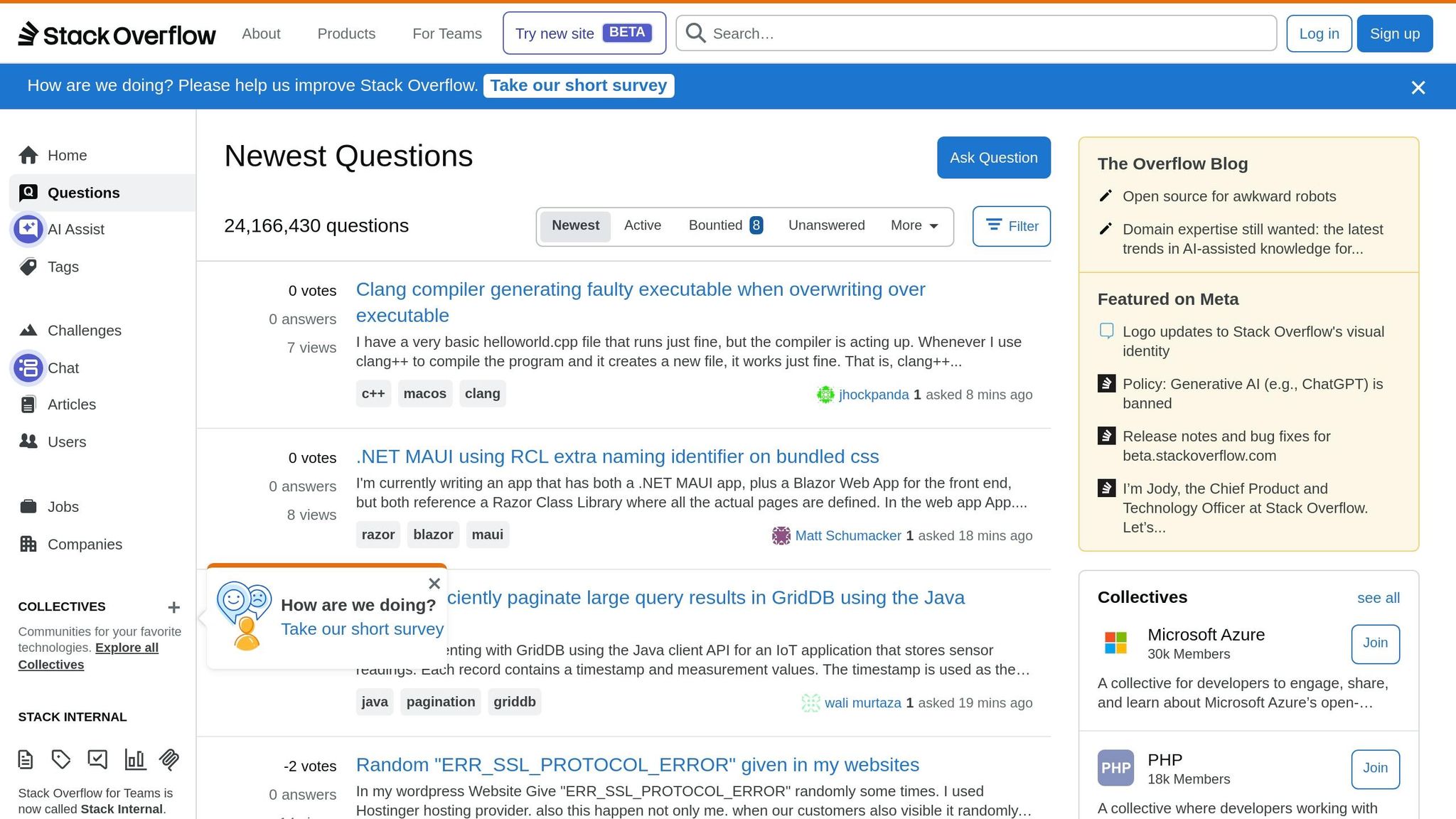
Public Q&A platforms like Stack Overflow play a key role in building trust and visibility. When developers face technical challenges, they often turn to these platforms for solutions. By providing detailed, accurate responses, you show a commitment to problem-solving, which enhances your API’s reputation.
As AI coding tools like Copilot and Cursor gain popularity, having a strong presence on Stack Overflow becomes even more critical. If your community knowledge isn’t well-documented in public forums, automated tools might overlook your API when suggesting solutions.
Stay active on Stack Overflow by monitoring questions related to your API and responding with thorough, code-rich answers. This not only helps developers directly but also ensures your API remains visible and reliable in public discussions. Additionally, use tools like F5Bot or Syften to track relevant conversations on platforms like Reddit and Hacker News, so you can provide timely insights wherever developers are seeking help.
Tracking API Adoption Metrics
Measuring the right metrics is crucial to understanding how developers engage with your API and identifying where your marketing efforts are effective. The tricky part? Distinguishing metrics that drive revenue and retention from those that are just for show. One key metric to track is Time to First Hello World (TTFHW) - the time it takes a developer to go from signing up to making their first successful API call. Ideally, this should be under five minutes (300 seconds). If developers struggle to get their first call working quickly, they’re likely to leave your platform before you can convert them into long-term users.
Another important metric to focus on is Weekly Active Tokens (WAT), which provides a clearer picture of actual API usage compared to simple login counts . As Winsome Marketing puts it:
"Revenue metrics tell you what happened. Developer experience metrics tell you what's going to happen" .
Key Metrics to Monitor
In addition to TTFHW and WAT, a range of other indicators can give you a better understanding of API adoption. These include signups, activated users, API calls per user, error rates, conversions, and retention cohorts. Each of these metrics offers insight into developer engagement and the effectiveness of your onboarding process.
Another metric worth tracking is Net Promoter Score (NPS) - developers who recommend your API are likely to become some of your strongest advocates. With 84% of developers now leveraging AI tools , it’s also worth monitoring emerging metrics like AI referral traffic and "share of answer" in AI coding assistants. Interestingly, developers who push code during their first session are 10x more likely to become loyal users and 3x more likely to recommend your API .
For community engagement, keep an eye on daily active members, messages per day, and response times in platforms like Discord or Slack . These metrics shed light on the health of your developer community.
Using Data to Improve Performance
Once you’ve gathered these metrics, the next step is turning them into actionable insights. Regularly analyze the entire developer journey - from landing on your homepage to making their first API call - to uncover potential user experience issues . For example, if your analytics show high impressions but low click-through rates on documentation pages, it might be a sign that developers prefer tutorials over traditional API references. Adjust your content strategy to better meet their needs.
Metrics can also highlight areas for technical improvement. If error rates spike on specific endpoints, revisit the related documentation or API functionality. If TTFHW is taking too long, consider offering a temporary sandbox environment with deferred registration. This lets developers experiment with your API before committing, which can boost trial-to-paid conversion rates by 40% and reduce onboarding time by 30–50% . Stripe implemented a similar strategy by adding a "Create account" button directly within their technical documentation, capturing high-intent developers early and improving conversions .
Conclusion
Marketing an API is a whole different ballgame compared to traditional SaaS. With the global open API market valued at $3.66 billion in 2023 and expected to soar to $25.04 billion by 2032 , the stakes are high. Yet, nearly 90% of developer tool startups fail within two years - often because they rely on conventional marketing tactics instead of strategies tailored for developers .
Success starts with treating your API as a product in its own right, complete with its own lifecycle. This means focusing on developer experience at every step - from clear, well-organized documentation to minimizing the time it takes for a developer to make their first API call. Adam DuVander, Founder of EveryDeveloper, captures this perfectly:
"Your API marketing should focus not on your product, but on the business and technical problems your product solves" .
Think of your documentation as your sales pitch, your free tier as a trust-building tool, and your use case content as proof of your API’s real-world impact. Visibility comes from being active in developer communities and leveraging targeted platforms like daily.dev Ads, which connect with over 1.6 million developers.
The most successful developer platforms prioritize education over traditional promotion. Tutorials that solve real technical problems, transparent pricing models, and seamless onboarding experiences are key. When developers can integrate your API in under five minutes, they naturally become your biggest advocates, sparking the kind of word-of-mouth growth that no ad campaign can match.
Finally, focus on metrics that matter - activation events, weekly active tokens, and conversion rates. Use that data to fine-tune your strategy. With 60% of developers viewing APIs as products , the platforms that stand out are those that respect developers' time, provide excellent resources, and let the value of their API shine through hands-on experience rather than hard selling.
FAQs
How do I reduce Time to First Hello World?
To speed up Time to First Hello World, it's all about cutting down onboarding hurdles and making the process as seamless as possible for developers. Start by offering clear, pre-configured tools like Postman Collections. Pair these with well-organized resources such as documentation, quick start guides, SDKs, and ready-to-use code snippets. These elements simplify the setup, reduce confusion, and help developers make their first API call quickly and effortlessly. The goal? A smoother, faster, and frustration-free onboarding experience.
What should my API free tier include?
When designing a free tier for your API, the goal should be to strike a balance between accessibility and control. Developers need enough resources to actually test and evaluate your service without feeling restricted, but you also need to guard against misuse.
A well-thought-out free tier might include features like:
- Limited API calls or usage quotas: Provide enough capacity for meaningful testing without overwhelming your system.
- Easy sign-up process: Skip unnecessary hurdles like requiring a credit card upfront. This lowers the barrier for developers to get started.
- Clear usage limits: Be upfront about how much usage is allowed and what happens when limits are reached.
- Simple upgrade paths: Make it easy for developers to move to a paid plan once they outgrow the free tier.
By being transparent and offering a fair free tier, you create an environment that builds trust and encourages developers to adopt your service. It's about showing confidence in your product while ensuring the experience is smooth and frustration-free.
Which metrics prove API marketing is working?
Tracking the right metrics is essential to gauge the success of API marketing efforts. Some key indicators include:
- Monthly Recurring Revenue (MRR): This shows the predictable revenue generated each month, offering a clear view of financial performance.
- Average Revenue Per User (ARPU): By calculating the revenue earned per user, you can assess the profitability of your customer base.
- Customer Lifetime Value (CLV): This metric estimates the total revenue a customer will bring during their relationship with your service.
- API Usage Volume: Monitoring the overall volume of API usage helps you understand how actively your API is being utilized.
- Signups and Active Users: These metrics reveal how many users are adopting your API and how many continue to engage with it.
- API Calls Per User: This provides insight into how frequently users are interacting with your API.
- Retention Rates: High retention rates indicate satisfied users who find ongoing value in your API.
By keeping an eye on these metrics, you can measure adoption rates, user engagement, and the broader impact on your business.