
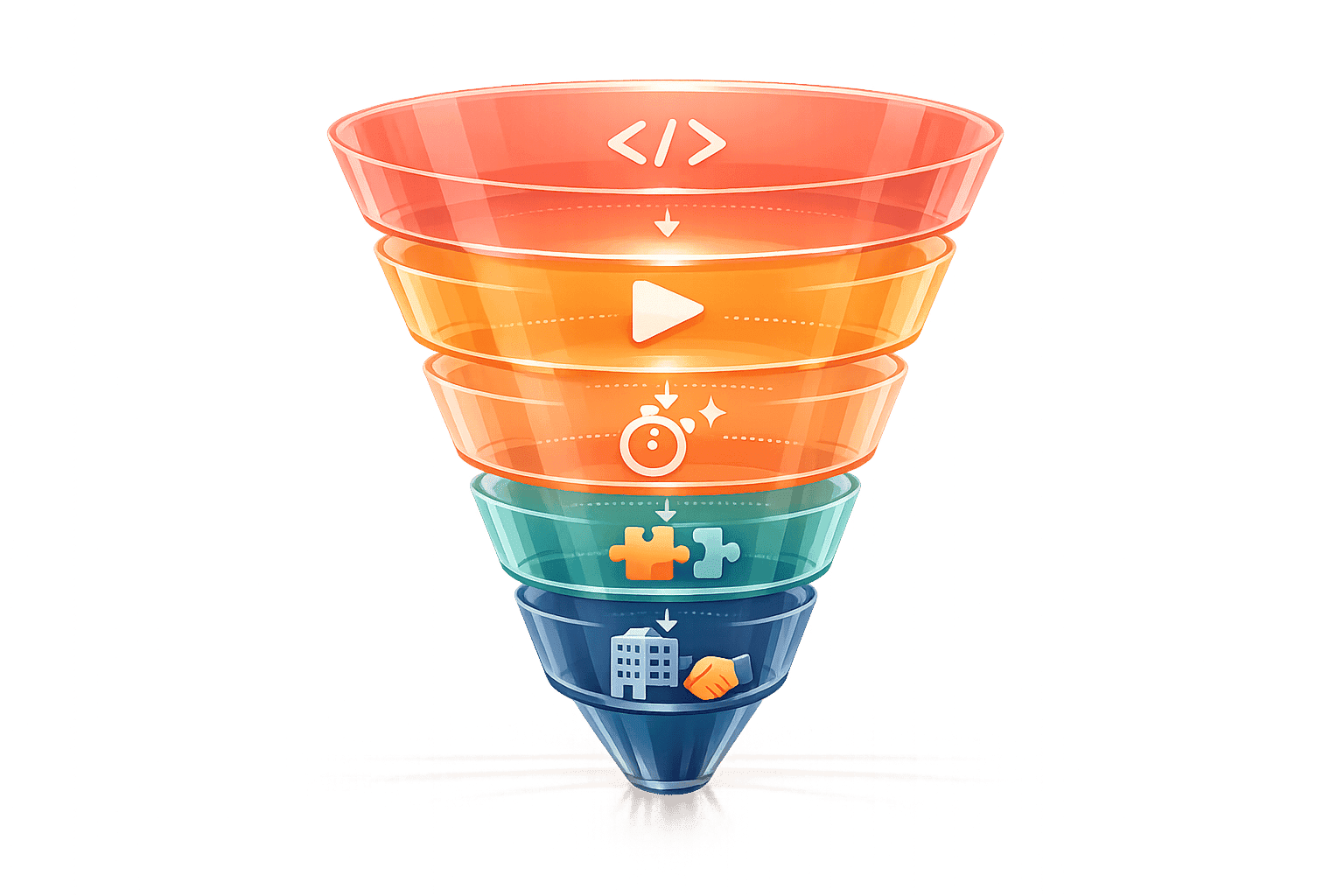
Selling to developers is nothing like selling to executives. Developer marketing (B2D) focuses on bottom-up adoption, where engineers validate tools through hands-on use before advocating for enterprise deals. Unlike traditional B2B funnels, which prioritize ROI pitches to decision-makers, B2D funnels rely on technical proof, self-service tools, and peer validation.
Key Takeaways:
- Developers prioritize utility. They care about solving technical problems, not flashy sales pitches or gated content.
- Non-linear journey. The funnel includes discovery, exploration, adoption, expansion, and procurement, with developers driving each phase.
- Friction kills interest. Gated docs, required demos, or marketing jargon alienate developers.
- Measure actions, not leads. Metrics like "Time to First Success" (TTFS) or API key activations reflect real engagement.
The secret? Offer open access to resources, simplify onboarding, and equip developers with tools to advocate internally. This builds trust and drives adoption, ensuring your product becomes a go-to solution for teams.
Why Standard B2B Funnels Don't Work for Developer Products
Here's the key issue: developers don't make purchases the way executives do. In a typical B2B sales process, you pitch the ROI to a VP or executive, who then enforces the adoption of the tool across their team. With developers, the process works in reverse. They start by using tools to tackle specific technical challenges, and only later might they advocate for an enterprise-level deal .
This reversal creates a trust gap that standard marketing methods often can't cross. Developers aren't swayed by analyst reports or flashy sales decks. Instead, they look for technical proof - things like working code examples, open API documentation, and validation from peers on platforms like Stack Overflow or GitHub.
What's more, the tactics that work in traditional B2B sales can actually alienate developers. For instance, requiring an email signup to access documentation or gating API keys behind a demo request is a quick way to lose their interest . Developers operate with what Pathak calls "radical practicality." Their focus is solving immediate pain points - like shaving four hours off debugging time - not aligning with overarching company revenue goals .
The table below highlights how the developer-focused funnel (sometimes called B2D, or Business-to-Developer) differs from the traditional B2B approach:
| Feature | Traditional B2B Funnel | Developer (B2D) Funnel |
|---|---|---|
| Target Audience | Executives/Decision Makers | Practitioners/Engineers |
| Primary Value | ROI and Vision | Utility and Pain Relief |
| Adoption Path | Top-Down (Mandated) | Bottom-Up (Organic) |
| Trust Source | Sales Reps & Analyst Reports | Code, Docs, and Peers |
| Sales Approach | Sales-led (Demos/Calls) | Self-service (Docs/Trials) |
Even the language used in traditional funnels often misses the mark with developers. They value technical clarity over marketing buzzwords. This is why understanding these differences is crucial - it lays the groundwork for the five key stages of the developer marketing funnel.
The 5 Stages of the Developer Marketing Funnel
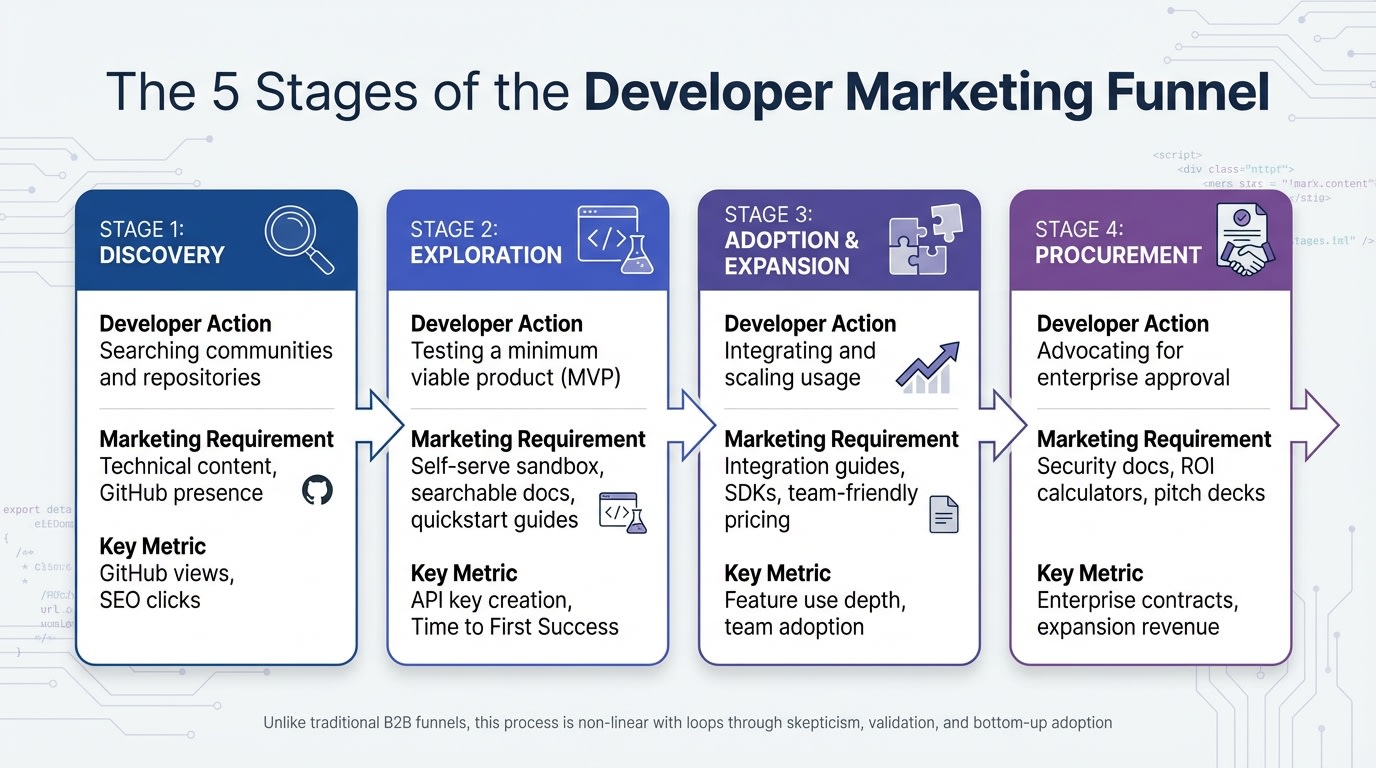
The developer marketing funnel unfolds in five distinct stages, each requiring specific strategies and metrics. Unlike a traditional B2B funnel, which moves in a straight line from awareness to purchase, this funnel loops through skepticism, validation, and bottom-up adoption . By understanding these stages, marketing teams can create the right tools and environments to guide developers effectively.
The process starts with Discovery, where developers encounter your product while tackling technical challenges. They’re not reading whitepapers or joining webinars - they’re diving into GitHub, Stack Overflow, and online forums. Next comes Exploration, where they test your product hands-on in a self-serve setup, avoiding the need for a sales interaction. If the product delivers, they move into Adoption, integrating it into their workflows. As they see its value, they advocate for their teams to adopt it in the Expansion phase. Finally, the Procurement stage kicks in, with developers championing the tool internally to secure budget and approvals for an enterprise contract.
Here’s how each stage aligns with developer actions and product requirements:
| Funnel Stage | Developer Action | Marketing/Product Requirement | Key Metric |
|---|---|---|---|
| Discovery | Searching communities and repositories | Technical content, GitHub presence | GitHub views, SEO clicks |
| Exploration | Testing a minimum viable product (MVP) | Self-serve sandbox, searchable docs, quickstart guides | API key creation, Time to First Success |
| Adoption & Expansion | Integrating and scaling usage | Integration guides, SDKs, team-friendly pricing | Feature use depth, team adoption |
| Procurement | Advocating for enterprise approval | Security docs, ROI calculators, pitch decks | Enterprise contracts, expansion revenue |
Removing friction is critical at each stage. For example, gating API documentation during Exploration or requiring a demo call can drive developers away . Similarly, at the Procurement stage, where developers often struggle with internal advocacy, pre-built pitch decks and ROI tools can make a huge difference .
Stage 1: Discovery - How Developers Find Your Product
Developers find tools while solving problems, not while browsing casually. They turn to Stack Overflow, GitHub, and forums like Discord or Reddit. Your marketing needs to meet them in these spaces, offering real technical solutions rather than promotional fluff.
Focus on content that addresses specific technical challenges. Instead of generic advice like "10 Best Practices for API Development", try something like "How to Reduce Latency in REST API Calls by 40%." This kind of problem-solving content draws in developers already facing the issues your product addresses . As EveryDeveloper puts it, "Technical products need marketing, but the audience doesn't want it to feel like marketing" .
Visuals matter too. Replace generic stock photos with actual code snippets - a practice known as the "Show the Code" rule . Developers trust tangible examples and compatibility markers (e.g., supported languages and frameworks) over flashy marketing copy .
GitHub plays a dual role as both a discovery platform and a trust builder. Metrics like repository views, clone activity, and community engagement reveal interest and product viability. Make sure your repository includes a clear README, working examples, and direct links to documentation. Once developers find your product, a seamless transition to hands-on testing is essential.
Stage 2: Exploration - Enabling Hands-On Testing
After discovering your product, developers want to dive in and test it right away. This stage is all about letting them "learn by doing" in a frictionless, self-serve environment . Any barriers, like gated documentation, can lead to instant abandonment .
A key metric here is Time to First Success - how quickly a developer can achieve a basic, working outcome with your tool. Benchmarks vary by product type: 5–15 minutes for API integrations, 15–45 minutes for SDKs, and 45–90 minutes for infrastructure tools . Mohammed Tahir from Hackmamba describes a successful first setup as when a developer "installs the package, runs a basic example without modification, and sees a successful output" .
To reduce friction, offer pre-configured examples and templates that include essentials like API keys. Documentation should be searchable, ungated, and organized around common use cases. Interactive navigation with concise explanations can save time for busy developers .
Monitor activation signals like API key creation, quickstart completions, and "copy code" events to confirm that developers are moving from evaluation to implementation. Offering a free tier - such as no-cost usage for the first 10,000 requests - can also encourage experimentation without immediate budget concerns .
Stage 3: Adoption and Expansion - Converting Users into Team Champions
Adoption happens when developers start using your tool for real work - adding it to dependency files, integrating it into CI/CD pipelines, or deploying it in production . This signals that your product delivers real value. From there, successful individual use often leads to team-wide advocacy.
Scaling from individual use to team adoption requires support. Developers need detailed architecture diagrams, integration guides, and active community resources to help them expand usage . They’ll also evaluate whether your product can handle broader team needs.
Watch for signals like mentions in company Slack or Discord channels, references in internal READMEs, or boilerplate setups. These can indicate that your product is gaining traction within teams . Build trust by creating content that solves technical problems without heavy-handed product pitches .
Transparent, team-friendly pricing is crucial. Clear pricing tiers help developers and their teams understand costs early in the decision-making process . Highlighting SDKs for multiple languages and compatibility markers also reassures developers that your tool fits seamlessly into diverse environments.
Stage 4: Procurement - Closing Enterprise Deals
Once a tool gains traction within a team, the focus shifts to enterprise procurement. This stage begins when usage scales to a level that requires formal approval for budget or compliance. Developers, now acting as internal champions, often find this stage challenging since it involves navigating internal selling processes .
Your job is to equip these champions with everything they need to succeed. Provide "convince your boss" kits, including ROI calculators, build-versus-buy comparisons, and pre-made slide decks . Templates for emails or Slack messages can help developers initiate conversations with technical and financial decision-makers.
Enterprise readiness documentation should be easy to find. Highlight features like audit logs, SLAs, and role-based access control (RBAC) on your pricing page or in a dedicated section . Security and compliance documentation, such as SOC 2 and GDPR certifications, should also be readily available - no sales call required.
Track metrics like views of enterprise feature pages and usage of ROI calculators to ensure that internal champions are building a strong case. Offer responsive technical sales support while avoiding aggressive tactics. Keep in mind that the journey from adoption to an enterprise contract can take months, but the trust built through earlier stages lays the groundwork for success.
How to Measure Developer Funnel Performance
When measuring developer engagement, it's crucial to focus on activity signals rather than traditional lead-based metrics. Developers interact with your product in unique ways - they clone GitHub repositories, copy code snippets, and execute CLI commands. Your metrics should reflect these actions across every stage of the funnel.
Micro-conversions are key indicators of progress. These include actions like visiting documentation, signing up for an API, making the first API call, or engaging in daily active usage . For example, tracking when a developer copies a code sample from your docs is a strong signal of intent and active testing .
Time to First Success (TTFS) is another essential metric. It measures how quickly a developer achieves a working result using your quickstart guide . Benchmarks for TTFS vary depending on the type of tool:
- 5–15 minutes for authentication or API client libraries
- 15–45 minutes for frameworks or SDK integrations
- 45–90 minutes for infrastructure or deployment tools
At the adoption stage, metrics like dependency lockfile entries, recurring CI/CD executions, and mentions in internal communication tools (e.g., Slack or Discord) confirm that developers are integrating your product into their workflows . These behaviors indicate trust and commitment to using your product in production.
To overcome identity tracking challenges, consolidate interactions from personal and work emails in your data warehouse. This approach helps capture the full developer journey . These nuanced signals offer a fresh perspective on traditional performance metrics.
Developer Funnel Metrics vs. Traditional SaaS Metrics
Developer funnels differ significantly from traditional SaaS funnels, requiring a shift in how you define and measure success. Instead of tracking marketing qualified leads (MQLs), focus on developer-specific actions like documentation engagement or code copying. Instead of sales-led demos, watch for self-serve quickstart completions. And instead of signed contracts, look for production deployments and CI/CD integrations .
Here's a comparison of traditional SaaS metrics and their developer funnel counterparts:
| Metric Category | Traditional SaaS Metric | Developer Funnel Equivalent |
|---|---|---|
| Top of Funnel | MQLs (Marketing Qualified Leads) | Documentation engagement & "Code Copy" events |
| Middle of Funnel | Sales-led Demos | Self-serve "Working Samples" & Quickstart completion |
| Bottom of Funnel | Signed Contract | Production deployment & CI/CD integration |
| Velocity | Lead-to-Close Time | Time to First Success (TTFS) |
Additional metrics can provide deeper insights. For example, tracking documentation scroll depth and navigation patterns reveals how much information developers need before moving to evaluation . Monitoring views of "Convince your boss" content packs or ROI calculators can indicate when a developer is building an internal business case .
Modern platforms even leverage AI to analyze signals from GitHub activity, documentation interactions, and telemetry data. This helps predict buying stages and prioritize accounts more effectively .
7 Common Developer Funnel Leaks and How to Fix Them
Even the most carefully crafted developer funnels can lose prospects at predictable points. The trick is figuring out where developers are dropping off and addressing the issues causing them to leave. Fixing these leaks is essential to ensuring a smooth journey from Discovery to Procurement. Below, we’ll break down seven common leaks and how to resolve them.
Gated Documentation
Requiring developers to register or provide an email to access API documentation is a surefire way to lose them. Developers want to evaluate your tool without jumping through hoops. The solution? Make all technical documentation freely accessible. This builds trust and allows developers to explore without hesitation. Keep an eye on documentation drop-off rates to measure the impact of removing these barriers .
Forcing Sales Conversations
If getting an API key requires a "Contact Sales" interaction, you're adding unnecessary friction to a process that developers prefer to navigate independently. A better approach is offering a free tier - like the first 10,000 requests at no cost - so developers can test your product easily. You can also provide automated onboarding experiences or interactive tutorials as alternatives to live sales calls .
Marketing Jargon Over Technical Specs
Buzzwords and vague marketing language can drive developers away. They want specifics. Instead of fluff, focus on clear technical details like "low latency", "type-safe", or "Postgres-compatible." Follow the "Show Code" rule: make a code snippet the first thing they see. This ensures your communication aligns with their expectations and simplifies the onboarding process .
Poor Onboarding
A high Time to First Success (TTFS) often signals onboarding problems. Simplify this experience with guided quickstart tools, copy-to-clipboard functionality, and sandbox environments that let developers test quickly. Track how long it takes from API key creation to first success, and resolve any obstacles developers encounter during the Exploration phase .
Inadequate Documentation
Incomplete or unclear documentation can frustrate developers as much as buggy code. If developers aren’t moving beyond your landing page or using code samples, your documentation isn’t doing its job. Analyze internal search logs to identify gaps and ensure your documentation supports hands-on testing during the Exploration phase .
Trial-to-Paid Conversion Gaps
Even if developers like your tool during Adoption, they may struggle to prove its value to decision-makers. Help them make the case with resources like ROI calculators, case studies, and presentation templates. These tools empower developers to act as internal advocates and support a smooth transition to the Procurement stage. Beyond that, focus on ensuring your product integrates deeply into their workflows to solidify its role .
Shallow Integration
If developers are only using your tool for a single task and not incorporating it into their main workflows, it’s a sign your product is stuck in testing. Monitor usage across multiple modules or check for your tool in dependency files, lockfiles, or CI/CD pipelines. This deeper adoption signals progression into the Expansion phase .
"The critical mistake B2D companies make is introducing B2B friction into a B2D flow."
– Ninad Pathak, Freelance Technical Writer
Using daily.dev Ads in Your Developer Funnel
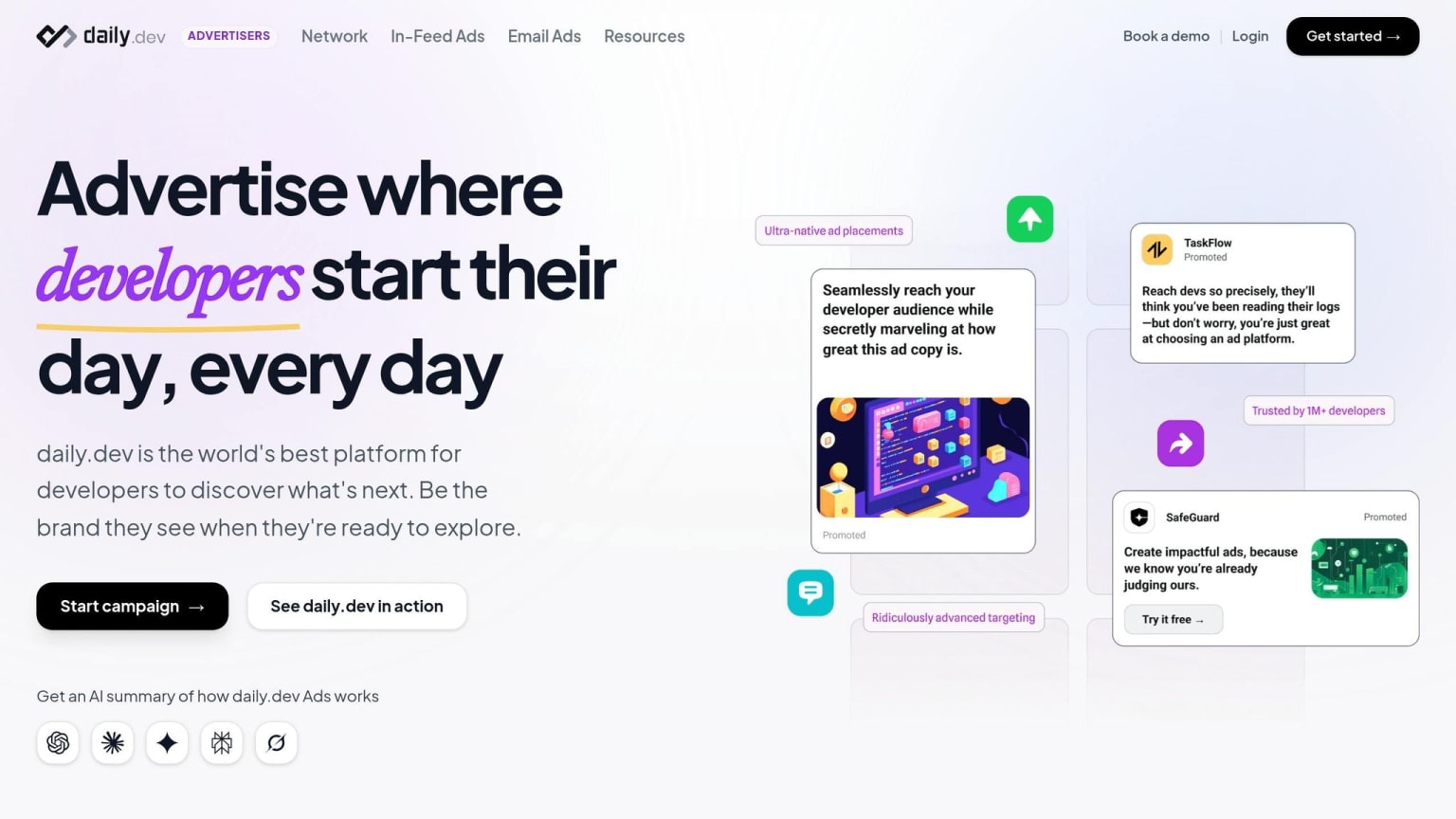
Targeted advertising can give a significant boost to the early and middle stages of your developer funnel. Reaching the right audience is key, and daily.dev Ads connects with over 1 million developers through native ad placements seamlessly integrated into their daily content streams. With targeting options based on seniority, programming languages, and tools, this platform is especially effective in building awareness and driving engagement.
Top-of-Funnel: Reaching Developers with daily.dev Ads
At the Discovery stage, your goal is to make your product stand out as developers search for solutions to technical challenges. daily.dev's in-feed and post page ads appear right within the trusted content streams developers rely on, introducing your product in a natural, non-disruptive way. By using technical language and including concise code examples, you can immediately establish credibility and demonstrate the value of your tool . This method not only grabs attention but also positions your product for further exploration.
Middle-of-Funnel: Driving Engagement with daily.dev Ads
Once developers are aware of your product, the focus shifts to engagement and activation. At this stage, it's all about helping developers achieve a quick, tangible result with your tool. daily.dev Ads can highlight resources like quickstart guides, integration tutorials, or starter repositories that reduce barriers during the evaluation phase. Instead of directing users to generic landing pages, link ads to specific "Getting Started" content or detailed documentation that enables developers to achieve success quickly. Features like copy-pasteable code samples or GitHub starter repos can make this process even smoother.
To measure engagement, track events such as copy_code_sample and api_key_created. The faster developers can go from curiosity to a working prototype - ideally within 5 to 45 minutes - the more likely they are to adopt your product fully .
Conclusion
This section highlights the importance of crafting a developer marketing funnel that aligns with how developers evaluate and adopt tools. Unlike traditional B2B funnels, which follow a predictable, linear path aimed at decision-makers, developer funnels are more dynamic. They revolve around cycles of skepticism, hands-on validation, and grassroots adoption, driven by the people who actually use the tools .
At its core, this shift boils down to technical utility versus ROI. While B2B marketing focuses on selling a vision of return on investment to executives, developer marketing prioritizes offering tangible, technical value to practitioners. Developers want tools they can test and trust before they champion them internally. This means the funnel must cater to their specific needs: offering self-serve resources, open access to documentation, and hands-on testing instead of traditional sales pitches or gated content.
Each stage of the funnel requires tailored tactics. During the Discovery phase, developers are drawn to code-first resources and active participation in technical communities. In the Exploration phase, they need seamless access to tools like sandboxes and quickstart guides that help them achieve success quickly - ideally within 5–45 minutes . At the Adoption stage, support their advocacy efforts by equipping them with materials like ROI calculators and presentation decks to help make the case internally.
Measuring success in developer funnels also requires a shift in focus. Instead of relying on vanity metrics like page views or lead counts, pay attention to technical engagement signals. Metrics such as API key activations, instances of copying code samples, and the time it takes for a user to achieve their first success provide far more meaningful insights into how well the funnel is performing.
"When a step slows down, we look at the material, the flow, or the environment around that moment. We adjust documentation, examples, messaging, or onboarding paths based on what the data shows" .
This approach underscores the need for constant refinement to ensure the funnel remains effective at every stage.
FAQs
How do I shorten Time to First Success (TTFS)?
To help developers achieve success quickly, it's all about delivering value right from the start. Offer resources that developers can dive into immediately - think clear documentation, sandbox environments, or free tiers that let them explore without barriers.
Make sure your efforts align with what developers are doing in real time, like using APIs or tackling specific problems. Focus on creating honest, technical content that builds trust. Avoid pushing sales too hard - let developers test things independently. The faster they find success, the more likely they are to stick with your product.
What signals show a developer is moving to team adoption?
Key indicators to watch for include developers spending more time with documentation, seamlessly incorporating the tool into their daily tasks, and enthusiastically promoting its use among their colleagues. These actions suggest the developer is evolving into a team advocate, helping to encourage wider adoption within their group.
What assets help developers win enterprise procurement?
Developers navigating enterprise procurement need a solid toolkit to address the unique challenges of this space. Some of the most effective resources include:
- Security reviews: Enterprises prioritize security. Providing thorough security assessments reassures decision-makers that your product meets their standards.
- Compliance documentation: Clear documentation demonstrating adherence to industry regulations is crucial for gaining trust and approval.
- ROI calculators: Enterprises want to see measurable value. ROI calculators help showcase the financial benefits of your solution.
- Champion enablement: Equipping internal advocates with the tools and information they need helps them champion your product within their organization.
These resources not only address enterprise concerns but also smooth out the procurement process and establish credibility with key stakeholders.