

Reaching developers with ads is tough - they’re skeptical and often ignore traditional marketing. Behavioral data changes the game by focusing on actions, like tools they use or articles they read, instead of generic labels like job titles. This approach helps advertisers target developers when they’re actively researching solutions, boosting relevance and conversions.
Here’s how it works:
- Track developer behavior: Monitor tool usage, content engagement, platform interactions, and community activity to understand their interests.
- Segment audiences: Group developers by intent - those exploring solutions, researching tools, or ready to buy.
- Personalize ads: Use insights to create technical, relevant ads that align with their needs.
- Leverage timing: Target developers during work hours when they’re more likely to engage.
- Optimize campaigns: Measure metrics like click-through rates, engagement, and ROI to refine strategies.
Platforms like daily.dev Ads simplify this process by offering native ad placements and real-time analytics for over 1 million developers. Behavioral targeting isn’t just effective - it’s essential for reaching developers with ads they find useful.
Understanding Behavioral Data for Developer Targeting
::: @figure 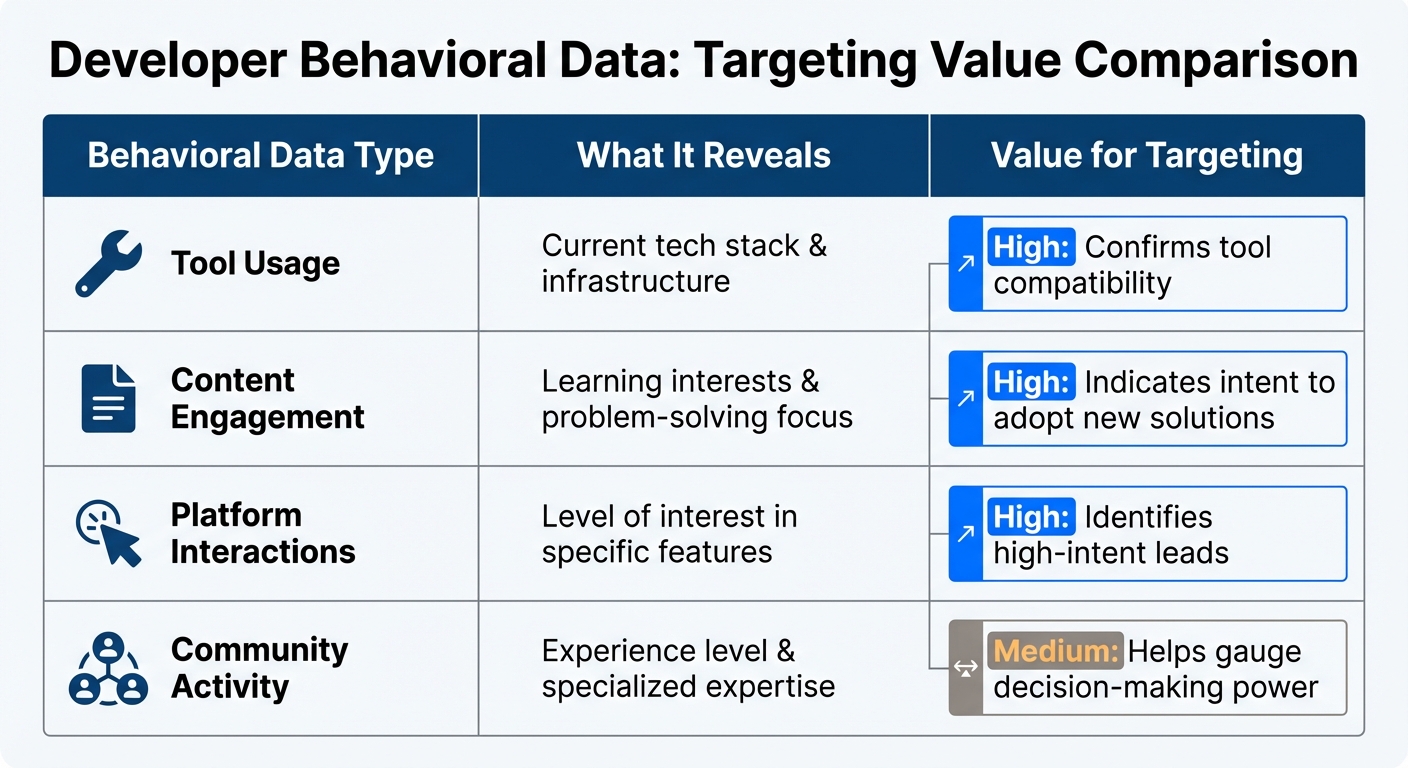 {Behavioral Data Types for Developer Ad Targeting: What They Reveal and Targeting Value}
Behavioral data focuses on tracking developers' actions rather than relying on traditional labels like job titles. It captures what tools developers use, the articles they read, the frameworks they search for, and how they interact with platforms. This approach stands apart from demographic targeting, which often makes assumptions based on factors like location, seniority, or job title. For instance, knowing someone is a "Senior Backend Engineer in New York" doesn't reveal if they're exploring Kubernetes solutions or researching the latest frameworks.
Developers with the same title often have very different priorities. One might be immersed in microservices, while another is fine-tuning database performance. Behavioral data bridges this gap by highlighting actual activities - like reading container orchestration documentation or downloading specific SDKs - offering a clearer picture of their needs and interests.
Behavioral targeting has been shown to boost conversions by over 10%. By engaging developers while they're actively researching solutions, advertisers can connect at the moments when developers are most open to exploring new tools or platforms.
Types of Developer Behavioral Data
Behavioral data provides a wealth of insights by tracking specific developer actions. These signals fall into key categories, each revealing a different layer of intent and interest:
Tool and technology usage: Monitoring interactions with programming languages, frameworks, and tools (such as Kubernetes, Docker, or database management systems) offers a snapshot of a developer's current tech stack and immediate project requirements.
Content engagement patterns: This goes beyond simple clicks. Developers who spend time reading detailed tutorials, engaging with code samples, or downloading resources show a deeper level of interest. For example, someone who thoroughly reads an article on API gateway patterns is more likely to be evaluating related solutions than someone who quickly leaves the page.
Platform interactions: Metrics like scroll depth or hover time on technical specifications can reveal both interest levels and technical expertise.
Community and repository activity: Open-source contributions, participation in industry events, and activity on platforms like GitHub provide insights into a developer's experience and expertise. Additionally, search and discovery habits - such as frequent research on container orchestration - can help predict future needs.
| Behavioral Data Type | What It Reveals | Value for Targeting |
|---|---|---|
| Tool Usage | Current tech stack & infrastructure | High: Confirms tool compatibility |
| Content Engagement | Learning interests & problem-solving focus | High: Indicates intent to adopt new solutions |
| Platform Interactions | Level of interest in specific features | High: Identifies high-intent leads |
| Community Activity | Experience level & specialized expertise | Medium: Helps gauge decision-making power |
Benefits of Behavioral Targeting for Developers
By leveraging these behavioral insights, advertisers can focus their efforts on developers who show genuine interest, reducing wasted ad spend. Instead of casting a wide net, they can target developers actively researching solutions, leading to higher click-through and conversion rates. According to Harvard Business Review, aligning ads with real-time intent significantly improves the effectiveness of digital ad campaigns.
The value lies in the precision of matching ads to intent. For example, a developer exploring Kubernetes orchestration will find an ad for a container management platform relevant and timely, rather than intrusive. Behavioral signals - like visits to pricing pages or clicks on emails - can dynamically update a developer's profile, allowing sales teams to engage at the right moment. Conversely, signs of low intent, such as reduced activity or visits to competitor sites, help prioritize leads effectively.
Timing also plays a critical role. Developers active during standard working hours (9:00 AM to 5:00 PM) are often more likely to be decision-makers compared to those browsing late at night. Platforms like daily.dev Ads use these insights to help advertisers connect with developers at the most impactful moments, boosting campaign relevance and overall success.
How to Collect and Analyze Developer Behavioral Data
Sources of Developer Behavioral Data
To understand developers' behavior, start by tracking their digital footprints. For instance, web traffic can reveal key intent signals - like when a developer moves from technical documentation to a pricing page, indicating heightened interest in a product or service . GitHub activity is another goldmine, showing which repositories developers star, fork, or contribute to. This provides a clear view of their tech stack and current interests.
Email campaigns offer direct engagement metrics, such as open rates and click-throughs, while software downloads and webinar attendance highlight active interest in specific tools or topics . Additionally, programming-related searches can shed light on what developers are researching in real time, whether it's Kubernetes orchestration or API gateway patterns. Platforms like daily.dev Ads make this process easier by tracking interactions with native ad placements, including in-feed and post-page ads, all within a developer-centric environment. This method collects data on interests, seniority levels, programming languages, and tools without relying on broad web scraping.
When gathering data, focus on three to five key signals . For targeting developers, prioritize actions like GitHub stars on specific repositories, downloads of development tools, and transitions from educational content to pricing pages. These signals often indicate a developer's readiness to evaluate or purchase a solution.
Once you've identified these critical signals, the next step is to analyze the data for actionable insights.
Analyzing Behavioral Patterns for Campaign Planning
The data you collect serves as the backbone for campaigns tailored to developers' intent. Real-time customer data platforms (CDPs) can help identify patterns across multiple touchpoints. For example, CDPs can notify your team when a developer shifts from consuming content to visiting pricing pages, signaling a higher level of interest .
AI-powered predictive scoring takes this a step further by analyzing historical data to identify behaviors that typically lead to conversions. Developers who attend webinars and download resources, for example, often display higher intent than those who engage with just one type of content . Timing also matters - quick, successive actions can signal urgency, while developers active during standard business hours are more likely decision-makers compared to those browsing late at night .
It's also essential to consider negative behaviors. If a previously engaged developer reduces activity or starts visiting competitor websites, this can signal a need to reallocate your efforts . By analyzing usage patterns, programming language preferences, and engagement depth, you can create campaigns that directly address developers' current needs. Research shows that 78% of marketers find behavioral targeting effective for customer engagement, often leading to conversion rate increases of over 10% .
How to Use Behavioral Data in Developer Ad Campaigns
Segmenting Developers Based on Behavioral Data
Behavioral data helps you group developers based on their actions, making your campaigns more precise. You can categorize developers into three groups: hot (those taking high-intent actions like visiting pricing pages), warm (those engaging with resources like downloads), and nurture (those in the early exploration phase) . Campaigns that leverage behavioral targeting have been shown to achieve conversion lifts of over 10% compared to non-targeted approaches .
Platforms like daily.dev Ads allow you to refine these segments even further by focusing on factors like seniority, preferred programming languages, and specific tools. For instance, junior developers exploring beginner-friendly frameworks will respond differently than senior developers evaluating enterprise-level solutions. By tracking engagement with code repositories or technical articles, you can craft messaging that aligns with their expertise and interests.
Once you've defined your segments, ensure your ad content speaks directly to the unique needs of each group.
Personalizing Ad Content and Placements
Behavioral insights can guide you in customizing both your ad content and placements for maximum impact . For example, developers often prefer ads with technical depth, such as tutorials, code samples, or detailed specifications. Use behavioral data to determine whether a developer needs beginner-friendly resources or advanced implementation guides.
On daily.dev Ads, you can choose the most effective placements for each segment. In-feed ads work great for discovery when developers are casually browsing, while post-page ads are better suited for those diving into technical topics. The soon-to-be-released personalized digest ads will allow you to deliver highly relevant content based on a developer's reading habits and interaction patterns.
Pay attention to metrics like cursor movements, scroll depth, and hover time to identify which ad designs and placements are most effective. Developers who actively engage with your technical content - rather than just scrolling past - are your best prospects. By setting thresholds for engagement, such as minimum hover times or scroll percentages, you can filter out less interested users and focus on those who show genuine intent. This approach ensures your ads align with developers’ real-time needs.
Using Retargeting and Cross-Channel Campaigns
Retargeting is a powerful way to re-engage developers who have shown high intent. For example, if a developer interacts with your code demo, downloads a technical whitepaper, or spends significant time on your integration documentation, these actions signal strong purchase intent. Use these behaviors to trigger follow-up ads across various placements and formats on daily.dev Ads.
Once your ad content is personalized, extend its reach through retargeting and cross-channel campaigns. By tracking cross-device behavior, you can serve unified, contextually relevant follow-up ads that maintain consistency across platforms.
Segment your retargeting by technical preferences to keep your messaging relevant. A developer engaging with Python content shouldn’t see ads for Java frameworks. With daily.dev Ads, you can align your campaigns with specific programming languages, tools, or seniority levels, ensuring your follow-ups resonate with the developer’s interests and technical environment.
Measuring and Optimizing Developer Ad Campaigns
Key Metrics for Behavioral-Based Campaigns
To truly understand how well your behavioral targeting is working, you need to track the right metrics. Metrics like click-through rate (CTR) and conversion rate are vital because they show how effectively your ads are engaging developers and driving actions like sign-ups or demo requests. But here’s the catch: these numbers don’t exist in a vacuum. Different developer segments may respond differently, so it’s important to interpret these metrics within the right context.
Another critical metric is return on investment (ROI), which evaluates how efficiently your ad spend is reaching high-intent developers. According to research from Harvard Business Review, digital ad targeting significantly improves response rates, with behavioral campaigns boosting conversions by over 10% compared to non-targeted approaches . Additionally, tracking engagement rate - interactions such as shares, comments, or likes - can give you a clearer picture of how well your content resonates with developers.
For a deeper analysis, go beyond the basics. Metrics like time-on-ad, scroll depth, and hover duration help differentiate genuine engagement from accidental clicks. Breaking these metrics down by developer segment can reveal which groups are most responsive to your campaigns. These insights are invaluable when setting up A/B tests to fine-tune your approach.
Using A/B Testing to Improve Campaigns
Once you’ve established baseline performance using key metrics, it’s time to launch a successful advertisement campaign and refine your strategy with A/B testing. This method lets you compare different ad variations to see what resonates most with specific developer segments. For example, you could test ads that highlight technical depth - think detailed specifications, code snippets, or tutorials - against more traditional promotional content. You can also experiment with ad placement, comparing in-feed ads meant for discovery with post-page ads targeting developers already immersed in technical topics.
Behavioral data can guide these experiments. If you notice that certain segments spend more time on ads featuring code examples, you can adjust creative elements like the style or complexity of those examples to better match their preferences.
To ensure your test results reflect genuine interest, set engagement thresholds, such as a minimum hover time or scroll depth, to filter out low-intent interactions. Removing noise from bots or accidental clicks ensures cleaner data. You can also analyze how ad placement impacts engagement by testing different viewport positions. Platforms like daily.dev Ads allow further refinement by tweaking targeting parameters such as developer seniority or preferred tools. This level of precision helps you uncover which messaging styles work best for each audience segment.
Conclusion
This guide has shown how behavioral data can transform developer ad targeting into a precise and impactful strategy. By analyzing actions such as content engagement, tool usage, and technical preferences, you can create highly targeted audience segments and craft campaigns that feel personal and relevant. According to research from Harvard Business Review, behavioral targeting can increase conversion rates by more than 10% compared to generic approaches. The numbers speak for themselves - data-driven methods deliver results.
To uncover genuine interest, focus on meaningful signals like time spent on ads, scroll depth, and hover duration. Combine these insights with segmentation based on seniority, programming languages, and tech stacks to ensure you’re reaching the right developers. Regular A/B testing and real-time tweaks further enhance campaign performance, keeping your efforts sharp and effective.
Platforms like daily.dev Ads make implementing these strategies straightforward. With native ad placements such as in-feed ads, post page ads, and personalized digests, you can connect with over 1 million developers in a single ecosystem. Built-in targeting options for seniority, languages, and tools remove the hassle of manual segmentation, while real-time analytics allow for on-the-fly campaign optimization. This seamless blend of data and delivery ensures your targeting hits the mark.
For businesses looking to engage with developers, behavioral targeting isn’t just helpful - it’s a must. Combining precise data analysis with strategic execution leads to stronger engagement and better ROI. When you use platforms tailored for developer audiences, the process becomes even more efficient and impactful.
Want to reach developers where they’re most engaged? Check out daily.dev Ads and launch campaigns that speak directly to your technical audience through smart targeting and native ad placements.
FAQs
How can behavioral data enhance ad targeting for developers?
Behavioral data gives advertisers the ability to craft ads that resonate deeply with their audience by analyzing how developers use tools, programming languages, and resources. This data uncovers patterns - like favorite programming languages, frequently used tools, or preferred types of content - that help advertisers segment their audience based on factors like expertise, seniority, and interests. When ads align with a developer's workflow, they feel more relevant and less disruptive, which naturally leads to higher engagement.
What makes behavioral data even more powerful is its real-time nature. Ad campaigns can quickly adjust to shifts in a developer's activity, such as exploring a new technology or focusing on a different project. This ensures ads are delivered at the perfect time and within the right context. The result? Improved click-through rates, higher conversions, and lower costs - all while keeping the user experience smooth and unobtrusive.
What behavioral data is most useful for effectively targeting developers?
When it comes to targeting developers effectively, the best behavioral data to focus on includes their technical preferences - think favorite programming languages, go-to frameworks, or preferred tools - and professional details like their seniority level or years of experience. On top of that, tracking engagement patterns can be incredibly revealing. For example, how much time they spend reading tutorials, interacting with code samples, or diving into specific topics can tell you a lot about what catches their attention.
By tapping into these insights, you can create ad campaigns that align perfectly with developers’ interests and habits, boosting both engagement and visibility.
How can advertisers create ads that meet developers' current needs?
Advertisers can tap into behavioral data to make sure their ads resonate with developers' current needs. By examining factors like the programming languages developers use, their level of expertise, the tools they rely on (think Docker or Kubernetes), and their engagement with resources like tutorials or code samples, advertisers can pinpoint what developers are focused on right now. This insight enables more accurate audience segmentation and targeting.
With access to real-time data, advertisers can create dynamic ads - such as in-feed placements or personalized digests - that match developers' ongoing preferences. By tweaking ad copy, visuals, and calls-to-action based on performance indicators like click-through rates or dwell time, campaigns remain relevant and impactful. Regular creative testing, like A/B comparisons, helps fine-tune messaging to keep up with developers' evolving interests, ensuring ads deliver timely and practical solutions.