

Ad policy violations can result in suspended campaigns or permanent account bans. To help developers navigate these challenges, this guide highlights key resources and rules across major platforms like Google Ads, Meta, Microsoft, and others. Here's what you need to know:
- Google Ads: Operates on a three-strike system for violations, with immediate suspension for serious breaches. Categories include prohibited content, restricted content, and editorial standards.
- Meta Ads: Reviews ads for compliance with community and advertising standards, focusing on prohibited content like hate speech and misinformation.
- Microsoft Advertising: Enforces strict formatting, clear labeling, and landing page rules to ensure transparency and user trust.
- IAB Standards: Provides technical frameworks like ads.txt and privacy tools for consistent ad delivery and fraud prevention.
- GDPR/CCPA Compliance: Outlines privacy regulations requiring opt-in (GDPR) or opt-out (CCPA) consent models, with hefty fines for violations.
- Ad Networks (TrafficJunky, ExoClick): Employ AI tools to prevent malvertising and enforce specific technical ad specifications.
- Consent Management Tools: Platforms like OneTrust and Usercentrics streamline compliance with privacy laws and consent collection.
Quick Tip:
Stay updated with policy changes, monitor ad statuses, and use compliance tools to avoid penalties. Bookmark this guide for easy access to resources that ensure smooth ad operations.
::: @figure 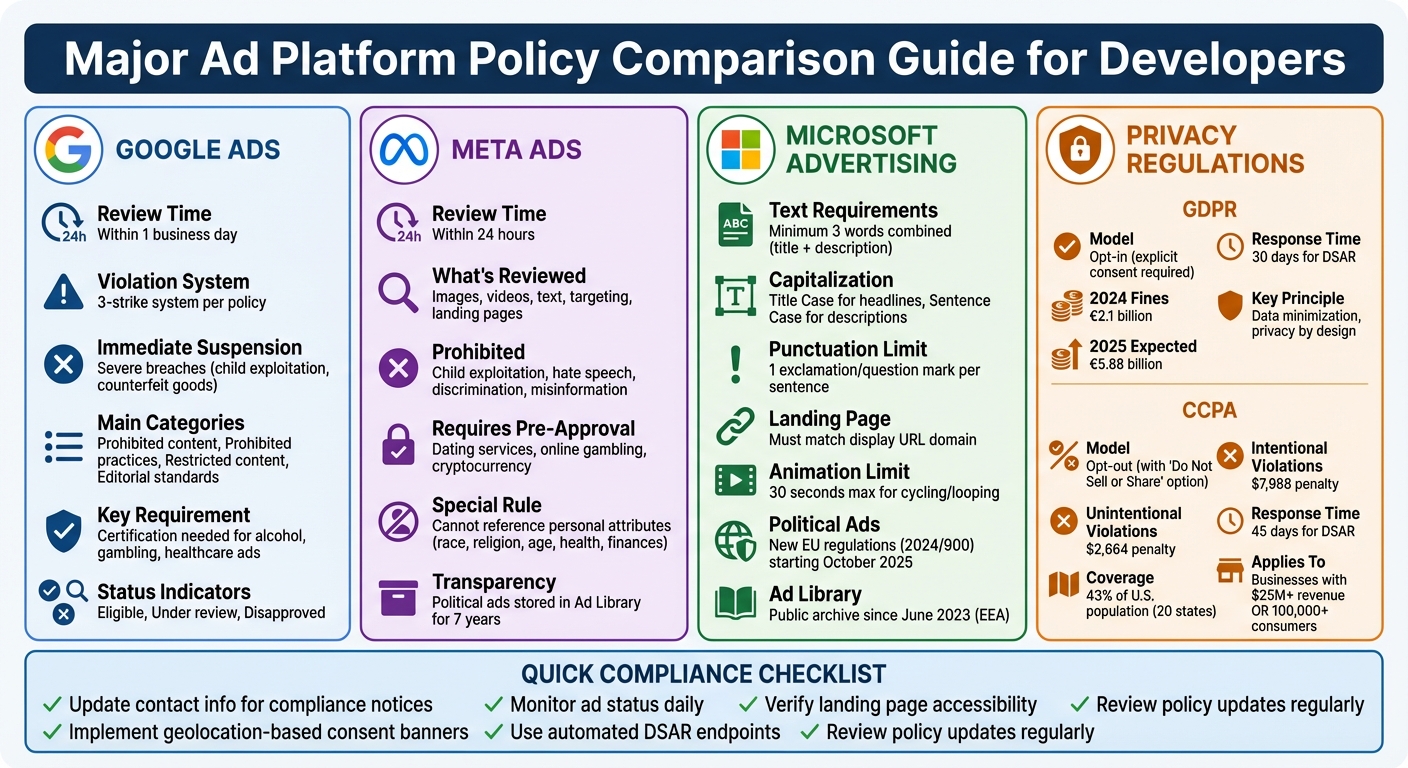 {Major Ad Platform Policy Comparison: Google, Meta, Microsoft & Privacy Regulations}
1. daily.dev Ads Policy Guidelines
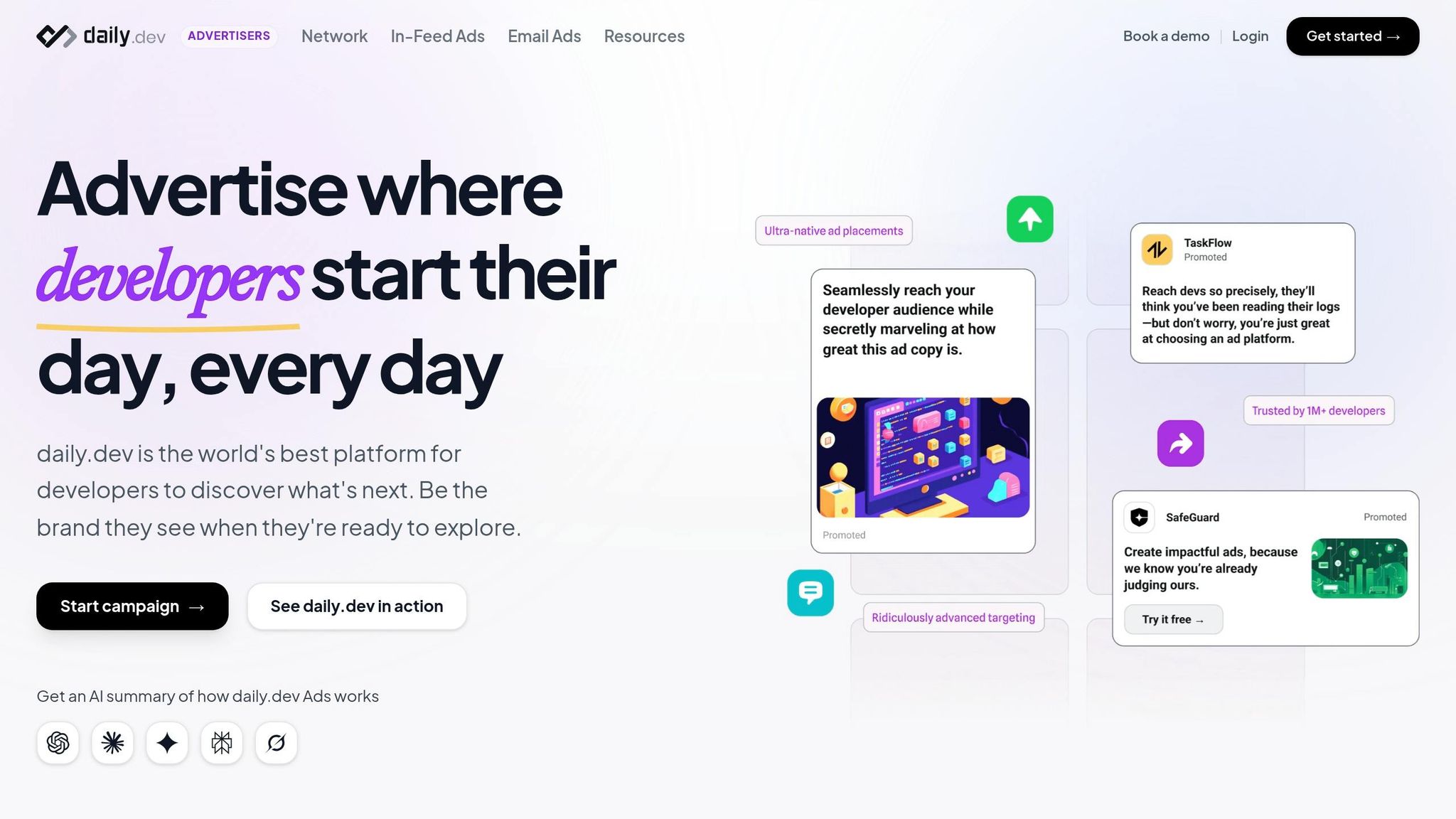
Daily.dev has established clear guidelines for running effective developer-focused ad campaigns. The emphasis is on technical clarity rather than flashy promotions. Ads must highlight working code, detailed documentation, and transparent trade-offs to encourage measurable actions from developers.
The platform supports native ad formats that seamlessly blend into its developer-centric content. These include in-feed ads, post page ads, and personalized digest ads, all designed to enhance engagement without disrupting the user experience.
To ensure precision, daily.dev offers tools to target specific audiences. Advertisers can segment campaigns by tech stack, programming language, or developer seniority using resources like the Developer Seniority Reach Calculator and the Programming Language Targeting Tool.
Conversions are kept simple and direct. Advertisers are encouraged to provide immediate value through features like sandboxes, free trials, or self-serve onboarding. The focus is on activation metrics such as time-to-first-value and API activation, ensuring developers can quickly experience the product's benefits.
Ready to launch a compliant campaign? Start by completing the onboarding process at business.daily.dev. The platform offers expert creative guidance and real-time performance tracking to help advertisers stay compliant while optimizing for key metrics in developer-focused advertising.
sbb-itb-e54ba74
2. Google Ads Policy Center
The Google Ads Policy Center lays out its rules in four main categories: Prohibited content, Prohibited practices, Restricted content and features, and Editorial and technical standards . Knowing these categories is key to avoiding issues in your campaigns, as each one outlines specific compliance requirements. This structure serves as the foundation for all Google Ads policies.
Prohibited Content
This category highlights material that is never allowed on the Google Network . Examples include counterfeit goods that misuse trademarks, services promoting dishonest behavior (like hacking tools or fake documents), and any sexually explicit material or child exploitation content. Violations involving the latter are treated as severe offenses, leading to immediate account suspension without prior warning .
Strike System for Violations
Google uses a strike system for policy breaches, offering up to three warnings per policy. Ad reviews are typically completed within one business day . To help advertisers stay compliant, Google provides clear feedback. The "Status" column in the Google Ads interface indicates whether an ad is marked as "Eligible", "Under review", or "Disapproved" . This system mirrors the transparency ethos seen in advertising on daily.dev.
Restricted Content and Editorial Standards
Some types of content - such as alcohol, gambling, or healthcare-related products - require developers to obtain certification before running ads . Beyond these restrictions, ads must meet professional editorial standards. This means avoiding excessive punctuation, gimmicky capitalization, or non-standard symbols . Additionally, landing pages must function properly, ensuring users can navigate freely without issues like a disabled back button .
"These policies ensure user safety and legal compliance by prohibiting harmful content." - Google Advertising Policies Center
Staying Compliant
If an ad is flagged for a violation, developers can appeal directly from their Google Ads account . To stay ahead of potential issues, teams should regularly check the Policy Center's "Upcoming and recent changes" section for updates . This proactive approach can help ensure ongoing compliance with Google's advertising standards.
3. Meta Ads Policies and Standards
Meta has established clear and detailed guidelines to ensure transparency and compliance for paid content across its platforms, including Facebook, Instagram, and the Audience Network.
Meta enforces these rules through its Community Standards and Advertising Standards, reviewing ads within 24 hours to assess elements like creative content, targeting options, and the landing page .
What Meta Reviews
When you submit an ad, Meta examines its images, videos, text, targeting details, and destination URLs. Certain types of content are strictly prohibited, such as material involving child exploitation, hate speech, discriminatory practices, misinformation, or unethical business practices . Additionally, ads for dating services, online gambling, or cryptocurrency products require prior written approval from Meta before they can run .
Personal Attributes and Data Restrictions
Meta has strict rules about referencing personal attributes in ads. Ads cannot directly or indirectly suggest anything about a person’s race, religion, age, sexual orientation, health, or financial situation. For lead ads, collecting sensitive information is only allowed with explicit user consent .
"Ads must not contain content that asserts or implies personal attributes. This includes direct or indirect assertions or implications about a person's race, ethnicity, religion, beliefs, age, sexual orientation... physical or mental health."
– Meta Transparency Center
Audience Network Implementation
Meta also regulates how ads appear in apps through its Audience Network. Ads must be clearly labeled (e.g., as 'AdChoices' or 'Sponsored') and should stand out visually. To avoid accidental clicks, they must only appear during natural breaks, like between game levels. Apps that generate 70,000 impressions within 14 days undergo a 90-day review process and must be available on official app stores .
Staying Compliant
To manage compliance, use the Meta Business Suite's Account Quality tool to monitor rejected ads. Ensure proper implementation of ads.txt or app-ads.txt files . Be aware that repeated violations can lead to account restrictions. For political or social issue ads, Meta stores them in the Meta Ad Library for seven years, providing transparency and accountability .
4. Microsoft Advertising Policies
Microsoft Advertising operates under stringent guidelines that emphasize transparency, relevance, and building user trust. These rules ensure ads are clearly marked, avoid mimicking editorial content, and steer clear of misleading practices.
When it comes to text and formatting, the standards are precise. Ad copy must follow proper grammar and spelling, with consistent capitalization - Title Case for headlines and Sentence Case for descriptions. Additionally, Microsoft enforces limits on punctuation, allowing only one exclamation point or question mark per sentence. Search ads must also include a minimum of three words combined across the title and description text . Language that creates unnecessary urgency (like "do this immediately") or employs click-bait tactics (such as "1 weird tip") is strictly prohibited . These rules extend beyond the ad text to include rigorous landing page requirements.
Landing pages must align closely with the ad copy and provide a seamless user experience. The display URL's domain must match the landing page's domain to avoid "URL Mismatch" issues. If personal data collection occurs, the landing page must prominently display a privacy policy link . Additionally, ads will be rejected outright if the landing page includes disruptive elements like pop-ups, pop-unders, or fake system error messages .
Media specifications are also tightly controlled. Images must be high-resolution and clearly reflect the advertised product. For animations, cycling or looping sequences are capped at 30 seconds . Audio and video content must include user controls such as mute, pause, and play buttons, with audio muted by default when the page loads .
Microsoft also enforces restrictions on demographic targeting for certain sensitive industries. For example, when advertising financial services, insurance, education, job opportunities, or housing, advertisers are prohibited from using age, gender, or other demographics for personalizing or profiling customers . Political advertising faces additional scrutiny. Starting in October 2025, new EU regulations (2024/900) will require explicit declarations for all political content . To further enhance transparency, Microsoft has maintained a public Ad Library since June 2023 for ads served in the European Economic Area, showcasing ad content and targeting information .
"They are designed to create a high-quality experience for our users, advertisers, and publishers."
– Microsoft Advertising
5. IAB Advertising Standards and Guidelines
The Interactive Advertising Bureau (IAB) Tech Lab plays a key role in shaping the digital advertising landscape by establishing essential protocols that developers rely on every day. These industry standards ensure ads function consistently across platforms, comply with privacy regulations, and avoid the need for custom implementations. By providing a common framework, these guidelines help streamline ad delivery while maintaining compliance within the broader advertising ecosystem.
The IAB New Ad Portfolio, updated on February 25, 2025, introduces responsive ad formats designed for mobile, desktop, AR, and VR environments. This shift eliminates the need for fixed-size ad units, encouraging developers to focus on responsive designs that enhance load times and overall performance . For video and Connected TV (CTV), the Ad Creative ID Framework (ACIF) offers a standardized way to assign unique identifiers to ad creatives. This system ensures consistent tracking across platforms, much like the methods used in traditional TV advertising .
For those navigating privacy compliance, the Global Privacy Protocol (GPP) is a critical resource. Finalized in August 2024, it simplifies the handling of consent signals across various regulatory frameworks . The protocol works alongside tools like ads.txt, app-ads.txt, and sellers.json to combat ad fraud by clearly identifying authorized sellers of ad inventory.
Developers can also take advantage of tools like the VAST Tag Validator and HTML5 Ad Validator to test ad creatives against technical standards . Additionally, the Open Measurement (OM) SDK v1.5 provides a unified approach for viewability and verification across mobile, web, and CTV platforms . These tools help developers ensure their implementations meet IAB standards before deployment.
"Technology standards play a crucial role in integrating stakeholders across the ad tech industry by establishing a unified framework for collaboration. These standards ensure that different systems, platforms, and tools can communicate seamlessly, reducing friction and improving efficiency."
– IAB Tech Lab
6. GDPR and CCPA Compliance Guides
Privacy regulations now play a central role in shaping how data is handled in advertising. The General Data Protection Regulation (GDPR) and the California Consumer Privacy Act (CCPA) offer two distinct approaches to data protection. GDPR requires an opt-in model, meaning users must give explicit consent before their data is processed. On the other hand, CCPA implements an opt-out model, where data collection happens by default but includes a "Do Not Sell or Share" option for users .
Regulatory enforcement has become much stricter in recent years. In 2024 alone, GDPR fines totaled €2.1 billion , and by 2025, that figure is expected to reach €5.88 billion . Under CCPA, penalties for violations are steep: $7,988 for intentional breaches and $2,664 for unintentional ones. Notably, after December 31, 2024, businesses will no longer have a cure period to address violations . These hefty fines make it clear that integrating compliance measures into the early stages of campaign planning is not optional - it's essential.
To navigate these regulations, developers must focus on technical and strategic compliance. For example, GDPR emphasizes data minimization and privacy by design, requiring businesses to collect only the data they truly need. Even pseudonymized data, like hashed emails or device IDs, is considered personal data under GDPR. Meanwhile, CCPA applies to for-profit businesses meeting certain thresholds, such as $25 million in annual revenue or processing data for 100,000 or more consumers. It’s worth noting that CCPA-style laws now cover about 43% of the U.S. population across 20 states .
One critical technical requirement is implementing automated endpoints to handle Data Subject Access Requests (DSAR). These requests must be addressed within 30 days under GDPR and 45 days under CCPA . Additionally, developers should use geolocation tools to present opt-in banners to users in the EU and opt-out options to users in California . Tracking pixels should not activate until user consent is obtained or when a Global Privacy Control (GPC) signal is detected.
The SCR Security Research Team emphasizes the importance of developers in this process:
"Privacy regulations don't just affect lawyers and compliance officers. Developers make the architectural decisions that determine whether an application is compliant or not."
In response to these evolving regulations, many businesses are shifting toward first-party data collection and server-side tracking solutions like the Facebook Conversions API. These methods not only simplify compliance but also help maintain user trust across different regions. By following these guidelines, developers can create ad campaigns that respect user privacy while protecting both trust and revenue streams.
7. Ad Network Compliance Checklists (TrafficJunky, ExoClick)
Broad privacy regulations like GDPR and CCPA set the groundwork for compliance, but ad networks like TrafficJunky and ExoClick have their own specific rules that developers must follow. These guidelines cover technical requirements and content restrictions, working alongside the broader standards already discussed.
Both networks maintain a strict stance against malvertising. ExoClick is very clear about this:
"ExoClick has zero tolerance for all malvertising including browser locking, ransomware, phishing, etc."
To combat such threats, ExoClick uses AI-driven tools like AdSecure, which perform 24/7 scans to identify and block malicious ads before they reach users. TrafficJunky also prohibits harmful practices such as malicious JavaScript, auto-downloading content, and exit blockers . Violating these rules can lead to immediate account termination, with no refunds for unused balances.
Technical Requirements
The networks also differ in their technical ad specifications. For example:
- TrafficJunky: Allows image banners up to 300KB (JPG, GIF, PNG) and videos up to 1MB .
- ExoClick: Enforces a stricter 150KB limit for all display banners .
Both networks require animated ads to display each frame for a minimum of 2 seconds to avoid flashing violations. For video ads, ExoClick specifies durations of 10–30 seconds for in-stream ads and a maximum of 10 seconds for native videos, which must stay under 1.5MB .
Deceptive Elements and Landing Page Rules
The checklists also address deceptive ad practices that violate Google's Abusive Ad Experience standards. These include:
- Fake "close" buttons
- Misleading play buttons
- Countdown timers
- Ads mimicking system warnings or error messages
TrafficJunky further prohibits VPN ads from using scare tactics like "update required" prompts or red danger symbols . Landing pages must align with the ad's content and open in new tabs to avoid "destination mismatch" rejections .
Proactive Compliance Support
ExoClick emphasizes its dedication to compliance enforcement. Bryan McDonald, the network's Director of Compliance, highlights their round-the-clock efforts:
"Our compliance team works day and night, every day of the year to ensure campaigns are approved quickly, to ensure that any ads that breach our rules are likewise identified and instantly removed from the network."
The team responds to compliance inquiries within 30 minutes and encourages developers to consult them before launching campaigns. This proactive approach helps identify potential issues early, reducing the risk of disapprovals or account penalties .
8. OneTrust Privacy and Compliance Resources
OneTrust provides a platform designed to help developers navigate privacy and consent requirements across various advertising channels. Its Google-Certified Consent Management Platform (CMP) is particularly crucial for businesses targeting European audiences through Google's ad network. This CMP supports IAB TCF 2.2 and 2.3 specifications, ensuring that consent collection aligns with the stringent standards of programmatic advertising in regulated regions .
The platform's Universal Consent & Preference Management (UCPM) system centralizes consent data in real time across multiple digital touchpoints, including web, mobile, and connected TV . Developers can maintain consistent consent records thanks to native SDKs for Android, iOS, Flutter, React Native, and OTT platforms like Amazon Fire TV, Apple TV, Roku, and Samsung. This integration ensures uniform privacy practices across all digital channels .
When it comes to performance, OneTrust excels. The v1/preferences API processes requests in under 100ms and supports up to 3,000 calls per minute . For user-facing preference centers, the v2/preferences API delivers responses in less than 1,000ms 99% of the time . To handle large-scale consent data imports, developers can use the "Stream Consent Receipts" bulk import template, which avoids throttling and efficiently processes high volumes .
The platform also automates compliance workflows, reducing manual effort. Its intelligent web scanning feature detects tracking pixels and cookies across digital properties, flagging potential violations before they escalate . For Google Consent Mode, OneTrust synchronizes user preferences directly with the Firebase Analytics SDK (versions 202512.1.0 and later), eliminating the need for additional developer coding . According to case studies, organizations using OneTrust saw a 227% return on investment over three years, with a payback period of just seven months .
To further support developers, OneTrust offers a comprehensive developer portal with API and SDK references. These resources enable seamless integration of consent signals into marketing platforms like Marketo, Salesforce, and Snowflake . For those just starting out, the platform includes free tools such as a Cookie Banner Gallery, a CCPA Opt-Out Builder for "Do Not Sell" links, and a free version of DataGuidance Research for the first domain . As Alex Cash, Director of OneTrust Consent and Preferences, puts it:
"User consent is a must when engaging in behavioral advertising" .
9. Usercentrics Regulatory Compliance Platforms Guide
Usercentrics supports consent management for over 2.4 million websites and apps across 195 countries, handling 8.8 billion consents each month . The platform is built to manage compliance with a wide range of privacy regulations, including GDPR, CCPA/CPRA, DMA, LGPD, PIPEDA, and VCDPA - all at the same time . For developers working with advertising platforms, this means one integration can handle consent requirements for multiple regions, eliminating the need for separate implementations for each jurisdiction.
The platform simplifies compliance by automatically detecting and categorizing cookies and trackers on a site, blocking non-essential services until users provide consent . This removes the hassle of manually identifying third-party scripts and pixels. With more than 2,200 legal templates for data processing services, developers don't have to create disclosure language from scratch - they can quickly set up compliant consent flows . Geolocation capabilities further streamline the process by detecting a user’s location and displaying the appropriate consent banner, such as an opt-in banner for GDPR in the EU or an opt-out notice for CCPA in the US .
For advertising compliance, Usercentrics offers full support for IAB TCF v2.2/2.3 and Google Consent Mode v2, ensuring ad campaigns meet regulatory requirements. It signals user preferences directly to advertising platforms like Google Ads and Meta . As a Google Gold Tier and App-ready partner in the Google CMP Partner Program, Usercentrics also provides Advanced Consent Mode. This feature allows Google tags to send cookieless pings when users decline consent, enabling conversion modeling to recover data insights that might otherwise be lost . Eike Paulat, Director of Product at Usercentrics, explains:
"Offering granular consent choices and enabling users to modify or revoke consent easily demonstrates respect for user privacy and their control over personal data" .
The platform also includes A/B testing for banner layouts and a "Consent or Pay" paywall model, which helps boost opt-in rates while maintaining ad revenue . For businesses managing multiple properties, the customization options and user-friendly setup are especially beneficial, as noted by Tobias Streitferdt, Director Metadata & Systems . Usercentrics boasts a customer retention rate of over 99% and holds a 4.3/5 rating on G2 .
Getting started is straightforward: add a script tag or integrate the App CMP SDK, configure data processing with the automated scanner, and activate consent signaling for ads. The system automatically updates your cookie list and privacy policy as new trackers are detected, reducing ongoing maintenance efforts. For server-side tracking, Usercentrics offers tools like the Meta Signals Gateway to send high-quality, consented signals to marketing platforms .
10. Thomson Reuters Global Compliance Concerns Report
Thomson Reuters provides in-depth compliance insights, drawing from the expertise of over 650 attorney editors and industry professionals . This report zeroes in on the adtech ecosystem, breaking down the roles of Demand-Side Platforms (DSPs), Supply-Side Platforms (SSPs), and Consent Management Platforms (CMPs). The goal? To help developers pinpoint where their compliance responsibilities start and stop . It also builds on earlier guidelines by addressing state-specific variations and the complexities of health data tracking.
For developers in the U.S., the report tackles a pressing issue: as of early 2025, more than 20 states have enacted comprehensive privacy laws, resulting in a patchwork of regulations . One key focus is the differing treatment of pseudonymous data. For example, states like Florida and Tennessee exempt pseudonymous data from opt-out requests, while California and Oregon do not. This highlights the need for tailored, state-specific compliance strategies instead of a universal solution .
The report also delves into heightened scrutiny of tracking technologies on health-related websites. The U.S. Department of Health and Human Services has clarified that protected health information (PHI) collected through tracking pixels can include details like IP addresses and unique identifiers . The report emphasizes the complexity of compliance in this area, particularly when it comes to distinguishing user intent:
"The initial guidance left companies wondering how to discern use cases and permissible data collection, while the examples in the updated version heighten concerns over an apparent obligation to distinguish user intentions." – Reuters
To navigate these challenges, the report suggests reviewing Business Associate Agreements (BAAs) with tracking vendors when handling health data. It also underscores the importance of monitoring universal browser-based opt-out signals, which more states are beginning to mandate . For developers working on consent mechanisms, it recommends categorizing cookies into four groups: Essential, Functional, Analytics, and Advertising .
Conclusion
The information provided above helps you tackle the challenges of ad policy compliance with confidence. Staying compliant not only protects your business but also reinforces trust within the developer community. The consequences of non-compliance can be severe, including account suspensions, restricted API access, or additional fees for violations.
"Advertisers have a responsibility not to promote content or engage in behavior that risks harm to our users, employees, or the Ads ecosystem." – Google Advertising Policies Center
This guide equips you with practical steps to avoid such risks. Make sure your contact information in the API center is up to date to receive compliance notices. Use the Policy Manager to keep track of ad statuses, and verify that your landing pages are accessible to Googlebot. Keep in mind that most ad reviews are completed within one business day, but any edits during the review process will restart the timeline.
For campaigns aimed at developers, compliance is non-negotiable. Whether you're addressing state-specific privacy regulations or implementing consent mechanisms for EU users, these tools and strategies serve as a clear roadmap. Regularly review these resources, bookmark them for easy access, and make compliance a part of your daily workflow. Pair these insights with daily.dev Ads to ensure your campaigns meet all necessary standards and remain secure.
FAQs
What’s the fastest way to diagnose why an ad was disapproved?
The fastest way to figure out why an ad was disapproved is by checking the specific reasons listed in the platform's policy help center. These resources usually provide detailed explanations along with step-by-step instructions to fix the problem. Platforms like Google Ads and Meta have straightforward guidelines to help you resolve disapproval issues quickly.
How can I ensure trackers don’t activate before user consent?
To manage user privacy effectively, implement a consent management solution that controls when tracking scripts activate. Start with a default setting that blocks all data collection, and adjust it dynamically once users provide their consent. Tools like Google’s Consent Mode or custom logic within tag managers can help ensure tracking scripts only run after consent is granted. This approach respects privacy preferences and prevents trackers from activating prematurely.
Which IAB standards should I prioritize first (ads.txt, GPP, OM SDK)?
Begin with ads.txt to improve transparency and combat ad fraud in programmatic advertising. This simple yet effective step helps ensure that only authorized sellers can represent your inventory.
Next, integrate the OM SDK (Open Measurement Software Development Kit) to enable accurate ad measurement and verification. This tool provides reliable metrics and ensures that your ad performance is tracked correctly.
Finally, address privacy compliance by focusing on GPP (Global Privacy Platform). This helps you align with privacy regulations and manage user consent seamlessly.
Following this order not only builds trust but also ensures you meet key advertising standards efficiently.