

When it comes to running ad campaigns for developers, tracking conversions accurately is a major challenge due to privacy settings, ad blockers, and browser restrictions. Server-to-server tracking APIs provide a reliable solution by bypassing these issues and sending data directly to ad platforms. Here's a quick look at the top 5 ad tracking APIs for developers:
- Cometly: Focuses on real-time tracking, custom integrations, and scalability for high-traffic campaigns. Ideal for B2B SaaS and enterprise teams. Starts at $1,000/month.
- Triple Whale: Designed for Shopify e-commerce, it integrates profit tracking and custom metrics. Pricing begins at $129/month based on revenue.
- Hyros: Tailored for high-ticket sales and complex funnels, with AI-powered attribution. Pricing starts at $500/month and scales with ad spend.
- RedTrack: Best for affiliates and media buyers, offering server-side tracking and event-based pricing. Starts at $149/month.
- Google Analytics 4 (GA4): A free option with robust analytics and server-to-server tracking via the Measurement Protocol.
Quick Comparison
| API Platform | Primary Use Case | Starting Price | Pricing Basis | Key Feature |
|---|---|---|---|---|
| Cometly | B2B SaaS / Enterprise | $1,000/mo | Flat fee / Scale | Real-time data for scaling ads |
| Triple Whale | Shopify E-commerce | $129/mo | Monthly Revenue | Profit tracking with COGS |
| Hyros | High-ticket Funnels | $500/mo | Ad Spend Volume | AI-driven attribution |
| RedTrack | Affiliates / Media Buying Teams | $149/mo | Event Volume | Server-side tracking accuracy |
| GA4 | General Analytics | Free | N/A | Comprehensive analytics tools |
Each API has unique strengths tailored to different needs. Whether you're scaling enterprise campaigns, optimizing e-commerce profits, or managing complex funnels, these tools help ensure accurate data and better ad performance. For more insights on optimizing your strategy, explore our developer marketing resources.
::: @figure 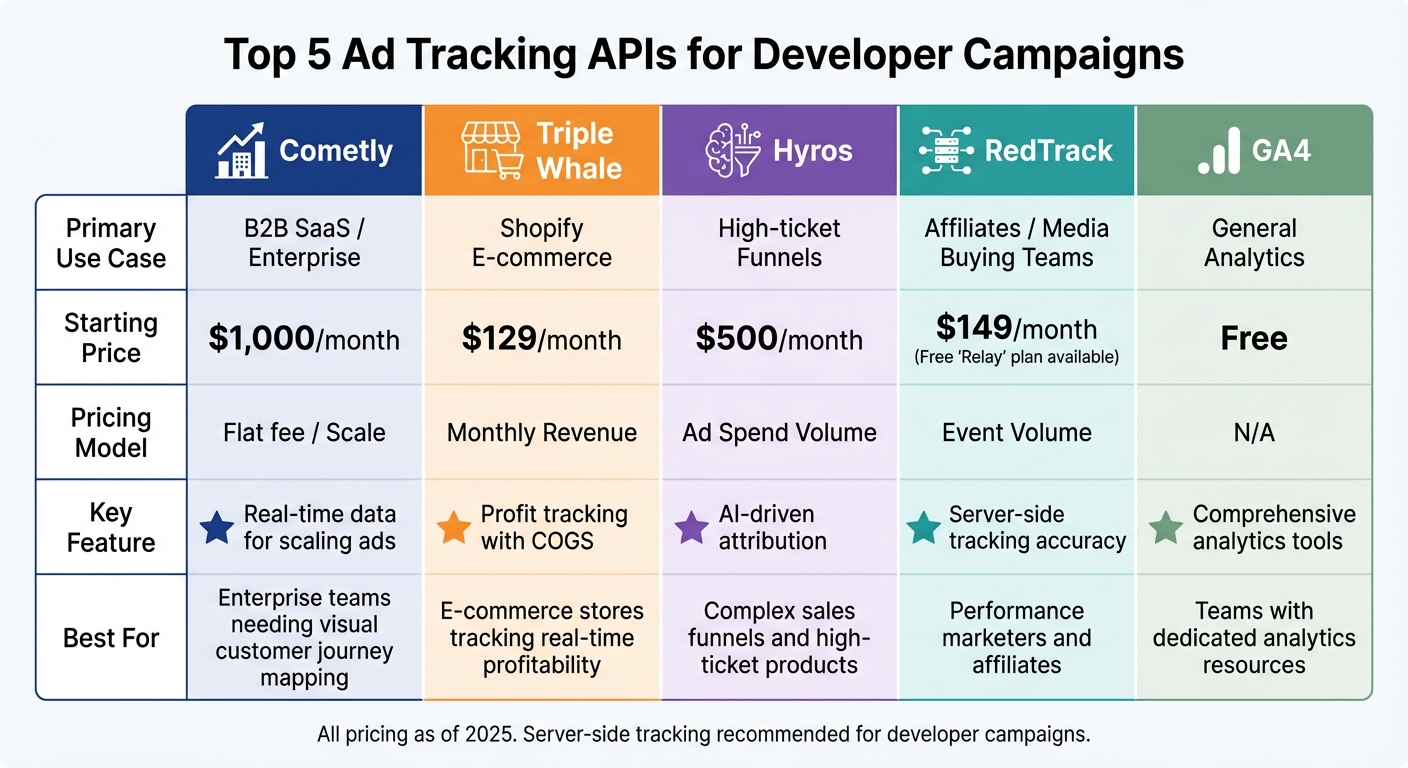 {Top 5 Ad Tracking APIs Comparison: Features, Pricing, and Use Cases}
1. Cometly API
Real-time tracking capabilities
Cometly’s server-side pixel is designed to track clicks, form submissions, and conversions without being hindered by browser-related issues . Through its RESTful API (https://app.cometly.com/public-api/v1), developers can programmatically send conversion events, capturing every interaction from the initial click to the final CRM conversion .
The platform’s Conversion Sync feature enhances event data before sending it to major platforms, improving attribution accuracy and match quality . This real-time data integrates seamlessly into an AI Ads Manager, which offers actionable recommendations for budget adjustments and highlights top-performing ads across multiple channels .
A great example of its impact comes from Trainual. Jonathan Ronzio, Co-founder & CMO, noted that after adopting Cometly’s tracking tools, Trainual increased its ad spend by 40%. The platform provided sharper ad targeting, better funnel insights, and greater control over cost-per-acquisition, giving the team confidence to scale their campaigns .
These real-time features provide a strong foundation for developers looking to customize their tracking solutions.
Developer-focused integrations
Cometly takes its real-time tracking a step further with flexible integrations that work with any programming language capable of HTTP requests, such as Python, JavaScript, PHP, and Ruby . Developers can tailor tracking to their needs by defining custom conversion goals like "subscription_start" or "milestone_reached." Additionally, its server-side form capture ensures data is collected even if a form submission is abandoned or browser scripts fail .
John Parkes, CMO at ClickFunnels, shared how Cometly helped address challenges caused by iOS tracking updates:
Cometly gave us something we've never had before: confidence in our data. We used to struggle with attribution across platforms... Now we know exactly what's working and with Cometly AI, we're optimizing in real time with smart recommendations on where to shift budget and how to scale faster .
This level of customization and reliability makes Cometly a valuable tool for developers managing complex funnels.
Scalability for high-traffic campaigns
Cometly’s infrastructure is built to handle the demands of high-traffic campaigns. By capturing conversions at the server level, it ensures data accuracy even when browser-based tracking fails . This design makes it resilient to issues like third-party cookie loss and privacy restrictions, which are common hurdles in modern advertising .
With support for over 100 integrations across marketing and sales tools, Cometly connects seamlessly to BI platforms, CRMs, and data warehouses - no custom scripting required . This scalability ensures that even the most data-intensive campaigns can run smoothly without compromising performance.
sbb-itb-e54ba74
2. Triple Whale API
Real-time tracking capabilities
Triple Whale's API facilitates a two-way data exchange, allowing developers to pull attribution metrics and push custom data directly into the platform . By leveraging the Triple Pixel, which captures first-party and zero-party data, it tracks customer journeys without relying on third-party cookies. This design ensures it remains unaffected by browser restrictions . Over 6,000 brands rely on the Triple Whale summary dashboard daily to monitor their business performance .
To sidestep browser limitations, Triple Whale employs server-side data transfer, much like other modern tracking solutions.
The Activities Table records user and system actions - such as budget changes, status updates, and new ad creation - complete with precise timestamps. The Attribution API further enhances this by exporting the full customer journey, from the initial click to the final conversion . This setup delivers real-time insights that help businesses understand how their operations impact performance.
Developers can use the Metrics Endpoint to input custom metrics like shipping costs or external ad spend . This feature consolidates performance data from various sources, offering a unified view of campaign results. As Triple Whale describes it:
Triple Whale centralizes the metrics from all the tools your customers use. Access the goldmine of eCommerce data with a single API .
Developer-focused integrations
The API supports OAuth2 for integrating third-party apps and Personal API Keys for individual developers . Developers can assign specific scopes - such as "Summary Page: Read" or "Pixel Attribution: Read" - when generating keys, ensuring access is restricted to necessary data only . The platform refreshes data every 15 minutes and integrates seamlessly with major platforms like Meta, Google Ads, TikTok, and Shopify .
For precise ad attribution, developers should include tracking parameters like tw_source and tw_adid . To assist with integration, Triple Whale provides a public GitHub repository featuring documentation and sample applications in Python and JavaScript .
Privacy compliance features
Triple Whale's server-side tracking and proprietary pixel are designed to comply with GDPR and CCPA regulations . The platform offers detailed scopes for API keys and allows for instant key revocation through an API Keys Log in case of security concerns . Developers can also configure regional data-handling settings and consent banners to align with local privacy laws .
Greg Dalby, SVP Omnichannel at Milk Bar, praised the platform's dependability:
It's our book of truth when it comes to what's performing and what's not. From a performance standpoint, we're at the point where we live and die by what's in Triple Whale .
The implementation process is straightforward, typically taking less than 10 minutes to integrate across platforms. However, developers are advised to consult legal experts to ensure their implementation complies with regional privacy requirements . These features make Triple Whale a strong complement to other APIs, particularly in the realm of server-side tracking for developer campaigns.
3. Hyros API
Real-time tracking capabilities
Hyros provides instant conversion and engagement data to major ad platforms, including Facebook, Google, and TikTok, through real-time postbacks. This immediate data flow helps reduce acquisition costs by supplying platforms with up-to-date signals . For call-based campaigns, the API employs Dynamic Number Insertion (DNI), which dynamically changes phone numbers on websites based on visitor sources. This ensures accurate attribution of unique leads .
With the JavaScript SDK, developers can track custom events using the trackEvent function. For instance, they can capture an "AddToCart" action and include details like userId, value, currency, and source . Hyros processes every click, interaction, and sale into RAG (Revenue Attribution Graph) data, fueling AI-powered personalization. A notable example is Tony Robbins' team, which used Hyros to scale ad spend by 43% for their "Business Mastery" program and over 100% for "Unleash the Power Within" by pinpointing high-revenue sources .
Developer-focused integrations
Hyros has been compared to "the Stripe of attribution" for its developer-friendly features, allowing businesses to build tailored attribution systems and turn tracking data into actionable AI marketing insights . The RAG API organizes customer journey data - such as pages visited, videos watched, and interactions with support - into structured formats that can power custom LLMs (Large Language Models) and automated tools. Developers can also track specific in-app actions to gain a comprehensive view of customer journeys within their software .
Alex Hormozi, founder of Acquisition.com, praised Hyros for its clarity:
You have transparency in all ad tracking, the people that are attracted to HYROS, are dedicated data enthusiasts .
Hyros processes data for over 100,000 businesses, with brands typically seeing a 15% boost in ad revenue after adopting the platform . For call tracking, businesses can manually adjust phone number pools (e.g., 2 numbers per 4 visitors per hour) to prevent attribution errors .
Privacy compliance features
Hyros adheres to privacy regulations like EU GDPR, UK GDPR, and the Swiss Federal Act on Data Protection (FADP). It has appointed the European Data Protection Office (EDPO) as its legal representative . All customer end-user data, including personally identifiable information (PII), is handled under a formal Data Processing Addendum (DPA) . The platform respects Global Privacy Control (GPC) signals, treating them as opt-out requests for targeted advertising .
Importantly, Hyros does not collect sensitive data such as biometric, genetic, or HIPAA-protected health information . When integrating with third-party APIs like Google Workspace, Hyros ensures that user data is not retained for developing or training non-personalized AI or machine learning models . Developers can create secure, customized attribution systems that integrate seamlessly with internal CRMs and dashboards while maintaining strict privacy standards . Additionally, Hyros offers a 14-day free trial, requiring no credit card, so businesses can test its features risk-free .
4. RedTrack API
Real-time tracking capabilities
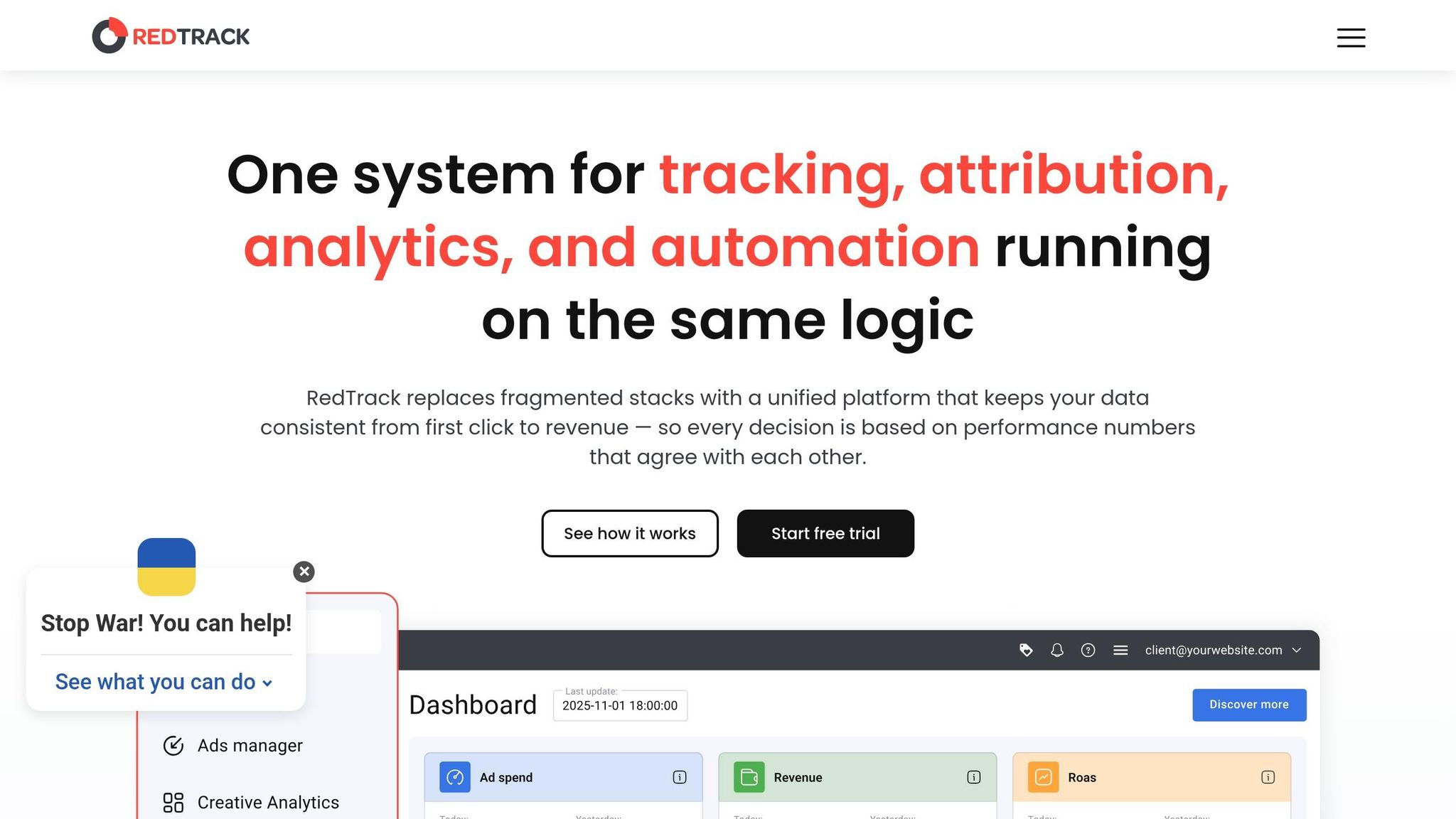
RedTrack delivers real-time click and conversion tracking, eliminating the usual 24–72 hour delays . With ad spend data updated as often as every 5 minutes, developers can monitor profitability instantly . In 2025 alone, RedTrack tracked over 1 billion conversions and managed $621.2 million in revenue .
Through its API, developers can access raw, unsampled click and conversion logs, allowing for independent audits and custom attribution . The platform's automated "Stop Rules" leverage this real-time data to pause poorly performing ads or blacklist placements when ROI drops or CPC spikes beyond defined limits . Its Server-to-Server (S2S) integration ensures 100% data accuracy, bypassing browser limitations and ad blockers, even with iOS 14+ restrictions . Cem Varghese, CEO of Venture Beyond, highlights its importance:
RedTrack's speed of reporting was important to us - you don't want to wait for three days for reporting to come in. You want to know straight away how your ads are performing .
This real-time tracking forms the backbone of RedTrack's developer-friendly integrations.
Developer-focused integrations
RedTrack extends its capabilities with integrations tailored for developers. Its dual API system includes a Data Access API for retrieving performance reports and raw logs, and an Account Management API for managing campaigns, offers, and traffic sources programmatically. This setup allows seamless integration into existing tech stacks . Data is provided in JSON format, making it compatible with BI tools, data warehouses, and internal systems. RedTrack supports over 200 integrations, including major networks like Meta, Google, and TikTok .
Developers can also push conversion events from external systems into RedTrack to unify their data . Using RedTrack's Conversion API (CAPI) has been shown to reduce cost per purchase by 35% and increase ROAS by 22%, while hybrid tracking methods improve event match rates from 55% to 82% . Additionally, a Chrome extension overlays RedTrack's real-time data onto the Meta Ads Manager interface, enabling immediate campaign optimization .
Privacy compliance features
RedTrack also emphasizes privacy compliance alongside its tracking and integration tools. For traffic originating from GDPR-covered regions, it automatically obfuscates IP addresses and hashes personal data, such as emails and phone numbers, before storing it . The Universal Tracking Script operates under customer domains and uses first-party cookies, ensuring compliance with privacy regulations while staying effective against ad blockers . Server-to-server tracking further ensures accurate data collection in environments where third-party cookies are restricted .
As a Badged Meta Business Partner, RedTrack is recognized for its expertise in managing conversion data . It offers unlimited tracking for a flat monthly fee, avoiding percentage-of-ad-spend or pay-per-conversion pricing models . Plans start at $149/month for the Solo tier, which includes 3 million tracking events and a read-only API (20 requests per minute). The Enterprise plan, at $999/month, supports 20 million events and provides Premium API access with up to 1,000 requests per minute .
5. Google Analytics 4 API
Real-time tracking capabilities
Google Analytics 4's Data API makes real-time tracking a breeze with its runRealtimeReport method. This feature provides event and usage data from the past 30 minutes (or up to 60 minutes for GA360 accounts), with events appearing almost instantly .
The API supports a variety of dimensions like eventName, deviceCategory, country, city, platform, and appVersion. It also tracks key metrics such as activeUsers, eventCount, keyEvents (conversions), and screenPageViews . For even more precise timing, the minutesAgo dimension comes into play, where "00" represents the current minute and "01" the previous one . If you're using the Measurement Protocol for real-time reporting, don't forget to include the engagement_time_msec event parameter to ensure accurate engagement metrics .
These capabilities make integrating real-time analytics into server-side systems straightforward and efficient.
Developer-focused integrations
GA4 is designed with developers in mind, offering APIs that fit seamlessly into existing workflows. The Measurement Protocol enables server-to-server tracking through HTTP POST requests, allowing developers to send up to 25 events in a single request . For offline data, events can be backdated by up to 72 hours using the timestamp_micros parameter, ensuring accurate logging .
The platform automatically links Measurement Protocol events with online activity through identifiers like client_id or app_instance_id, ensuring that offline conversions are properly attributed to user sessions and advertising IDs like GBRAID and WBRAID. To simplify implementation, Google provides client libraries in popular programming languages such as Java, Python, and Node.js, along with an Event Builder tool for validating payloads . During development, enabling validation_behavior with the ENFORCE_RECOMMENDATIONS setting helps identify and correct malformed requests or invalid parameters .
Privacy compliance features
GA4 also emphasizes privacy, offering several tools to ensure compliance with data protection regulations. Google Consent Mode adjusts tag behavior based on user consent preferences, while the User Deletion API allows developers to handle data removal requests for specific user identifiers, aligning with GDPR's "Right to be Forgotten" requirements. Events sent via the Measurement Protocol automatically inherit privacy settings, including preferences like "non-personalized ads" and "limit ad tracking."
Additionally, the Attribution Reporting API, part of Google's Privacy Sandbox initiative, enables conversion tracking without invasive cross-site tracking. It matches ad interactions with conversions while minimizing the sharing of sensitive data. To authenticate each Measurement Protocol request and prevent spam, an api_secret from the GA4 interface must be included .
Feature Comparison Table
Here’s a quick-reference table summarizing the standout features and pricing of five popular ad tracking APIs. Your choice will depend on factors like your technical setup, campaign needs, and budget. This table highlights pricing models, primary use cases, and what sets each platform apart.
| API Platform | Primary Use Case | Starting Price | Pricing Basis | Key Differentiator |
|---|---|---|---|---|
| Cometly | B2B SaaS / Server-side accuracy | $1,000/mo | Flat fee / Scale | Visual customer journey mapping for enterprise teams |
| Triple Whale | Shopify E-commerce Profit Tracking | $129/mo | Monthly Revenue | Real-time profit tracking with COGS and shipping costs |
| Hyros | High-ticket / Complex Funnels | $500/mo | Ad Spend Volume | AI-powered attribution across webinars, calls, and CRMs |
| RedTrack | Affiliates / Media Buying Teams | $149/mo* | Event Volume | Server-side architecture bypassing iOS restrictions |
| GA4 | General Web & App Analytics | Free | N/A | Comprehensive analytics with a steep learning curve |
*RedTrack also offers a "Relay" plan that is free forever for early-stage brands .
Additional Pricing Insights
- Triple Whale adjusts pricing based on revenue, charging $799/month for stores generating $3M in monthly revenue .
- Hyros pricing scales significantly, ranging from $1,500 to over $3,000 per month for higher ad spend volumes. This cost is often justified for businesses with long sales cycles, like coaching programs or B2B services .
- RedTrack uses an event-based model, charging $20–$30 per million additional events beyond plan limits. Paid plans can go up to $999/month for 20 million events .
Technical Considerations
Modern APIs rely on REST + JSON architecture and offer SDKs for major platforms, including PHP, JavaScript, Android, and iOS . Server-side tracking remains a critical tool for capturing complete conversion data, especially as privacy restrictions evolve. Balancing reliability, scalability, and ease of integration is key to ensuring accurate campaign tracking across platforms.
Conclusion
Choose an ad tracking API that aligns with your technical setup and campaign objectives. Each API discussed has specific strengths tailored to different needs. For instance, Cometly excels in providing detailed visual mapping for complex customer journeys, making it ideal for B2B SaaS campaigns. On the other hand, e-commerce teams benefit from real-time profit tracking, while Hyros stands out for high-ticket products with long sales cycles, thanks to its advanced attribution capabilities. Whether it's visual journey mapping or precise profit tracking, the right API can elevate every aspect of a developer campaign. This variety highlights the importance of dependable, server-side tracking solutions.
Server-side tracking is particularly crucial for developer-focused campaigns. Developers often rely on ad blockers and privacy-focused browsers, which can disrupt traditional pixel-based tracking methods, leading to missed conversions . Tools like RedTrack address this challenge by using server-side techniques to bypass these restrictions. This approach ensures more accurate conversion data while simplifying campaign management, especially for performance marketers who need efficient setups and clear attribution.
Technical precision is non-negotiable in developer campaigns. While GA4 provides free, in-depth analytics, its steep learning curve makes it a better fit for teams with dedicated analytics resources.
Finally, prioritize strict data compliance. Developers place a high value on privacy, so APIs designed with zero-storage policies and regional data processing help build trust . This commitment to compliance aligns with the growing trend of unified API platforms.
Modern solutions are moving toward a single interface that normalizes data across platforms like Meta, Google, LinkedIn, and Reddit . This unified approach reduces the hassle of managing separate integrations and lets your team focus on optimizing campaigns instead of wrestling with mismatched data formats.
FAQs
When should I use server-side tracking instead of a browser pixel?
Server-side tracking is a great choice when you need more precise data collection and want to overcome challenges like ad blockers, browser restrictions, or privacy settings that can interfere with client-side tracking. This method is especially helpful for enhancing attribution accuracy and performance metrics, all while staying compliant with privacy regulations.
How do I choose the right tracking API for B2B SaaS, e-commerce, or affiliate campaigns?
Choosing the right tracking API hinges on the type of campaign you're running. For B2B SaaS, focus on APIs that offer in-depth metrics, automation capabilities, and seamless integration with your existing tools. E-commerce campaigns thrive with APIs that provide real-time tracking, cross-device attribution, and fraud detection features. If you're in affiliate marketing, prioritize solutions with multi-platform tracking, robust fraud prevention, and automation tools. Align your API choice with your specific business goals and campaign requirements to achieve the best results.
What identifiers should I send to improve attribution without violating privacy laws?
To improve attribution while respecting privacy regulations, consider using identifiers such as gclid and gbraid from click URLs. These identifiers work well for ad tracking on both Android and iOS platforms, even when users choose to opt out of tracking. This is because they rely on URL parameters rather than device-based identifiers, ensuring compliance with privacy standards.