

Developers are a critical audience for AI tools, but reaching them requires a tailored approach. Here's what works:
- GitHub: Share your AI tool through open-source contributions, sponsorships, and engaging with GitHub Discussions.
- Stack Overflow: Build trust by answering AI-related questions and sharing expertise without direct promotion.
- Reddit: Participate in developer subreddits (e.g., r/MachineLearning) and host AMAs to connect with communities authentically.
- daily.dev Ads: Use targeted ads to reach over 1 million developers worldwide, focusing on programming languages, tools, and seniority.
- Developer Blogs & Newsletters: Publish tutorials and case studies on platforms like Dev.to and Hashnode to educate and engage developers.
Each channel serves a unique purpose. Use GitHub for credibility, Stack Overflow for problem-solving, Reddit for community interaction, daily.dev Ads for quick exposure, and developer blogs for in-depth content. Combining these strategies ensures your AI tool reaches the right audience effectively.
GitHub: Connecting with Developers Through Open Source
GitHub is more than just a place to store code - it's where developers come together to evaluate, discuss, and adopt tools. With its massive developer community, the platform is a prime space for showcasing whether an AI tool is worth their time. The secret? Engaging authentically within the open-source community. Here's how to make the most of GitHub's features.
"In open source, we feel strongly that to really do something well, you have to get a lot of people involved." - Linus Torvalds, Creator of Linux
Contributing to Open Source Projects
One of the best ways to build credibility in the developer world is by actively contributing to open-source projects. Whether it's through code, documentation, or bug fixes, these efforts show that your team is solving real problems. Developers notice when your contributions show up in commit histories, pull requests, and discussions - it builds trust in a way no ad campaign can.
Make your own project contributions easy to navigate. Start with a clear, engaging README that includes a one-line value proposition, visual demos, and key benefits. Simplify the process for newcomers by tagging issues with labels like good first issue or help wanted. Include detailed instructions through CONTRIBUTING.md and establish community standards with a CODE_OF_CONDUCT.md file .
Timing is crucial for visibility. For example, a well-timed launch on Hacker News can drive thousands of views and GitHub stars. Projects earning around 200 stars in a single day often climb the GitHub Trending list, attracting even more attention. To maximize reach, coordinate announcements across platforms like Hacker News, Reddit, Dev.to, and social media within a 24–48 hour window.
"Brand is the moat. Not code." - IndieRadar Team
Sponsoring Projects for Visibility
Beyond contributing, sponsoring open-source projects is another way to show commitment to the developer community. Supporting projects that your AI tool relies on not only strengthens the ecosystem but also gets your brand in front of developers who use related technologies. Make sure your sponsorship is visible by enabling the "Who can see your sponsorship" setting, so your organization appears on the sponsored project's profile and sponsorship dashboard .
Choose sponsorship tiers wisely. Higher tiers often come with perks like logo placement in READMEs, mentions in newsletters, or public shout-outs on social media . For instance, Stripe sponsored Nick DeJesus in 2022 because his use-shopping-cart library simplified shopping cart management during Stripe checkout. This move supported a critical dependency while boosting Stripe's visibility among developers .
Sponsorship Tiers and Visibility Incentives
| Tier Level | Typical Monthly Amount | Common Visibility Incentives |
|---|---|---|
| Bronze | $5 – $20 | Public acknowledgment, badge on profile |
| Silver | $21 – $50 | Early access to updates, exclusive Q&A |
| Gold | $51 – $100 | Logo in README, direct interaction with developers |
| Platinum | $101+ | Personalized thank-you, prominent logo placement |
To identify sponsorship opportunities, use GitHub's Explore tool at github.com/sponsors/explore. This tool highlights dependencies your AI tool relies on that are eligible for sponsorship . Sponsoring as an organization, rather than as an individual, ensures your brand and logo are prominently displayed on the sponsored project's page .
"If you're interested in sponsoring projects you depend on, you can check out the GitHub Sponsors Explore Page. This list will include a list of projects your accounts depend on, and indicate which ones are eligible for sponsorship." - Rizèl Scarlett, Staff Developer Advocate, Block
Using GitHub Discussions
GitHub Discussions offers a way to connect with your community beyond code. It turns your repository into a hub where developers can ask questions, share use cases, and troubleshoot problems. By responding quickly and engaging meaningfully, you show that your project is active and that you value its community. Ignored discussions, on the other hand, can give the impression that a project is abandoned.
Use Discussions as a resource for education. Share tutorials, how-to guides, and screencasts that show practical ways to use your AI tool. Discuss technical challenges and milestones to create a transparent narrative that resonates with developers. Over time, your Discussions page can become a go-to reference for both current users and those considering your tool.
"The community aspect of open source is actually a driver towards building distributed trust…Once you become a part of the community around an open source project, you assume one or more of the roles that you start trusting." - Mike Bursell
Stack Overflow: Building Trust Through Knowledge Sharing
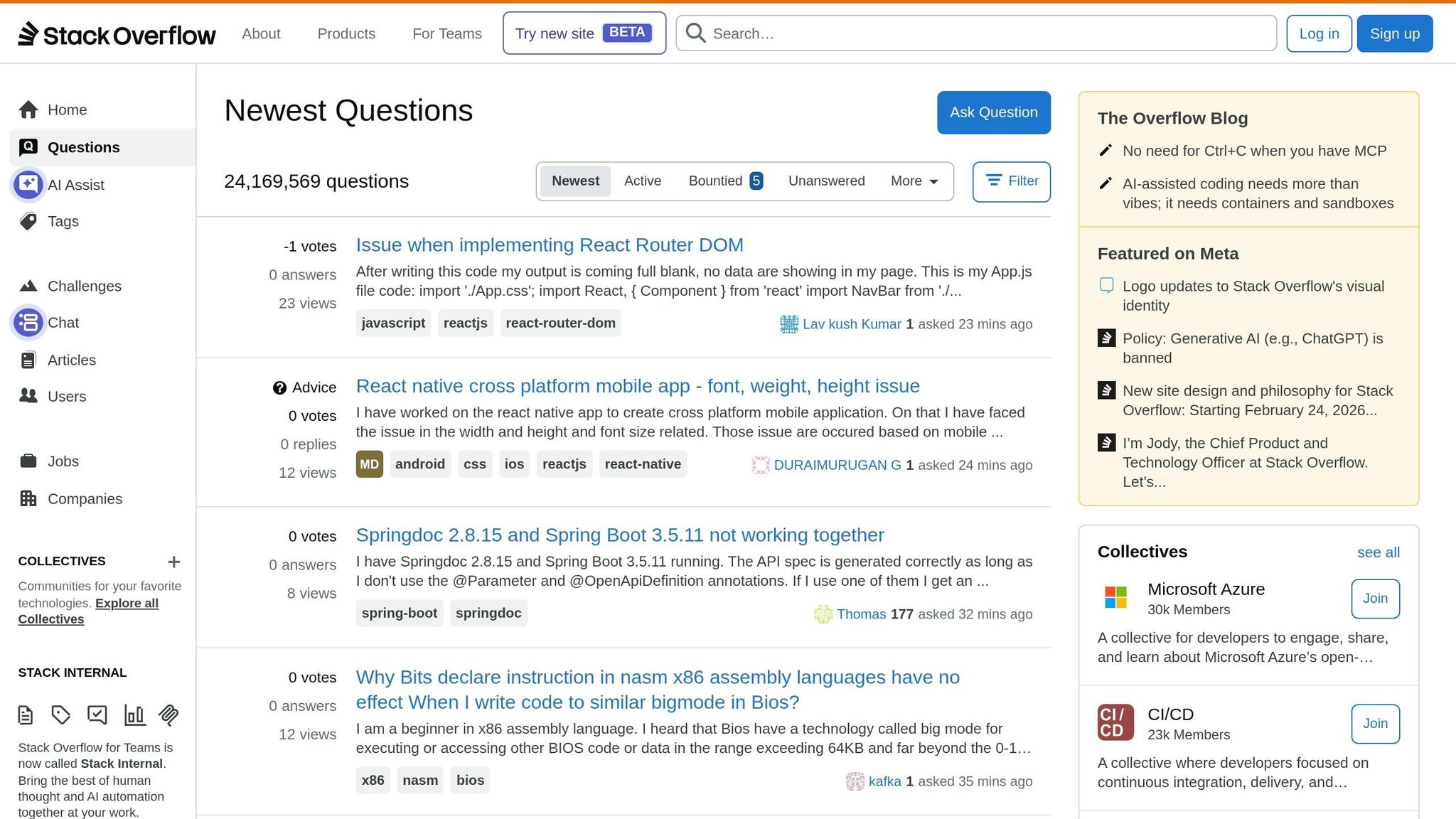
Stack Overflow is where developers go to solve technical problems quickly. With 93% of developers visiting the platform multiple times a month, it’s a go-to resource for tackling challenges encountered during active projects . The platform is tightly moderated by elected members, ensuring content stays relevant, technical, and professional. This moderation fosters an environment where credibility is built through expertise, not flashy ads.
To make the most of Stack Overflow, it’s important to understand how developers use it. They come with specific questions, searching for precise answers that allow them to return to work without delay. Questions are organized by topic tags, which help users navigate technical interests and challenges . If you’re engaging on the platform, your focus should be on delivering clear, actionable, and high-quality answers that address real-world problems.
"Developers know they can quickly get to the answer they need, discover other helpful information, and get back to work." - Stack Overflow
Answering Questions Related to AI Use Cases
The first step in answering questions effectively is tracking topic tags that align with your AI tool’s strengths. Look for questions where your expertise can shine, and when you respond, go beyond the basics. Explain not just how to solve the problem but also why your solution works [19][21].
Whenever possible, include a Minimal Reproducible Example (MRE) to illustrate the issue. Keep the code concise and relevant, and post it as text or Stack Snippets to maintain searchability [19]. Given that 45% of professional developers feel AI tools struggle with complex tasks [18], your answers should focus on areas where human insight can make a difference.
After posting your answer, stay engaged. Address follow-up questions and clarify points as needed. This interaction shows your commitment to the community and gradually builds your credibility [19]. With 42% of developers trusting AI output but 31% expressing distrust [18], positioning yourself as a knowledgeable human expert who validates solutions can carry a lot of weight.
Once you’ve provided a detailed answer, consider broadening the conversation by offering additional resources or insights.
"Marketing to developers and technologists is different... It requires a sharp, no-nonsense approach because developers have limited time and they don't respond well to a typical sales pitch." - Stack Overflow [21]
Sharing Resources Without Hard Selling
If your AI tool genuinely addresses the problem being discussed, it’s okay to mention it - but only when it’s directly relevant. Developers appreciate insights that enhance their problem-solving process, not aggressive marketing . When referencing your tool, explain how it solves the issue, why it’s effective compared to alternatives, and provide links to detailed documentation [19][21].
Use blockquotes to cite community knowledge or documentation, giving proper credit and highlighting validated content [20]. This approach builds trust, especially since 63% of developers believe AI tools often lack the context needed to handle specific codebases [18]. Stack Overflow’s ad guidelines reinforce this trust, creating a respectful environment for both users and brands .
For organizations looking to establish a stronger presence, Stack Overflow’s Collectives™ feature is worth exploring. It allows companies to manage Collections and assign Recognized Members to engage with the community through expertise rather than overt marketing . Developers often play a significant role in their organizations’ technology decisions, so building trust through meaningful engagement is essential for long-term success .
Reddit: Connecting with Developer Communities
After establishing credibility on platforms like GitHub and Stack Overflow, Reddit becomes the next logical step. It’s a space where authentic conversations and community-driven discussions thrive, making it a great platform to connect with developers.
With over 430 million monthly active users and about 14 billion monthly page views [22], Reddit offers a unique opportunity to engage with a wide range of developers. Subreddits such as r/MachineLearning (2.5 million members), r/programming, and r/webdev (1 million members) are hotspots for sharing knowledge, solving technical challenges, and discussing industry trends. However, Reddit users are quick to dismiss anything that feels like a sales pitch - authenticity is non-negotiable.
The platform rewards what’s known as "proof drops", which means sharing tangible results, technical insights, and measurable outcomes instead of relying on marketing jargon. For instance, between late 2024 and early 2025, EIT Campus used targeted Reddit strategies to reach educators, resulting in 16.7 million impressions, 46,000 clicks, and a 492% increase in website traffic [22][23].
Participating in Developer Subreddits
To make an impact on Reddit, you’ll need to invest time in building trust and credibility. A good rule of thumb is the 90/10 rule: dedicate 90% of your activity to providing genuine value - like answering questions, offering frameworks, or sharing insights - and limit promotional content to just 10%.
Before mentioning your AI tool or product, aim to leave 15–25 helpful comments in a subreddit. This helps establish your reputation as someone who contributes meaningfully to the community. A 14-day warm-up plan can help: identify relevant subreddits, engage daily with thoughtful comments (avoiding links initially), and gradually introduce soft mentions or resources that provide value.
When commenting, consider this four-step approach:
- Acknowledge the problem: Show you understand the issue at hand.
- Offer actionable advice: Share 2–4 steps or ideas that can help.
- Be honest about tradeoffs: Highlight any limitations or downsides.
- Add a link (if appropriate): Include a disclosed link, but only if it genuinely adds value.
Transparency is critical. For example, if you’re affiliated with a product or company, mention it openly (e.g., "I’m the founder of X"). In 2025, Composio.dev successfully engaged Reddit users by embedding blog links in authentic product comparison posts, presenting themselves as helpful peers rather than overt marketers [23]. Tailor your approach based on the subreddit: technical groups like r/DevOps expect detailed metrics and logs, while broader communities like r/startups (1.6 million members) are better for discussing strategies like pricing and positioning.
For deeper engagement, hosting AMAs (Ask Me Anything sessions) can take your community presence to the next level.
Hosting AMAs to Share Expertise
AMAs are a fantastic way to build trust and showcase your expertise, especially when they focus on your knowledge rather than directly promoting your product. For example, in 2025, Storytel hosted an AMA with author Erik Engelv in storytelling-related subreddits, achieving a 3.4x increase in ad awareness and a 266% higher video completion rate compared to typical benchmarks [23].
To run a successful AMA, frame it around your technical or operational expertise. Titles like "I built a vector database from scratch - AMA" position you as a peer within the community. Transparency is just as important here as on other platforms. Reach out to subreddit moderators 7–10 days in advance to propose your AMA and explain what value you’ll bring to the discussion.
During the AMA, take the time to answer questions thoroughly and honestly. If someone asks about your AI tool, share insights into how it works, the challenges you faced, and areas where it still has room to improve. This level of candor not only builds trust but also encourages word-of-mouth recommendations, which can be far more impactful than direct marketing.
daily.dev Ads: Targeted Advertising for Developer Audiences
daily.dev Ads offers direct access to over 1 million active developers worldwide through native, in-feed advertising [29]. The platform curates content from more than 10,000 sources, attracting millions of monthly sessions. With 85% of users being developers or tech professionals, it’s a prime space for promoting AI tools, especially when you’re looking to create awareness quickly without the need for long-term community-building efforts [29].
Reaching Over 1 Million Developers Worldwide
daily.dev has a global footprint, spanning over 200 countries, with a particularly strong presence in the US, Europe, and Asia [29]. What makes this audience stand out is its makeup: 70% are mid-to-senior level engineers [29]. These are the decision-makers and influencers who assess and recommend AI tools within their companies. The platform draws developers who are actively keeping up with tech trends, meaning your AI tool is showcased to an audience already in an evaluation and learning mindset. This expansive reach is paired with precise targeting capabilities, outlined below.
Targeting by Programming Languages, Tools, and Seniority
The strength of daily.dev Ads lies in its ability to target specific developer segments. You can define your audience based on criteria like programming languages, tools, frameworks, and seniority levels. For example, if you’re promoting an AI code generation tool, you could target senior Python developers familiar with TensorFlow or PyTorch [29][30].
Here’s a breakdown of the platform’s user base:
- JavaScript: 45% of users
- Python: 30%
- Java: 20%
You can also refine targeting by tech stacks, company size, and roles, ensuring your ads reach developers who align with your ideal user profile. This precision can deliver campaigns with 5–10x better ROI compared to broader developer-focused campaigns [29].
The pricing model is CPC-based, ranging from $0.50 to $3.00 per click for US-focused campaigns, with a minimum daily spend of about $50 [29]. For AI tool promotions, advertisers typically see a CPA of $5–15 for trial sign-ups, making it a cost-effective method for reaching technical audiences.
Native Ad Placements for Better Engagement
daily.dev’s native ad formats achieve click-through rates of 0.5–2%, far surpassing the 0.05–0.1% rates common with standard display ads [29]. These ads are seamlessly integrated into content feeds and weekly personalized digests, appearing alongside curated technical articles and tutorials. This approach avoids the disruption caused by traditional banner ads, ensuring a smoother user experience.
To maximize engagement, focus on creating ad content that delivers immediate value. For example, a direct call-to-action leading to a demo or GitHub repository can encourage meaningful interaction [29].
Set your audience, design native creatives, and allocate your budget wisely. Use A/B testing to refine your messaging, and leverage real-time performance tracking to adjust based on conversions. Starting with a budget of $500–$1,000 for initial testing allows you to fine-tune your approach before scaling up your spend [29].
sbb-itb-e54ba74
Developer Newsletters and Blogs: Promoting Through Content
After engaging with developers on platforms like GitHub, Stack Overflow, and Reddit, content marketing becomes a powerful way to build trust and showcase expertise. Developer newsletters and blogs take a content-first approach by offering technical insights and solutions instead of overt advertisements. By publishing tutorials or case studies, you’re not only highlighting your AI tool’s practical applications but also positioning yourself as a helpful resource rather than just another company trying to sell something.
Publishing Tutorials and Case Studies
Tutorials are effective because they show your tool in action. Focus on specific developer challenges, like reducing build times or automating repetitive tasks, and walk through the solution step-by-step. Make sure to include code snippets in widely-used languages like Python or JavaScript, and don’t shy away from sharing measurable results. For instance, if your AI tool cuts processing time by 40%, back it up with before-and-after metrics that developers can easily understand.
Case studies, on the other hand, should focus heavily on problem-solving - think 80% about the issue and its solution, and only 20% about your tool. Developers are quick to spot overly promotional content, so keep it genuine. Provide direct links to GitHub repositories or documentation to give readers hands-on access. This approach often leads to 2–5x more qualified leads compared to traditional ads, as it attracts an audience that’s already technically engaged and curious.
Together, tutorials and case studies create a strong foundation for sharing content on platforms like Dev.to and Hashnode, where developers actively seek in-depth, technical material.
Using Platforms Like Dev.to and Hashnode
Dev.to and Hashnode are home to millions of developers looking for insightful, technical content. These platforms use algorithms that prioritize posts with high engagement, meaning quality content can gain significant organic reach without needing paid ads. For example, Dev.to alone attracts over 1 million monthly users, and top AI-related posts often garner 10,000+ views and hundreds of reactions.
When posting on these platforms, choose tags like #AI, #MachineLearning, or #DevTools to boost visibility. Aim for articles between 1,500 and 3,000 words, packed with data and actionable insights. Include live demos or links to GitHub repositories to provide immediate value. Actively participate in the comments section to answer technical questions and engage with readers - this builds trust and keeps the conversation alive. Posts that educate rather than promote tend to perform better, with 15–30% higher click-through rates compared to purely promotional content. This makes platforms like Dev.to and Hashnode perfect for promoting AI tools in a way that feels helpful and authentic.
Channel Comparison: Which Works Best for AI Tools
::: @figure 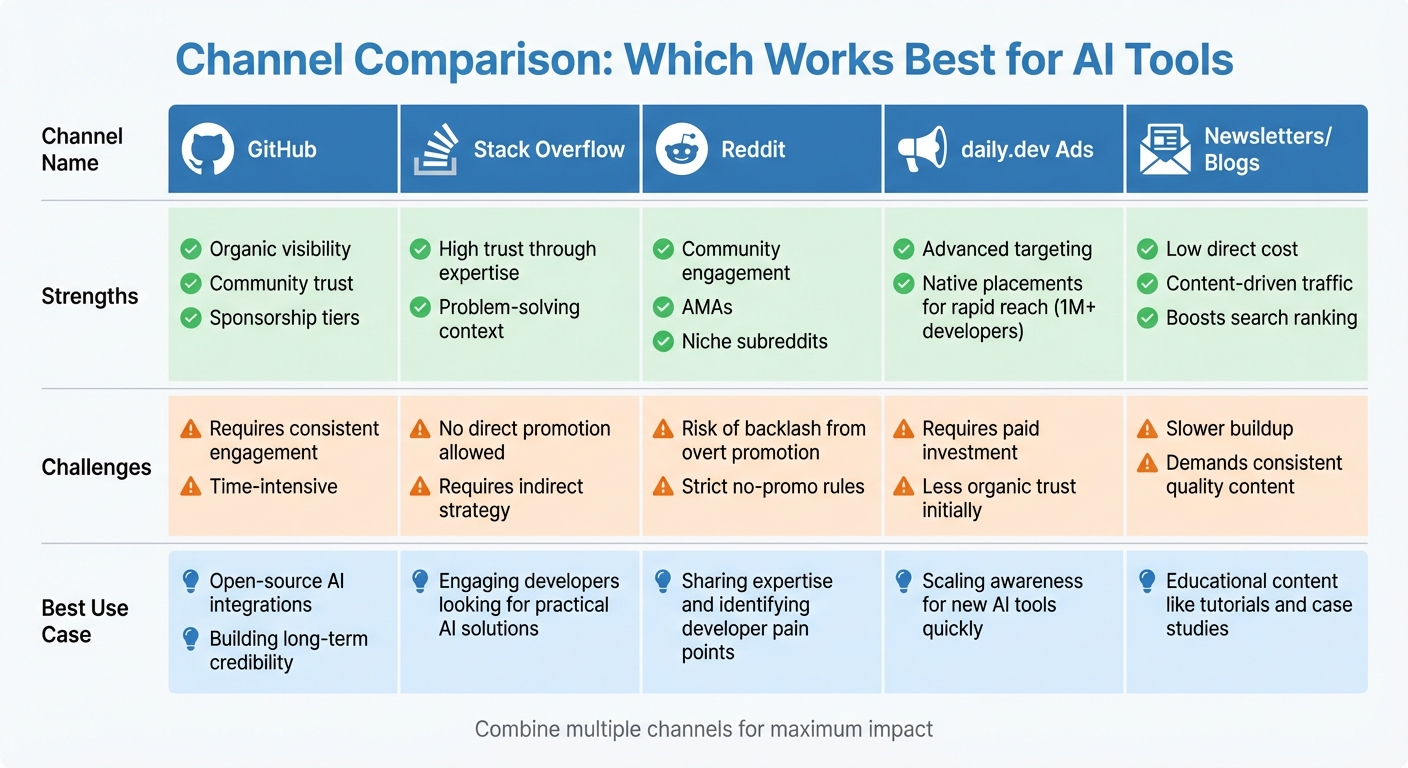 {Developer Marketing Channels Comparison: Strengths, Challenges, and Best Use Cases for AI Tools}
Choosing the right channel depends on your goals and the resources you have at your disposal. For example, GitHub contributions are excellent for building trust among developers, but they demand continuous effort and engagement. On the other hand, Stack Overflow is a powerful tool for generating indirect leads by answering AI-related questions, though it strictly prohibits direct promotion. If you're considering Reddit, it offers great opportunities for community interaction through AMAs and subreddit discussions. However, blatant self-promotion can backfire, so a careful approach is essential.
If you're looking for rapid exposure, daily.dev Ads might be your best bet. This platform uses advanced targeting to reach over 1 million developers worldwide, allowing you to filter by programming languages, tools, and seniority. With native ad placements that blend into developers' workflows, it minimizes ad fatigue while maintaining visibility. This approach contrasts with organic channels, which rely more on content relevance and community participation rather than algorithm-driven targeting.
For a balance between cost-effectiveness and engagement, developer newsletters and platforms like Dev.to are great options. These channels excel at driving traffic through tutorials and case studies, attracting a technically savvy audience. While the buildup is slower compared to paid channels, the trust they generate often results in higher-quality leads over time.
Channel Comparison Table
Here’s a quick side-by-side comparison of each channel’s strengths, challenges, and the best scenarios for their use:
| Channel | Strengths | Challenges | Best Use Case |
|---|---|---|---|
| GitHub | Organic visibility, community trust, sponsorship tiers | Requires consistent engagement, time-intensive | Open-source AI integrations, building long-term credibility |
| Stack Overflow | High trust through expertise, problem-solving context | No direct promotion allowed, requires indirect strategy | Engaging developers looking for practical AI solutions |
| Community engagement, AMAs, niche subreddits | Risk of backlash from overt promotion, strict no-promo rules | Sharing expertise and identifying developer pain points | |
| daily.dev Ads | Advanced targeting, native placements for rapid reach | Requires paid investment, less organic trust initially | Scaling awareness for new AI tools quickly |
| Newsletters/Blogs | Low direct cost, content-driven traffic, boosts search ranking | Slower buildup, demands consistent quality content | Educational content like tutorials and case studies |
When evaluating success, focus on developer-centric metrics like API usage or SDK downloads. Developers value substance over flashy advertising, so channels that allow for technical, straightforward messaging tend to yield better results. Combining multiple channels - like using GitHub for credibility, newsletters for education, and ads for scaling reach - can help you maximize your AI tool's impact.
Conclusion and Next Steps
Promoting your AI tool to developers is all about balancing trust and targeted outreach. Platforms like GitHub, Stack Overflow, and Reddit allow you to build credibility through authentic engagement, while developer-focused spaces like newsletters and Dev.to help position your tool as a helpful resource.
For scaling quickly, daily.dev Ads can be a game-changer. With access to over 1 million developers, it offers targeted placements tailored by programming languages, tools, and even seniority levels.
Start small and refine your approach before going big. Take inspiration from the Wasp team, who, in 2023, grew their open-source SaaS boilerplate to 6,000 GitHub stars in just six months. They used an iterative strategy that not only boosted engagement but also earned them top spots on Google[41]. As you move forward, focus on metrics that developers care about - like GitHub stars and community interaction - rather than traditional marketing benchmarks. Developers value straightforward, technical messaging far more than flashy ads, so continually track and adjust based on what truly resonates with them.
FAQs
Which channel should I start with if I have limited time?
If you're pressed for time, dive into developer discussion boards such as Stack Overflow, Reddit, GitHub, and Discord. These platforms are developer favorites and offer a space for genuine interaction. Concentrate on establishing trust and demonstrating your technical know-how to engage with this audience effectively.
How do I mention my tool without sounding promotional?
When presenting a tool to developers, the key is to focus on practical solutions and technical depth. Instead of using flashy or promotional language, highlight what your tool can do through detailed documentation, code samples, or case studies that solve specific challenges developers face.
Developers value content that feels credible and solution-oriented. Peer validation is also important, so consider sharing real-world examples or success stories that demonstrate your tool’s effectiveness.
To connect with this audience, engage on platforms like GitHub, Stack Overflow, or Reddit. Offer thoughtful, in-depth insights and solutions to questions or problems. By doing so, you position yourself as a helpful resource, not a salesperson. Keep your tone technical and authentic, focusing on the actual value your tool brings to the table.
What metrics should I track to measure developer adoption?
To understand how well developers are adopting your AI tool, focus on metrics that reflect their technical engagement, community involvement, and usage habits. Some key areas to monitor include:
- API call frequency: This shows how often developers are actively using your tool's functionalities.
- GitHub activity: Track contributions, issues raised, and stars to gauge interest and collaboration.
- Documentation views: A spike here can indicate developers are exploring how to use your tool.
- SDK implementation rates: This reveals how many developers are integrating your tool into their applications.
- Feature activation: See which features are being used most often to understand their appeal.
- Onboarding completion: This helps measure how many developers successfully get started with your tool.
By analyzing these metrics, you can get a clearer picture of how your tool is being adopted and its overall impact on developer communities.