

Developers are a highly sought-after audience in 2026, demanding precise, transparent, and value-driven ad strategies. With global ad spending reaching $1 trillion and privacy regulations tightening, choosing the right platform is critical for success. Three standout options for targeting developers are daily.dev Ads, Google Ads, and LinkedIn Ads:
- daily.dev Ads: Focused exclusively on developers, offering behavioral targeting based on tool usage and content preferences. Native ad formats integrate seamlessly into developers' workflows, with CPM pricing starting at $10–$20.
- Google Ads: A versatile platform with vast reach across search, video, and display. Advanced targeting and analytics tools make it ideal for capturing search intent, though costs can be high for competitive keywords.
- LinkedIn Ads: A premium choice for B2B campaigns targeting technical professionals. Offers precise targeting based on job titles and skills, but comes with higher costs and a smaller developer audience.
Key takeaway: Combine platforms to maximize impact - use daily.dev for developer-specific targeting, Google Ads for scale, and LinkedIn Ads for professional outreach.
1. daily.dev Ads
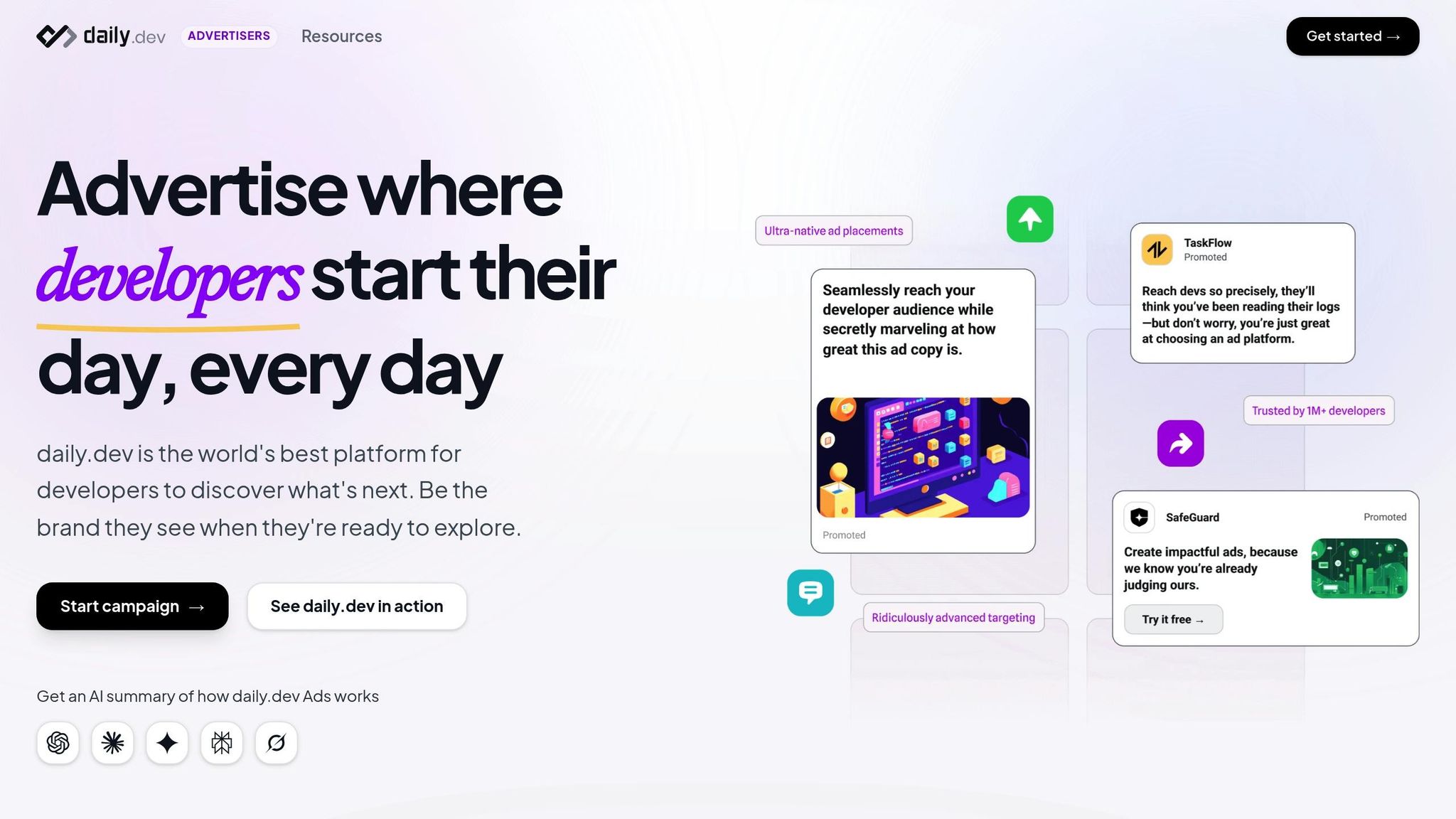
daily.dev Ads connects with over 1 million developers who actively explore tools and technical content. The platform records over 1 billion interactions driven by real developer behavior, reaching about 1 in 50 developers globally . With a 4.8/5 rating on Product Hunt and more than 20,000 GitHub stars, it has established itself as a trusted space for meaningful engagement during high-intent discovery moments. This makes it an ideal choice for advertisers aiming to connect with developers in a precise and impactful way.
Audience Targeting
daily.dev goes beyond standard demographic targeting, offering a behavioral approach that focuses on what developers actually do. Advertisers can tailor their campaigns based on:
- Seniority levels: Aspiring developers, entry-level, mid-level, or senior engineers.
- Programming languages: JavaScript, Python, Java, Swift, Go, and more.
- Tool usage: Docker, Kubernetes, Jenkins, Jupyter Notebook, Visual Studio Code, and others.
By analyzing what developers read, the tools they use, and their engagement patterns, the platform ensures ads are shown to users with genuine interest. For added flexibility, advertisers can choose between global campaigns or focus on specific regions, ensuring their message resonates in the right context.
Ad Formats
daily.dev offers three native ad formats designed to seamlessly integrate into a developer's workflow:
- In-Feed Native Ads: Appear within personalized content feeds, offering high visibility without interrupting the user experience.
- Post Page Ads: Displayed during discussions and content sharing, targeting moments when developers are actively engaged.
- Personalized Digest Ads: Delivered directly to inboxes, customized to align with individual interests for a more direct connection.
These formats are designed to fit naturally into trusted, discovery-driven environments, making them less likely to be skipped or ignored.
Analytics and Performance Tracking
The platform provides advanced analytics tools, including real-time creative testing and A/B testing, specifically designed for technical headlines and developer-focused messaging. Performance metrics are tied to developer behaviors, such as tool usage and content interaction, ensuring ad relevance.
For marketers, the Tech Campaign ROI Estimator is a valuable tool. It allows teams to input budget and reach data to predict conversions and profitability before launching a campaign. Key performance indicators include product adoption, event participation, and qualified lead generation - metrics that matter most to technical brands.
Pricing and ROI
daily.dev uses a CPM pricing model, starting at $10–$20 for developer-targeted campaigns, with a minimum monthly spend of $1,000 . The platform offers three pricing tiers:
- Starter: $1,000/month at $15 CPM
- Pro: $5,000/month at $12 CPM
- Enterprise: Custom pricing
Advertisers have reported a 5x ROI improvement, with developers spending an average of 30 minutes daily on the platform - three times higher than engagement seen with general social ads. Additionally, the Developer Marketing Budget Calculator helps businesses plan campaigns based on their budget, campaign duration, and channel selection, making it a practical option for both startups and larger enterprises.
sbb-itb-e54ba74
2. Google Ads
Google Ads provides a comprehensive advertising platform that spans Google Search, YouTube, the Display Network, and Google Play. This makes it an ideal choice for developer-focused campaigns, offering multi-channel reach to engage technical audiences as they search for solutions, watch tutorials, or explore technical content across various sites and apps .
Audience Targeting
With Google Ads, you can target audiences using specific keywords like "best cloud IDE" or "Python API for data", as well as by location, demographics, and even user behavior. For example, you can target developers who have previously visited documentation pages . These targeting options are paired with ad formats designed to connect with technical users and capture their intent effectively.
Ad Formats
Google Ads offers a range of ad formats tailored to technical audiences:
- Responsive Search Ads: Combine up to 15 headlines and 4 descriptions to dynamically create ads that resonate with users.
- Performance Max Campaigns: Leverage Google's entire inventory, from YouTube to Maps, to optimize for conversions .
- Video Action Campaigns: Showcase demo videos of developer tools to drive conversions .
- App Campaigns: Promote mobile components or SDKs by serving ads across Google Search, Google Play, YouTube, and the Display Network. These campaigns support up to 20 image and 20 video assets, and deep links can direct users straight to specific app content .
This variety ensures that campaigns can be customized to meet the unique needs of technical audiences, whether promoting tools, apps, or developer resources.
Analytics and Performance Tracking
Google Ads excels in performance tracking, offering tools that cater to data-driven marketers:
- Google Ads API: Using Google Ads Query Language (GAQL), marketers can create custom queries to retrieve detailed metrics, from campaign-level data down to individual keywords .
- Firebase Analytics: Perfect for mobile app campaigns, this tool provides free, unlimited tracking of user behavior and app growth .
- Scripts: Automate reporting and make real-time adjustments, such as pausing underperforming keywords .
These tools ensure precise measurement of campaign performance, meeting developers' expectations for transparency and data accuracy. Additionally, bidding strategies can be aligned with specific objectives. For example:
- Use
MaximizeClicksto drive traffic to documentation. - Opt for
MaximizeConversionswith TargetCpa to boost lead generation (e.g., API sign-ups). - Choose
MaximizeConversionValuewith TargetRoas for campaigns promoting paid developer tools .
Pricing and ROI
Google Ads operates on a flexible bidding model, allowing advertisers to set budgets and pay on a CPC (cost-per-click) or CPM (cost-per-thousand-impressions) basis. Costs depend on keyword competition, with technical terms often commanding higher prices in competitive niches.
Automation tools like the Google Ads API and Scripts simplify campaign management by automating tasks such as pausing underperforming keywords or scheduling ads around major developer events . Additionally, webhooks can send lead data directly from Google Ads to CRM systems, helping marketers segment leads more efficiently . This flexibility and automation make it easier to manage budgets and maximize ROI, even for complex technical campaigns.
3. LinkedIn Ads

LinkedIn Ads stands out as a top-tier B2B platform for connecting with developers, delivering a 113% ROI for B2B marketing efforts and accounting for 80% of all B2B social media leads . Its strength lies in leveraging verified professional data, which matches the precision required in developer marketing. The platform allows you to target technical professionals based on accurate job titles, specific skills like "Kubernetes", "React", or "Machine Learning", and even interests tied to particular tech stacks or programming languages . This focus on precision was further enhanced in June 2025 with the introduction of native CRM integration, enabling real-time revenue tracking and providing clarity on which campaigns drive results . Additionally, pairing LinkedIn ads with organic branding can amplify conversion rates by up to six times, highlighting the value of a combined approach . These features make LinkedIn Ads a powerful tool for crafting campaigns tailored to technical audiences.
Ad Formats
LinkedIn offers a variety of ad formats designed to resonate with technical audiences:
- Thought Leader Ads: These ads let you sponsor posts from verified developers or engineers on your team, fostering trust within the developer community .
- Document Ads: Share technical whitepapers or guides directly within the feed - no landing page required .
- Video Ads: Known for driving 300% more engagement compared to static formats .
- Lead Gen Forms: With auto-filled data from user profiles, these forms achieve a conversion rate of 13%, over five times the industry average .
Analytics and Performance Tracking
LinkedIn Ads provides advanced analytics that integrate seamlessly into your broader campaign strategy. Features include:
- Real-time Reporting: Detailed professional demographics let you see exactly who is engaging with your ads.
- AI-Powered Optimization: Automatically adjusts bidding, ad placement, and creative delivery for better performance.
- Predictive Analytics: Helps estimate long-term pipeline impact, a critical feature given that B2B sales cycles average 211 days .
- Conversion Tracking: Tracks specific outcomes such as API key requests, documentation downloads, and webinar sign-ups .
Pricing and ROI
The platform's pricing reflects its premium targeting capabilities. Average CPC ranges from $6.50 to $10, CPM is between $33 and $65, and cost per lead typically falls between $150 and $400 . While these costs are higher than other platforms, the quality of leads makes the investment worthwhile. Notably, Q3 is the most profitable period, delivering a pipeline ROI of 6.01x for every dollar spent .
Pros and Cons
::: @figure 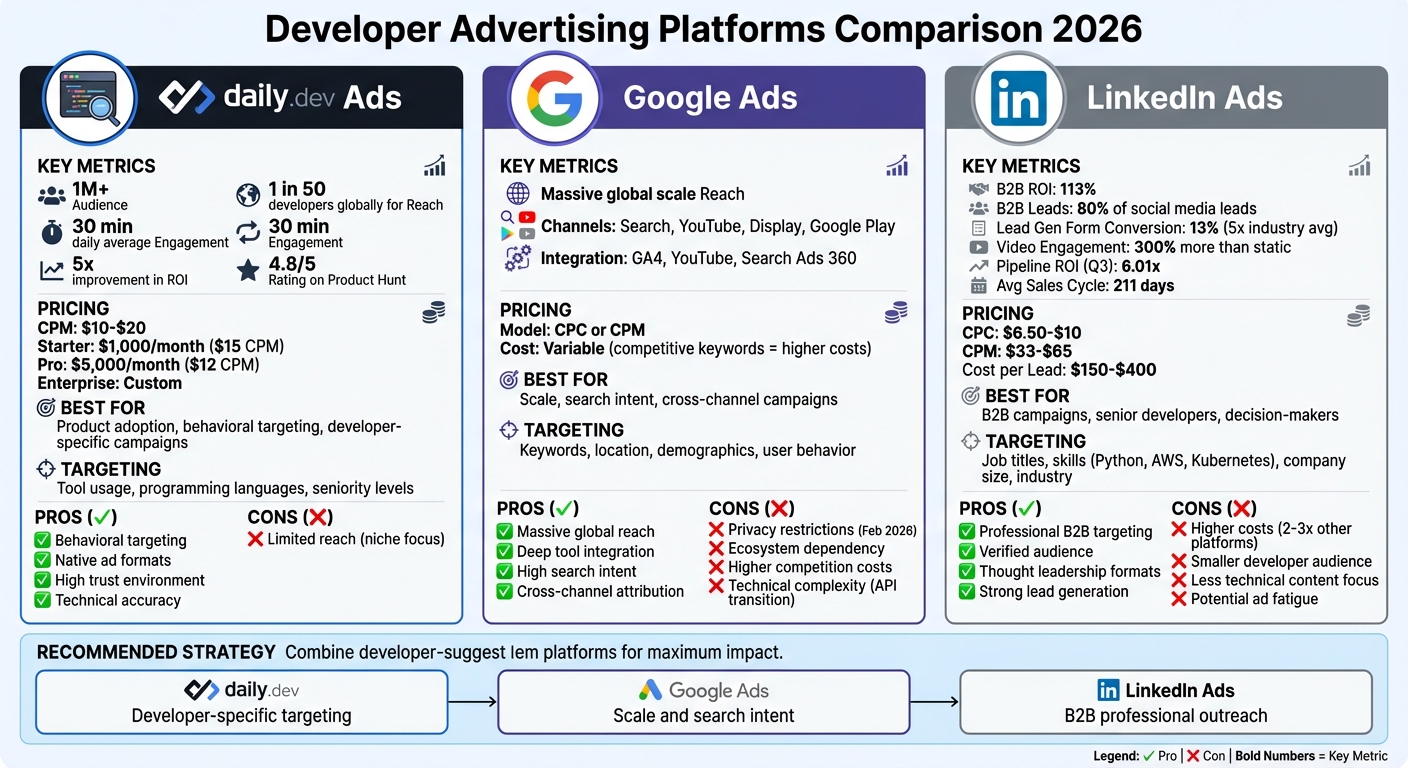 {Developer Advertising Platforms Comparison 2026: daily.dev vs Google Ads vs LinkedIn Ads}
Here's a quick overview of the strengths and weaknesses of each platform to help fine-tune your campaign strategy:
| Platform | Pros | Cons |
|---|---|---|
| daily.dev Ads | - Behavioral targeting leverages specific tool usage and content engagement, ensuring precise developer intent matching - Native ad formats blend smoothly into developer workflows, reducing disruptions - High trust environment within a developer-focused community - Technical accuracy through clear headlines and transparent labeling |
- Limited reach due to its niche focus on a developer-specific audience |
| Google Ads | - Massive global reach across search, display, video, and connected TV - Deep integration with Google Marketing Platform tools like GA4, YouTube, and Search Ads 360 for unified targeting - High search intent targeting for developers actively seeking solutions - Cross-channel attribution enables comprehensive performance tracking |
- Strict privacy restrictions starting February 2026 will limit session attribute and IP imports - Ecosystem dependency reduces independent control over data - Higher competition inflates costs for developer-related keywords - Increased technical complexity due to the mandatory Data Manager API transition |
| LinkedIn Ads | - Professional B2B targeting based on job titles, skills (e.g., Python, AWS), company size, and industry - Verified professional audience for precise targeting - Thought leadership formats like Sponsored Content and Thought Leader Ads help establish credibility - Strong lead generation through effective Lead Gen Forms |
- Higher costs with cost-per-click often 2–3× more than other platforms - Smaller developer audience compared to tech-specific platforms - Less focus on technical content discovery as it prioritizes professional networking - Potential ad fatigue among users primarily interested in networking |
Choosing the right platform depends on your campaign goals. Google Ads provides unmatched reach and advanced targeting but requires adapting to upcoming API changes and managing competitive costs. LinkedIn Ads is ideal for B2B campaigns targeting verified professionals, though it comes with a higher price tag and a smaller pool of developers. On the other hand, daily.dev Ads excels in developer-specific targeting through behavioral data and native ad formats that align with the technical audience's preferences . Weigh these factors carefully to align your strategy with your objectives.
Conclusion
Selecting the best advertising platform for developer campaigns in 2026 hinges on aligning your goals with the strengths of each platform. If your focus is on product adoption or lead generation, daily.dev Ads stands out. With its behavioral targeting capabilities and over 1 billion interactions, it connects you with high-intent developers across the globe with precision.
For campaigns requiring a broader reach, Google Ads is hard to beat. Its massive scale, combined with GA4 and YouTube integration, ensures visibility - even as the new API restrictions take effect on February 2, 2026.
On the other hand, LinkedIn Ads is particularly effective for B2B campaigns, offering robust tools to target senior developers and decision-makers. With verified profiles and filters like job titles, skills (e.g., Python, AWS), and company size, it’s ideal for reaching niche professional audiences.
A winning strategy often involves combining platforms. For example:
- Leverage daily.dev Ads for connecting with developers actively seeking solutions.
- Use Google Ads for scale and capturing search intent.
- Tap into LinkedIn Ads for precise B2B targeting.
Regardless of the platform, the key is to create ads that lead to seamless user experiences and address genuine problems immediately. Start small by focusing on one platform that aligns with your main objective, monitor performance closely, and expand based on conversion data.
In 2026, successful developer advertising will reward campaigns that prioritize technical accuracy, privacy-first approaches, and meaningful value over outdated marketing tactics. The combination of precision targeting and frictionless user experiences will be your edge in this ever-evolving landscape.
FAQs
How do I choose the right platform for my developer marketing goal?
To pick the best platform, start by understanding your target audience, your campaign objectives, and the unique features each platform offers. Pay attention to where developers spend their time and how they interact on those platforms. For instance, platforms like daily.dev offer native ad options that let you target developers based on factors like programming language or seniority. This makes them a great choice for goals like lead generation or driving product adoption. Align your campaign goals - whether it's building awareness, boosting engagement, or driving conversions - with the platform’s capabilities to get the best results.
What ad creative works best with developers in 2026?
By 2026, the most effective ads targeting developers will prioritize technical precision, relevance, and credibility. Forget about broad, generic messaging - developers are drawn to content that directly addresses their specific needs. This could mean showcasing exact technical details, such as API compatibility or providing code snippets that solve real-world problems.
Developers also respond well to ads that seamlessly integrate into their workflows. Think ads placed in IDEs, technical documentation, or other tools they already rely on. These placements feel less intrusive and more like a natural extension of their work environment.
To truly resonate with this audience, personalization is key. Ads should be targeted based on developers' roles, industries, or even the tools they use. Additionally, backing up claims with clear evidence - like performance benchmarks or case studies - helps establish trust and encourages engagement.
How can I measure ROI while staying privacy-compliant in 2026?
In 2026, balancing effective ROI measurement with privacy concerns will require a smarter approach. Advanced attribution models, like multi-touch attribution, are key. These models help evaluate multiple touchpoints along the customer journey without relying on invasive tracking methods.
Instead of intrusive data collection, focus on behavioral data. For example, track how users engage with resources like tutorials or code samples to identify high-quality leads. This approach provides insights into user intent without compromising privacy.
To stay compliant with privacy regulations, rely heavily on first-party data. Combine this with real-time performance tracking to fine-tune your campaigns. Monitor actionable metrics such as conversion rates and engagement depth to make informed adjustments, ensuring your efforts remain both effective and respectful of user privacy.