

Developers trust data, not hype. To convince them your tool works, you need case studies that show measurable results, real challenges, and solutions they can verify. A good case study follows a clear framework: define the problem, explain the solution, and back it up with hard numbers. For example, showcasing how a tool reduced API response time by 89% or cut manual work from 15 hours to 2 resonates with engineers.
But creating a solid case study isn’t enough. You need to get it in front of the right audience. Platforms like daily.dev Ads help you target developers based on their skills, seniority, and interests. By using native ad formats like in-feed ads or personalized digests, you can ensure your success stories land where they’ll have the most impact.
Key takeaways:
- Developers value data-driven proof, clear results, and transparency over marketing claims.
- Use metrics engineers care about, like efficiency gains or performance improvements.
- Add testimonials and visuals (charts, graphs) to strengthen your case.
- Platforms like daily.dev Ads help distribute case studies to over 1 million developers, boosting engagement and conversions by 3–5×.
The bottom line: Build trust with developers by combining credible case studies with targeted promotion.
::: @figure 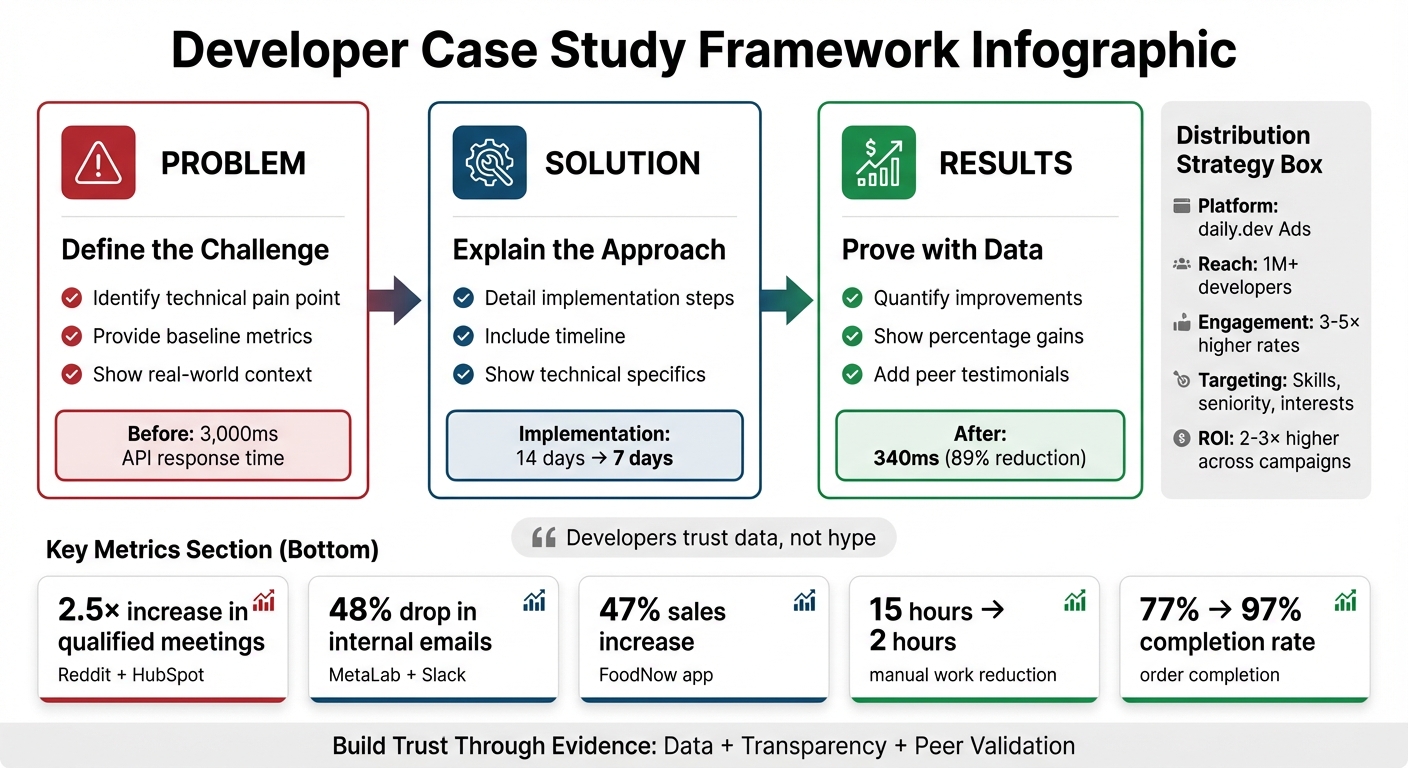 {Developer Case Study Framework: Problem-Solution-Results with Key Metrics}
What Makes a Case Study Work for Developers
Developers look for solid evidence, backed by data they can trust. A strong case study for engineers follows a clear structure, uses metrics that matter to them, and doesn’t shy away from discussing real-world limitations.
Problem-Solution-Results Framework
The best case studies align with how developers think: they identify a technical challenge, explain the solution, and validate the results with hard data. This approach, often called the Challenge-Solution-Results (CSR) framework, keeps the story grounded and relatable .
Start by outlining the initial problem. For instance, Reddit’s sales team struggled with scaling. After adopting HubSpot Sales Hub, they saw a 2.5x increase in qualified meetings without adding staff and cut their sales cycle from 90 to 45 days . Notice how the "before" numbers make the "after" results more impactful.
Make the process feel authentic by detailing the implementation timeline. For example, MetaLab’s case study with Slack highlighted a 48% drop in internal emails and decisions being made 25% faster, all while documenting their step-by-step consolidation process .
"A case study is a documented example of how a person or company solved a specific problem using a specific approach, with real context and real outcomes."
- Waleria Pagowska, Brand24
Don’t shy away from mentioning challenges along the way. Stories that seem too perfect can feel like marketing fluff and fail to build trust .
This structured approach naturally leads into presenting clear, measurable metrics.
Using Numbers and Technical Details
Once the narrative is clear, solid data brings it to life. Engineers care about time and efficiency, so focus on metrics they value. For instance, instead of vague ROI claims, quantify the impact: cutting manual work from 15 hours per week to just 2 hours . Or, highlight improvements like reducing API response time from 3,000ms to 340ms - an 89% reduction that increased order completion rates from 77% to 97% for the FoodNow app .
Avoid overly specific claims that might seem exaggerated. Saying a tool saves "exactly 28 minutes per week" can sound suspicious . Stick to rounded, believable figures, and always provide context by anchoring your data with baselines, timeframes, and clear metrics .
In addition to numbers, personal stories and visuals can make your case even stronger.
Customer Testimonials and Visual Data
While numbers show results, testimonials from real engineers add credibility. Developers trust the voices of their peers over generic marketing language. Instead of vague praise like "They were great to work with", detailed quotes carry more weight. Take this example from Khalid Al-Suwaidi, Founder of FoodNow:
"Khalid Al-Suwaidi, Founder of FoodNow, remarked, 'Ahmed literally saved our project. We were losing customers daily due to app slowness. After his updates, sales increased 47% and complaints dropped to nearly zero'" .
Visuals also play a key role in grabbing attention and clarifying results. Charts, graphs, and infographics can make data more digestible . For example, Gainsight’s case study with Gong highlighted that top performers asked 47% more questions, leading to a 19% increase in close rates for the team within a single quarter .
To make your case study even more skimmable, include a stats box that highlights 3–5 key metrics . And don’t underestimate the power of video testimonials - these can boost conversion rates by up to 80%, with two-thirds of consumers more likely to take action after watching a customer video .
sbb-itb-e54ba74
Case Study Examples from daily.dev Ads Campaigns
daily.dev Ads campaigns demonstrate how targeted placements can drive measurable engagement and adoption, aligning perfectly with the case study framework discussed earlier.
Here are three examples showing how daily.dev Ads successfully boost technical engagement.
Promoting Monetization Tools with In-Feed Ads
A SaaS company offering developer monetization platforms targeted mid-to-senior developers with over three years of experience, focusing on those working in JavaScript and Python. By using in-feed ads, the company placed its messaging directly within content streams where these developers were already active.
The results? A 30% boost in engagement, a 25% increase in sign-ups, and $50,000 in revenue generated within just 60 days. ROI was tracked with precision, thanks to detailed metrics . The campaign also tackled fragmented revenue tracking by highlighting unified analytics and A/B testing integrations. Users saw revenue optimization improve 40% faster, supported by clear growth charts and before-and-after visuals .
This example underscores the potential for diverse and impactful campaign strategies.
Growing Custom Integration Adoption with Post-Page Ads
An API orchestration platform utilized post-page ads to emphasize seamless integrations with popular tech stacks like React and Node.js. These ads targeted developers at their highest point of interest, delivering impressive results: a 45% reduction in time-to-first-integration (from 14 days down to 7), a 35% adoption rate among those exposed, and conversion rates twice as high as standard banner ads . Developer testimonials further validated the campaign's effectiveness .
This case highlights how well-timed placements can amplify technical messaging.
Marketing Search Tools with Personalized Digest Ads
A search optimization tool, similar to Algolia, used personalized digest ads tailored to developers' specific interests, such as full-stack development. These ads showcased improvements like a 60% reduction in search latency and a 40% boost in relevance - results verified by third-party audits to build trust with engineers . The tool also addressed a 20% error rate by implementing ML-based indexing, achieving 50% faster query speeds. Before-and-after graphs and quotes from engineering leads made the technical results easy to digest and credible .
These precisely targeted ads, combined with technical visuals and reliable metrics, delivered 2-3x higher ROI across all campaigns .
How to Present Technical Results to Engineers
Engineers rely on data they can verify. To effectively present technical results, focus on clarity, reproducibility, and addressing specific developer challenges. Engineers value precise metrics, transparent methods, and approaches they can replicate. Below are practical ways to ensure your results are clear and trustworthy.
Visualizing Key Metrics
Proper visualizations can make technical data easier to understand. The type of chart you choose should match the data you're presenting. For instance:
- Treemaps work well for hierarchy.
- Sankey diagrams are ideal for pipelines.
- Force-directed graphs help illustrate dependencies .
For performance metrics, use color gradients (from cool to warm) in tables to highlight regressions or outliers, making them easy to spot without requiring readers to sift through raw numbers . Enhance these tables with sparklines and percentage change indicators (+/- %) to show trends over time . When presenting latency data, histograms are particularly effective for displaying percentile distributions. This is crucial since 69% of developers report losing eight or more hours weekly to inefficiencies like technical debt and overly complex processes .
Including Reproducible Details
To build trust with developers, your results must be verifiable. Include specifics like OpenTelemetry code, collector configurations, and histogram bucket boundaries. Keep the main content streamlined by placing raw data and detailed appendices elsewhere .
Explain why you chose certain tools or frameworks, not just the results they produced . Provide code snippets, diagrams, or step-by-step workflows that detail how you achieved your results. This level of transparency is essential, especially when 66% of organizations admit to shipping untested code to meet deadlines . Clearly define success metrics and outline how you assessed the effectiveness of your solution . These details validate your findings and help address key developer concerns.
Addressing Developer Pain Points
Once you've established clarity and reproducibility, focus on the real challenges developers face. Tailor your case study to issues like scalability, performance, and integration. Highlight outcomes that developers care about. For example, emphasize "reduced page load time by 50%" rather than "closed 20 tickets" . Developers appreciate concrete evidence, such as a "3x increase in conversion rates", instead of vague claims .
Cover both technical improvements (e.g., 5–10% increased activation) and the confidence your solution inspires . Use before-and-after visuals to make results more relatable , and back your claims with third-party validation from sources like G2, Clutch, or technical partners such as AWS . Remember, it takes an average of 23 minutes for a developer to refocus after a context switch . To keep their attention, make your case study easy to skim with clear headings and a detailed table of contents .
"When you say it, it's marketing. When your customer says it, it's social proof." - Andy Crestodina
Using daily.dev Ads to Promote Your Case Studies
If you’ve built a strong case study, the next step is making sure it reaches the right audience. That’s where daily.dev Ads come in. With access to over 1 million developers actively searching for tools, this platform gives you a way to present your success stories directly to those who will appreciate them most. Featuring native ad formats like in-feed, post-page, and personalized digest ads, daily.dev Ads integrate seamlessly with organic content, achieving 3–5× higher engagement rates. This makes it a powerful tool for promoting case studies that need developer attention.
Here’s how you can use daily.dev Ads to connect with the right developers and maximize the impact of your case studies.
Targeting the Right Developer Audience
Getting your case study in front of the right developers requires precision. daily.dev Ads offers a range of targeting options, including filters for developer seniority (junior, mid-level, senior, and staff), programming languages (like JavaScript, Python, Go, and Java), and specific tools or technologies (such as React, Kubernetes, and AWS). For instance, if your case study highlights how a monetization tool helped senior engineers increase revenue, you can target developers who face similar challenges.
Using the daily.dev Ads dashboard, you can refine your audience by:
- Filtering by seniority level
- Adding language and tool-specific filters (e.g., Node.js for backend tools or Python for data solutions)
- Creating custom audiences based on past converters
- Excluding low-intent users with exclusion lists
Even small-budget campaigns can deliver impressive results. Tests often show a 20–30% higher click-through rate for technical case studies, with an average cost-per-click ranging from $0.50 to $2.00 USD. Once you’ve defined your audience, the next step is crafting ad creatives that resonate with them.
A/B Testing Case Study Creatives
Developers respond differently to various ad formats and messaging, so A/B testing is essential. To find what works best, test 3–5 creative variations per campaign. Experiment with:
- Formats: Static images versus carousels with metrics graphs
- Headlines: For example, "Boosted Revenue 340% with Our Tool" versus "How X Solved Y for Engineers"
- Calls-to-action: Options like "Read Case Study" or "See Results"
Track key metrics such as click-through rates, conversion rates, and engagement time. Allocate about 20% of your budget to testing, and scale the winning variations after reaching 1,000 impressions. This approach can improve performance by 50–80% in B2B tech ads.
For example, carousels often achieve double the click-through rate of single images. In early 2024, Cal.com used daily.dev In-Feed Ads to promote their scheduling API to senior JavaScript developers. By A/B testing headlines like "300% Faster Bookings" against testimonials, they achieved a 2.8% click-through rate, 1,200 sign-ups, and a 45% conversion rate - resulting in $45,000 in attributed revenue at just $1.20 CPC.
Using Platform Features for Better Results
daily.dev Ads includes tools designed to boost the visibility and effectiveness of your campaigns. Real-time analytics allow you to monitor performance metrics like impressions, clicks, and conversions. This makes it easy to adjust your strategy mid-campaign, such as pausing underperforming ads. Creative guidance tools also offer suggestions for optimal formats based on audience data.
Native ad placements - whether in feeds, post pages, or personalized digests - blend seamlessly with the content developers are already consuming. This integration builds trust and increases view-through rates by 40%, making your case studies more impactful. By embedding key elements directly in your ads, such as teaser metrics or links to full PDFs and videos, you can create a more engaging experience.
In September 2023, Supabase ran Post-Page Ads to promote their Postgres integration case study to 50,000 Python developers. They tested visuals like metrics graphs versus quotes, achieving a 28% increase in sign-ups and a 4.1× return on ad spend. Maria Lopez, Supabase’s Marketing Head, used real-time tracking to fine-tune the campaign. This strategy not only boosted visibility but also drove an 80% increase in tool adoption - proving how effective daily.dev Ads can be for B2B campaigns.
Conclusion
Case studies help transform awareness into trust, especially among developers. Engineers aren't swayed by flashy marketing - they need solid evidence that your tool solves genuine problems. As markepear.dev puts it:
"Testimonial ads are a format that helps you move people from 'I know what you are doing' to 'I trust you.'"
By showcasing specific metrics, technical insights, and peer validation, you create the kind of social proof that converts skepticism into confidence. Developers value straightforward messaging - clear explanations without unnecessary jargon .
With daily.dev Ads, you can amplify your case studies to over 1 million active developers. These ads allow precise targeting based on seniority, programming languages, and tools, ensuring your success stories reach the right audience. Native ad formats integrate seamlessly with organic content, making your message feel more authentic.
Leverage daily.dev Ads to test various creatives, monitor performance in real time, and scale what resonates. When your case studies demonstrate how your tool solves real challenges developers face, and you pair that with targeted promotion, you build trust and drive adoption effectively.
FAQs
What metrics do developers trust most in a case study?
Developers tend to trust customer ratings, reviews, and testimonials the most. These forms of social proof carry weight because they showcase real-world experiences and outcomes, making it easier for developers to evaluate credibility and effectiveness.
How do I make my case study results reproducible and credible?
To make your case study results impactful and trustworthy, it's essential to focus on quantifiable ROI and use specific metrics to showcase value. A well-structured case study built around the Challenge-Solution-Results framework helps make your outcomes more concrete and relatable.
Here’s how to do it:
- Highlight measurable improvements: Use clear data points like percentage increases, cost reductions, or time saved. These details create a strong impression and show real-world impact.
- Get client approvals: Always secure permission from clients before publishing. It not only ensures accuracy but also bolsters credibility.
- Make it skimmable: Design your case study with busy stakeholders in mind. Break up content with headings, bullet points, and visuals to make key takeaways easy to spot.
By focusing on clarity and structure, you’ll make your case study results more accessible and persuasive for your audience.
Which daily.dev Ads format works best for promoting a case study?
In-Feed Native Ads are the top choice for promoting a case study on daily.dev. These ads are crafted with developers in mind, making them a perfect fit for engaging this audience while establishing trust. They allow you to highlight your case study in a way that aligns seamlessly with the interests and preferences of the technical community.