

Developers don’t buy into flashy marketing - they look for solutions. The best way to market developer tools is through high-quality, technical content that solves real problems. Developers evaluate your product through tutorials, documentation, and code examples before committing to a trial. Here’s what works:
- Tutorials: Step-by-step guides with accurate code samples.
- Comparison Content: Honest evaluations of tools and alternatives.
- Case Studies: Data-driven success stories from real users.
- Technical Documentation: Clear, up-to-date resources that double as a marketing tool.
Consistency matters. Publishing 2–5 posts weekly, targeting developer pain points, and distributing content across platforms like Reddit, Hacker News, and Dev.to can drive growth. Metrics like documentation engagement and trial activations are more meaningful than pageviews. The key? Provide value first, earn trust, and let your content do the selling.
Content Types That Work Best for Developers
When it comes to connecting with developers, not all content formats deliver the same results. Developers value content that solves real problems and offers immediate utility - no sign-ups, no fluff, just practical solutions.
Tutorials are a go-to format for this audience. With code samples and step-by-step screenshots, they provide hands-on learning for specific engineering challenges. Accuracy is everything here; one broken code example can send developers elsewhere. Mudit Singh, Director of Marketing at LambdaTest, highlights the importance of keeping tutorials up to date:
"We have to refresh content nearly every week, to ensure that past content is still relevant. This is especially true for tutorials, where we have to ensure the latest updates in tech or feature changes are incorporated."
While tutorials build trust, comparison content is crucial for developers in the decision-making phase. Searches like "Postgres vs. MySQL" or "alternatives to [competitor]" often indicate developers are weighing their options. The best comparisons are transparent, openly acknowledging your product's limitations and even recommending competitors where they excel. This level of honesty can establish credibility that overly promotional content simply can't achieve.
Next, case studies add another layer of trust by providing real-world proof. These stories resonate when they include concrete results, like a 40% reduction in latency or saving $15,000 per month on infrastructure costs. Developers appreciate seeing how others have tackled similar challenges, using hard data to back up the claims.
Finally, technical documentation plays a dual role: it supports users while also serving as a marketing tool. Developers often review documentation before even signing up for a trial, using it as a measure of overall product quality. Keith Lacy, a marketing strategist, sums it up well:
"The quality, depth, and honesty of your documentation is a direct signal of how seriously you take your developer audience."
Effective documentation doesn’t just explain features - it addresses specific problems, like "how to handle rate limiting." By focusing on problem-solving, you can attract high-intent traffic from developers actively searching for solutions.
Building a Technical Blog Strategy
A technical blog without a strategy is just a random collection of posts. Developers can quickly spot the difference between intentional, well-planned content and disorganized efforts. Consistency and purpose are key to earning their trust.
Choosing High-Impact Topics
The most effective technical topics address real-world problems. Start by creating a pain point backlog. Dive into platforms like Stack Overflow, Reddit's r/programming, or GitHub Issues to uncover recurring challenges in your field. You can also tap into your engineering team - ask them about the toughest problems they faced before your tool existed. These insights lead to topics that resonate because they stem from actual developer experiences .
Your content should also match the developer's stage in their journey:
- Discovery phase: Developers are asking, "How do I achieve this outcome?" They need conceptual guides or technology comparisons.
- Evaluation phase: The question becomes, "Can I integrate this with my stack?" Quickstarts with runnable code samples are ideal here.
- Mastery phase: At this stage, they're troubleshooting advanced issues. Offer in-depth tutorials or production-level best practices .
Striking a balance between "evergreen" content and "spiky" viral pieces is crucial. Evergreen posts consistently bring traffic, while spiky content can generate buzz on platforms like Hacker News. For example, in early 2026, Robert Gibb at fabric.inc published a niche technical post that hit Hacker News' front page, leading to 5 demo requests in a single day. This approach contributed to a 3x increase in referral traffic and keyword rankings within weeks .
As Vo Tu Duc from ContentDrive explains:
"The goal is not to persuade them that your product is the best solution. The goal is to create content so useful that, in the process of solving their problem, they discover for themselves that your product is the best solution."
Once your topics are lined up, stick to a consistent publishing schedule to maintain momentum.
Setting Your Publishing Frequency
When it comes to publishing, consistency is more important than sheer volume. That said, maintaining a steady output is critical for gaining traction. For most technical blogs, publishing twice a week is a solid starting point . If your goal is ambitious - like reaching 100,000+ monthly pageviews within a year - you'll need to aim for 3–5 high-quality posts per week .
Take ContainIQ as an example. Between 2022 and 2023, CEO Nate Matherson led a strategy that produced 225 technical articles in just 14 months. By the end of that period, the site attracted over 200,000 monthly visitors, contributing to the company’s acquisition in 2023 . Growth often follows a predictable pattern: 10,000 visitors after 3 months, 50,000 after 6 months, and 150,000+ after a year of consistent publishing .
Avoid bottlenecks in your approval process. If every post needs the CEO’s sign-off, you’ll struggle to maintain the speed required for growth . Empower your technical team or trusted partners to ensure quality while keeping the schedule on track. A dependable publishing cadence builds credibility and signals to developers that you’re committed to serving their needs.
Who Should Write: Engineers and Developer Advocates
Developers can tell when content is written by someone without hands-on experience. That’s why practicing engineers should create your content . Their technical expertise and real-world perspective make tutorials practical and architecture posts credible - qualities that are essential for engaging a developer audience.
If pulling engineers away from core tasks isn’t feasible, consider building a writer pool of external engineers with expertise in areas like DevOps, AI infrastructure, or cybersecurity. Every piece should still undergo a thorough technical review by a full-time engineer to validate code snippets, logic, and feasibility .
Developer advocates are another excellent resource. They combine product knowledge with an understanding of the developer community, making them well-suited to translate complex concepts into accessible content. As Ravi Dehar from Gusto shared about working with Draft.dev:
"Draft.dev really accelerated our developer-focused marketing efforts... without pulling away our internal technical teams to write that content."
This approach ensures your content remains accurate and credible while keeping your strategy sustainable over the long term.
Using Documentation as a Marketing Channel
When thinking about technical blogs and strategies, it’s crucial to see documentation not just as support material but as a key marketing tool. Many developer tools treat documentation as an afterthought, something to be thrown together after a product launch. That approach misses the mark. Documentation is often the first real interaction developers have with your product - it’s where your marketing promises meet technical reality, even before someone signs up or talks to sales .
Modern B2B buyers, especially technical ones, spend most of their decision-making process doing independent research. For these audiences, documentation plays a central role in the evaluation process .
What Makes Documentation Stand Out?
Good documentation builds trust. Developers judge it on factors like:
- Accuracy: Every code example should be tested and ready to run.
- Completeness: Cover edge cases, not just the easy, ideal scenarios.
- Transparency: Be upfront about limitations or constraints.
- Up-to-date Information: Regular updates signal that the product is actively maintained .
Failing on any of these points - like outdated code samples or placeholder "coming soon" pages for core features - can lead to immediate disengagement . Onyeanuna Prince, a Technical Writer and DevOps Engineer, sums it up well:
"Documentation is not just a supporting artifact but a marketing tool in its own right. It communicates product value, builds trust at the moment of highest intent, and plays a direct role in adoption."
Aligning Marketing and Documentation
Your marketing materials and documentation need to work together seamlessly. Use consistent terminology across both. For instance, if your homepage calls a feature "Real-Time Sync", don’t refer to it as "Live Updates" in your docs . Every marketing use case should have a corresponding implementation guide in your documentation. This alignment ensures developers don’t feel lost when moving from your website to your documentation .
In Product-Led Growth (PLG) models, documentation often takes the place of a sales team. There’s no sales engineer to answer questions about implementation, so your documentation needs to cover everything - from basic authentication to advanced topics like rate limits . The Splunk Documentation Team captures this perfectly:
"There is no definition of 'done' without docs. Customer documentation is part of the working software."
Treat Your Documentation Like a Product
Your documentation site deserves the same attention as your marketing pages. Focus on:
- Search functionality: Make it fast and effective.
- Clear structure: Organize information intuitively.
- Mobile optimization: Ensure readability on all devices .
For technical SEO, target specific, high-intent queries like "How to implement OAuth with [Your API]" or "Python library for [your use case]" . A well-crafted quickstart guide should help developers achieve a "Hello World" result in under 15 minutes .
Finally, track metrics like time spent in documentation before conversion, how often prospects view documentation, and how engagement with docs correlates with trial-to-paid conversions . These insights can help you refine your approach and make documentation a powerful driver of growth.
Distributing Content Beyond Your Blog
Publishing great technical content on your blog is just the first step. To truly connect with developers, you need to take your content beyond your site and into the spaces they frequent. Developers aren’t sitting around waiting for your RSS feed updates - they’re actively exploring forums, communities, and platforms to find tools and insights. Your distribution strategy should align with where they’re already spending their time.
One effective tactic is the "write once, distribute five times" approach. This means taking a single article and repurposing it across multiple platforms - like turning it into a Twitter thread, a Reddit post, a newsletter pitch, a Hacker News submission, or a cross-post on Dev.to. While each platform may require tweaks in tone or format, the core message stays the same, allowing you to maximize your reach.
Developer Communities and Newsletters
Developers are naturally cautious about traditional marketing. They use ad blockers, avoid sponsored content, and can spot a sales pitch from a mile away. To earn their attention, your content needs to offer genuine value - practical insights that stand on their own, without feeling promotional.
- Hacker News: When posting here, stick to clear and descriptive titles - no clickbait. Submit during U.S. business hours for better visibility, and engage in the comments to spark discussions and build trust. Don’t just drop a link; participate in the conversation.
- Reddit: Focus on niche subreddits rather than broad communities. Share a brief summary of your article’s key points alongside the link. This shows you’re contributing to the discussion, not just promoting your content.
- Twitter: Turn your article into a thread, breaking down the main takeaways into bite-sized tweets. A preview of the most valuable insights can encourage readers to click through without relying on a generic caption.
- Newsletters: Personalize your pitch when reaching out to curators. Highlight a unique angle or explain why your content is particularly relevant to their audience. Avoid sending generic, one-size-fits-all emails - they’re likely to be ignored.
- Dev.to and Hashnode: Use canonical URLs to link back to your original post, preserving SEO benefits while extending your reach. On these platforms, detailed tutorials, original research, and experience-based posts tend to perform better than simple listicles or surface-level tips.
Additionally, consider using tools like daily.dev to complement your organic efforts.
Using daily.dev Ads to Boost Reach
Organic distribution is great for building credibility over time, but daily.dev Ads can help you amplify your content quickly within a trusted developer ecosystem. These ads integrate directly into developers’ daily feeds, offering seamless exposure.
With targeting options based on seniority, programming languages, and tools, you can ensure your tutorials or articles reach the right audience. Native placements - such as in-feed ads, post page ads, and personalized digest placements - position your content alongside material that developers are already engaging with.
Plus, real-time performance tracking lets you see what’s working and adjust your strategy for even better results. Combining organic outreach with tools like daily.dev Ads can help you connect with developers in meaningful ways while expanding your content’s reach.
Repurposing Technical Content Across Channels
Expanding on content distribution strategies, repurposing allows you to extend your reach by tailoring content to fit each platform. Publishing a single piece of technical content once and leaving it at that means missing out on a much larger audience. Research shows that 94% of marketers repurpose content, and those who do so systematically can achieve up to three times more output without increasing production time . The trick lies in reformatting your blog posts or tutorials into platform-specific formats that feel natural - avoiding the trap of simply copy-pasting links everywhere.
The process begins by breaking your technical content into smaller, digestible parts like key statistics, insights, frameworks, or quotable points . For instance, a 2,000-word tutorial can transform into a Twitter thread, a LinkedIn carousel, a short video clip, and an email teaser - all derived from the same material. A great example of this comes from Jamie Partridge, CEO of PostEverywhere, who repurposed a blog post about AI content tools in September 2024. While the original blog garnered around 2,000 views, the repurposed pieces reached approximately 90,000 people. This included 47,000 impressions from LinkedIn posts, 12,000 views on a Twitter thread, 8,500 views on an Instagram carousel, and 23,000 combined views on two YouTube Shorts . This approach not only amplified the content’s reach but also aligned with broader strategies for marketing developer tools.
To make the most of repurposing, adapt your content to match the tone and format of each platform. For example:
- Twitter Threads: Break down a blog post into a 5–7 tweet thread with a compelling hook at the start and a link to the full post at the end .
- LinkedIn Carousels: Turn a technical framework into a 5–7 slide carousel using a 4:5 aspect ratio and minimal text (less than 30 words per slide) .
- Short Video Clips: Record a 60–90 second video highlighting one key insight. Since 85% of social video is viewed without sound, adding captions is crucial .
This approach ensures you maximize the value of every piece of content while catering to the varying preferences of developer audiences.
Timing is another critical factor. Spread out your repurposed content over 2–4 weeks . This staggered distribution not only prolongs the content’s visibility but also targets different audience segments at the right moments. For instance, you might publish the blog on Monday, follow up with a Twitter thread on Tuesday, a LinkedIn post on Wednesday, an Instagram carousel on Thursday, and a newsletter teaser on Friday . If you’re cross-posting full articles to platforms like Dev.to or Hashnode, always use canonical URLs to link back to your original blog and maintain SEO authority .
"Repurposing isn't just about efficiency. It's about reach. Your audience isn't on one platform - they're on five or six."
– Jamie Partridge, Founder & CEO, PostEverywhere
Measuring Content Success: Metrics Beyond Pageviews
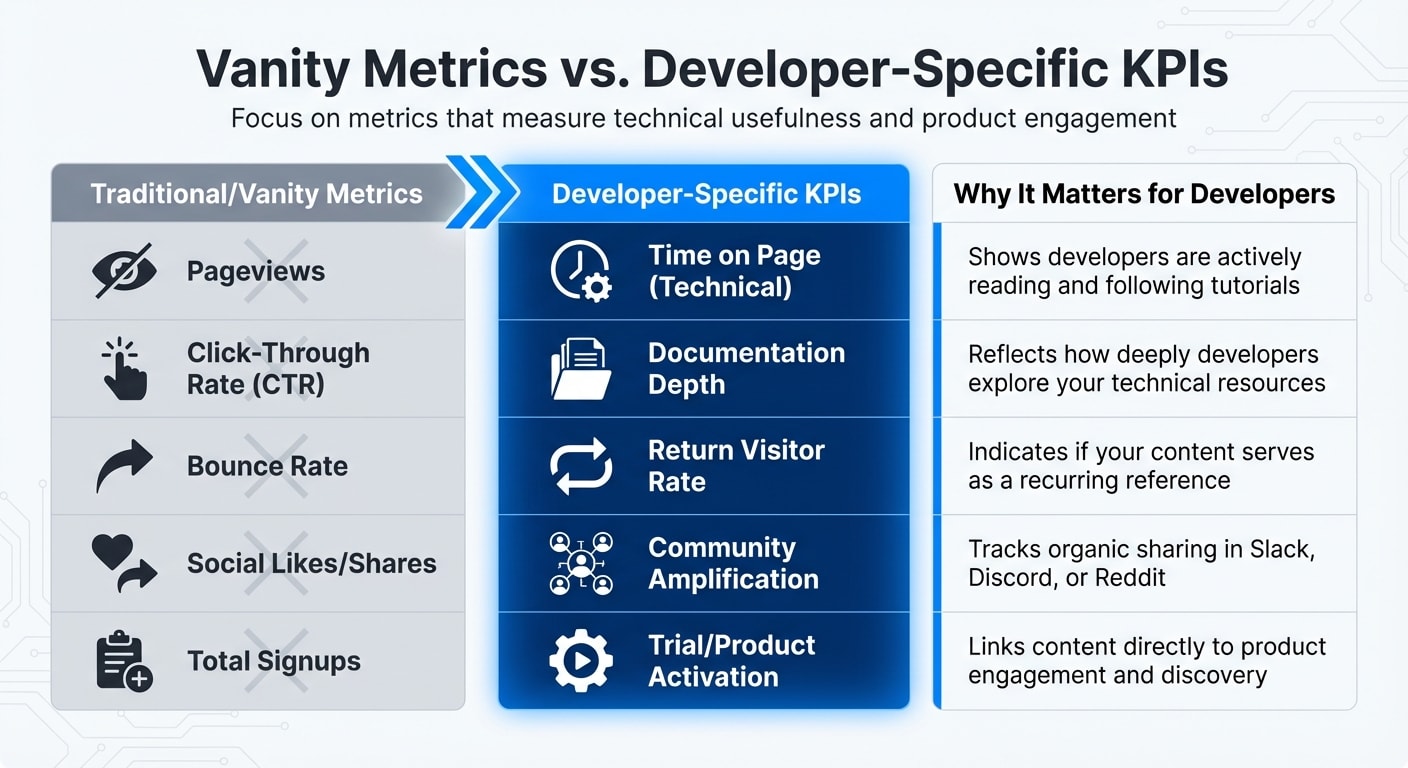
Relying solely on pageviews and social shares can be misleading when evaluating developer adoption. For example, a blog post attracting 1,000 monthly visitors but yielding zero conversions offers less value than one with just 100 visitors and a 25% conversion rate . The real focus should be on metrics that showcase technical usefulness and product engagement, not just surface-level awareness.
Developer decisions are often influenced by content they encountered weeks or even months earlier. This makes tracking metrics like return visitor rate (how frequently developers revisit your technical resources) and documentation depth (how far they explore your guides) critical for gauging trust and intent . Similarly, time spent on technical tutorials can reveal whether developers are actively engaging with and testing your code examples .
"The metrics that matter are not the ones that are easiest to report."
– Keith Lacy, Marketing Strategist, The Marketing Juice
Instead of focusing on total signups, it’s more insightful to measure trial or free tier activations specifically originating from content-driven traffic . Take SurrealDB as an example - in 2024, they used Doc-E.ai to analyze community interactions and documentation activity. This helped identify that power users were driving the majority of their revenue, ultimately reducing support ticket volumes by 30% . Another key metric is community amplification, such as unprompted shares in Slack channels, Discord servers, or Reddit threads, which signal genuine developer trust .
Vanity Metrics vs. Developer-Specific KPIs
Traditional metrics often fail to capture whether your content is solving actual technical challenges. Here’s how to reframe your approach:
| Traditional/Vanity Metrics | Developer-Specific KPIs | Why It Matters for Developers |
|---|---|---|
| Pageviews | Time on Page (Technical) | Shows developers are actively reading and following tutorials |
| Click-Through Rate (CTR) | Documentation Depth | Reflects how deeply developers explore your technical resources |
| Bounce Rate | Return Visitor Rate | Indicates if your content serves as a recurring reference |
| Social Likes/Shares | Community Amplification | Tracks organic sharing in Slack, Discord, or Reddit |
| Total Signups | Trial/Product Activation | Links content directly to product engagement and discovery |
These developer-specific metrics help bridge the gap between vanity numbers and actionable insights. By focusing on these KPIs, you can better determine whether your content is driving meaningful engagement and product interaction.
For instance, successful developer content programs often see rapid growth in traffic. Programs typically reach 10,000 monthly visitors within three months, 50,000 by six months, and surpass 150,000 in a year . ContainIQ’s journey is a great example: under CEO Nate Matherson, the company published 225 pieces of technical content over 14 months, achieving over 200,000 monthly visitors before their 2023 acquisition . Tracking metrics like early API calls, SDK integrations, and onboarding steps can also provide a clearer link between content efforts and revenue growth.
Conclusion
A winning developer tool marketing strategy zeroes in on technical value rather than flashy promotions. Developers don't have patience for buzzwords - they want solutions and actionable code examples that address their challenges . These resources often serve as their first impression of your product .
Shifting the focus from "what's new" to "what matters" is a game-changer. Educational content that tackles real technical problems consistently outperforms simple product announcements. Tutorials, for instance, generate three times the traffic of posts centered on product features . This means your blog should prioritize problem-solving guides over feature updates, and your documentation can double as a powerful top-of-funnel marketing tool.
"The goal is not to persuade them that your product is the best solution. The goal is to create content so useful that... they discover for themselves that your product is the best solution."
– Vo Tu Duc, ContentDrive
Once you've built a foundation of problem-solving content, the next critical step is smart distribution. Even the most technically sound material needs the right audience. Tools like daily.dev Ads can amplify your content, placing it directly in front of developers where they actively seek solutions. With access to over 1 million developers, daily.dev Ads enables targeted promotion based on factors like seniority, programming languages, and technical interests. This tailored approach respects the developer mindset and drives engagement far beyond generic ad campaigns.
Establishing technical credibility is a long-term effort - it doesn't happen overnight . Consistently publishing accurate, high-quality technical content, combined with strategic distribution through developer-specific channels, lays the groundwork for sustained growth. Metrics like documentation depth and return visitor rates are key indicators of success, showing whether your content is effectively driving product discovery and adoption. By integrating technical content creation with targeted outreach, you can build lasting connections with developers and encourage meaningful product engagement.
FAQs
What should I publish first for a new developer tool?
Creating high-quality tutorials, quick-start guides, or other foundational content is a great way to introduce developers to your tool. These resources make it easier for them to understand and start using your product, while also building trust and showing off its benefits.
The key? Focus on clarity and include practical examples. When developers see how they can apply your tool in real-world scenarios, it makes the content more engaging and actionable. This approach not only grabs their attention but also helps them feel confident about adopting your tool.
How do I keep tutorials and docs accurate as the product changes?
Keeping tutorials and documentation accurate as your product evolves is essential. Regularly reviewing and updating your content ensures it reflects any new features, use cases, or technical details. To achieve this, establish a clear style guide and involve subject matter experts in the review process. This approach helps maintain clarity and consistency across your resources. By staying proactive with updates, you not only reduce developer frustration but also build trust, ensuring your materials always align with the current state of your product.
Which content metrics best predict trial activation and adoption?
Metrics such as activation rates, retention, time spent, interaction depth, lead quality, and conversion rates provide a clearer picture of trial activation and adoption. These indicators emphasize the quality of user engagement and long-term value, moving beyond superficial numbers like pageviews.