

Developer advocacy communities are essential for connecting with developers and driving business outcomes. These communities help improve product trials, increase feature adoption, and reduce costs, but many fail due to focusing on vanity metrics instead of real impact. Here's what you need to know:
- Why They Matter: Developers trust peers over marketing. Communities provide social proof, technical support, and foster engagement that leads to higher conversion rates and retention.
- Key Challenges: Scaling while maintaining trust, measuring ROI, and turning passive members into active contributors.
- Steps to Build a Thriving Community:
- Define Goals: Align community objectives with business outcomes like revenue, adoption, or reduced support costs.
- Set Metrics: Avoid vanity metrics. Focus on engagement depth, response times, and retention rates.
- Build a Team: Recruit developer advocates with technical skills and empathy. Train them for engaging effectively and inclusively.
- Engage Members: Provide valuable resources, recognize contributors, and create safe, welcoming spaces.
- Measure Success: Track meaningful metrics (e.g., DAU/MAU ratio, sentiment analysis) and adjust strategies based on data.
The bottom line: A well-structured developer advocacy community can boost trial-to-paid conversions by 35%, speed up feature adoption by 37%, and reduce support costs by up to 35%. Focus on clear goals, meaningful engagement, and continuous improvement to create lasting impact.
::: @figure 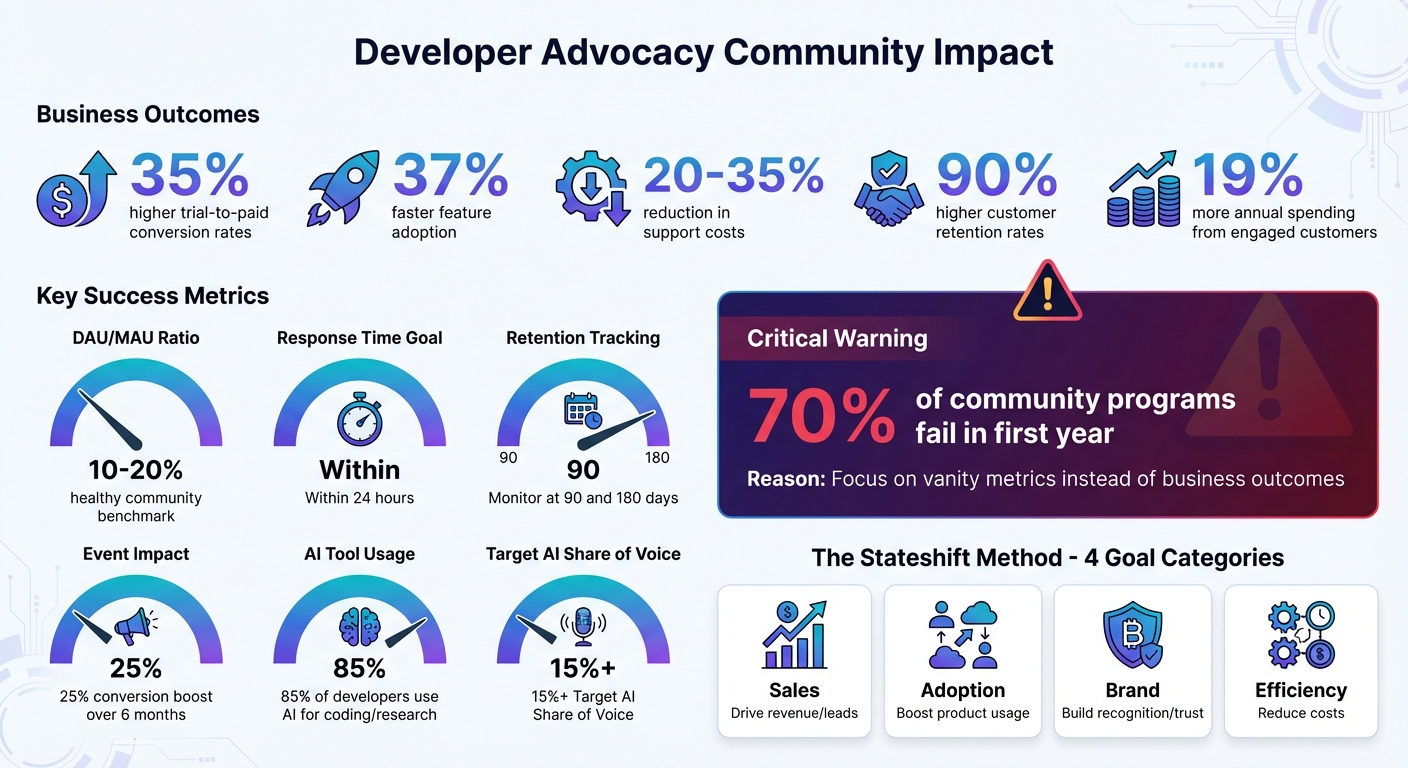 {Developer Advocacy Community Impact: Key Statistics and ROI Metrics}
Define Your Vision and Set Clear Goals
Before launching your community, it's crucial to define its purpose. The key difference between communities that thrive and those that fade lies not in the platform you choose, but in having clear goals from the outset. Jono Bacon, CEO of Stateshift, emphasizes this point:
"The difference between communities that work and those that don't isn't the platform. It's whether you built a system or just opened a chat room" .
Start by identifying the specific challenges developers face and how your community can address them. Highlight the benefits your community offers, such as quicker problem-solving, opportunities for professional growth, and access to technical support .
Inclusivity should be a priority from the beginning. Allocate resources and assign clear diversity, equity, and inclusion (DEI) responsibilities. Sanity.io serves as a great example. They built an inclusive DevRel program by dedicating resources to DEI. Knut Melvær, their DevRel leader, explained:
"We didn't want to just say thoughts and prayers - we wanted to commit to something. The best way to commit to something is to dedicate resources to it" .
Sanity.io hired Lauren 'Lo' Etheridge to lead DEI efforts and made a commitment to feature speakers from underrepresented groups at every monthly meetup. This structured approach ensures accountability as the community grows.
Align Community Goals with Business Objectives
Your community should serve both developers and your business. The Stateshift Method categorizes outcomes into four key areas: Sales (driving revenue or leads), Adoption (boosting product usage), Brand (building recognition and trust), and Efficiency (reducing costs like support expenses) .
For instance, if your focus is adoption, you might aim for a 20% increase in active users engaging with a new feature within three months. If efficiency is your goal, you could target a 15% reduction in customer support tickets by fostering peer-led forums where developers assist each other . Each goal should tie directly to how your company measures success - whether that's product trials, feature activation, or revenue growth.
Once your objectives are aligned, the next step is to define clear and measurable outcomes.
Set Measurable Metrics for Success
Steer clear of vanity metrics like follower counts. Instead, focus on metrics that truly matter: engagement depth, response times, and retention rates. Healthy developer communities often maintain a DAU/MAU ratio (Daily Active Users to Monthly Active Users) of 10-20%, and successful ones aim to respond to questions within 24 hours .
Use the SMART framework to set goals that are Specific, Measurable, Achievable, Relevant, and Time-bound. For example, track contributor retention at 90 and 180 days to gauge whether members remain active . For inclusivity, measure participation rates across various channels and monitor diversity in your speaker lineups . When hosting events, evaluate their impact on conversions - well-planned community events can boost conversions by 25% over six months .
It's essential to establish measurement systems before launching your community. As Mindy Faieta from Stateshift points out:
"A thriving community doesn't just happen - it requires intention, planning, and alignment with broader organizational objectives" .
sbb-itb-e54ba74
Build a Team of Developer Advocates
Creating a team of developer advocates is about blending technical know-how with strong interpersonal skills to connect your company with the developer community. As Sara Waszyńska, Developer Advocacy Specialist, explains:
"Developer Relations is all about being authentic and building relationships. Do not treat your program as a next campaign, start building the movement" .
Diversity is key from the start. A diverse team brings a range of perspectives that are crucial for meaningful and inclusive engagement. This diversity isn't just about gender, race, or geography - it also includes "T-shaped skills", where individuals have broad knowledge in areas like marketing, community management, or writing, combined with deep expertise in technical or creative domains. Jen Sable Lopez, Director of Community and Advocacy at OutSystems, sums it up well:
"To build, to have a diverse DevRel team is going to help you do your jobs better and help the community, and know how to guide them and understand them and all of that good stuff" .
Recruit the Right Advocates
Finding the right developer advocates means looking for people who balance technical skills with strong soft skills. While coding knowledge is important, empathy, relationship-building, and the ability to understand and address developer pain points are just as critical . This balance is especially important since over 80% of developers in leadership roles influence decisions about tools and technologies . Credibility within the developer community is non-negotiable.
Often, the best candidates are already part of your engineering team or active members of your developer community . To identify them, use a multi-step process: start by evaluating their online presence and technical expertise, then conduct interviews to assess their communication skills and ability to connect .
Because it's rare to find someone who excels at both coding and public communication, you might want to establish two growth paths for your team. One path can focus on community engagement, like attending events and networking, while the other can center on creating content, such as technical documentation, blog posts, or video tutorials . This approach lets you build a team where each member's strengths complement the others. Once hired, provide training to enhance both their technical skills and their ability to engage inclusively.
Train Advocates for Inclusive Engagement
Once you've recruited the right people, the next step is training them to engage effectively and inclusively. Advocates should be equipped to meet the diverse needs of developers while communicating with clarity and respect.
Training should cover technical skills, empathy, platform norms, and inclusive communication. Advocates need to understand how to navigate spaces like GitHub, Stack Overflow, and Discord while maintaining professionalism . On platforms like daily.dev, where traditional outreach methods often fall flat, building trust is especially important .
Teach your team to use a "micro and macro" approach: start by helping individual developers solve specific problems, then scale those solutions into resources like guides or tutorials that benefit the larger community . Tools like Gallup StrengthFinder or the HIGH5 Test can help identify each advocate's unique abilities. Practical resources, such as Figma templates for those with limited design experience or Grammarly for non-native English speakers, can help everyone contribute effectively .
Encourage authenticity and transparency. Train advocates to clearly explain your product, tech stack, and processes without relying on buzzwords like "rockstar" or "ninja." Instead, focus on real technical challenges and foster an open, honest team culture .
Engage and Grow the Community
Building a thriving advocacy community starts with creating content that resonates and choosing the right platforms to host it. Before opening your community to members, make sure it’s stocked with useful resources like FAQs, tutorials, and documentation. This ensures newcomers find value right away. Platforms like Discord, Slack, or Reddit are excellent choices for hosting because they’re widely trusted and easy to access.
Support your community’s growth by recognizing and empowering its most active members. Promote standout contributors to Community Champion roles, but take the time to verify their expertise by reviewing their open-source contributions and ongoing involvement in development. For example, in July 2024, SurrealDB, a dev tool provider, integrated Doc-E.ai into their community management. This AI tool helped automate FAQs and moderation tasks, cutting support tickets by 40% and boosting community engagement by 25% .
Creating a safe and respectful environment is essential. A strong code of conduct is your foundation - it should clearly define acceptable behavior and stress the importance of respect and constructive communication.
"Your code of conduct is the backbone of your community culture. It should outline acceptable and unacceptable behavior, emphasizing inclusivity, respect, and constructive communication" .
Combine human moderators with AI tools to address issues like harassment or offensive language swiftly. Use inclusive language in all interactions to ensure everyone feels welcome to share their perspectives. Beyond digital interaction, strengthen connections with offline initiatives that bring your community together in meaningful ways.
Use Online and Offline Channels
Once your community has a solid base of resources and champions, focus on expanding its reach both online and offline. Online, make your community easy to discover by optimizing for search engines. Encourage members to create and share their own resources, which fosters collaboration and keeps conversations lively. Add gamification elements - like badges, points, or contests - to reward participation, and keep members engaged by offering exclusive perks like early access to beta features or priority event registration.
Offline, host hybrid events that blend virtual and in-person experiences, such as meetups or hackathons. These events are great for networking and provide a dynamic complement to online interactions. In August 2023, Rizèl Scarlett, a Developer Advocate at GitHub, shared her journey with GitHub Copilot, documenting her initial skepticism and eventual enthusiasm while creating beginner-friendly content.
By sharing her "skeptic to enthusiast" journey and first-time experiences, she made the technology more accessible to a broader community and was invited to deliver a keynote at the All Things Open conference .
Promote Events and Resources with daily.dev Ads
To supercharge your outreach efforts, consider using daily.dev Ads for targeted campaigns. This platform allows you to reach developers at scale with ads tailored to their interests, experience levels, programming languages, and preferred tools. With options like in-feed ads, post page ads, and personalized digest ads, your promotions integrate seamlessly into the developer experience, ensuring visibility without being intrusive.
With access to over 1 million developers worldwide, daily.dev Ads is a powerful way to promote events like hackathons, webinars, or the launch of new tools. Its precise targeting capabilities let you focus on developers by tech stack, experience, or location, making it ideal for both local meetups and global virtual events. Real-time performance tracking also helps you fine-tune your campaigns, ensuring your message resonates with the right audience. Whether you’re introducing a new tool, hosting a conference, or sharing educational content, daily.dev Ads connects your message with developers actively seeking knowledge and community engagement.
Measure Success and Improve Continuously
To keep your community thriving, it’s essential to monitor the right data and use it to drive ongoing improvements. As Jono Bacon, Founder of Stateshift, aptly explains:
"Community metrics aren't just numbers on a dashboard. They're the compass guiding your strategy and the mirror reflecting your community's health" .
The key lies in distinguishing between success metrics, which measure impact (like monthly active users), and insight metrics, which highlight trends or potential issues (like GitHub stars or shifts in sentiment) .
Some key metrics to track include traffic, active users, signups, and sentiment. Traffic shows interest, but your core active members are the backbone of your community - these are the people who keep coming back and contributing. Sentiment analysis serves as an early warning system, helping you identify frustration or disengagement before it becomes a bigger problem . For a more complete picture, pair metrics together. For example, combine signup data with sentiment analysis to see if new members are becoming loyal advocates or if they’re disengaging early on .
From here, let’s explore specific metrics that go beyond activity and delve into long-term engagement and community impact.
Track Engagement and Diversity Metrics
Using consistent UTM parameters and platform analytics is critical for comparing the effectiveness of different channels . Assign one or two team members to manage tracking codes to ensure consistency across platforms, whether it’s Twitch live-coding sessions or traditional webinars .
Beyond basic engagement, focus on the User-Generated Content (UGC) ratio - the percentage of content created by members versus staff. A low UGC ratio might signal that your community is overly reliant on moderators, which can limit inclusivity and organic growth . Other important metrics include returning member rates, which help predict loyalty, and accepted solutions, which link community activity to reduced support costs . Additionally, track AI visibility metrics. With 85% of developers regularly using AI tools for coding and research, capturing a strong AI Share of Voice (15% or more) can be a meaningful indicator of influence .
By analyzing these metrics, you can refine your engagement strategies and foster a more vibrant, self-sustaining community.
Adjust Strategies for Sustained Impact
Metrics are only valuable if you act on them. Kurtis Kemple, a Developer Marketing Expert, emphasizes:
"If the metrics change and you don't, stop measuring it. You're wasting effort, and not reacting to the metrics... can hurt any trust you've established!" .
Establish a reporting cadence to stay on top of your data. Conduct weekly pulse checks to address immediate issues (like new posts or member activity), monthly reviews for identifying trends (such as sentiment shifts or cohort behavior), and quarterly evaluations to measure business ROI through metrics like retention and expansion .
To ensure transparency and alignment, create shared dashboards that show how developer relations contribute to signups and other business goals . Tools like Common Room can provide a cross-channel view of user behavior, giving you a holistic understanding of your community's dynamics . Keep in mind that building an authentic community takes time - product adoption typically starts to gain traction after 90 days, with feature adoption increasing by 30–50% over a 6–12 month period . Focus on metrics tied to your company’s "North Star", often a revenue-related goal, to ensure your efforts align with broader business objectives .
Conclusion: Building a Thriving Advocacy Community
Creating a strong developer advocacy community takes more than just enthusiasm - it requires a well-designed system that aligns with your company’s goals while genuinely addressing developers' needs. The most successful communities are built on a foundation of clear purpose, genuine interaction, inclusive practices, and ongoing evaluation.
The numbers speak for themselves: companies using a community-to-product approach experience 35% higher trial-to-paid conversion rates, with community-driven feature adoption happening 37% faster than average . Additionally, customers engaged through these communities show 90% higher retention rates and spend 19% more annually .
Mindy Faieta, Customer Success Lead at Stateshift, sums it up perfectly:
"Developer advocacy is not about recruiting louder fans. It is about building the structure that helps the right developers succeed in amplifying your story" .
This means identifying passionate, skilled advocates and equipping them with structured rituals, useful resources, and meaningful recognition. It’s about creating an environment where developers feel secure, can track their progress, and know their contributions are valued .
Interestingly, 70% of community programs fail in their first year because they chase engagement volume instead of focusing on metrics tied to business outcomes . To avoid this pitfall, focus on metrics like activation rates, retention, peer-to-peer support, and the performance of user-generated content.
To succeed, your strategy should reward both intrinsic and extrinsic contributions. The best communities strike a balance, seamlessly integrate into product workflows, and empower their champions to expand peer support. Trust is built through consistent and transparent engagement, while inclusivity and long-term value remain at the core. When done right, your advocacy community not only strengthens developer relationships but also reduces support costs by 20-35% , making it a powerful driver of sustainable growth and meaningful connections.
FAQs
How do I set a clear goal for my developer community?
To establish a clear goal, outline objectives that are precise, measurable, and connected to your overall purpose. Aim for outcomes such as boosting active user numbers or improving event attendance. Keep track of your progress using metrics like engagement rates or audience growth. Leveraging frameworks like SMART (Specific, Measurable, Achievable, Relevant, Time-bound) can provide structure and help ensure your efforts remain focused and practical.
What metrics show real community ROI (not vanity stats)?
Metrics that show true community ROI are those that highlight genuine engagement and growth. Some key examples include developer activity - like API call frequency, GitHub contributions, and documentation views - resource usage, tutorial completions, event attendance, and feedback scores. These go beyond surface-level numbers, offering a clearer picture of the community's real impact and value.
How do I turn lurkers into active contributors?
Creating an engaging developer community means finding ways to bring lurkers - those who observe but rarely participate - into the fold. One effective approach is to encourage members to share their projects, discuss best practices, or jump into ongoing conversations. By tailoring activities to match their skill levels and interests, you make participation feel approachable and relevant.
Recognizing contributions, no matter how small, can also go a long way in motivating members. Whether it’s a shoutout for sharing a useful tip or highlighting a creative project, acknowledgment builds a sense of belonging. Above all, fostering a welcoming and inclusive environment ensures that even passive members feel comfortable stepping up and becoming active participants.