

Developers today are not who they used to be. AI is reshaping how they work, what tools they use, and even who qualifies as a "developer." Here’s what you need to know:
- TypeScript surpassed Python and JavaScript as the #1 GitHub language in August 2025, driven by AI's need for structured, reliable code.
- 80% of new developers use AI tools like Copilot within their first week, bridging skill gaps faster than ever.
- AI is breaking down traditional roles - backend engineers now tackle frontend tasks, and product managers create app prototypes with natural language commands.
- GitHub's Developer Maturity Arc outlines how developers evolve with AI tools, from beginners to advanced orchestrators.
Brands relying on outdated customer profiles are missing out. Developers now span a broader, more diverse audience, and targeting them effectively requires rethinking marketing strategies. Platforms like daily.dev Ads centralize access to over 1 million developers, simplifying engagement across this expanding landscape.
How AI Is Changing Who Builds What
Traditional roles in software development are shifting in ways we couldn’t have imagined just a few years ago. Tasks that used to require deep specialization are now being tackled across disciplines, thanks to AI. For example, backend engineers are now venturing into frontend work - not because they've suddenly mastered new skills, but because AI has smoothed out the barriers that once kept them in their lanes.
The Full-Stack Effect
AI tools are redefining what developers can achieve beyond their core expertise. Take shell scripting as an example: AI-driven projects have seen a 206% year-over-year increase in shell scripting, as AI removes the need to memorize complex Bash syntax . Similarly, TypeScript has risen to become the #1 language on GitHub as of August 2025, with a growth of 66% year-over-year. Its strong typing provides the structure AI needs to generate dependable code across different parts of the stack .
The impact extends far beyond experienced developers. Today, 80% of new developers start using tools like Copilot from day one, allowing them to bridge skill gaps quickly. Junior developers, in particular, are completing tasks up to 55% faster with AI assistance . This isn’t just about speed - it’s about opening doors. Work that once required years of expertise is now accessible to anyone who understands the problem, even if they lack deep domain knowledge.
Andrea Griffiths captures this shift perfectly:
"AI isn't just speeding up coding. It's reshaping which languages, frameworks, and tools developers choose in the first place" .
This means developers are now picking technologies based on how easily they integrate with AI, not just their own skill set. This shift has dramatically widened the pool of potential users for many tools and frameworks.
Why Most ICPs Are Too Narrow
As AI enables developers to move beyond traditional boundaries, conventional Ideal Customer Profiles (ICPs) are falling short. ICPs that rely on job titles or specific programming languages no longer reflect how developers use tools. For instance, a backend developer might now use TypeScript regularly, thanks to AI making it more accessible. Similarly, a DevOps engineer might find themselves building full-stack features because AI takes care of the tricky implementation details.
This shift is also changing the way developers orchestrate code. Between May and September 2025, GitHub's autonomous coding agent merged over 1 million pull requests, showcasing how AI has evolved from being a simple autocomplete tool to managing significant portions of the workflow .
If your ICP assumes developers are confined to narrow technical silos, you could be missing out. The developer who might have ignored your tool six months ago could now be an ideal user - not because their role has changed, but because AI has transformed what they can achieve within their role.
sbb-itb-e54ba74
Using GitHub's Developer Maturity Arc to Segment Your Audience
::: @figure 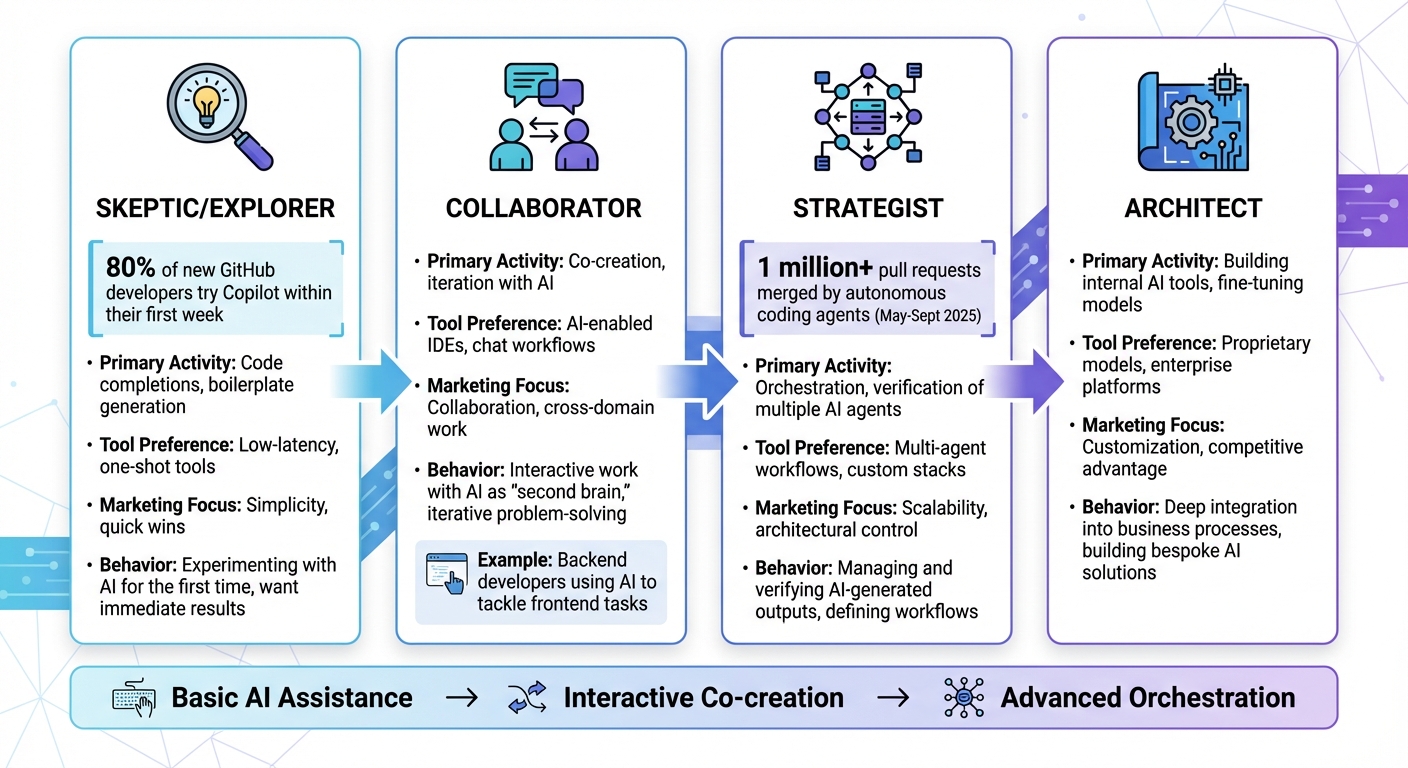 {GitHub Developer Maturity Arc: Four Stages of AI Tool Adoption}
GitHub's research introduces the Developer Maturity Arc, a framework that maps out how developers evolve in their use of AI tools. This arc includes four stages: Skeptic, Explorer, Collaborator, and Strategist. Each stage reflects a developer's level of comfort and expertise with AI, from initial skepticism to advanced orchestration of AI systems .
This segmentation is invaluable for marketers because each stage comes with its own set of needs, workflows, and preferences. A novice developer exploring basic AI tools has vastly different expectations compared to someone managing complex AI-driven systems. By tailoring your messaging to these stages, you can effectively address the diverse audiences AI workflows now encompass. This framework provides clarity on how to craft messaging that resonates with developers at different points in their journey.
Developers Just Starting with AI Tools
Skeptics and Explorers are at the beginning of their AI journey. These developers are experimenting with AI-assisted tools for the first time, using features like code completions and boilerplate generation. Their primary expectation? Speed and simplicity. They want tools that deliver results immediately, and if the AI falls short, they often revert to manual methods .
Interestingly, 80% of new GitHub developers try Copilot within their first week . At this stage, they’re not looking for advanced workflows or intricate features - they just want AI to handle repetitive coding tasks.
For marketers, the focus here should be on ease of use and quick productivity gains. Highlight how the tool simplifies coding, reduces friction, and eliminates mundane tasks, allowing developers to focus on more engaging work.
Developers Using AI Across Multiple Domains
Collaborators represent a more advanced stage of AI adoption. These developers are comfortable working interactively with AI, engaging in iterative processes to co-create solutions. AI tools become their "second brain", helping with planning, sense-making, and problem-solving .
At this stage, developers start to blur traditional boundaries, leveraging AI to work across domains. For instance, a backend developer might use AI to tackle frontend tasks, or a DevOps engineer could explore full-stack development. Unlike beginners, Collaborators value the iterative nature of AI, preferring tools that support ongoing dialogue rather than one-off answers .
Marketers should shift their messaging to emphasize collaboration, iteration, and cross-domain capabilities. Showcase how AI can empower developers to expand their skillsets and tackle challenges beyond their usual scope.
Developers Running Multiple AI Agents
At the pinnacle of the maturity arc are the Strategists - developers who fully integrate AI into their workflows. These individuals go beyond basic task automation, orchestrating multiple AI agents to handle complex, end-to-end processes. From generating pull requests to managing issues, Strategists rely on AI to streamline their operations .
For example, within five months of GitHub's autonomous coding agent launch, developers merged over 1 million pull requests . At this level, the focus shifts from writing code to managing and verifying AI-generated outputs. Strategists define workflows, set constraints, and ensure quality control.
To engage this audience, marketers should emphasize scalability, control over architecture, and tools for verification. Highlight features that support the coordination of multi-agent systems and ensure the reliability of AI-driven outputs.
| Maturity Stage | Primary Activity | Tool Preference | Marketing Focus |
|---|---|---|---|
| Skeptic/Explorer | Code completions, boilerplate | Low-latency, one-shot tools | Simplicity, quick wins |
| Collaborator | Co-creation, iteration | AI-enabled IDEs, chat workflows | Collaboration, cross-domain work |
| Strategist | Orchestration, verification | Multi-agent workflows, custom stacks | Scalability, architectural control |
The Challenge of Reaching a Broader Developer Audience
Expanding your developer audience brings a new set of hurdles for marketing. In the past, when your Ideal Customer Profile (ICP) was tightly defined - like focusing solely on senior backend engineers working in Python - you could zero in on niche communities and specific channels. But with AI tools breaking down traditional boundaries, your audience now includes backend developers, frontend developers, DevOps engineers, and even hobbyists using AI to cross disciplines. A highly targeted approach that once worked well now struggles to keep up. This shift introduces issues like budget fragmentation and difficulties in maintaining targeting efficiency.
Running campaigns across various languages, frameworks, and experience levels spreads your resources thin. For example, separate campaigns for TypeScript developers, Python enthusiasts, or AI-first beginners demand unique creative strategies and segmented budgets. This fragmented approach not only makes campaign management more complex but also increases the cost per acquisition.
Old ICP Limits vs. New Audience Size
The Developer Maturity Arc highlights how outdated ICPs restrict your potential reach. Previously, ICPs focused almost exclusively on code producers. But as AI broadens the developer landscape, your addressable audience grows significantly. If your messaging stays locked into narrow technical roles, you risk overlooking an increasingly diverse developer base.
The challenge isn't just about reaching a larger audience - it's about engaging a more varied one. While older ICPs focused on specialized roles, today's developers span a wide spectrum. They include frontend developers, backend engineers, DevOps professionals, and even those orchestrating complex AI workflows. Some are just starting their AI journey, while others are seasoned experts managing multi-agent systems. To effectively connect with this diverse group without overspending, you need a unified strategy that bridges these different segments rather than chasing them across scattered channels.
How daily.dev Ads Solves the Reach Problem
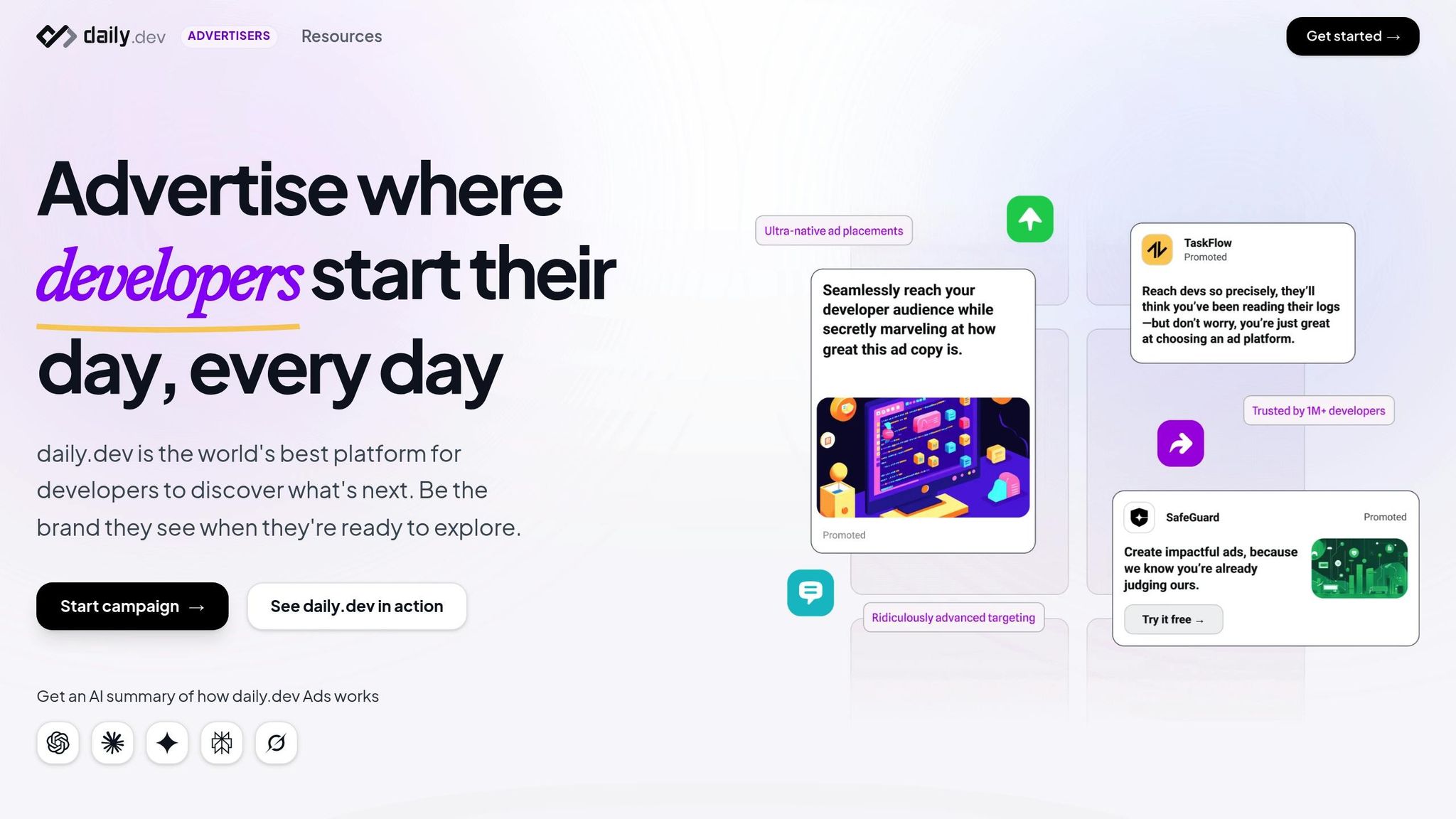
With AI reshaping the development landscape, daily.dev Ads brings over 1 million developers - accounting for 1 in 50 globally - together on a single platform . Instead of juggling multiple campaigns across scattered developer communities, you can focus your efforts where developers naturally gather. This platform is built around how developers discover tools and stay informed, offering a streamlined way to connect with them. By unifying your approach, you can target specific segments based on seniority, programming languages, and tools.
Targeting by Seniority, Language, and Tools
The platform enables precise audience segmentation. You can target developers by their seniority - whether they’re Aspiring, Entry-Level, Mid-Level, or Senior Engineers. It also allows you to reach developers based on their preferred programming languages, such as JavaScript, Python, or Go, and the tools they use, like Docker, Kubernetes, or VS Code. Using real-time behavioral data, the platform identifies developer intent. For example, it can detect when a backend developer starts exploring frontend frameworks or when a senior engineer dives into AI tools. With over 1 billion tracked interactions , this system provides the insights needed for highly targeted and relevant advertising.
One Platform Instead of Dozens of Channels
By centralizing your reach, you eliminate the hassle of running fragmented campaigns across various communities. The platform offers three seamless ad formats that integrate naturally into the developer's daily workflow: in-feed native ads, post page ads for high-intent discussions, and personalized email digest ads. This approach ensures your message reaches developers at every stage of their career without diluting your strategy or disrupting their experience. It’s a simplified, effective way to connect with developers where they’re already engaged.
Conclusion
The developer community is undergoing a major shift, breaking away from traditional boundaries. With over 180 million GitHub developers and nearly 80% of new users adopting AI tools, the old ways of defining ideal customer profiles (ICPs) are becoming outdated. The lines between backend, frontend, and infrastructure roles are blurring, making it harder to categorize and target developers effectively .
While this evolution broadens your potential reach, it also scatters your audience across countless platforms, making it challenging to target them without a clear and unified strategy.
This is where daily.dev Ads steps in. By bringing together over 1 million developers on a single platform, it allows for precise targeting based on seniority, programming languages, and tools - all without the hassle of managing fragmented campaigns . Instead of chasing developers across multiple communities, you can connect with them directly where they’re already active. Whether they’re just diving into TypeScript or managing complex AI-driven workflows, daily.dev Ads ensures your message reaches the right audience.
It’s time to rethink your ICP. Developers who may not have fit your profile in the past are now adopting advanced workflows, driven by the rise of AI. The boundaries of development have shifted - make sure your marketing strategy keeps pace.
FAQs
How should I update my ICP for AI-driven role blur?
AI is reshaping the tech landscape, blurring the lines between traditional developer roles. To keep up, broaden your Ideal Customer Profile (ICP) by redefining what it means to be a developer. Today, developers often work across the entire stack, thanks to AI tools that make it easier to tackle tasks outside their usual expertise. This shift means traditional role boundaries are becoming less relevant.
When updating your ICP, include AI-savvy developers with a range of skills, programming languages, and experience levels. It’s also helpful to segment this audience by their level of maturity - think of groups like beginners, experienced practitioners, and strategic leaders. Each group has unique needs and expectations, and tailoring your approach accordingly can make your messaging far more effective.
Finally, focus on platforms that can engage this expanded audience without spreading your marketing too thin. The goal is to connect with this diverse group efficiently, ensuring your efforts remain cohesive while reaching the right people.
How do I message each stage of the Developer Maturity Arc?
To communicate effectively at each stage, adjust your messaging to align with the mindset of the developers:
- Skeptic: Counter doubts by focusing on how AI can boost productivity and take over mundane, repetitive tasks, freeing up time for more meaningful work.
- Explorer: Emphasize the chance to learn and grow. Provide accessible resources and tutorials to help them feel more confident with AI tools.
- Collaborator: Highlight how AI can enhance teamwork by streamlining workflows and speeding up project delivery.
- Strategist: Point out AI’s role in scaling operations and making smarter, data-driven decisions to achieve long-term goals.
Tailor your approach as developers move through these stages to keep the conversation relevant and impactful.
How can I reach this bigger dev audience without splitting budget?
To connect with a larger audience of developers effectively, prioritize platforms that bring together users of varying skill levels, programming languages, and frameworks. With AI reshaping the developer landscape, it's crucial to engage on platforms where these communities naturally intersect. By understanding the progression of developers - from beginners to seasoned experts - you can craft messages that resonate across the spectrum. This approach ensures your resources are used efficiently, avoiding the need to spread your budget thin across overly specialized channels.