

Developers are a tough audience to reach. They avoid flashy ads, ignore aggressive campaigns, and value technical content over traditional marketing. To connect with them, focus on trusted platforms and credible content. Here’s a quick breakdown of what works:
- Community Platforms: Developers trust forums like Stack Overflow, GitHub, and Reddit. Peer discussions and knowledge-sharing here drive engagement.
- Social Media: LinkedIn targets decision-makers, Twitter builds awareness, and Discord fosters real-time, technical conversations.
- Developer Ads: Platforms like daily.dev Ads integrate directly into developers’ workflows with targeted, native formats.
- Multi-Channel Strategy: Combining discovery platforms (Google, YouTube) with community-driven spaces ensures repeated exposure across the developer’s journey.
The key? Respect their expertise, provide actionable content, and measure success with metrics like engagement rates, tutorial completions, and multi-touch attribution. Developers value honesty and relevance - meet them where they are.
What Makes a Developer Marketing Channel Effective
The secret to reaching developers lies in aligning with their workflows and values. Developers are naturally skeptical of traditional marketing tactics, so channels that succeed are those that resonate with their way of thinking, working, and decision-making. Focusing on these characteristics ensures your efforts connect, rather than wasting resources on strategies developers are likely to dismiss. Let’s break down three key traits that make a developer marketing channel stand out.
Peer Validation and Community
Developers trust their peers more than any polished marketing pitch. Channels that encourage knowledge-sharing and collaboration consistently outperform those that rely solely on brand-driven messaging. When developers see others like themselves discussing tools, sharing implementation stories, or offering genuine recommendations, they take notice. That’s why platforms like developer forums, communities, and collaborative spaces tend to generate higher engagement. Peer recommendations carry weight because they come from people with firsthand, relevant experience - making them far more persuasive than traditional ads.
Transparency and Trust
Developers have a knack for spotting fluff and rejecting anything that feels insincere. To earn their trust, marketing channels need to deliver honest, technical content. This means no clickbait, no overpromising, and no shortcuts. Instead, focus on offering real value - whether through detailed documentation, practical tutorials, or solutions to common problems. Developers respect platforms that prioritize accuracy and substance over flashy gimmicks. Channels that waste their time or feel manipulative will be abandoned quickly, while those that provide meaningful, trustworthy content will keep them coming back.
Workflow Integration
The most effective channels meet developers where they already are - right in the middle of their daily workflows. Whether it’s through IDE extensions, documentation platforms, or technical blogs, successful marketing doesn’t interrupt; it integrates. When developers encounter ads or content in contexts where they’re actively solving problems or exploring new tools, they’re far more likely to engage. By aligning with their existing habits and activities, these channels feel seamless rather than intrusive, making them much more effective.
Developer Advertising Channels That Drive Conversions
Connecting with developers means showing up where they already gather to solve problems, share knowledge, and discover new tools. To create campaigns that resonate, you need to understand the platforms they trust and use daily.
Community-Driven Platforms
Platforms like Stack Overflow, GitHub, and Reddit are central to developer communities. Stack Overflow is a go-to resource for developers seeking reliable answers to technical questions. GitHub, while primarily a code-hosting platform, is also where developers explore projects, evaluate tools, and make decisions based on community feedback and documentation. Reddit, with its developer-focused subreddits like r/programming and r/webdev, fosters open discussions where developers share unfiltered opinions about technologies.
However, marketing on these platforms requires finesse. Developers are highly skeptical of overt promotions. Take Hacker News, for instance - it reaches over 6 million developers monthly , but its audience rejects anything that feels overly commercial. To succeed here, your content must be purely technical, innovative, and curiosity-driven . Before diving into any of these channels, it’s smart to review ongoing conversations to see if your product or related topics are already being discussed .
In addition to these forums, social networks provide another avenue to engage with the developer community.
Social Media and Professional Networks
LinkedIn, Twitter, and Discord each play a unique role in connecting with developers. LinkedIn is ideal for reaching decision-makers, while Twitter and Discord cater more to the broader developer audience. Twitter serves as a hub for thought leadership, where developers share insights, debate new technologies, and build their professional brands. Discord, on the other hand, creates intimate, real-time spaces for in-depth technical discussions and collaboration. Together, these platforms allow you to target decision-makers on LinkedIn, build broad awareness on Twitter, and foster deeper engagement on Discord.
YouTube is another powerful channel. As the second-largest search engine , it’s a go-to platform for developers looking for tutorials, tool comparisons, and implementation guides. It offers opportunities for both organic reach and targeted ads, making it a versatile addition to your strategy.
These social platforms complement advertising efforts tailored specifically to developer workflows.
Developer-Focused Advertising Platforms
daily.dev Ads represents a new wave of advertising designed to fit seamlessly into the developer experience. Instead of disrupting their workflow with traditional ads, daily.dev integrates directly into curated feeds of articles, tutorials, and news.
With a global reach of over 1 million developers, daily.dev Ads uses native placements that appear in feeds, on post pages, and soon in personalized digests. It offers precise targeting options based on seniority, programming languages, and even the tools developers use. This ensures your ads reach the right audience.
Given that many developers use ad blockers, native formats like these are far more effective. daily.dev Ads also provides real-time performance tracking and expert creative guidance to fine-tune campaigns. The platform emphasizes technical depth and authenticity, aligning with developers’ preference for non-intrusive, relevant content over flashy, generic ads.
Building a Multi-Channel Developer Marketing Strategy
::: @figure 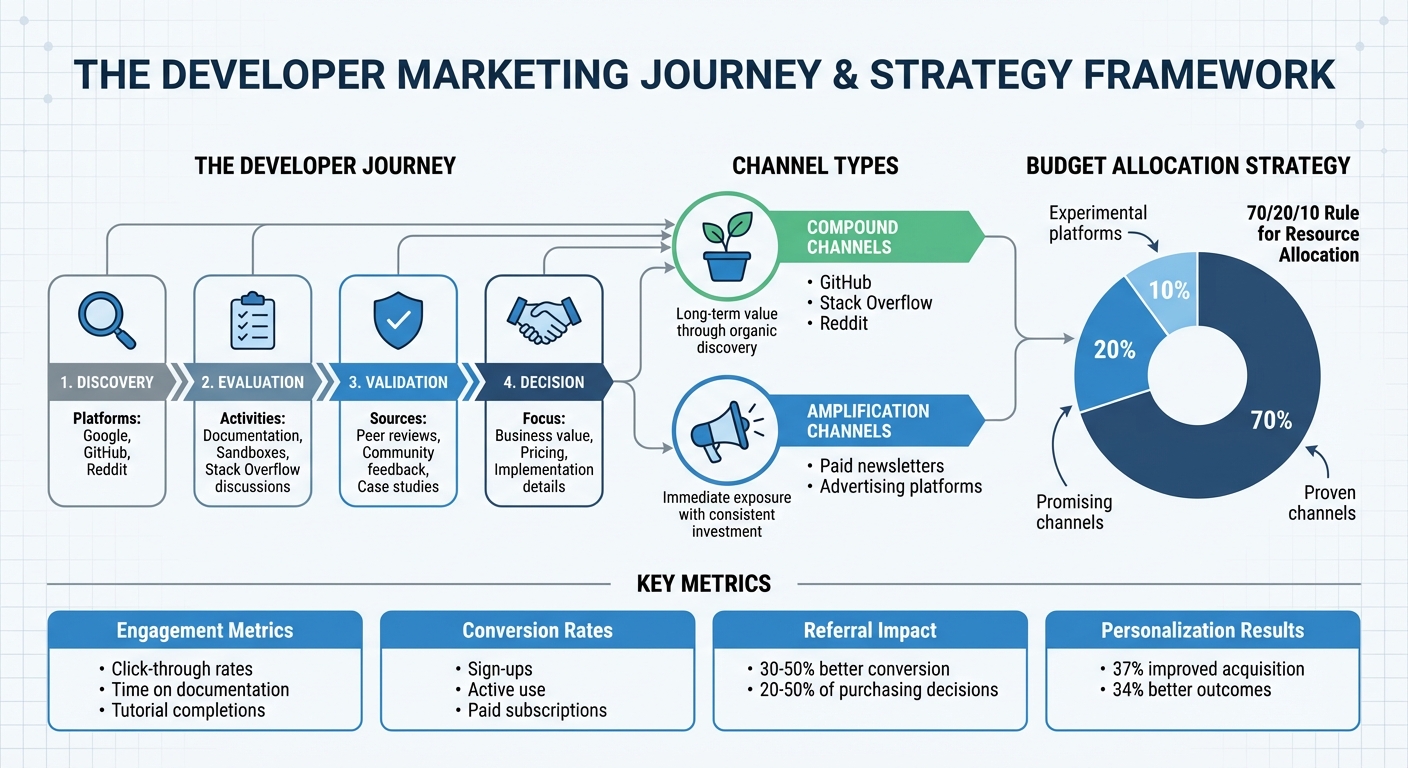 {Developer Marketing Journey: Multi-Channel Strategy Framework}
Relying on a single platform limits your ability to connect with developers effectively. A multi-channel strategy allows you to engage with developers repeatedly across various platforms, building trust and ensuring your message resonates at every stage of their decision-making process. Developers don’t stick to just one channel - they explore multiple platforms during research, evaluation, and decision-making. To reach them effectively, your marketing efforts need to align with their journey.
Understanding the Developer Journey
Developers use different platforms depending on their stage in the decision-making process. For example:
- Discovery: Platforms like Google, GitHub, and Reddit are popular for initial research.
- Evaluation: Developers dive into documentation, explore sandboxes, and engage with discussions on Stack Overflow.
- Validation: Peer reviews, community feedback, and case studies play a key role.
- Decision: Clear details about business value, pricing, and implementation become critical.
If developers are actively searching for solutions, focus on search-driven platforms like Google, YouTube, and Stack Overflow. On the other hand, if you’re introducing a new product category, use “evangelism” channels such as social media, podcasts, and conferences to build awareness .
Combining Broad and Niche Reach
To effectively reach developers, you need a mix of compound channels and amplification channels:
- Compound channels (e.g., GitHub, Stack Overflow, Reddit): These grow gradually but offer long-term value through organic discovery.
- Amplification channels (e.g., paid newsletters, advertising): These provide immediate exposure but require consistent investment to maintain visibility .
Start by building credibility on compound channels. For example, Convex’s open-source launch on r/programming created lasting organic value, while Paragon’s sponsorship of a high-profile newsletter generated millions of impressions and significant engagement . Once you’ve established trust on these foundational platforms, leverage amplification channels to scale your reach.
Testing and Optimizing Your Channel Mix
The right channel mix comes from experimentation and data-driven decisions. Use the 70/20/10 rule to allocate your budget: 70% on proven channels, 20% on promising ones, and 10% on experimental platforms . This approach provides stability while allowing room to explore new opportunities.
Measure both early indicators (like engagement rates and tutorial completions) and late indicators (such as conversion rates and revenue) to refine your strategy . Add simple tools like an open-form question - “How did you find out about us?” - in your registration process to gain direct insights into which channels drive results . Continuously test, analyze performance, and adapt based on real-world data to optimize your approach.
Measuring and Evaluating Channel Performance
When assessing developer channels, it’s crucial to use metrics that reflect the long-term and multi-step nature of developer engagement. Developers often interact with content over extended periods before making decisions, so your approach should account for these complex journeys.
Key Metrics for Success
Start by focusing on engagement metrics that show whether your content is connecting with developers. Pay attention to indicators like click-through rates, time spent on essential pages (such as documentation), and tutorial completion rates. These metrics help distinguish genuine interest from casual browsing.
Additionally, track conversion rates at each stage of the developer journey - starting from sign-up, moving to active product use, and ultimately transitioning to paid subscriptions. Developers often experiment and evaluate extensively before committing, so breaking down conversions by stage provides a clearer picture of their progress.
Multi-Touch Attribution for Developers
Developers rarely make decisions after a single interaction. For instance, they might first learn about your product in a Reddit thread, then explore it further on Stack Overflow, dive into your documentation, and finally sign up after seeing a targeted ad weeks later.
Using multi-touch attribution helps you map out how each interaction contributes to the final conversion. This method uncovers patterns that traditional analytics might miss, especially in cases where community-driven discovery and word-of-mouth are involved. By analyzing these insights, you can refine your attribution model and better understand the developer journey.
Using Developer Feedback
Referral marketing and word-of-mouth are especially powerful in developer communities. Referred leads tend to convert 30–50% better than other channels, and word-of-mouth influences 20–50% of all purchasing decisions.
To measure these effects, track the percentage of new customers acquired through referrals and compare their lifetime value to customers from other sources. Also, monitor community-driven metrics like GitHub stars, Stack Overflow mentions, and Reddit discussions. When developers organically promote your product in technical spaces, it’s a strong indicator that your strategy is resonating. These advocates often become your most reliable and impactful acquisition source.
Conclusion
Based on our analysis of effective strategies and multi-touch approaches, successful developer marketing thrives on using a mix of channels. The best strategies combine community-driven platforms, professional networks, and developer-focused advertising to create multiple touchpoints throughout the often lengthy evaluation process. Developers explore a variety of fragmented channels - ranging from technical forums to social media - so it’s crucial for your brand to deliver consistent messaging while tailoring it to fit the unique context of each platform.
Bringing together data and channels enables personalization, which has been shown to improve acquisition by 37% and enhance personalization outcomes by 34%. This level of precision is especially important when marketing to developers, who expect every interaction to deliver relevance and value, not generic sales pitches.
daily.dev Ads simplifies the process of connecting with over 1,000,000 developers by offering precise targeting options based on seniority, programming languages, and tool preferences. With native ad placements - such as in-feed ads and post page ads - the platform ensures your message is seamlessly integrated into the technical spaces developers trust and engage with daily.
As highlighted throughout this guide, successful developer marketing hinges on meeting developers where they are, offering value, and showing respect for their needs. By aligning every interaction with what developers care about, brands can build trust and drive conversions. Continuously refining your channel mix with accurate data and multi-touch attribution will help ensure long-term success.
FAQs
Which channels should I prioritize for my developer audience?
To connect with developers in a meaningful way, it's crucial to engage with them on platforms they already trust and frequent. Some top channels to consider include:
- Stack Overflow: A go-to hub for technical Q&A where developers actively seek and share knowledge.
- Reddit: Ideal for diving into niche discussions and connecting with specific developer communities.
- Twitter: Perfect for sharing real-time updates and engaging in industry conversations.
- LinkedIn: A professional space for networking and sharing industry insights.
For targeted outreach, consider using developer-focused native ads on platforms like daily.dev Ads. These allow precise targeting based on programming languages, experience levels, and interests, which can lead to better engagement and conversions. Always prioritize trust, deliver value, and ensure technical accuracy in your interactions.
How do I measure ROI from developer marketing?
To gauge ROI from developer marketing efforts, it's essential to monitor metrics that reflect engagement, adoption, and revenue impact. Start by focusing on developer engagement indicators like API call frequency, GitHub activity, and documentation views. These metrics highlight how actively developers are interacting with your tools and resources.
Next, dive into product usage data. Metrics such as SDK implementation rates and feature activation provide insights into how effectively developers are integrating your product into their workflows.
On the campaign side, track key performance indicators (KPIs) like click-through rate (CTR), conversion rate, cost per click (CPC), and cost per thousand impressions (CPM). These help evaluate the performance of your marketing efforts and guide optimizations to improve outcomes.
How can I target developers without sounding salesy?
To connect with developers in a meaningful way, prioritize content that delivers genuine value and maintains technical precision. Speak their language by addressing specific challenges they face and backing up your claims with tangible results, such as measurable performance boosts or cost reductions. Meet them where they are - platforms like GitHub or technical forums are great places to engage. Share educational materials like tutorials or code snippets that they can actually use. Skip the buzzwords and overblown promises; developers respect honesty and practical solutions that make their work easier.