

Developers don't make quick decisions when choosing tools. They take weeks - or even months - exploring options, reading reviews, and consulting peers. The key to standing out? Make sure your brand is the one they think of first when they face a problem. This requires consistent visibility and valuable content in the spaces developers frequent, like blogs, forums, and conferences.
Here’s the takeaway:
- Developers need 6–7 interactions with a brand to remember it.
- Familiar brands are 50% more likely to be tried and 63% more likely to be chosen over unknown ones.
- A strong brand presence can lead to 10–20% revenue growth and boost retention by 60%.
To build trust, focus on:
- Educational Content: Tutorials, code samples, and open-source tools that solve developer problems.
- Community Engagement: Participate in forums like Stack Overflow and Reddit without pushing your product.
- Multi-Channel Visibility: Use platforms like daily.dev Ads for targeted reach while maintaining authentic content.
The goal? Build trust early so your brand is top-of-mind when developers are ready to decide.
::: @figure 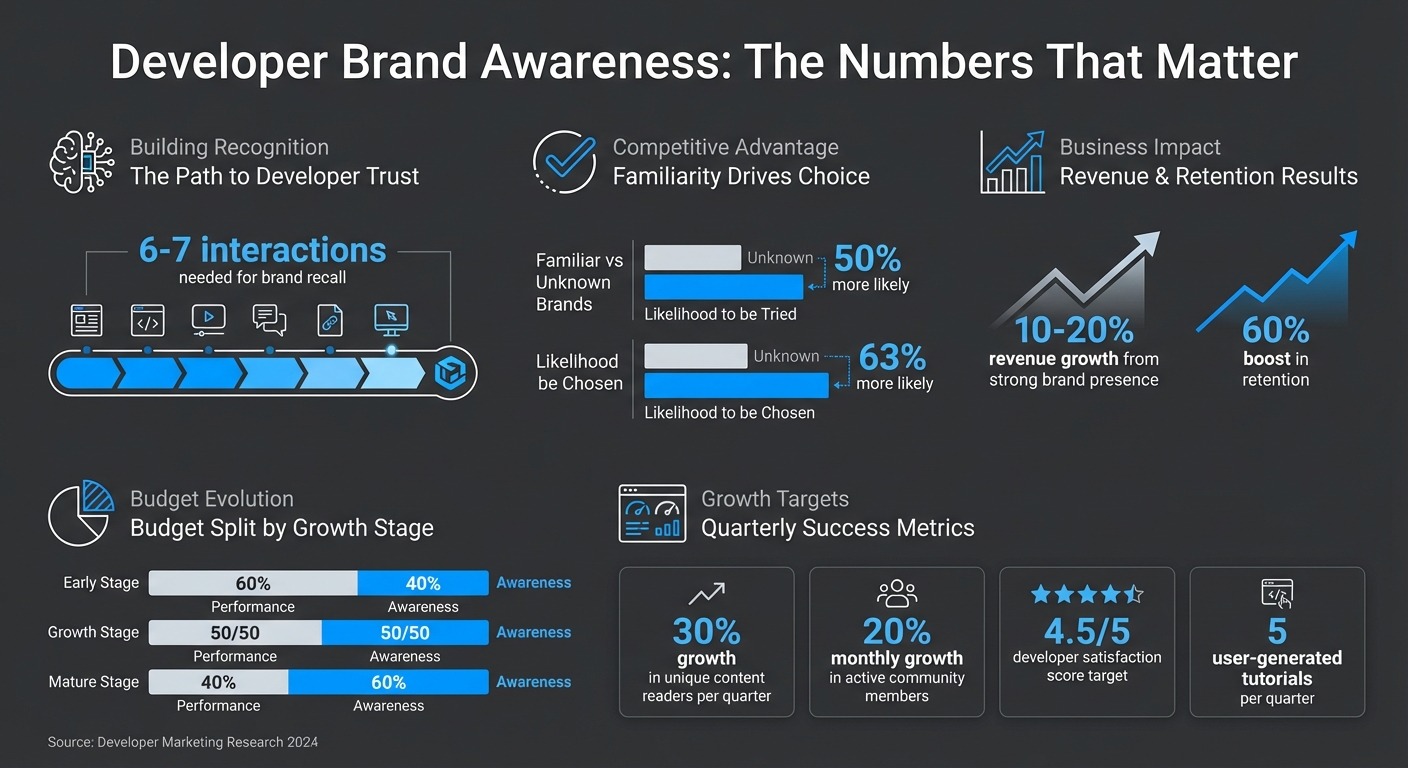 {Developer Brand Awareness Statistics: Key Metrics for Building Trust}
Why Brand Awareness Matters for Developer Tools
The developer tools market is a tough space to stand out in. With millions of developers and thousands of competing products, getting noticed isn't just helpful - it’s essential. Developers often take weeks or even months to decide on a tool, which means your brand needs to be on their radar well before they're ready to commit. If they don’t know you when they start evaluating options, you’re already at a disadvantage.
In this crowded market, mental availability is your real edge. When developers face a problem, they naturally turn to brands they already recognize and trust. If your brand isn’t familiar to them, you won’t even make their shortlist. The companies that succeed are the ones developers think of first when they need a solution. In an environment where every impression matters, staying top-of-mind is critical.
How Repeated Exposure Builds Trust
Familiarity breeds trust. Each time a developer comes across your brand - whether it’s through a detailed tutorial, an engaging talk at a conference, or a thoughtful discussion in a forum - you’re reinforcing your presence in their mind. Over time, this recognition builds credibility.
This isn’t about shouting your name everywhere. Instead, it’s about maintaining a steady, value-driven presence in the spaces developers already frequent. When your brand consistently delivers useful content, you naturally earn their trust. That trust reduces the perceived risk of trying your product. Even if your features are similar to a competitor’s, developers are more likely to choose a brand they’ve seen and trust over one they’ve never heard of. This steady exposure lays the foundation for long-term loyalty.
Brand Awareness as a Long-Term Advantage
Building a strong brand isn’t just about short-term wins - it’s a long game. When developers recognize your brand, it creates a protective moat that’s hard for competitors to breach. The more familiar your brand becomes, the more likely you are to be the first choice when developers need a solution.
Investing in brand awareness pays off over time. It leads to higher revenue growth and better customer retention compared to less-recognized competitors. As the cost of performance marketing continues to climb, strong brand equity becomes an asset that keeps delivering results long after the initial investment.
How to Build Mental Availability with Developers
Building mental availability with developers takes time and consistent effort. It’s about being present in the spaces they frequent and making sure your brand is top-of-mind when they encounter challenges. This isn’t achieved through flashy, one-off campaigns but through steady, repeated exposure across multiple channels. The idea is to integrate your brand into the places where developers naturally seek solutions.
The guiding principle? Consistency matters more than intensity. A steady, reliable presence in trusted spaces gradually builds recognition. Over time, this creates mental shortcuts that prompt developers to think of your brand when they’re ready to explore solutions. Let’s dive into some practical ways to achieve this.
Content That Developers Actually Use
Developers value content that solves their problems without strings attached. The best resources offer technical guides, code samples, and open-source tools that they can immediately apply to their work. Brands that create these kinds of materials build trust by providing genuine help - resources that developers are likely to share with others.
Focus your efforts on creating blogs optimized for SEO, YouTube tutorials that address specific use cases, and open-source tools that integrate seamlessly into developer workflows. For example, a well-crafted debugging guide or deployment tutorial isn’t just content - it’s a trust-building tool. Developers remember the brands that help them overcome challenges and are more likely to recommend tools that have already proven useful in their daily tasks. Combine this with active participation in communities to solidify your brand’s position as a trusted resource.
Showing Up in Developer Communities
Engaging authentically in developer communities is a powerful way to build credibility. Platforms like Stack Overflow, Reddit, and Discord are where developers go to solve problems, share knowledge, and discover tools. By answering questions, sharing code snippets, or contributing to discussions - without pushing your product - you position your brand as a helpful ally, not just another vendor.
Consistency is key here. Don’t limit your participation to promotional periods. Host AMAs on Discord, provide thoughtful answers on Stack Overflow, and join Reddit discussions with genuine insights. You can also identify active contributors on GitHub or forums and consider creating ambassador programs to reward those who support your tool organically. Developers heavily influence tech decisions within their organizations, and they trust authentic interactions far more than polished marketing. This kind of engagement lays the groundwork for long-term trust and adoption.
Maintaining Visibility Through Social and Events
Social media and events are vital for keeping your brand at the forefront of developers’ minds. Platforms like Twitter (now X) are great for sharing quick technical tips, while LinkedIn is better suited for professional thought leadership. Conferences, sponsorships, and newsletter placements in developer-focused publications like JS Weekly or Go Weekly offer additional ways to stay visible.
The best strategy combines always-on channels with periodic high-impact moments. For instance, daily.dev’s in-feed ads reach over 1.6 million developers who are actively exploring new content. Pair this consistent presence with strategic conference sponsorships and newsletter placements to create multiple touchpoints. This multi-channel approach ensures your brand stays visible throughout a developer’s decision-making process.
Using Content to Build Awareness Without Selling
The best developer content solves problems instead of pushing a product. By tackling issues like debugging, improving performance, or making architectural decisions, you position your brand as a go-to resource. When developers consistently find help through your content, they naturally associate your brand with reliability and expertise. This approach builds trust without triggering the skepticism that often comes with promotional material. It's all about offering value first, laying the groundwork for the strategies outlined below.
The goal? Create content developers want to bookmark and share. Tutorials optimized for SEO can address specific challenges, driving organic traffic while building trust. Open-source libraries can showcase your technical skills and earn mentions on platforms like GitHub, Stack Overflow, and Reddit. Conference talks are another way to highlight your expertise. Each of these efforts strengthens your brand’s presence, and consistent branding across these touchpoints can boost recognition by 39.7% on average .
Creating Content That Provides Real Value
To craft content developers genuinely care about, focus on solving the problems they’re actively searching for. Use long-tail keywords pulled from real conversations on Stack Overflow or Reddit - phrases like "how to optimize React performance" or "debugging Node.js memory leaks." Pair these with step-by-step tutorials and practical code snippets. This "search-to-solve" method not only drives traffic but positions your brand as a helpful ally, not just another vendor.
Open-source contributions are particularly impactful. By releasing tools like utility libraries, debugging aids, or framework integrations, you allow developers to engage with your work without any sales pitch. Take Vercel’s success with Next.js as an example - they open-sourced the framework, creating a positive "brand halo" that naturally drew developers to their hosting services. Focus on tools that address common challenges within your ecosystem, and developers will share them organically, expanding your reach without extra spending.
Technical guides and original research are also powerful tools. Publish data-driven insights or fresh takes on familiar topics to encourage sharing and citations. Over time, this creates a snowball effect - 35% of organizations that consistently deliver valuable content report a 10–20% boost in revenue . Essentially, your content becomes a magnet, attracting developers before they even start evaluating tools.
Speaking and Contributing Without Pitching
Content isn’t just about writing - it’s also about showing up in the right places and sharing knowledge. Conference talks and podcast appearances are excellent platforms to build credibility. Focus on technical deep dives like "Scaling Node.js Applications" or "Database Migration Strategies", using real-world examples to engage your audience. Skip the flashy product slides and keep it educational. Wrap up with a Q&A session to reinforce your role as an expert, not a salesperson. Developers remember the brands that teach them something useful.
Podcasts offer another way to connect. Share insights on industry trends or personal growth stories, but keep it practical and actionable. Research the host’s audience and typical topics in advance, and bring resources like blog posts or GitHub repositories to follow up - without attaching a sales pitch. This conversational format helps your message come across as genuine, much like how Supabase leaders discuss open-source databases without overtly promoting their platform.
When it comes to forums, the same value-first approach applies. Answer questions on Stack Overflow with detailed code examples, join Reddit discussions with thoughtful insights, and participate in Discord chats without pushing your product. Over time, consistent, high-quality contributions build your reputation and visibility. Track the impact through social mentions and increases in brand search volume. Developers who see your team solving real problems in public spaces are more likely to trust your brand when they need tools.
Running Paid Awareness Campaigns with daily.dev Ads
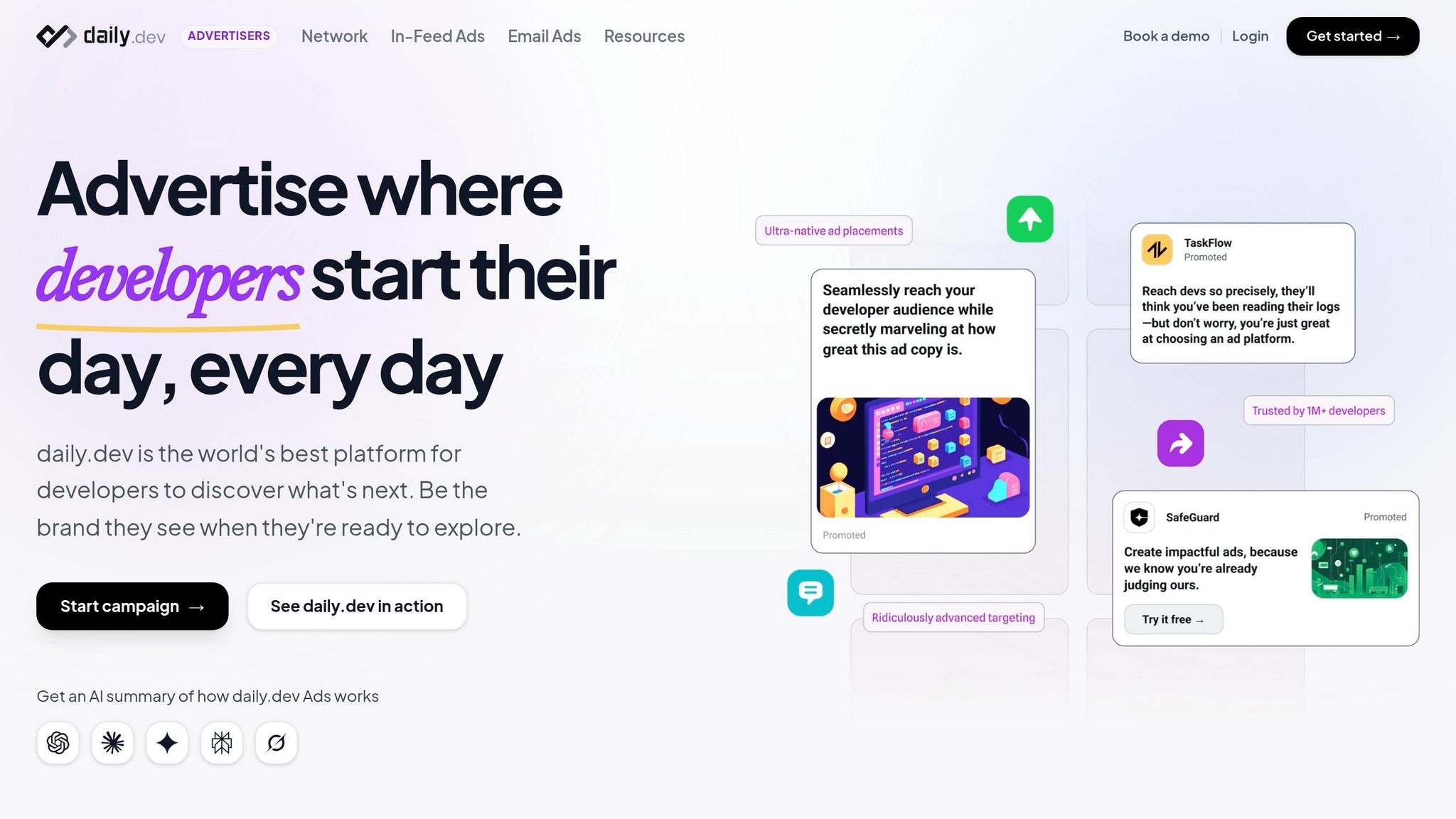
Paid campaigns can be a game-changer when organic strategies aren't delivering the reach you need. Whether you're launching a new product, competing in a crowded space, or trying to connect with tens of thousands of developers quickly, advertising helps bridge the gap. Unlike organic efforts, which can take months to build momentum, paid campaigns can deliver results fast - imagine reaching 100,000 developers in just a week . This kind of visibility keeps your brand on developers' radar, making it more likely they'll think of you when evaluating tools.
The ideal time to invest in paid campaigns is when your product is ready for developers to try - self-serve signups and a clear "aha moment" make a big difference. Paid ads are also perfect for boosting existing content, like tutorials or conference talks, to reach developers who might not frequent traditional communities. Plus, compared to hiring a full DevRel team (which can exceed $200,000 annually for just one hire), a solid advertising program can start at $3,000 per month . For smaller teams, this offers a quicker and more manageable way to build awareness while complementing your organic efforts to earn developer trust.
Setting Budgets and Campaign Timing
Budgeting for scale is critical. A monthly spend of $10,000–$20,000 is a good starting point for consistent brand awareness. This allows you to maintain a steady presence on daily.dev while giving you flexibility to increase spend around key moments like product launches or major events. A two-pronged approach works best: keep your brand visible consistently, and ramp up spending during critical windows. For example, if you're rolling out a new feature, start increasing your budget 30 days prior to the launch to establish mental availability before developers begin actively searching for solutions .
Your budget should align with your company's growth stage. Series A companies often allocate about 35% of their marketing budget (roughly $7,000–$17,500 per month) to developer advertising. As companies grow into Series B and beyond, budgets typically expand to $15,000–$60,000+ per month, supporting multi-channel campaigns . These investments aren't about chasing instant ROI - they're about building recognition over time. While it's important to track metrics weekly to fine-tune your spending, think in terms of months, not days, when measuring success.
Targeting Developers with Precision
daily.dev Ads provides access to over 1.6 million developers in discovery mode, enabling precise targeting based on seniority, programming languages, and tools. This lets you connect with the right audience at the right level of expertise. Native in-feed and post-page ads integrate seamlessly into developers' workflows, avoiding the interruptions typical of traditional display ads. This not only reduces ad fatigue but also ensures your brand stays visible in the spaces where developers naturally spend their time.
The platform's targeting capabilities also make it easy to test and refine your messaging. For example, you can run five different headlines and quickly identify which one resonates most within just 1–2 months . This rapid feedback loop gives you the confidence to scale up your spending once you've nailed the messaging that works.
Creating Ads That Educate Instead of Promote
Developers respond best to ads that educate rather than sell. Focus on solving specific problems - like reducing API latency or debugging Node.js memory leaks - and link to helpful resources like tutorials. Your ad should feel like a useful tip, not a sales pitch. This approach respects how developers think and builds trust by offering value upfront.
"The best developer marketing strategies combine DevRel for trust-building and community with advertising for scale and speed." - Idlen
Keep your ads technical and straightforward. Use native formats that blend into the feed, and avoid flashy designs or overly promotional language. Developers appreciate concise, practical messaging. Think of your ads as an extension of your educational content - just amplified to reach a broader audience. Over time, this consistent, value-driven strategy positions your brand as a trusted resource rather than just another vendor vying for attention.
sbb-itb-e54ba74
How to Measure Brand Awareness Impact
When building long-term trust for developer tools, measuring brand awareness requires going beyond basic metrics like clicks and impressions. These numbers alone don’t show whether your brand is remembered. Instead, focus on signals like direct URL entries, brand name searches, and unprompted mentions in developer communities.
Metrics That Show Brand Growth
One of the clearest signs of brand awareness is direct traffic. If someone types your website URL from memory or uses a bookmark, it’s a strong indicator that your brand has made an impression. Similarly, tracking brand search volume through tools like Google Trends can reveal whether more developers are actively seeking your brand over time. A consistent rise in searches for your company name points to successful awareness efforts.
Another key metric is social mentions. Platforms like Twitter, Reddit, and Stack Overflow can show how often developers are discussing your tool without prompting. Look at both the volume of mentions and the context - are they recommending your tool or asking questions about it? Discussions comparing your tool to competitors (e.g., "Tool X vs. Tool Y") are especially valuable, as they show you’re on developers’ radar.
Adding a simple "How did you hear about us?" question to your signup process can capture word-of-mouth referrals and community influence that automated tools might miss. This self-reported data is particularly useful for understanding private conversations within developer circles.
For content-driven strategies, track unique readers of your technical content, aiming for about 30% growth each quarter. Also, watch for community members creating tutorials or guides about your tool. A goal of five user-generated pieces per quarter signals not just awareness but genuine trust in your brand.
These metrics lay the groundwork for using tools to measure your brand’s growth in more detail.
Tools for Tracking Brand Lift
Once you’ve identified the right metrics, the following tools can help you measure your progress. Brand lift surveys, conducted quarterly, provide direct feedback on recognition and perception. Ask developers simple questions like "Have you heard of [Your Product]?" or "How familiar are you with it?" to establish a baseline and track changes over time. Keep these surveys brief - developers are unlikely to complete lengthy questionnaires.
Cohort analysis is another valuable method. By comparing developers who were exposed to your brand campaigns with those who weren’t, you can measure long-term impacts. Over six to twelve months, track retention and engagement to see if developers familiar with your brand are more likely to stick around and engage deeply.
Attribution surveys at signup help identify the touchpoints that mattered most in a developer’s journey. Since traditional tracking often misses key moments, directly asking users fills in the gaps. Combine this qualitative feedback with quantitative data like active community member growth (aim for roughly 20% monthly increases) and developer satisfaction scores (targeting 4.5 out of 5 or higher). Together, these metrics offer a comprehensive view of your brand’s health, far beyond what any single data point could provide.
Splitting Budget Between Awareness and Performance
Marketing for developer tools requires a mix of awareness and performance campaigns, with the balance shifting as your company evolves. Early on, the focus is on quick wins and validation, while later stages prioritize building a strong brand presence. Let’s break down how this transition works, from getting initial traction to dominating a mature market.
How Budget Split Changes as You Grow
In the early stages, allocate about 60% of your budget to performance marketing and 40% to awareness efforts. At this point, your priority is capturing demand and proving product-market fit. Awareness activities should be cost-effective and often founder-led - think technical blog posts, speaking at local meetups, and joining developer communities where you can make an impact without overspending.
Once you hit the growth stage, shift toward a 50/50 split. With demand validated, it’s time to balance generating leads with educating the broader market. This is when you can start investing in consistent awareness channels like daily.dev's in-feed ads, which reach over 1.6 million developers actively exploring new tools. The aim is to maintain visibility while continuing to convert developers who are already searching for solutions.
For mature companies, the focus flips to 40% performance marketing and 60% awareness efforts. By this stage, performance campaigns often face diminishing returns as your target audience becomes saturated. A strong brand presence becomes your competitive edge, creating a "moat" that competitors can’t easily breach, even if they outspend you on ads.
This evolving budget split reflects the changing dynamics of developer markets as your company grows.
Why Awareness Becomes More Important Over Time
The increasing emphasis on awareness isn’t random - it’s tied to how developer markets mature. As competition heats up, acquisition costs rise, and performance marketing yields start to plateau. Brand awareness, on the other hand, compounds over time and helps protect your position in the market.
"Brand awareness is about creating future demand for your product, not about converting existing demand into users." - Jakub Czakon, CMO, neptune.ai
A well-established brand also boosts the effectiveness of your performance marketing. When developers recognize and trust your name, they’re more likely to engage with your ads, reducing your cost per click and improving overall efficiency. This creates a virtuous cycle: awareness builds trust, trust enhances ad performance, and better performance frees up more budget to reinvest in awareness.
For companies targeting enterprise sales, this becomes critical. Developers often act as internal advocates during long procurement processes, and they’re far more likely to champion a tool they already know and trust. A strong brand ensures you’re the first solution they think of when the need arises.
Conclusion
Building developer brand awareness is about earning trust well before developers even realize they need your solution. In the developer tools market, where sales cycles often stretch over time, trust grows gradually, and familiarity plays a key role in establishing credibility. When developers face challenges that your tool can solve, they’re more likely to turn to the brand they already recognize and trust.
This strategy works best when you combine meaningful community engagement with scalable advertising efforts. The most effective approach merges the trust-building power of DevRel with the reach and efficiency of advertising. As Idlen put it, "DevRel builds something advertising cannot buy: trust." To keep your brand top-of-mind, you need both genuine interaction and consistent visibility across all developer touchpoints.
Platforms like daily.dev Ads can help make this happen. With over 1.6 million developers actively exploring tools and solutions, in-feed placements ensure your brand stays visible where developers spend their time. Consistently delivering educational content keeps your presence strong, which is critical in a market where long sales cycles demand ongoing engagement.
The recognition you establish today will become a lasting advantage as your company grows. While startups may focus on immediate performance marketing wins, established brands reap the rewards of sustained awareness efforts, creating a competitive edge that’s hard to replicate.
Start building your brand presence now, so when developers are ready to choose, yours is the name they trust.
FAQs
How long does developer brand awareness take to work?
Building awareness for a developer-focused brand doesn’t happen overnight. It’s a process that demands consistent effort over several months. Developers typically need to encounter your brand multiple times before they feel familiar enough to engage. This means trust-building takes time, and the key to success lies in staying patient and persistent throughout the journey.
What should I do first if I have limited DevRel resources?
If you're working with limited Developer Relations (DevRel) resources, prioritize creating educational content to build trust and awareness among developers. Focus on materials like technical guides, step-by-step tutorials, or even open-source tools that solve real problems. By offering something genuinely useful, you not only establish credibility but also create a strong base for ongoing engagement with your developer community.
How do I prove brand awareness is paying off?
To gauge brand awareness, start by looking at brand search volume using tools like Google Trends. Keep an eye on direct website traffic - it’s a strong indicator of how familiar people are with your brand. You can also conduct surveys to find out if developers recognize your product and associate it with your niche.
Don’t forget to monitor social mentions on platforms like Twitter or Reddit, as these can reveal how often your brand is part of the conversation. Dive into community discussions, especially comparisons like “X vs. Y,” to see where your product stands. Lastly, use survey feedback to link trial signups back to brand awareness efforts.