

Building a developer community is more than just creating a space for discussion - it's about fostering collaboration, solving real problems, and driving product growth. Here's the key takeaway: active, engaged communities lead to higher adoption, retention, and revenue.
Why It Matters:
- 78% of developers find new tools through peer recommendations.
- Community-driven customers cost 40% less to acquire and have a 60% higher lifetime value.
- Leads from communities convert 40% better than traditional marketing leads.
How to Build It:
- Choose the Right Platform: Discord for real-time chat, GitHub Discussions for searchable knowledge, Slack for professional teams, or forums like Discourse for structured discussions.
- Attract Developers: Start with a clear mission, reach out personally to early members, and seed your platform with valuable developer marketing content.
- Engage and Retain: Focus on onboarding, quick wins (15-minute time-to-value), and regular activities like tutorials or office hours.
- Measure Success: Track meaningful metrics like Monthly Active Contributors (MACs), retention rates, and peer-to-peer support ratios.
- Monetize Carefully: Offer premium features or job boards, but only after building trust and providing free value.
Quick Comparison of Community Platforms:
| Platform | Best For | Cost | Search/SEO |
|---|---|---|---|
| Discord | Casual, real-time chat | Free | Poor |
| Slack | Small professional teams | ~$7.25/user/mo | Moderate |
| GitHub Discussions | Open-source projects | Free | Excellent |
| Discourse (Forums) | Large, structured communities | $20–$500+/mo | Excellent |
Key Roles:
- Developer Advocates: Engineers who create technical content and represent your product.
- Community Managers: Build relationships, moderate platforms, and maintain engagement.
Why It Works:
Engaged communities lead to stronger product adoption, higher customer retention, and more organic growth. The focus should always be on quality over quantity - a small, active group of contributors is far more impactful than a large, silent audience.
Start small, focus on value, and build alongside your developers.
Selecting Your Community Platform
Picking the right platform for your community is a game-changer. It directly influences how developers connect, share knowledge, and solve problems together.
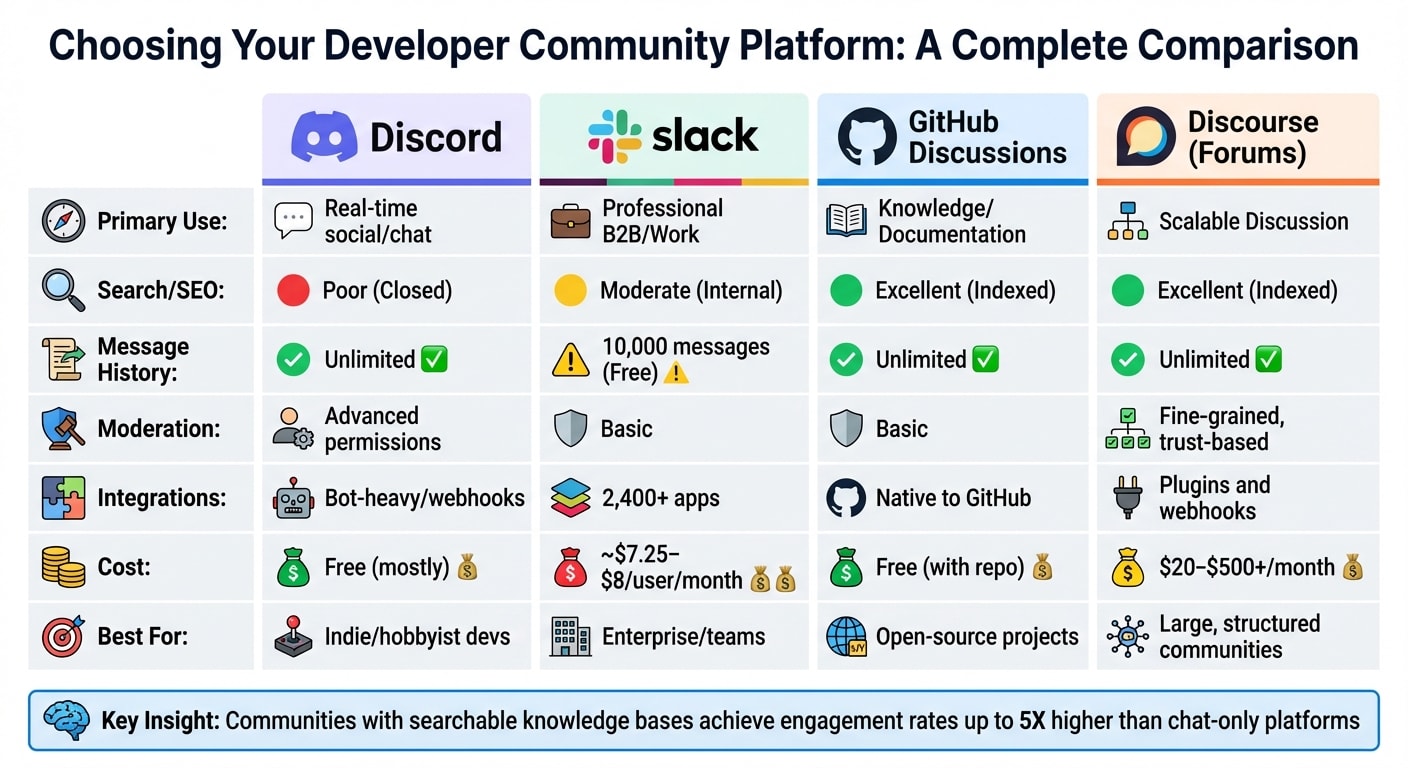
Discord is all about real-time chat. If your community consists of tech-savvy hobbyists or indie developers who thrive on quick, spontaneous interactions, Discord is a great fit. However, keep in mind that conversations on Discord aren't indexed by search engines, so valuable insights can easily get buried over time .
Slack works well for professional and persistent conversations. It's familiar to enterprise teams and is ideal for smaller B2B communities with fewer than 100 members. On the free plan, only the most recent 10,000 messages are accessible, and paid plans start at around $7.25 per user per month. For larger communities, the costs can escalate quickly .
GitHub Discussions is perfect for creating a permanent, searchable archive of technical knowledge. If you're managing an open-source project or need a platform that integrates seamlessly into developers' workflows, GitHub Discussions fits the bill. It’s free for public repositories, making it a natural choice for open-source communities .
Forums like Discourse shine when it comes to structured, long-form discussions. They offer advanced moderation tools and reduce support tickets by creating a searchable knowledge base. You can self-host for free (aside from VPS costs, which typically range from $20–$50 per month), or opt for managed hosting, which can cost anywhere from $20 to $500+ monthly .
Both GitHub Discussions and forums excel at indexed search capabilities. This is a major advantage - when developers search for error messages and land on a relevant thread, it can drive significant engagement. Communities with well-organized, searchable knowledge bases have been shown to achieve engagement rates up to five times higher than those relying solely on chat platforms .
To avoid fragmenting your community, stick to one platform where your target developers are already active. David Spinks, co-founder of CMX, puts it best:
"The community is the people not the platform. If you don't have an engaged audience yet, go to where your target members are already spending time" .
Discord vs. Slack vs. GitHub Discussions vs. Forums
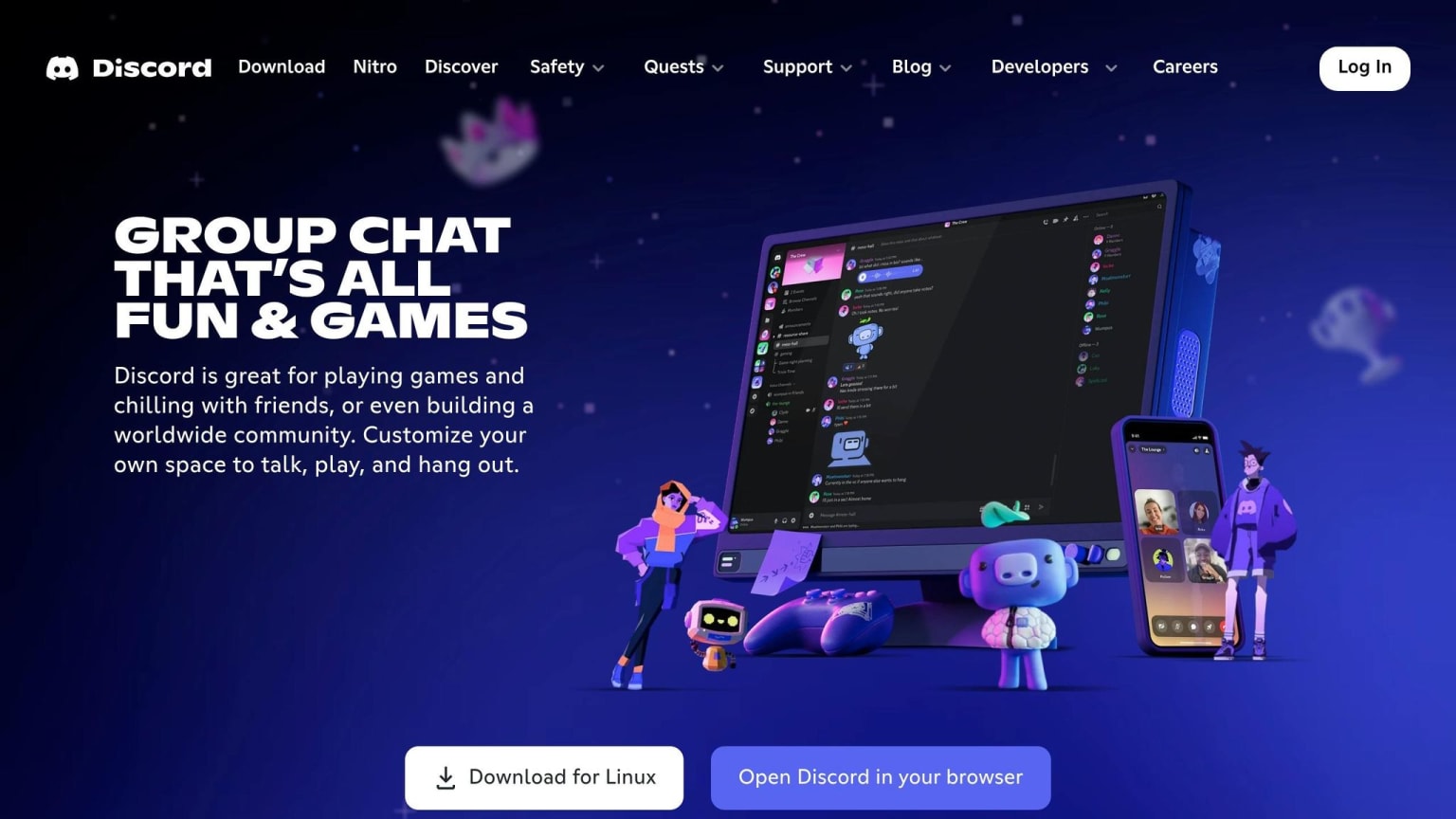
Here’s a quick comparison to help you weigh your options:
| Feature | Discord | Slack | GitHub Discussions | Discourse (Forums) |
|---|---|---|---|---|
| Primary Use | Real-time social/chat | Professional B2B/Work | Knowledge/Documentation | Scalable Discussion |
| Search/SEO | Poor (Closed) | Moderate (Internal) | Excellent (Indexed) | Excellent (Indexed) |
| Message History | Unlimited | 10,000 messages (Free) | Unlimited | Unlimited |
| Moderation | Advanced permissions | Basic | Basic | Fine-grained, trust-based |
| Integrations | Bot-heavy/webhooks | 2,400+ apps | Native to GitHub | Plugins and webhooks |
| Cost | Free (mostly) | ~$7.25–$8/user/month | Free (with repo) | $20–$500+/month |
| Best For | Indie/hobbyist devs | Enterprise/teams | Open-source projects | Large, structured communities |
When considering costs, Discord’s free tier is ideal for small or bootstrapped projects. Slack’s per-user pricing can become expensive as your community grows. GitHub Discussions is free for GitHub users, while Discourse offers flexibility depending on whether you self-host or choose managed hosting.
Pro Tip: Before launching your platform, make sure it’s not empty. Seed it with at least 20 discussion threads and invite 30–50 founding members to prevent the dreaded "ghost town" effect. Also, check if the platform supports data portability to simplify future migrations .
In short, Discord is great for casual, real-time interaction, Slack suits professional workspaces, and GitHub Discussions acts as a technical archive. Forums like Discourse are ideal for large, organized communities. The key is to select the platform that aligns with where your developers already spend their time, then focus on making it a vibrant space for engagement and growth.
Launching Your Developer Community
Starting a developer community begins with a clear mission and understanding the people you want to reach. Before diving into tools and platforms, focus on the behaviors you want to encourage: creating a sense of belonging (safety), supporting skill development (progress), and offering visibility for contributions (recognition). These psychological factors are key to keeping developers engaged beyond their first visit.
Once you’ve chosen your platform, the next step is to attract active developers. Use social monitoring tools to track relevant keywords tied to your tech stack or the problems your product addresses. Platforms like GitHub, Reddit, Hacker News, and X are great starting points. As Jonathan Reimer from Octolens puts it:
"Developers tend to be cautious and skeptical about how brands engage with them. Mainstream marketing and sales speak won't work with this audience, and you don't get a second chance to make a good first impression" .
This means offering value upfront - answer questions, share resources, and build trust without pushing your community too early.
When you identify potential members, reach out personally to your first 10–20 developers. This approach sets the tone for your community and ensures you’re starting with people who genuinely care about your mission. You might even consider forming a small Technical Advisory Board (TAB) with key practitioners who are active in other communities and share your vision. These early members can provide honest feedback, guide your product’s direction, and help amplify your efforts as the community grows .
One of the most important elements to focus on is time-to-value (TTV). Can new users quickly understand your community and see results in under 15 minutes? Your landing page or GitHub README should clearly answer three questions: What is this?, What does it do?, and How do I try it? - all in a single scroll . To keep things engaging, seed your platform with cornerstone content like tutorials, architecture docs, or case studies that solve real problems. This creates quick wins and reinforces a culture of belonging, growth, and recognition.
Getting Your First 100 Engaged Developers
A structured onboarding process is crucial to building engagement and reducing early churn. Guide new members with a seven-day framework that includes welcoming them, providing education, encouraging participation, offering direct support, spotlighting contributions, inviting collaboration, and sharing success stories . This method transforms passive members into active contributors.
Co-creation can also be a game-changer. For example, one company built a pre-launch waitlist of 5,300 people using a "Future of Work" survey, converting 793 professionals and 50 companies into users within the first month . Similarly, a founder launched a group that grew to 3,000 members in two months, generating $28,000 in revenue within 48 hours and driving the company to $1.5 million in its first year .
Instead of relying solely on static support tickets, host regular "office hours." Snap Inc.'s DevRel team used this approach during the beta of their Camera Kit SDK, combining office hours with a community forum. This strategy empowered experienced users to support newcomers, reducing support tickets by 85% . Over time, this builds a contributor ladder, helping members evolve from observers to active participants and, ultimately, advocates.
Developer communities also offer tangible business benefits. Community-driven customers cost 40% less to acquire and have a 60% higher lifetime value . Leads generated through community interactions convert 40% better than traditional marketing leads . Additionally, customers involved in brand communities have 90% higher retention rates and spend 19% more annually compared to those who aren’t engaged . As Mindy Faieta, Customer Success Lead at Stateshift, explains:
"Community is a product adoption engine - not an accessory" .
To measure success, focus on behavioral metrics instead of vanity numbers. Track metrics like "Time to First Contribution", "Peer-to-Peer Support Rate", and "Community-Qualified Leads (CQLs)" instead of simply counting members. Around 70% of community programs fail within their first year because they prioritize engagement volume over meaningful outcomes . Your goal isn’t to create the largest community - it’s to build the most engaged one. A small, active group of 100 developers who regularly contribute and support each other is far more impactful than 10,000 silent members.
Building a Community Content Strategy
To craft a content strategy that resonates with a developer community, focus on the bigger picture - go beyond your product. As Adam Gordon Bell, Podcast Host at CoRecursive, explains:
"Your product is this little thing, and your whole world is about the product, right? But if you zoom out and look at the larger context, that's the number one thing I think people miss" .
Create content that tackles industry-wide challenges, explores emerging technologies, and addresses real problems developers face. Think in terms of variety - articles, tutorials, podcasts - anything that educates and engages. For example, an early-stage founder who dedicated 90% of their time to writing educational articles on industry topics (rather than product-specific guides) laid the groundwork for sustained community growth . A single technical tutorial on AWK attracted 60,000 visitors from Hacker News because it addressed a genuine developer pain point .
When it comes to publishing, consistency matters more than perfection. Clayton Kast of Draft.dev emphasizes that regular publishing helps build an audience faster than waiting for flawless content. Developers value information-rich, technical content that educates without feeling like an ad. Your goal? Help them learn new skills, solve problems, or grasp complex ideas - without constantly steering the conversation back to your product.
And don’t underestimate the importance of distribution. Developers are more likely to trust content shared by peers or internal experts than by a brand. Use community champions to amplify your content and research popular topics using tools like subreddit "top" filters. After publishing, engage with your audience by responding to questions or comments on the platforms where your content is shared. This follow-up can turn casual readers into active community participants. Once this strategy is in place, you can shift focus to encouraging contributions from your community.
How to Encourage User-Generated Content
Once you’ve built a steady stream of valuable content, the next step is fostering community contributions. Developers are far more likely to contribute when given clear instructions and specific prompts. Instead of asking them to "share your thoughts", guide them with actionable requests. For instance, you could invite them to share how they implemented a solution, debugged an issue, or optimized performance for a particular use case. Embedding such prompts into your developer portal and documentation makes participation easier.
Energize contributions with contests, challenges, or themed discussions. Publicly recognize contributors by crediting their work, offering early access to features, or providing discounts on premium services. You can also elevate active community members by inviting them to speak at events or conferences, turning them into advocates for your brand. If you notice users already creating content - like YouTube tutorials or blog posts - about your product or related technologies, build relationships with them.
To gather technical insights without overwhelming your team, consider having a content creator interview your internal experts for articles or podcasts. Richard Rodger, CEO of VoxGig, highlights the importance of giving technical team members who excel at communication the time and space to share their knowledge:
"You've got to create space in your technical organization for people who are good at communicating to have time to get out there and do stuff" .
Finally, ensure contributions align with community standards by moderating submissions, and always secure permission before repurposing content. When contributors see their work appreciated and amplified, they’re more likely to continue engaging with your community.
Key Roles for Managing Developer Communities
Building a thriving developer community requires dedicated professionals who can bridge the gap between your product and its users. Two essential roles in this effort are Developer Advocates and Community Managers, each bringing unique skills and responsibilities to the table.
Developer Advocates
Developer Advocates are, first and foremost, skilled engineers. Their expertise lies in coding, creating demos, and solving technical issues . They craft tutorials, write API guides, and build sample applications to make onboarding smoother for developers. Beyond the technical work, they represent your product at events, lead hackathons, and act as a vital feedback channel between developers and your product team.
In the United States, the median annual salary for a Developer Advocate is $152,500, with senior roles earning up to $199,750 and top earners surpassing $220,000 .
Community Managers
Community Managers, on the other hand, focus on fostering relationships and keeping the community engaged . As Amit Ashwini puts it:
"Discord requires hosts. Actual humans. People who can spin up conversation, enforce culture, and shut down nonsense" .
Their responsibilities include organizing meetups, addressing member concerns, and creating engaging programming - like weekly "What are you building?" threads or monthly showcases. Success in this role depends on strong emotional and social intelligence, as it often involves resolving conflicts and translating community needs into actionable insights for the organization. In the US, the average salary for a Technical Community Manager is approximately $73,157 .
Developer Advocates vs. Community Managers
If you're deciding which role to prioritize, here’s how their responsibilities differ:
Developer Advocates: Look for candidates with a proven track record, such as well-documented repositories, published tutorials, or recorded conference talks. As Teresa Garanhel, Content Lead at Product Marketing Alliance, explains:
"Developers trust the opinion of their peers above everyone else's and they also listen to people who speak their language" .
Community Managers: Speed and consistency are key. For example, unanswered queries for 27 hours can drastically reduce engagement . A strong daily presence is crucial, as Amit Ashwini emphasizes . Empowering superfans with micro-moderator roles can also help maintain activity during peak times.
As your community grows, you might want to refine the Developer Advocate role into specialized positions, such as API advocates, content engineers, or platform evangelists, to better address the evolving needs of your ecosystem .
Hiring the right people for these roles is critical to ensuring the long-term success of your developer community.
Tracking Community Health and Success
To sustain growth in a developer community, it’s not just about numbers - it’s about engagement quality. Yet, many teams focus on sheer volume, with 87% tracking how many people join rather than how many actively contribute. For example, celebrating 1,000 new Discord members might feel like a win, but if only 12 of them participate meaningfully, the impact is minimal . Developer communities thrive on collaboration, where quality always outweighs quantity.
Key Metrics: Engagement, Sentiment, and Contributions
The heartbeat of a healthy community lies in Monthly Active Contributors (MACs) - those who actively add value through coding, creating content, or offering support, rather than just passively consuming . Another important metric is the Peer-to-Peer Support Ratio, which compares how often members help each other versus relying on your team. A solid benchmark is a 3:1 ratio, meaning for every question your team answers, the community answers three .
Retention is equally critical. Pay attention to how many first-time contributors return within 90 and 180 days. In thriving communities, 25–40% of these contributors come back within 90 days, and in top-performing ones, 10–15% stay active for over a year . These retention rates reveal far more about a community's stability than surface-level stats like member count.
When evaluating contributions, focus on their impact. For instance, a pull request fixing a core feature bug holds more weight than one correcting a typo. Similarly, documentation that reduces support tickets or integrations that unlock new possibilities should be scored higher . Don’t forget to monitor unsolicited mentions on platforms like Stack Overflow, Reddit, and GitHub - these organic endorsements can be a goldmine of insights .
Why Community Metrics Matter
Strong community engagement has tangible business benefits. It can lead to 15–30% higher customer lifetime value (LTV), 90% retention rates, and 25–35% lower support costs . Additionally, active communities often see 25–40% faster adoption of new features . Investing in tools to measure these metrics - ranging from $500 to $2,000 per month - can deliver a 15–25% boost in trial-to-paid conversions within just three months . For example, platforms like Common Room provide in-depth community analytics for $500 to $1,500 per month, though free tools like GitHub Insights and Google Alerts can also help you get started .
Up next, we’ll dive into how to monetize community engagement while maintaining trust.
Monetizing Your Community Without Breaking Trust
When it comes to monetizing a community, trust is the foundation. Developers, in particular, tend to shy away from traditional marketing tactics, so the approach here needs to be different. Instead of seeing your community as something to exploit, think of it as an asset to nurture. The goal is to generate revenue without compromising the community's growth or its core values. In fact, any revenue strategy should tap into only a small fraction of the community's potential while leaving room for it to thrive .
Trust-First Monetization Approaches
The best way to monetize is by blending free, valuable resources with optional premium services. This means fostering open discussions and sharing expertise while introducing paid options that genuinely enhance the members' experience. For instance, a DevOps-focused community might host free conversations about common challenges while offering premium tools like advanced deployment templates or exclusive integrations that solve specific problems.
Job boards are another effective option, especially in professional communities. By curating job opportunities that align with members' skills and interests, they provide value while generating revenue. Similarly, freemium models work well when the free tier is genuinely useful, with an upgrade path that feels natural as users encounter real limitations.
Timing matters, too. Monetization works best when introduced as members transition from exploring the community to actively engaging and adopting its resources. Use insights from community data to understand what resonates most with your audience. Then, ensure your premium offerings directly address their needs. For example, if a developer has been using your free tier and comes across a paid feature that solves a specific pain point, it feels like a logical next step - not a pushy sales pitch.
This approach prioritizes authentic, relationship-driven growth over aggressive tactics. By focusing on active engagement and collaboration, you preserve the sense of belonging that makes a community special. When trust is the priority, monetization becomes a natural extension, creating a sustainable and thriving ecosystem.
Expanding Community Reach with daily.dev Ads
Once you've built a strong developer community, the next step is getting your content in front of the right audience. daily.dev Ads provides a way to connect directly with over 1 million developers who actively engage with tech content through personalized feeds. Instead of disrupting their experience, these ads seamlessly integrate into their daily content consumption, making them a natural part of the feed.
Here’s how it works: sponsored content is woven into developers' feeds. For instance, Tailwind CSS used this platform to share community-driven tutorials and challenges, leading to an impressive 15,000 additional profile visits and a 30% increase in GitHub stars in just one month . This approach focuses on amplifying community contributions rather than pushing overt sales pitches, maintaining trust while delivering real value. Plus, the targeted placement ensures your content reaches the right people without feeling intrusive.
Targeting Developers by Skills and Experience
With daily.dev Ads, you can zero in on developers based on their programming language, framework, and experience level. Whether it’s JavaScript, Python, or Go, or frameworks like React or Kubernetes, the platform analyzes reading habits to deliver your content to the most relevant audience. For example, a Kubernetes community shared advanced contributor guides specifically with Senior DevOps engineers, achieving a 40% boost in engagement from qualified leads compared to broader social media campaigns .
Audience segmentation by skill level - Junior, Mid-level, Senior, or Staff/Principal - allows for highly tailored messaging. A React community used this feature to promote a virtual meetup, increasing attendance among senior frontend developers by 25% . This kind of targeting lets you fine-tune your approach: share beginner-friendly resources with junior developers or advertise advanced workshops to senior professionals. The result? Your content feels relevant and engaging to every segment.
Ad formats include native feed posts, sponsored articles, event banners, and carousel ads, all strategically placed at the top of personalized feeds, ensuring over 90% viewability. Developer-centric placements consistently outperform traditional banner ads, generating up to three times more clicks. For example, one community saw a threefold increase in clicks for Discord server invites using native ads . With average click-through rates of 1-3% and costs ranging from $0.50 to $2.00 per click, this platform delivers measurable outcomes while staying true to the value-first principles that foster healthy developer communities.
Conclusion
Creating a thriving developer community isn't about chasing vanity metrics. It's about turning curious visitors into passionate advocates by focusing on three core pillars: Safety (fostering belonging), Progress (supporting growth), and Recognition (valuing contributions).
The numbers speak for themselves. Customers who engage in brand communities are not only more loyal but also more profitable. Community-driven customers cost 40% less to acquire, boast a 60% higher lifetime value, and enjoy 90% higher retention rates. On top of that, they spend 19% more annually compared to non-members . This highlights the importance of viewing your community as a key driver of product adoption, not just an afterthought.
As we've covered in the onboarding strategy, the first seven days are critical. Focus on delivering a clear "seven-day win" for new users, and enlist 5–10 power users to help shape the community. Instead of tracking superficial metrics like message volume, measure meaningful outcomes like time-to-first-contribution and feature adoption. As Mindy Faieta from Stateshift puts it:
"Champions are the only scalable strategy."
Building a strong community isn't a solo effort. Empower your early contributors - they can answer questions, set the tone, and help nurture a positive culture as your community grows.
When monetization aligns with what your community values, it feels natural and supports sustainable growth. Tie premium offerings to real user needs and milestones, and developers will see how their participation leads to real results. It's no surprise that community-driven leads convert 40% better than traditional marketing leads - they're already pre-qualified through hands-on experience .
The difference between a thriving community and one of the 70% that fail in their first year lies in intentionality. Start small, focus on the metrics that matter, and build alongside your developers - not just for them.
FAQs
How do I pick one community platform and avoid fragmentation?
When choosing a platform for your developer community, it’s important to think about both your community’s goals and the needs of your developers. Ask yourself: Where are your target developers already spending their time?
For instance, Discord is perfect for real-time conversations and fostering quick, interactive discussions. On the other hand, GitHub Discussions works well for technical Q&A and more structured, long-term threads.
It's usually best to focus on a single platform to create a smooth and unified experience. Spreading your efforts across multiple platforms can stretch your resources thin and make it harder to keep your community engaged and thriving. Stick to where your developers are most active, and build from there.
What should I do in the first week to get developers contributing?
To kickstart engagement with your first 100 developers, creating a welcoming and inclusive environment is key. Start by identifying developers who are already active in your community or niche. These early participants can set the tone for collaboration and growth.
Make sure your project is easy to approach by providing clear, concise documentation. This includes setup guides, contribution instructions, and FAQs. Label beginner-friendly issues with tags like “good first issue” to help newcomers find tasks they can confidently tackle.
Encourage participation by fostering a friendly and open atmosphere. Welcome questions, no matter how basic, and acknowledge contributions to make everyone feel valued. Platforms like Discord and GitHub Discussions are excellent for promoting interaction. These tools allow for real-time communication and the sharing of ideas, making it easier for users to engage and even create content themselves.
By focusing on accessibility and inclusivity, you’ll make it easier for developers to join, contribute, and stick around.
Which community metrics matter most for growth (not vanity stats)?
The key metrics that truly drive community growth are engagement, retention, contribution quality, advocacy, and product alignment. These indicators provide a clearer picture of meaningful progress compared to surface-level stats like activity counts or the number of new members. Prioritizing these ensures growth that is both impactful and sustainable.