

Platforms grow faster when they allow third-party developers to build on them. Examples like Stripe, Twilio, and Shopify show how integrations and marketplaces drive revenue, user retention, and network effects. Here's how you can replicate their success:
- APIs as a foundation: Offer stable, well-documented APIs to enable developers to build integrations.
- Third-party integrations: Extend platform capabilities without overloading internal teams.
- Marketplaces: Create a directory where users discover and adopt integrations, boosting visibility and usage.
Platforms like Salesforce and Shopify have shown that integrations can account for a significant share of revenue, while also improving customer retention. To succeed, focus on clear documentation, partner incentives, and easy onboarding. The goal is to make your platform indispensable by becoming the center of an ecosystem.
Key Metrics to Track:
- Time to first API call (under 30 minutes is ideal).
- Activation rate (partners actively building and using APIs).
- Partner-driven revenue percentage.
- Integration usage and its impact on user retention.
::: @figure 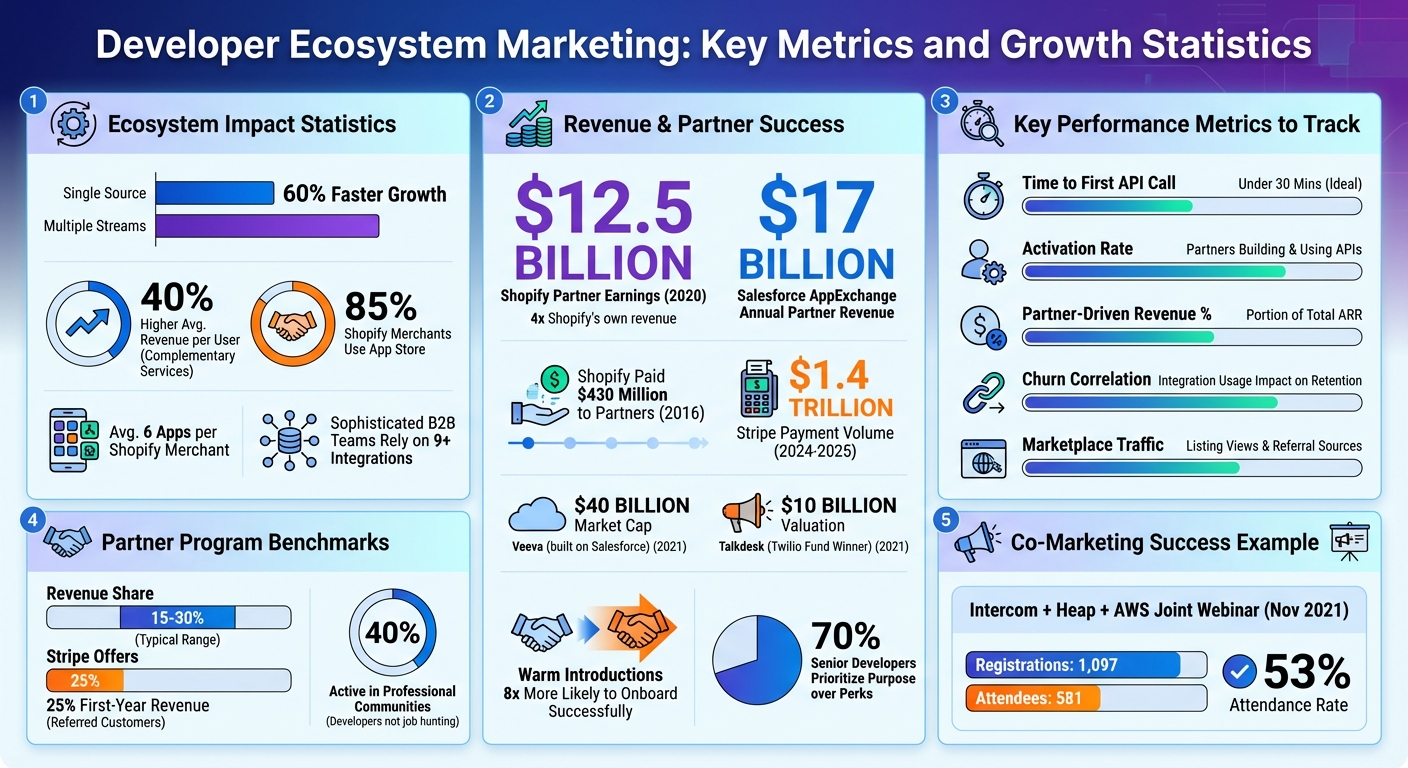 {Developer Ecosystem Marketing: Key Metrics and Growth Statistics}
What Is Developer Ecosystem Marketing?
Developer ecosystem marketing brings together three key elements: your platform, integrations created by partners, and a centralized marketplace where users can find and use these integrations. Together, these components form a solution that goes beyond what any single product can achieve.
This approach stands apart from traditional product marketing. Instead of building every feature in-house, you empower external developers to expand your platform's functionality. Your APIs serve as the foundation, integrations act as the glue, and the marketplace becomes the engine that drives distribution. Research backs this up: platforms offering services that complement their core functionality see 40% higher average revenue per user .
The 3 Parts of a Platform Ecosystem
To understand how this ecosystem works, it helps to break it into three main pieces. Each plays a unique role, and together, they create a powerful system.
The core platform: This is the base product, equipped with APIs and developer tools. Companies like Stripe, Twilio, and Shopify exemplify this by offering stable, well-documented APIs. Stripe handles payment processing, Twilio focuses on communication, and Shopify provides e-commerce infrastructure - all with consistent, versioned endpoints that developers can rely on.
Third-party integrations: These expand the platform's capabilities without draining internal resources. For instance, Stripe supports payments for tools like subscription management software and accounting platforms. Twilio enables communication features in customer support and marketing systems.
The marketplace or directory: This is where users discover and install integrations, serving as both a distribution channel for partners and a customer acquisition tool for the platform. Shopify's App Store is a prime example - its partners earned $12.5 billion in revenue in 2020, quadrupling Shopify's own revenue that year . A thriving marketplace signals to developers that the ecosystem is worth their time and effort .
How Network Effects Drive Platform Growth
Every new integration adds value to your platform, setting off a chain reaction. More integrations attract more users, which in turn draws more developers. This creates a flywheel effect that's tough for competitors to replicate .
The numbers tell the story: 85% of Shopify merchants use at least one App Store app, with an average of six apps per merchant . These users are less likely to leave because your platform becomes central to their daily operations. On average, sophisticated B2B teams rely on nine or more integrations to run their businesses .
Partners also bring their customer base to your platform, effectively becoming distribution channels. For example, when a project management tool integrates with your CRM, their users get exposed to your platform. This creates a cost-effective way to attract high-intent buyers who already value connected systems . Platforms with multiple revenue streams across their ecosystem grow 60% faster than those dependent on a single source .
Revenue sharing further strengthens these partnerships. In 2016, Shopify paid over $430 million to its partner ecosystem . By 2021, Shopify reduced its commission to 0% for developers earning under $1 million annually, down from a previous 20% fee . These incentives encourage developers to invest their time and resources into your ecosystem.
What You Need Before Building an Ecosystem
Before you can create a thriving ecosystem, you need a solid foundation. Here are four essential elements:
API-first architecture: Your APIs should be treated as standalone products with clear tiers, pricing, and capabilities. Avoid one-off manual integrations . Clean, versioned, and well-maintained endpoints are a must.
Developer-friendly documentation: A self-service portal should let partners register, manage API keys, and access guides without needing your team's help. Offer a sandbox environment that mirrors production so they can test their integrations . Long approval processes, like waiting 72 hours for API key approval, can kill momentum .
Proven platform value: Show potential partners that building an integration is worth their time. This means having market traction and customer demand . For example, Veeva's life sciences CRM, built on Salesforce in 2007, became Salesforce's go-to solution for the pharmaceutical industry. By 2021, this partnership helped Veeva reach a $40 billion market cap .
Partner incentives: Make it rewarding for developers to build on your platform. This could include revenue sharing, co-marketing opportunities, or early access to new features . Twilio's "Twilio Fund", launched in 2011 with 500 Startups, provided seed funding for developers. One of its early winners, Talkdesk, grew into a cloud-based call center software valued at $10 billion by 2021 .
How to Build Your Integration Ecosystem
Setting Up Your Partner Program
To create a thriving partner program, you need an infrastructure that scales while reducing manual effort. Start with a developer portal that allows instant registration, API key generation, and easy access to documentation. As one expert put it:
If your onboarding requires three emails, two calls, and a custom Slack channel, they'll move on .
Offer APIs as standardized products with clear tiers, pricing, and terms. This avoids the pitfall of one-off integrations. A platform team shared their experience:
There are between 500 and 700 products that use our API. Each integration is effectively one-off. That's not a partner program. That's 700 manual projects .
Standardizing your offerings paves the way for scalable partnerships.
To manage resources effectively, implement partner tiers. For instance, technology partners might focus on building robust integrations, referral partners can bring in leads, and strategic partners could align closely with your roadmap. Design revenue models to fit these roles, such as percentage-based sharing (like Stripe's 25% of first-year revenue from referred customers ), usage-based fees, or fixed bounties for high-priority integrations.
Adding co-marketing support can amplify the value of these partnerships. This might include marketplace listings, shared messaging documents, or joint events. For example, in November 2021, Intercom teamed up with Heap and AWS for a joint webinar featuring their shared customer, SimpleTexting. The event brought in 1,097 registrations and 581 attendees - a 53% attendance rate - with all partners benefiting from shared leads .
Once your partner program is solid, the next step is to actively recruit integration partners.
How to Find and Recruit Integration Partners
With a scalable partner program in place, focus on finding integration partners who align with your customers' needs. Start by interviewing customers to uncover manual tasks or tool-switching pain points. Group these insights into categories like CRM, payments, or marketing automation, and prioritize the top one or two brands in each category .
Use account mapping tools to evaluate customer overlap. If there's little crossover, the integration may not be worth the engineering effort. A well-maintained integrations marketplace can also act as a magnet, signaling that your ecosystem is active and worth joining .
For outbound efforts, target developers at companies offering complementary tools. Platforms like daily.dev Ads let you reach the right audience - platform engineers and API leads - by targeting tech stacks, seniority levels, and specific technologies. In your outreach, emphasize benefits like revenue sharing, co-marketing opportunities, and technical support. Include a clear call-to-action to join your partner program.
Make your program easy to find both online and at events. Use precise language on your partner landing page to describe your ideal collaborator, whether that’s “high-quality agencies” or “plugin builders.” This helps potential partners self-qualify. Sidney Maestre, Lead Developer Evangelist at Xero, sums it up well:
Once you get them in the door, keep giving! .
Supporting Your Integration Partners
Support is key to ensuring your partners succeed. Offer dedicated technical assistance via Slack or Discord channels, where your developer relations team can provide real-time help. High-value partners should receive priority support and gain access to your product roadmap.
Set up a sandbox environment so partners can safely test their integrations . Track metrics like "time to first API call" - aim for under 30 minutes - to confirm your onboarding process is smooth .
In addition to technical help, provide comprehensive marketing support. For instance, Shopify offered early partner Bold Apps co-promotion and dedicated resources. In just 18 months, Bold Apps expanded its team tenfold and launched a dozen apps on the platform . Recognition also plays a role - certification programs, milestone celebrations (like hitting 1,000 installs), and partner awards can build loyalty.
Finally, empower your partners with self-service analytics dashboards. These tools let them track integration usage, active users, and revenue performance. As Allan Knabe, CEO of Apiable, explains:
The best API programs aren't measured by traffic. They're measured by partner revenue .
Building an Integration Directory for SEO
An integration directory isn't just a helpful resource for developers - it’s also a powerful tool for attracting high-intent traffic through search engines. Each integration page acts as a landing page, targeting specific keyword combinations like "[Your Platform] + [Partner Tool] integration" . These searches often come from users who are actively seeking solutions, making them more likely to convert. By aligning your SEO strategy with your integration ecosystem, you can boost both visibility and user engagement.
How to Structure Integration Pages
Each integration deserves its own dedicated page. Start with a descriptive title that includes both your platform's name and the partner tool. Follow this with a clear explanation of what the integration does, along with visuals like the partner's logo and screenshots that showcase the integration in action. Don’t forget to include a direct link to installation documentation .
To increase credibility, add social proof elements like installation numbers, user ratings, and customer reviews. Organize your integrations into categories like CRM, Marketing Automation, and Project Management, so users can quickly find tools that fit their needs. Offering a search function with filters for use cases, industries, and tool types can make navigation even smoother.
As marketplace expert Jesse Cunningham puts it:
"If you build it, they will not all just come."
This highlights the importance of optimizing each page for both search engine visibility and intuitive browsing within your directory.
SEO Value of Integration Directories
Integration directories are SEO goldmines. They rank highly for specific queries like "[Platform] + [Integration]" or "[Use Case] Integration." Plus, backlinks from partners can enhance your domain authority, strengthening your ecosystem’s presence in the market and encouraging more partners to join.
These directories also support co-marketing efforts. Each integration page gives partners a polished resource they can share in their own campaigns. The more integrations you add, the stronger the network effect becomes. Just look at HubSpot’s ecosystem, which serves more than 250,000 paying customers actively searching for integrated solutions .
Integration Directory Examples
Some companies have mastered growth through integration directories. For instance:
- Zapier: With over 10,000 integrations, each has its own landing page tailored to specific tool combinations.
- Shopify: The platform's marketplace hosts more than 8,000 apps, paying out over $430 million to partners in 2016 .
- Slack: Features over 2,000 apps, organized into categories with robust search and filtering options.
Stripe offers another compelling example. Between 2024 and 2025, Stripe doubled its App Marketplace listings year-over-year, processing $1.4 trillion in payment volume . This success was fueled by structured listings that clearly outlined use cases, installation steps, and partner details - making it easier for users and search engines to find exactly what they were looking for.
Using Paid Ads to Recruit Partners
Most platforms use paid ads to attract end users, but if your goal is ecosystem growth, focusing on recruiting integration partners can be far more effective. Instead of sticking to traditional user acquisition strategies, paid ads can help you connect with developers at complementary companies. These developers can extend your platform’s reach by bringing their existing customer bases into the fold.
Targeting Developers at Potential Partner Companies
The key to successful partner recruitment lies in precise targeting. Platforms like daily.dev Ads allow you to filter audiences by tech stack, company size, and seniority. This ensures your ads reach developers who are actually involved in making integration decisions. Focus on developers who use technologies that align with your platform. Why? Because 40% of developers are active in professional communities even when they’re not actively job hunting - they’re content but open to opportunities for growth .
LinkedIn is another valuable tool for targeting, offering filters based on job titles like "API Lead", "Head of Partnerships", or "Platform Engineer." Combining daily.dev and LinkedIn lets you engage developers both in their learning spaces and on professional networks. Recruitment data shows that candidates sourced through warm, opt-in introductions are eight times more likely to onboard successfully compared to those approached through cold outreach .
Once you've zeroed in on your audience, the next step is creating ads that speak directly to these highly qualified developers.
Creating Partner Recruitment Ads
With your ideal candidates identified, your ad creative should emphasize the real-world benefits of partnering. Instead of generic promises, focus on specifics like revenue share percentages (commonly 15–30%), co-marketing support, and priority technical access. For instance, Stripe’s partner program offers up to 25% of revenue from referred customers during the first year .
It’s worth noting that 70% of senior developers prioritize purpose over flashy perks . Frame your partnership opportunity as a way to solve meaningful technical challenges. Add credibility by including social proof - showcase logos of successful partners and performance metrics that highlight your program’s impact.
Make your call-to-action clear and actionable, directing developers to a self-service portal where they can immediately access documentation and sandboxes. As Jeff Osier-Mixon from Intel Corporation puts it:
Money is important, but it functions as a representation of recognition, not value. This is why a personal note from a project's leaders goes so far .
Partner Recruitment Ad Budget
To make an impact, allocate around $10,000 per month for partner recruitment ads. This investment is justified by the long-term revenue that a strategic partner can generate. For example, Salesforce’s AppExchange drives over $17 billion annually for its partners .
Use unique tracking parameters for each integration to monitor partner-attributed revenue. Track both direct revenue (customers referred by partners) and influenced revenue (deals closed because the integration existed). Integrated users often show stronger retention and lower churn rates compared to non-integrated users , making every recruited partner a lasting asset for your platform’s ecosystem.
Measuring Your Ecosystem Performance
Understanding how well your ecosystem is performing is crucial to knowing if your investment is yielding results. The metrics you track can reveal whether partners are actively building, users are adopting integrations, and your marketplace is contributing to revenue growth.
Metrics That Matter for Ecosystems
Simply counting installs doesn’t tell the full story. What’s more important is whether partners move from signing up to actually using your platform. One key metric to follow is time to first API call. In thriving ecosystems, developers typically achieve a successful API response within 30 minutes of registration . This metric highlights potential friction points that could slow down progress.
Another critical measure is the activation rate, which tracks the percentage of users completing key setup steps . Monitoring the journey from registration to production is essential. For example, Stripe achieved 40% year-over-year growth in enterprise API usage by focusing on these activation milestones .
You’ll also want to measure partner-driven revenue percentage - this shows how much of your total ARR comes from customers using integrations. Platforms with diverse monetization strategies across their ecosystems often experience 60% faster growth than those relying on a single revenue stream . Look at both direct revenue (from partner referrals) and influenced revenue (from deals closed because an integration exists).
Churn correlation is another important metric. It helps determine whether integrations actually improve customer retention . Compare how long integrated users stay versus non-integrated ones. If integrated users stick around longer, your ecosystem is adding value. If not, it’s time to reassess the effectiveness of your integrations.
Lastly, track marketplace traffic to gauge how well users are discovering integrations. Pay attention to listing page views and referral sources. Searches like “[Your Product] + [Partner] integration” often signal high-intent users who are ready to convert .
| Metric Category | KPI | Why It Matters |
|---|---|---|
| Onboarding | Time to First API Call | Evaluates developer experience and ease of use |
| Engagement | Activation Rate | Indicates whether partners are building, not just signing up |
| Business Impact | Churn Correlation | Confirms if integrations help retain customers |
| Growth | Partner Growth Rate | Reflects ecosystem momentum - gaining or losing steam |
| Monetization | API Revenue per Partner | Highlights high-value partnerships for better resource allocation |
Warning Signs of Ecosystem Problems
Once you’ve established your key metrics, it’s equally important to spot early signs of trouble within your ecosystem.
If partners go live but stop making API calls, it’s a red flag. This could mean the integration isn’t delivering value, pricing is off, or documentation is unclear . Usage analytics can help identify these “quiet” partners before they churn completely .
Low activation rates suggest partners are signing up but not building. As Jesse Cunningham wisely points out:
If you build it, they will not all just come .
To address this, offer self-service portals where developers can instantly access API keys and sandbox environments, reducing onboarding friction.
High partner churn - losing partners faster than you’re gaining them - signals deeper issues. Re-engagement campaigns can target accounts that aren’t fully utilizing integrations . Jen Keepes from CallRail emphasizes this approach:
We're analyzing our usage and engagement to proactively identify accounts that are not fully leveraging the integration .
Outdated marketplace listings can also discourage new installs. Regular audits are essential to ensure screenshots, documentation links, and customer reviews are up to date . Timing matters too - ask for reviews only after customers have achieved success milestones, not immediately after installation .
Tracking Co-Marketing Results
Beyond technical metrics, co-marketing performance offers valuable insights into partner engagement.
The effectiveness of co-marketing efforts can be seen in metrics like combined audience reach and content performance. For instance, a joint webinar by Intercom, Heap, and AWS had a 53% attendance rate from 1,097 registrations . Similarly, a co-marketing report by Klaus and Intercom generated over 500 downloads in just three months .
To streamline attribution, use standardized campaign naming conventions (e.g., Date_Type_Region_Partner_CampaignName) and UTM parameters for all partner activities . This makes it easier to identify which tactics are driving registrations.
Partner satisfaction is another key indicator. Track NPS scores and retention rates, and monitor how often integration guides are shared in forums or internal Slack channels . As Apiable notes:
The best API programs aren't measured by traffic. They're measured by partner revenue .
Focusing on API revenue per partner helps you decide which integrations deserve more attention and resources for co-marketing efforts.
Conclusion
A strong developer ecosystem can transform integrations into a powerful engine for growth. Leading platforms have shown that ecosystems often generate far greater revenue than standalone product efforts. By harnessing network effects, platforms can achieve results that far surpass those of traditional, isolated approaches.
The key to success lies in a few core principles: simplifying the process for partners to build integrations, offering clear incentives like revenue sharing or co-marketing opportunities, and maintaining an integration directory that serves as a high-intent acquisition channel. As Jesse Cunningham aptly puts it:
If you build it, they will not all just come.
A well-thought-out strategy is essential to recruit partners, help them succeed, and amplify their impact.
Recruiting the right partners requires precision. To connect with developers at potential partner companies, it’s important to target by factors like tech stack, seniority, and decision-making power. Tools like daily.dev Ads make this possible, offering access to over 1 million developers actively engaged with relevant tools and technologies. Whether you're promoting your partner program, highlighting successful integrations, or driving applications from qualified partners, this platform’s advanced targeting ensures your message reaches the right audience. This approach to recruitment aligns directly with the goal of creating a revenue-generating ecosystem.
The platforms that will lead the way in the future will view their ecosystems not as cost centers but as revenue engines. As Apiable emphasizes, the success of API programs is measured by the revenue they generate through partnerships, not just by traffic metrics. Metrics like activation rates, partner-driven revenue, and the depth of integrations provide a clearer picture of whether your ecosystem is delivering real value or simply functioning as a static directory. These strategic priorities are essential for building a thriving, dynamic ecosystem.
FAQs
When should we build an ecosystem?
To create a thriving ecosystem, focus on integrating your product with popular platforms that your customers already use. These integrations should not only enhance the user experience but also contribute to customer acquisition, retention, and growth.
The real magic happens when network effects come into play. As more users and partners engage with your platform, the value of these integrations grows, making your product an essential part of workflows and partner channels. Over time, this interconnected system can make your platform irreplaceable.
How do we incentivize partners?
We encourage partners to collaborate with us by offering revenue sharing, co-marketing opportunities, technical support, and tiered programs. These strategies help strengthen relationships, promote teamwork, and create lasting partnerships.
How do we measure ecosystem success?
Ecosystem performance is often gauged using a few critical metrics. These include the number of active integrations, partner-driven revenue as a share of total ARR, and integration usage, such as installs and active users. Other valuable indicators are partner satisfaction (measured through tools like NPS), marketplace traffic driven by SEO, and the success of co-marketing efforts.
Keeping a close eye on these metrics helps spot potential problems, like inactive integrations or high partner churn. This kind of monitoring ensures the ecosystem remains functional and thriving over time.