

Scaling a developer-focused product beyond 1,000 users requires a different playbook than what got you here. Developers are skeptical of traditional marketing, with over 60% using ad blockers and an aversion to "salesy" tactics. Instead, focus on building trust, optimizing product-led growth, and leveraging data-driven strategies. Here's the key to unlocking sustainable growth:
- Understand the Developer Growth Curve: Early adopters (100–1,000 users) rely on personal engagement, but scaling (1,000–10,000 users) demands a repeatable channel, while broader adoption (10,000+ users) requires balancing proven methods with experimentation.
- Track the Right Metrics: Focus on activation rates, time-to-first-value (under 15 minutes), trial-to-paid conversion (15–25%), and retention signals like team invite rates.
- Build Trust: Developers value transparency. Detailed changelogs, high-quality documentation, and authentic community engagement are more effective than ads.
- Expand Channels Thoughtfully: Optimize organic strategies like SEO and documentation before adding paid channels like developer newsletters or technical communities.
- Design Growth Loops: Encourage user-driven growth through referrals, integrations, and shared outputs, aiming for a viral coefficient above 1.
Growth plateaus happen when signups stall, activation dips, or retention falters. Diagnose the issue by analyzing funnel stages and running targeted experiments. Success hinges on delivering real value through your product and maintaining credibility with developers.
The Developer Growth Curve Explained
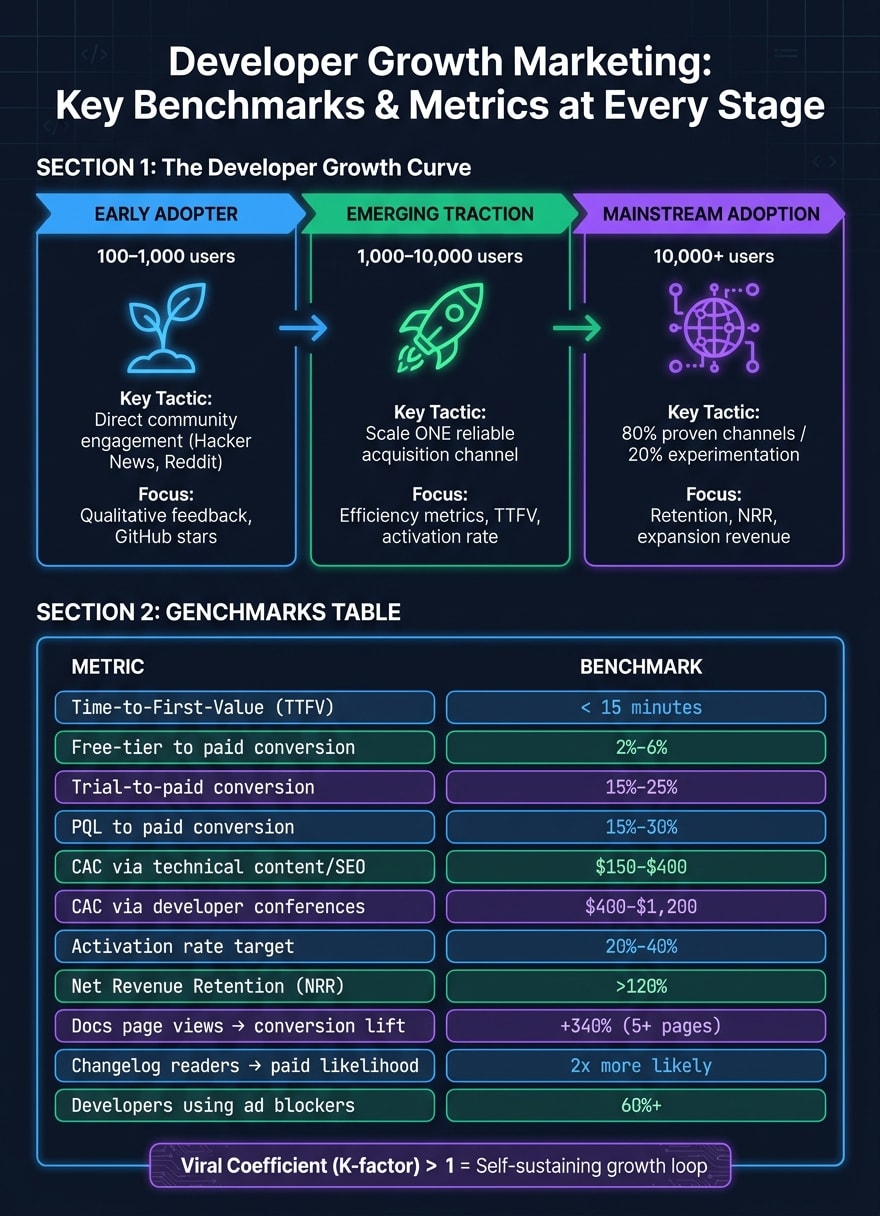
Stages of Developer Adoption
The growth of developer-focused products tends to follow three distinct phases.
During the early adopter phase (100–1,000 users), the focus is on direct, hands-on engagement to validate the product. Growth here is personal and manual, often driven by founders interacting directly with the community. Platforms like Hacker News and Reddit can be valuable for sparking early interest.
Next comes the emerging traction phase (1,000–10,000 users), where scaling becomes trickier. Organic growth through word-of-mouth starts to slow, making it crucial to identify at least one reliable acquisition channel. As Jakub Czakon, CMO at Neptune.ai, advises:
"The mistake I see folks make... is experimenting too much and not optimizing enough: you find a channel that works and grows and you jump to another channel to try it out. Don't. Focus on scaling that one channel."
Finally, the mainstream adoption phase (10,000+ users) allows for a broader approach. A good strategy here is allocating 80% of your budget to proven channels and using the remaining 20% to test new opportunities .
As you move through these phases, keeping an eye on the right metrics becomes essential.
Core Metrics to Track
The metrics that matter evolve with each growth phase. In the early adopter stage, qualitative feedback is key - think user interviews, GitHub stars, or community activity. These signals often provide better insights into product-market fit than traditional metrics like conversion rates.
Once you surpass 1,000 users, efficiency metrics take center stage. These include:
- Time-to-First-Value (TTFV): Measures how quickly a developer gets to a key milestone, like completing a "Hello World" task. The goal? Under 15 minutes .
- Activation rate and trial-to-paid conversion: Indicators of how well your onboarding process works.
- Customer Acquisition Cost (CAC) per channel: Helps understand the cost-effectiveness of your growth strategies.
One standout metric is team invite rate, which signals strong product adoption. When developers invite teammates, it shows they’re relying on your tool, which often leads to higher conversions.
Retention data also plays a critical role. For example, developers who view five or more documentation pages during their first session convert 340% more often than those who don’t . This highlights the importance of offering clear, high-quality documentation.
Benchmarks for Growth-Stage Products
Here are some benchmarks to guide growth-stage developer products:
| Metric | Benchmark |
|---|---|
| Time-to-First-Value (TTFV) | < 15 minutes |
| Free-tier to paid conversion | 2%–6% |
| Trial-to-paid conversion | 15%–25% |
| PQL (Product-Qualified Lead) to paid conversion | 15%–30% |
| CAC via technical content/SEO | $150–$400 |
| CAC via developer conferences | $400–$1,200 |
These are directional benchmarks, not hard targets. For instance, if your trial-to-paid conversion rate is only 5%, the issue might lie in your activation or onboarding process rather than your ability to drive traffic.
Finding the Right Growth Levers for Developer Products
To grow a developer-focused product, you need more than just intuition. It’s about leveraging data, understanding your audience, and earning developers' trust. These elements work together to create a scalable path to acquisition.
Using Product Analytics to Spot Growth Opportunities
Once your user base crosses 1,000, gut feelings alone won’t cut it. Your growth opportunities are often hidden in your product usage data - analyzing this data is key to uncovering them.
Start by identifying your activation metric. For many developer tools, this might be the first successful API call or a live deployment. Optimizing your onboarding process to help users hit this milestone faster can make a huge difference. Louis Corneloup, Founder at Dupple, emphasizes this point: “Time-to-first-successful-API-call” is a critical activation metric . If it takes more than 10 minutes for most users to reach activation, it’s time to simplify your onboarding flow .
Beyond activation, tracking Weekly Active Developers (WAD) provides a better indicator of growth than monthly metrics. Additionally, monitoring engagement with your documentation - such as which guides attract the most traffic - can help you identify high-intent users who are seriously evaluating your product.
"In SaaS, the product IS the funnel. Marketing's job is to get developers to the 'Try' stage. The product has to carry them through Adopt, Expand, and Champion." - Ayoub Kaddouri
This data-driven approach sets the stage for audience segmentation and trust-building, which are equally crucial.
Segmenting Your Developer Audience
Once you’ve gathered actionable insights from your data, the next step is segmenting your audience to fine-tune your messaging. Developers aren’t a monolith - they differ by role, company size, and adoption style. Use signup data to customize tutorials and documentation so they resonate immediately.
At the account level, tracking how many developers from a single organization engage with your product can reveal potential for enterprise sales and expansion. It’s also helpful to distinguish between two adoption styles:
- Bottom-up adoption: Individual developers sign up, often motivated by a free tier or self-serve onboarding.
- Top-down adoption: Decisions come from the organization, requiring ROI documentation and materials on security and compliance.
Tailoring your approach to these adoption styles allows you to run more targeted experiments and improve your growth strategies.
Balancing Growth Speed with Developer Trust
Growth isn’t just about speed - it’s about sustainability. For developer products, trust is non-negotiable. Developers are detail-oriented and will examine changelogs, GitHub issues, and error messages before fully committing. If you sacrifice transparency to move faster, you risk losing trust permanently.
One simple but effective way to build trust is by maintaining a clear and detailed changelog. Instead of vague updates like “bug fixes and performance improvements,” explain what changed, why, and how it impacts users. Interestingly, developers who read changelogs before signing up are twice as likely to become paying customers .
Another way to earn trust is by participating in developer communities like Discord, Slack, or Reddit. Spend 4–6 weeks engaging in discussions without self-promotion. This kind of authentic interaction builds credibility that no ad campaign can replicate .
Expanding Beyond Organic Growth Channels
After establishing trust and building a strong community, relying solely on organic growth will eventually hit a plateau. While word-of-mouth and GitHub stars are fantastic early indicators of success, they lack the predictability needed for sustained scaling. At this stage, it’s crucial to expand your acquisition efforts while continuing to nurture the strategies that are already working.
Strengthening Your Organic Growth Channels
Before diving into new strategies, it’s vital to fully optimize your existing organic channels. One of the most effective tools at your disposal is your documentation. High-quality, detailed documentation is a powerful conversion tool and should be treated as a core product feature rather than an afterthought.
Another underutilized opportunity lies in integration directories. By listing your tool in platforms like the VS Code Extension Marketplace, GitHub Apps, or Vercel’s integration directory, you can reach developers who are actively searching for solutions - without spending a dime on ads. For example, Joe Karlsson, Developer Advocate at CloudQuery, led a targeted three-month effort focused on technical content and SEO. This included fixing redirect chains on 200 pages and optimizing documentation. The results were impressive: a 121% increase in organic daily visits, 426 keywords ranking in the top 10, and a 61% rise in trial signups .
"I've watched one comparison post stay in the top 10 performers for over a year with zero updates. Good data ages better than good writing." - Joe Karlsson, Developer Advocate, CloudQuery
Adding Paid Acquisition to Your Growth Mix
Introducing paid channels should only come after you’ve established a strong organic foundation - typically when you have 10–30 paying customers. Jumping into paid strategies too early, before refining your onboarding process or ensuring your documentation is airtight, can lead to wasted spending on a funnel that leaks potential users.
When you’re ready to invest in paid acquisition, steer clear of generic programmatic display ads. With over 60% of developers using ad blockers , banner ads often fail to deliver results. Paid search for developer-related keywords can cost between $5–$15 per click, but low click-through rates due to ad-blindness make it a tough sell . Instead, consider advertising in developer-focused newsletters or placing native ads in technical communities. These options offer better returns with lower costs per click and come with built-in credibility since the audience has already opted into the content.
The golden rule for paid content is to maintain the same technical depth and specificity as your organic content. Overhyped terms like “enterprise-grade” or “revolutionary” won’t resonate. Developers value clear, problem-solving language that aligns with their needs, which ensures your paid efforts complement your organic strategies without compromising trust.
Using daily.dev to Reach Developers at Scale
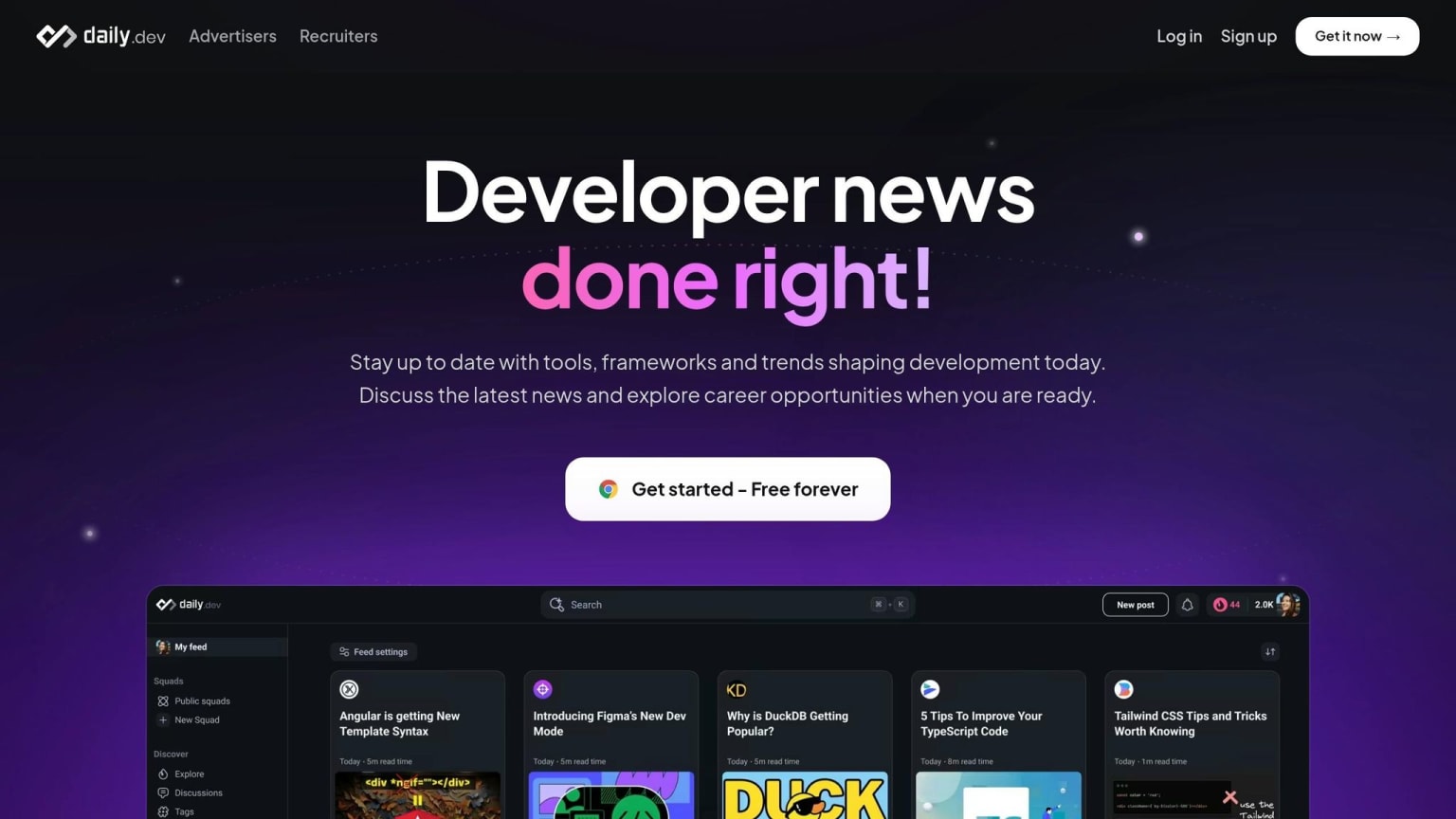
Once your paid strategy is in place, daily.dev offers an excellent opportunity to scale effectively. This platform connects you with over 1 million developers in a setting where they’re already engaging with technical content. Native ad placements, such as in-feed and post-page ads, integrate seamlessly into their browsing experience, avoiding the disruptive nature of traditional ads.
What makes daily.dev particularly appealing is its precision targeting capabilities. You can filter by criteria like seniority, programming languages, and specific tools. This means, for instance, that a Rust-focused infrastructure product won’t waste impressions on front-end JavaScript developers. Additionally, real-time performance tracking allows you to fine-tune your messaging and link spending directly to meaningful developer interactions rather than superficial metrics. This approach ensures your campaigns are both efficient and impactful.
Building Growth Loops and Expanding into New Markets
Designing Growth Loops for Developer Products
Creating self-sustaining growth loops can significantly reduce your reliance on constant marketing spend. Unlike traditional funnels, which require new campaigns for every user, growth loops are systems where each user helps bring in the next. Here's how it works: a user takes an action, that action generates an output, and that output attracts new users back into the loop.
For developer tools, some of the most effective growth loops include:
| Loop Type | How It Works | Real-World Example |
|---|---|---|
| Collaborative | Users invite teammates to a shared workspace | Slack, Jira |
| Artifact/UGC | Users share outputs (like widgets or reports) that link back to your tool | Algolia's "Powered by Algolia" search widget |
| Incentivized | Users earn product credits for successful referrals | DigitalOcean's $200 credit for new users |
| Integration | Marketplace listings passively drive discovery | GitHub Marketplace, VS Code Extension Marketplace |
One key metric to monitor is the Viral Coefficient (K-factor). This is calculated by multiplying the average number of invitations a user sends by the invite-to-signup conversion rate. A K-factor above 1 means the loop is self-sustaining and growing on its own. If it's below 1, you'll need to rely on organic or paid channels to keep the loop running .
However, the loop's success hinges on your product continually delivering value. As Andrew Chen, a growth expert, explains:
"A bad product can adversely affect your viral experience… a widget that no one wants will lead to very few embeds [or invites]." - Andrew Chen
To strengthen your loop, focus on your product's natural "aha moment" - whether it's the first successful API call, the first deployment, or the first shared report. The faster users reach that moment, the more effective your loop becomes.
Planning International Expansion
Once you've built strong growth loops, consider scaling into new markets to sustain momentum. International expansion can open doors to a fresh user base, especially when domestic growth begins to slow. But here's the catch: expansion is not just about translating your product.
Localization goes far beyond language. Start by validating demand before committing major resources. One approach is running targeted paid search campaigns using technical keywords in a specific region. Measure activation rates - ideally, you want to see rates between 20% and 40% for developer tools . If a region hits that range with minimal localization, it's worth a deeper look.
Building trust is crucial, and community engagement is often more effective than advertising. Spend 4–6 weeks participating in region-specific forums like targeted subreddits, Discord servers, or niche Slack groups . This kind of groundwork helps establish credibility in ways that paid ads can't match. Once trust is built, your documentation becomes your most powerful tool. As Louis Corneloup, Founder at Dupple, highlights:
"For devtools, documentation is the highest-converting marketing asset."
Lastly, don't underestimate the power of integration directories for global reach. Listing your tool in platforms like GitHub Marketplace or the VS Code Extension Marketplace offers passive exposure to developers worldwide. Whether they're in Berlin, São Paulo, or Singapore, developers often search these same directories .
Diagnosing and Fixing Growth Plateaus
Recognizing the Signs of a Growth Plateau
After you've optimized your growth channels, the next challenge is identifying and addressing plateaus that can stall developer growth. These plateaus often creep in unnoticed - signups level off, activation rates drop, and key adoption metrics stagnate quietly . When this happens, it’s tempting to double down on marketing, but that can erode trust. A better approach? Slow down and figure out what’s really going on.
The best way to diagnose the issue is by breaking down your funnel into three stages. For example:
- Plenty of site visits but low signups? That points to a problem with your positioning or messaging.
- Healthy signups but poor activation rates? Onboarding friction - especially in the critical first 5 minutes - is likely the culprit.
- Users activate but don’t stick around? You might have a product-market fit problem.
Each of these scenarios demands a tailored solution. Mixing them up wastes resources and could even make things worse. Careful diagnosis ensures you address the actual problem while maintaining developers' trust in your product.
Metrics are your best friend here. One particularly effective metric is time-to-first-API-call, which gives you a clear view of early friction. Pair this with data like team invite rates and documentation views to cover acquisition, activation, and expansion comprehensively .
Don’t forget to check your site’s technical health, either. Issues like redirect chains and orphan pages can quietly hurt your SEO performance, even if you’re cranking out new content. Fixing these existing issues often yields faster results than creating fresh posts .
Once you’ve identified where your funnel is breaking down, you can start designing experiments to bring users back on track.
Running Experiments to Restart Growth
To tackle growth plateaus, refine each stage of your funnel - acquisition, activation, and expansion - and run targeted experiments to pinpoint what works.
For example, if activation rates are low, focus on your onboarding process. Audit the first 5 minutes to ensure users can quickly achieve a meaningful outcome, like running a working code sample. Use time-to-first-successful-API-call as your benchmark, rather than vanity metrics like page views .
If organic traffic has stalled, consider an SEO sprint instead of churning out more content. In early 2026, Joe Karlsson, Developer Advocate at CloudQuery, led a three-month SEO sprint for a cloud-native devtool company. By cleaning up redirect chains across 200 pages and optimizing for technical queries, the company saw impressive results: organic traffic jumped 121% (according to Ahrefs), 426 keywords hit the top 10, and trial signups grew by 61% .
For discovery-related plateaus, rethink your documentation strategy. Developers who explore five or more unique documentation pages in their first session convert at a rate 340% higher than those who view just one page . Transitioning from feature-focused docs to solution-oriented guides - like “how to handle webhook retries” instead of “introducing Feature X” - can capture long-tail search traffic and attract users actively seeking answers.
Conclusion: Putting Developer Growth Marketing into Practice
Scaling past 1,000 users demands a focus on deliberate, step-by-step strategies. As Jakub Czakon emphasized, it’s important to resist the temptation to jump between channels. Instead, identify what works and scale it effectively. By leaning on the growth loops and channel diversification mentioned earlier, your job is to apply these methods consistently. Once you’ve built a solid foundation, the 80/20 rule should guide your efforts - allocate 80% of your resources to refining what’s proven to work, and 20% to experimenting with new opportunities.
Developer trust is a force multiplier for growth. Balancing speed with trust is essential for maintaining momentum as your user base expands. PQL conversion rates (15–30%) far outperform standard rates (2–5%) because developers who genuinely see value in your product become advocates, bringing your tool to every company they work with. Preserving that trust means steering clear of gated content, cold outreach, and buzzword-heavy messaging. Instead, focus on delivering technical depth through honest documentation, detailed changelogs, and tutorials that address real-world problems.
The channels that grow steadily over time - organic search, documentation, open-source tools, and community engagement - should be prioritized above all else. Paid acquisition should amplify a product that’s already trusted, not act as a substitute for organic trust. Considering that over 60% of developers use ad blockers , reaching them requires meeting them in spaces they already trust, with content they genuinely value. A well-rounded strategy combining paid, organic, and international efforts works best when anchored by a product developers believe in.
As benchmarks show, rising Weekly Active Developers, activation rates between 20–40%, and Net Revenue Retention exceeding 120% are clear indicators of sustainable growth. Achieving these metrics means you’re building a product that earns developer trust - and their advocacy.
FAQs
What’s the fastest way to improve time-to-first-value for developers?
Clear, well-structured technical content is the fastest way to reduce the time it takes for developers to see value. Detailed documentation paired with runnable examples allows developers to dive in and start working right away. This not only encourages signups but also speeds up adoption. The key is to make these resources straightforward and practical, ensuring developers can quickly apply what they learn.
How do I know which acquisition channel to scale after 1,000 users?
After hitting the milestone of 1,000 users, it’s time to double down on the channels that are already working for you. For developer-focused SaaS companies, strategies like open-source distribution, well-crafted documentation, and strong developer relations (DevRel) often yield great results.
From there, consider broadening your approach by testing scalable channels. This could include leveraging in-product virality or engaging with niche developer communities. To make smart decisions, track key metrics like customer acquisition cost (CAC), user engagement, and product usage. Focus on channels that not only drive growth but also maintain the trust and loyalty of your developer audience.
What growth loop should I build first for my devtool?
Start with a sharing and showcase loop to encourage developers to spread the word about your tool. Make it easy for them to share their work - whether it’s code snippets, dashboards, or projects - through one-click sharing or custom branded links. Features like read-only project URLs or embedded badges (such as build status indicators) can help your tool gain visibility. These elements tap into developers' natural sharing habits, promoting organic growth and building trust while keeping user acquisition cost-effective.