

Want to connect with developers and promote your product effectively? Partnering with technical content creators - like engineers, educators, and open-source contributors - is key. These influencers focus on hands-on expertise and problem-solving, making them trusted voices in the developer community. Here's what you need to know:
- Why it works: Developers trust peers who share coding experience, not traditional ads. Influencers like Fireship and ByteByteGo reach millions by sharing tutorials, demos, and real-world challenges.
- Types of influencers: YouTube creators, Twitter personalities, newsletter authors, and GitHub maintainers each offer unique ways to engage audiences.
- How to find them: Start with your community (forums, Discord) or platforms like YouTube, GitHub, and Reddit. Look for creators with technical depth, not just big follower counts.
- Partnership models: Options include sponsored tutorials, product reviews, affiliate programs, and long-term ambassador deals. Costs vary - micro-influencers might charge $500–$5,000, while larger creators can exceed $20,000 per post.
- Tracking success: Use promo codes, custom landing pages, and post-purchase surveys to measure impact. Engagement metrics like comments and likes are often more revealing than views alone.
The Growth of Developer Influencers
Developer influencers are reshaping how technical products connect with their audiences. Unlike traditional influencers who often focus on lifestyle and aesthetics, these creators prioritize practicality and openness - sharing code snippets, documenting their mistakes, and solving real-world technical challenges publicly .
The impact is undeniable. Influencers like Fireship boast over 4 million subscribers, while Traversy Media engages with more than 2.37 million developers . ByteByteGo’s system design newsletter reaches over 1 million readers . A standout example comes from late 2024, when Bolt.new (StackBlitz) hosted a global hackathon that drew 130,000 participants, resulting in 1 million web apps being built in just 30 days. Winners were even showcased on a Times Square billboard, with over $1,000,000 in non-dilutive funding awarded .
This rise aligns with the "Building in Public" movement, where developers share their product-building journeys in real time, including wireframes, successes, and failures . This level of transparency fosters trust that traditional advertising struggles to achieve. As Stormy AI Blog aptly put it:
"The future of B2B marketing isn't found in a slide deck; it's found in a terminal."
This authenticity has paved the way for various types of developer influencers, each playing a unique role in the technical ecosystem.
Types of Developer Influencers
Developer influencers can be grouped into several key categories, each catering to different aspects of the developer community:
- YouTube tech creators: These influencers produce detailed tutorials and product reviews, making YouTube a go-to platform for discovering technical content .
- Twitter/X dev personalities: They drive real-time engagement by sharing quick tips, participating in trends, and contributing to the "Building in Public" movement .
- Newsletter authors: Writers like those behind ByteByteGo deliver in-depth technical insights directly to highly engaged subscribers .
- Open-source maintainers: Found on GitHub, these creators wield significant authority, with their contributions serving as "Proof of Work" that validates their expertise beyond follower counts .
Each platform offers unique advantages. YouTube is ideal for discovery and long-form education, Twitter/X excels in real-time conversations, LinkedIn connects with professional decision-makers, GitHub provides a code-first approach, and Reddit fosters peer-to-peer problem solving .
Understanding these categories helps highlight the distinct ways developer influencers impact the market.
Why Developer Influencers Matter for Marketing
Developer influencers are crucial for marketing because they address a major hurdle: technical decision-makers often disregard traditional ads. Instead, they trust peers who demonstrate expertise through hands-on problem-solving and visible contributions . This has given rise to Creator-Led Growth (CLG), where creators take charge of the entire process - from building awareness to driving adoption - while boosting authority and search visibility through long-term partnerships .
These influencers bring a well-rounded approach, combining technical demos, open-source contributions, educational content, and relationship-building on various platforms . A single tutorial can ripple out, influencing countless developers as they evaluate tools for their teams.
The surge in AI tools has accelerated this trend. With the growing demand for "builder-influencers", companies now rely on these creators to simplify complex integrations and APIs through engaging technical storytelling . Beyond raising awareness, these influencers serve as a vital feedback loop, connecting communities with engineering teams and shaping products based on real-world usage .
sbb-itb-e54ba74
How Developer Influencers Differ from Traditional Influencers
Developer influencers stand apart from traditional influencers by focusing on technical expertise rather than sheer follower count. While lifestyle influencers often rely on polished content and broad appeal, developer influencers earn trust through their hands-on experience - whether that's in coding, contributing to open-source projects, or solving real-world technical challenges. For technical decision-makers, flashy promotional content doesn't cut it. They look for recommendations from peers who have proven their credibility through tangible expertise.
Authenticity Is Non-Negotiable
Developer audiences are quick to detect anything that feels staged or overly promotional. Unlike consumer campaigns where scripted messages might pass, developers value genuine insights and reject content that feels forced. As DevTools Academy puts it:
"Technical decision makers don't pay attention to traditional ads. And they're getting harder to reach via increasingly fragmented social media. Technical leaders listen to trusted friends and peers."
For developers, credibility is built through the "Three Cs": Coding, Content, and Community. This means showcasing technical skills through demos or open-source projects, creating educational resources like tutorials, and engaging with others in forums or platforms like Discord. When a developer influencer endorses a tool, their audience trusts that the recommendation is based on real-world use, not a marketing script.
Because of this, scripted collaborations rarely work in this space. Cole Stark, CMO at Pieces, highlights the importance of authenticity:
"word-of-mouth marketing is often the most effective channel in the developer space, even if it's difficult to measure."
The best partnerships give influencers the freedom to explore your product and provide honest feedback - even if that doesn't align perfectly with your marketing goals. This approach ensures their audience sees the endorsement as credible and trustworthy.
Technical Accuracy Is Required
Accuracy is non-negotiable when targeting developer audiences. Tutorials, reviews, and recommendations play a critical role in their decision-making process, and even small mistakes can damage both the influencer's reputation and your brand's credibility. Developers rely on this content to evaluate tools for integration into their systems, so precision is key.
This demand for accuracy is tied to how developers consume content. They're not looking for entertainment - they're searching for actionable solutions to their problems. The return to long-form content in developer communities highlights this preference for detailed and comprehensive explanations over surface-level summaries. When developers follow a tutorial, they'll test the code, scrutinize the results, and quickly identify any errors.
Adding to the challenge, developers are naturally skeptical and often avoid traditional tracking methods like UTMs or referral links. They prefer discovering tools organically through trusted voices. This means they evaluate not just the product itself but also the expertise and understanding of the person recommending it.
These unique dynamics underline the importance of finding influencer partners who can genuinely connect with technical audiences and deliver value through their expertise.
How to Find the Right Developer Influencers
When it comes to finding developer influencers, technical credibility should always take precedence over follower counts. The most effective partnerships often begin within your own community and grow outward through targeted research.
Where to Discover Developer Influencers
Start close to home by exploring your own community. Look for "hand-raisers" or "super fans" in places like your Discord channels, forums, or open-source repositories. These individuals, who typically make up about 2–5% of your user base, are already passionate about your product and deeply understand it .
YouTube is a standout platform for finding developer influencers. It allows you to gauge someone's technical expertise, teaching approach, and the level of engagement they generate with their audience. As Karl McCarthy, Founder of Yard, puts it:
"I think YouTube is head and shoulders above everything else because you can see what people are reviewing… you can get a really good idea of, like, if this person is any good or not."
Pay attention to how creators explain concepts and the quality of discussions happening in their comment sections to spot genuine engagement.
Twitter (formerly X) is another useful platform for real-time discovery. Follow relevant hashtags and conversations to find developers actively discussing tools and technologies that align with your goals. LinkedIn is also valuable for connecting with influencers in specific industries or companies by exploring professional groups and discussions.
For more niche opportunities, Reddit is a goldmine for understanding developer challenges through technology-specific subreddits. Twitch is great for connecting with developers during live-coding sessions, while GitHub allows you to evaluate technical authority by examining repository stars and contribution histories. Additionally, platforms like daily.dev are becoming increasingly helpful for identifying trending technical authors and thought leaders.
If you're scaling your influencer efforts, tools like Plug.Dev can streamline the process by offering targeted creator discovery, dashboards for managing partnerships, and performance tracking for YouTube-focused campaigns .
Once you've identified potential influencers, the next step is evaluating their fit based on their technical skills and audience engagement.
How to Evaluate Influencer Fit
After narrowing down your list of potential influencers, use the "Three Cs" framework to evaluate their suitability. This includes:
- Coding: Assess their technical demos and contributions to open-source projects.
- Content: Look at the quality of their educational materials and how well they explain complex topics.
- Community: Gauge their ability to build and maintain active relationships with their audience.
Focus on depth rather than reach. A smaller influencer with 10,000 highly engaged followers can often deliver more value than one with 100,000 generic followers. The key is understanding where your target audience spends their time.
To measure engagement quality, dig deeper than surface-level metrics like likes and views. Analyze comments for meaningful technical discussions and look for evidence of consistent tool integration. Reviewing their past collaborations can also give you a sense of how they balance sponsored content with authenticity.
When reaching out, make it personal. Avoid generic mass emails. Instead, reference specific technical content they've created and explain why your tool aligns with their expertise. Tailored outreach is especially important, as B2B buyers increasingly rely on social channels for trust and credibility.
Partnership Models That Work
After identifying the right developer influencers, the next step is choosing a partnership model that aligns with your marketing objectives. Here’s a breakdown of some effective options:
- Sponsored tutorials: These are great for driving product adoption by offering educational, hands-on content.
- Product reviews: Build trust as influencers provide honest feedback after testing your product.
- Co-created content: Collaborate with influencers to develop technical resources like documentation, sample projects, or conference presentations, which help establish credibility.
Affiliate programs are another option, offering a performance-based model where influencers earn commissions for conversions. This is a low-risk way to start partnerships. Meanwhile, conference co-presentations can position your brand alongside respected voices in the industry, though they require more planning and resources. For a more authentic touch, unboxing videos showcase first impressions and often provide valuable UX insights .
Common Partnership Types
Different partnership types work better for specific goals:
- For awareness, short-form content like 100-second videos or social media posts works well .
- To build trust and educate, invest in in-depth technical tutorials, such as full-stack builds or system design walkthroughs, showing off your product's real-world applications .
- For direct conversions, expert reviews paired with affiliate links and performance bonuses can deliver strong results.
Here’s an example: In 2026, a Python-focused tech educator with 42,000 subscribers partnered with an online coding bootcamp for a $4,500 flat-fee deal. The 6-minute tutorial reached 67,000 views, achieved an 11% engagement rate, and generated 156 course sign-ups at a $28.85 cost-per-acquisition . Another case involved a financial influencer with 98,000 subscribers who partnered with a financial services brand. For an $18,000 flat fee plus performance bonuses, the 8-minute review generated 34 qualified leads, each with an average customer value of over $50,000. This deal ended up being worth $24,800, with a recurring $25,000 per quarter retainer .
Long-term ambassador programs are another compelling option. These partnerships, which range from $2,000 to $10,000+ monthly, create authentic brand advocates rather than one-off promoters. As Karl McCarthy, Founder of Yard, points out:
"They (developer evangelists) just can't fake it" .
Comparing Partnership Models
Each model serves a unique purpose, and costs vary:
- Flat-fee sponsored videos: At $2,400–$5,000 per 100,000 views (based on a $12–$25 CPM), these are excellent for brand awareness. While predictable in cost and high in reach, they may lack the authenticity of performance-based models.
- Affiliate and commission-based deals: These excel at driving conversions with minimal upfront costs. They’re highly authentic since influencers only earn when results are delivered.
- Product-only partnerships: These involve providing access to your product or tool. They require minimal investment and yield authentic feedback but generally have lower reach .
Tiered packages can simplify negotiations by offering clear options. For example:
- Starter package ($3,000): Includes a 1–2 minute integration and a social media post.
- Standard package ($7,500): Offers a dedicated 3–5 minute segment with engagement reports.
- Premium package ($15,000): Features a custom 5–7 minute dedicated video with cross-platform promotion .
These structured packages help align expectations and budgets, making collaborations smoother.
How to Negotiate and Structure Deals
::: @figure 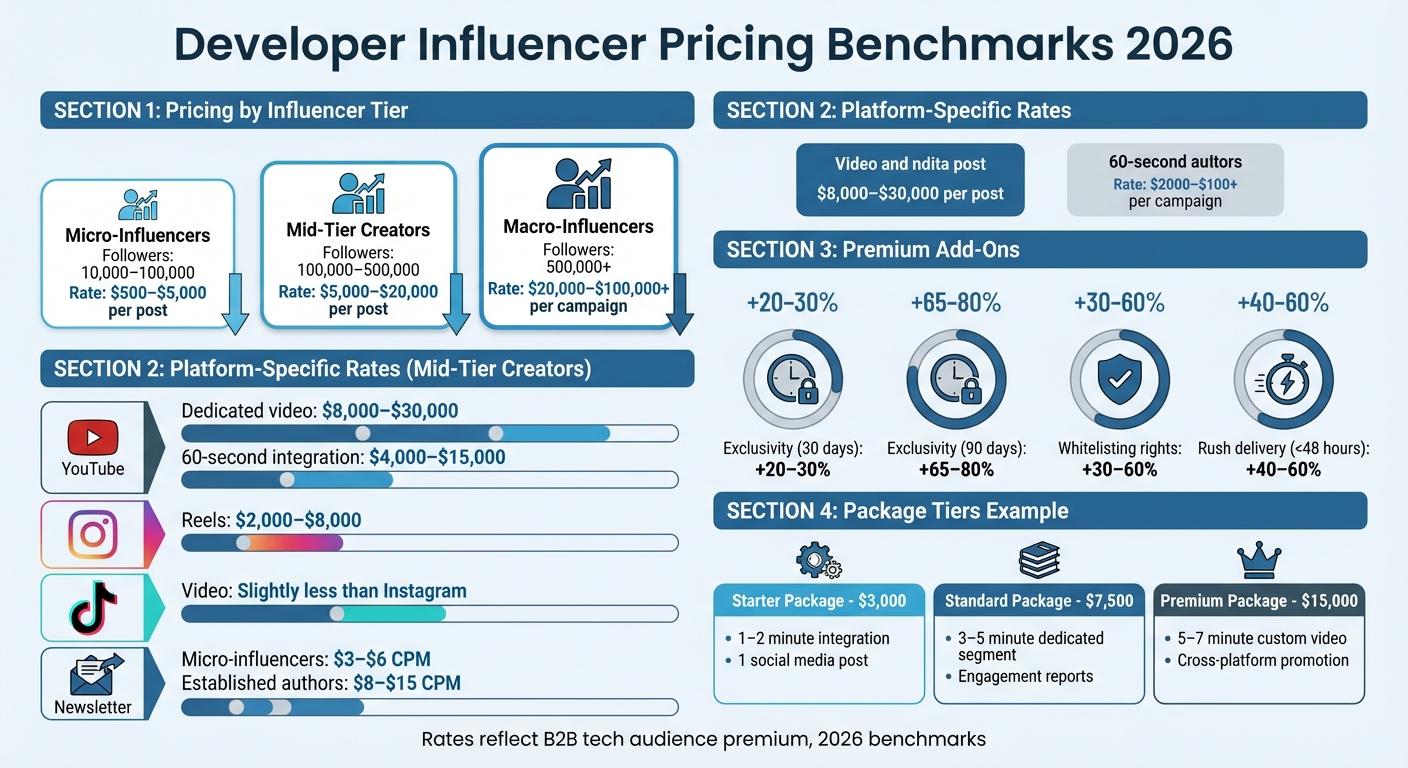 {Developer Influencer Pricing Guide: Rates by Tier and Platform in 2026}
After selecting a partnership model, the next step is hammering out pricing and contract terms. Influencer rates can vary widely based on factors like audience size, platform, and the creator's technical expertise. Developer influencers, in particular, tend to charge more because their audiences are made up of decision-makers in professional settings. To ensure smooth collaboration, it's crucial to establish clear deliverables and legal requirements upfront.
Pricing Benchmarks by Influencer Tier
In 2026, developer influencer rates generally align with tiered benchmarks, reflecting a premium for B2B tech audiences. Here's a breakdown:
- Micro-influencers (10,000–100,000 followers): $500–$5,000 per post
- Mid-tier creators (100,000–500,000 followers): $5,000–$20,000 per post
- Macro-influencers (500,000+ followers): $20,000 to over $100,000 per campaign.
Platform choice also plays a big role in pricing. For example, YouTube commands the highest rates due to the complexity of video production. A mid-tier creator might charge $8,000–$30,000 for a dedicated video or $4,000–$15,000 for a 60-second integration. On Instagram, Reels for mid-tier creators typically cost $2,000–$8,000, while TikTok videos are slightly less expensive. Newsletter sponsorships, on the other hand, are priced by CPM (cost per thousand impressions), ranging from $3–$6 for micro-influencers and $8–$15 for more established authors.
Certain factors can increase these base rates. For instance:
- Exclusivity clauses: Adding a 20–30% premium for 30-day exclusivity or 65–80% for 90 days.
- Whitelisting rights (for paid ads): Typically an extra 30–60%.
- Rush delivery (under 48 hours): Often incurs a 40–60% fee.
Defining Deliverables and Legal Requirements
Once pricing is set, it's time to clearly outline deliverables and legal terms in your agreements. Be specific - don’t just request "social media content." Instead, specify something like: "4 Instagram Reels, 8 Stories, and 1 long-form YouTube video (60–90 seconds)". Also, include details like the number of revision rounds (two is common) and timelines for brand approval.
To comply with regulations, require creators to include FTC disclosures, such as #ad or #sponsored tags, in all posts, video titles, and descriptions. Contracts in 2026 should also address AI-generated content, requiring creators to confirm their work is original and disclose any AI tools they’ve used.
It’s equally important to define content usage rights. Specify how long you can use the content, on which platforms, and under what conditions. Typically, creators retain ownership while granting you a limited, attributed license. Distinguish between organic posting (regular distribution) and paid amplification, which usually costs an additional 25–50%.
Lastly, include payment terms. A Net 30 policy is standard, but adding a late payment penalty, such as 1.5% monthly interest, can help ensure timely payments.
Running Developer Influencer Campaigns
Once contracts are signed, the real work begins. Running a developer influencer campaign is all about striking the right balance: you want the content to align with your marketing goals, but it’s equally important to preserve the influencer’s authentic voice. Developer audiences are quick to spot overly scripted or insincere content - and they’ll tune out. The best approach? Treat influencers as collaborators, not just another advertising channel.
How to Brief Influencers Without Scripting Them
Authenticity and technical accuracy are non-negotiable when working with developer influencers. These principles should guide every step of the process, from briefing to content review.
The briefing stage sets the foundation for the entire collaboration. Start by sharing your campaign goals and providing access to your product, but let the influencer take the lead in shaping the narrative. For developer content to resonate, influencers need to genuinely engage with your product.
Make sure to equip them with robust technical resources - documentation, API keys, or even access to your engineering team. A great example of this approach comes from Pieces, a software company that, in 2026, invited influencers to "unbox" their product. Influencers recorded their first impressions and onboarding experiences, offering the engineering team valuable feedback while creating content that felt genuine and relatable. Importantly, influencers had the freedom to share honest opinions, even if that meant skipping over features they didn’t find useful. This transparency earned the trust of their audiences and highlighted the product’s actual strengths .
Tailor your brief to the influencer's content style. If they specialize in tutorials, suggest they build something with your tool. If they’re known for deep technical dives, provide them with architecture diagrams or performance metrics. The goal isn’t to dictate the message but to empower them to dive deep and create meaningful content. Give them the time and space to explore your product, build examples, and fully understand the developer experience before they publish anything .
Once the brief is nailed down, the focus shifts to managing timelines and content reviews.
Managing Reviews and Campaign Timelines
A strong briefing process is just the start. To ensure your campaign runs smoothly, you’ll need to manage timelines effectively. Flexibility is key - many developer influencers juggle full-time jobs alongside their content creation. Make sure your deadlines align with their schedules .
A phased approach often works best. Start with a three-month pilot involving a small group of influencers (3–5 is a good number). This allows you to test different content formats and refine your messaging. From there, you can scale up to a six- or nine-month campaign with your top-performing influencers, having them create multiple pieces of content across various platforms .
For individual pieces, especially tutorials, remember that quality takes time. Influencers need to learn your tool, code, troubleshoot, and ensure everything is accurate before publishing .
Streamline your review process to keep things moving without stifling creativity. Tools like Slack can help with quick check-ins and real-time project updates . When reviewing content, focus on ensuring technical accuracy and compliance with FTC guidelines. Avoid the temptation to micromanage the narrative - even if an influencer points out a limitation in your product. Honest feedback builds trust and credibility with their audience. Finally, establish clear and efficient approval timelines to keep the campaign on track.
Measuring Campaign Performance
Tracking the success of developer influencer campaigns can be tricky. Traditional methods often fall short because developers tend to avoid tracking links, preferring to research products on their own after seeing content. As Ella Blake, a social media strategist, explains:
"If you measure them like paid search, you'll systematically under-credit the creators who are actually generating intent and over-credit whatever channel is grabbing the final click" .
Tracking Methods and Metrics
To get a clear picture of campaign performance, you'll need to use multiple tracking tools. Here are some effective methods:
- Unique promo codes: Codes like "CREATORNAME10" can track direct conversions. However, be cautious - these codes often end up on deal sites, skewing attribution. Using short expiration dates can help reduce this issue .
- Creator-specific landing pages: Simple URLs (e.g., yourproduct.com/influencername) are easier for developers to use than long UTM links. These pages can track "micro-conversions" such as time spent on the page, documentation views, or "add to cart" actions. These signals are valuable even if the purchase happens much later .
- Post-purchase surveys: Ask customers, "How did you hear about us?" during checkout or sign-up. This method helps capture the "halo effect" that tracking links and cookies often miss. As Karl McCarthy, founder of Yard, points out:
"I always think it's funny when you ask a marketer about attribution, and everyone just hides" .
For YouTube campaigns, engagement metrics are more telling than views. PostHog suggests avoiding videos with fewer than 5,000 views and recommends tracking benchmarks like 0.002–0.005 comments per view and 0.03–0.05 likes per view. Campaigns exceeding 0.005 comments or 0.05 likes per view are considered high-performing .
By combining these methods, you can develop a well-rounded view of campaign performance before diving into ROI calculations.
Calculating ROI
Once you've gathered enough data, it's time to measure ROI. Proper attribution is key to understanding the true impact of developer influencer campaigns.
Avoid relying solely on last-click attribution, as it often undervalues the role of influencers in generating awareness. Instead, consider geo-holdout tests to measure incrementality. This involves comparing regions with and without influencer activity to see the revenue lift. From there, calculate incremental CAC (iCAC) - a crucial metric for scaling campaigns .
When presenting ROI to stakeholders, focus on metrics that truly reflect success, such as:
- Net revenue (after accounting for discounts and returns)
- New customer acquisition rate
- Profit contribution
- Payback period
For B2B campaigns, prioritize cost per qualified lead and booked calls over raw lead numbers .
It's also important to establish deduping rules before launching campaigns. Decide in advance how to allocate credit when a customer interacts with multiple channels, such as clicking an influencer link but converting later via email. Options include "last non-direct click", "first touch for discovery", or multi-touch models that distribute credit across channels .
| Tracking Method | Primary Signal | Best For |
|---|---|---|
| Promo Codes | Offer/Discount | Direct sales and immediate conversion tracking |
| Affiliate Links/UTMs | Click/Traffic | Measuring CTR and web behavior |
| Landing Pages | Intent/Education | High-consideration technical tools |
| Post-Purchase Surveys | Awareness/Halo | Capturing organic discovery and word-of-mouth |
| Lift Tests | Incrementality | Proving real-world revenue impact |
Scaling with daily.dev Ads
After establishing successful partnerships with developer influencers and seeing positive ROI, the next logical step is expanding your reach. The challenge? Doing so in a way that feels genuine to the developer community. That’s where paid amplification comes in.
Using daily.dev Ads to Amplify Campaigns
daily.dev offers a platform specifically tailored to developers, boasting an audience of over 1 million professionals actively seeking technical content . With its precise targeting options, you can zero in on developers based on their seniority, preferred programming languages, or tools they use. For example, a Python tutorial can be directed toward senior Python developers, while Kubernetes content can reach DevOps engineers who actively work with it.
The platform’s native ad formats - such as in-feed placements, post page ads, and digest ads - are designed to integrate seamlessly into developers’ content consumption habits. This makes daily.dev an ideal choice for amplifying tutorials, demos, or deep-dives created by influencers. As Cole Stark from Draft.dev highlights, platforms like daily.dev enable developers to share knowledge effectively, creating a perfect space for promoting influencer-driven content.
By combining targeted amplification with native placements, you can extend the reach of influencer content without sacrificing authenticity.
Combining Influencer and Paid Campaigns
To achieve the best results, treat influencer content and paid advertising as complementary strategies. Karl McCarthy, founder of Yard, captures this synergy:
"I feel like user-generated content is coming for our world" .
This reflects the growing trend of leveraging community-created content and using paid ads to amplify the most impactful pieces.
Start by identifying your top-performing influencer content. This could be a YouTube tutorial with high engagement, a technical blog post with strong organic traction, or a GitHub demo that resonates with developers. Then, use daily.dev Ads to target developers who fit your ideal audience but haven’t yet encountered the content organically.
Even the most engaging influencer content has its limits when it comes to organic reach. That’s where daily.dev’s native placements shine - they increase visibility while preserving the authenticity of the original message.
For maximum impact, coordinate your influencer launches with daily.dev Ads. For instance, when an influencer publishes a tutorial or product review, immediately boosting it with ads can create momentum. This unified approach combines the influencer’s credibility with the platform’s ability to distribute content widely.
The secret to success lies in keeping the content authentic. As Draft.dev reminds us:
"The core principles of developer influencer marketing will remain the same: authenticity, trust, and genuine relationship-building" .
Conclusion
Developer influencer marketing isn’t just standard influencer marketing with a technical spin - it’s a completely different game. It thrives on authenticity, technical precision, and genuine connections. As Karl McCarthy from Yard aptly says:
"They (developer evangelists) just can't fake it" .
This guide has highlighted how technical expertise, sincere engagement, and thoughtful planning are the cornerstones of successful developer influencer campaigns.
The key is to prioritize technical credibility over vanity metrics like follower counts. Instead of chasing big names, start within your own community. That passionate 2–5% of users who are already advocates can often be your best collaborators. When you expand outward, focus on influencers who align with your values and can authentically engage with their audience.
When partnering, give influencers clear guidance on your goals and product details, but let them share their experiences in their own voice. This freedom ensures their audience feels the content is genuine, preserving the trust they’ve worked hard to build.
Metrics are essential, even when attribution isn’t straightforward. With 75% of B2B buyers using social media during their purchasing journey , tools like promo codes, customer surveys, and engagement metrics can help track campaign success. A phased approach works best: start small with 3–5 influencers, double down on top performers, and eventually integrate their content into your larger strategy. This process ensures you’re scaling effectively while staying authentic.
To take things further, amplify the best-performing content using tools like daily.dev Ads. This method helps you reach over 1 million developers while keeping the trust and credibility that make developer marketing so impactful. By combining authentic influencer partnerships with strategic paid promotion, you can create lasting momentum and meaningful growth.
FAQs
How do I pick the right developer influencer for my product?
When searching for a developer influencer, prioritize those with genuine engagement, proven technical know-how, and a respected reputation within their communities. Look for individuals who are not only active but also trusted voices in spaces like GitHub, Twitter (or X), YouTube, or other developer-focused platforms.
The key is to find influencers who consistently produce accurate, high-quality content and actively participate in their niche - whether that’s through tutorials, open-source contributions, or thought leadership.
As for costs, expect a wide range. Smaller influencers typically charge between $500 and $2,000, while well-known names in the industry may have rates starting at $5,000 or more.
What budget should I plan for a first developer creator sponsorship?
When planning your first sponsorship in the US, consider allocating a budget of $100–$500 for micro-influencers with 1,000–10,000 followers. This range is perfect for testing collaborations with smaller creators who often have highly engaged audiences. If you're targeting influencers with larger followings or requesting video content, expect costs to climb beyond $1,000. Starting with a modest budget allows you to measure engagement effectively and establish genuine connections, all while keeping financial risks in check.
How can I measure ROI when developers don’t click tracking links?
To evaluate ROI without depending on tracking links, pay attention to developer-focused engagement metrics such as API call frequency, documentation views, SDK downloads, sandbox sign-ups, and product activations. You can also use tools like UTM parameters, promo codes, or referral traffic to link influencer activities to conversions. Additionally, tracking metrics like reach, impressions, and brand mentions can provide insights into awareness and long-term effects, aligning your analysis with how developers interact with your offerings.