

Developers don’t respond to marketing the same way other audiences do. They avoid forms, ignore demos, and distrust sales outreach. Why? Because they value independence, hands-on testing, and clear documentation over flashy pitches or gated content. Traditional Marketing Qualified Lead (MQL) strategies fail with developers because they focus on surface-level metrics like downloads or job titles, rather than actual product engagement.
Here’s what works instead:
- Free trials over demos: Let developers test your product immediately.
- Self-serve onboarding: Skip sales calls and let them explore at their own pace.
- High-quality documentation: Clear, accessible docs are non-negotiable.
- Activation metrics, not MQLs: Track product usage (e.g., API calls, integrations) instead of form fills.
Companies like Stripe, Sentry, and Supabase succeed by giving developers what they need: hands-on access, open-source options, and community-driven support. Switch from chasing MQLs to focusing on Product Qualified Leads (PQLs) and activation metrics for better results.
Why MQL Tactics Fail with Developer Audiences
Traditional MQL (Marketing Qualified Lead) strategies rely on the assumption that prospects are willing to follow lengthy marketing funnels. Developers, however, tend to dismantle these funnels rather than follow them. With their knack for debugging and problem-solving, they can spot the mechanics of marketing automation from a mile away. For them, filling out a form doesn’t signal interest - it signals being funneled into a CRM, endless nurture emails, and inevitable sales pitches.
Developers Won't Fill Out Forms
To developers, forms are roadblocks, not gateways. Whether it’s a "Request a Demo" button or a gated piece of documentation, these barriers often drive them away. As Adam DuVander, founder of EveryDeveloper, puts it, developers "reverse engineer your marketing automation and pull the ripcord" . Research backs this up, showing that only 4% of developers trust content written by companies .
When technical content is gated, developers often resort to fake or throwaway email addresses just to get past the obstacle. This not only lowers the quality of leads but also erodes trust in your brand. Forms may seem like a simple way to gather information, but for developers, they’re just another reason to exit your site.
Aggressive sales tactics only add to the problem.
Developers Don't Trust Sales Outreach
Sales outreach, especially when unsolicited, feels intrusive to developers. Their work often requires deep focus, and interruptions like chatbots or pop-up surveys are quick ways to lose their interest. Yacine Hmito, Head of Technology at Fabriq, sums it up well:
"If I see 'Book a demo' or 'Talk to Sales,' I am out."
The numbers paint an even clearer picture: only 4% of people trust marketing professionals to act with integrity, and 96% of developers are skeptical of a company’s claims before they even engage with its content . This distrust makes traditional sales tactics ineffective with this audience.
MQL Criteria Miss Developer Buying Intent
MQL models often prioritize surface-level attributes like job titles or company size to qualify leads. But in a developer-driven buying process, the person experiencing the pain point is usually a practitioner - not an executive. These practitioners may not fit the typical "qualified" profile, but they’re the ones who will use the product and advocate for its adoption.
Here’s how marketing and sales often define "qualified" differently:
| Marketing's "Qualified" | Sales' "Qualified" |
|---|---|
| Job title (e.g., VP+) | Has budget allocated for the purchase |
| Company size (e.g., 500+ employees) | Has authority to make the decision |
| Content engagement (e.g., downloads) | Has an active, urgent pain point |
| High website traffic/repeat visits | Has a specific purchase timeline (1–2 quarters) |
This misalignment explains why roughly 79% of marketing leads never convert to sales . Developers downloading API documentation are researching, not signaling purchase intent. Even at top-performing companies, only 1–2% of MQLs turn into revenue .
This disconnect highlights how traditional MQL strategies fail to capture the real buying journey of developers.
Developer Journeys Are Hard to Track
Developers don’t follow a neat, linear path through a marketing funnel. They might read your documentation today, experiment with your API weeks later, and only then recommend your product to their team. Traditional attribution models struggle to track these nonlinear journeys, especially when developers interact across platforms like GitHub, Stack Overflow, Discord, and Reddit.
"Marketing often defines qualification based on engagement, while sales defines it based on readiness. When these definitions aren't aligned, marketing qualified leads look good in dashboards but fail in real conversations."
- Harshita Chopra, CEO, Technoradiant
Conventional dashboards may even flag a developer as "cold" after a period of inactivity, despite the fact that they might still be evaluating the product on their own time.
Developers Adopt Tools Bottom-Up
Developers favor a bottom-up approach to adopting new tools. They often start with a product for a side project, prove its value through hands-on use, and then advocate for it within their organization. This approach makes traditional enterprise sales strategies, which focus on decision-makers at the top, far less effective. By the time a sales team reaches out to a VP, the developer who championed the tool may have already moved on to a competitor offering a self-serve trial.
Companies like Stripe, Sentry, and Supabase have embraced this bottom-up approach:
- Stripe invested heavily in high-quality documentation, allowing developers to integrate payments in just an afternoon.
- Sentry open-sourced its core product, letting developers assess its technical quality directly through the code.
- Supabase built a community of over 350,000 members by incorporating user feedback into their product development .
These examples show that developers want to evaluate products through hands-on testing, not through rigid MQL frameworks. When traditional strategies disrupt their natural discovery process, they create frustration instead of meaningful engagement.
sbb-itb-e54ba74
What Developers Want from Lead Generation
Traditional MQL strategies often fall short when it comes to developers. They don’t want to be treated like conventional "leads" or pushed into sales conversations. Instead, they prefer a frictionless experience where they can explore and test a product on their own terms. Companies that strip away these barriers and let their product speak for itself are far more likely to earn developers' trust.
Free Trials Over Demos
When a product claims to be "blazingly fast" or "highly scalable", developers don’t want to take your word for it - they want to see it in action. Hands-on testing is how they validate speed, scalability, and performance.
Sales demos, on the other hand, often create unnecessary friction. Developers don’t want scripted presentations or sales pitches. They want immediate access to the product so they can test it in real-world conditions. Companies that prioritize free trials over mandatory demos make it easier for developers to evaluate their tools without roadblocks.
Self-Serve Onboarding Beats Sales Calls
Developers value independence. They prefer onboarding themselves rather than being guided by a sales team. Sales calls often disrupt the quick, self-directed exploration developers rely on to determine if a product fits their needs.
With self-serve onboarding, developers can dive into features, test integrations, and uncover limitations at their own pace. This approach respects their workflow and eliminates the friction of unnecessary sales interactions.
Documentation Matters More Than Datasheets
Good documentation is essential for developers. It’s often their first stop when evaluating a product, helping them understand how it works and whether it meets their needs. High-quality documentation signals that a company respects its technical audience and stands behind its product.
As Nimrod Kramer, CEO of daily.dev, puts it:
"If your docs suck, your product might as well not exist. No developer wants to wade through promotional content to figure out how to use your API."
Detailed, clear documentation allows developers to assess trade-offs, identify edge cases, and make informed decisions - all without being funneled into a traditional sales process.
API Access Without Obstacles
Developers want immediate access to APIs and tools for testing. Requiring contact forms or sales calls before granting access only creates delays and frustration. Offering a free trial, sandbox environment, or direct API access removes these hurdles, letting developers experiment and evaluate functionality on their own terms.
This hands-on, no-friction approach aligns perfectly with how developers prefer to work, making it easier for them to see the value of your product without unnecessary interruptions.
Shift from MQLs to Activation Metrics
::: @figure 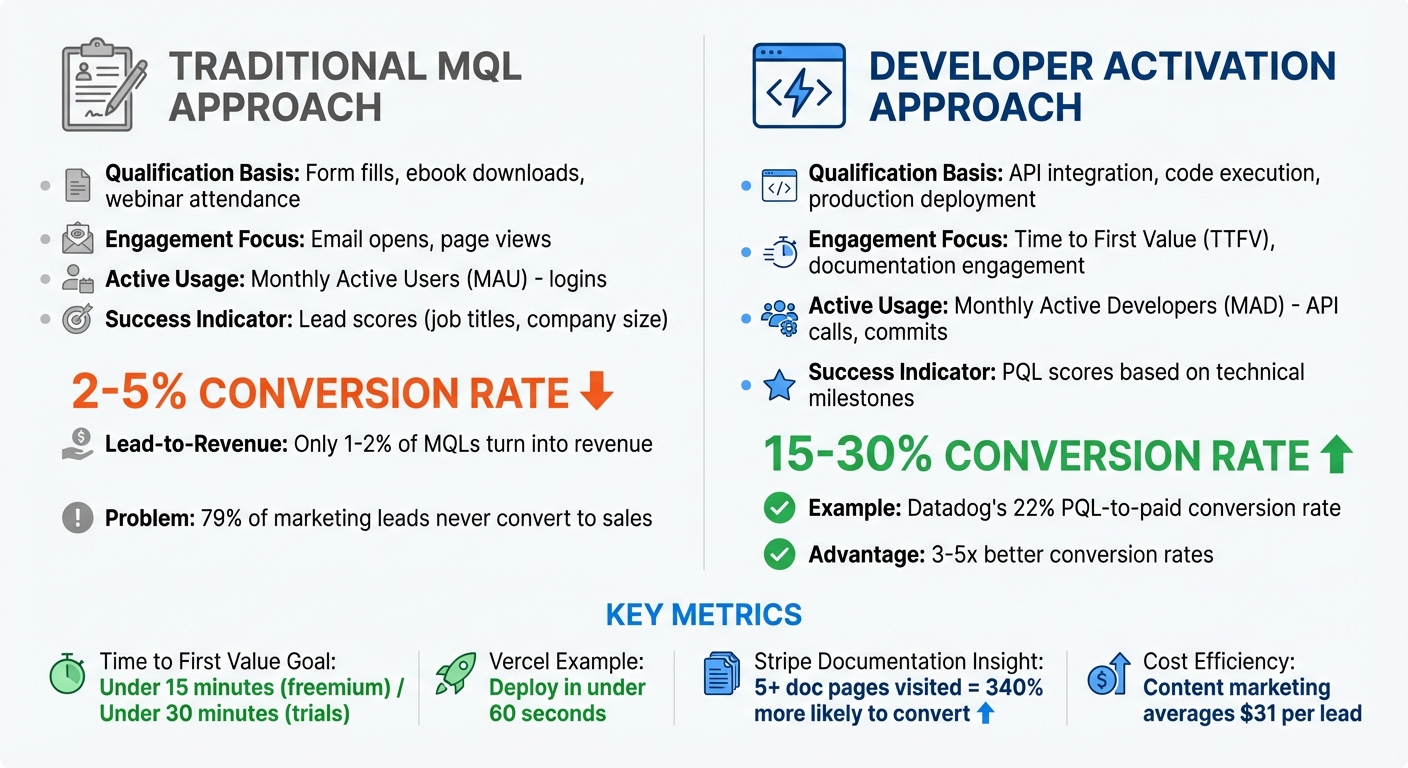 {MQL vs PQL Conversion Rates and Activation Metrics for Developer Tools}
MQLs (Marketing Qualified Leads) focus on tracking downloads and form submissions, but they miss the mark when it comes to actual product usage. For developer tools, this creates a major blind spot. As Pintel.ai explains:
"The MQL was designed as a handoff signal, not a revenue signal."
This misalignment highlights a big challenge: 89% of tech companies struggle to measure the success of their developer go-to-market strategies effectively . Even more telling, most revenue teams discover that 60–70% of their closed deals stem from just 20–30% of their lead attributes . In other words, your MQL dashboard might look impressive, but it doesn’t always translate into actual revenue growth.
Measure Activation, Not MQLs
Activation metrics shift the focus from content consumption to how developers interact with your product. Instead of tracking form fills, consider metrics like signups, time-to-value, usage frequency, and conversion rates. These metrics reveal whether developers are genuinely finding value in your tool.
One of the most effective activation metrics is the Product Qualified Lead (PQL). Unlike an MQL - someone who might have attended a webinar - a PQL is someone who has actively engaged with your product. This could mean integrating your API, deploying code to production, or reaching a specific technical milestone. The difference in conversion rates is striking: PQLs convert at 15–30%, compared to just 2–5% for MQLs .
Take Datadog, for instance. Their definition of a PQL is a user who sends at least 100 monitoring events and stays active for 7+ days. This approach has led to a 22% PQL-to-paid conversion rate, nearly 10 times better than typical MQL results .
Another crucial metric is Time to First Value (TTFV), which measures how quickly a developer achieves their first meaningful success - like a working API call, deployed app, or integration. Vercel, for example, has streamlined their process to enable developers to deploy applications in under 60 seconds . For most products, the goal should be a TTFV of under 15 minutes for freemium models and under 30 minutes for trials .
Even documentation engagement can be a predictor of success. Stripe found that developers who interact with 5 or more unique documentation pages during their first session are 340% more likely to convert than those who visit just one page . Tracking and optimizing for this kind of engagement can make a big difference.
This focus on activation metrics aligns with how developers actually use and evaluate tools, making it a much more accurate gauge of their interest and potential.
MQL vs. Activation Metrics Comparison
Here’s a side-by-side look at the differences:
| Metric Name | Traditional MQL Description | Developer Activation Description | Key Advantage |
|---|---|---|---|
| Qualification Basis | Tracks form fills, ebook downloads, and webinar attendance. | Focuses on API integration, code execution, and production deployment. | Higher intent; 3–5x better conversion rates . |
| Engagement Focus | Monitors email opens and page views. | Prioritizes Time to First Value (TTFV) and documentation engagement. | Reflects actual product utility . |
| Active Usage | Measures Monthly Active Users (MAU) based on logins. | Tracks Monthly Active Developers (MAD) using API calls or commits. | Captures project-based, irregular developer workflows . |
| Success Indicator | Relies on lead scores tied to job titles and company sizes. | Uses PQL scores based on technical usage milestones. | Identifies users already gaining value from the product . |
Switching from MQLs to activation metrics offers a more accurate way to measure genuine developer engagement. This isn’t just about improving tracking - it’s about aligning your metrics with how developers evaluate and adopt tools. When you focus on what truly matters, you’re better positioned to drive real revenue instead of chasing vanity metrics.
Content Developers Actually Use
To truly engage developers, your content needs to provide immediate, practical value. Developers aren’t interested in flashy marketing or lengthy sales pitches - they want solutions they can use right away. This means moving away from traditional marketing materials like ebooks, whitepapers, and datasheets, and focusing on formats that developers actually find useful.
Here’s why this approach works: Companies that blog consistently generate 13x more leads than those that don’t . Plus, technical, problem-solving content can deliver 3x more leads at 62% lower cost compared to traditional methods . Why? Because developers want to see how your tools work in action, not read abstract claims about how great they are.
Code Examples, Not Ebooks
Forget gated ebooks loaded with marketing jargon. Developers want ready-to-use code snippets they can copy, test, and deploy immediately. Think JavaScript, Python, or Go examples that tackle real-world challenges like API integrations or authentication flows.
Stripe sets the gold standard here. Their documentation includes plug-and-play code snippets for payment processing. For instance, their "Accept a payment" example in React allows developers to fork the code and see it in action right away - no forms, no friction . Similarly, Vercel offers Next.js starter templates with full deployment-ready code, enabling developers to kick off projects in minutes .
The secret? Make your code examples testable. Developers should be able to drop your snippets into tools like CodeSandbox or Replit and see results instantly. This hands-on experience builds trust faster than any marketing material ever could.
Beyond snippets, step-by-step tutorials provide even more value by guiding developers through complete solutions.
Tutorials, Not Whitepapers
Step-by-step tutorials solve real problems and resonate far better with developers than abstract whitepapers. Instead of a dense PDF titled "The Future of Cloud Infrastructure", create something actionable like "Build a real-time chat app with Supabase in 10 minutes."
Why does this work? 73% of marketers say interactive content like tutorials produces high-quality leads . Tutorials align perfectly with how developers learn - by doing, not reading theory. They also perform well in search, where SEO-driven content converts leads at a 14.6% rate, compared to just 1.7% for outbound marketing .
To make your tutorials effective:
- Include clear prerequisites.
- Break the process into numbered steps.
- Provide a GitHub repository with complete code.
- Add troubleshooting tips and natural trial CTAs, like "Sign up for a free API key here."
This approach not only educates developers but also keeps costs low, with content marketing averaging just $31 per lead .
Honest Product Comparisons
Developers are naturally skeptical of sales pitches, but they trust transparent, data-driven comparisons. Instead of pushing promotional datasheets, offer side-by-side metrics like latency, pricing, scalability, and edge cases.
Stripe excels at this with their "Stripe vs. competitors" documentation, which breaks down pricing tiers and feature differences in detail . Supabase takes a similar route, offering "Firebase alternatives" comparisons that highlight their open-source benefits while openly addressing trade-offs .
This kind of honesty builds credibility. Companies that prioritize content strategies like these are among the 67% of revenue leaders who consistently exceed targets . Acknowledging both your strengths and limitations shows developers you’re not just selling a product - you’re helping them make informed decisions.
Using Paid Ads to Drive Developer Activation
Paid ads can resonate with developer audiences, but only if you ditch traditional lead generation tactics and focus on activation. The key is to meet developers where they already spend their time - on the tools and platforms they use - and guide them straight to hands-on experiences. For example, platforms like daily.dev Ads provide access to over 1.6 million developers in "discovery mode", letting you target by specific technologies instead of using broad, generic platforms. This approach aligns perfectly with developers' preference for immediate, practical evaluation.
The distinction lies in relevance. While 89% of B2B marketers rely on LinkedIn for lead generation , generic platforms often fall short with developers, who adopt tools from the ground up. In contrast, targeting based on tech stacks integrates seamlessly with developers' workflows and challenges, capturing their attention when it matters most. Companies like Stripe and Vercel have perfected this strategy by focusing their efforts on specific technologies rather than generic demographics. Below, we'll explore how to refine your targeting, eliminate friction, and compare ad strategies for better results.
Target by Tech Stack and Seniority
With daily.dev Ads, you can zero in on developers based on programming languages (e.g., JavaScript, Python, React), tools and frameworks (e.g., Node.js, AWS, Docker), and even experience levels (junior, mid-level, senior). This precise targeting ensures your ads reach developers who are already using relevant technologies, leading to better engagement than broad demographic campaigns. For instance, if you're promoting a PostgreSQL monitoring tool, targeting developers already working with PostgreSQL is far more effective than casting a wide net for "software engineers." This approach, often referred to as technographic targeting, converts 3–5× faster than traditional cold outreach .
Send Developers to Trials, Not Forms
Your ads and landing pages should focus on eliminating any barriers for developers. Use direct, action-driven calls-to-action like "Start coding now" or "Try our API in 2 minutes - no credit card required." Instead of routing users to lead capture forms, send them straight to self-serve trial pages. Including code snippet previews in your ads can also set clear expectations.
Take Postman as an example. They run ads that link directly to tutorial-based collections developers can try immediately, leading to activation rates that are three times higher than form-gated demos. While the average B2B cost per lead is $391.80 , targeted ads focusing on activation have brought costs down to as low as $31 . Additionally, leads generated through SEO and intent-driven ads convert at 14.6%, compared to just 1.7% for outbound efforts . This is why daily.dev Ads consistently deliver higher-quality leads.
Traditional Ads vs. daily.dev Ads
Here’s a quick comparison of traditional ads and daily.dev Ads:
| Aspect | Traditional Ads (LinkedIn/Google) | daily.dev Ads |
|---|---|---|
| Targeting | Broad job titles and demographics | Tech stack, programming languages, and seniority |
| Ad Placement | General feeds and search results | Curated developer news feeds |
| Goal | Form fills and MQLs | Trial signups and activation |
| Outcome | Lower conversion rates | Higher quality leads and team growth |
LinkedIn may account for 80% of B2B social leads , but its focus on traditional MQL campaigns often falls flat with developers. On the other hand, daily.dev Ads integrate your message directly into curated tech news feeds where developers browse daily. This placement ensures 70% visibility on high-volume developer terms, enabling you to reach developers in "discovery mode." By combining contextual ad placement with tech stack targeting, these ads deliver 62% more qualified interactions , engaging developers through relevant, technical content rather than interrupting them with irrelevant pitches.
When and How to Involve Sales Teams
Sales teams can make the most impact when activation metrics show strong developer engagement. The key is to involve sales only after developers display genuine buying intent through their product usage. This is where Product Qualified Leads (PQLs) come in - users who show meaningful engagement with the product. PQLs convert at rates 3–5x higher than traditional Marketing Qualified Leads (MQLs) . Why? Because actions like completing an API integration or moving code from sandbox to production demonstrate a serious level of commitment.
Look for technical milestones that signal readiness. Examples include hitting 100+ monitoring events over a week, seeing 150% week-over-week API call growth, inviting team members, or accessing security documentation. For instance, Datadog uses a benchmark of 100 monitoring events sustained over 7 days, which results in a 22% conversion rate . Identifying these kinds of milestones ensures sales teams step in at the right time.
Trigger Sales at Usage Milestones
Automate your triggers based on actual product usage, not just demographic data. For example, a developer who visits 10+ unique documentation pages is likely a serious evaluator . Other strong indicators include creating a production endpoint or committing production-ready code.
Achintya Gupta, CEO & Co-founder of Reo.Dev, highlights this approach:
"In these [Evaluation] accounts, developers have thoroughly engaged in the evaluation process... This is an opportune moment for Account Executives to monitor these accounts closely... They can identify where to introduce sales engineering support to bolster the developers' efforts."
Beyond usage patterns, pay attention to compliance-related inquiries - these often signal developers are preparing for broader adoption within their organization.
Respond to Security and Compliance Questions
Security and compliance reviews are a major part of the validation phase, accounting for 20% of the total influence during evaluation . When developers start asking about SOC 2 compliance or accessing enterprise feature documentation, they’re likely building a business case internally.
At this stage, sales teams should act as technical partners, not pushy sellers. Help developers build proof-of-concept projects and navigate procurement processes without turning it into a hard sales pitch. Providing resources like security whitepapers and compliance checklists can empower developers to move forward independently .
Use In-App Messages, Not Cold Calls
Developers have a radar for spotting automated marketing efforts. Lee Robinson, VP of Product at Vercel, sums it up well:
"Developers go straight to the documentation and code samples. They're trying to finish the job quickly and don't want to deal with BS."
Instead of cold calls, use behavior-triggered in-app messages that offer tailored help at the right moment. For instance, when a developer successfully completes an API call, send a message offering a technical consultation for scaling. To make it feel personal, have the message come from a founder or senior engineer rather than a generic bot.
Also, give developers choices. Options like "Read Documentation", "Join Discord", or "Talk to an Engineer" let them engage on their own terms . This is especially important since 96% of developers assume company-written content is untrustworthy before even reading it . By offering genuine, helpful interactions, you can build trust and guide developers without overwhelming them.
Conclusion: Move Beyond MQLs for Developer Lead Generation
Traditional MQL strategies treat developers as if they're just another B2B audience - but developers aren't here to buy; they're here to build. Instead of sitting through demos, they want to dive into your product right away. Instead of whitepapers, they trust code examples. And the moment you ask them to fill out a form just to access basic documentation? They're gone.
Shifting from MQLs to activation metrics isn't just a passing trend - it aligns with how developers genuinely evaluate tools. Product Qualified Leads (PQLs) boast conversion rates 3–5x higher than traditional MQLs because they focus on actual product engagement rather than superficial demographic data . By tracking activation metrics, you're identifying developers who have already shown technical intent - whether that's completing API integrations, deploying code, or inviting teammates.
Elizabeth Epton, Senior Content Marketing Manager at Blues, sums it up perfectly:
"Developers can smell a non-technical sales pitch from a mile away, and nothing makes them close a tab faster than buzzwords without substance."
The answer isn't to ditch lead generation altogether - it’s to approach it like a system you’d engineer. Define meaningful technical milestones, set up your product to track them, and involve sales only when developers hit key usage thresholds. Make sign-ups frictionless, ungate your documentation, and let developers achieve their first successful API call without wading through marketing barriers .
FAQs
What’s the difference between MQLs and PQLs?
A Marketing Qualified Lead (MQL) is someone who engages with your marketing efforts - like downloading an eBook or signing up for a webinar. These actions show interest but don’t necessarily indicate they’re ready to buy.
On the other hand, a Product Qualified Lead (PQL) interacts directly with your product. This might include actions like using an API, activating key features, or exploring trial functionality. These behaviors often signal a deeper level of intent and a higher likelihood of conversion compared to MQLs.
How do I define activation for my developer product?
Activation for a developer product happens when a developer goes beyond simply signing up or experimenting with the product - they start actively using it and finding value in it. This is often reflected in measurable actions like making API calls, contributing code, visiting documentation, or testing tools. These behaviors indicate that the developer is weaving the product into their workflow, showing real engagement and laying the groundwork for ongoing use.
Can I still use gated content for developer demand gen?
Developers aren't fans of gated content. They often see it as an obstacle rather than a resource. Instead, they gravitate toward technical resources that they can access and explore freely - think documentation, tools, or APIs. If you want to connect with developers, focus on offering resources that allow them to experiment and learn on their own terms, without unnecessary barriers.