

Developers buy software differently. They start with a problem, test tools independently, and only involve decision-makers after validating a solution. This bottom-up process flips traditional marketing on its head. To succeed, you need to focus on developers' unique habits:
- Discovery: Developers find tools via GitHub, forums, or blogs.
- Hands-On Evaluation: They test tools using free tiers or sandboxes.
- Deep Learning: They explore advanced use cases and documentation.
- Advocacy: Developers pitch the tool internally to managers or teams.
Key Stats:
- 60% of developers use ad blockers.
- 54% influence tech purchases.
- 30%-50% of IT spending bypasses official budgets.
Tailor your approach with practical, self-serve resources like clear documentation, runnable examples, and tutorials. Avoid flashy marketing - developers trust functionality over hype. Tracking metrics like API key creation, quickstart success, and team adoption signals can help refine your strategy.
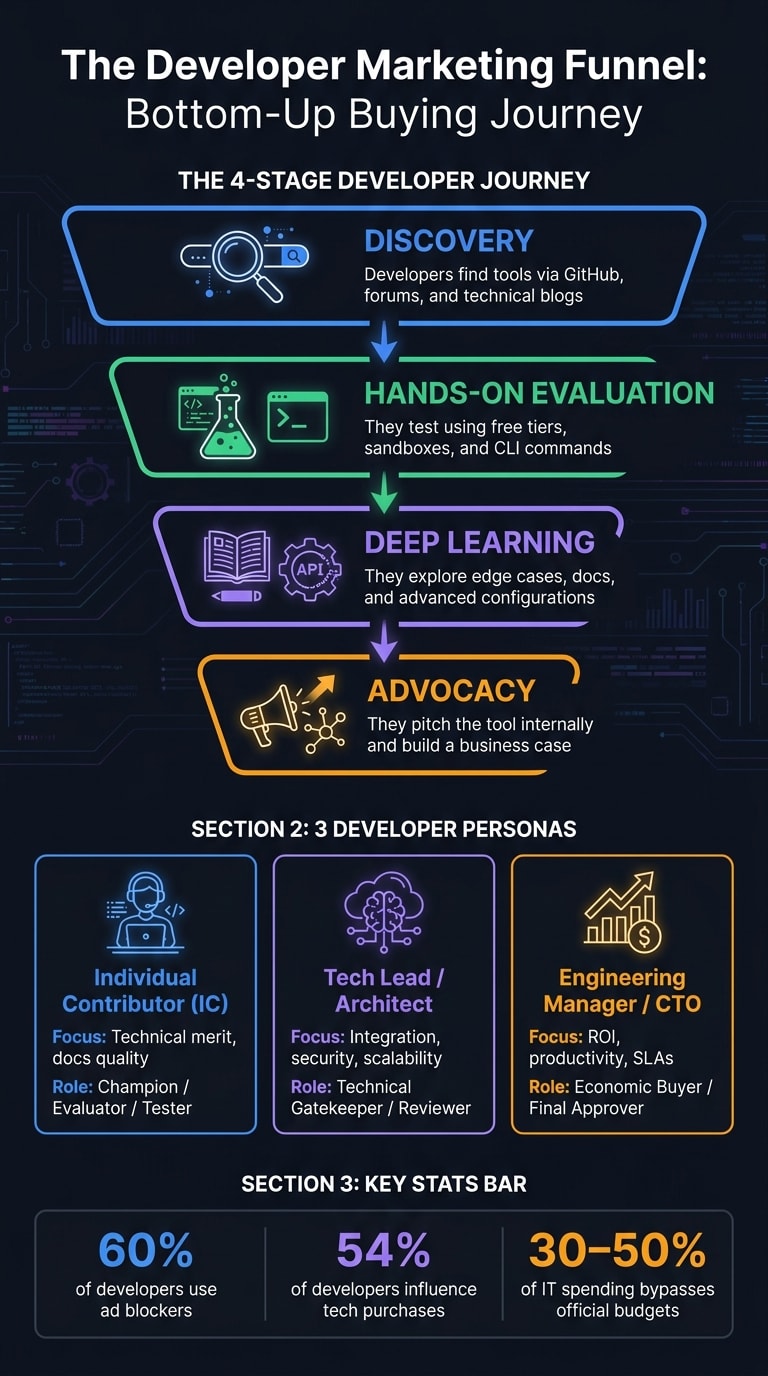
Mapping the Developer Buying Journey
Developer Personas and Their Role in Buying Decisions
Developers aren't a one-size-fits-all group. A backend engineer assessing a database tool has different concerns than a DevOps engineer evaluating a CI/CD platform. However, most buying decisions involve three key personas, each playing a distinct role.
| Persona | Primary Focus | Role in Buying Process |
|---|---|---|
| Individual Contributor (IC) | Technical merit, developer experience, documentation quality | Champion, Evaluator, Tester |
| Tech Lead / Architect | Integration fit, security, scalability | Technical Gatekeeper, Reviewer |
| Engineering Manager / CTO | ROI, team productivity, SLAs | Economic Buyer, Final Approver |
The process typically starts with the IC, who initiates discovery and testing. Next, the tech lead steps in to evaluate how well the tool integrates, its security, and its scalability. Finally, the Engineering Manager or CTO reviews the ROI and approves the budget.
This step-by-step approach works because each persona requires tailored information. For example, an IC needs hands-on resources like API documentation, while a senior decision-maker needs financial justifications. Sending the wrong information to the wrong person - like sharing ROI-focused case studies with an IC - can derail the process entirely.
This framework helps explain the behavioral patterns developers exhibit during the buying journey.
Common Behavioral Patterns Across the Funnel
Developers often follow predictable behaviors throughout their buying process, and understanding these tendencies can help you engage more effectively.
One of the most consistent patterns is anonymous research. Developers prefer to stay under the radar in the early stages. They use personal emails, browse in incognito mode, and avoid filling out forms to sidestep sales outreach. As Gonto and Matteo Tittarelli note:
"Developers... prefer learning new tools and apps by deploying an MVP in a demo environment. This behavior... prescribes a UX that is entirely self-serve."
Another key behavior is learning by doing. Instead of poring over lengthy whitepapers, most developers dive straight into the action. They clone repositories, run quickstart guides, and judge a tool based on its actual performance. If the initial setup is clunky - like broken documentation or unclear instructions - chances are they won't come back.
As developers move toward advocacy, their needs shift. They now look for resources that help them make a business case, such as ROI calculators, security summaries, or "convince your boss" materials. These tools are far more effective at this stage than another technical tutorial .
By understanding these behaviors, you can better align your approach to each stage of the developer journey.
Each Stage of the Developer Journey, Explained
The developer journey is often a bottom-up process, starting with individual exploration and eventually influencing organizational decisions. While developers may loop between stages like research and testing, their progression generally follows this path:
Discovery begins with a problem. A developer might encounter issues like latency, missing integrations, or scaling challenges. From there, they start exploring solutions by browsing GitHub, Reddit, Stack Overflow, and technical blogs. At this stage, they're not evaluating vendors - they're simply asking, "Does this solve my problem?"
Hands-on evaluation is where developers get serious. They sign up - often using personal emails - and start testing. They run CLI commands, hit API endpoints, and verify that the tool delivers on its promises. As Matthew Revell, Founder of Hoopy Limited, explains:
"Developers: Test before they trust. Developers need to see a product in action, experiment with it, and validate its usefulness firsthand before committing."
Deep learning happens after a successful initial test. Developers now dig deeper, exploring edge cases, advanced configurations, and architectural details. They look for signs of compatibility, such as supported frameworks, architecture diagrams, and troubleshooting guides, to ensure the tool is ready for production .
Advocacy is the final stage, where the developer transitions from user to internal champion. Convinced of the tool's value, they build a case within their organization. This might involve sharing benchmarks, scheduling discussions with managers, or translating technical wins into business outcomes. At this point, the developer's grassroots adoption connects with the company's purchasing decision .
How to Optimize Each Stage of the Developer Funnel
Discovery: Reaching Developers Where They Already Look
Developers are proactive problem-solvers. They don’t wait for solutions to come to them - they go looking. That’s why your content needs to exist in the spaces they frequent: GitHub, Reddit, Stack Overflow, technical blogs, and developer news feeds.
What works best here? Content that’s practical and directly addresses real-world challenges. Think deep-dive engineering articles, framework comparisons, or tutorials. For example, a post titled "How to Reduce API Latency in Distributed Systems" will resonate far more than a generic announcement like "Introducing Our New API Tool." The key is to provide value first, visibility second. When developers find genuinely helpful content, they’re naturally inclined to explore your solution further.
Equally important is building trust within the developer community. Developers tend to trust their peers more than marketing campaigns, so being present and authentic in these spaces is critical. This could mean answering questions, participating in discussions, or sharing transparent insights. Platforms like daily.dev, which curates technical content for millions of developers as part of their daily routine , offer a great opportunity to connect through native, in-feed placements that blend seamlessly into their experience.
Once developers see value in your content, they’re ready to dive in and test the tool themselves.
Evaluation: Giving Developers the Tools to Test and Validate
When developers show interest, the evaluation phase is all about making their testing experience as smooth as possible. If they can’t see a working "hello world" example within five minutes of signing up, you risk losing their attention. That’s why self-serve access is non-negotiable. Free tiers, sandbox environments, and one-click demos are essential for letting developers test your tool on their own terms.
Pair these with targeted tutorials, like "Build an Appointment Reminder with SMS," to provide clear, actionable use cases. These guides help bridge the gap between curiosity and confirmation.
The way you communicate during this phase also matters. Developers value clarity over hype. As EveryDeveloper puts it, "Technical products need marketing, but the audience doesn't want it to feel like marketing." Avoid using buzzwords like "revolutionary" or "seamlessly" and stick to straightforward, honest messaging.
Once developers have tested your tool, the next step is to provide the resources they need to truly understand it - and advocate for it.
Deep Learning and Advocacy: Building Trust and Internal Influence
After developers validate your tool, the focus shifts to helping them dive deeper and equipping them to become advocates. This is where advanced resources like detailed documentation, architecture diagrams, edge case examples, and SDK references come into play. In fact, clear, runnable documentation can be a game-changer. As Louis Corneloup, Founder at Dupple, puts it:
"For devtools, documentation is the highest-converting marketing asset. Clear docs with runnable examples produce more signups than any ad."
At this stage, developers are not just users - they’re potential champions within their organizations. Their focus shifts from asking, "Does this work?" to "How do I convince my team?" To support them, provide tools like ROI calculators, security summaries, and presentation templates. These resources empower developers to make a strong case internally.
It’s worth noting that team invite rates are a powerful indicator of paid conversions in the developer funnel . Making it easy for developers to share your tool with their colleagues can have a direct impact on your bottom line.
Metrics and Signals for Measuring Developer Funnel Performance
Tracking the right metrics at each stage of the developer funnel is crucial to refining the journey from discovery to advocacy. Hackmamba highlights this challenge:
"Developer marketing metrics are rarely discussed in depth. In most devtool teams, reporting ends up being page views, signups, or community activity screenshots. None of these show whether developers are actually moving closer to adoption or advocacy."
To address this, align your metrics with the funnel stages. Use external signals during discovery, product-focused metrics during evaluation, and organizational indicators for long-term adoption.
Tracking Awareness and Engagement at the Discovery Stage
At the discovery stage, you’re not just looking at impressions - you want to see if developers are genuinely engaging with your tool. Metrics like GitHub repo views, documentation scroll depth, and visibility of relevant Stack Overflow questions can reveal whether your content is reaching the right audience.
One particularly useful signal is the "copy code" event. By tracking how often developers copy code snippets and monitoring rankings for targeted search terms (like "how to secure a React app"), you can better understand how developers are exploring your tool.
Measuring Success During Hands-On Evaluation
When developers reach the evaluation stage, one of the most telling metrics is Time to First Success (TTFS) - the median time it takes for a developer to go from starting a Quickstart to achieving a successful outcome. Ideal benchmarks vary by tool type:
- Auth/API libraries: 5–15 minutes
- Frameworks/SDKs: 15–45 minutes
- Infrastructure tools: 45–90 minutes
If your TTFS is consistently above these ranges, it could signal onboarding friction that needs immediate attention.
Other key metrics include API key creation, CLI/SDK authentication success, and package manager installs. Pairing these with Quickstart completion rates can help pinpoint where developers encounter roadblocks, giving you a clear roadmap for improvements.
Signals That Indicate Advocacy and Long-Term Adoption
Once developers move beyond evaluation, the focus shifts to signals within their environment. Metrics like recurring CI/CD executions, presence in lockfiles, and mentions in internal communication channels (e.g., Slack or Discord) indicate your tool has transitioned from trial to dependency. Additionally, tracking feature adoption depth - where developers utilize multiple features - can help predict churn and gauge deeper engagement.
Advocacy signals are even more powerful when they reflect organizational adoption. For example, seeing your tool referenced in internal READMEs, included in company boilerplate repos, or mentioned in team discussions suggests that developers are advocating for your tool within their teams. These behaviors often signal team-level adoption and could lead to paid conversions.
| Funnel Stage | Key Signals | What It Means |
|---|---|---|
| Discovery | GitHub repo views, documentation scroll depth, code copy events, problem-focused search rankings | Developer is exploring your tool for workflow fit |
| Evaluation | API key creation, CLI/SDK authentication success, TTFS, package manager installs | Developer has achieved a working result in their local environment |
| Adoption | Presence in lockfiles, recurring CI/CD runs, API call volume, feature adoption depth | The tool has moved from trial to a real project dependency |
| Advocacy | Internal Slack/Discord mentions, README references, boilerplate inclusion | Developer is actively recommending the tool to peers or management |
Conclusion: Building a Signal-Driven Developer Marketing Funnel
Key Takeaways from the Developer Funnel Approach
The journey developers take when deciding to adopt a tool is anything but linear. They proceed at their own pace - testing, experimenting, and seeking feedback from peers. This process often stretches over weeks or even months before they make a commitment. As Dorota Owczarek of Advocu explains:
"When developers decide to adopt a tool, they're committing to hours, maybe days, of testing, integrating, and ultimately relying on it... It's not just a purchase; it's the beginning of a working relationship."
At the heart of this journey is bottom-up adoption. Developers prefer to try a tool on their own before engaging with sales, which makes a self-serve, product-led strategy with a free tier a must-have. Trust is earned through practical resources like clear documentation, runnable examples, and content that solves real technical problems instead of relying on exaggerated claims. In fact, well-crafted documentation often outperforms traditional advertising when it comes to driving conversions. Reducing friction at every step is just as important - small hurdles can stop adoption in its tracks before developers even reach the advocacy stage.
These principles highlight the importance of using native, context-aware advertising to nurture developers through every phase of the funnel.
How daily.dev Ads Supports Every Stage of the Funnel
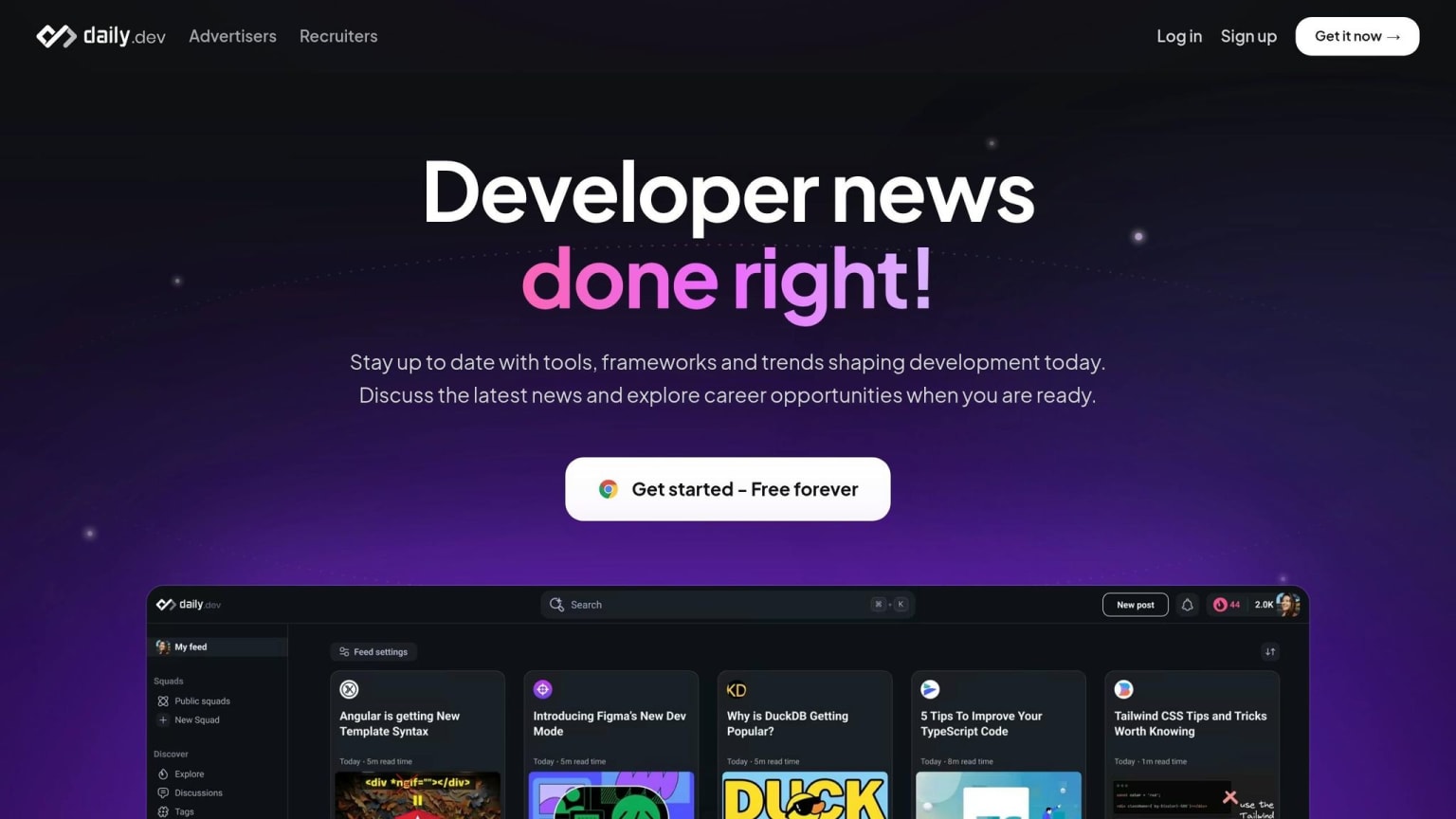
daily.dev Ads aligns with the way developers explore and adopt tools by embedding itself into the spaces where they naturally spend their time. Traditional ads often fail to reach developers, but daily.dev Ads takes a different approach by appearing in trusted environments with content that is practical, relevant, and avoids overt promotion.
With over 1 million developers on the platform, daily.dev Ads offers native ad placements that feel like a natural part of the developer's workflow. It allows for precise targeting based on criteria like seniority, programming language, and the tools developers already use. This ensures visibility during discovery, evaluation, and even as developers advocate internally for the tools they trust. By integrating seamlessly into the developer's daily routine, daily.dev Ads supports the signal-driven strategy that modern developer marketing thrives on.
FAQs
How do I shorten Time to First Success (TTFS)?
If you're looking to speed up a developer's journey to achieving success with your product, the key is to focus on early engagement using practical, trust-building strategies. Developers value hands-on experiences and credible recommendations far more than broad marketing campaigns. Here's how you can make an impact:
- Hands-on Testing: Give developers the chance to try your product directly. Whether it's through free trials, sandbox environments, or detailed demos, this hands-on approach helps them see the value for themselves.
- Peer Recommendations: Developers trust their peers. Encouraging testimonials, case studies, or word-of-mouth endorsements can go a long way in building credibility.
- Detailed Technical Content: Provide in-depth guides, tutorials, and documentation that address real-world problems. This kind of content resonates with their technical mindset and shows you're serious about solving their challenges.
Additionally, direct technical engagement is a powerful trust-building tool. Hosting meetups, attending conferences, or participating in developer communities allows you to connect on a personal level and foster authentic relationships.
Avoid wasting time on broad awareness campaigns. Developers aren't looking for flashy ads - they're seeking practical solutions. By offering relevant resources, hands-on support, and a community-driven approach, you can align with their needs and help them achieve success faster.
What should I publish for the advocacy stage?
In the advocacy stage of the developer marketing funnel, the goal is to strengthen trust and loyalty. This is where you focus on creating content that continues to be helpful, such as step-by-step tutorials, troubleshooting guides, and transparent updates about your product or service.
It's also important to stay actively involved in developer communities. Whether through forums, social media, or meetups, authentic engagement shows that you value their input and expertise. By consistently offering meaningful support and respecting their knowledge, you inspire developers to share their positive experiences, turning them into natural advocates for your product.
What signals best predict paid team adoption?
The most effective signals for forecasting paid team adoption are developer trust, timing, and behavioral insights. Additional indicators include how developers interact with technical content, their usage of tools, and the impact of personalized marketing efforts designed to align with their specific needs and preferences.