

In 2026, succeeding in developer marketing requires using multiple channels together. Here's why:
- Content marketing builds trust and credibility through resources like tutorials and documentation, but it takes 6–12 months to show results.
- Community efforts create advocates and gather feedback through forums, events, and groups, but they need 12–18 months to gain traction.
- Paid reach accelerates discovery by targeting developers where they already engage, delivering quick visibility within weeks.
The best approach combines these channels. Content and community establish long-term trust, while paid campaigns amplify visibility and speed up adoption. Tools like daily.dev Ads can target developers based on roles, tools, and interests, promoting your best content in places where developers actively seek solutions.
To allocate budgets effectively:
- 40–50% for content and community
- 30–40% for paid reach
- The rest for product documentation and experimentation
Track performance with metrics tailored to each channel, and use multi-touch attribution to understand how they work together. This integrated strategy ensures scalable, measurable growth in developer engagement.
Why Developer Marketing Needs Multiple Channels
Relying on just one channel isn’t enough to succeed in developer marketing. Content might establish credibility, but it won’t reach developers who’ve never heard of your brand. Community efforts can turn developers into advocates, but they require months to gain traction. Paid campaigns, while great for quick awareness, still depend on strong content to deliver real value. No single channel can simultaneously handle awareness, trust-building, and adoption . That’s why an integrated approach - combining content, community, and paid reach - is key to moving developers from awareness to adoption.
The data backs this up. Teams that use multiple channels see better outcomes compared to isolated efforts. For instance, 64% of developer marketing teams report that community and events deliver the highest ROI . Successful teams layer these channels to amplify their impact. As Strategic Nerds, a developer marketing consultancy, explains, developer marketing efforts “compound” over time. Single-channel strategies, however, are more vulnerable - especially when leadership grows impatient and starts cutting budgets . Let’s explore how each channel uniquely contributes to your overall strategy.
Content and Community Build Long-Term Trust
Content like documentation, tutorials, and code samples solves real problems for developers, earning credibility along the way. Companies like Stripe, Supabase, and Vercel have built massive developer audiences by focusing on content that prioritizes usefulness over sales pitches . High-quality documentation and functioning code establish a level of trust that no ad campaign can replicate.
Community channels - forums, Discord groups, and events - take that trust further by fostering peer validation and interaction. These platforms allow developers to share feedback and experiences, turning them into advocates for your brand. However, building these relationships takes time. SEO traffic grows slowly, and measurable adoption trends often take 6–12 months to surface . While content and community steadily build trust, paid reach plays a different role: speeding up discovery.
Paid Reach Speeds Up Discovery
Paid advertising helps tackle the challenge of discovery by placing your content in front of developers who might never find it organically. Instead of waiting for slow organic growth, you can target specific developer roles, tools, and interests to quickly boost awareness . That said, paid reach isn’t a replacement for content or community - it’s a way to amplify their effects.
The context of paid reach matters. A developer engaging with technical content on platforms like daily.dev is in a learning mindset, actively seeking information. On the other hand, a banner ad interrupting someone in the middle of debugging creates a completely different, often less effective, interaction . Native ad formats that align with how developers naturally consume content tend to perform better because they provide value upfront. By using paid reach to promote your best tutorials and documentation, you create a faster path from discovery to technical evaluation - without undermining the trust built through content and community. Next, we’ll dive into how each channel delivers specific results and how they work together to scale your efforts.
sbb-itb-e54ba74
What Each Marketing Channel Delivers
::: @figure 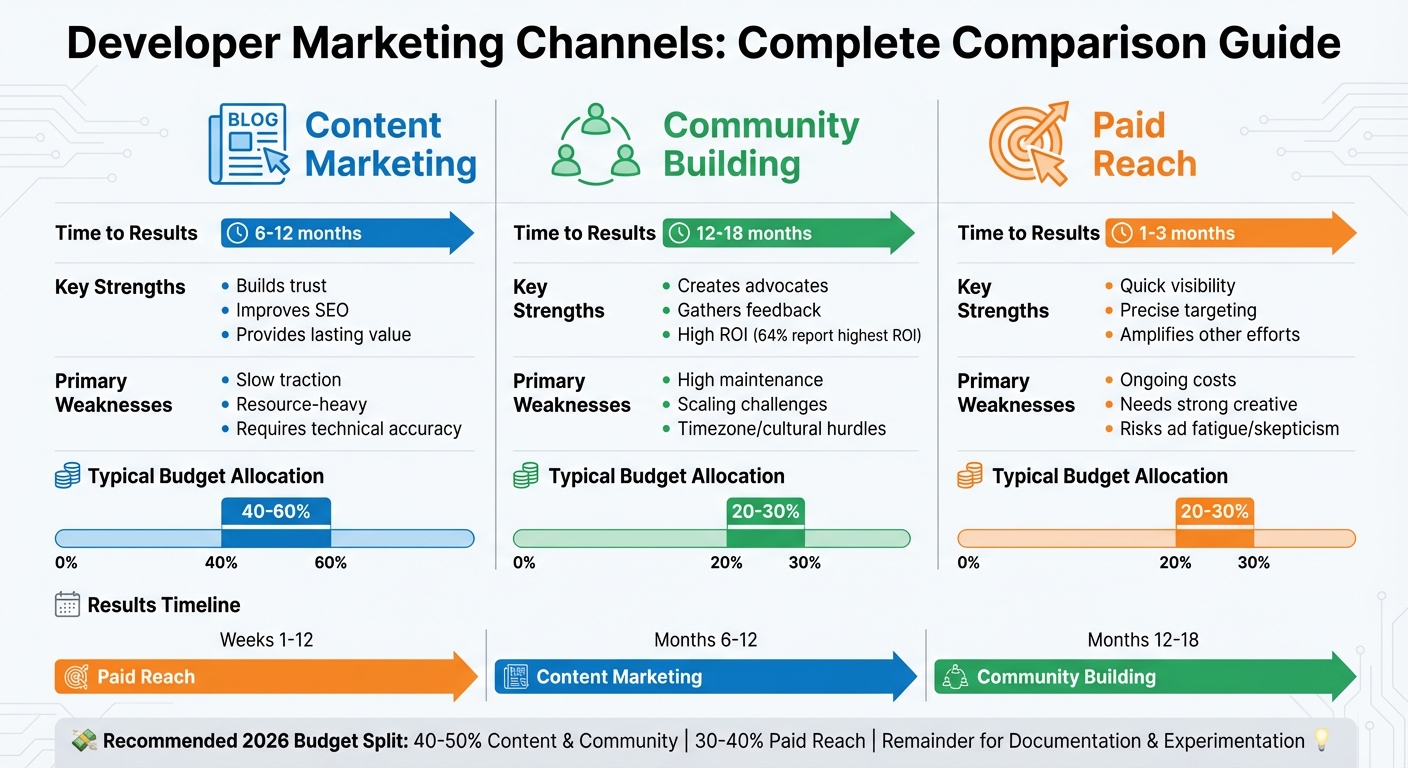 {Developer Marketing Channels Comparison: Timeline, Strengths, and Budget Allocation}
Let’s break down what each marketing channel brings to the table in terms of timing, cost, and overall impact.
Content marketing is all about building authority. It does this through resources like tutorials, blog posts, and guides that address real problems. Over time - typically 6 to 12 months - this approach fosters trust and credibility. A well-crafted technical guide, for example, can provide long-term value, but it requires ongoing investment in creating and maintaining high-quality content. The downside? Organic discovery is slow, and the process of technical writing and review can be resource-heavy .
Community building stands out for driving advocacy and gathering invaluable feedback. While it takes longer to gain traction - usually 12 to 18 months - it delivers high returns, with 64% of developer marketing teams reporting it as their most effective channel . However, it’s not without challenges. Building and maintaining a thriving community demands constant moderation and engagement, which can be costly and less predictable to scale .
Paid reach fills the gaps left by content and community efforts, addressing challenges in discovery. It provides targeted visibility within weeks by placing ads where developers are already engaged, such as technical feeds. But context is critical - a developer browsing technical content on daily.dev may welcome relevant ads, while a poorly timed banner ad could feel intrusive and disrupt their workflow .
Channel Comparison: Timeline, Strengths, and Weaknesses
| Channel | Time to Results | Key Strengths | Primary Weaknesses | Typical Budget Allocation |
|---|---|---|---|---|
| Content | 6–12 months | Builds trust, improves SEO, provides lasting value | Slow traction, resource-heavy, requires technical accuracy | 40–60% |
| Community | 12–18 months | Creates advocates, gathers feedback, high ROI | High maintenance, scaling challenges, timezone/cultural hurdles | 20–30% |
| Paid Reach | 1–3 months | Quick visibility, precise targeting, amplifies other efforts | Ongoing costs, needs strong creative, risks ad fatigue or skepticism | 20–30% |
For early-stage marketing efforts, most teams allocate 50–60% of their budget to content (especially documentation), 20–30% to community building, and around 20% to paid reach for testing. As the program matures, the budget often shifts to 40% for content, 30% for community, and 30% for paid reach to drive faster growth .
These percentages aren’t set in stone - they’re starting points. The real key is to stay flexible and adjust based on what resonates with your audience and drives the best results for your product.
How daily.dev Ads Works as Your Paid Reach Component
Once you've set aside budgets for content and community, you can take things up a notch with daily.dev Ads. This tool helps amplify your organic efforts by showcasing your best content to developers who haven’t discovered you yet. Here’s how it works.
Target Developers by Role, Tools, and Interests
With daily.dev Ads, you can zero in on developers using behavioral signals. Filter by experience level (junior, senior, staff), programming languages (like Python, JavaScript, or Rust), tools (such as Docker, Kubernetes, or Supabase), and even technical interests like AI or cloud-native development . Why does this matter? A senior backend engineer researching database solutions has entirely different priorities compared to a frontend developer exploring UI frameworks. This level of targeting ensures your message resonates with the right audience.
Native Ad Formats That Fit Developer Behavior
daily.dev Ads offers three ad placements that naturally blend into developers' browsing habits:
- In-feed ads appear seamlessly within the curated tech news feed.
- Post-page placements show up after relevant articles.
- Personalized digest ads are included in daily email summaries .
These formats work because developers are already in a learning mindset, browsing for insights and solutions. By appearing alongside trusted sources like Stripe and Vercel, your ads benefit from the credibility of their environment .
Amplify Your Content and Community Efforts
Use daily.dev Ads to promote your most impactful tutorials, blog posts, or documentation to developers actively seeking solutions. For example, target a React tutorial to frontend developers or showcase a virtual meetup on Postgres to database engineers . This strategy not only drives traffic but also strengthens your SEO and builds momentum for your content. Over time, one-time visitors can become loyal users joining your Discord or GitHub communities.
These ads help you reach developers beyond your current audience, creating a cycle where paid visibility supports organic growth . To get started, review your best-performing content, align it with relevant targeting segments, and allocate 20–30% of your budget to test its impact against your organic efforts . Up next, we’ll dive into how to track and measure these results across your marketing strategy.
How to Measure Results Across Your Marketing Mix
To effectively evaluate your developer marketing strategy, tailor your metrics to each channel. For paid reach, metrics like impressions, clicks, and cost per acquisition (CPA) provide quick feedback - often within days. A good benchmark for native developer ads is a click-through rate between 0.5% and 2%, with a CPA under $5 in most developer niches. Content marketing, on the other hand, takes time to build momentum, with views and sign-ups typically increasing over one to three months. Aim to convert 2% to 5% of content views into sign-ups. Community efforts require even more time - three to six months or longer - but they often yield the highest ROI. In fact, 64% of developer marketing leaders highlight community as their most effective channel. Track metrics like engagement rates (10% to 20% monthly active participation), referral traffic, and Net Promoter Score (NPS) to measure advocacy. These benchmarks provide a strong foundation for assessing each channel.
Track Different Metrics for Each Channel
Each channel requires its own set of metrics:
- For daily.dev Ads, track impressions to measure reach, clicks to gauge interest, and post-click conversions like content views or trial sign-ups.
- For content marketing, focus on page views, time spent on the page, and lead conversions such as demo requests or trial sign-ups.
- For community efforts, monitor engagement metrics (e.g., comments, posts, and reactions per member), referral traffic to product pages, and member retention over time.
Using pixel-based conversion tracking can help you connect activity across these channels, giving you a clearer picture of how each contributes to your goals.
What to Expect and When
Results vary by channel, so timing is key. Paid reach through daily.dev Ads provides almost immediate feedback, with click-through rates and conversions visible within the first week or two. Content marketing takes longer, typically growing 10% to 20% month over month, with noticeable traction after one to three months. Community efforts grow more gradually, compounding over three to six months as engagement deepens and referrals increase. In the first quarter, you might see 20% to 50% of your pipeline driven by a combination of paid and organic efforts. Understanding these timelines helps you set realistic expectations and refine your strategy.
Attribute Results Across Multiple Touchpoints
Developer conversions rarely happen after a single interaction. Multi-touch attribution models - whether linear or data-driven - can help you assign credit across the full buyer journey. For example, you might track a sequence where a paid ad leads to a blog post visit, followed by a community sign-up, and eventually a trial conversion. Tools like UTM parameters and CRM platforms (e.g., HubSpot, Salesforce) can reveal these patterns. Additionally, platforms such as monday.com show that over 40% of conversions are influenced by multiple touchpoints. Regularly reviewing attribution data allows you to adjust your budget and focus on the channel combinations that contribute the most to your pipeline.
Making the Budget Case Internally
How to Split Your Budget Across Channels
When planning your developer marketing budget, aim to allocate 40–50% to content and community, 30–40% to paid reach, and the remaining portion to product documentation and experimentation. This approach mirrors how developers typically discover and evaluate tools - they trust solid content and authentic community interactions, while paid campaigns help you reach those who might not find you organically.
For example, with a $1M budget, you’d distribute $400K–$500K to content and community, $300K–$400K to paid reach, and $100K–$300K to product improvements and testing. This breakdown aligns with the projected industry benchmarks for 2026.
When presenting this to stakeholders, emphasize how these channels work together: paid reach brings traffic, content builds credibility, and community engagement transforms users into advocates. Developers often have lengthy evaluation processes and tend to be skeptical of single-channel approaches. Multi-channel strategies using attribution models can boost pipeline contributions by 20–50%, making a strong case for this balanced approach.
Use Data to Show Combined Channel Performance
After outlining your budget allocation, back it up with performance data to make your case compelling.
Multi-touch attribution can demonstrate how paid campaigns support organic conversions. Tools like HubSpot or Salesforce reveal that over 40% of conversions involve multiple touchpoints. This data underscores the importance of a cohesive, multi-channel strategy.
To make your argument even stronger, use resources like the Tech Campaign ROI Estimator and the Developer Marketing Budget Calculator. These tools allow you to create tailored projections based on your specific budget and timeline, helping stakeholders see the potential impact. For example, companies like Supabase and Vercel have grown their followings by investing heavily in content and community, then amplifying their reach with precise, targeted ads. Ads placed directly in developer feeds have been shown to convert 2x better than traditional banner ads in multi-touch attribution models.
"Developer marketing only works when the product delivers immediate, obvious value. No landing page, brand campaign, or 'community strategy' can cover for a bad product experience." – Daphna Giniger
To further solidify your case, highlight the importance of aligning your marketing and product teams. Use feedback to refine your content and focus your efforts on high-value initiatives, such as daily.dev Ads, which can showcase technical content to over 1 million developers. This kind of collaboration ensures that each dollar you spend contributes to a unified and effective marketing system.
Conclusion
By 2026, succeeding in developer marketing requires a well-rounded, multichannel approach. Organic strategies, like content and community building, are essential for establishing trust over 6–12 months. At the same time, tools like daily.dev Ads can deliver quick results, boosting visibility in just weeks.
Each channel plays a distinct role. Organic efforts create loyal advocates and showcase expertise, while paid campaigns accelerate discovery and amplify your message. A smart budget allocation - around 40–50% for content and community efforts and 30–40% for paid reach - aligns with how developers explore and assess tools.
Tracking performance across these channels is key. Multi-touch attribution, which maps out the entire developer journey, helps validate the effectiveness of this balanced approach.
To gain internal support, use data to demonstrate how these channels complement each other. Show how organic trust combined with targeted paid campaigns can scale developer engagement. Tools like daily.dev Ads don't just expand your reach - they enhance the impact of your existing content and community efforts, creating a powerful, scalable strategy for connecting with developers.
FAQs
How do I pick the right mix of content, community, and paid reach for my stage?
The right approach depends on where you are, what you aim to achieve, and who your developer audience is. In the beginning, prioritize content and community - these help establish trust and build a solid reputation over time. As your reach expands, incorporate paid efforts to connect with developers who might not have discovered you yet. Striking the right balance ensures your strategy adapts as your audience grows, fostering engagement and paving the way for sustainable growth and lasting loyalty among developers.
What should I run as the first paid campaigns on daily.dev Ads?
Start your campaigns by targeting developers who are in the discovery or research phase. Focus on creating educational and technical content such as tutorials, API guides, or case studies. These resources can help developers understand your product better while addressing their specific needs. Including elements like product documentation, SDKs, or free trials is a smart way to build trust and credibility.
Developers prioritize accuracy and practical solutions, so make sure your content stays relevant and highlights the technical strengths of your product. This approach not only engages your audience but also sets the stage for broader marketing initiatives down the line.
How do I prove multi-touch impact to leadership without perfect attribution?
Tracking developer engagement requires a clear focus on metrics that capture the broader picture of interaction and growth. Key indicators like API calls, documentation views, and SDK adoption provide valuable insights into how developers are engaging with your platform.
To get a well-rounded understanding, combine different measurement methods. For example, look at how these metrics reflect overall engagement trends, the expansion of your developer community, and the adoption of technical tools. This approach helps illustrate the collective impact of various touchpoints rather than trying to pinpoint a single source of success.
Instead of aiming for perfect attribution, emphasize how these combined interactions contribute to your goals. By showing the synergy between these metrics, you can better demonstrate the tangible outcomes of your developer engagement efforts.