

Marketing to developers requires a different approach. Developers value accuracy, transparency, and utility over flashy promotions. This article compares three platforms - Stack Overflow Advertising, GitHub Sponsors, and daily.dev Ads - to help you choose the best fit for your goals.
Key takeaways:
- Stack Overflow Advertising: Targets developers during problem-solving with precise Q&A-based ads. Ideal for high-intent engagement.
- GitHub Sponsors: Supports open-source projects, connecting brands with developers by funding tools they rely on.
- daily.dev Ads: Places native ads in developers' daily content feeds, using behavioral targeting for precise outreach.
Quick Comparison
| Platform | Primary Focus | Ad Formats | Targeting | Best For |
|---|---|---|---|---|
| Stack Overflow Advertising | High-intent Q&A engagement | Display ads, tag sponsorships | Based on technical Q&A activity | Reaching developers solving problems |
| GitHub Sponsors | Open-source community funding | Sponsorship tiers | Dependency-based targeting | Building trust through sponsorships |
| daily.dev Ads | Behavioral targeting in workflows | Native ads, digest emails | Programming languages, tools, seniority | Generating leads with native ads |
Each platform serves different goals, whether it's building trust, generating leads, or boosting visibility. Choose based on your campaign's priorities and where developers spend their time.
::: @figure 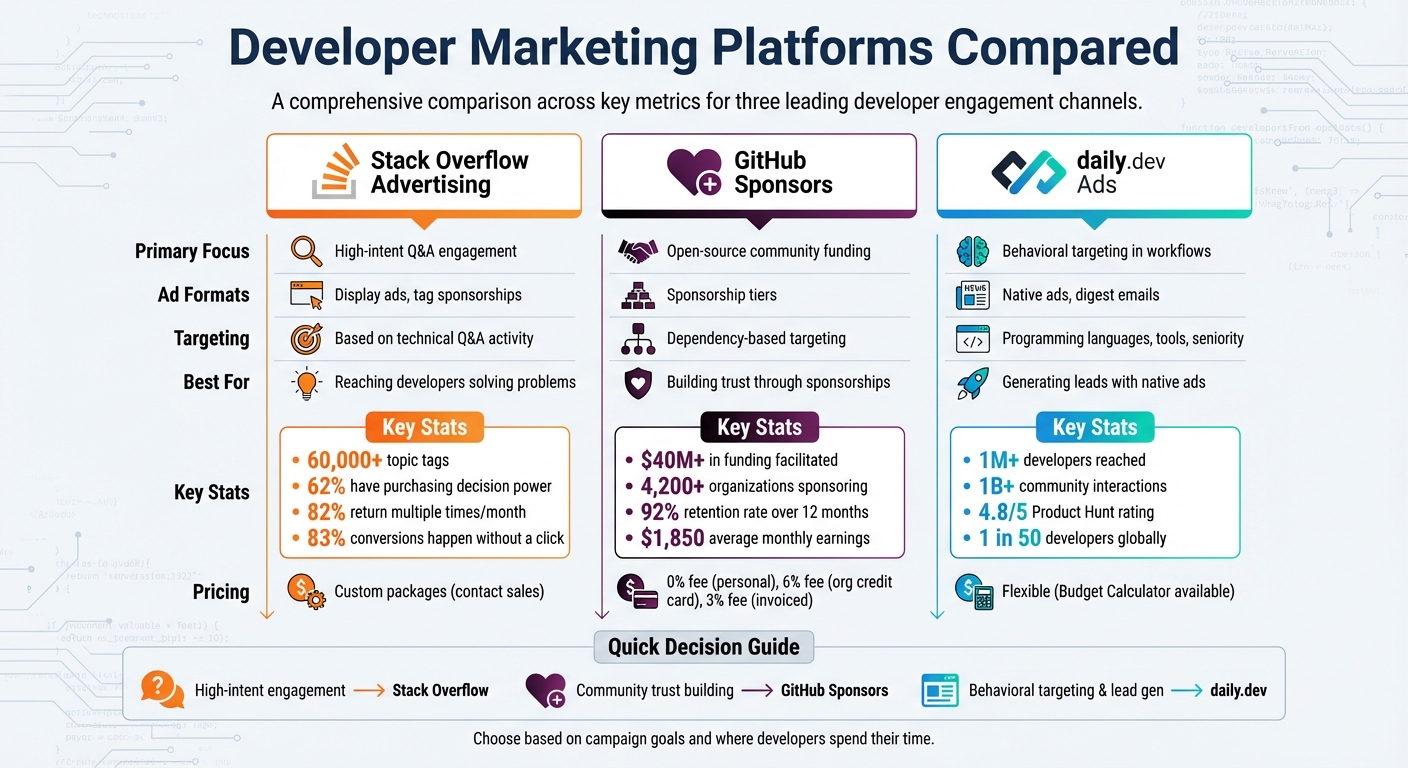 {Developer Marketing Platforms Comparison: Stack Overflow vs GitHub Sponsors vs daily.dev}
1. Stack Overflow Advertising
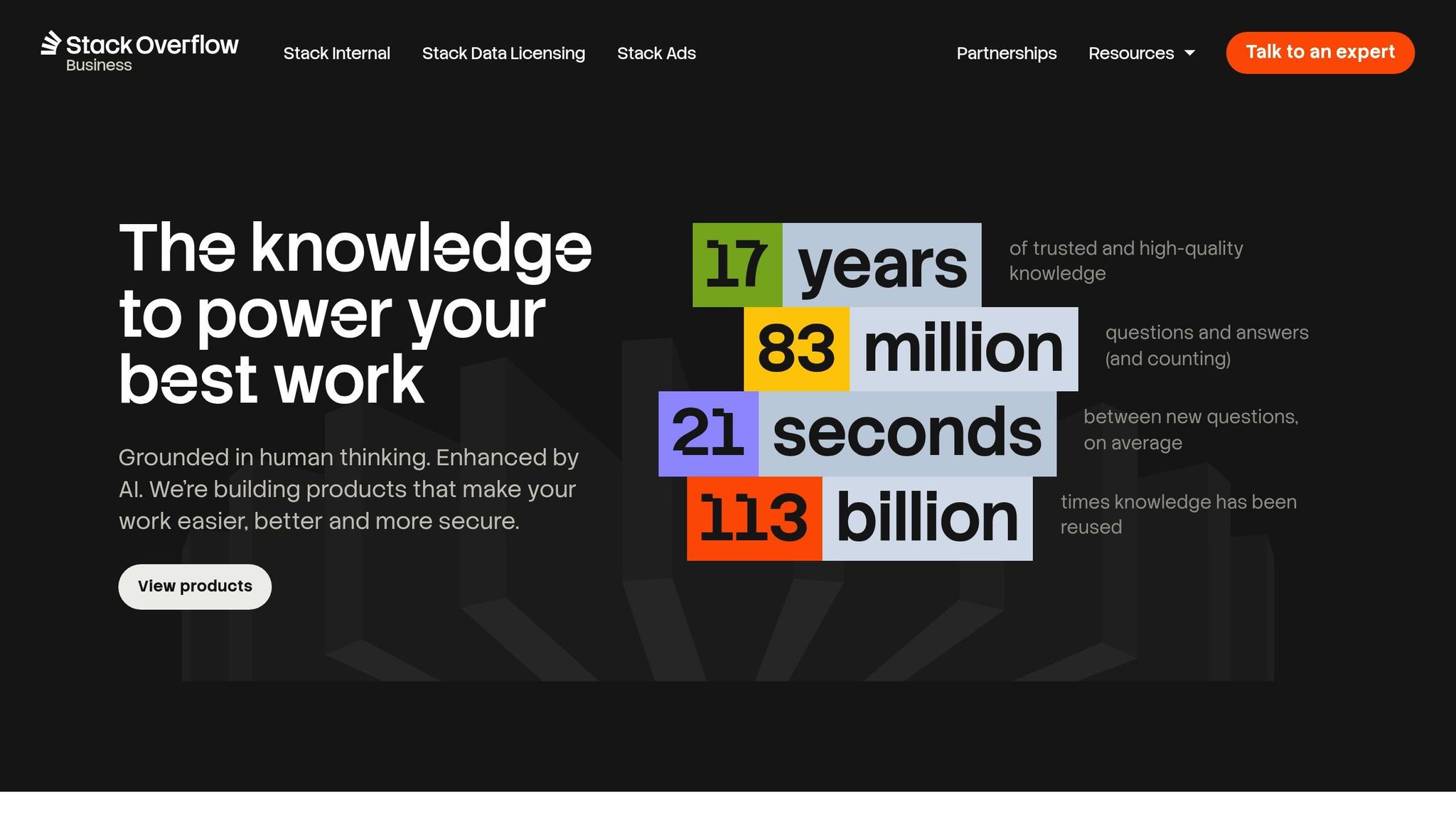
Stack Overflow’s advertising strategy focuses on precision, leveraging developer activities to target audiences effectively. With over 60,000 topic tags covering specific technical skills and technologies, advertisers can zero in on developers working with particular programming languages, frameworks, or tools . Campaigns can also be tailored based on user intent, professional roles, past behavior, and technology interests .
Targeting Capabilities
This layered targeting approach allows advertisers to connect with developers in highly specific scenarios - like a Python developer diving into machine learning or a front-end engineer exploring React. Why does this matter? Because 62% of developers on Stack Overflow have a direct say in technology purchasing decisions at their companies . Stack Overflow spans 183 distinct technical communities, each focused on unique challenges and interests . With 82% of developers returning to the platform multiple times a month, ads placed on Q&A pages reach users during active research and problem-solving moments .
To complement this precise targeting, Stack Overflow provides a variety of ad formats designed to engage developers at the right time.
Ad Formats and Features
Stack Overflow offers several advertising options to suit different campaign goals.
- Display and banner ads: Available via direct or programmatic deals, these are ideal for generating leads .
- Topic Tag Sponsorships: These secure a 50% share of voice on specific technical tags, ensuring your brand appears on highly relevant pages .
- Site Sponsorships: For broader exposure, these extend visibility across the entire Stack Exchange network .
The Direct to Developers format takes a native content syndication approach, distributing technical documentation, videos, and tutorials directly within a developer’s workflow . This ensures your content aligns with their specific questions at the exact moment they’re seeking solutions. Other options include Company Pages for employer branding, as well as sponsored placements in newsletters, blogs, and podcasts . Campaigns also come with dedicated support and detailed dashboards for tracking budgets and performance .
Pricing and ROI
Stack Overflow doesn’t list fixed pricing; instead, it offers custom packages tailored to your B2B marketing or employer branding needs . Programmatic guaranteed deals are available at premium rates, so contacting the sales team is essential to get a quote that matches your budget and objectives .
The platform’s pricing aligns with its observed conversion behaviors: 83% of conversions happen without a click, typically within 30 days . According to Stack Overflow’s internal data:
"Seeing an ad on Stack Overflow influences developers to search out more information on their own. On average, 83% of conversions from advertising on Stack Overflow happen without a click."
This trend reflects how developers often complete their immediate tasks before seeking additional details, making post-impression behavior critical. For marketers, shifting focus from click-through rates (CTR) to view-through conversions and monitoring user actions over a 30-day window is highly recommended . The Direct to Developers format, in particular, is highlighted as a cost-effective way to attract qualified traffic from developers actively searching for technical solutions .
2. GitHub Sponsors
GitHub Sponsors offers a fresh, community-driven approach to developer marketing. Instead of relying on traditional ads, it serves as a funding platform where companies and individuals can financially back the open-source developers and projects they depend on . This creates a unique way to engage with the developer community by investing in the tools and people that matter most.
Targeting Capabilities
GitHub Sponsors uses dependency-based targeting to connect organizations with the open-source projects they already rely on. With built-in discovery tools, companies can identify and support the maintainers of these critical dependencies directly . Instead of guessing who to reach, this approach ensures funds go to the developers whose work is already integrated into your systems. And with bulk sponsorship options, companies can support hundreds of projects at once via the GitHub Sponsors Explore page . Considering that 90% of companies use open-source software, this method aligns financial support with technical needs .
Currently, the platform operates in 103 regions worldwide and has facilitated over $40 million in funding for maintainers. More than 4,200 organizations are actively sponsoring projects . In 2022, organizational support accounted for 40% of all sponsorship funding, with such contributions being 15 times more valuable to maintainers than individual donations . This targeted funding approach is seamlessly integrated into GitHub Sponsors' ad formats, embedding sponsorship opportunities directly into the developer workflow.
Ad Formats and Features
GitHub Sponsors incorporates sponsorship options right into developers' daily workflows. Buttons for sponsorship appear on repository pages and developer profiles, resulting in an impressive 92% retention rate over 12 months among supporters - far outpacing traditional advertising channels . On average, developers earn $1,850 monthly on the platform, with individual supporters contributing an average of $19.47 each . This high retention rate reflects how sponsors prioritize funding essential infrastructure they rely on every day, fostering long-term engagement.
Organizations can also offer customizable sponsorship tiers with set monthly payments, typically ranging from $100 to $500 per month for corporate backers . Wolfgang Gehring, FOSS Ambassador at Mercedes-Benz, highlights the importance of this support:
"Crucial parts of the open source infrastructure are maintained by a few hardworking individuals that often do it for free... It should be in the interest of all of us that we can rely on foundational tools" .
Pricing and ROI
GitHub Sponsors keeps costs low for contributors. Personal accounts enjoy a 0% fee, while organization accounts incur a 6% fee for credit card payments (split between a 3% processing fee and a 3% GitHub service fee). Organizations paying via invoiced billing see this drop to just 3%, making it a cost-effective choice for large-scale sponsorships .
Rather than focusing on traditional metrics like clicks or impressions, the platform emphasizes community goodwill, increased visibility within developer circles, and the stability of essential open-source tools. Steve Ruiz, Founder of tldraw, explains the value of this approach:
"I might not have even tried to build a startup around tldraw without that validation - and I doubt it would have worked without the mix of individual and corporate sponsors backing up my pitch" .
With 92% of the audience consisting of developers or engineers and 75% aged between 25 and 44, sponsorships through GitHub Sponsors position brands directly in front of technical communities. This authentic investment strengthens engagement and trust within the developer ecosystem .
GitHub Sponsors stands out as a way to support open-source projects while building meaningful connections with the developer community.
3. daily.dev Ads
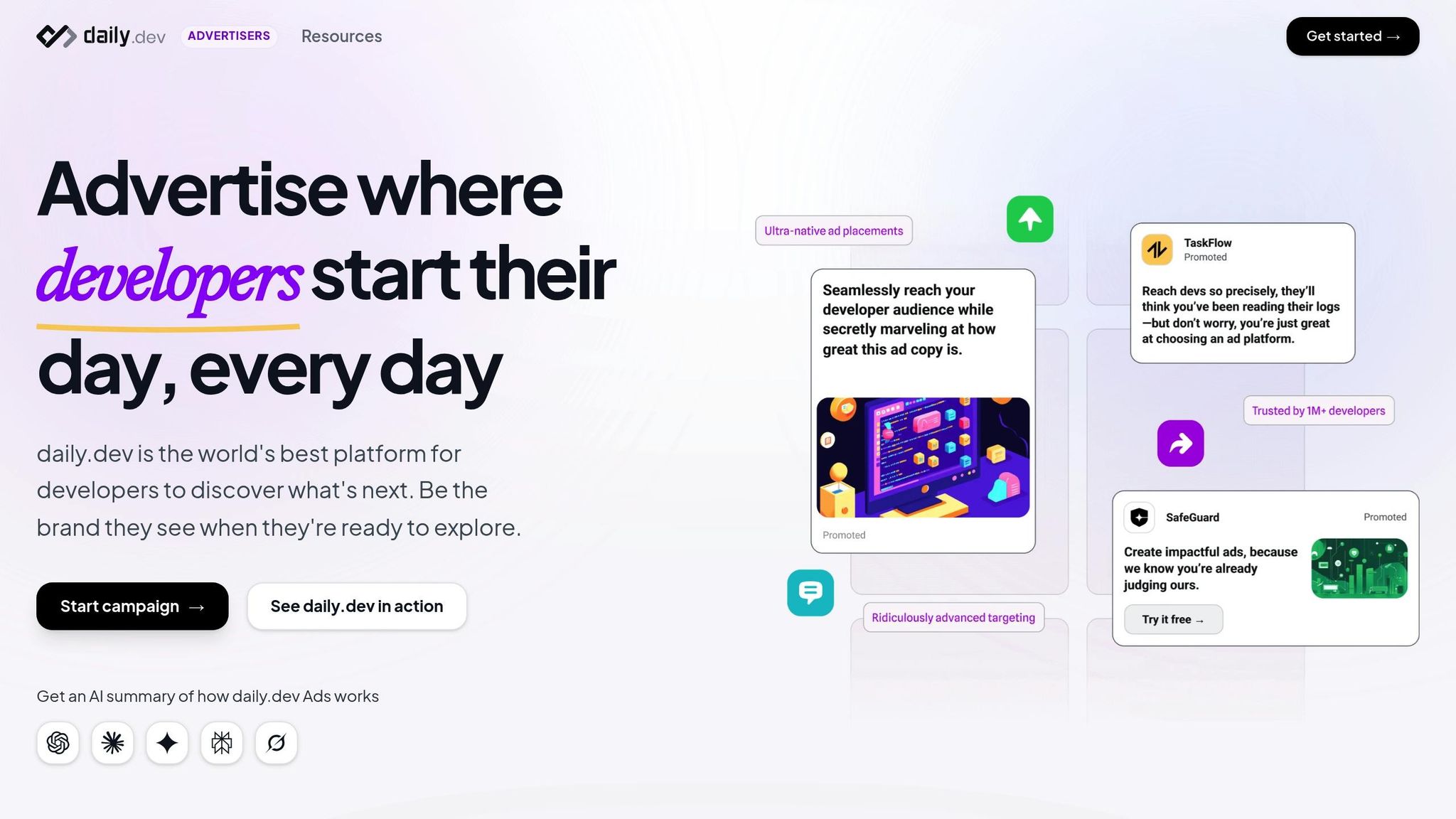
daily.dev Ads places advertising directly into the daily routines of over 1 million developers worldwide. By seamlessly integrating ads into personalized content feeds, developers encounter promotions while exploring tools, technical articles, and industry updates. With over 1 billion interactions in its community and a stellar 4.8/5 rating on Product Hunt, daily.dev has established itself as a trusted hub for developer-focused content. This trust creates an ideal environment for precise, behavior-driven ad targeting.
Targeting Capabilities
daily.dev Ads goes beyond basic demographics, offering advanced behavioral and technical targeting. Marketers can refine their audience based on programming languages like JavaScript, Python, Go, and Swift, as well as developer seniority levels, from beginners to seasoned engineers. Targeting even extends to the specific tools developers rely on, such as Docker, Kubernetes, Jenkins, Jupyter Notebook, and VS Code.
What sets this platform apart is its focus on timing. Ads are displayed when developers are actively engaging with related content, leveraging intent-based targeting. By analyzing tool usage patterns and content engagement, the platform ensures ads appear at moments when developers are most likely to be interested. To make planning easier, the Audience Targeting Planner helps map out segments by language and experience level before campaigns are launched.
Ad Formats and Features
daily.dev Ads prioritizes native ad formats that blend effortlessly into the developer feed. Ads are placed in three key spots: in-feed native ads, post page ads, and personalized digest emails. This approach minimizes ad fatigue by aligning promotions with the educational content developers are already consuming.
The platform also emphasizes technical clarity over flashy marketing. As Daphna Giniger from daily.dev explains:
"If marketing isn't anchored to fast, frictionless user wins, it's dead on arrival - no matter how creative the execution."
Successful campaigns often direct developers to high-value resources like live coding demos, interactive sandboxes, and technical guides. To optimize performance, the platform supports A/B testing for ad copy and creative elements, helping marketers refine their approach.
Pricing and ROI
Although specific CPM or CPC rates aren’t disclosed, daily.dev provides tools like the Developer Marketing Budget Calculator and Tech Campaign ROI Estimator. These resources help advertisers design campaigns based on budget, duration, and reach goals. The pricing model is flexible, catering to startups looking for growth as well as large enterprises aiming for sustained visibility.
The platform’s strength lies in its high-intent placements - targeting developers during moments of active discovery rather than passive browsing. With access to 1 in every 50 developers globally, daily.dev ensures meaningful exposure. Its credibility is further reinforced by 20,000 GitHub stars, 160,000 followers, and over 2,500 reviews. As the platform notes:
"daily.dev reaches developers while they actively discover tools and ideas, so your brand lands in a high-trust moment instead of a low-intent scroll."
Up next, we’ll delve into the broader pros and cons of this advertising approach.
sbb-itb-e54ba74
Advantages and Disadvantages
Here's a quick look at the key strengths and challenges of each platform, building on the detailed overviews provided earlier. Each platform brings something different to the table for developer marketing campaigns, so understanding these trade-offs can help you match your campaign goals with the right tools.
Stack Overflow Advertising shines when it comes to reaching developers in the middle of solving technical problems. Ads appear in high-intent moments, grabbing attention when engineers are actively searching for solutions.
GitHub Sponsors taps into the authenticity of the open-source community, offering a way for marketers to connect with developers in a way that aligns with community-driven values.
daily.dev Ads stands out with its behavioral targeting and native ad formats. These ads integrate naturally into the content developers are already consuming, showing up at the right time with the right message. Plus, daily.dev Ads offers advanced tools for planning and targeting.
Here’s a side-by-side comparison to highlight the major differences:
| Criteria | Stack Overflow Advertising | GitHub Sponsors | daily.dev Ads |
|---|---|---|---|
| Primary Strength | High-intent Q&A engagement | Community-driven reach | Behavioral targeting with data insights |
| Ad Format | Content-based placements | Sponsorships | Native ads (in-feed, post page, digest ads) |
| Targeting Approach | Based on technical Q&A engagement | Community and open-source driven | By programming language, experience, tools |
| Planning Tools | N/A | N/A | Budget Calculator, ROI Estimator, Audience Planner |
| Ideal Use Case | Reaching developers during problem-solving | Content distribution and developer relations | Driving demand with native ads |
| ROI Measurement | N/A | N/A | Transparent estimation with dedicated tools |
Each platform has its sweet spot. Whether you’re after instant conversions, long-term community engagement, or consistent visibility during developers' daily workflows, your choice will depend on your campaign's specific priorities.
Conclusion
Picking the right developer marketing platform starts with understanding your campaign goals and matching them to each platform's strengths. If your aim is to connect with developers during high-intent problem-solving moments, Stack Overflow Advertising positions your brand where engineers are actively searching for technical solutions. On the other hand, GitHub Sponsors is ideal for fostering community engagement and forming genuine connections within the open-source world.
For marketers focused on generating qualified leads through behavioral targeting, daily.dev Ads offers a sharp solution. Its ability to target developers based on programming language, experience level, or tool usage - combined with ad formats that seamlessly blend into developers' daily routines - makes it a powerful choice for precise outreach. These unique strengths highlight how each platform can play a specific role in a broader omni-channel strategy.
The growing reliance on omni-channel marketing reflects the increasingly fragmented habits of developers in 2026 . Successful campaigns now hinge on reaching developers across multiple touchpoints, tailored to where they spend their time and what they aim to achieve.
To get started, define your primary objective - whether it's building brand awareness, generating leads, or earning community trust. Then, choose the platform that aligns best with your goals. With a clear strategy and the right tools, you'll connect with developers at the moments when your message matters most.
FAQs
Which platform fits my goal best?
When deciding on the best platform for your campaign, it all comes down to your goals. If you're aiming to reach a specific developer audience, daily.dev Ads is a strong choice. It allows for native ads that can target developers based on programming language or seniority, though the minimum spend is $5,000.
On the other hand, if your focus is on fostering community connections or building trust, platforms like GitHub Sponsors and Stack Overflow are excellent options.
Ultimately, the right platform depends on whether your priority is precise targeting, engagement, or credibility. Matching your campaign's focus with the platform's strengths will help you get the best results.
How should I measure ROI beyond clicks?
To get a better sense of ROI beyond just clicks, it’s important to focus on metrics that reflect deeper developer engagement and impact. Look at API call frequency, documentation views, and GitHub activity - these can show how actively developers are interacting with your tools.
You should also monitor product usage metrics like SDK implementation rates, feature activation, and onboarding completion. These numbers give insight into how effectively your campaign encourages adoption and builds a growing community, offering a more complete picture of meaningful engagement and ROI.
Can I run these platforms together?
Yes, you can absolutely use these platforms together. In fact, many developer marketing strategies thrive by leveraging multiple channels to broaden their reach and boost engagement. For example, pairing daily.dev Ads with GitHub Sponsors allows you to connect with developers through both content feeds and sponsorship opportunities. By using multiple platforms, you create diverse touchpoints, enhance visibility, and adapt your messaging to align with what developers value most. Just make sure your messaging stays consistent across channels and keep a close eye on performance metrics to fine-tune your campaigns effectively.