

Developers are decision-makers in B2B SaaS purchases. They value technical accuracy, hands-on resources, and peer recommendations over flashy sales tactics. To market effectively to them, focus on practical, problem-solving content and community engagement.
Key insights:
- 60% of developers can approve or reject tools.
- 83% of developer conversions happen without direct clicks.
- 73% abandon products requiring sign-ups before testing.
What works:
- Content: Tutorials, API docs, and code samples that solve problems.
- Community: Participate in forums, sponsor hackathons, and contribute to open-source.
- Ads: Use developer-specific platforms like daily.dev for precise targeting.
Metrics to track: API usage, GitHub stars, documentation views, and retention rates. Developers take time to decide, so focus on long-term engagement over quick wins.
This article explains how to connect with developers by providing real solutions, building trust, and measuring meaningful results.
::: @figure 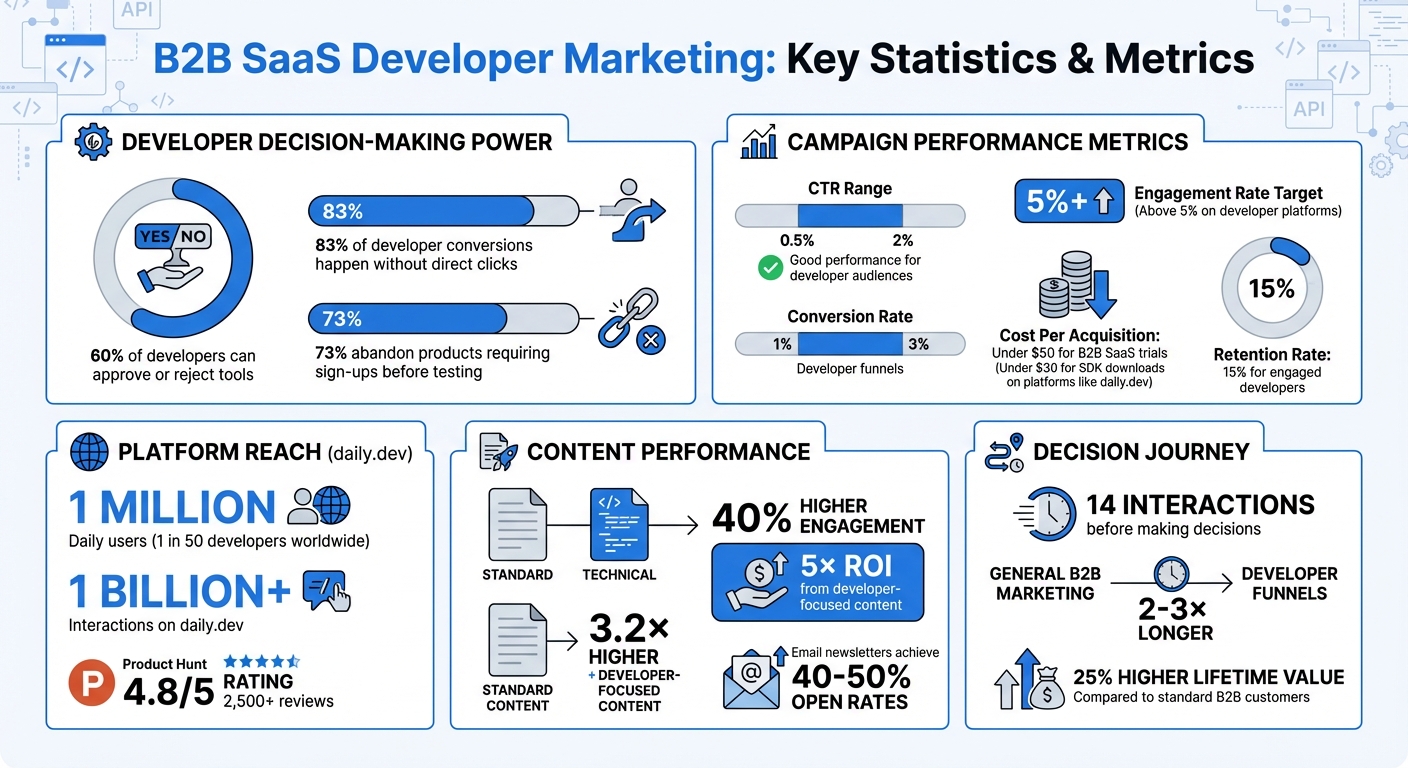 {Developer Marketing Statistics and Key Metrics for B2B SaaS}
Understanding Developer Audiences in B2B SaaS
Grasping the unique mindset of developers is key to creating marketing strategies that resonate in the B2B SaaS world. Unlike traditional B2B buyers, developers approach decisions as problem-solvers. They care less about flashy branding or sales pitches and more about whether a tool can solve specific technical problems. Their focus is squarely on technical merit, performance, and how well a product integrates with their existing workflows.
This audience leans heavily on peer validation and community feedback. GitHub stars, Stack Overflow threads, and trusted colleague recommendations often carry more weight than a vendor’s claims. Developers value authenticity above all else, as Upasana Sahu from SmartReach.io aptly puts it:
"Developers don't trust what you say; they evaluate what you prove" .
This makes elements like clear documentation, polished code samples, and top-notch APIs far more persuasive than traditional marketing efforts.
Developers also prefer hands-on testing over passive consumption of sales materials. They want to dive into APIs, explore sandboxes, and comb through documentation without barriers. In fact, 73% of developers will abandon a product if they have to sign up or register before testing it . Any friction in this evaluation process can mean losing their interest entirely.
Key Traits of Developers as a Target Audience
When targeting developers, technical accuracy and transparency are non-negotiable. They expect detailed documentation that includes language-specific SDKs, cURL examples, and exhaustive error codes. These resources are not just helpful - they’re benchmarks for a product's credibility and usability.
Developer Experience (DX) is another critical factor. From seamless onboarding to effective debugging tools, every interaction shapes their perception of a product. Developers favor self-service options, such as instant API access or sandbox environments, over gated content or mandatory sales calls. They evaluate tools based on whether they can enhance productivity, elevate their professional standing, or make their workflows more efficient.
Programmatic control is another priority. Developers gravitate toward API-first designs that allow for automation and customization, rather than being confined to graphical interfaces. They also appreciate radical transparency - whether it’s about a product’s limitations, performance trade-offs, or development roadmaps. As Upasana Sahu notes:
"Marketing to developers isn't about being louder, it's about being useful" .
While these characteristics make developers thorough evaluators, they also present unique hurdles for marketers.
Challenges in Reaching Developer Audiences
One of the biggest hurdles in marketing to developers is their skepticism. They are quick to dismiss anything that feels disingenuous or overly promotional, making authenticity and technical depth essential.
Developers also tend to avoid traditional advertising channels. Instead, they discover tools and solutions while troubleshooting specific problems or conducting targeted searches. This means that marketing efforts need to align with their discovery habits, focusing on educational and problem-solving content that surfaces when they need it most.
Finally, tracking conversions and attributing success can be tough. Developers often engage with content across multiple platforms over an extended period before taking action. Instead of focusing solely on immediate sign-ups, marketers should prioritize long-term engagement metrics like documentation views, SDK downloads, or participation in community forums. Adapting to these challenges can help craft strategies that genuinely connect with developer audiences.
sbb-itb-e54ba74
Core Developer Marketing Strategies
Developer marketing requires a unique approach. It's all about meeting developers where they are - offering technical depth, fostering independence, and proving value through practical, actionable solutions rather than lofty claims.
Creating Value-Driven Content
At the heart of developer marketing is technical content that solves real-world problems. This includes detailed tutorials, API documentation, code examples, and guides that developers can immediately put to use. The focus here isn’t on hyping up features; it’s about showing how your product fits seamlessly into existing workflows, cutting down friction and making life easier for developers.
One effective tactic is documentation-led funnels. Instead of hiding valuable resources behind forms or pushing for sales calls, this approach uses technical documentation as the main conversion tool. It aligns with developers’ preference for self-service, allowing them to evaluate solutions independently.
But the content must be technically accurate to earn trust. For example, when Kalungi partnered with CPGvision, they built a documentation-first strategy that focused on technical SEO and addressed developer pain points. The result? A 533% boost in SEO performance and $4.7M in pipeline growth . The takeaway: create content that developers genuinely need, not just content designed to rank for broad keywords.
When done right, such content lays the groundwork for trust and credibility among technical audiences.
Building Trust Through Community Engagement
Developers tend to trust their peers far more than they trust vendors. That’s why active participation in developer communities is such a powerful strategy. Sponsoring hackathons, contributing to open-source projects, or engaging in forums like Stack Overflow or GitHub shows that your company is invested in the ecosystem - not just in selling software.
By joining these conversations, answering questions, and hosting meetups, you position your company as a peer rather than an outsider. This kind of peer validation is far more persuasive than any ad or sales pitch.
Though community engagement takes time to yield results, the benefits are long-lasting. For instance, Kalungi’s work with Beezy focused on community visibility and organic growth. This approach led to a 63% increase in organic traffic and $2M in qualified pipeline, while also establishing a reputation for credibility .
Using Developer-Focused Advertising Platforms
While organic strategies are essential, targeted advertising on developer-specific platforms can amplify your reach. Traditional advertising channels, like broad Google Ads campaigns, often fall flat with developers - they lack the technical nuance and feel disconnected from their daily work.
Developer-focused platforms, on the other hand, are designed to reach technical audiences where they’re already active - whether they’re researching tools, exploring solutions, or catching up on industry trends. For B2B SaaS companies, these platforms allow for precise targeting based on programming languages, technical skills, or professional interests, delivering better results than generic campaigns .
The key to effective advertising for developers is to keep it simple and informative. Ads should point directly to technical resources like documentation, quick-start guides, or sandbox environments - avoiding flashy designs or sales-heavy pages. This respects the way developers evaluate tools and helps them make well-informed decisions.
Key Developer Advertising Channels
To connect with developers effectively, you need to meet them where they already spend their time - platforms and spaces integral to their workflow. These channels let you engage developers on their terms, ensuring your approach aligns with their technical needs and interests.
daily.dev Ads for Targeted Developer Reach
daily.dev is a news aggregator tailored for developers, boasting over 1 million daily users and reaching 1 in 50 developers worldwide. With over 1 billion interactions driven by real user behavior, it offers a high-intent audience - developers actively seeking new tools and solutions, not just casually browsing .
The platform uses native ad placements that seamlessly blend into content feeds, post pages, and email digests. This integration aligns with a developer's workflow, making ads feel less intrusive. As Nimrod Kramer explains:
"Most advertising platforms rely heavily on SEO-driven traffic... That's not discovery behavior, it's transactional. They're in a task-focused mindset, not a browsing one" .
daily.dev excels at capturing developers in a discovery mindset, making it perfect for campaigns focused on product adoption. You can target ads based on seniority, programming languages, or specific tools like Docker and Kubernetes. For instance, Netlify's campaign on daily.dev resulted in 5,000 sign-ups at a $2 cost per click, showcasing a strong return on investment .
The platform's credibility is further reinforced by its 4.8/5 rating on Product Hunt, over 2,500 reviews, and recognition as Product of the Year .
While dedicated platforms like daily.dev are invaluable, developers also engage deeply on broader social media and forum-based communities.
Social Media and Developer Forums
Developers are highly active on platforms like Twitter (now X), Reddit, and Stack Overflow, using them for real-time discussions, community problem-solving, and technical debates. Success on these platforms requires a value-first approach - offering helpful, relevant content rather than pushing direct promotions.
On Twitter, hashtags like #DevOps or #JavaScript are hubs for developer conversations. For example, Vercel's Twitter threads on optimizing Next.js attracted over 10,000 engagements by focusing on practical advice instead of overt sales messaging. Similarly, Reddit can be a goldmine for reaching niche audiences. Sponsored posts in subreddits like r/programming or r/MachineLearning perform well when they genuinely address community needs. GitHub's Reddit campaigns, for example, achieved a 20% traffic increase by prioritizing community-driven content.
Another standout example is HashiCorp's Reddit AMAs (Ask Me Anything) on Terraform. These sessions helped the company earn 50,000 GitHub stars, positioning them as contributors to the community rather than as vendors. The key takeaway? Developers value authenticity. Engage in discussions, answer technical questions, and contribute to open-source projects before introducing your product.
To complement these efforts, targeted email campaigns can further nurture your connection with developers.
Email Campaigns and Newsletters
Email marketing remains surprisingly effective for reaching developers, with newsletters often achieving open rates of 40–50%. The secret lies in relevance and personalization.
Segment your email lists by tech stack and use case to ensure your messaging resonates. For example, emails about API tools can be sent to Node.js users, while React developers receive tips on build optimization. PostHog's newsletter series is a great example - it achieved a 25% trial sign-up rate by sharing open-source analytics code and practical guides, avoiding generic product pitches.
The best-performing emails include code snippets, technical deep-dives, and actionable use cases. Subject lines like "Boost your React builds by 30%" outperform vague messaging because they promise specific, measurable benefits. Tools like ConvertKit and Dev.to newsletters are particularly effective for drip campaigns, focusing on education first and conversion second. Regular A/B testing of subject lines, content formats, and call-to-action placement can help refine your approach.
Measuring Success in Developer Marketing Campaigns
Once you've nailed down effective strategies and chosen the right advertising channels, the next step is measuring how well your campaigns are performing. This isn't just about tracking numbers - it's about understanding what works and refining your approach. For developer-focused campaigns, the emphasis should be on quality engagement rather than sheer volume. Developers value technical depth, so your metrics need to reflect that, helping you optimize campaigns in real time.
Key Metrics for Developer Campaigns
Start with click-through rates (CTR). For developer audiences, a good CTR ranges from 0.5% to 2%, due to their selective nature. For instance, Stripe achieved a 1.8% CTR with API-focused ads. Interestingly, targeting specific tech stacks - like React developers using JavaScript-heavy content - can increase CTR by up to 1.5 times compared to broader campaigns.
Technical content resonates more with developers, driving 40% higher engagement compared to standard materials. Examples like GitHub's newsletter campaigns, which used repository forks as a proxy for conversions, reached an impressive 12% engagement rate. On developer platforms, aim for engagement rates above 5%, keeping in mind that developers often need around 14 interactions before making decisions.
When it comes to conversions, developer funnels usually see rates of 1% to 3%. While their decision-making process can take 2–3 times longer than in general B2B marketing, the payoff is often worth it, with up to 25% higher lifetime value. Stripe’s API campaigns, for example, achieved a 2.7% conversion rate, fueling significant adoption. Keep your cost per acquisition (CPA) in check - under $50 for B2B SaaS trials is a good benchmark. Platforms like daily.dev Ads report CPAs under $30 for SDK downloads, with engaged developers showing a 15% retention rate.
Don’t forget to track developer-specific KPIs, such as API usage, GitHub stars, documentation views, and developer Net Promoter Scores (NPS). Developer-focused content can lead to conversion rates 3.2 times higher and deliver a 5× return on investment.
Using Real-Time Analytics
Real-time analytics are your secret weapon for campaign management. Platforms like daily.dev Ads provide live dashboards that track impressions, CTR, and geo-specific engagement. This allows you to quickly tweak underperforming ads - sometimes within hours. For example, data showing that 70% of React developers respond to JavaScript ads can help you shift budgets toward these high-performing segments.
One B2B SaaS campaign used real-time metrics to identify peak engagement hours - weekdays between 9 AM and 5 PM UTC - and increased conversions by 35% by reallocating budgets during those windows. Testing ad creatives, such as comparing API documentation against product demos, can yield performance boosts of 20–30% in just 24 hours.
To get a full picture, combine data from multiple tools. Use Google Analytics 4 for tracking events like code snippet views, Mixpanel for analyzing trial sign-ups, and Amplitude for monitoring retention rates. Vercel experts suggest correlating these insights with downstream metrics - like targeting 10% of engaged users to drive actual API calls. Tools like Segment can unify this data, speeding up iteration cycles by about 40%.
Iterating and Optimizing Campaigns
Campaign optimization is an ongoing process. Use real-time insights to guide weekly reviews. Look for anomalies, such as a CTR drop of more than 20%, and analyze performance by channel and audience. For example, compare how Node.js developers on daily.dev respond versus Python developers on Reddit. A/B testing can also reveal what resonates - subject lines with specific promises like “5× faster builds” often outperform vague ones.
Case studies highlight the value of fine-tuning. PostHog boosted its CTR from 0.8% to 2.1% by tailoring campaigns to developer stack preferences, leading to a 28% increase in conversions. Twilio optimized forum ads, achieving a 40% retention improvement and generating $2.5 million in annual recurring revenue (ARR) from developer-focused efforts.
Avoid getting distracted by vanity metrics like impressions, which can waste up to 60% of your ad spend. If engagement is high but conversions lag, revisit your landing pages - adding SDK trials or interactive demos can make a difference. Automating performance alerts (e.g., notifications when CTR drops below 1%) has been shown to improve ROI by 25%. Reallocating budgets from low-performing channels to top performers every two weeks can drive 15–25% gains in key metrics.
Think of analytics as a feedback loop. Developers often spend considerable time researching before integrating a product, so tracking their entire journey - from the first ad click to API integration - is critical. This approach ensures you’re building genuine product adoption, not just chasing surface-level engagement.
Conclusion and Key Takeaways
Reaching developers in the B2B SaaS space requires a tailored strategy. Developers value technical credibility, hands-on tools, and peer recommendations far more than flashy sales pitches. They’re most receptive when actively searching for solutions, not during casual browsing. This means your campaigns need to align with their workflow, providing immediate, technical resources rather than relying on gated content. This approach helps create opportunities for adoption and retention.
Take a hard look at your current strategy and compare it to how developers behave. As discussed earlier, success comes from value-first content and community involvement. Focus on creating tutorials, API documentation, and guides that solve real problems. Build trust by engaging in forums or contributing to GitHub. Tools like daily.dev Ads allow for precise targeting, offering better results than broad, impression-focused ad networks.
Keep an eye on key metrics like developer sign-ups, API usage, GitHub stars, and retention rates. Use real-time analytics to adapt quickly, reallocating resources to the most effective areas and improving conversions.
Stripe is a great example of how this works in practice. They’ve achieved massive adoption by combining detailed documentation, community-driven events, and targeted advertising to fuel developer-led growth .
FAQs
What developer marketing services drive B2B SaaS adoption?
Building trust and showcasing technical value are at the heart of developer marketing services aimed at boosting B2B SaaS adoption. The key is to meet developers on their terms and in their spaces. This often involves:
- Clear and accessible documentation: Think API guides that are easy to follow and help developers get started quickly.
- Hands-on experiences: Offering free trials or sandbox environments allows developers to explore and test your product in real-world scenarios.
- Educational content: Case studies, tutorials, and how-to guides provide practical insights and demonstrate the value of your solution.
Connecting with developers also means engaging with their communities. Platforms like daily.dev Ads help create authentic connections by targeting the spaces where developers already spend time. This kind of tailored outreach not only increases visibility but also builds trust, paving the way for stronger adoption rates.
How do I reduce friction before a developer tries my product?
To make things easier for developers, focus on offering clear, self-serve resources. This includes detailed documentation, accessible APIs, and interactive demos that allow them to explore your product on their own terms. Pair this with targeted content like step-by-step tutorials and real-world case studies to establish trust and show how your product delivers results.
Another key step? Build a sense of community. Encourage engagement through forums or events, and provide free trials or demos to minimize any hesitation. The goal is simple: ensure your resources are easy to access and thorough enough to make the evaluation process feel effortless.
Which metrics prove developer marketing is working long-term?
Long-term success in developer marketing can be measured through metrics that highlight sustained engagement and product adoption. Key indicators include API call frequency, documentation views, SDK implementation rates, feature activation, and onboarding completion. These metrics provide a clear picture of how consistently developers interact with and rely on your product.
Other valuable signs of success include community growth - evidenced by active participation in forums, contributions to open-source projects, and peer recommendations. Additionally, metrics like technical adoption and revenue impact reflect deeper trust and loyalty, going beyond fleeting interest to demonstrate a lasting commitment to your platform.