

Marketing developer tools on a tight budget is possible if you focus on what works: building trust, engaging communities, and showing value upfront. Traditional ads can cost thousands per customer, but startups can achieve growth through smarter, cost-effective strategies.
Key Takeaways:
- Developers prefer trust over flashy ads. Small teams can win by offering clear documentation, free tiers, and active community involvement.
- Free strategies deliver high returns. Open source projects, GitHub engagement, and participating in forums like Stack Overflow or Reddit build credibility.
- Content drives growth. Write technical blog posts, optimize documentation, and repurpose content across platforms for better reach.
- Small budgets can go far. A $1,000 campaign on developer-focused platforms like daily.dev can generate meaningful leads. With $5,000, you can expand reach and test multiple channels.
- Community is key. Start engaging developers early to lower acquisition costs and create loyal advocates for your product.
Bottom line: Developers value tools that solve their problems without aggressive sales tactics. Focus on clear communication, helpful resources, and community-led growth to make every dollar count.
Why Developers Trust Small Teams
Developers have a knack for spotting anything that feels insincere. That’s why they often place more trust in small, agile teams than in larger corporations with hefty marketing budgets. For them, it’s all about technical merit and practical value - not flashy sales pitches. Small teams naturally excel here, as they tend to highlight their product’s functionality and real-world benefits.
Big companies, on the other hand, can create barriers that frustrate developers. Things like locking documentation, APIs, or free tiers behind sales calls or demos can feel like unnecessary hoops to jump through. Developers prefer hands-on exploration - the freedom to dive in, experiment, and learn on their own terms. When a smaller team offers clear documentation, a sandbox environment, or a generous free tier, it shows respect for the developer's time and independence.
Communication is another area where small teams shine. Instead of pushing hard for sales, they focus on helping developers solve problems. You’ll often find them actively participating in communities like GitHub, Stack Overflow, or daily.dev, where they share knowledge and genuinely engage with peers. These interactions feel real because, more often than not, developers are speaking with someone who actually works on the product - not someone reciting a script.
This shift toward community-led trust has changed how developers make decisions. They now rely more on peer recommendations, open-source contributions, and discussions in developer forums. Metrics like GitHub stars, API success rates, and community engagement carry more weight than traditional marketing numbers. Small teams that grasp this dynamic can use their size to their advantage, connecting with developers in a way that feels personal and technically meaningful.
In fact, limited resources can work in their favor. By focusing on solving genuine problems with clean code and straightforward communication, small teams earn a level of respect that no amount of advertising can buy. Developers value authenticity over polish, and that’s where small, focused teams can truly stand out.
sbb-itb-e54ba74
Free Marketing Channels for Developers
When budgets are tight, free marketing channels can become the backbone of growth strategies. For developer tools, open source has proven to be a standout way to establish both brand recognition and trust on a large scale.
Using Open Source to Build Credibility
"Brand is the only moat. When anyone can build anything, the winner is whoever people trust. Open source builds trust faster than any marketing campaign."
- IndieRadar Team
In many cases, your GitHub repository doubles as your landing page. Developers often gauge your project's credibility by looking at star counts, recent activity, and how issues are handled. A well-timed launch on Hacker News can bring in 5,000–15,000 views and hundreds of GitHub stars in just a few hours. This momentum is further fueled by GitHub’s trending algorithm, which prioritizes "star velocity" - the number of stars gained within a short 24–48 hour window .
To make your repository shine, optimize your README file. Include a concise one-line description, a demo GIF, clear positioning (e.g., "alternative to [Competitor]"), and simple installation instructions. Providing a prebuilt Docker image can also simplify self-hosting for users. By adopting an "Open Core" model, you can offer a free version for individual developers while monetizing enterprise features like support, security, and compliance. Smaller companies might spend $500–$2,000 monthly, while larger enterprises could sign contracts worth $50,000 annually .
"Think of open source as the ultimate freemium tier. Users self-host on their own machines. You pay nothing for their usage. And in exchange, they become your marketing army."
- IndieRadar Team
Encouraging contributions is another way to build momentum. Labeling issues with tags like "good first issue" and providing clear contribution guidelines can make it easier for newcomers to get involved. In an era where AI makes code replication simple, fostering an active and engaged community can become a key differentiator. From there, focus on turning casual users into loyal advocates by actively engaging with developer communities.
Engaging in Developer Communities
Beyond maintaining your code repository, interacting with developer communities helps solidify your reputation. These communities are where authentic conversations happen. Platforms like GitHub Discussions, Stack Overflow, Reddit’s r/selfhosted, and daily.dev are excellent spaces to connect. By offering helpful insights - even on topics unrelated to your product - you can build goodwill. If you do mention your tool, explain how it solves a particular problem and share links to documentation or code examples.
Consistency across multiple platforms is key. Participate in GitHub Discussions, Stack Overflow, Reddit, Dev.to, Lemmy, Discord, and Slack to expand your reach. Thoughtful engagement not only builds credibility but also fosters valuable relationships with developers who could become advocates for your product.
Launching on Show HN and Similar Platforms
Once you've established trust through open source and community engagement, platforms like Hacker News can help amplify your reach. The Show HN section is especially effective for introducing developer tools, often driving thousands of highly engaged users to your product in a single day . To make the most of this opportunity, craft a post that clearly explains what your product does and highlights its unique benefits.
Engaging with feedback is just as important as the launch itself. Transparent and responsive interactions go a long way in building trust. To maximize impact, coordinate your launch with posts on other platforms like Reddit (r/selfhosted), Dev.to, and social media. This can boost traffic quickly and improve your chances of appearing on GitHub’s trending page .
Content Marketing with Zero Budget
Content marketing is a powerful way to establish credibility for your developer marketing startup, especially when you're working with no budget. Unlike paid ads, which provide linear growth, content marketing offers the potential for exponential returns. For example, a company generating 12,000 organic visitors per month would need to spend roughly $24,000 on ads to achieve the same traffic numbers .
Writing Technical Blog Posts
Developers tend to trust content written by founders over polished material produced by agencies. Sharing how you solved specific problems resonates far more than generic "how-to" guides. A great strategy is to focus on writing the content you wish you had when facing technical challenges. Use real-world language from support tickets or customer conversations to align with actual search intent .
Many bootstrapped startups start seeing their first organic leads within 4–6 weeks of consistent content creation and community engagement . That said, it usually takes at least 12 months of sustained effort in content marketing to see meaningful, compounding results . Early on, prioritize bottom-of-the-funnel content - such as case studies, product demos, and technical FAQs - as these are more likely to convert leads than broad awareness pieces. Repurpose each post across different channels to maximize its reach.
"Early-stage, especially bootstrapped, startups should just focus on bottom-of-the-funnel pieces, just because it's so much easier to see the benefit and business impact of those."
- Craig Hewitt, Founder, Castos
To make the most of your efforts, follow the 50/50 rule: spend half your time creating high-quality content and the other half promoting it. This could include writing guest posts, participating in community forums, and sharing on social media .
Turning Documentation into Marketing
For developer-focused products, documentation often serves as the first meaningful interaction users have with your tool . Beyond being a product resource, it can also attract search traffic by addressing specific errors or challenges developers face. According to research from SlashData, poor or unclear documentation is one of the main reasons developers abandon tools during their evaluation process, even when the technology itself is solid .
"Documentation is not just a supporting artifact but a marketing tool in its own right. It communicates product value, builds trust at the moment of highest intent, and plays a direct role in adoption."
- Onyeanuna Prince, Technical Writer and DevOps Engineer
Always launch with complete, high-quality documentation - it’s not something to leave for later. Make it easy to find by optimizing for SEO, ensuring smooth navigation, and providing fast search functionality . Link your marketing pages directly to relevant sections of your documentation to create a seamless experience. Additionally, you can repurpose well-written documentation into blog posts, white papers, or tutorials to attract more organic traffic .
This approach naturally opens the door to live presentations as another way to extend your content marketing efforts.
Speaking at Conferences and Meetups
Once you’ve laid the groundwork with written content and documentation, live events can help humanize your brand even further. Speaking at conferences or meetups is a great way to showcase your expertise. Many smaller conferences and local meetups offer free speaking slots, particularly for technical presentations that address real-world problems. Focus on sharing your experiences and solutions instead of directly pitching your product.
The founder's personal voice is especially impactful. Early-stage customers often choose to work with people who truly understand their challenges, rather than relying solely on a brand . Documenting your journey through blog posts and talks - often referred to as "building in public" - is an effective, zero-cost way to attract early adopters who appreciate transparency .
When planning talks, target long-tail keywords in your titles and related blog posts. These keywords often address specific technical challenges and are easier to rank for than broader, more competitive terms . Record your presentations and repurpose them into YouTube videos, blog content, or social media posts to reach a wider audience beyond the event itself.
Where to Spend Your First $1K-$5K
::: @figure 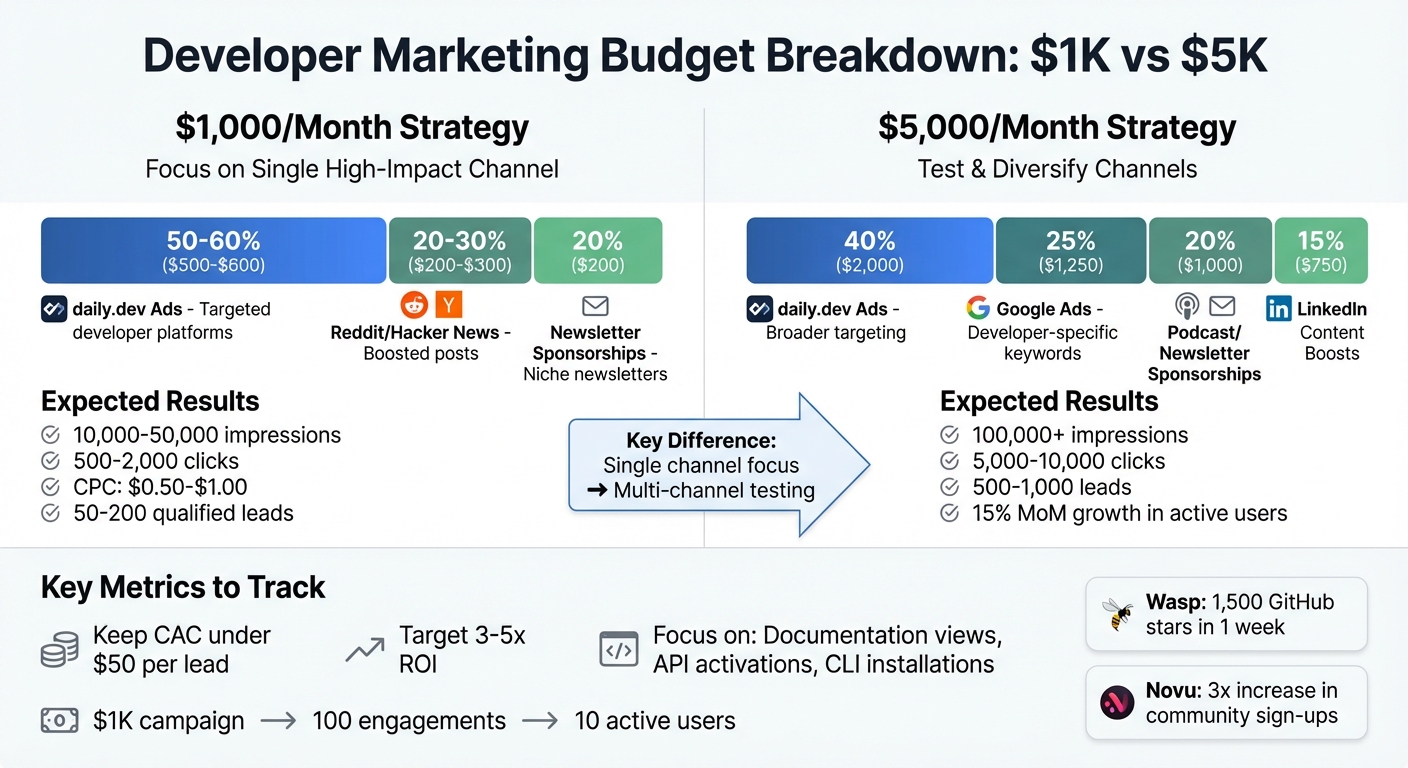 {Developer Marketing Budget Allocation Guide: $1K vs $5K Monthly Spend}
Once you've made the most of free tactics, it's time to allocate your first budget wisely to engage developers effectively. The key is to invest where developers already spend their time.
Budget Breakdown: $1K vs. $5K
If you’re working with $1,000, focus on a single high-impact channel. Allocate $500–$600 (50–60%) to targeted developer platforms like daily.dev Ads, which let you reach developers based on their tech stack and interests. Use $200–$300 (20–30%) to boost posts on Reddit communities like r/programming or Hacker News. Save the remaining $200 (20%) for small sponsorships in niche newsletters . This approach can result in 10,000–50,000 impressions, 500–2,000 clicks (at a cost-per-click of $0.50–$1.00), and 50–200 qualified leads .
With $5,000, you can test and diversify. Spend $2,000 (40%) on daily.dev Ads for broader targeting, $1,250 (25%) on Google Ads focusing on developer-specific keywords like "devtool marketing on a budget", $1,000 (20%) on sponsorships in developer podcasts or newsletters, and $750 (15%) on amplifying content through LinkedIn boosts . This expanded plan can deliver 100,000+ impressions, 5,000–10,000 clicks, and 500–1,000 leads. Some tech startups have reported achieving 15% month-over-month growth in active users with this approach . These allocations also offer clear benchmarks to measure your campaign’s effectiveness.
In October 2023, Wasp, an open-source web framework, demonstrated how to make a small budget work. They combined a "Launch Week" strategy with targeted promotion on developer platforms, focusing on driving traffic to their GitHub repository and sharing detailed technical content. This effort earned them over 1,500 GitHub stars in just one week and the #1 spot on Hacker News. Co-founder Martin Šošić led the campaign, emphasizing practical, developer-focused content over traditional sales messaging.
Expected Returns from Small Budgets
When working with limited funds, focus on metrics that reflect genuine developer engagement. For instance, track documentation views, API key activations, CLI tool installations, or the time it takes a developer to complete their first API call after clicking your ad. A $1,000 campaign that brings in 50 engaged developers is far more impactful than spending $5,000 to generate 500 low-intent sign-ups.
In early 2024, Novu, an open-source notification infrastructure, showcased the power of targeted spending. They focused their budget on native ads and community-driven growth by promoting their "Notification Directory", a free resource. This strategy resulted in a 3x increase in community sign-ups compared to previous campaigns with broader targeting. The campaign, spearheaded by their Head of Developer Relations, Nevo David, highlights the value of aligning marketing efforts with developer needs.
To maximize your impact, add UTM parameters to all links and set up tracking pixels early on to build retargeting audiences . Keep your customer acquisition cost (CAC) under $50 per lead, and aim for a 3–5x ROI. For example, a $1,000 campaign should generate at least 100 meaningful engagements, leading to 10 active users .
Building Your Developer Audience Early
Start building your developer community before you think you need it. Waiting too long can mean a sluggish start, and developers tend to gravitate toward tools with active, problem-solving communities already in place. Taking this early initiative pairs well with other free marketing efforts, boosting your tool's credibility from the beginning.
Engaging with developers early on also feeds into a broader developer marketing strategy. Why? Because community-led growth is far more cost-efficient than traditional marketing methods for developer-focused tools. For instance, creating and nurturing a Discord community can cost just $7–$60 per customer acquisition, compared to the hefty $1,000–$7,500 spent on Google Ads .
"Community isn't just cheaper than marketing. It's better. It scales differently. It creates loyalty that marketing never could." – Chris Kernaghan, Owner of We Are Founders
To get started, aim to bring in your first 100 members. Reach out to developers who've already shown interest in your tool - those who’ve starred your GitHub repo, joined relevant forums, or engaged with your technical content. As a founder, commit to being hands-on during the first three months. Respond to questions quickly, celebrate user milestones, and foster trust in ways that targeted advertising simply can't replicate .
Organize your community with purpose. Create focused channels, such as #showcase for sharing projects, #help for troubleshooting, or #hackathons for collaborative challenges. Aim for community health metrics like 20–40% daily active users and 60–80% of queries answered by members themselves. These numbers signal a thriving, self-sustaining community that won’t drain your resources .
Building your audience early doesn’t just nurture loyalty - it also slashes future marketing costs. For devtool startups working with tight budgets, this approach is a game-changer.
When to Hire Your First Developer Marketer
The right time to bring on a dedicated marketer is when you're transitioning from building to scaling, not when growth has already stalled. If you've secured initial traction, have early adopters actively using your product, and organic growth is starting to plateau, it's time to act. If your technical team is too busy juggling engineering tasks, bug fixes, and customer support to focus on a go-to-market strategy, that's another clear sign it's time to hire . This step aligns with the goal of scaling your community engagement after achieving early momentum.
Key indicators include relying on a "build it and they will come" mindset, having a small but engaged user base that needs nurturing, or lacking a clear product position in the market . As DigitalOcean explains:
"In a tech landscape that's crowded with thousands of apps and the latest tech solutions, the concept of 'build it and they will come' is a fallacy" .
As you move from DIY marketing efforts to a more structured growth approach, the need for a dedicated marketer becomes obvious. For your first hire, look for a T-shaped marketer - someone with a deep specialty in one area (like content or community building) but broad skills across social media, strategy, and analytics. They should also have a knack for copywriting and funnel strategy . While a computer science degree isn't necessary, technical curiosity is a must. The ideal candidate understands that developers respond to education and enablement, not aggressive sales tactics . Resourcefulness is another critical trait - your first marketer should know how to stretch a limited budget effectively.
Consider these options when making your first hire:
- Content Marketer: Best for building long-term trust and SEO.
- Growth Marketer: Ideal for testing and identifying effective channels.
- Community Marketer: Perfect if you already have enthusiastic early adopters who can help spread the word.
Avoid hiring performance or brand marketers at this stage. These roles typically require large advertising budgets and are more effective after you’ve achieved product-market fit .
Before expanding your team, ensure you have strong foundational resources in place. This includes comprehensive documentation, freemium or sandbox access, and basic user support . Instead of turning to costly recruiters, leverage employee referrals, customer newsletters, or niche communities like Reforge or Superpath to find candidates. To evaluate technical marketing skills, consider a short paid project (under three hours) before extending an offer .
Growing Your Marketing as You Scale
Bootstrapped vs. Funded Marketing Tactics
Switching from a bootstrapped approach to a funded one can completely reshape your developer marketing strategy. Bootstrapped startups prioritize long-term returns by leaning on organic channels like SEO, technical documentation, and community engagement. These methods take time to build momentum - a $5,000 monthly investment in content might start bringing in 1,000 visitors after 4–6 months . The catch? Consistent effort is required for at least a year before you see meaningful results .
On the other hand, funded startups often pivot to paid advertising to achieve rapid growth. Paid channels deliver quick wins but come with a linear cost structure - if $2,000 gets you 1,000 visitors, doubling that to 2,000 visitors means doubling your spend to $4,000 . Over time, though, a well-established organic strategy can outperform paid efforts. For example, traffic from a mature organic plan could cost a competitor $24,000 to replicate through ads .
As your budget grows, execution also evolves. Founder-led efforts give way to specialized hires or agencies that bring structured processes. Platforms like daily.dev Ads can be especially useful for reaching developers where they already spend time. These channels not only build trust but also drive targeted demand. The next step? Measure your progress using metrics that align with your stage of growth.
Metrics That Matter for Developer Marketing
As your funding increases and marketing tactics evolve, tracking the right metrics becomes essential. Early-stage bootstrapped teams should focus on bottom-of-funnel conversions, such as developer sign-ups, sandbox activations, and trial starts. Carly Cais, Founder of RevvSpark, emphasizes this approach:
"I would not recommend diving into content creation beyond a simple website until a startup has customers that they can learn from" .
Similarly, Craig Hewitt, Founder of Castos, advises bootstrapped startups to:
"focus on bottom-of-the-funnel pieces, just because it's so much easier to see the benefit and business impact of those" .
As you scale with funding, broaden your metrics to include full-funnel tracking. For top-of-funnel awareness, monitor metrics like documentation views and blog traffic. Mid-funnel engagement can be measured through GitHub stars, forum activity, and newsletter opens. At the bottom of the funnel, continue tracking conversions while adding metrics like customer acquisition cost (CAC) and payback period to evaluate the efficiency of paid channels. The goal is to find a balance - meeting short-term growth targets for investors while ensuring long-term financial sustainability.
How daily.dev Ads Work for Startup Budgets
For startups aiming to connect with developers without exhausting limited funds, daily.dev Ads provides a platform designed specifically for how developers discover tools. Reaching 1 in 50 developers globally - over 1 million engineers actively seeking technical content - this platform places your ads during key moments of trust, like when developers are exploring APIs, reading documentation, or researching new technologies. This ensures your message lands when developers are most receptive.
The platform’s targeting capabilities go far beyond basic demographics. You can focus on specific programming languages (like JavaScript, Python, or Go), developer tools (such as Docker, Kubernetes, or Jenkins), and even seniority levels, from beginners to senior engineers. This level of precision means you can make the most of a $1,000 budget by reaching developers who align perfectly with your tech stack. As Nimrod Kramer, CEO of daily.dev, puts it:
"Discover why daily.dev is the ideal ads platform for reaching developers: high-intent direct traffic, desktop-first sessions, and unmatched targeting based on real developer behavior."
Another standout feature is the platform’s desktop-first focus, aligning with how developers work. Technical evaluations - like testing code or reviewing documentation - happen on desktops, not mobile devices. Ads are placed as in-feed native ads, seamlessly integrated into content feeds, or as email ads, delivered straight to developer inboxes. Both formats emphasize technical clarity, which resonates with a developer audience that prioritizes substance over flash.
What $1K, $5K, and $25K/Month Get You
With its precise targeting, daily.dev Ads can scale to match your startup’s growth stage. Here’s how different budgets can work for you:
$1,000 monthly: Perfect for early-stage startups, this budget focuses on driving discovery. You can promote free trials or technical blog posts while testing your messaging and identifying which developer segments respond best.
$5,000 monthly: At this level, you can run sustained campaigns that go beyond awareness. This includes A/B testing technical messaging, targeting multiple language communities, and tracking micro-conversions like visits to documentation. The Tech Audience Ad Cost Estimator helps you predict your reach before committing your budget.
$25,000 monthly: For startups ready to scale, this budget enables an always-on presence that builds brand recognition. You’ll appear alongside major players like Google and Atlassian, target senior engineers for enterprise features, and engage junior developers for community adoption. This tier supports event promotion, product ads, and consistent visibility across the developer ecosystem.
Targeting Options and Analytics
daily.dev’s targeting is built on real developer behavior, not self-reported job titles or LinkedIn profiles. For example, when a developer reads Kubernetes articles, stars a Go repository, or interacts with CI/CD content, that data informs ad placement. This ensures your ads reach developers based on their actions, not just their resumes.
The platform also delivers real-time analytics to track meaningful metrics like trial sign-ups, documentation visits, GitHub activity, and event registrations. Instead of focusing on vanity metrics like impressions, you can measure actionable outcomes. Tools like the Developer Seniority Reach Calculator help you estimate your campaign’s reach across experience levels before launching. Plus, continuous A/B testing of technical creatives ensures you optimize your Return on Ad Spend (ROAS) as you grow. With these insights, even small budgets can drive measurable adoption and growth.
Conclusion
Developer marketing on a startup budget isn’t about throwing money around - it’s about using it wisely. The most effective strategies focus on earning trust, sharing knowledge, and showcasing technical expertise rather than relying on flashy campaigns or hard-sell tactics. Start with the basics that cost nothing: great documentation, contributing to open source, and engaging with the developer community. These efforts establish credibility that no amount of advertising can achieve overnight.
When it’s time to spend, keep in mind that content marketing offers long-term benefits, while paid ads provide short-term scalability. A small monthly budget for targeted content can generate consistent, measurable traffic over time. Craig Hewitt, Founder at Castos, puts it perfectly:
"Early-stage, especially bootstrapped, startups should just focus on bottom-of-the-funnel pieces, just because it's so much easier to see the benefit and business impact of those" .
This approach requires patience and persistence - think of it as a 12-month commitment to building a foundation of content and community engagement. Each technical blog post, documentation update, and meaningful interaction adds up, creating momentum that compounds over time. Balance your efforts between creating valuable resources and promoting them effectively to connect with developers in a way that resonates.
No matter your budget - whether it’s $1,000 or $25,000 per month - the rules are the same: be where developers are, speak their language, and offer real value. Platforms like daily.dev Ads allow you to target developers based on actual behavior, ensuring your budget works smarter, not harder. Focus on metrics that matter, such as trial sign-ups, GitHub activity, and documentation engagement, rather than chasing vanity metrics like impressions.
Your startup’s small size is an asset, not a drawback. Developers appreciate the authenticity and innovation that smaller teams bring to the table, often outshining larger enterprises. Start with free resources, invest thoughtfully in content, and scale your paid efforts as you grow. The developers you engage today can become your biggest advocates tomorrow, creating a ripple effect of trust and loyalty that fuels long-term success.
FAQs
What should I do first if I have $0 for developer marketing?
If you’ve got no budget, put your energy into community engagement and organic content creation. Join developer communities, contribute to open-source projects, or attend hackathons to build trust and connections. Share your expertise by creating technical content such as blog posts, tutorials, or detailed documentation. These efforts can help you attract developers and drive organic traffic. The secret? Genuine interactions and solving real problems are what will help you grow your audience without spending a dime.
How do I measure developer marketing success beyond clicks and sign-ups?
To truly assess the success of developer marketing, you need to look past basic metrics like clicks and sign-ups. Instead, focus on engagement and adoption metrics that reflect genuine interest and usage. Some key indicators to monitor include:
- API call frequency: A clear sign of how often developers are interacting with your product.
- Documentation views: Shows how many developers are actively seeking guidance or learning about your tools.
- SDK downloads: Tracks interest in integrating your software into their projects.
- Sandbox sign-ups: Indicates hands-on experimentation with your platform.
Beyond these, keep an eye on actions that demonstrate deeper involvement, such as successful integrations, feature activations, and participation in your community. This could mean contributing to open-source projects, joining discussions in forums, or other forms of engagement that signal trust and technical adoption. These metrics reveal the long-term impact and loyalty your product is building among developers.
When should a startup start running daily.dev Ads?
Start running daily.dev Ads once your startup has earned developers' trust through organic methods like open source contributions, active participation in developer communities, or publishing technical content. This stage usually comes after you've built a solid developer audience and are prepared to expand your reach with a targeted paid campaign. Most startups begin with an initial budget ranging from $1,000 to $5,000.