

Reaching developers with ads is tough - they ignore generic marketing and expect technical accuracy. To succeed, you need precise targeting, smart platform choices, and constant optimization. Here’s the key takeaways:
- Developers are fragmented: They hang out on niche platforms like GitHub, Stack Overflow, and coding forums. Broad targeting won’t work.
- Segmentation is critical: Use data to create personas based on skill level, job role, and behavior (e.g., trial signups, downloads).
- Programmatic vs. direct buying: Programmatic is great for broad reach and testing; direct buying secures premium ad spots on trusted platforms.
- Native ads work best: Ads that blend into developer content - like in-feed or post-page ads - perform better than intrusive banners.
- Budget wisely: Split your budget between awareness campaigns and performance-focused testing. Use incrementality testing to measure real ROI.
- AI and automation: Use AI for smarter bidding, automated creative personalization, and workflow efficiency.
To win over developers, focus on technical messaging, use trusted platforms, and rely on data-driven strategies to maximize impact. Always prioritize relevance and avoid overloading them with ads.
How to Segment and Target Developer Audiences
To effectively segment developer audiences, start by leveraging your internal CRM and web analytics data. This data can reveal patterns in developer behavior, such as which profiles are more likely to convert, the duration of evaluation cycles, and the technical criteria they prioritize. First-party data from these sources is increasingly valuable, especially as privacy regulations become stricter in 2026 .
Next, create clear developer personas by focusing on key dimensions like seniority levels (junior, mid-level, senior, architect), primary programming languages, tech stacks, and job roles (e.g., backend engineer or DevOps specialist). Each profile has unique needs: for example, a senior backend engineer prioritizes ROI and technical detail, while a junior developer is drawn to educational and community-driven content. Incorporating behavioral signals - such as search queries, documentation downloads, and trial signups - can further refine these personas and enable tiered strategies for bidding and creative personalization .
Community insights add another layer of depth to these profiles. Monitoring discussions on platforms like GitHub, Stack Overflow, and Reddit can uncover pain points and tool preferences that analytics might miss. These insights can also highlight emerging sub-groups, such as developers focusing on AI/ML integration versus those optimizing infrastructure.
Once you’ve defined your segments, align them with the channels developers frequent most. For instance:
- Senior architects tend to engage with LinkedIn and industry publications for thought leadership.
- Junior developers are more active on YouTube, Discord, and technical blogs.
- Mid-level developers often prefer podcasts and webinars.
Using programmatic buying with layered signals can increase match rates by 25–40% while reducing wasted impressions by 30% .
With targeted segments in place, allocate your budget strategically. For high-intent developers actively evaluating solutions, consider bid multipliers of 2–3× the baseline. Awareness-stage segments, on the other hand, can remain at standard rates . To avoid alienating developers with excessive ad exposure, set conservative frequency caps - developers are particularly sensitive to ad fatigue. Finally, refine your approach through A/B testing with creative variations, and monitor metrics like click-through rates (CTR) and cost per acquisition (CPA) to ensure continuous optimization .
Media Buying Strategies That Work for Developer Campaigns
::: @figure 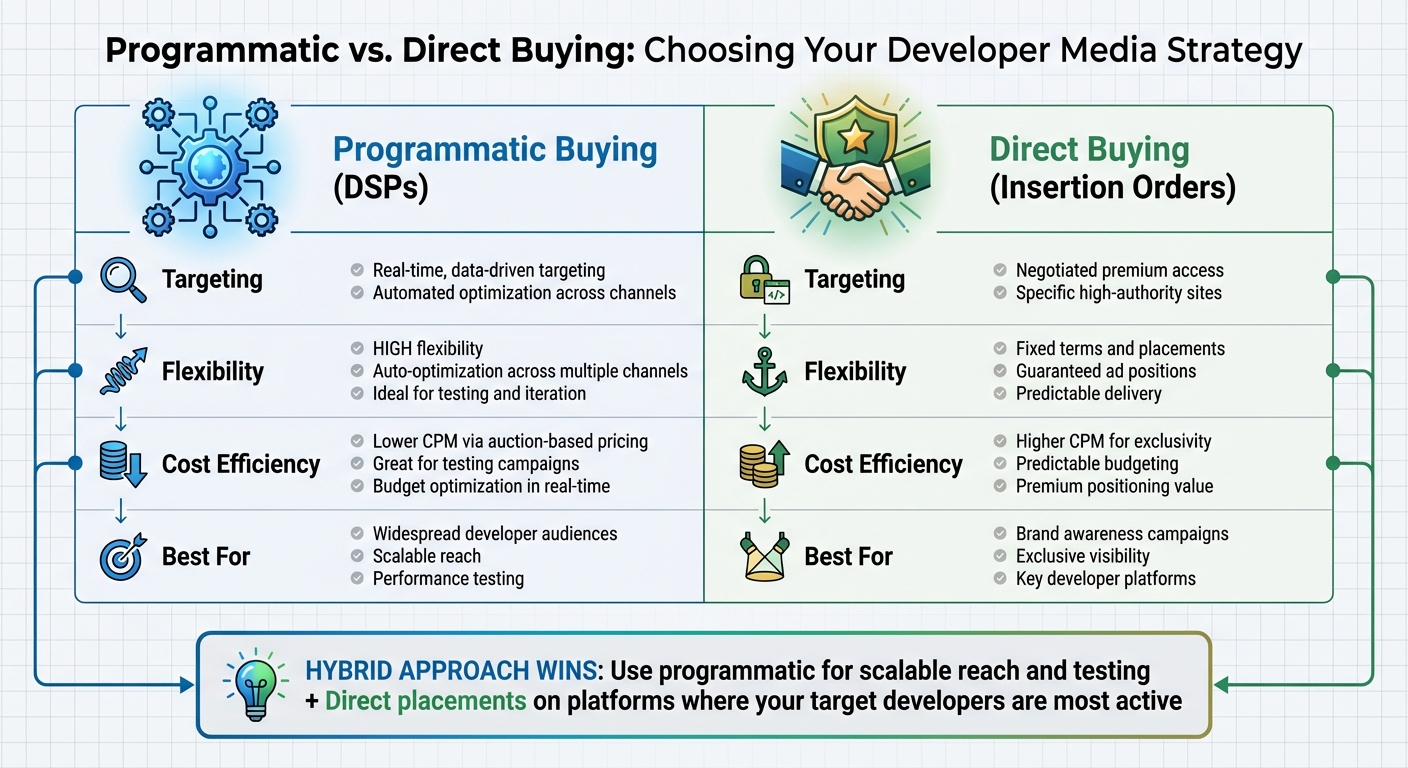 {Programmatic vs Direct Buying for Developer Advertising Campaigns}
Connecting with developers effectively requires not just targeted segmentation but also selecting the right media buying strategy. Let’s dive into what works best.
Programmatic vs. Direct Buying: Which to Use
Choosing between programmatic buying through demand-side platforms (DSPs) and direct insertion orders depends on your campaign goals and budget flexibility. With your developer segments in mind, pick the method that aligns with your needs.
Programmatic buying is the go-to choice for reaching widespread developer audiences in 2026. It offers real-time bidding, automation, and precise targeting, making it ideal for engaging developers on a large scale.
On the other hand, direct buying through insertion orders works best for securing premium ad space on key developer sites. This approach ensures predictable placements and costs, which is especially useful for brand awareness campaigns requiring exclusive visibility on high-authority platforms. Once secured, native ads can amplify developer engagement within these placements.
| Aspect | Programmatic Buying (DSPs) | Direct Buying (Insertion Orders) |
|---|---|---|
| Targeting | Real-time, data-driven targeting | Negotiated, premium access to specific sites |
| Flexibility | High; auto-optimization across channels | Fixed terms with guaranteed placements |
| Cost Efficiency | Lower CPM via auctions; great for testing | Higher for exclusivity; predictable budgeting |
A hybrid approach often yields the best results. Use programmatic buying for scalable reach and testing, then secure direct placements on platforms where your target developers are most active. Multi-channel programmatic campaigns also help optimize budget allocation by offering better insights into reach and frequency.
How to Use Native Ad Placements
Native ads are designed to blend seamlessly into developer-focused content, avoiding the intrusive nature of traditional banner ads. These ads, whether in-feed or post-page, integrate naturally into the platform’s user experience.
To make native ads effective, focus on contextual relevance. Developers are quick to dismiss promotional fluff, so your ads need to provide genuine value. Highlight technical capabilities, share performance benchmarks, or offer educational resources that resonate with their needs.
Timing matters, too. Place native ads during moments of high engagement - like after a developer finishes reading a technical article or while they browse a curated feed. This ensures you’re reaching them when they’re actively looking for new tools or solutions. Leveraging AI tools can further enhance results by testing different ad variations to see what works best for each developer segment.
Advertising on Developer-Focused Platforms
Developer-focused platforms provide a trusted environment for reaching qualified audiences. Take daily.dev Ads, for example - it connects advertisers with over 1 million developers through native formats like in-feed ads, post-page ads, and personalized digest ads. These platforms allow for precise targeting based on factors like seniority, programming languages, or specific tools, ensuring your campaigns hit the right audience.
The credibility of developer-focused platforms sets them apart from general advertising networks. They offer verified technical audiences, contextual trust, and ad formats tailored to how developers consume information. Plus, with real-time performance tracking and expert creative guidance, these platforms make it easier to tweak and optimize campaigns as you go.
When choosing a platform, prioritize those developers rely on daily for professional learning and staying updated on technology trends. Look for advanced targeting options that reduce wasted impressions and maximize your campaign’s impact.
How to Optimize Budgets, Creatives, and Campaign Performance
After establishing targeted segmentation and media buying strategies, the next step is ensuring your budgets, creatives, and performance tracking are fine-tuned. By doing this, you can make the most of your ad spend while keeping your campaigns relevant to developers.
How to Allocate Your Media Buying Budget
To get the most out of your media budget, divide it into two distinct pools:
- A brand baseline pool to maintain consistent awareness across key developer platforms.
- A performance pool - typically 20–30% of your budget - that focuses on testing and scaling high-performing channels .
Instead of relying solely on platform-reported metrics like clicks or impressions, use incrementality testing to measure the true impact of your campaigns. This involves running controlled tests to compare developer conversions between exposed and control groups. By identifying what genuinely drives results, you can shift your budget toward strategies with real ROI .
Regularly rebalance your budget based on performance analytics to uncover new audiences and refine your channel mix. When negotiating with platforms, look for opportunities like seasonal packages, added-value impressions, or performance guarantees to maximize your CPM efficiency . Once your budget is set, the next focus is crafting ads that connect with developers.
Creating Ad Creatives That Resonate with Developers
Developers value technical accuracy and straightforward messaging . Instead of flashy marketing, focus on providing clear documentation, technical solutions, and addressing developer-specific challenges directly .
Personalization is key, but it needs to be precise. Use the segmentation insights you’ve developed to tailor messages by skill level, tech stack, or specific use cases. For instance, Python developers will respond better to Python-related examples, while DevOps engineers will appreciate content focused on infrastructure . This kind of technical relevance consistently outperforms generic targeting.
For developer audiences, especially those on mobile, optimize your creative assets with lightweight formats, short vertical videos, and fast-loading designs . Test multiple creative variations - such as technical deep-dives versus use-case–focused ads - across your audience segments. Once you identify which approaches generate the most engagement, allocate more budget to those winning variations .
Tracking Performance and Measuring ROI
To accurately measure ROI, rely on third-party tools rather than platform-reported metrics. Use incrementality testing alongside Media Mix Modeling (MMM) to understand how different channels interact and to eliminate platform bias .
Set KPIs based on where your audience is in the funnel. For brand awareness campaigns, track metrics like reach, viewability, and ad recall lift. For mid-funnel efforts, focus on engagement and consideration lift. For direct response campaigns, measure CTR, CPA, and ROAS . Specifically for developer campaigns, monitor outcomes like developer signups, API adoption rates, or product trial conversions - metrics that directly tie back to your media spend .
Choose attribution models that align with developer sales cycles. While single-touch attribution works for simpler paths, multi-touch or data-driven models are better suited for capturing the complexity of developer journeys . Demand transparent reporting, clear vendor SLAs for viewability and fraud protection, and regular KPI reviews to ensure every dollar is working toward your business goals . By staying data-driven, you’ll base decisions on actual results - not assumptions.
Using AI and Automation to Scale Developer Campaigns
Once you've fine-tuned your budget and creative approach, AI and automation can take your campaigns to the next level by reducing manual tasks, improving bidding precision, and tailoring ads to specific developer groups.
AI-Powered Bidding Strategies
AI simplifies bidding by processing real-time auction data - like user behavior, device type, and browsing context - to make smarter decisions . Instead of adjusting bids manually, predictive budget allocation shifts spending across platforms based on live performance trends, time-of-day patterns, and weekly data, helping you get the most out of your investment .
The advertising world is increasingly adopting "automated systems" to manage media buys more efficiently. For instance, in December 2025, Butler/Till collaborated with Scope3 and PubMatic to test an AI-driven media activation agent for Geloso Beverage Group. Using Anthropic's Claude model, the system directly handled media buys through PubMatic, cutting out traditional demand-side platforms. Led by VP Ryan Lammela and a team of eight, the project aimed to reduce execution costs by 40% while speeding up campaign optimization using contextual targeting . Ryan Gauss from PubMatic highlighted the benefits of this approach:
"humans to define objectives, guardrails, and risk tolerance, while agentic systems plan, execute, and optimize continuously within those boundaries" .
To make AI bidding effective, it's crucial to set clear goals and risk parameters from the start. This ensures the system operates within your brand's safety standards while focusing on meaningful business outcomes, not just surface-level metrics like reach . Beyond bidding, automation also plays a key role in personalizing ad content for improved developer engagement.
Automating Creative Personalization
Automation makes it possible to deliver tailored ad experiences to different developer groups without manually creating each version. Custom AI tools can generate platform-specific ad variations by referencing developer persona documents that outline pain points, motivations, and technical preferences. These tools also perform "Message Match" checks to ensure your keywords, ad copy, and landing pages are aligned .
Reducing Manual Work with Workflow Automation
Advanced bidding and creative tools are just the start - workflow automation can drastically cut down the time spent on routine campaign tasks while maintaining quality. AI-driven systems can reduce the costs of executing a media plan and cut media planning and programmatic buying time by up to 40% . This shift allows media planners to focus on validating AI-generated recommendations rather than handling tedious data entry. Paul Harrison, Co-Founder and CTO of Simpli.fi, explains:
"AI's impact on media buying and planning is just beginning to unfold... We see AI not as a replacement but as a powerful ally for media planners, helping them elevate their strategies and reach new heights of campaign performance" .
To get the most out of automation, upload product spec sheets directly into your AI tools. This ensures your product features are accurately translated into benefits without additional manual input. You can also automate competitor analysis to extract messaging insights and unique selling points from rival ad copy and landing pages. By saving time on these tasks, you can dedicate more energy to high-level strategy, creative development, and scenario planning - ultimately scaling your campaigns and reaching more qualified developers effectively.
Conclusion
Effective developer media buying hinges on precision, genuine engagement, and ongoing refinement. Unlike traditional B2B campaigns that often rely on broad targeting and platform-reported metrics, developer-focused efforts demand validated measurement at every step. Every dollar spent should be backed by incrementality testing rather than vanity metrics like impressions or clicks .
Start with well-defined audience segmentation. Use first-party data and community insights to create developer personas that accurately reflect their technical needs and preferences . Then, focus on the platforms where developers actually spend their time - whether that's developer-centric platforms, technical documentation hubs, or niche communities . A balanced approach works best: combine programmatic buying for reach with direct placements on trusted platforms to maintain relevance .
Your budget strategy should be flexible. Experiment with different spend levels across channels, measure impact using incrementality curves, and shift resources in real time to the most effective segments . Pair this with creative content that prioritizes technical credibility - developers are more likely to engage with practical examples, code snippets, and real-world use cases rather than generic marketing language .
AI and automation can take these efforts further by streamlining manual processes and improving accuracy. From predictive bid adjustments to dynamic creative testing, automation allows your team to focus on strategy while maintaining the technical precision developers expect . Treat your campaigns as living experiments, constantly refining creative, targeting, and budget based on performance data .
Developer media buying isn't about guesswork - it's about data-driven ROI, smart channel selection, and messaging that resonates with the unique challenges developers face. By combining solid measurement practices, sharp targeting, and constant optimization, you can create campaigns that yield measurable results and earn the trust of one of the most discerning audiences in B2B marketing.
FAQs
Which developer segments should I target first?
Understanding developers means recognizing their diverse needs, which often depend on their skill level, career stage, and area of expertise. For instance, early-career developers - like students or those just starting out - tend to gravitate toward educational resources and step-by-step tutorials that help them build foundational skills. On the other hand, specialized developers, such as DevOps engineers or AI/ML experts, usually look for content with technical depth and advanced insights.
To make the most impact, focus on the audience segments that align closely with your product’s strengths. Prioritize developers who are actively searching for tools or solutions; they’re more likely to engage and find immediate value in what you offer.
When should I use programmatic vs. direct buying?
Programmatic buying streamlines the ad purchasing process by using AI and real-time bidding. This approach is perfect for scaling campaigns, achieving precise targeting, and making adjustments on the fly. On the other hand, direct buying involves one-on-one negotiations with publishers, giving advertisers greater control over premium ad placements, ensuring brand safety, and tailoring messaging to specific needs.
In short, programmatic buying is best when you need efficiency and scalability, while direct buying is ideal for securing personalized, high-quality, or exclusive placements where maintaining control is crucial.
How do I prove ROI beyond clicks and impressions?
To measure ROI in a way that goes beyond just clicks and impressions, it's essential to focus on metrics that highlight developer engagement and the impact on your product. Some critical indicators include:
- API call frequency: How often developers are using your API can reveal the level of integration and reliance on your product.
- GitHub activity: Monitoring stars, forks, and contributions can offer insights into interest and community involvement.
- Documentation views: High engagement with your documentation indicates developers are actively exploring your tools.
- SDK implementation rates: Tracking how often your SDK is being adopted shows how effectively you're meeting developer needs.
- Onboarding completion: A completed onboarding process often signals a strong intent to use your product.
In addition, behavioral data can paint a clearer picture of campaign effectiveness. Metrics like time spent on tutorials, clicks on code samples, and engagement with technical content help demonstrate how your efforts are driving meaningful developer actions and contributing to product success.