

Summary: Selling developer tools to CTOs and VPs of Engineering requires a focus on technical proof and measurable results. These leaders value transparency, data-driven insights, and risk mitigation over flashy marketing. Developers often test tools before leadership gets involved, so marketing must appeal to both groups.
Key Takeaways:
- Decision-Making: 67% of CTOs and IT managers make final decisions on tools, often after developers have already adopted them.
- Evaluation Criteria: Leaders prioritize security (e.g., SOC 2 compliance), integration, reliability, and measurable business outcomes like cost savings or faster delivery.
- Developer Role: Developers influence decisions by testing tools through hands-on trials, spreadsheets, and proof-of-concept tests.
- Content That Works: Use architecture case studies, ROI analyses, and security whitepapers to address both technical and business concerns.
- Credibility: Avoid buzzwords like "AI-driven magic." Instead, provide specific details about compliance, performance, and technical mechanisms.
How to Succeed:
- Focus on clear documentation and proof of value.
- Provide resources like ROI calculators and security whitepapers to help developer champions influence leadership.
- Use platforms like daily.dev and industry events to connect with both developers and engineering leaders.
- Train sales teams to address both technical and business priorities during discovery calls.
Bottom Line: To win over engineering leaders, deliver specific, evidence-backed messaging that aligns with their risk-averse, results-driven approach.
How Engineering Leaders Approach Tool Procurement
::: @figure 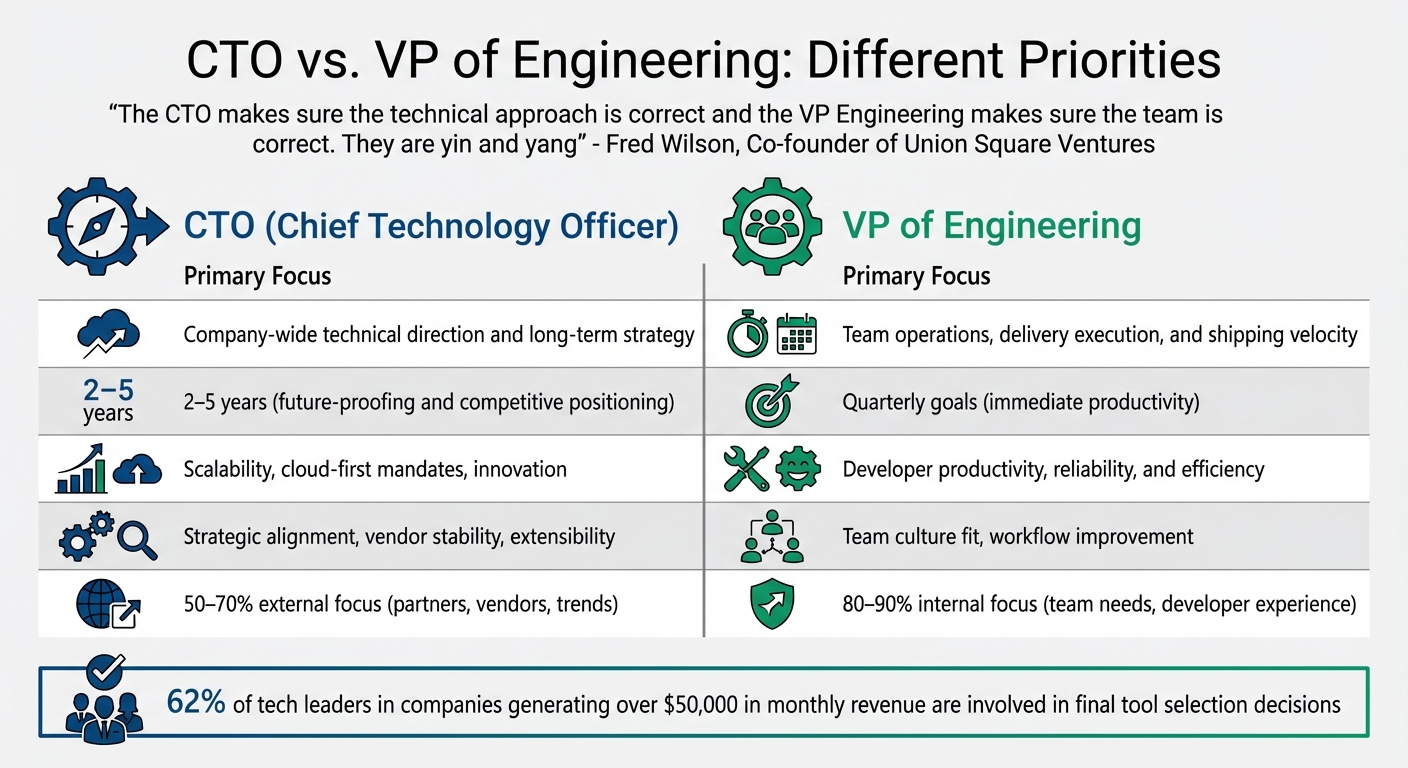 {CTO vs VP of Engineering: Tool Evaluation Priorities and Focus Areas}
Engineering leaders approach tool procurement in a way that's vastly different from traditional executives. They treat the process like they would a technical problem - relying on technical validation, data-driven analysis, and hands-on testing rather than sales pitches or vendor relationships. Their method is deliberate, skeptical, and entirely grounded in evidence.
The numbers back this up: 67% of decision-makers and 52% of experienced leaders actively participate in tool selection, reflecting the detailed and methodical nature of their evaluations . Many CTOs even take it further, testing small code changes in production to assess developer experience and deployment friction .
Their evaluation process is thorough and uncompromising. Leaders demand tools that meet specific security standards such as SOC 2 Type II compliance, AES-256 encryption, and multi-factor authentication (MFA) for root access. Seamless integration is non-negotiable - tools must work with existing IDEs, support both cloud and on-premise environments, and align with current source code management systems . Ninad Pathak, Founder of Pathak Ventures, sums it up perfectly:
"If your docs are messy, outdated, or hard to read, the assumption is that your code is messy, outdated, and hard to read" .
This makes documentation much more than an afterthought - it’s a reflection of code quality and even serves as a sales tool. Vendors need to meet these high standards by presenting clear, data-backed messaging that resonates with technical buyers.
The procurement process itself is equally rigorous. Leaders favor "Proof of Value" evaluations, which go beyond basic functionality to assess real-world business outcomes. Typically, they narrow their focus to no more than three vendors at a time, dedicating 8–10 developer hours per vendor to test installation and setup . They also dive deep into the product’s reliability by tracking support tickets, attending incident reviews, and sitting in on customer meetings. This helps them identify "reality reservoirs" - the gaps where current systems fall short . Ultimately, features alone don’t sell a tool; what matters is whether it solves a real problem without creating unnecessary complexity.
The Evaluation Process for CTOs and VPs of Engineering
For engineering leaders, the goal is to bridge technical requirements with tangible business outcomes. Tools must not only work flawlessly but also deliver measurable benefits like cost savings or faster time-to-market.
Their evaluation criteria can be grouped into three main areas:
- Business Outcomes: Does the tool reduce staffing needs, speed up shipping timelines, or provide a clear return on investment (ROI)?
- Technical Integration and Reliability: Can it work with existing infrastructure without requiring major changes? How does it handle errors, and does it improve team productivity?
- Security and Compliance: Leaders expect specifics - like multi-region replication and proven encryption standards - not vague claims of "enterprise-grade security."
Many engineering leaders use the Accelerate framework (DORA metrics) to measure deployment frequency and lead time, ensuring the tool’s impact is quantifiable after implementation. Collaboration is also key - platform, security, and DevOps teams all weigh in to ensure the tool meets a wide range of technical needs. Documenting the context of past technical decisions helps avoid repeating previous mistakes.
This rigorous approach naturally highlights the differences in focus between CTOs and VPs of Engineering.
CTO vs. VP of Engineering: Different Priorities
While both roles share a commitment to thorough evaluations, their priorities differ based on their responsibilities within the organization. Fred Wilson, Co-founder of Union Square Ventures, explains the distinction:
"The CTO makes sure the technical approach is correct and the VP Engineering makes sure the team is correct. They are yin and yang" .
| Priority Area | CTO (Chief Technology Officer) | VP of Engineering |
|---|---|---|
| Primary Focus | Company-wide technical direction and long-term strategy | Team operations, delivery execution, and shipping velocity |
| Time Horizon | 2–5 years (future-proofing and competitive positioning) | Quarterly goals (immediate productivity) |
| Tooling Goal | Scalability, cloud-first mandates, innovation | Developer productivity, reliability, and efficiency |
| Evaluation Lens | Strategic alignment, vendor stability, extensibility | Team culture fit, workflow improvement |
| External vs. Internal | 50–70% external focus (partners, vendors, trends) | 80–90% internal focus (team needs, developer experience) |
CTOs focus on long-term strategy, ensuring tools align with the company’s multi-year technology roadmap and future architectural needs. Vendor stability is a major concern for them, given the long-term implications of their decisions. On the other hand, VPs of Engineering prioritize tools that enhance team productivity and help meet immediate delivery goals. Since they often control the budget, their focus is on short-term wins that improve workflows and shipping velocity.
Interestingly, 62% of tech leaders in companies generating over $50,000 in monthly revenue are involved in final tool selection decisions . While CTOs often engage externally with vendors and industry events, VPs of Engineering spend more time internally, identifying inefficiencies and figuring out where tools might be wasting their team’s time.
sbb-itb-e54ba74
What Engineering Leaders Look for in Developer Tools
Engineering leaders approach tool evaluation with a dual focus: measurable technical performance and strategic business outcomes. They must address two distinct audiences - developers who rely on the tool daily and business stakeholders concerned with ROI and compliance. Developers want to know if the tool will disrupt their workflow, while executives care about its impact on budgets and staffing levels . Effective marketing must bridge these priorities.
This dual focus creates a unique challenge. While 67% of CTOs and IT managers are the ultimate decision-makers , developers play a crucial role in the selection process. They evaluate tools through spreadsheets, proof-of-concept tests, and hands-on trials, often shaping the shortlist. If a tool doesn’t meet developers' expectations during testing, even the strongest ROI pitch won’t save the deal.
Team Productivity, Reliability, Security, and Total Cost of Ownership
Engineering leaders rely on tangible metrics rather than vague assurances. Key performance indicators like DORA metrics - lead time for changes, deployment frequency - and flow efficiency (the ratio of active work time to total time) are central to their evaluations . For instance, Newforma’s CTO dashboard demonstrated its value by reducing lead time by 63%, cutting pull request cycle time by 60%, and increasing deployment frequency by over 2,100%, resulting in 22× faster delivery .
Reliability and security are non-negotiable. Even if developers are enthusiastic about a tool, leaders won’t move forward without clear assurances like SOC 2 compliance and strong encryption standards . Vague claims or lack of transparency can raise red flags.
Total Cost of Ownership (TCO) is another critical factor. This includes not just licensing fees but also cloud costs, technical debt, and even developer retention. For example, in companies generating over $50,000 in monthly revenue, 46% of tech leaders are directly involved in approving expenses, compared to just 23% in companies with under $5,000 monthly revenue . Leaders expect vendors to connect technical benefits to financial outcomes, such as explaining how features like horizontal pod autoscaling can reduce cloud expenses by 40% .
| Evaluation Factor | What Leaders Measure | Business Impact |
|---|---|---|
| Productivity | Lead time, deployment frequency, flow efficiency | Accelerated time-to-market, faster revenue generation |
| Reliability | Change failure rate, recovery time | Reduced downtime costs, stronger customer trust |
| Security | SOC 2 compliance, encryption standards, MFA | Lower risk exposure, adherence to regulations |
| Total Cost of Ownership | Licensing, cloud costs, technical debt, attrition rates | Comprehensive financial savings |
In addition to these metrics, one often-overlooked factor is developer satisfaction, which can have a profound impact on business outcomes.
Why Developer Happiness Matters to Leadership
Developer satisfaction isn’t just a perk - it’s a strategic priority. Happier developers are more productive and less likely to leave, which directly impacts the organization. For example, teams with high psychological safety see attrition risks drop from 12% to 3% . This is especially important in a landscape where 48% of global knowledge workers report symptoms of burnout . Engineering leaders closely monitor whether their tools are contributing to unnecessary friction.
As Jakub Czakon, CMO at a developer tool startup, points out:
"CFOs will double-click on [a budget] but finally agree with the CTO saying that keeping the team happy and productive is good business" .
Tools that eliminate repetitive, low-value tasks not only improve retention but also result in higher-quality work. Ryan McElroy highlights this sentiment:
"A common characteristic of fantastic programmers is a deep disgust with mindless toil" .
The maturity of an organization’s tooling reflects how much it values its developers’ time. Frustrated developers are more likely to leave or turn to Shadow IT solutions, which can account for 30% to 50% of IT spending . By the time a CTO realizes a tool has become embedded in the workflow, the decision is often already made.
To win over both developers and leadership, your marketing should empower developers with resources like ROI analyses, security whitepapers, and case studies that make the case for the tool. Stripe’s success in the payments market is a prime example. Their documentation, featuring clear, copy-pasteable code snippets, allowed developers to integrate the tool before the CFO even reviewed the purchase. This made their documentation an invaluable sales tool .
Marketing to Developers and Their Leaders at the Same Time
When it comes to marketing to developers and their leaders, you're essentially speaking to two very different mindsets. Developers are focused on questions like, "Will this break my build?" Meanwhile, executives are thinking about how to justify the cost to the CFO. These aren't just different roles - they represent entirely distinct ways of thinking, with different priorities and timelines.
The problem is, many marketing strategies fail by leaning too heavily on one side. If you focus only on business outcomes, like claiming to "reduce costs by 30%", developers might dismiss it as vague or irrelevant. On the flip side, diving deep into technical specifics without tying them to business value can leave executives uninterested. The key is finding a way to speak to both groups at once.
Combining Technical Details with Business Impact
A great way to bridge the gap is by using what Ninad Pathak, Founder of Pathak Ventures, calls the "Mechanism + Result" formula. This approach explains how a feature works and immediately connects it to why it matters for the business. For instance: "Our horizontal pod autoscaler deactivates idle nodes (mechanism), lowering your cloud bill by 40% (result)." This method not only resonates with developers but also demonstrates business value to executives.
Specifics are your best friend here. Instead of saying your product is "secure by design", list concrete details like SOC 2 Type II compliance, AES-256 encryption, and multi-factor authentication. Developers can evaluate these claims for accuracy, while executives see them as proof that compliance and security concerns are addressed. Conversely, vague buzzwords like "AI-driven magic" can set off what engineers call "fluff detectors," instantly damaging credibility.
Stripe is a standout example of how to balance this dual-audience approach. Its documentation allows developers to verify functionality while simultaneously easing executive worries about time-to-market.
As Ninad Pathak puts it:
"Technical storytelling does not choose one audience over the other. It acts as a translator between them. It connects the 'Code' to the 'Commerce.'"
This principle can be applied across your content. Case studies should highlight both technical architecture and measurable business outcomes. Security whitepapers should detail encryption protocols alongside how they reduce compliance risks. Migration guides should include technical steps while estimating cost savings - whether that's cutting cloud expenses or saving developer hours. By addressing both audiences in one cohesive message, you ensure your marketing resonates on both fronts.
Content That Works for CTOs and VPs
Engineering leaders aren’t swayed by flashy brochures or generic feature lists. What they want is proof - evidence that your tool can tackle their specific technical challenges while delivering measurable business outcomes. The most effective content combines technical depth with tangible results, aligning with the evidence-driven mindset these leaders bring to evaluations.
Architecture Case Studies and Migration Stories
Architecture case studies are a powerful way to show you understand the complexity of real-world systems. When a CTO reads about another company transitioning from a monolithic architecture to microservices using your tool, they’re not just looking for a polished success story. They’re focused on the messy middle - the tough decisions, trade-offs, and problem-solving that happened along the way.
The best case studies are transparent, highlighting not only successes but also challenges and how they were addressed. A detailed post-mortem that explains what went wrong and how it was fixed builds far more trust than a generic one-pager with stock photos. By openly discussing failures and solutions, you demonstrate the kind of technical expertise that engineering leaders can evaluate and trust.
Migration stories resonate because they tackle a key concern: integrating with existing systems. CTOs aren’t working with a clean slate - they’re managing complex legacy systems. A step-by-step migration guide showing how your tool integrates with their current stack, complete with timelines and technical details, proves you understand their challenges. Include specifics like which APIs were used, how data was transferred, and the actual downtime (if any).
Adding quantifiable business outcomes and clear security measures strengthens your credibility even further.
ROI Analyses and Security Whitepapers
Engineering leaders expect ROI analyses that go beyond vague promises. They want clear, data-driven projections. Providing interactive calculators where they can input variables like team size, current cloud spend, or developer hours allows them to see potential savings for themselves. For example, explaining how horizontal pod autoscaling could reduce cloud bills by 40% only resonates if you break down the technical mechanism behind it and let them verify the math.
Security whitepapers are essential for enterprise-level deals. These leaders need detailed documentation to satisfy compliance teams and boards. Include specifics like SOC 2 Type II compliance, AES-256 encryption, multi-factor authentication, and audit log details. This level of transparency shows you take security seriously and gives them the tools they need to evaluate your product.
As Ninad Pathak, Founder of Pathak Ventures, points out, “Vague marketing language damages credibility with technical audiences who expect clear explanations of how features work” .
Finally, offering self-serve demos is a must. CTOs prefer video walkthroughs that showcase the actual interface over high-level slide decks. These demos let them independently verify your claims and see the product in action. Making it easy for them to access and evaluate the real product reinforces your commitment to providing evidence-based proof - something that resonates deeply with engineering leaders.
Where to Reach Engineering Leaders
Connecting with engineering leaders isn’t about flooding generic channels with ads. Instead, it’s about being present in the trusted spaces where they naturally discover tools - through peer networks and specialized communities. These leaders often rely on organic adoption, making reputation-driven, targeted channels essential.
Industry Conferences and Executive Communities
Face-to-face interactions at industry events can build trust in ways that digital outreach often can’t. Conferences like KubeCon, AWS re:Invent, and QCon are hotspots for CTOs and VPs actively seeking solutions and exchanging insights with peers. These events create opportunities for direct, meaningful conversations about technical challenges and solutions - without the barriers of cold outreach.
Executive communities and peer networks also play a big role. Engineering leaders often explore tools through "Best Practice" guides and shared experiences within private Slack groups or other professional circles .
One major advantage of these spaces is the transfer of reputation. When a respected CTO endorses a tool at an event or within a trusted community, that recommendation carries far more weight than any ad campaign. Engineering leaders are careful about the tools they select - they trust peers who’ve already vetted those tools and taken the professional risk .
Developer Platforms Like daily.dev
Developer platforms like daily.dev offer a rare opportunity to reach both individual developers and engineering leaders in one place. With over 1 million developers on the platform daily, your message can connect with both the hands-on evaluators and the decision-makers. It’s worth noting that 67% of CIOs, CTOs, and IT managers are responsible for final decisions on tool selection for their teams .
What makes platforms like daily.dev so effective are their native ad placements. These ads - whether in-feed or on post pages - let you target by seniority, programming languages, or specific tools. For example, if your content focuses on Kubernetes security or API performance optimization, it will reach exactly the leaders grappling with those challenges. Since these ads blend seamlessly into the content developers and leaders are already consuming, they feel less intrusive. Combined with peer insights, this approach can significantly enhance a tool’s credibility.
Peer Recommendations and Expert Endorsements
Engineering leaders value technical validation and hold peer recommendations in high regard. Signal-based outreach - where you tailor your messaging to their specific technical context - achieves reply rates between 15% and 35%, far outperforming the 2% to 5% response rates of generic outreach . This works because it shows you’ve done your homework.
Highlighting named experts instead of generic claims like “used by Fortune 500 companies” is a quick way to build trust. For example, showcasing testimonials from specific engineers at respected organizations resonates more with these leaders. Among engineering leaders with over five years of experience, 54% are directly involved in recommending tools . These experienced professionals want insights from peers who’ve faced similar challenges - not just polished marketing promises.
Turning Developer Adoption into Leadership Conversations
Developer adoption often kicks off 6–12 months before procurement . This creates a critical opportunity to spot companies testing your tool and turn early users into advocates who can sway leadership decisions.
From Developer Champions to Leadership Buy-In
When developers actively use your tool - forking repositories, submitting pull requests, or deploying it in production - it serves as concrete proof of its value . This early traction sets the stage for these users to become internal champions, a vital step in gaining leadership support.
To help these champions make their case, provide them with resources like security whitepapers, SOC2 compliance documents, and ROI calculators . These materials enable them to present both the technical benefits and the strategic value of your tool. Keep in mind that 67% of CIOs, CTOs, and IT managers are the ultimate decision-makers for tool selection , so your champions need to address both technical and business priorities.
Pay attention to signals like repeated GitHub activity from multiple developers at the same company. These can indicate growing internal interest and momentum. When you see this, it’s time to shift your focus from developer support to leadership-level conversations. Tailoring your outreach - by referencing specific actions like a recent fork or pull request - can significantly improve response rates, achieving 15% to 35% compared to the 1–3% typical of generic cold emails . This approach ensures that your advocates can effectively engage decision-makers and drive the conversation forward.
Preparing Sales Teams for Engineering-Led Deals
When selling to engineering leaders like CTOs or VPs of Engineering, traditional sales tactics often fall flat. These buyers are known for their "highly tuned fluff detectors" , which means they can quickly spot vague claims and lose confidence in your product and messaging.
To connect effectively, sales teams need to address two distinct audiences: practitioners and executives. Practitioners are focused on technical details like API quality, error handling, and integration, while executives care more about ROI, compliance, and time-to-market . Bridging the gap between technical mechanisms (like horizontal pod autoscaling) and business outcomes (such as cutting cloud costs by 40%) is essential . This dual approach ensures discovery calls focus on both the technical specifics engineers demand and the business-critical outcomes executives prioritize.
Technical Discovery Calls and Proof of Concept Frameworks
Discovery calls need to balance the concerns of both engineers and executives. Engineers worry about risks like wasted time and broken builds, while executives are focused on issues like overspending and reputational damage . Sales reps should tailor their questions accordingly:
- For practitioners: "Will this break my build? How does it handle errors? Can I integrate it with my stack?"
- For executives: "Will this reduce headcount? Will it speed up time-to-market? Is it compliant?"
Specificity is key to building credibility. For example, instead of saying "we're secure", provide concrete details like "AES-256 encryption with SOC 2 Type II compliance." Instead of claiming "we're fast", say "read latency under 30ms" . As Ninad Pathak from Pathak Ventures puts it:
"By strictly defining the boundaries of your technology, you make the claims inside those boundaries irrefutable. If you tell me exactly where your product breaks, I believe you when you tell me where it works" .
Being upfront about limitations can foster more trust than making overly polished claims. Engineering leaders value honesty about trade-offs because it reflects a deeper understanding of your technology . Train your sales team to openly acknowledge product limitations; this builds credibility and reinforces the validity of your other claims.
Supporting the Vendor Evaluation Process
Once discovery calls establish trust, the next step is to support the vendor evaluation process with thorough documentation and resources. For engineering leaders, documentation serves as a reflection of your product’s quality . If your API documentation is outdated or poorly organized, they may assume the same about your code. Treat documentation as a core sales tool. Offer resources like:
- Copy-pasteable code snippets
- Clear API references
- Detailed technical post-mortems that highlight diagnostic expertise
Equip your sales team with materials that help internal champions advocate for your product. These could include ROI calculators, architectural diagrams, and trial results formatted like professional reports . It's also important to understand the full range of influencers in an account, from the CTO to specialists in compliance, security, and price negotiation . Engaging compliance teams early can prevent them from stalling deals later in the process . Additionally, providing hands-on support, like solutions engineering assistance or community office hours, can make a big difference for high-priority accounts during testing periods .
Finally, the best sales teams continuously review pipeline metrics to identify which resources and strategies drive deals forward . Use these insights to refine your discovery process and evaluation materials, ensuring they meet the specific needs of engineering leaders and their teams.
Conclusion
Marketing to CTOs and VPs requires skipping the buzzwords and focusing on specifics. As Ninad Pathak from Pathak Ventures aptly notes, these leaders have "highly tuned fluff detectors" . They can spot vague claims a mile away. To win their trust, you need hard evidence, not empty promises. For example, instead of saying "secure by design", highlight specifics like "AES-256 encryption with SOC 2 Type II compliance." Details like these resonate far more with technical decision-makers.
There's also the challenge of addressing two distinct audiences: the hands-on developer and the executive decision-maker. Developers care about things like API quality and error handling, while executives are more concerned with ROI and time-to-market. Striking the right balance means being upfront about your product's strengths and limitations. This transparency builds trust - not just with developers but also with the leadership they report to, making it easier for your sales team to close the deal.
Your content strategy plays a critical role here. Think of it as your toolkit: architecture case studies, post-mortems, and ROI analyses. These resources help developers assess your tool's technical merits while providing the business case leadership needs to greenlight adoption. Keep in mind that 71% of B2B buyers rely on whitepapers during their research process , so creating detailed, evidence-backed content is a must.
Beyond content, it's important to meet your audience where they already are. Platforms like daily.dev, for instance, are where developers naturally engage - an average of 200 times per month . This in-flow visibility is key. As Michael Shannack from daily.dev explains:
"Tools get found when they're in flow... Dev trust isn't bought: it's earned" .
By appearing in these trusted spaces, your message reaches both developers and the leaders who rely on their input.
In short, the formula is straightforward: specificity beats skepticism. Show you understand the technical details and back it up with evidence-based content. That's how you earn the credibility engineering leaders demand.
FAQs
What proof do CTOs need before approving a developer tool?
CTOs need solid proof to evaluate a tool's worth. This means providing ROI analyses, security whitepapers, architecture case studies, migration success stories, and reliability metrics. They focus on hard data and practical examples rather than marketing claims, ensuring the tool fits their team's requirements and aligns with their organization's objectives.
How do I market to both developers and engineering leadership?
To connect with developers and engineering leaders, it's essential to understand their distinct priorities. Developers are drawn to technical depth, real-world evidence, and tools that make their work more efficient. On the other hand, engineering leaders prioritize team productivity, security, and the total cost of ownership.
To resonate with both groups, focus on content that speaks to their needs. For developers, this might mean offering technical case studies and resources that demonstrate practical value. For leaders, materials like ROI analyses and security whitepapers can address broader organizational concerns.
The key is a dual approach: provide developers with the technical validation they need while showcasing the strategic advantages that leadership values. This way, you not only engage the technical team but also secure buy-in from decision-makers.
What should a strong proof-of-concept include for VPs of Engineering?
A solid proof-of-concept for VPs of Engineering should focus on validating technical feasibility. This means tackling the riskiest assumptions through targeted experiments and streamlined solutions. The goal is to show that the concept can theoretically work before diving into larger-scale market validation. This method builds confidence in the idea's potential while keeping risks to a minimum.