

Developers are using AI tools more than ever, but trust in these tools is plummeting. By 2025, 84% of developers planned to use AI tools, up from 76% in 2024. Yet only 29% trusted AI outputs, down from 40% the previous year. Mistrust is rising, with 46% actively doubting the accuracy of tools they rely on daily. This trust gap is forcing marketers to rethink strategies.
Here’s the core takeaway: Trust is now a key metric in developer marketing. Understanding the nuances of developer marketing is essential for building this trust. Developers demand proof, not promises. They value data, benchmarks, and peer validation over flashy campaigns. Marketing efforts that fail to align with this mindset risk losing credibility - and customers.
Key Points:
- AI Adoption vs. Trust: Usage climbed to 84% in 2025, but trust dropped to 29%.
- Skeptical Audience: Developers prefer peer recommendations (87%) and community-driven insights (boosting trust by 58%).
- Metrics That Matter: Focus on time-to-success, API adoption, and Product-Qualified Leads (PQLs) over traditional metrics.
- Context is Critical: Messages delivered in trusted environments like daily.dev perform better, with click-through rates 3–5× higher than traditional ads.
To succeed, marketers must meet developers where they are - on platforms they trust, with content that delivers clear, measurable value.
The Trust Gap: What Happened in 2024–2025
::: @figure 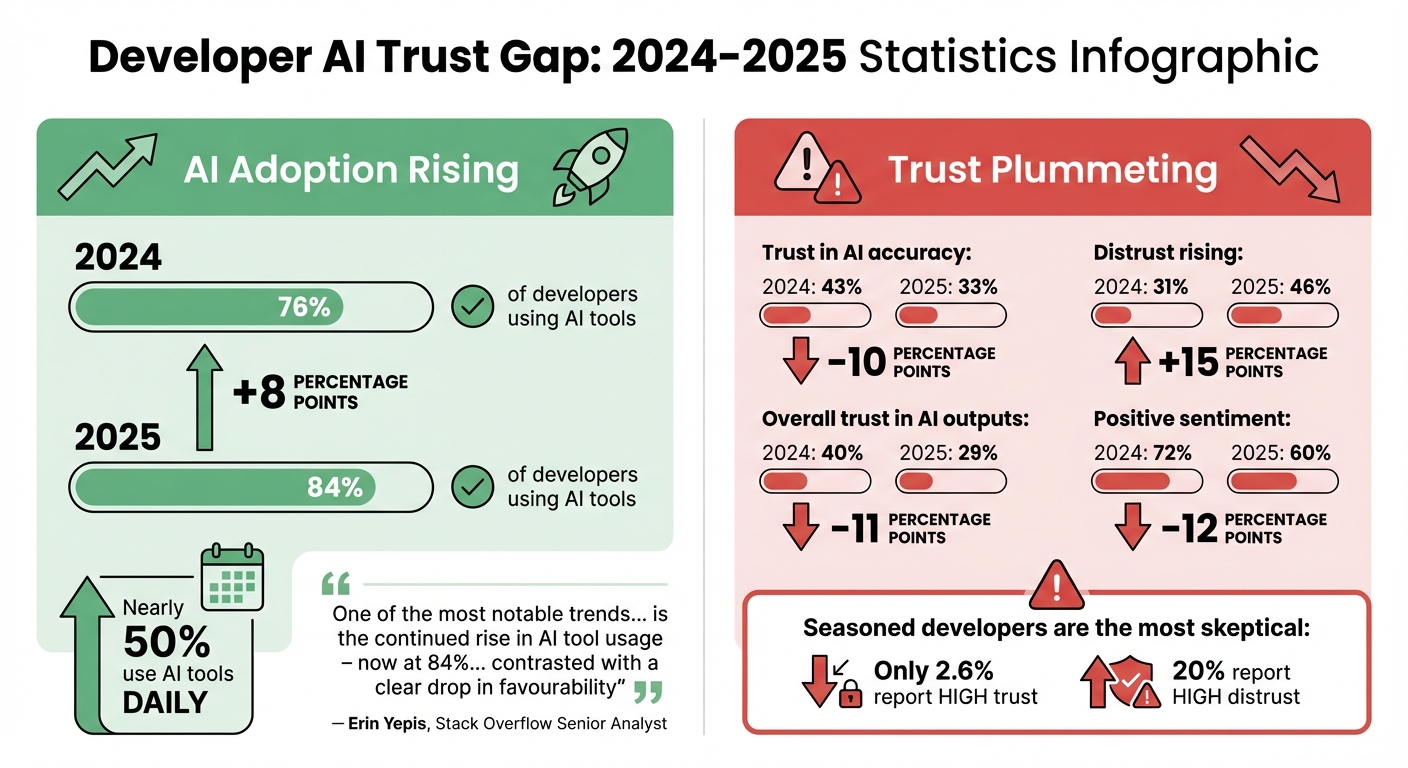 {Developer AI Trust Gap 2024-2025: Adoption vs Trust Statistics}
More AI Tools, Less Confidence
AI tools became more popular, but trust in them took a nosedive. Between 2024 and 2025, adoption rates climbed from 76% to 84% - a noticeable 8-point increase in just one year . Nearly half of professional developers now use these tools daily . Yet, confidence in AI accuracy dropped sharply, falling from 43% to 33%, while distrust rose from 31% to 46% .
This trend highlights a broader shift in how developers scrutinize claims. Erin Yepis, a senior analyst at Stack Overflow, summed it up:
"One of the most notable trends... is the continued rise in AI tool usage – now at 84%... contrasted with a clear drop in favourability" .
Sentiment toward AI tools also took a hit, with positive views dropping from 72% in 2024 to 60% in 2025 .
This skepticism is especially strong among seasoned developers. Those with the most technical experience report the lowest levels of high trust (just 2.6%) and the highest levels of distrust (20%) . Their firsthand encounters with inconsistent AI outputs make them tougher critics of vendor claims.
This erosion of trust isn’t just a philosophical issue - it directly affects marketing outcomes.
What Mistrust Costs You
Developer mistrust comes with a tangible price tag. According to Evans Data Corporation's 2025 Developer Marketing Survey, which analyzed insights from over 185,000 developers, 76% of companies grapple with attribution challenges, while 43% struggle to calculate customer acquisition costs accurately . These figures point to the failure of traditional marketing methods to resonate with an increasingly skeptical audience.
The pressure is mounting - 83% of marketers now say they must prove ROI, up from 68% five years ago. Yet, only 36% can measure it effectively . Developers are quick to dismiss vendor claims, leaning heavily on peer recommendations (87%) and preferring community-driven content, which boosts trust by 58% . When marketing fails to align with these preferences, it’s not just a financial waste - it risks damaging long-term relationships with an audience that values authenticity over flashy promises.
sbb-itb-e54ba74
What Actually Works with Developers
Developers Want Proof, Not Promises
Developers are naturally skeptical and rely on evidence over empty assurances. With 75% of developers citing a lack of trust as their primary reason for consulting humans over AI , it's clear they expect solid verification. Successful marketing to developers focuses on delivering tangible value - no flashy campaign or polished landing page can make up for a product that fails to offer quick, seamless results .
The key is moving away from hype and focusing on substance. Developers respond to data-driven proof like benchmarks, error rates, and confidence scores woven into your messaging . Tools like live coding demos, sandboxes, and practical code examples resonate because they allow developers to test claims directly, in real-time, rather than relying on static promises .
"If marketing isn't anchored to fast, frictionless user wins, it's dead on arrival - no matter how creative the execution" .
Peer validation often outweighs vendor messaging. Recommendations from fellow developers influence 87% of them, and community platforms like Slack or Discord boost brand trust by 58% . When developers encounter genuine discussions about your product on Reddit or Discord, it carries far more credibility than any paid advertisement. This preference for authentic, community-driven insights is reshaping how trust is built and measured.
Metrics That Show Developer Trust
Once developers prioritize proof over promises, the next challenge is measuring trust in a meaningful way. Vanity metrics like click-through rates won’t cut it here. True trust lies in how developers engage with and adopt your product. For freemium offerings, aim for a time-to-first-successful-run under 15 minutes . Track whether developers move from reading documentation to signing up for APIs - and whether those signups lead to consistent API usage in real-world projects .
Conversion-focused metrics are particularly revealing. Product-qualified leads (PQLs) outperform marketing-qualified leads (MQLs) by 3-5 times, with trial-to-paid conversion rates of 15-25% and activation rates between 20-40% . Retention indicators, such as daily active users or integrations with CI/CD pipelines, demonstrate that your product has become an essential part of a developer’s workflow . And when your tool gets mentioned organically in technical forums? That’s trust earned through actual usage, not purchased through ads .
Why Context Determines Whether Your Message Lands
Interruption vs. Learning Mode
Whether a message resonates or gets ignored often hinges on the timing and setting in which a developer encounters it. Think about cold emails or pop-ups - they show up uninvited, disrupting a developer's workflow. These interruptions naturally trigger skepticism. This is especially true now, as 84% of developers use or plan to use AI tools, but only 33% actually trust them .
On the flip side, catching developers while they're actively seeking knowledge or solutions leads to much better engagement. Platforms like daily.dev are great examples - these curated spaces attract developers who are already looking for meaningful insights. The credibility of the platform itself rubs off on the brands that show up there. The context signals value, not intrusion. As Daphna Giniger from daily.dev puts it:
"Developer marketing only works when the product delivers immediate, obvious value. No landing page, brand campaign, or 'community strategy' can cover for a bad product experience" .
The numbers back this up. While 51% of professional developers use AI daily, 45% say debugging AI-generated code takes longer than writing it themselves . This makes developers highly selective about what they engage with. Messages delivered in trusted spaces - like a feed they've chosen to explore - benefit from the context. In contrast, interruptions face resistance, especially from seasoned developers who tend to be more skeptical. This approach of aligning with the right context directly addresses the trust gap mentioned earlier and highlights why timing your message to match developers' engagement mode is so critical.
How to Measure Contextual Marketing Performance
Understanding the importance of context is one thing, but proving its impact requires analyzing developer behavior in detail. Start by tracking how deeply developers engage with your content. Are they spending time with it? Are they moving from reading to signing up? Most importantly, do those signups lead to active API usage? In trusted learning environments, you’re likely to see higher conversion rates because the message connects with developers already in a problem-solving mindset. This reinforces the need for trusted spaces, as discussed earlier.
Look for specific actions like visits to your documentation or sandbox trials. These behaviors show that your message was credible enough to explore further - a stark contrast to the quick dismissals that interruptive tactics often face. Real-time tracking also helps identify which headlines and placements turn clicks into meaningful engagement . By focusing on these metrics, you can fine-tune your approach and ensure your message lands where it matters most.
What Advertising in a Trusted Developer Feed Looks Like
How daily.dev Ads Uses Native Placements
Advertising on daily.dev takes advantage of a platform developers actively choose for staying informed about the latest in tech. This isn't just another space for passive scrolling - it's where developers invest time to learn and grow.
daily.dev serves as a personalized news feed for over 1 million monthly active developers across 185+ countries. On average, users spend 20–30 minutes daily engaging with curated content about tools, trends, and industry updates . This creates a prime opportunity for advertisers to connect with an audience that's already in discovery mode.
The platform integrates ads seamlessly with its content through in-feed native ads, post-page placements, and newsletter spots. These ads are designed to match the look and feel of the feed, maintaining the user experience. For instance, newsletter placements often boast open rates exceeding 40%.
Advanced targeting capabilities allow advertisers to refine their reach based on factors like tech stack, job role, experience level, and location. Want to target Node.js developers? You’ll be speaking to over 200,000 users. Looking for CTOs? That’s more than 50,000 senior decision-makers. This precision ensures your message resonates with a highly relevant audience that prioritizes data and practical value over vague claims.
Native ads on daily.dev deliver engagement rates that outperform traditional display ads, with click-through rates ranging from 0.5% to 2%. That’s 3–5 times higher than the industry norm. Plus, 85% of daily.dev users report discovering new tools through the platform .
Real-Time Performance Tracking
Effective advertising doesn’t stop at placement - it thrives on real-time insights.
daily.dev Ads provides a real-time dashboard that tracks key metrics like impressions, clicks, CTR, CPC, and conversions. This allows marketers to assess performance instantly and make data-backed adjustments. By running A/B tests that highlight benchmarks, integrations, or specific use cases, advertisers can fine-tune campaigns to align with developer preferences.
Pricing is straightforward, starting at US$5–10 CPM or US$0.50–2.00 CPC, with a minimum spend of US$500 per campaign. For larger campaigns, custom packages begin at around US$5,000 per month, with volume discounts available .
How to Track Trust as a Marketing Metric
Which Metrics Actually Measure Trust
Metrics like impressions and click-through rates might show activity, but they don’t reveal trust. To measure trust, focus on behavioral signals that reflect genuine engagement.
Instead of chasing raw traffic, prioritize qualified demand. This means monitoring how quickly developers move from awareness to meaningful actions - such as starting a trial, diving into documentation, or integrating your tool. Another key indicator? How effortlessly developers achieve a "win" after their first interaction with your product.
And don’t underestimate the power of personal recommendations. A striking 63% of developers trust referrals from peers more than advice from developer communities . These trust-driven signals not only confirm engagement but also create a foundation for stronger marketing outcomes.
How Trusted Context Improves ROI
Once you establish measurable trust signals, leveraging a trusted environment can significantly boost your campaign returns.
Take platforms like daily.dev, for example. Advertising in such spaces shifts the dynamic. Here, developers are already in a learning mindset, actively seeking information. This built-in credibility amplifies the impact of your message.
The numbers back this up. Native ads on daily.dev achieve click-through rates between 0.5% and 2% - that’s 3 to 5 times higher than traditional display ads. Their newsletters see open rates above 40%, and 85% of users report discovering new tools on the platform . This isn’t just engagement - it’s discovery that leads to exploration and adoption.
What’s more, this trusted context lowers your cost per acquisition. When your ad appears alongside content developers choose to engage with, you’re not competing for attention - you’re earning it. Real-time performance tracking lets you pinpoint which headlines and clearly labeled ads resonate most, helping you optimize for both trust and conversions .
This synergy between context and engagement drives better ROI. Developers interacting with your brand in a trusted feed are already self-qualified. They’re there to learn, open to discovering solutions, and expect meaningful content. When you meet those expectations, trust converts into tangible business results far more effectively than interruptive advertising ever could.
Conclusion
Trust has become a cornerstone of marketing success, especially when it comes to developers. Despite the widespread use of AI tools, data reveals a noticeable gap in trust toward vendor claims . When developers are skeptical, they turn to peer recommendations and community validation to guide their decisions .
Relevance matters - your message must fit naturally within a developer's workflow. To truly connect, focus on platforms developers already trust and use regularly. For instance, native placements on platforms like daily.dev, where developers actively seek reliable content, can outperform traditional display ads in terms of engagement .
Tracking the right metrics is essential to understand whether your efforts are building trust or wasting resources. Metrics like Product-Qualified Lead (PQL) conversion rates - which often outperform Marketing Qualified Lead (MQL) rates by 3–5× - as well as trial-to-paid conversion rates (15–25%), and the time it takes developers to achieve their first success, offer valuable insights . These indicators reveal if your messaging resonates or misses the mark.
Effective advertising aligns with a developer’s natural learning process. Test your approach in environments that enhance credibility, such as trusted platforms where developers actively seek curated information. A/B testing can help compare the effectiveness of traditional interruption-based tactics versus those that integrate seamlessly into learning-driven contexts .
Developers today prioritize evidence over empty promises. To earn their trust, meet them in the spaces they already rely on for learning and let the context of those environments amplify your message. Raw claims alone won’t cut it anymore. Trust-driven engagement is the path forward.
FAQs
How do you measure developer trust without surveys?
Developer trust can be observed through various behavioral and engagement metrics. For instance, how much time developers spend interacting with technical resources, their frequency of returning to your platform, or their participation in trials can all indicate confidence in your offerings. High levels of activity within trusted spaces, such as developer platforms, often reflect this trust. Additionally, active participation in community spaces - like contributing to forums or open-source projects - helps establish transparency and credibility, offering a clear way to assess trust without needing to rely on traditional surveys.
What proof makes developers believe marketing claims?
Developers place their trust in marketing claims when those claims are rooted in honesty, technical precision, and evidence-based information. They value clear documentation, peer reviews, and openness about a product's limitations. Specifics like detailed features, technical specifications, and contributions to open-source projects carry significant weight. Participating in developer communities and providing practical resources - such as tutorials - demonstrates a genuine commitment to offering value. This transparency goes a long way in bridging the trust gap.
What’s the fastest way to improve time-to-first-success?
The fastest way to improve time-to-first-success is by building trust with honest, technical, and value-focused messaging. Share your message where developers are already active and eager to learn - platforms like daily.dev are perfect for this. This strategy enhances credibility and reduces doubt, making your message more impactful.