

Developers in 2026 rely on AI tools, community feedback, and documentation to choose tools. Here's how discovery works today:
- AI Queries: Developers describe their problems to AI tools like ChatGPT or Claude and receive tailored recommendations. AI ranks tools based on niche expertise, updated content, and structured data.
- Community Validation: Peer reviews on platforms like GitHub, Reddit, and daily.dev confirm which tools are worth trying.
- Documentation Review: Clear, automated, and detailed documentation is critical for final decisions.
Key Takeaways:
- AI Visibility: Optimize content for AI tools and focus on niche expertise.
- Community Presence: Engage on trusted developer platforms and contribute value.
- Documentation Quality: Ensure thorough, easy-to-follow documentation with practical examples.
Daily.dev plays a growing role in tool discovery, offering curated peer-approved recommendations to over 1 million developers. Brands can leverage native ads and targeted campaigns to reach developers effectively.
Stay relevant by aligning with these discovery stages and meeting developers where they are.
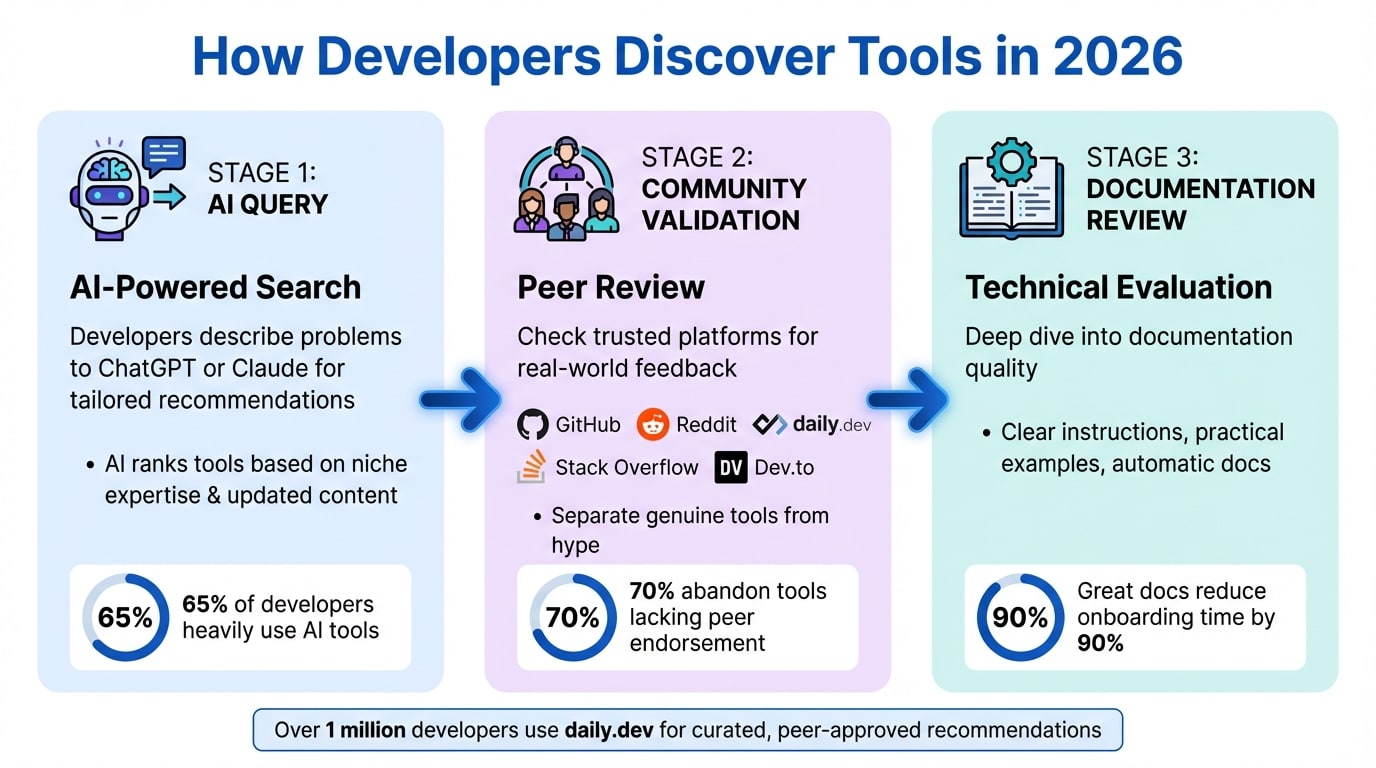
How Developers Discover Tools in 2026
The way developers find tools has evolved into a clear three-step process: starting with an AI-powered search, moving through community feedback, and ending with a close review of documentation. Each stage plays a key role - skipping one could mean losing the interest of potential users.
Stage 1: AI Query
Today, developers kick off their search by interacting with AI tools like ChatGPT or Claude. Instead of typing in generic keywords, they describe their specific challenges and receive customized suggestions, often including targeted tool recommendations. These AI tools pull from vast datasets and prioritize content that's easy to understand. As Karl Hughes from Draft.dev puts it:
Developer tool discovery has shifted to AI-powered search, requiring new optimization strategies.
Mentions on platforms like Reddit, Dev.to, and newsletters now heavily influence how AI ranks tools, with authority being judged on niche topics rather than broad backlink profiles. A Google Discover update from February 2026 has also made regularly updated content more visible than older material.
Once developers get AI-curated suggestions, the next step is checking with their peers for honest feedback.
Stage 2: Community Validation
After AI recommendations, developers turn to their communities for real-world insights. Whether it's developer forums, curated platforms, or social feeds, they look for candid reviews from peers who’ve already used the tools. This step helps them separate genuinely helpful tools from those that are all hype and no substance.
Stage 3: Documentation Review
The final step is diving into the tool's documentation to see if it meets their needs. Developers want thorough, automated, and clear documentation to minimize effort. Tools like FastAPI are often praised for their simplicity and features like automatic documentation and type validation. Ankita Tripathi highlights this:
FastAPI gives you that simplicity plus automatic documentation, type validation, async support.
Developers also appreciate detailed error messages and straightforward setup instructions. TheBitForge notes:
The documentation is excellent, error messages are clear, and the tooling is notably polished.
Strong typing and runtime validation in documentation not only reduce mistakes but also signal that a tool is well-developed and reliable.
Where Brands Lose Developers in the Discovery Process
Let’s break down the key moments where brands often fall short in connecting with developers. In today’s AI-driven discovery landscape, missing these critical elements can mean being overlooked - even if your tool is top-notch. It’s not just about effort; it’s about being present in the right places with the right kind of content.
Missing from AI Query Results
When developers turn to AI-powered assistants for tool recommendations, brands that haven’t optimized for this type of discovery simply don’t show up. Since Google’s February 2026 Discover Core Update, authority is now judged by subject area, not the entire domain. Brands spreading themselves thin across multiple topics often lose to those with deep expertise in specific technical niches .
Outdated content is another major issue. Even though 65% of developers heavily use AI tools, old tutorials or examples with deprecated code can make a brand irrelevant . AI tools also need well-structured content - think tables, FAQs, or self-contained sections - to properly extract and cite information. If your best technical resources are locked behind gates without a crawlable version, you’re essentially invisible to AI-driven search engines. Karl Hughes from Draft.dev highlights this shift:
Developer tool discovery has shifted to AI-powered search, requiring new optimization strategies: Topic-by-topic expertise now drives visibility.
Another red flag? Over-reliance on AI-generated content. AI-only material generates 5.4 times less traffic than human-written content. While 96% of developer marketing teams have tried using AI, only 7% find it "very useful" for polished publications .
But it’s not just about showing up in AI results. A lack of presence in developer communities is equally damaging.
Absent from Developer Communities
Developers trust peer recommendations far more than branded promotions. If your brand isn’t active on platforms like GitHub, Discord, Stack Overflow, or daily.dev, you’re missing out on the validation that drives adoption.
Large Language Models (LLMs) give extra weight to positive mentions on third-party platforms like Reddit, Dev.to, and newsletters, rather than traditional backlinks. Brands that focus only on their own domain miss out on these critical data points that AI uses to assess credibility.
Instead of “selling,” brands need to focus on enabling. Developers are looking for solutions to technical challenges, not advertisements. By contributing to open-source projects, offering valuable tools or sandboxes, and sharing educational content where developers already hang out, brands can build trust organically without being intrusive.
Even if you manage to appear in AI results and gain traction in communities, one thing can still derail your efforts: poor documentation.
Poor Documentation Experience
Bad documentation can be a dealbreaker. Developers expect high-quality tools to come with equally excellent documentation. Confusing or incomplete docs often signal a lack of attention to detail and quality.
Great documentation can make a huge difference - it’s been shown to reduce developer onboarding time by up to 90% . Yet, many brands still fall short by providing unclear instructions or failing to include practical examples. Developers want documentation that works for everyone, from beginners to seasoned experts.
Take FastAPI, for example. Its adoption surged by 40% in 2025, partly because it provides automatic documentation, cutting down the manual workload for developers . If your documentation forces users to jump between external sites or struggle to find what they need, they’re likely to abandon your tool for one that offers a smoother, more cohesive experience.
Why Community Validation Matters Now
Building on the earlier discussion about community validation, let's dive into why peer endorsement has become indispensable. In today's discovery process, where AI generates a flood of options in seconds, community validation helps cut through the noise. AI might suggest dozens of tools instantly, but without context, it’s hard to know which ones are actually worth your time. By 2026, developers are navigating an overwhelming sea of AI-generated suggestions. Without a way to filter out what's ineffective or unproven, they risk wasting time on tools that lack practical value or active user adoption. This is where community validation steps in - it answers the critical question AI can't: What are other developers actually using and recommending?
Consider this: surveys show that 70% of developers abandon tools that lack peer endorsement . That’s a huge drop-off, highlighting how AI often fails to provide insights into real-world adoption, reliability, or effectiveness. Developers lean on peer feedback to confirm whether a tool is truly worth integrating into their workflows.
Where Developers Look for Peer Signals
To make sense of AI-generated noise, developers turn to trusted spaces for peer insights. Platforms like GitHub, Stack Overflow, and Reddit have long been go-to sources, but curated feeds are now gaining traction. These feeds streamline the process by surfacing recommendations from trusted voices, saving developers from sifting through endless promotional content.
For example, when tools like LinearB or Postman appear in curated feeds backed by peer reviews, the validation comes from real-world data - case studies, improved workflows, and tangible time savings. Take CodeSandbox as an example: its cloud environments reportedly save developers over five hours a week . Stories like these, shared by peers, can transform a tool from being "interesting" to "must-try."
How daily.dev Fits the Validation Step
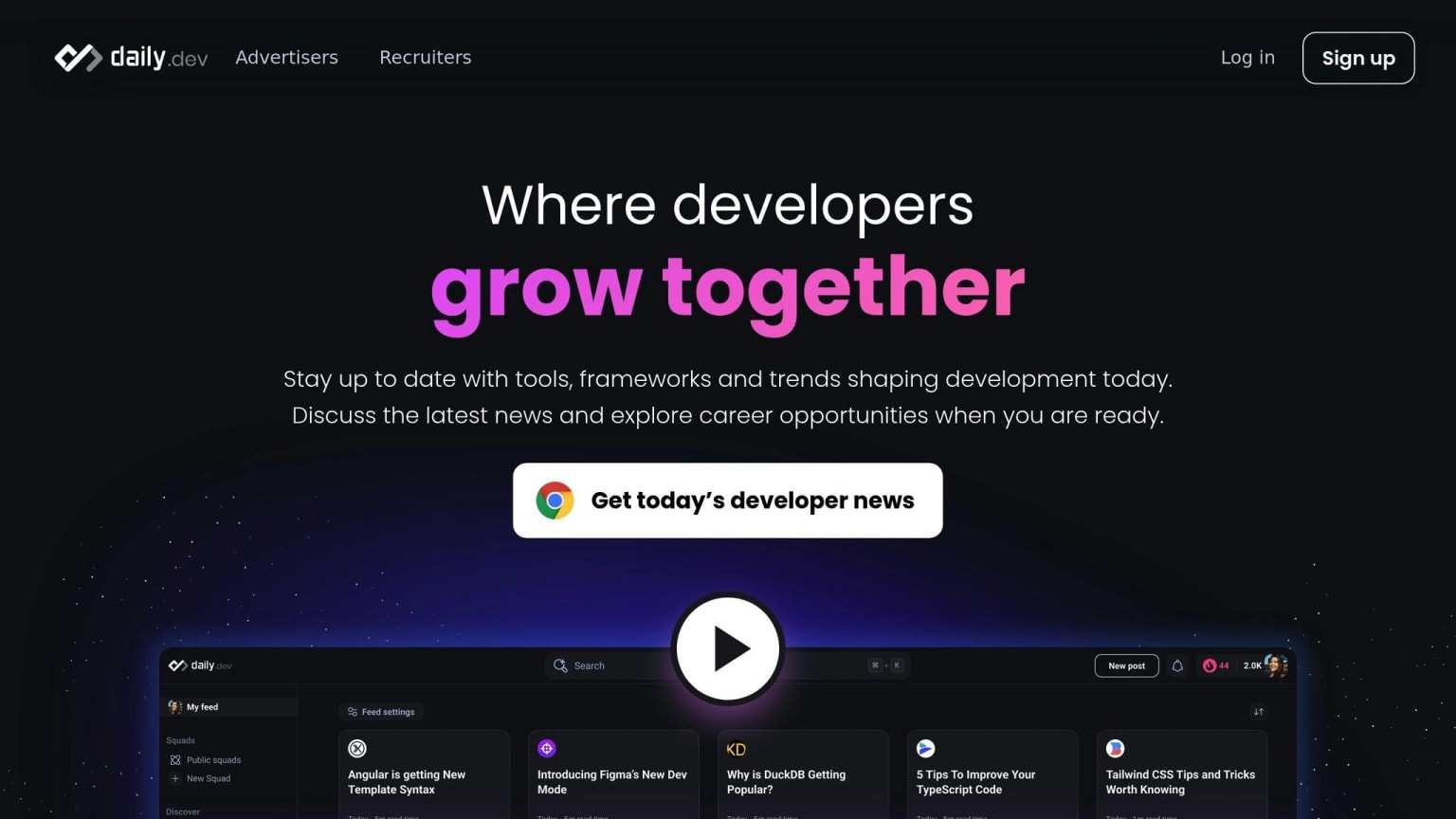
With over 1 million developers using daily.dev as their go-to resource for tools and trends , it has become a key part of the validation process. Whether as a browser extension or an app, daily.dev seamlessly integrates into a developer's workflow, delivering a personalized stream of peer-curated content. It’s designed to highlight essential, peer-approved recommendations without disrupting the discovery process.
The platform filters content based on engagement and relevance, cutting out promotional clutter and spotlighting tools backed by authentic community feedback. For instance, tools like GitHub Copilot, which boasts 55% faster coding speeds , or Sourcegraph gain credibility on daily.dev through real usage patterns and discussions, not just marketing hype. This ability to separate meaningful recommendations from fleeting AI suggestions cements daily.dev's role as a crucial part of the modern discovery process for developers.
How to Show Up on daily.dev
Daily.dev plays a key role in connecting with developers by offering opportunities to engage directly within their community. By leveraging the platform's tools, you can present your product or service in a way that seamlessly integrates into the developer's workflow. Native ad placements on daily.dev ensure your message reaches developers where they're already focused - on technical content and recommendations.
Using Native Ad Placements
Daily.dev offers three main ad formats designed to fit naturally into the developer experience:
- In-feed ads: These appear within the content stream, blending into the developer's browsing flow.
- Post page ads: These show up alongside articles that developers are actively reading.
- Personalized digest ads: These are included in curated email summaries sent to developers.
Each format is crafted to feel organic, avoiding interruptions while maintaining relevance. To make the most of these placements, focus on clear and direct messaging. Highlight the specific benefits of your tool right away. For example, if your product speeds up API testing or reduces deployment time, lead with that. This approach aligns with daily.dev's focus on context-driven, non-intrusive promotions.
Targeting by Developer Profile
Daily.dev allows you to target your audience with precision, based on factors like programming languages, seniority, and specific interests. For example, you can tailor your ads to developers working with Python, JavaScript, or Go, or target professionals at different seniority levels - junior, mid-level, senior, or staff. The platform also uses behavioral data, such as content engagement patterns and tool preferences, to ensure your ads appear when developers are actively exploring solutions in your category.
The audience planner tool helps you refine these parameters before launching your campaign. By narrowing down your audience, you ensure your budget is spent on reaching developers who are most likely to benefit from your offering.
Running Effective Campaigns
Testing and optimization are key to running a successful campaign. Use split testing to experiment with different technical headlines and creative elements. Structure your ad copy and landing pages in a "Problem, Solution, Value" format:
- Identify the pain point.
- Show how your tool solves it.
- Clearly highlight the benefit.
Since many developers use daily.dev on mobile devices, ensure your ads and landing pages are optimized for mobile. Keep a close eye on performance metrics and make adjustments in real time.
As Daphna Giniger from daily.dev explains:
Developer marketing only works when the product delivers immediate, obvious value. No landing page, brand campaign, or 'community strategy' can cover for a bad product experience.
Your campaign should lead to a quick win for the developer - whether that's through a demo, a working code snippet, or a trial that immediately addresses their problem .
Conclusion
Today, developers often start with AI queries, confirm their options through community feedback, and make final decisions by diving into documentation. This guide has outlined how aligning with these stages - AI tools, community input, and documentation - keeps your brand relevant and visible.
Community validation has become a cornerstone of this process. Platforms like daily.dev, trusted by over a million developers to surface key recommendations, play a pivotal role in this phase . If your brand isn’t appearing in these curated feeds, you risk being overlooked during the critical evaluation stage - when developers are deciding what to try next.
Native ad placements on daily.dev offer a way to connect with developers at this decisive moment. These ads position your tool as a peer-endorsed solution that seamlessly fits into their workflow. By embedding your brand in trusted spaces like this, you strengthen your presence across every step of the developer journey.
The brands making waves in 2026 are those that optimized for AI visibility, established themselves in developer communities, and ensured their documentation was ready when developers sought answers. Platforms like daily.dev bridge the crucial community validation gap, often determining whether a tool gets adopted or ignored.
To stay ahead in 2026, position your brand where developers are already looking.
FAQs
How do I make AI tools recommend my developer product?
To have AI tools recommend your product, you need to make it a natural part of the developer discovery process. Start by creating detailed, high-quality content - think tutorials, guides, and comprehensive documentation - that AI models can easily find and use as references. Beyond that, immerse yourself in developer communities. Authentic engagement in these spaces helps build trust and credibility, which is key. Developers often rely on peer recommendations, so being active and visible in these communities increases the likelihood of both AI and developer-driven endorsements.
What peer signals make developers trust a new tool?
Developers tend to trust new tools when they witness community validation. This often comes in the form of peer recommendations, active participation in forums or open-source projects, and open, honest communication about the tool's strengths and limitations. These elements work together to build credibility and show how the tool performs in practical, everyday use.
What docs content most impacts trial and adoption?
Documentation that encourages trial and adoption should include step-by-step tutorials, practical use case examples, and comprehensive technical guides. These resources not only help developers trust the product but also show how it addresses real-world challenges while offering opportunities for hands-on exploration.