

Developers are the key to your API's success. To attract and retain them, focus on these essentials:
- Clear Documentation: Developers need to make their first API call quickly. Offer step-by-step guides, code examples in multiple languages, and interactive sandboxes.
- Smooth Integration: Provide SDKs for popular languages, clear error messages, and transparent rate limits to simplify their workflow.
- Targeted Visibility: Advertise on platforms like daily.dev to reach developers where they already are. Use native ads for better engagement and track performance in real-time.
- Developer-Centric Marketing: Create technical content that solves problems, offer quickstart guides, and showcase success stories to build credibility.
- Responsive Support: Offer live chat, forums, and regular office hours to assist developers and keep them engaged.
The secret? Make their first interaction easy and their ongoing experience frictionless. When developers succeed with your API, they’ll spread the word.
::: @figure 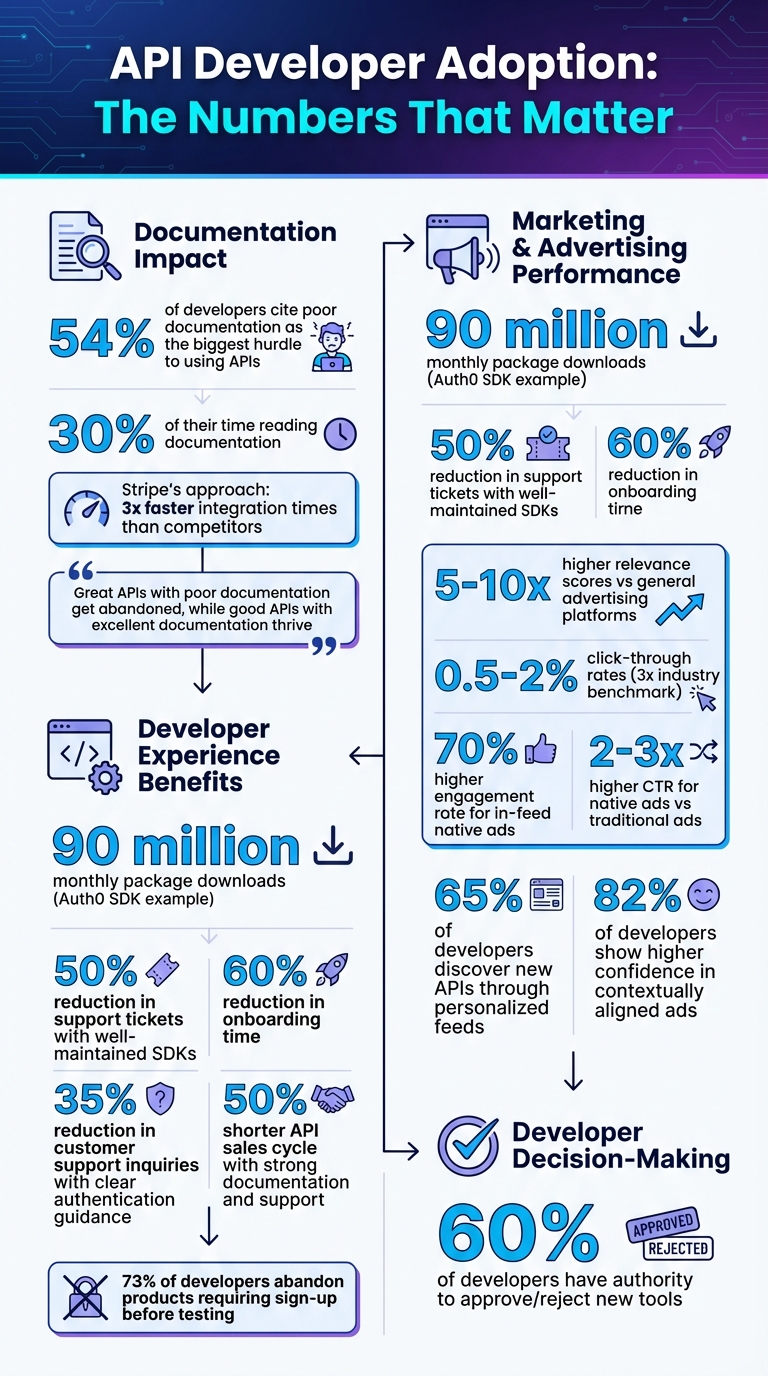 {API Developer Adoption: Key Statistics and Impact Metrics}
Create Clear API Documentation
When developers first encounter your API, the documentation is often their introduction. And if it’s not up to par, you risk losing them. In fact, 54% of developers cite poor documentation as the biggest hurdle to using APIs . If they can’t make that first API call quickly, they’re likely to move on. Your goal? Make that first call happen within minutes. Jessica Jansasoy, SEO Content Strategist at ReadMe, sums it up perfectly:
"Your API documentation has one crucial job: getting developers to their first successful API call as quickly as possible."
Developers spend about 30% of their time reading documentation . So, every second you save them counts. As the Docuweave team points out:
"Great APIs with poor documentation get abandoned, while good APIs with excellent documentation thrive."
Write Step-by-Step Guides and Tutorials
Your documentation should enable developers to achieve a successful API call in just five minutes. A quickstart guide is key here - include a working code snippet that delivers a successful request almost immediately after they land on your page.
Instead of breaking down endpoints in isolation, focus on complete workflows. For instance, rather than documenting payment endpoints separately, provide a guide like "How to process a payment from start to finish." This approach connects the dots, showing how different API calls work together and what decisions developers will face along the way.
A great example of this is Twilio’s documentation, which set a standard in 2025 with their "5-minute quickstarts." These guides include runnable code examples in over seven programming languages, complete with actual HTTP requests and responses, so developers can confirm their work instantly .
Provide Code Examples in Multiple Languages
Developers appreciate ready-to-use, copy-paste code snippets. Include examples in popular languages like JavaScript, Python, Java, PHP, and Ruby, and ensure they come with all necessary imports, setup instructions, and realistic sample data (e.g., "user_123" or "jane@example.com") to clarify expected formats.
Take inspiration from Stripe’s API documentation, which, as of November 2025, offers fully functional code snippets preloaded with test credentials. This approach has reportedly made their integration times three times faster than their competitors .
Add Interactive API Explorers and Sandboxes
Interactive features like "try-it-out" tools are a game-changer. They let developers make live API calls directly from their browser in a sandbox environment, providing instant feedback without requiring any local setup.
Each endpoint page should act as a standalone entry point, including embedded authentication details, base URLs, and testing tools . For added convenience, allow developers to modify API keys directly within the documentation .
For example, ApyHub, an API marketplace, takes this a step further with interactive API consoles and a credit system called "API Atoms." This system helps developers test and manage variable usage costs for resource-heavy APIs like those involving AI or large datasets .
Great documentation doesn’t just help developers get started - it lays the groundwork for a seamless experience and strengthens your API’s appeal in the long run.
Improve the Developer Experience
Great documentation might get developers interested, but a smooth integration process is what keeps them engaged. Even with flawless docs, developers will walk away if using your API feels like a hassle. The key is to eliminate barriers at every stage - from writing the first line of code to resolving errors in production. Building on strong documentation, these strategies help ensure developers have a frustration-free experience.
Offer Official SDKs and Libraries
SDKs serve as a crucial link between your API and developers. Without them, developers are left to wrestle with raw HTTP requests and complex authentication flows . For instance, Auth0 by Okta supports 12 programming languages and offers over 45 open-source SDK libraries, with 90 million monthly package downloads on NPM alone .
SDKs simplify and speed up integration. They cut down "Time to Hello World" (TTHW) - the time it takes to make that first successful API call - by automating tasks like token management, retries, and error handling . Martin Walsh, Director of Engineering at Auth0, emphasizes:
"A delightful developer experience revolves around providing an intuitive, idiomatic experience that allows for seamless integration with minimal code."
Distribute SDKs through popular package managers like npm (JavaScript), PyPI (Python), CocoaPods (Swift), or NuGet (.NET) . Make sure your SDKs follow the conventions of each programming language for an effortless developer experience. Companies that invest in well-maintained SDKs and developer portals often see a 50% drop in support tickets and can reduce onboarding time by up to 60% .
Write Clear Error Messages and Rate Limits
When things go wrong, error messages should guide developers toward solutions - not leave them confused and stuck. Jessica Jansasoy, SEO Content Strategist at ReadMe, puts it best:
"Error messages shouldn't just tell developers they've hit a wall. They should help them find a path around it."
Good error messages answer three key questions: What went wrong? Why did it happen? How can it be fixed? Use standard HTTP status codes (like 400, 401, 403, 404, 500) for quick context, and include specific subcodes like invalid_api_key for more detailed debugging . Add a unique request_id in every error response so your support team can easily trace issues in logs .
For rate limits, clarity is essential. Clearly outline your policies and implement specific exception classes in your SDKs - such as XeroRateLimitException - to help developers apply "backoff and retry" logic effectively . Provide separate, reasonable limits for sandbox environments to allow safe experimentation while protecting your infrastructure . Thoughtful error handling naturally ties into the importance of accessible support.
Set Up Responsive Support Channels
Even with robust SDKs and clear error messages, developers will sometimes need extra help. Responsive support can make the difference between a developer sticking with your API or abandoning it altogether. In fact, strong documentation and support can shorten the API sales cycle by up to 50%, while clear guidance on authentication alone can reduce customer support inquiries by 35% .
Offer a variety of support options to fit different needs. Use live chat or Slack for urgent issues, developer forums for searchable, ongoing discussions, and Stack Overflow for public, technical questions that benefit from community input . Nick Lloyd from Apideck highlights the value of support in developer relations:
"Developer relations provides a path for additional support, greatly supporting the developer journey and improving DX."
You might also consider hosting regular office hours where API experts can assist developers with complex challenges in real time . Keep an eye on platforms like Stack Overflow and Reddit to offer help even when developers don’t directly reach out . And remember, 73% of developers will abandon a product if they’re required to sign up before testing it . Make sure your support channels are accessible from the start.
Advertise Your API on Developer Platforms
Having excellent documentation and a smooth integration process is just the start - developers need to know your API exists. Without visibility, even the best API will struggle to gain traction. That’s where targeted advertising comes in. By promoting your API on platforms where developers already spend time, you can connect with the right audience looking for solutions.
Run Targeted Campaigns on daily.dev Ads
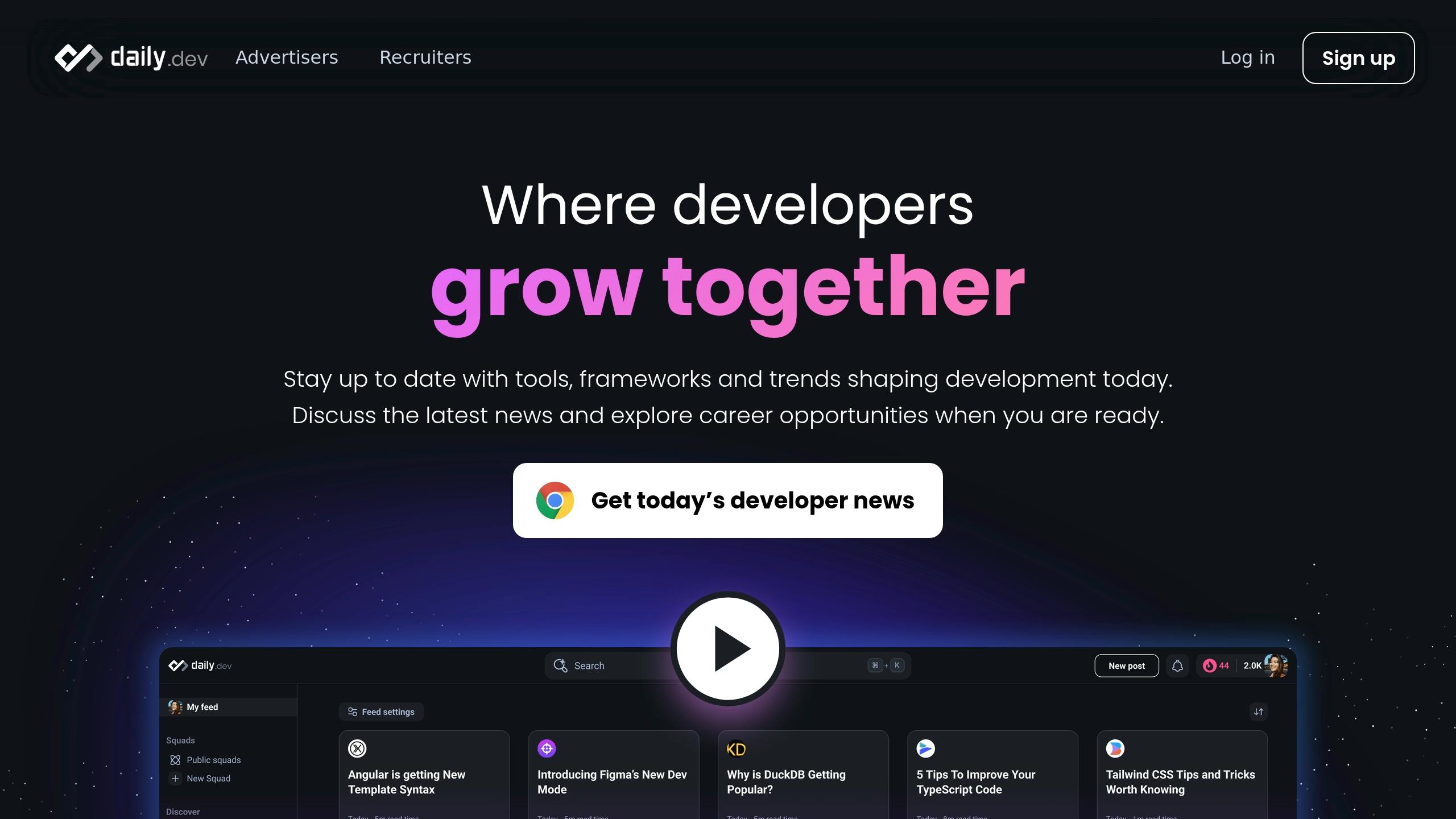
daily.dev Ads is a platform that puts your API in front of over 1 million developers worldwide who use it to stay updated on tech news and tools . Unlike broader advertising platforms, daily.dev allows you to target developers based on their seniority level (junior, mid, senior), the technologies and tools they use (like Node.js or React), and their preferred programming languages (such as JavaScript or Python) . This level of precision ensures your API reaches the developers most likely to integrate it into their projects.
For instance, a SaaS company promoting a payment API targeted senior JavaScript developers, leading to a 25% increase in API sign-ups within the first month . Similarly, a data analytics API campaign aimed at Python developers in the machine learning space saw a 40% boost in trial registrations with personalized ad creatives emphasizing quick integration . Campaigns on daily.dev often achieve 5-10x higher relevance scores compared to general advertising platforms, with click-through rates averaging 0.5-2%, which is three times the industry benchmark for tech ads .
These targeted campaigns allow you to deliver ads that feel more like helpful recommendations than interruptions.
Use Native Ad Placements for Better Results
Native ads on daily.dev fit naturally into developers’ feeds, making them less intrusive and more engaging. In-feed ads appear directly within personalized news feeds, reaching developers during their regular content browsing with a 70% higher engagement rate . Post-page ads, on the other hand, appear after relevant articles - like those about API best practices - positioning your API as the logical next step. This approach builds trust, with 82% of developers expressing higher confidence in ads that align with the content they’re already consuming .
Because native ads feel like part of the browsing experience, they deliver 2-3x higher click-through rates compared to traditional ads. In fact, 65% of developers discover new APIs through personalized feeds on platforms like daily.dev . To make the most of these placements, keep your messaging technical and straightforward. Developers respond well to code snippets and practical problem-solving rather than flashy marketing language.
To maximize the impact of native ads, you’ll need to monitor their performance closely - something we’ll dive into next.
Monitor Campaign Performance in Real-Time
daily.dev Ads offers real-time dashboards to track metrics like impressions, clicks, conversions (e.g., API key requests), cost-per-acquisition, and audience demographics . This constant flow of data lets you make immediate adjustments, such as pausing underperforming ads or reallocating your budget to better-performing segments. For example, one campaign shifted its focus from broad targeting to specific programming languages, resulting in 2x better ROI . Another campaign tweaked ad creatives mid-run based on engagement data, driving a 35% increase in sign-ups while cutting costs by 20% .
To measure true adoption, focus on developer-specific metrics like API calls and SDK downloads rather than just clicks. Tools like UTM tracking and API sign-up pixels can help you track direct ROI from developer registrations. A/B testing is also crucial - ads featuring code snippets or “5-minute integration” hooks often perform best. By continuously analyzing and refining your campaigns, you can make the most of your advertising budget and ensure your API reaches the right audience.
Build a Marketing Funnel for Developers
Developer marketing funnels don’t follow the same playbook as traditional sales funnels. Developers are a unique audience - they want tools that work and hands-on proof that your API can solve their specific challenges . Forget the typical awareness–consideration–conversion model. Most developers already know the problem they’re tackling, so your role is to establish credibility in the spaces they already frequent . The focus should be on guiding developers to discover, evaluate, and adopt your API through education and trust - not hard selling.
The middle stages of the funnel matter most here . Let developers test your API in real-world scenarios using sandboxes and sample code before they commit . As Advocu explains:
"When developers decide to adopt a tool, they're committing to hours, maybe days, of testing, integrating, and ultimately relying on it... It marks the start of a lasting integration."
By creating a seamless developer experience, your funnel can effectively move developers from discovery to active usage.
Create Content for the Awareness Stage
At this stage, your goal is to meet developers where they’re already searching for answers. This means crafting SEO-friendly blog posts that address specific technical problems, like “how to integrate a payment gateway in Python” or “best API for real-time data streaming” . Developers trust platforms like Google, YouTube, Reddit, and GitHub, so focus on these spaces. Avoid generic content like “Introduction to APIs,” which might attract the wrong audience. Instead, write content tailored to developers actively seeking solutions your API provides .
Your content should inform, not sell. As EveryDeveloper puts it:
"Technical products need marketing, but the audience doesn't want it to feel like marketing."
Skip the fluff. Developers value tutorials, technical guides, and FAQs that showcase expertise. Pair this with solid technical documentation to highlight your API’s practical advantages. Tools like Syften or F5bot can help you monitor Reddit or Hacker News for questions your API can answer. Jump into those discussions with helpful responses . On GitHub, optimize your repositories by fine-tuning names, descriptions, and tags so developers can easily find your SDKs and sample code .
Help Developers Get Started and Stay Active
Once developers find your API, the next step is making their first interaction smooth and fast. Aim to reduce the time from sign-up to the first successful API call to just a few minutes . Offer quickstart guides with code snippets in multiple programming languages and provide interactive sandboxes so developers can test your API without needing to install anything locally .
To keep developers engaged long-term, ensure you have idiomatic SDKs that feel natural in their preferred programming languages. Offer detailed reference documentation and maintain responsive support channels, such as Slack or Discord . Place actionable buttons like “Get API Key” or “Create Account” directly within your documentation - developers reading your docs are already highly interested . You could also follow Supabase’s example and host “Launch Weeks,” where you bundle feature updates into a series of daily announcements to generate excitement and keep your community engaged .
Once developers are onboard, showcasing peer validation can strengthen their commitment.
Share Success Stories and Case Studies
Trust grows when developers see others succeed with your API. Share real-world examples and case studies that demonstrate how your API helped solve specific problems . Highlight community-built projects and user-generated content through developer advocates to lend authenticity . Since 60% of developers have the authority to approve or reject new tools , proof of success can often tip the scales in your favor.
Cater to developers at different skill levels by layering your content. Start with easy-to-follow tutorials for beginners, and provide in-depth technical documentation or advanced repositories for experienced users . Use empathetic messaging by framing solutions around their challenges. Instead of saying, “This tool will help you solve X,” try, “You can use this tool to fix X,” keeping the focus on their control . Remember, developers are problem-solvers. If your API helps them tackle real-world issues, you’ll earn their trust and loyalty .
Conclusion
To boost API adoption, focus on clear documentation, an easy developer experience, targeted ads (like daily.dev), and a well-structured marketing funnel. These elements need to work together to ensure developers can adopt your API effortlessly.
But success doesn't stop there. The real game-changer is measuring what truly matters. As Derric Gilling, Co-founder & CEO of Moesif, explains:
"No longer can you just measure vanity metrics like pageviews and signups. Instead, you should be measuring the entire funnel and understand the inputs that impact each stage" .
Make "Time to First API Call" your guiding metric, and dive deeper into the funnel. Don't just count account signups - track meaningful actions, like developers making multiple transactions or exploring advanced features.
A great first experience is the cornerstone of developer advocacy. Prashant Sridharan, a developer marketing expert, sums it up perfectly:
"A developer who has a great first experience is your most valuable marketing channel. They'll tell other developers" .
Reducing onboarding friction, writing helpful error messages, and responding promptly to support requests aren't just support tasks - they're marketing investments that grow in value over time.
FAQs
What should I measure beyond sign-ups?
When evaluating your API's success, don't stop at sign-up numbers. Instead, prioritize metrics that reveal how developers are actually engaging with your API. Look at data like API call frequency, the extent to which various features are being used, and how quickly developers transition from signing up to actively using your API in a meaningful way.
Other critical metrics include tracking the number of active developers, monitoring retention rates, and analyzing the quality of feedback or support requests. These insights help you understand whether your API is providing genuine value and becoming an integral part of developers' projects.
How do I cut time to first API call fast?
To speed up the time it takes for developers to make their first API call, focus on making onboarding simple and user-friendly. Developers should immediately understand what your API does, find the starting point effortlessly, and complete both signup and their first call in just a few minutes.
Here’s how to make that happen:
- Clear Homepage: Make sure your homepage clearly communicates the API's purpose and value.
- Easy Signup: Offer a straightforward signup process, such as third-party authentication through platforms like Google or GitHub.
- Quick-Start Guides: Provide concise, step-by-step guides to help developers get started without wading through unnecessary details.
- Well-Structured Documentation: Organize your documentation so developers can quickly find what they need.
- Interactive Tools: Include features like API sandboxes or live demos to let users test your API in real time without heavy setup.
By focusing on these elements, you’ll create a smooth experience that helps developers go from signup to success in no time.
What SDKs should I build first?
When building SDKs, begin by focusing on the programming languages your target developer community uses the most. For example, TypeScript, Python, Go, Java, or C# are often good starting points. The key is to choose languages that are widely adopted in your industry or are already favored by your API users.
To make the process smoother, consider using SDK generation tools. These tools not only save time but also help you produce code that is type-safe, follows best practices for each language, and feels natural for developers working in those ecosystems. This way, you can deliver high-quality SDKs across multiple languages without reinventing the wheel.