

Launching a developer tool is different from traditional software. Developers value hands-on experience, technical validation, and community recommendations over sales tactics. Here’s what matters most:
- How Developers Discover Tools: Only 5.4% respond to cold emails, but 52% rely on "dark social" channels like Slack, Discord, and internal wikis.
- Key Metrics: Product Qualified Leads (PQLs) convert 3-5x better than Marketing Qualified Leads (MQLs). Tracking success is a challenge - 89% of companies struggle to measure their developer-focused strategies.
- Effective GTM Models:
- Product-Led Growth (PLG): Ideal for tools under $10K annual value, focusing on self-serve onboarding and high-quality documentation.
- Sales-Led Growth: Works for high-value contracts ($25K+), requiring tailored onboarding and enterprise-level support.
- Community-Led Growth: Builds trust through open-source projects and active developer communities.
- Hybrid: Combines PLG, community, and sales to scale from individuals to enterprises.
Pre-Launch Tips: Use waitlists, beta programs, and open-source previews to build anticipation. Platforms like GitHub and Hacker News are critical for early traction.
Launch Day Strategy: Coordinate across Product Hunt, Reddit, Hacker News, and email lists. Use concise, technical demos to engage developers.
Post-Launch Focus: Maintain momentum with consistent content, community engagement, and targeted ads. Pricing strategies should balance free tiers, usage-based, and enterprise options.
The key takeaway? Developers prioritize functionality, trust, and usability. Align your GTM strategy with these values to build lasting success.
4 GTM Approaches for Developer Tools
::: @figure 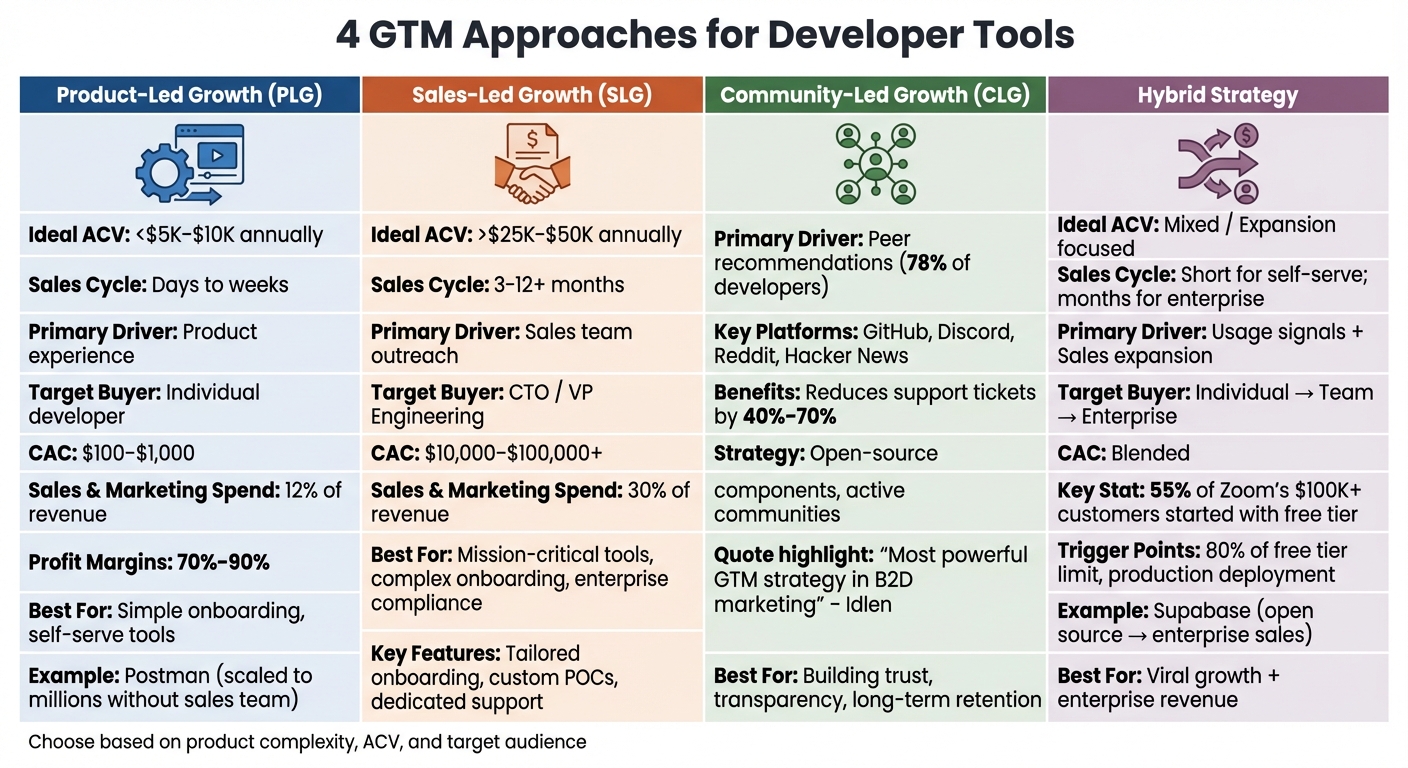 {Comparison of 4 Go-to-Market Strategies for Developer Tools}
Choosing the right go-to-market (GTM) strategy can make a huge difference when launching developer tools. Successful companies often align their approach with factors like product complexity, target audience size, and growth stage. Let’s break down four common GTM models and when they work best.
Product-Led Growth (PLG)
In a product-led growth model, the product essentially sells itself. Developers can sign up, integrate the tool, and see its value immediately - think one-click GitHub integrations or instant API access with working code samples. The idea is to remove every obstacle between a developer discovering your product and actually using it.
This approach is cost-effective. Companies using self-serve GTM spend just 12% of revenue on sales and marketing, compared to 30% for traditional sales models . Customer acquisition costs (CAC) range from $100 to $1,000, with profit margins reaching 70% to 90% . For instance, Postman scaled to millions of users without a dedicated sales team, relying on developers to organically discover and share the platform . Similarly, Cursor, an AI-powered code editor, hit over $100 million in revenue using a freemium model and PLG .
PLG is ideal for tools with an annual contract value (ACV) under $5,000 to $10,000, where onboarding is simple, and individual developers can adopt the tool without needing approval from higher-ups . High-quality documentation plays a critical role here - developers judge a tool by how quickly they can start using it .
For tools with higher ACVs or more complex onboarding, a sales-led approach might be more appropriate.
Sales-Led Growth
Sales-led growth focuses on personalized experiences like tailored onboarding, custom proofs-of-concept, and dedicated support to close larger deals. This model works well for products with ACVs exceeding $25,000 to $50,000 annually, longer sales cycles, and decision-makers like CTOs or VPs of Engineering .
This approach is particularly effective for mission-critical tools - especially in industries like FinTech - where navigating procurement processes, security reviews, and compliance requirements is essential. Here, the sales team acts as a trusted advisor, helping technical leaders integrate the product into their systems while addressing any concerns during extended evaluation periods.
When complemented by peer recommendations, this strategy can gain even more momentum, paving the way for a community-led approach.
Community-Led Growth
Community-led growth relies on fostering a user community to drive acquisition and retention. Instead of relying on traditional marketing, this approach creates spaces where developers can collaborate, share insights, and advocate for the product. Peer recommendations play a huge role, with 78% of developers citing them as their primary discovery channel .
"Community-Led Growth (CLG) has emerged as the most powerful go-to-market strategy in B2D marketing - outperforming product-led growth, sales-led growth, and marketing-led growth in terms of retention, expansion, and long-term defensibility."
- Idlen
Open-sourcing parts of your product is a common tactic here, as it builds trust and transparency - key concerns for developers wary of vendor lock-in. Active communities can also ease the burden on support teams, reducing technical support tickets by 40% to 70% . Platforms like GitHub, Discord, Reddit, and Hacker News are crucial for building and maintaining these communities.
Hybrid Strategies
Many successful developer tools combine multiple GTM strategies to scale effectively. A hybrid approach often starts with PLG or community-led growth to drive organic adoption, then layers in a sales model to capture enterprise opportunities. Supabase is a great example - they gained traction through open source and self-serve onboarding, then added enterprise sales to convert high-usage accounts into six-figure contracts.
A key part of hybrid strategies is leveraging product usage data. For instance, when users hit 80% of a free tier limit or deploy to production, it can trigger targeted conversations about enterprise plans . Zoom’s S-1 filing revealed that 55% of customers generating over $100,000 in annual revenue started with a free host . This approach combines the viral growth of PLG with the revenue potential of targeted sales efforts.
| Factor | Product-Led (PLG) | Sales-Led (SLG) | Hybrid |
|---|---|---|---|
| Ideal ACV | <$5K–$10K annually | >$25K–$50K annually | Mixed / Expansion focused |
| Sales Cycle | Days to weeks | 3–12+ months | Short for self-serve; months for enterprise |
| Primary Driver | Product experience | Sales team outreach | Usage signals + Sales expansion |
| Target Buyer | Individual developer | CTO / VP Engineering | Individual → Team → Enterprise |
| CAC | $100–$1,000 | $10,000–$100,000+ | Blended |
Hybrid strategies shine when your product delivers immediate value to individual developers while scaling seamlessly across teams or organizations. It’s a way to harness PLG’s viral growth while capturing the revenue potential of enterprise sales.
sbb-itb-e54ba74
Pre-Launch: Building Anticipation
The pre-launch phase is a crucial part of any go-to-market (GTM) strategy for developer tools. It sets the stage for a successful launch by generating interest and gathering useful feedback. Whether you're aiming for a quiet start or a buzz-filled debut, this phase can make all the difference.
Setting Up Waitlists and Beta Programs
Developers aren't drawn to generic "sign up for updates" forms. They want something immediate and valuable. To catch their attention, offer perks like early access, exclusive pricing, or sneak peeks of your product.
Focus on highlighting a standout feature - something that grabs attention instantly. As Virgil Dean from Poindeo wisely notes:
"The concept of MVP (Minimum Viable Product) is dangerous for a launch. 'Viable' means it works. 'Loveable' means people want to share it" .
For example, Dub.co, an open-source link management tool, created a "Coming Soon" page on Product Hunt just a week before their official launch. This simple move, combined with an email to their 25,000+ subscribers, brought in 663 new signups on launch day . Timing is key - launch your teaser page exactly seven days before the big day to maximize your "Notify Me" list.
To test your product's appeal, spend $100 on Google Ads and check if your landing page converts at over 30%. A conversion rate above 30% indicates strong interest in your tool . Once users sign up, follow up immediately with a welcome email series (3-5 emails). Including a GIF or short video of your product in action can significantly boost click-through rates .
For beta recruitment, personalized outreach is far more effective than bulk emails. Tools like Loom let you send personalized video messages to developers who’ve shown interest in your project. This approach often achieves nearly 100% open rates, far outperforming standard text-based emails . Sweeten the deal with meaningful incentives, like lifetime discounts or free access for a few months, to turn beta testers into loyal advocates .
During the beta phase, conduct 15 to 20 customer interviews to confirm that your product solves a problem developers are willing to pay for . Save positive feedback - whether in video testimonials or screenshots - and use it to create a "Wall of Love" for your launch page . High-quality video demos can also boost conversions by 20% to 30%, compared to static images .
Next, consider using open-source previews to lower the barriers for entry.
Using Open Source Previews
Open-source tools naturally build trust by being transparent and community-driven. Instead of unveiling a fully-featured product, start with a small, highly valuable component that solves a specific problem exceptionally well.
Take ChartDB, for instance. In early 2026, co-founder Jonathan Fishner shifted focus from a complex AI database client to a simple open-source database visualization tool. By releasing this tool on GitHub with zero sign-up requirements, they attracted 250,000 users and 21,000 GitHub stars - all without spending a dime on ads. This strategy eventually led to over $9,000 in monthly recurring revenue .
The secret? Removing friction. Fishner explains:
"Reduction of friction is the key to providing engagement from developers. If they can't see the value in 30 seconds, they are gone" .
For ChartDB, this meant enabling users to run scripts locally and export schemas without sharing sensitive credentials - keeping their data private.
Treat your GitHub repository like a marketing tool. Star counts signal credibility to developers searching for solutions . Use your open-source preview to gather feedback and bug reports, and respond quickly to build trust. Instead of vague promises about updates, share short videos showing new features or fixes. These "Feature Drops" keep your community engaged and excited .
Finally, build momentum by showcasing your progress on Hacker News.
Teasing on Hacker News
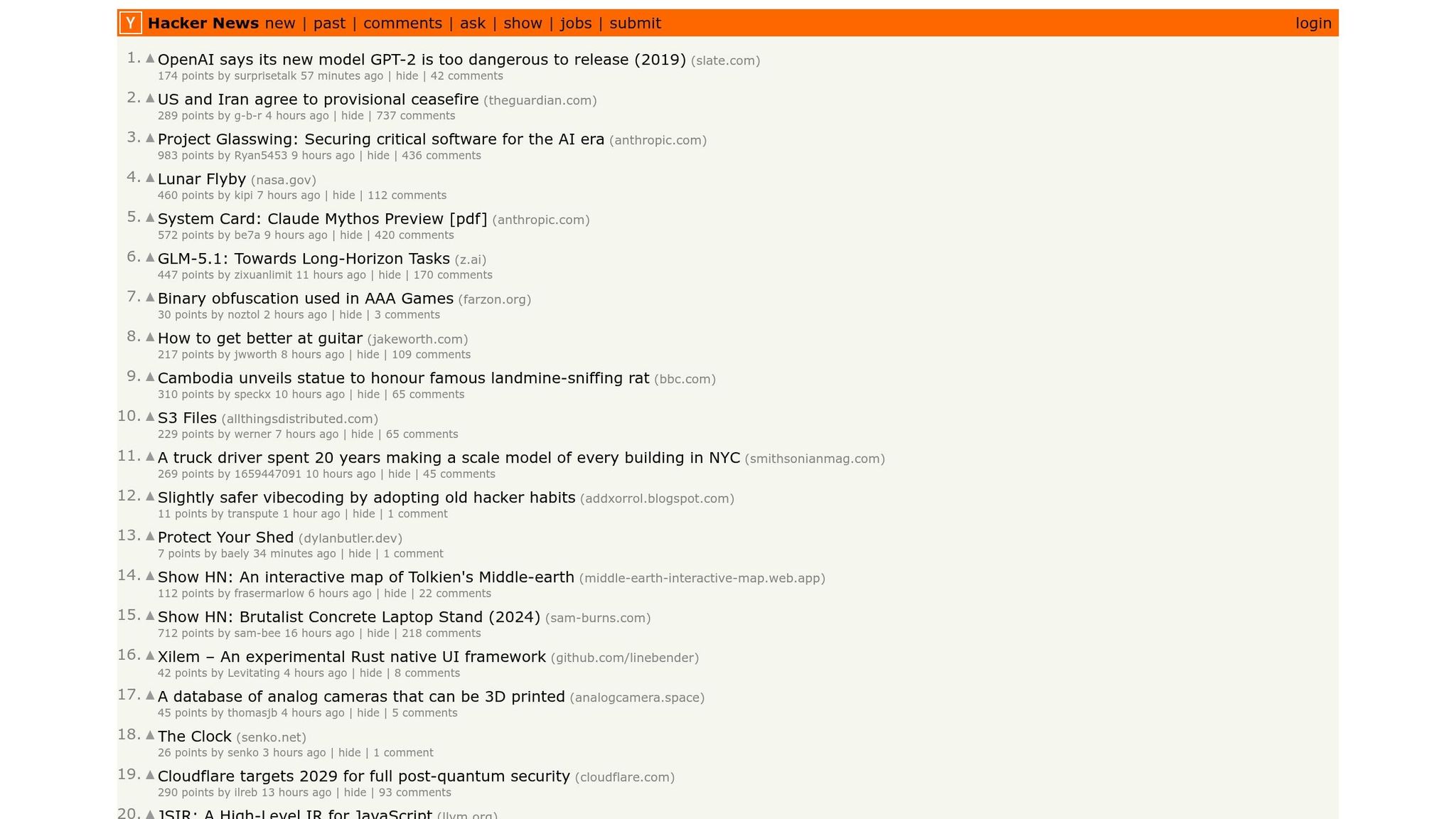
Hacker News can bring thousands of visitors to your site in mere hours - if you play by its rules. Avoid marketing-heavy language and focus on presenting your tool as a resource, not a sales pitch.
Use the "Show HN" format: "Show HN: [Product Name] – [Brief Description]" . Be clear and straightforward - technical audiences appreciate transparency over hype. Post during U.S. business hours for maximum visibility, and stay active in the comments to answer questions and address feedback .
When posting, include a "Maker's Comment" describing your technical approach, backstory, and tech stack . Developers value honesty and enjoy learning about the challenges you faced. As Fishner puts it:
"The homepage is where so many developers every day going and checking those launches. It is the ultimate distribution engine for the developer economy" .
Don't manipulate votes. Hacker News has algorithms to detect and suppress posts that use "vote rings." Instead, focus on creating something genuinely interesting. Share honest accounts of your experiences, including challenges or failures - developers respect authenticity and are more likely to engage with your content .
| Pre-Launch Phase | Focus Activity | Key Asset |
|---|---|---|
| Foundations (Days 1-7) | Define "Minimum Loveable Product" | Visual Hook/Teaser Video |
| Distribution (Days 8-14) | "Feature Drops" & Community Outreach | GitHub Repo / "Coming Soon" Page |
| Engagement (Days 15-22) | Recruit Beta Testers | Personal Video DMs / Testimonials |
| Final Hype (Days 23-30) | Polish Demo & Send Email Blast | High-Quality Screen Recording |
Launch Day Playbook
Launch day is a whirlwind 24-hour campaign that spans multiple platforms. Developers are active on various channels, so timing and tailored messaging are key. A well-executed multi-channel strategy can bring in 5–6× more users compared to sticking to just one platform .
Coordinating Multi-Platform Announcements
Kick things off at 12:01 AM PT on Product Hunt. This timing ensures you maximize the 24-hour voting period. The first hour is critical - early upvotes carry about 4× more weight in the algorithm, so secure those votes early . Post your "Maker's Comment" with details about your product's technical approach, backstory, and a special offer for the community.
By 6:00–6:30 AM PT, send your launch email to your waitlist. At 9:00 AM PT, share your story on LinkedIn about building your product, followed by posts on Indie Hackers and relevant subreddits like r/SaaS. Frame your Reddit post as a feedback request, such as: "I built [Product] to solve [Problem] (feedback welcome)."
For Hacker News, use the "Show HN" format and post between 2:00–3:00 PM PT to capture evening traffic in the U.S. Avoid marketing-heavy language here; the community tends to downvote anything that feels like a sales pitch. Keep the momentum going throughout the day with 5–7 updates on Twitter/X, celebrating milestones like "Just hit top 5 on Product Hunt!"
A great example of this strategy in action is Dub.co. They achieved the #1 Product of the Day spot with 1,085 upvotes and gained 663 new signups .
| Platform | Posting Time (PT) | Content Focus |
|---|---|---|
| Product Hunt | 12:01 AM | High-quality visuals, Maker's story, community deal |
| Email List | 6:00–6:30 AM | Warm leads and existing supporters |
| 9:00 AM | Personal journey and "Building in Public" updates | |
| 10:00–11:00 AM | Problem/solution narrative and feedback requests | |
| Hacker News | 2:00–3:00 PM | Technical depth using "Show HN" format |
| Twitter/X | Throughout the day | Real-time milestone updates and social proof |
By coordinating these actions, you maintain visibility across the platforms developers rely on to discover and evaluate new tools. Fine-tune your content and timing to match their preference for direct, technical demonstrations.
Timing and Content for Technical Audiences
Developers want to see products in action. Use high-quality video demos (under 60 seconds), GIFs showcasing specific features, and code examples to highlight technical depth. Well-polished video demos can increase conversions by 20–30% .
Keep your tagline concise - under 60 characters - and focus on a specific benefit instead of vague buzzwords. For example, instead of "AI-powered developer productivity platform", say, "Track time without starting a timer." This approach resonates with developers who prioritize practical, problem-solving tools. As InfiniteAny aptly states:
"The market does not care how you built your product... The market cares about one thing - does this solve my problem better than the alternative?"
Engagement is just as important. A single thoughtful comment on Product Hunt can drive 40–50 upvotes . Respond to every comment within 15 minutes to keep the momentum alive. When Tally launched "Tally 2.0" in 2023, their active participation in the comments led to over 1,000 upvotes, 9,800 homepage visits, and 766 new users on launch day. This doubled their weekly signups from 2,300 to 4,400 .
While midweek launches (Tuesday–Thursday) often attract more traffic, they’re also more competitive. If you’re aiming for the "Product of the Week" badge, a Monday launch could give you extra time to build engagement.
Amplifying Your Launch with daily.dev Ads
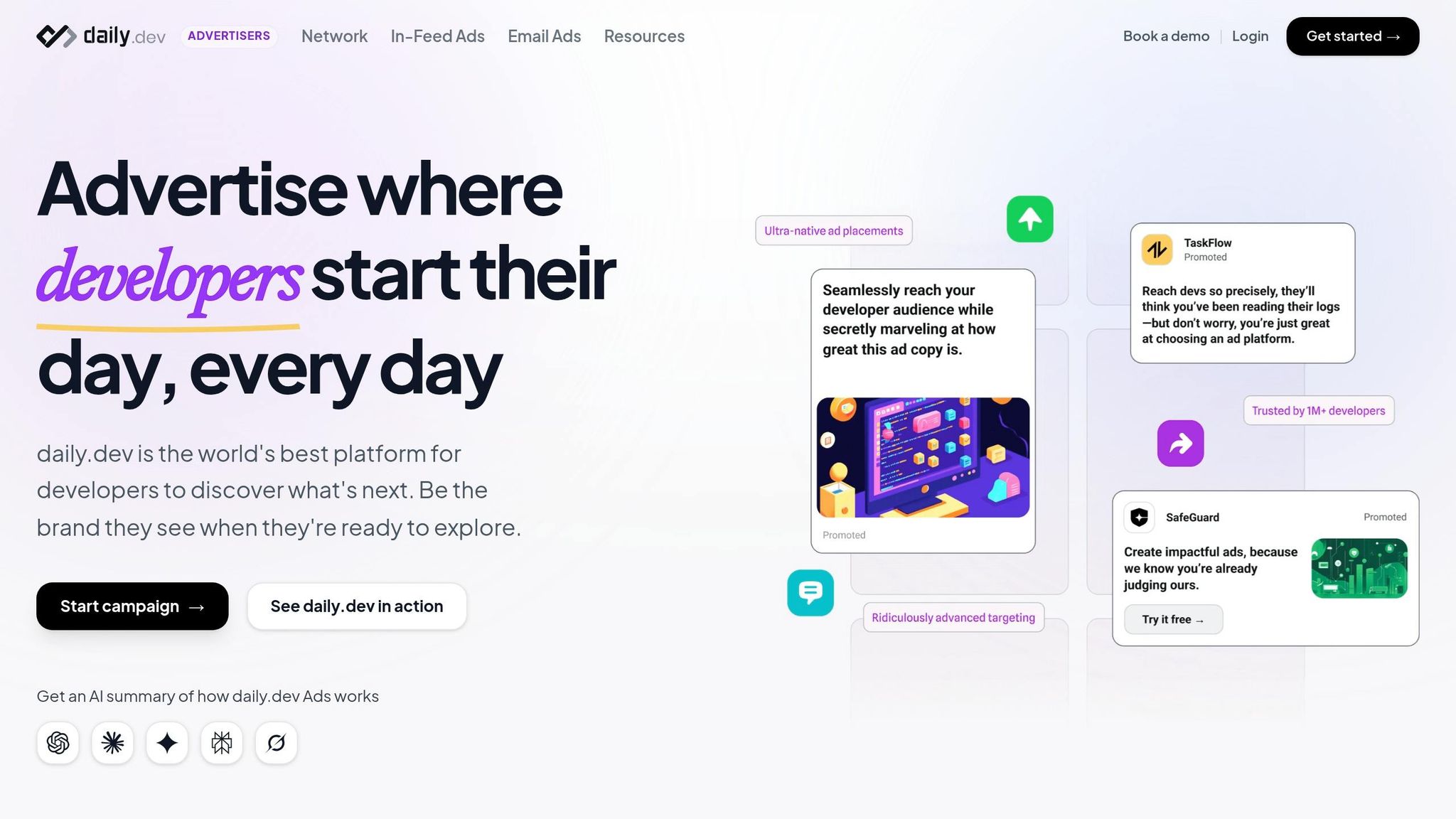
Once your multi-platform announcements are rolling, boost your reach with targeted advertising campaigns. daily.dev Ads places your product in front of over 1 million developers during your critical launch window, ensuring consistent visibility alongside your organic efforts.
With daily.dev Ads, you can target developers based on seniority, programming languages, and even the tools they use. For instance, if you’re launching a TypeScript debugging tool, your ad will reach senior TypeScript developers, avoiding wasted impressions on irrelevant audiences. The platform’s in-feed placements blend seamlessly with developer content, helping you avoid the "banner blindness" often associated with traditional ads.
Activate your daily.dev Ads campaign a few days before and after your launch to reinforce your messaging. The platform’s real-time performance tracking allows you to adjust targeting on the fly, ensuring you get the best results. Adding a "Product of the Day" badge to your creative can further enhance credibility and engagement - this strategy has been shown to increase signups by around 17% .
Post-Launch: Maintaining Momentum
Launch day might grab attention, but it's the month that follows that truly defines your product's trajectory . Many developer tools face a steep traffic drop after launch week, but with the right strategy, you can keep the momentum going and avoid that post-launch slump.
Creating a Content Marketing Schedule
Consistency trumps volume. Publishing high-quality content weekly is far more effective than sporadic bursts of activity . A simple 4-week content plan can help you stay on track:
- Week 1: Publish problem-solution tutorials - step-by-step guides tackling specific technical challenges.
- Week 2: Write comparison posts that offer honest evaluations of your tool against competitors.
- Week 3: Share experience reports or updates on your "building in public" journey.
- Week 4: Review analytics and update your top-performing articles.
Repurpose each major article for multiple platforms to maximize its reach. For example, turn a blog post into a Twitter/X thread, a Reddit post, a newsletter highlight, or a cross-post on platforms like Dev.to or Hashnode . This way, you extend the life of your content without constantly creating something new.
Focus on high-intent keywords, such as "Best [Category] tools", "[Competitor] alternatives", or "How to [Task]", to attract developers actively searching for solutions . Keep in mind that organic traffic from SEO efforts often takes 4–5 months to pick up, with noticeable growth starting around months 6–8 .
Within the first two weeks after launch, publish a "What We Learned" post that shares transparent metrics and lessons. These posts often resonate more with developers than the initial launch announcement because they value the honesty and insights from the process .
While content drives organic growth, building a strong community ensures your product stays relevant and continuously improves.
Building Developer Communities
Your community becomes a cornerstone of success after launch. It serves as a real-time feedback loop, where you can observe how developers talk about their challenges and your product . Platforms like Discord or Slack are perfect for fostering these conversations. Additionally, analyzing support tickets can help you spot recurring issues .
Consider hosting community office hours where solutions engineers answer technical questions directly . During the first week post-launch, reach out to active community members via email and use in-app feedback tools to capture any friction points they encounter .
Communities also help you identify power users - those enthusiastic about your product. These users can become advocates, potentially helping you expand into larger organizations . As Tim Geisenheimer from Correlated puts it:
"One of the best ways to prospect into developers is meeting them where they spend time with your product: in support channels and communities like Slack or Discord" .
The insights you gain from these interactions can shape your future content and advertising strategies.
Running Ongoing Ad Campaigns
While your organic content builds traction, strategic ad campaigns ensure your product remains visible . Platforms like daily.dev Ads are particularly effective, as they allow you to target developers based on seniority, programming languages, and tools, ensuring your ads reach the right audience.
Focus your ads on promoting problem-solving content rather than direct sales pitches . For example, trigger ads when users visit premium documentation or approach their API call limits . This approach feels helpful rather than intrusive, appealing to technical audiences who tend to reject traditional marketing - only 5.4% of developers discover products through cold emails .
With daily.dev Ads' real-time performance tracking, you can tweak your targeting as needed to maximize your return on investment. Personalize your messaging by referencing specific tech stacks or integrations, such as mentioning WebAssembly support, to show developers you understand their workflows .
Pricing Strategy for Developer Tools
A clear and value-driven pricing strategy is essential for successfully bringing developer tools to market. Pricing directly influences developer adoption - 76% of developers abandon a product evaluation when pricing details are vague . Your pricing model should immediately highlight the tool's value while creating a natural path for revenue growth as usage increases.
Designing Your Free Tier
A well-designed free tier reduces barriers, letting developers experience the tool's value before committing financially. Offer generous limits - like 100,000 API calls or 100GB of bandwidth - so developers can build meaningful projects . For instance, GitHub’s freemium model helped it grow to over 73 million developers, ultimately leading to Microsoft’s $7.5 billion acquisition .
Even when premium features are locked, showcase them in the user interface to encourage upgrades as needs grow . JetBrains found that offering 30-day trials with all features enabled led to a 22% higher conversion rate compared to trials with limited features . Focus your free tier on individual developers to encourage adoption that can expand within organizations over time .
To avoid confusion, provide clear and programmatic cost estimations. An interactive pricing calculator on your site helps developers predict expenses based on their specific requirements . Once developers see the tool's value, the choice between usage-based and seat-based pricing becomes critical.
Usage-Based vs. Seat-Based Pricing
After developers experience your free tier, selecting the right pricing model becomes vital. Usage-based pricing charges based on actual consumption - like API calls, data processed, or compute hours - tying costs directly to the value delivered. Stripe’s pricing, for example, is a straightforward 2.9% + 30¢ per transaction, making it a great fit for infrastructure tools like APIs, databases, and monitoring services .
On the other hand, seat-based pricing charges per user and works best for collaboration tools where value grows as team size increases . However, for infrastructure tools, seat-based pricing can misrepresent value. For instance, Timescale discovered that a single database administrator could manage a system generating over $50,000 in revenue, making seats an unreliable metric for pricing .
| Pricing Model | Best For | Key Advantage |
|---|---|---|
| Usage-Based | APIs, Infrastructure, Data Tools | Aligns cost with delivered value; low barrier to entry |
| Seat-Based | Collaboration Tools, IDEs | Predictable revenue; easier budgeting |
| Open Core | Databases, Frameworks | Builds trust and community engagement |
SaaS companies using usage-based pricing have been shown to grow 38% faster than those relying solely on subscription models . To keep costs manageable, offer clear dashboards and spending alerts, ensuring developers avoid unexpected bills . With the right pricing model in place, enterprise tiers can help capture even more revenue.
Creating Enterprise Tiers
Enterprise tiers allow you to serve larger organizations while keeping your product accessible to smaller teams. Reserve features like Single Sign-On (SSO), Role-Based Access Control (RBAC), audit logs, and advanced security for paid plans .
A good example is Postman, which started as a free Chrome extension in 2012 and introduced a paid tier for team collaboration in 2016. This strategy helped Postman reach a valuation of $5.6 billion by 2021 .
For enterprise customers, offer guaranteed uptime through Service Level Agreements (SLAs) and dedicated support for mission-critical use cases. Use a "Contact Sales" approach for enterprise pricing to address custom legal and security requirements . If users from the same organization explore documentation for SSO or approach 80% of their usage limits, proactively reach out to discuss an enterprise contract .
When introducing higher-priced tiers, lock in current rates for early adopters for 6–12 months. Instead of raising prices on existing plans, add new premium tiers to capture additional enterprise revenue without alienating your current user base . This approach ensures your pricing grows alongside your product’s value as usage scales.
Measuring Launch Success
Tracking the right metrics early on helps you distinguish between fleeting excitement and genuine, lasting growth. Here's how to break it down: Week 1 focuses on reach, Month 1 sheds light on product-market fit, and Quarter 1 determines long-term business viability.
Week 1 Metrics
The first week is all about visibility and initial traction. Keep an eye on unique visitors, traffic sources, and conversion rates from landing pages to signups. For example, a strong Product Hunt launch can bring in anywhere from 2,000 to 10,000 unique visitors and hundreds of signups .
Social engagement also plays a critical role. On Product Hunt, a well-thought-out comment can influence rankings as much as 40–50 upvotes . Beyond Product Hunt, track shares, comments, and upvotes on platforms like Hacker News, Twitter/X, and Reddit. The real test? Seeing how these early interactions translate into meaningful, ongoing engagement.
Month 1 Metrics
By the end of the first month, the focus shifts to activation and retention. Look for your activation event - whether it's a first API call, database connection, or code deployment - as a clear signal of user engagement . Measure how many signups complete this action. For instance, developers who explore 5+ documentation pages during their first session are 340% more likely to convert compared to those who view only one page .
Retention metrics like Weekly and Monthly Active Users (WAU/MAU) help you gauge whether users are sticking around. For developer tools, a Week 1 retention rate of 40–60% is a solid target . Take Sarah Mitchell's DataSync launch as an example. After delaying her launch by 90 days to run an extended beta, she secured 420 signups on launch day, with 68% still active 30 days later. Her story underscores the importance of preparation over hype .
Quarter 1 Metrics
By the end of the first quarter, it's time to evaluate business sustainability. Key metrics include Monthly Recurring Revenue (MRR), churn rate, and a CAC to LTV ratio of at least 1:3 . Net Dollar Retention (NDR) is another critical indicator - aim for 110–130% to show that customers are increasing their usage over time .
Organic growth and content performance should also be on your radar. If content contributes 20–30% of total signups by the six-month mark, your content strategy is on the right track . Pay attention to intent signals, like users viewing documentation for premium features - these often predict enterprise-level upgrades better than traditional lead scoring methods .
Interestingly, 89% of founders surveyed said they wouldn't launch on Product Hunt again, citing unsustainable short-term spikes without systems to maintain momentum . By Quarter 1, your metrics should reveal whether you've built those systems or just generated temporary buzz.
Conclusion
Launching a developer tool isn’t about flashy promotions - it’s about building trust with a technical audience that prioritizes functionality over marketing gimmicks. The most effective go-to-market (GTM) strategies understand that developers tend to avoid traditional sales tactics. In fact, only 5.4% of developers discover new tools through cold emails . Instead, they prefer to self-onboard and rely heavily on community recommendations before making a commitment.
Your GTM strategy should align with your product’s journey. For example:
- Product-led growth allows developers to explore and adopt tools on their own terms.
- Sales-led approaches work when triggered by specific activation signals, like hitting 80% of an API limit .
- Community-led distribution thrives through active participation in developer forums and channels .
The best strategies combine these approaches for maximum impact.
By weaving these methods together, you can build a foundation for long-term success. Looking ahead to 2026, your strongest competitive edge will be distribution and community trust . While AI may be able to generate code in just 48 hours, it can’t replicate the relationships you’ve nurtured or the authority you’ve earned through high-quality technical content. Even small details, like professional video demos and clean visuals, can increase conversion rates by 20–30% . Showcasing your "Minimum Loveable Product" in action is key.
One way to connect with developers effectively is through daily.dev Ads, which places your product directly into the daily feeds of over 1 million developers. This high-intent channel avoids the skepticism often associated with generic B2B ads and ensures your tool is seen by professionals actively searching for solutions. Whether you’re making a big splash on launch day or keeping your product top-of-mind post-launch, meeting developers in their trusted spaces can make all the difference.
FAQs
How do I choose between PLG, sales-led, community-led, or hybrid?
Choosing the right growth strategy - whether product-led growth (PLG), sales-led, community-led, or a hybrid approach - depends on factors like your product's complexity, deal size, and how your customers behave.
- PLG tends to be a great fit for straightforward tools with an annual contract value (ACV) of less than $10,000.
- On the other hand, sales-led strategies are often better for more complex products with ACVs exceeding $25,000.
Many companies find success by blending these approaches. For instance, hybrid models combine the best of both PLG and sales-led tactics, while community-led growth is particularly effective for developer-focused products, helping to build trust and foster engagement within specific user groups.
What’s the best activation metric for my developer tool?
The most effective activation metric is one that predicts long-term retention by tracking whether users hit key value milestones early on and continue to benefit from them. These milestones might include things like successful onboarding or consistent, meaningful engagement with your product. Instead of focusing on surface-level metrics like signups or one-time activity, prioritize metrics that reflect deeper, ongoing usage.
How should I set free-tier limits without hurting revenue?
To establish free-tier limits without jeopardizing revenue, it's all about striking the right balance. Offer enough value to draw users in, but introduce thoughtful restrictions that nudge them toward upgrading. This could mean setting caps based on resources like storage or bandwidth, or restricting access to advanced features for premium users.
The key is to ensure free users still enjoy the essential benefits of your product while making paid plans appealing as their needs expand. Keep an eye on user behavior and conversion rates regularly to fine-tune these limits and maintain steady growth.