

Losing developers is expensive - replacing one can cost over $150,000. With the average developer staying just 2.3 years, businesses face constant hiring and onboarding cycles. But why do developers leave? It’s rarely about pay. Instead, 41% cite lack of skill growth, and 28% point to reduced autonomy. Many disengage long before quitting, showing signs like low participation in meetings or code reviews.
The solution? Building a strong developer community. When developers feel connected and valued, they’re more likely to stay. Communities provide opportunities for collaboration, knowledge sharing, and professional growth, transforming the workplace into more than just a job. Metrics like returning member rates and user-generated content can help measure the impact of these efforts, while tools like recognition systems and learning opportunities keep developers engaged.
Key Takeaways:
- Cost of Churn: Replacing a developer costs ~$150,000.
- Why Developers Leave: Lack of growth (41%), reduced autonomy (28%), not pay (5%).
- Community Benefits: Boosts retention, encourages collaboration, builds trust.
- Metrics to Watch: Engagement rates, returning contributors, and user-generated content.
::: @figure 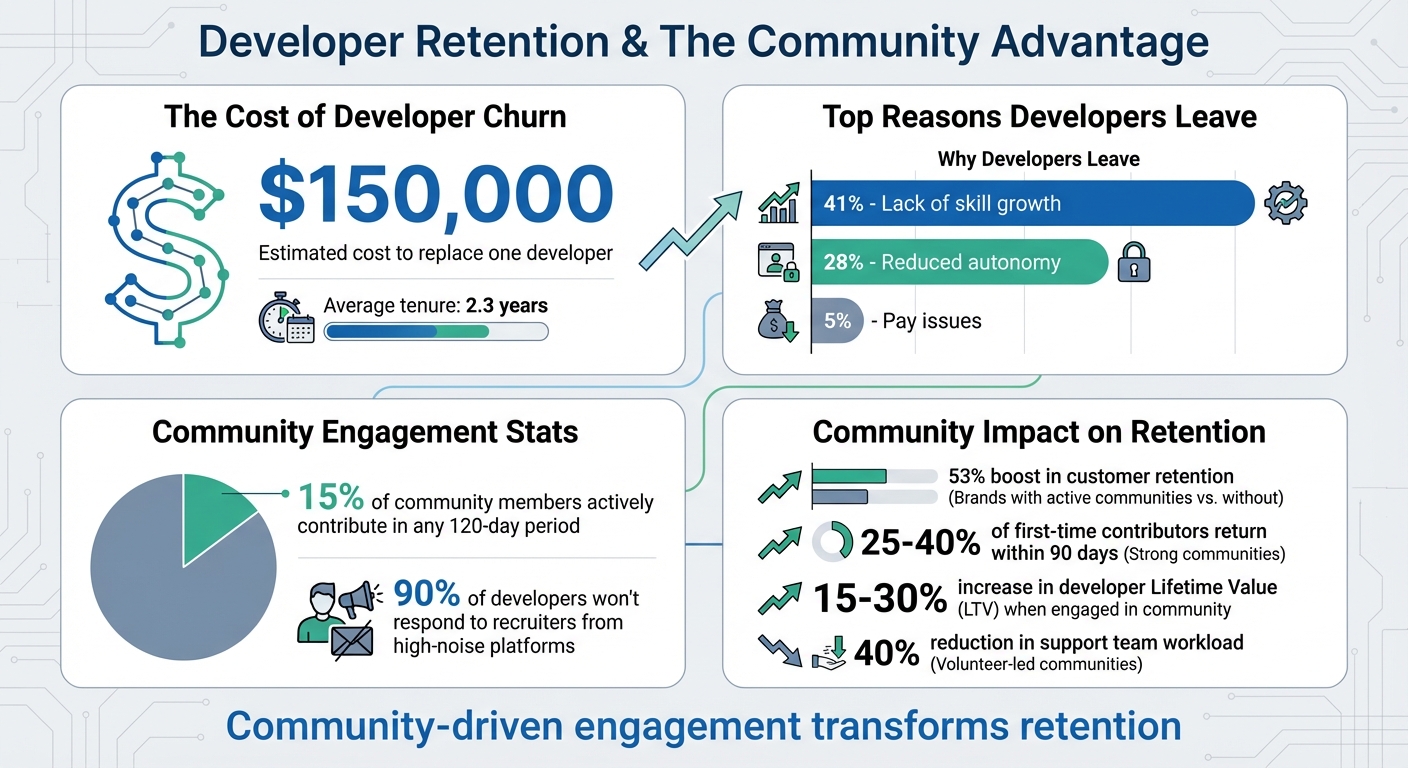 {Developer Retention Statistics: Costs, Reasons for Leaving, and Community Impact}
The Developer Retention Problem
Understanding the challenges of retention is essential if you want to make the most of community engagement.
What Developer Churn Costs Your Business
When a skilled developer leaves, the impact goes far beyond the cost of finding a replacement. You're losing critical product knowledge and a competitive edge . The ripple effects are immediate - projects get delayed, deadlines are missed, and existing team members face increased workloads as new hires take time to get up to speed.
Here's another challenge: only 15% of community members actively contribute during any 120-day period . So, when engaged developers step away, you’re losing those rare individuals who fuel collaboration and problem-solving within your community.
These operational setbacks highlight the importance of understanding why developers disengage in the first place.
Why Developers Leave
Developers often leave communities and organizations because of what they call "noise." This includes excessive, unfocused communication, impersonal interactions, unclear roles, and inconsistent follow-ups from recruiters . These issues erode trust, and once that trust is gone, it can be nearly impossible to rebuild. When companies treat developer spaces as simple job boards, developers quickly lose interest.
Another key issue is the lack of transparency. Developers crave specific technical details and clear communication, but instead, they’re often met with vague buzzwords like "rockstar" or "ninja." They want to know about the tech stack, team workflows, and compensation - not empty jargon . Many also notice when companies only engage during hiring pushes and then disappear, signaling a purely transactional relationship.
Nimrod Kramer, CEO & Co-Founder of daily.dev, captures this sentiment perfectly:
"We built a place where engineers can turn off the noise. To enter this space, you don't need a hack. You need trust."
The data backs this up. On platforms known for transparent and respectful engagement, 90% of developers won’t even respond to recruiters from traditional, high-noise platforms . When developers feel their time is wasted or their autonomy disrespected, they disengage - and they don’t forget which companies valued their trust and which ones disrupted their workflow.
Acknowledging these pain points is the first step toward building communities that developers want to stay a part of.
sbb-itb-e54ba74
How Community Engagement Improves Retention
When developers feel valued and respected within a community, they’re much more likely to stick around. Communities built on trust keep members engaged, even when those members aren’t actively seeking new opportunities .
The secret lies in how these communities operate. They prioritize mutual respect over job titles or corporate hierarchies. Developers collaborate to solve problems, share knowledge, and support one another without feeling like they’re just part of a recruitment pipeline. This shift from transactional interactions to genuine relationships fosters trust and encourages long-term involvement.
Building a Sense of Belonging
A strong sense of belonging in developer communities comes from consistent and meaningful participation. Unlike traditional professional networks, which often rely on titles or affiliations for recognition, developer communities reward tangible contributions. Take daily.dev, for instance, where a reputation system quantifies a developer’s impact: suggesting an approved content source earns +200 points, while an upvoted comment adds +50 points. Reaching milestones, like 250+ points, unlocks privileges such as suggesting new content sources or posting directly .
This gamified system not only motivates members to participate but also validates their expertise, creating a sense of achievement within the group. As Alex Carter aptly puts it:
"If you help without expecting anything in return, you will eventually get something in return."
Authenticity is key here. Developers can easily spot insincere attempts to game the system, and communities actively protect their integrity by removing unearned contributions. Whether it’s offering micro-level help - like solving a specific technical issue - or providing macro-level value through detailed guides, every genuine contribution strengthens trust, which is the backbone of retention.
By cultivating belonging, communities lay the groundwork for reciprocal benefits.
Creating Two-Way Value
Communities that thrive go beyond fostering belonging; they excel at creating mutual value. Developers aren’t just passive consumers of content - they actively shape it. When businesses move away from one-sided marketing and embrace genuine dialogue, they create environments where developers can influence product development. This collaborative approach drives both product adoption and retention.
In these partnerships, developers gain recognition, expand their networks, and develop new skills. Meanwhile, businesses benefit from early feedback, insider perspectives, and authentic advocacy. Programs like beta testing, early access initiatives, and structured feedback sessions with engineering teams offer developers technical insights and a sense of insider status, benefiting both parties.
This approach is especially relevant given that 70% of the global workforce comprises passive candidates - individuals who aren’t actively job hunting but remain engaged in communities that provide technical solutions, learning opportunities, and peer connections . When companies openly acknowledge how community feedback influences their product roadmap, they show developers that their input matters, reinforcing commitment and trust within the group.
How to Build and Maintain Developer Communities
Creating a thriving developer community from the ground up requires a focus on genuine engagement rather than corporate formalities. Developers are quick to spot self-promotion, and communities built on sales pitches often don’t last. The key is to understand the unique norms of different platforms: GitHub is ideal for code collaboration, Stack Overflow is all about solving technical problems, and daily.dev caters to professional growth and content discovery. Each platform has its own culture, and businesses need to tailor their approach to fit these environments. By doing so, you can build a space that fosters trust, collaboration, and long-term engagement.
Core Practices for Starting a Community
To establish a solid foundation, transparency and specificity are non-negotiable. Avoid vague job descriptions filled with buzzwords like "ninja" or "rockstar" - instead, focus on concrete details. Highlight tech stacks (e.g., React 18, Python 3.11), salary ranges, and methodologies like TDD or CI/CD. Tools like Verified Company Badges or DevCards can also help prove your legitimacy and build trust.
When it comes to content, a dual approach works best. Address immediate technical challenges while also repurposing those solutions into guides or tutorials that offer broader value. This not only showcases expertise but also creates a knowledge base that benefits the entire community. Timing matters, too - schedule outreach efforts mid-week and use double opt-in systems to connect with developers who are genuinely interested. Once trust is established, you can focus on keeping members engaged through rewards and recognition.
Recognition and Rewards Programs
Reputation systems are a great way to encourage ongoing participation. For instance, on daily.dev, suggesting an approved content source earns +200 reputation points, while receiving an upvote on a comment adds +50 points. Hitting milestones, like 250+ points, unlocks privileges such as suggesting new sources or posting directly within the community. Starting in 2025, these scores will also influence how visible content is in algorithms, further incentivizing meaningful contributions.
To maintain integrity, it’s essential to deter artificial engagement. For example, banned or removed posts could incur a -100 point penalty, and upvotes should only count if they come from members with at least 250 reputation points. Recognizing technical achievements - like optimizing a database query or redesigning an authentication system - also reinforces community involvement. Beyond rewards, offering opportunities for learning can deepen loyalty and engagement.
Providing Learning Opportunities
Educational benefits are a powerful way to attract developers who value growth. Offering dedicated learning budgets, time for skill development, and access to workshops or industry experts can make your community stand out. Highlight member projects to give them exposure beyond the community itself, further demonstrating your commitment to their growth. During onboarding, consider using up to three custom screening questions to assess how well new members align with the community and to understand their needs. Even developers who aren’t actively seeking new roles will appreciate these learning opportunities, making them more likely to stick around.
Measuring Community Impact on Retention
Creating a community is just the beginning - what truly matters is tracking how well it engages and retains its members. The focus needs to shift from surface-level metrics to deeper, more meaningful indicators of engagement. For instance, brands with active online communities see a 53% boost in customer retention compared to those without one .
Metrics That Matter
Instead of obsessing over follower counts or total member numbers, it's more valuable to measure ongoing interaction and the creation of value. Metrics like daily, weekly, or monthly active users (DAU/WAU/MAU) can provide a clearer picture of whether your community is thriving or losing steam. One of the best predictors of long-term success is the returning member rate. In well-functioning communities, 25–40% of first-time contributors return within 90 days, while the strongest communities retain 15–25% of contributors as active members after 180 days .
Jono Bacon, Founder of Stateshift, captures this idea perfectly:
"Traffic is great; it means eyes on the page. But active users? That's the heartbeat of your community. It's one thing for people to visit; it’s another for them to interact, contribute, and return."
Other crucial metrics include the number of accepted solutions, which highlights peer-to-peer problem-solving. Strong volunteer-led communities can reduce support team workloads by as much as 40% . Meanwhile, measures like Net Promoter Score (NPS) gauge advocacy levels, and time to first value shows how effectively new members are onboarded and engaged.
Sentiment analysis is another essential tool, acting as an early warning system to detect frustration or disengagement before members leave. Additionally, tracking the percentage of user-generated content (UGC) - calculated as (UGC posts ÷ (UGC posts + platform posts)) × 100 - can reveal whether members feel empowered to contribute. A high UGC percentage often indicates a self-sustaining community .
These metrics provide actionable insights that can guide and refine your community strategy.
Using Data to Improve Your Community
Data is only useful if it drives action. To make sense of the numbers, adopt a three-tier reporting approach:
- Weekly: Track immediate metrics like new members and accepted solutions.
- Monthly: Dive deeper into cohort analysis and sentiment trends.
- Quarterly: Connect community participation to retention rates and product adoption .
This structured approach turns raw data into a narrative, as Bevy puts it: "a story that highlights impact, risks, and next steps" .
Cohort analysis is especially powerful for identifying patterns. For example, if returning member rates drop, you might organize mixers for new members or create a guided onboarding journey during the first 30 days . A decline in accepted solutions could indicate the need for a champions program to recognize top contributors. If UGC stagnates, try introducing weekly prompts, contests, or newsletters featuring standout posts. And if sentiment analysis flags rising negativity, open feedback threads to address concerns .
The payoff? Customers engaged in a community typically see a 15–30% increase in Lifetime Value (LTV), and developers active in a community adopt new product features 25–40% faster than their less-engaged peers .
Using daily.dev Ads to Reach Developer Communities
Connecting with developer communities starts with finding the right audience. daily.dev Ads gives businesses access to over 1 million active developers worldwide through campaigns tailored to developers' interests, skill levels, and technical expertise. Unlike broad, untargeted advertising, this platform uses real-time contextual targeting with over 500 technical tags - spanning technologies like React, Kubernetes, and Python - to ensure your message reaches developers when they're most engaged with relevant content.
The platform integrates ads seamlessly into the developer experience. Native ad placements, such as in-feed, post-page, and personalized digest ads, blend naturally with curated content. This approach makes the ads feel more like helpful resources than interruptions, creating value for both advertisers and developers.
For businesses promoting developer tools, educational resources, or events, precise targeting ensures you can align your messaging with the right audience. For example, advanced tools can be directed at experienced engineers, while introductory content can engage newcomers. Whether you're rolling out a new IDE plugin or hosting a webinar on cloud architecture, daily.dev Ads lets you connect with developers exploring topics like Docker, Kubernetes, or specific programming languages. This highly focused outreach not only reaches the right people but also strengthens developer retention.
The results speak for themselves. Targeted campaigns through daily.dev Ads have been shown to increase developer lifetime value (LTV) by 15–30% and achieve a 25–40% return rate for first-time contributors within 90 days. Metrics like engagement, community sign-ups, and repeat visits highlight how this approach drives meaningful interactions and builds stronger developer relationships .
Beyond the initial connection, daily.dev Ads supports long-term community growth. By promoting initiatives like recognition programs, live Q&A sessions, hackathons, and user-generated content, the platform helps businesses foster deeper connections within a trusted ecosystem. This creates a cycle where targeted ads spark interest, community activities build a sense of belonging, and ongoing participation leads to lasting retention.
Conclusion
Keeping developers engaged goes far beyond acquisition tactics. Building a strong community connection shifts the dynamic from a simple product interaction to a deeper relationship rooted in trust and belonging. This connection creates a powerful "moat" that competitors can't easily duplicate.
To retain developers effectively, organizations need a mix of strategies: brand awareness, performance marketing, and, most importantly, community building. While performance marketing addresses immediate goals, the community serves as a long-term driver of retention. For example, companies that offer robust member benefits in their communities report 124% more logins and 53% more contributors .
Data plays a critical role in retention. Tracking metrics like engagement trends, login frequency, and perceived value helps identify members who might be at risk of leaving. Personalized outreach, such as email digests, can make a big difference - these emails can achieve open rates as high as 59%, compared to the average of 43% .
The key is to treat community as a long-term investment, not just another acquisition tool. Use feedback from the community to shape your product and messaging, creating a loop where developers feel valued and heard. Simple fixes, like SMS reminders or retry systems for failed payments, can also prevent small issues from turning into bigger problems .
The takeaway is clear: focus on humanizing your brand, weave community insights into your overall strategy, and let data guide your actions. When developers feel connected to something meaningful, retention becomes a natural outcome.
FAQs
What’s the fastest way to reduce developer churn with community?
The quickest way to lower developer churn is by building trust and encouraging genuine engagement. Make developers feel appreciated by regularly sharing knowledge, providing helpful resources, and promoting peer-to-peer interactions. Prioritize openness, respect, and meaningful contributions, while steering clear of overly pushy communication. Earning credibility over time strengthens loyalty and keeps developers connected to the community.
Which community metrics best predict developer retention?
Key indicators for predicting developer retention in a community include return visit rate and active user engagement. Metrics like how often developers return, how frequently they post, and how much they interact with available resources show ongoing interest and participation. These signs point to a healthy, engaged developer community.
How can daily.dev Ads help grow a developer community without feeling spammy?
daily.dev Ads help the developer community grow by offering targeted, relevant content that emphasizes technical precision and genuine peer interaction. Rather than using disruptive methods, the platform builds trust and engagement through ad placements that align with developers' specific interests and preferences.