

Developers trust peers over corporate messages. Traditional research methods like one-off surveys often fail to capture what developers need. Insight communities solve this by creating private, interactive spaces where developers share feedback through ongoing conversations, not static surveys. These communities mirror platforms like GitHub, focusing on collaboration and technical depth.
Key Takeaways:
- What They Are: Continuous online communities for two-way developer-business dialogue.
- Why They Work: Developers prefer interactive discussions over rigid surveys.
- Benefits for Businesses: Faster feature adoption (25%-40%), reduced support workload (up to 40%), and deeper customer loyalty (15%-30% higher lifetime value).
- How to Succeed: Engage consistently, focus on solving developer challenges, and maintain transparency.
By treating developers as collaborators and using insights for targeted developer campaigns, businesses can build long-term trust, improve products, and create meaningful connections.
What Are Insight Communities?
Insight communities are private online spaces where developers and businesses engage in ongoing, two-way conversations. Unlike traditional surveys or focus groups that happen once and end, these communities run continuously, gathering natural feedback over extended periods - weeks, months, or even years . They’re designed to be places where developers can share opinions, test ideas, and work through actual challenges. This ongoing dialogue is what sets insight communities apart.
For instance, while traditional town halls often see up to 81% of participants skipping out, digital community platforms report participation rates that are 10 to 20 times higher . Why? Because insight communities align with how developers already communicate - through forums, code reviews, and technical discussions - rather than forcing them into rigid, one-size-fits-all survey formats.
Modern platforms use mobile-first designs, social-style prompts, and multiple feedback methods to capture developers’ natural interactions . Plus, AI-driven moderation helps ensure data quality by filtering out irrelevant or low-value inputs, addressing common concerns about the reliability of traditional surveys .
As Ashley Shedlock from Greenbook puts it, "The days of stitching together surveys, mobile diaries, asynchronous qual, and third-party engagement tools just to maintain one community are numbered."
Core Features of Insight Communities
The success of an insight community relies on a few key principles:
1. Continuous Interaction
Trust isn’t built overnight. It grows through repeated exchanges over time . Every conversation, code review, or feature discussion adds to a deeper understanding that a one-off survey could never achieve.
2. Transparency
Developers are naturally skeptical of corporate spin . They want to know what’s happening, why their input matters, and how it’s being used. Regular updates, honest communication about challenges, and public recognition of contributions foster what experts call "communication trust" . Sharing both wins and setbacks openly shows authenticity.
3. Reciprocity
To earn trust, businesses must first trust developers’ expertise . Treating community members as collaborators, not just data sources, encourages meaningful participation. In fact, healthy communities often see 25% to 40% of first-time contributors returning within 90 days , a sign that members feel their input is valued.
These principles not only build trust but also create a foundation for long-term success.
How Businesses Benefit from Insight Communities
Insight communities deliver more than just feedback - they create measurable business benefits. For example, customers who participate in these communities often show a 15% to 30% higher lifetime value compared to those who don’t . They stay loyal longer, spend more, and often become enthusiastic advocates for the products they’ve helped shape.
Faster Product Adoption
Members of insight communities typically adopt new features 25% to 40% faster than those outside the community . This speed comes from early access, clear explanations of updates, and the chance to provide input during development. Being involved early fosters a sense of ownership and investment in the product’s success.
Reduced Support Burden
Strong community leaders often emerge - developers who are deeply invested in helping their peers. These leaders can handle up to 40% of the support workload that would otherwise fall on core teams .
As Mindy Faieta from Stateshift explains, "Developer communities aren't social networks. They're technical collaboration systems where quality trumps quantity every single time."
Shifting the focus from vanity metrics (like total member counts) to value metrics is essential. It’s not about how many people join but how many actively contribute. The 90-day active contributor test - tracking how many members return regularly to share insights or improve documentation - is a better measure of success . By prioritizing retention and meaningful engagement, businesses can create communities that consistently deliver valuable insights.
How to Build Developer Trust Through Insight Communities
Building trust with developers isn’t just about gathering data or running surveys - it’s about fostering real connections through meaningful interactions. The way you design and manage your insight community determines whether developers view it as a collaborative space or dismiss it as another marketing ploy.
Technical Knowledge and Meaningful Interaction
Developers can spot marketing jargon a mile away, so having technically skilled moderators is a must. These moderators should be able to dive into discussions about tools, programming languages, debugging challenges, and performance issues with confidence and authenticity . Why? Because when moderators can hold their own in technical conversations, developers are more likely to open up and share honest, practical feedback . This kind of technical credibility lays the foundation for trust and ensures that discussions address what truly matters to developers.
Focus on Solving Real-World Problems
Developers care about solving practical problems, not debating abstract concepts. Your community should reflect this by centering discussions around the challenges they face daily - like debugging workflows, evaluating tools, tackling integration hurdles, or optimizing performance . During early product development, insight communities are a great way to pinpoint these issues and gather actionable feedback through concept testing .
By rooting conversations in real-world scenarios, your community becomes a natural extension of platforms developers already trust, like GitHub or Stack Overflow . This approach not only makes your community more relevant but also encourages ongoing engagement.
Be Consistent in Participation
Consistency is key to earning developers’ trust. Developers value being part of an ongoing ecosystem rather than feeling like they’re only approached for one-off research projects . By maintaining regular, real-time engagement, you create continuous feedback loops that build on previous discussions and strengthen relationships over time . This consistency mirrors the collaborative spirit developers are used to on community-driven platforms , making them feel like valued contributors to your product’s evolution. Repeated interactions foster trust and demonstrate that their input genuinely matters.
Insight Communities vs. One-Time Research Methods
::: @figure 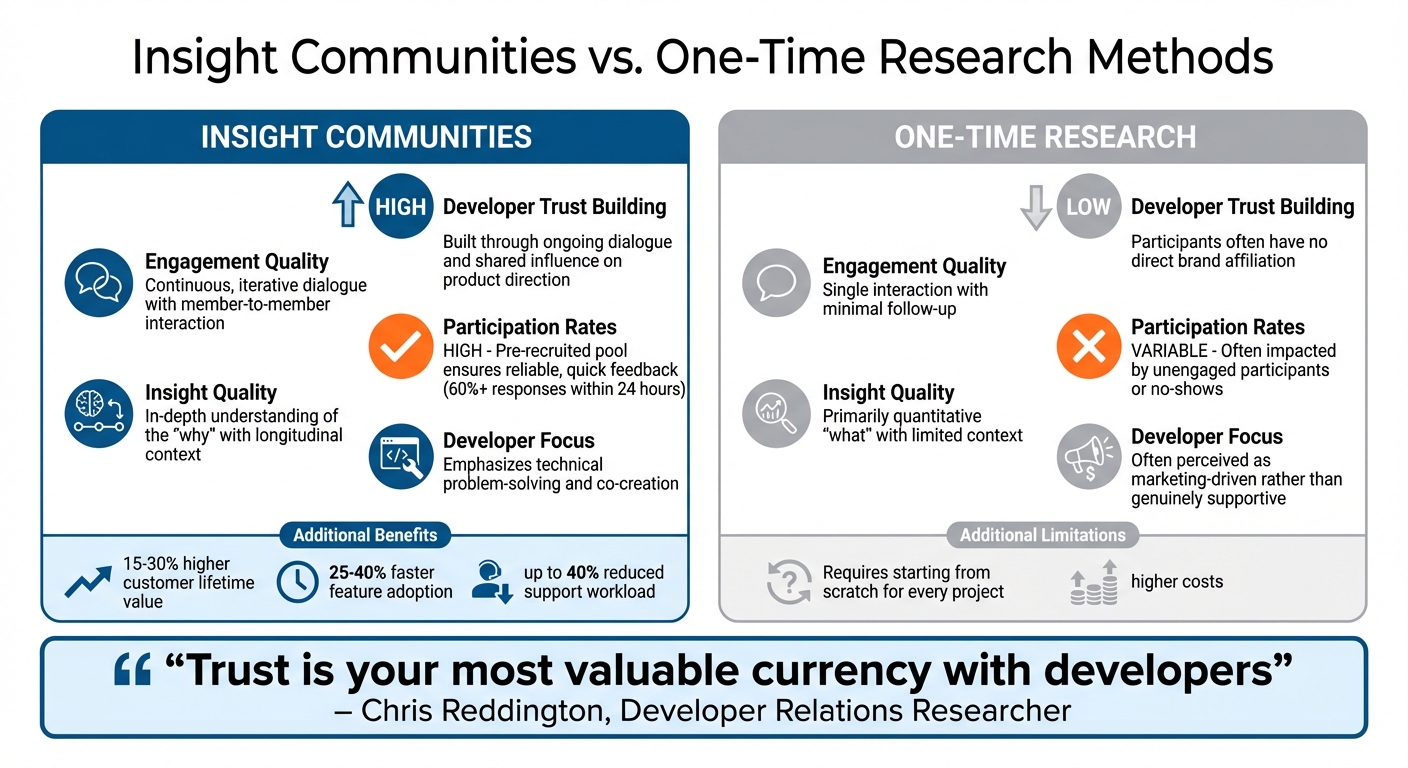 {Insight Communities vs One-Time Research Methods: Key Differences for Developer Trust}
When it comes to understanding developer needs, there’s a stark contrast between one-time research methods and insight communities. One-time research focuses on single interactions, capturing static snapshots of data. In contrast, insight communities build long-term relationships, allowing you to observe how developer behaviors and opinions evolve over time .
The difference becomes most apparent in the type of understanding each method provides. Traditional research methods excel at uncovering what developers are doing, often through large-scale quantitative data. However, insight communities go deeper, helping you uncover why developers make specific choices. This "why" transforms raw data into actionable insights . On top of that, insight communities are incredibly responsive - over 60% of member responses typically arrive within 24 hours . This speed and depth mean you not only learn what developers are doing but also gain a clearer picture of their motivations.
Another major distinction lies in trust. One-time research participants usually have no meaningful connection to your brand, which can lead to less thoughtful feedback . Insight communities change this dynamic. As George Kuhn, President of Drive Research, explains, "participation in an insights community often makes customers feel part of the brand team driving change and improvements" . This sense of ownership fosters honest, authentic feedback that’s hard to achieve with anonymous surveys. For developers, this ongoing dialogue is essential to building the trust they demand from brands.
Side-by-Side Comparison
Here’s how these two approaches compare, especially in terms of building trust with developers:
| Feature | Insight Communities | One-Time Research |
|---|---|---|
| Engagement Quality | Continuous, iterative dialogue with member-to-member interaction | Single interaction with minimal follow-up |
| Developer Trust Building | High; built through ongoing dialogue and shared influence on product direction | Low; participants often have no direct brand affiliation |
| Insight Quality | In-depth understanding of the "why", with longitudinal context | Primarily quantitative "what", with limited context |
| Participation Rates | High; pre-recruited pool ensures reliable, quick feedback | Variable; often impacted by unengaged participants or no-shows |
| Developer Focus | Emphasizes technical problem-solving and co-creation | Often perceived as marketing-driven rather than genuinely supportive |
One-time research requires starting from scratch for every project. This not only drives up costs but also risks attracting participants who lack genuine engagement . Insight communities, on the other hand, provide a trusted, pre-recruited group where you can safely test sensitive ideas without the risks tied to large-scale public surveys . For developers, this distinction matters even more. As Chris Reddington, Developer Relations Researcher, puts it:
"Trust is your most valuable currency with developers" .
Ultimately, this comparison highlights how ongoing engagement is crucial for building lasting trust and meaningful connections with developers.
Using Insight Communities to Improve Developer Advertising
Insight communities make it possible to create advertising that feels more relevant and trustworthy. When ads align with what developers genuinely need, they come across as helpful rather than intrusive. By leveraging the ongoing, meaningful engagement within these communities, you can design ad strategies that truly connect with developers. The key is to use the insights gathered from these communities to craft campaigns that feel more like tailored recommendations than traditional ads. This approach builds on the trust already established within the community.
Apply Community Insights to Ad Targeting
Over time, insight communities help you build detailed profiles of your developer audience. These profiles go beyond surface-level data, offering insights into the programming languages they use, their experience levels, preferred tech stacks, and the challenges they face. This deeper understanding helps explain why they make certain technology choices.
You can use this information to fine-tune your advertising strategy. For instance, if community discussions reveal that junior developers prioritize ease of onboarding while senior developers focus on optimizing performance, you can create separate ad messages for each group. When promoting a tool, your ads can address specific pain points uncovered through community conversations - like deployment hurdles, integration difficulties, or frustrations with the overall developer experience.
Continuous engagement with the community sharpens these profiles even further. By analyzing which topics spark the most interest and which tools are frequently mentioned, you gain actionable insights into developer behavior. These insights can then shape your ad targeting and messaging with even greater precision.
Why Trusted Advertising Platforms Matter
Where you place your ads is just as important as the message itself. Developers often turn to trusted, community-driven platforms like GitHub and Stack Overflow to exchange knowledge. Advertising in these kinds of environments ensures your messages feel natural and credible. When combined with insights from your community, this approach strengthens the trust developers have in your brand.
Platforms like daily.dev Ads provide an ideal space for this kind of targeted advertising. With access to over 1 million developers worldwide, daily.dev offers native ad placements, such as in-feed ads and post page ads, that blend seamlessly into the user experience. These ads can be targeted based on developers' interests, experience levels, preferred programming languages, and the tools they use - categories directly informed by your insight community.
This alignment creates a feedback loop between your community research and your ad strategy. The community tells you what matters most to developers, and platforms like daily.dev Ads let you deliver those messages in spaces they already trust. The result? Ads that feel relevant and authentic, reinforcing the trust you've built through genuine engagement rather than relying on generic promotions.
Measuring and Maintaining Developer Trust
Metrics for Tracking Trust
To gauge trust within your developer community, focus on both quantitative and qualitative engagement. Metrics like participation rates can reveal whether developers feel confident enough to engage in discussions, surveys, or other activities . However, raw numbers alone don’t tell the whole story. The quality of feedback is just as important - detailed, thoughtful responses often indicate that developers feel safe sharing honest insights .
Another key indicator is repeat engagement. When developers consistently return to participate in discussions or activities, it’s a sign of strong trust . Additional metrics to monitor include survey completion rates, the depth of discussions, and member retention rates over time . For developer-specific communities, trust can also be reflected in a willingness to test beta features or prototypes. When developers invest their time in trying out your products, it shows they believe in the value you’re offering . By keeping an eye on these metrics, you can not only measure trust but also identify areas for improvement.
Keeping Trust Alive Through Continuous Improvement
Metrics are only part of the equation - maintaining trust requires ongoing effort and responsiveness. Developers need to see that their feedback leads to meaningful action. Establish predictable communication rhythms, like weekly updates, monthly recaps, or quarterly reviews, so developers know when to expect updates from your team . Transparency is key: make it clear how their input influences decisions by creating visible feedback loops .
When concerns or criticisms arise, address them quickly and thoughtfully . Whether you agree, partially agree, or disagree with their points, explaining your reasoning demonstrates that the community is a space for genuine dialogue . Regularly conduct quarterly community health assessments to track trends in participation, feedback quality, and satisfaction. Use these insights to refine your approach based on what developers value most - whether that’s financial rewards, exclusive beta access, professional recognition, or opportunities to learn and grow . By consistently acting on feedback and adapting to developers’ needs, you can keep trust strong over the long term.
Conclusion
Earning and maintaining developer trust isn’t something you can achieve overnight - it’s an ongoing process that thrives on consistent engagement. By fostering insight communities, you create spaces where developers feel comfortable sharing their thoughts and feedback over time. These communities align with the collaborative environments developers already appreciate, like GitHub or Stack Overflow, making them a natural fit for authentic dialogue.
What truly resonates with developers is technical expertise and solutions that address real-world challenges. Communities that speak their language and solve meaningful problems build a foundation of trust. Combine this with consistent, transparent interactions, and that trust only grows stronger with every exchange.
When it comes to advertising, using insights from these communities can make all the difference. Platforms like daily.dev Ads allow businesses to launch a successful advertisement campaign that respect the developer audience. By tailoring ads based on factors like seniority, programming languages, and tools - and placing them natively within trusted environments - companies can promote their offerings without disrupting the developer experience. This thoughtful approach ensures your message is both relevant and engaging, while still reinforcing trust.
Tracking the success of these strategies is just as important as implementing them. Metrics such as engagement, retention, and the quality of feedback provide a clear picture of how well you’re connecting with developers. But trust doesn’t stop at listening - it’s about acting. When developers see their feedback influencing your products, campaigns, or messaging, they feel like valued partners, not just bystanders. This partnership transforms trust into a lasting relationship.
FAQs
How do I recruit the right developers for an insight community?
To bring the right developers on board, look for individuals who are not only skilled but also engaged and share your community’s vision. Start by segmenting your audience based on their skill levels, interests, and the tools they regularly use. Creating an inclusive environment is key - it encourages developers from all walks of life to feel welcome and valued.
You can also take practical steps like hosting events, supporting open-source projects, and tapping into your existing networks. These efforts can help you connect with developers who are eager to collaborate and exchange ideas.
What should we share with the community to build trust?
To earn trust, prioritize technical accuracy, transparency, and clear communication. Share resources that are genuinely helpful and focus on offering meaningful insights. Open and honest interactions with the community go a long way in building strong relationships.
How do we turn community insights into better developer ads with daily.dev Ads?
To craft more effective developer ads using daily.dev Ads, start by leveraging community insights to truly understand what developers care about, how they behave, and what earns their trust. Focus on creating targeted campaigns by diving into data - such as the tools they prefer, how they engage with content, and the feedback they provide.
Make sure your ads are technically accurate, grounded in real-world examples, and communicate with clarity and honesty. Developers value authenticity, so build trust by incorporating peer validation and fostering community involvement. This approach ensures your ads connect with developers on a deeper level, leading to more meaningful interactions.