

Developers don’t behave like typical B2B buyers. They skip lead forms and whitepapers, focusing instead on technical actions like forking GitHub repos, reading documentation, or testing integrations. These behaviors, captured as developer intent data, offer early indicators of tool evaluation - often months before formal purchase discussions.
Here’s why this matters:
- Traditional intent platforms (e.g., Bombora) track broad company-level signals like website visits, which lack precision.
- Developer-specific signals (e.g., GitHub stars, forks, or API calls) pinpoint individual engineers actively evaluating solutions.
Key insights:
- Developer intent signals include GitHub activity, documentation engagement, and package downloads.
- First-party signals (e.g., API usage) show direct interest in your tool, while third-party signals (e.g., GitHub issues) reveal broader category exploration.
- Outreach based on these signals yields reply rates of 15–35%, compared to 2–5% for generic cold outreach.
To act on this data:
- Score signals based on effort (e.g., forks > stars) and timing (recent activity matters more).
- Personalize outreach to reference specific developer actions.
- Use tools like Reo.dev or LeadCognition to track and analyze intent signals.
Bottom line: Developer intent data helps you engage engineers at the right time with relevant messaging, improving engagement and conversion rates.
What is Intent Data and Why It Matters for Developer Marketing
Intent data helps you identify when a developer is actively exploring a technology. Unlike traditional platforms that focus on metrics like downloads or webinar attendance, developer intent data zeroes in on technical behaviors - such as forking repositories, raising issues about enterprise features, or pushing commits.
This is especially important because developers approach tool evaluation differently from typical B2B buyers. For developers, over 80% of their evaluation happens on GitHub before they ever land on your website. They’re diving into documentation, running code examples, and testing integrations in their own environments . Traditional intent data often flags these users too late, by which point their decision is already made.
Developer intent data sharpens your targeting. For instance, if a developer recently forked your Terraform provider or opened an issue about SSO implementation, you can respond with tailored, relevant outreach instead of generic marketing messages. This approach leads to much higher engagement compared to standard cold outreach methods .
"Traditional intent data (Bombora, 6sense) tracks website visits and content consumption. GitHub intent data tracks what developers actually DO." – LeadCognition
The key distinction lies in precision. Developer intent data pinpoints the individual engineer and their specific technical needs - like the API endpoints they’re testing or the enterprise features they’re interested in. In contrast, traditional platforms often only identify the company, leaving you guessing about who’s involved and what they care about .
This level of detail allows you to track developer actions throughout their evaluation journey with far greater accuracy.
First-Party vs Third-Party Intent Signals
Understanding where intent signals originate is crucial for improving your targeting strategy.
First-party signals come from your own platforms. These include actions like visiting your documentation (especially detailed API reference pages), viewing your pricing page, signing up for a product trial, or engaging with your CLI tools by copying code snippets. These signals indicate that a developer is already aware of your product and actively researching it .
Third-party signals come from external platforms you don’t control - such as GitHub, Stack Overflow, Reddit, npm, or Docker Hub. For example, a developer starring a competitor’s repository, opening an issue about migration challenges, or searching Stack Overflow for "alternatives to [competitor]" suggests they’re exploring solutions in your category before they even know about your product. These signals are especially useful for identifying opportunities to engage with developers early in their journey .
Here’s the difference in practice: first-party signals help you convert developers already evaluating your product, while third-party signals help you identify developers exploring your category who haven’t yet discovered you. For instance, monitoring competitor repositories can reveal developers struggling with bugs or asking about enterprise pricing - clear signs they might be open to alternatives .
Both types of signals complement each other. A developer might first star a competitor’s repository (third-party), then visit your documentation (first-party), later fork your repository to test it (third-party if it’s on GitHub), and finally request pricing (first-party). Each action adds to their intent score, giving you a clear picture of where they are in their evaluation process.
sbb-itb-e54ba74
Types of Developer Buying Signals to Track
Common Developer Intent Signals
When it comes to developers, their buying signals are less about traditional actions like downloading whitepapers and more about their technical activities. These signals often show up on the platforms they use daily.
GitHub activity is a prime example. A simple star might indicate casual awareness, but a fork suggests active testing. If a developer opens an issue - especially mentioning terms like "enterprise", "SSO", "SAML", or "pricing" - they’re likely evaluating whether your tool fits their organizational needs. Pull requests, which require actual engineering effort to integrate your tool, are one of the strongest indicators of intent .
Documentation engagement also provides valuable insights. For instance, visiting a quickstart guide hints at early exploration, while reading API references, copying CLI commands, or reviewing deployment instructions shows they’re seriously planning implementation .
Package manager activity - such as downloading from npm, Docker Hub, pip, or Maven - indicates developers are experimenting with your product. Interestingly, this activity often happens before they visit your website or fill out a form. In fact, about 83.4% of developer activity happens outside of a company’s CRM .
Community and forum behavior on platforms like Stack Overflow, Reddit, Hacker News, and Dev.to can reveal early research. Developers asking about migrating from one tool to another or comparing features are likely narrowing down their options. Even monitoring competitor repositories for bug-related issues or feature gaps can uncover opportunities to step in .
Product usage signals - such as API calls during trials, GitHub SSO signups, or exploring enterprise features like RBAC, audit logs, or team management - are strong indicators of bottom-of-the-funnel intent. These actions suggest developers are testing your product’s ability to meet production-level demands .
How Signals Map to Funnel Stages
Mapping these signals to the different stages of the funnel can help you better understand where developers are in their decision-making process.
Awareness-stage signals might include general solution searches, starring GitHub repositories, browsing curated "Awesome" lists, or watching repositories for updates. For example, a developer starring 50 repositories in a single week is likely bookmarking options rather than actively evaluating them .
Consideration-stage signals reflect hands-on testing. Forking repositories, installing packages through npm or Docker, diving into technical documentation, and running CLI commands are all signs that a developer is comparing tools and assessing which one solves their challenges.
Decision-stage signals point to readiness to commit. These include viewing pricing pages, requesting demos, opening issues about enterprise features like SSO or SAML, asking migration-related questions, or even pushing production commits. Accounts with active developer engagement are three times more likely to be at the bottom of the sales funnel, and 70% of accounts in opportunity or deal stages exhibit high developer activity .
The strength of these signals depends on factors like clustering and timing. For instance, if a developer stars a repository, forks it, and opens a deployment-related issue within two weeks, that’s a much stronger signal than activity spread out over several months. Outreach based on such high-intent signals can achieve reply rates of 15–35%, compared to the 2–5% typical for cold outreach, especially if you follow up within 24–48 hours .
"A developer who stars 50 repos a week is a poor lead. A developer who forks your repo, adds configuration files, and opens an issue about their deployment environment is actively buying." – LeadCognition
How to Build an Intent Data Strategy for Developer Tools
Connecting Signals to Funnel Stages
To effectively use intent data, map each signal to a specific stage in your sales funnel. For example:
Awareness-stage signals: These include GitHub stars and repository watches. They show that developers are bookmarking your tool for future reference but aren’t ready to buy yet. Instead of jumping into sales mode, focus on nurturing these developers through educational content or community engagement.
Consideration-stage signals: At this stage, developers are actively evaluating your tool. Signals like forking a repository, downloading packages from npm or Docker Hub, or spending time on API documentation suggest they’re testing how well your solution addresses their needs. A great example is Saleor’s 2026 initiative using Reo.dev to track high-intent documentation pages and GitHub activity. Under Rian Dillon’s leadership, their team boosted meetings by 20% month-over-month by concentrating on accounts showing these signals .
Decision-stage signals: These are the strongest indicators of purchase intent and require immediate attention. Actions like submitting pull requests, opening issues related to enterprise features (e.g., SSO or SAML), or deploying your tool in production suggest developers are ready to commit. Quick outreach is critical here - Unstructured.io saw 40% of their sales pipeline originate from developer intent signals. RevOps Lead Orlando Nieves credited a 20% increase in booked meetings to focusing on real usage signals .
By assigning scores to these signals, you can efficiently move leads through the funnel, ensuring your efforts are focused where they matter most.
Implementation Steps
Once you’ve mapped signals to funnel stages, it’s time to put this strategy into action with a structured approach:
Identify signal sources: Monitor your repositories, competitors, and related tool integrations. Use tools like GitHub’s Events API or specialized platforms to capture real-time data on stars, forks, pull requests, and issues .
Match GitHub identities to professional profiles: You can connect 60–70% of GitHub stargazers to LinkedIn profiles and verify work emails for 40–55% of them . Use this data to enrich your lead database.
Develop a scoring model: Prioritize signals such as pull requests, issues, and forks. Add weight for recent activity and enterprise-specific keywords like "SSO", "SAML", "RBAC", or "audit logs" .
Focus on your ICP (Ideal Customer Profile): Concentrate on companies with 50–5,000 employees and roles like Senior or Staff Engineer. This approach not only protects your domain reputation but also ensures you’re targeting prospects with the highest conversion potential .
Refine and track metrics: Measure reply rates by signal type and time-to-outreach. Signal-based outreach often achieves reply rates of 15–25%, significantly outperforming traditional cold outreach, which typically sees rates of just 2–5% .
Tools and Platforms for Capturing Developer Intent
Analytics and CRM Tools
Analytics and CRM tools are essential for understanding developer behavior, especially since 83% of developer activity often goes unnoticed in traditional CRM systems . These platforms focus on gathering first-party data from sources like documentation pages, GitHub repositories, and product usage. By connecting individual developer actions to their company accounts, they provide a clearer picture of developer intent.
Reo.dev is a revenue intelligence platform tailored for developer tools. It tracks signals from sources such as documentation, package managers (npm, pip, Docker), CLI activity, and product usage. Additionally, it can deanonymize sign-ups and website traffic to identify high-intent accounts. Reo.dev covers 25 million developers across 50,000 skill sets, enabling precise targeting . For instance, Orlando Nieves, RevOps Lead at Unstructured.io, used Reo.dev to capture real usage signals. This led to a 20% increase in booked meetings and generated 40% of their total pipeline from accounts identified by the platform [6,12].
LeadCognition offers a GitHub-centric approach by monitoring repository events like stars, forks, issues, pull requests, and commits in real time. This platform processes millions of GitHub events daily to identify buying signals. It uses a proprietary scoring model to rank leads based on purchase intent and enhances profiles with verified work emails and LinkedIn data. Pricing begins at $0 per month for 25 unlocks [2,8].
Common Room provides a holistic view of developer activity by tracking engagement across platforms like GitHub, Slack, and Discord. This enterprise community intelligence tool helps marketing teams understand developer interactions across multiple channels. Starting at roughly $12,000 per year, it requires a sales contract [1,8].
These tools form the backbone of targeted campaigns, which can then be executed through specialized developer advertising platforms.
Developer Advertising Platforms
Once analytics refine your understanding of developer behavior, platforms like daily.dev Ads help you reach developers at pivotal moments. This platform captures signals from where developers consume content, discover tools, and stay updated on industry trends. It provides actionable insights into developer interests, programming languages, and the tools they’re exploring.
With daily.dev Ads, you can target developers based on factors such as seniority, programming languages, and technology stacks. This level of precision ensures your campaigns connect with developers when they’re actively seeking solutions. The platform also identifies the topics developers engage with most, allowing you to time your outreach to align with their current projects and needs.
These engagement signals often correlate with buying intent. For example, if a developer frequently interacts with content about Kubernetes orchestration or serverless architecture, it’s a strong indicator they’re researching tools in that space. daily.dev Ads also offers real-time performance tracking, enabling you to monitor which segments respond best and adjust your campaigns accordingly. Its in-feed and post page ad placements ensure high visibility while maintaining a seamless developer experience.
How to Score and Prioritize Developer Intent Signals
::: @figure 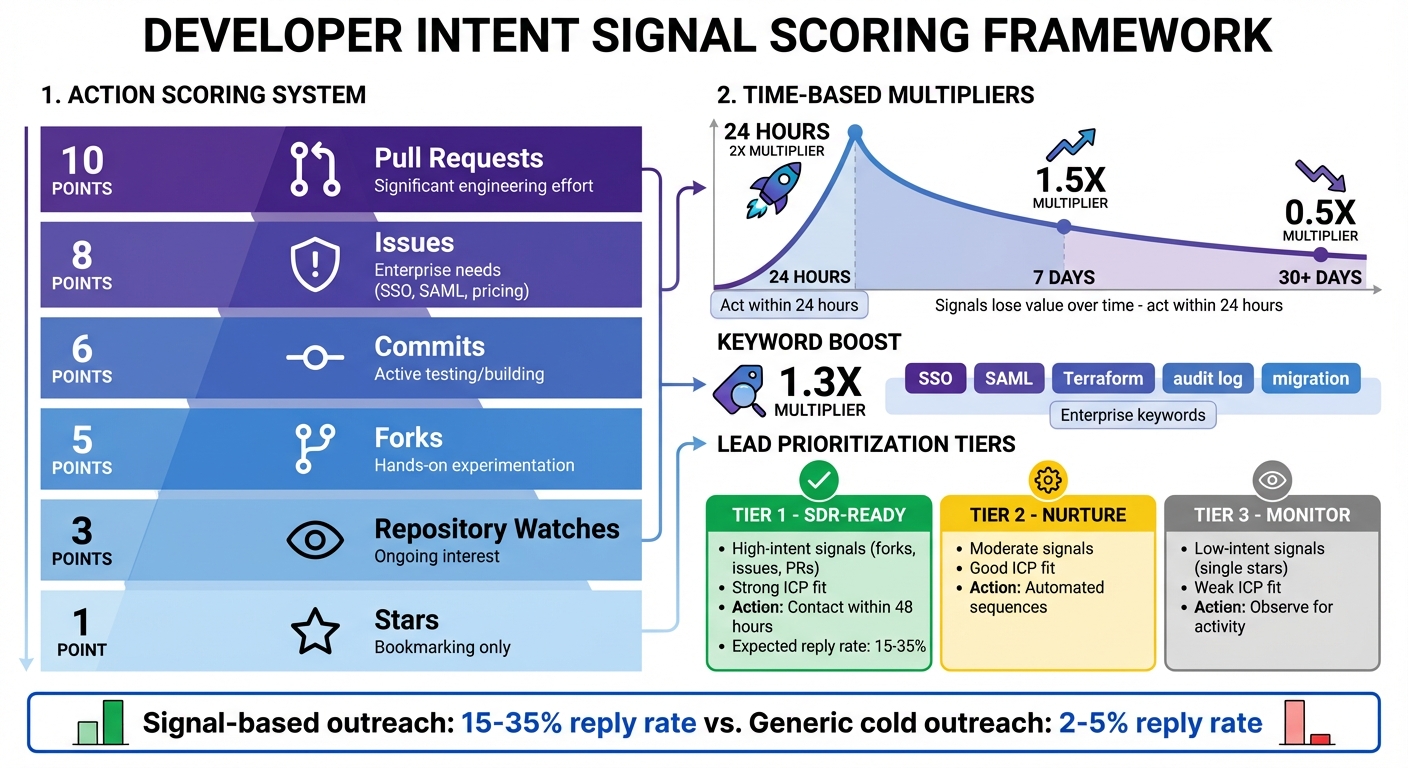 {Developer Intent Signal Scoring Framework and Prioritization Guide}
Once you've mapped developer actions to different stages of the funnel, the next step is scoring these actions to prioritize outreach effectively. Not all developer activities carry the same weight - some actions, like forking a repository and opening issues, show a much higher level of intent than others. For example, a developer who stars your repo, forks it, and opens an issue about deployment challenges is likely progressing toward a purchase decision. The key difference lies in the depth of the signal - the technical effort involved in each action.
Assigning Scores to Developer Actions
A point-based system can help quantify developer engagement. Actions that require more effort or technical involvement should be assigned higher scores. Here's a suggested breakdown:
- Pull requests: 10 points (highest score, as they reflect significant engineering time and effort)
- Issues: 8 points (especially those mentioning enterprise needs like SSO, SAML, or pricing)
- Commits: 6 points (indicating active testing or building)
- Forks: 5 points (showing hands-on experimentation or private testing)
- Repository watches: 3 points (indicating ongoing interest)
- Stars: 1 point (serving more as bookmarks than deep engagement)
Timing is crucial. Developer intent signals are most valuable within the first 24 hours and decline significantly after 30 days. To account for this, apply time-based multipliers:
- 2x for actions within the last 24 hours
- 1.5x for actions within the past 7 days
- 0.5x for actions older than 30 days
For example, a fork that occurred yesterday holds far more weight than one from last month.
Additionally, increase scores when developers use specific high-intent keywords in issues or pull requests. Phrases like "SSO", "SAML", "Terraform", "audit log", or "migration" often indicate enterprise-level evaluation, and you can apply a 1.3x multiplier to these signals .
Prioritizing Leads Based on Intent
Once you've scored developer actions, you can group and prioritize leads based on patterns of engagement. While isolated actions might not always indicate intent, clusters of signals paint a clearer picture. For instance, if a developer stars your repository, forks it, and opens an issue within two weeks, this suggests they are moving from evaluation to purchase .
Moreover, pay attention to team-level activity. When multiple developers from the same company domain engage with your repository, it's often a sign of a coordinated evaluation effort rather than individual interest .
Here’s a simple way to prioritize leads:
- Tier 1 (SDR-ready): High-intent signals, such as forks, issues, or pull requests, combined with a strong ICP (Ideal Customer Profile) fit. These leads should be contacted within 48 hours.
- Tier 2 (Nurture): Moderate signals with a good ICP fit. These leads are ideal for automated outreach sequences.
- Tier 3 (Monitor): Low-intent signals, like single stars or weak ICP fits, should be observed for further activity .
Outreach driven by developer signals tends to perform significantly better, with reply rates of 15–35%, compared to just 2–5% for generic cold outreach .
Lastly, filter out irrelevant signals from bot accounts, students, hobbyists, or competitors. You can do this by examining account age, contribution history, and company domains . By focusing only on genuine buying signals, this scoring system enables you to act quickly and align your outreach with the pace of developers' decisions.
How to Act on Developer Intent Signals
Personalizing Campaigns and Outreach
Once you've scored and prioritized your leads, it's time to use intent signals for targeted and meaningful outreach. Instead of sending out generic cold emails, engage developers when they take specific actions - like forking your repository or opening an issue about enterprise features. These moments show genuine interest and are prime opportunities for connection.
The secret to effective outreach lies in the details. Reference the exact action the developer took. For example, instead of a vague message like "I see you're in tech", say something like, "I noticed you opened issue #312 on [repo] regarding Parquet partitioning improvements." This level of specificity shows that your message is personal, not automated, and that you understand their technical needs.
Timing is everything. When developers open issues or submit pull requests, they're often in evaluation mode and make decisions quickly - sometimes within days. Reaching out within 24 hours of a high-intent action can double your reply rates compared to waiting 72 hours or longer . In fact, outreach based on specific GitHub signals can yield reply rates between 15% and 30%, far outpacing the roughly 1% response rates typical of generic cold emails .
Avoid generic phrases like "book a demo." Instead, offer something valuable and low-friction - such as a code snippet, a technical benchmark, or documentation tailored to their specific issue.
For example, in early 2026, Tim Grassin, CEO of Kubegrade, used this method to gauge interest in Kubernetes tools. By focusing on technical activity and referencing GitHub signals, his outreach campaign achieved a 22% response rate and led to five demos being booked . Similarly, in March 2026, Orlando Nieves, RevOps Lead at Unstructured.io, shifted from general community engagement to targeting developers actively using their product. This approach generated 40% of the company’s pipeline from identified accounts and increased monthly meeting bookings by 20% .
While personalized outreach is great for directly connecting with developers, intent signals can also be used to supercharge your advertising efforts.
Running Intent-Driven Campaigns with daily.dev Ads
Taking intent signals a step further, daily.dev Ads let you apply this targeted strategy to advertising. The platform helps you reach developers based on their engagement patterns, such as their seniority, preferred programming languages, and the tools they use. This ensures your ads are seen by developers who are actively researching solutions.
With native ad placements like in-feed and post page ads, daily.dev Ads integrate naturally into the content developers consume daily. By combining behavioral signals - like visits to documentation pages or searches for comparison tools - with daily.dev's precise targeting, you can deliver ads that resonate with developers right when they're evaluating their options. For example, if developers are reading documentation or searching for "Kubernetes migration tools", you can serve ads that highlight your product's specific benefits, ensuring your message reaches an audience already showing buying intent.
Using Intent Data with Account-Based Marketing for Developer Tools
Applying Intent Signals in ABM Campaigns
Traditional ABM often relies on static strategies, which can fall flat when targeting developers. Developers respond better when outreach is tailored to their technical needs and delivered at the right time. This is where intent data changes the game.
Instead of starting with a pre-defined target account list and hoping for engagement, intent data takes a different approach. It begins with actual developer behavior - such as forking repositories, reading API documentation, or installing packages - and works backward to identify potential high-value accounts. For instance, when multiple developers from the same company engage with your tool in quick succession, it often signals a team-wide evaluation rather than individual interest . This behavior-first strategy also uncovers signals in the hidden "dark funnel", where many developer evaluations take place.
The "dark funnel" refers to the early stages of evaluation, where developers explore tools through GitHub activity, documentation, and package managers - long before they fill out forms or schedule demos . By the time a developer reaches out, their opinion is often already formed. Intent data shines a light on this hidden phase, helping you identify accounts that may be 6–12 months away from formal procurement decisions .
The impact of this approach is clear. In 2026, Orlando Nieves, RevOps Lead at Unstructured.io, shifted to a signal-based ABM strategy. As a result, 40% of the company’s pipeline came from accounts surfaced through intent data. The team also booked 20% more meetings each month by concentrating on accounts actively using their tools . Similarly, Drew Trombley from Pinata leveraged intent data to sift through 800,000 developers and pinpoint enterprise-ready accounts showing coordinated team engagement . These examples highlight how intent-driven ABM sharpens targeting and drives faster conversions.
You can also apply these intent signals to your advertising campaigns. Platforms like daily.dev Ads allow you to integrate this ABM approach seamlessly. By targeting developers based on seniority, programming languages, and tools they use, daily.dev Ads aligns with clear buying intent. When paired with your first-party intent data, the platform enables you to deliver native in-feed and post page ads to developers at companies already showing evaluation activity - reaching them when they’re most engaged.
Conclusion
Developer marketing operates on a completely different wavelength compared to traditional B2B strategies. Developers don’t rely on whitepapers or case studies to evaluate tools - they fork repositories, dive into documentation, and experiment with code on platforms like GitHub. That’s where intent data becomes a game-changer. It tracks these behaviors in real time, uncovering evaluation activity as early as 6–12 months before an actual purchase decision is made .
The numbers speak for themselves. Signal-based outreach boasts reply rates of 15–35%, far outpacing the 2–5% seen with traditional cold outreach methods . A real-world example? Orlando Nieves from Unstructured.io embraced intent-driven marketing and saw 40% of their pipeline come from accounts flagged by behavioral signals, while also booking 20% more meetings each month .
To make the most of intent data, implement a scoring model that highlights high-intent actions. For example, assign significant points to activities like pull requests or engagement with enterprise-related issues, and double those points for recent actions . Timing is also crucial - outreach sent within 24 hours of a signal can double the reply rate compared to messages sent after 72 hours . This approach ensures your sales team focuses on developers who are seriously considering your tools, not just casually browsing.
Take it a step further by pairing intent data with platforms like daily.dev Ads. These platforms let you target developers based on their seniority, programming languages, or tools they use, delivering ads that feel relevant and timely. This strategy connects technical evaluation with actionable marketing, creating opportunities for immediate results.
The bottom line? Intent data isn’t just a luxury - it’s a necessity. Without it, you risk missing out on revenue while developers explore other options, test features, and make decisions without you in the conversation. With intent data, you position yourself exactly where and when it matters most.
FAQs
How do I turn GitHub activity into usable intent signals?
When developers perform actions like opening issues related to enterprise features or submitting pull requests for integrations (e.g., SSO), they’re signaling a strong interest in your tools. These behaviors often reflect active evaluation or purchase intent. Similarly, activities such as starring repositories, forking projects, or participating in discussions can provide valuable insights into potential prospects.
By scoring these activities, you can focus your outreach efforts on developers who show genuine interest. This approach allows for more targeted engagement and personalized campaigns, increasing the chances of building meaningful connections.
Which developer actions predict purchase intent most reliably?
When developers show certain behaviors, it often signals a genuine interest in purchasing. Actions like opening issues related to enterprise features, submitting pull requests for integrations such as SSO, starring repositories that align with their needs, or engaging in discussions about specific tools or features are strong indicators. These activities typically reflect active evaluation and a clear intent to adopt.
How can I act on intent signals without annoying engineers?
To effectively act on intent signals without frustrating engineers, it's essential to focus on outreach that's timely, relevant, and unobtrusive. Pay attention to actions that indicate genuine interest, such as starring repositories, opening issues related to enterprise features, or forking projects to explore integrations. Implement a scoring system to differentiate between casual interactions and meaningful engagement. Tailor your communication based on where they are in their journey - whether they're in the awareness, consideration, or decision stage. By timing your outreach well and personalizing it, you can minimize disruptions while boosting the chances of meaningful engagement.