

Marketing to developers requires precision and authenticity. Developers value practical resources over flashy sales tactics, making targeted strategies essential - especially on a limited budget. Here's a quick breakdown of effective, budget-friendly methods to reach developers:
- Content Marketing: Educational guides and technical content drive engagement (55.3% of professionals say it’s the most effective).
- daily.dev Ads: Target developers with CPM rates of $5–$10 and achieve high click-through rates (up to 25%).
- GitHub Sponsorships: Support open-source projects to build trust and gain visibility.
- Stack Overflow Ads: Reach 82% of developers monthly with tailored campaigns.
- Content Syndication: Republish technical content on platforms like Dev.to and Medium to expand reach by 300–500%.
- Retargeting Campaigns: Re-engage developers using tools like Google Analytics with budgets starting at $10/day.
- Developer Newsletters: Advertise in niche newsletters (e.g., JavaScript Weekly) with CPMs of $5–$20.
- Social Media Ads: Use LinkedIn, Twitter, and Reddit to target developers with CPCs as low as $0.50.
- Webinars: Host low-cost, technical webinars to engage developers directly.
- Open-Source Contributions: Publish libraries or fix bugs to connect with developer communities.
Key takeaway: Focus on platforms and strategies that developers already trust and use. Track performance weekly, shift budgets to high-performing channels, and prioritize delivering content that solves real problems.
::: @figure 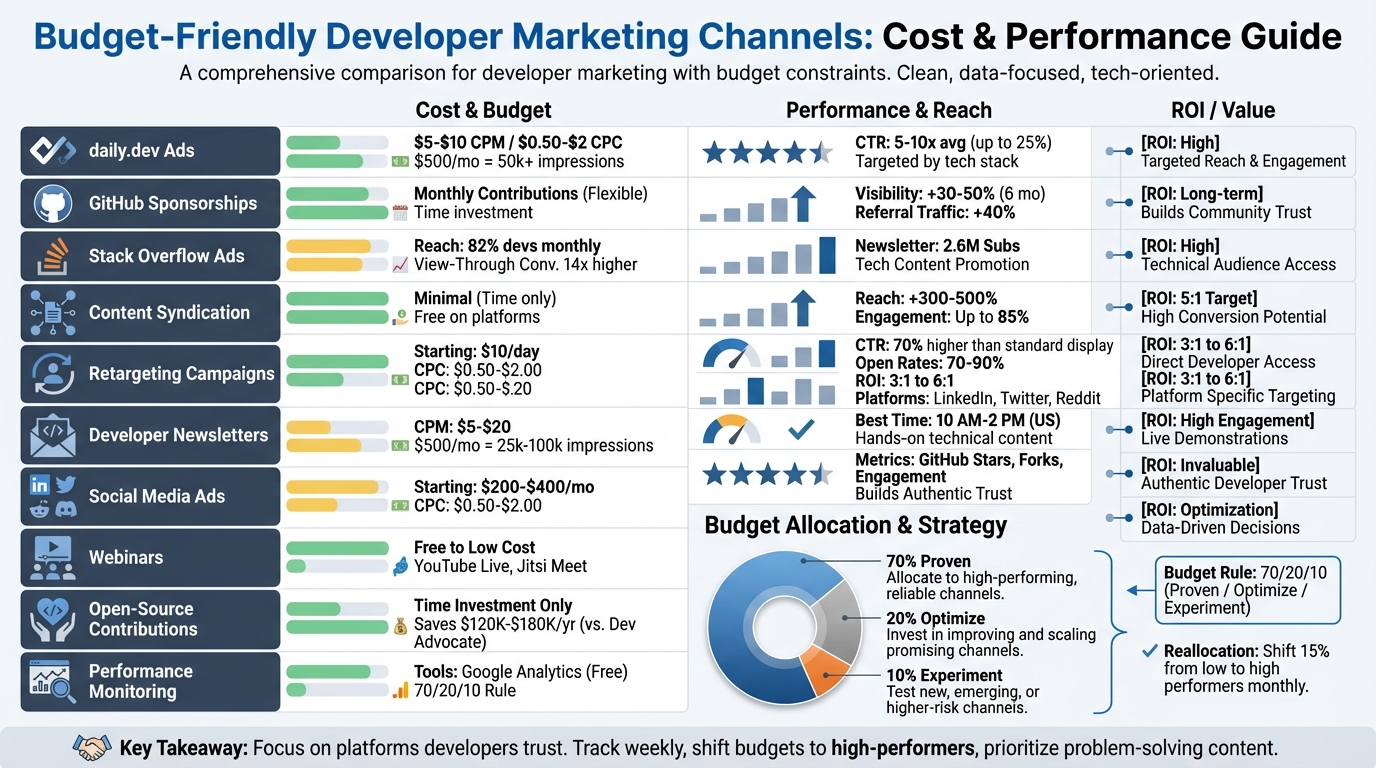 {Budget-Friendly Developer Marketing Channels: Costs and Performance Comparison}
1. Use daily.dev Ads for Targeted Developer Campaigns
daily.dev is a news aggregator tailored specifically for developers, serving over a million users with curated tech content. It allows advertisers to target developers based on programming languages, tech stacks, roles, and experience levels. This level of precision ensures your ads are seen by the right people at the right time, making your campaigns more impactful.
Budget-Friendly Advertising Options
daily.dev offers competitive pricing, with costs ranging from $5–$10 CPM or $0.50–$2 per click. For instance, a dev tool company allocated $1,500 over a 30-day campaign targeting AWS users, resulting in 150 qualified leads at just $10 each. This effort contributed to a 20% pipeline growth. Even with a modest $500 monthly budget, advertisers can achieve over 50,000 impressions, making it a smart choice for startups or smaller teams.
Reaching Developers Where They Are
The platform uses AI to align ads with the content developers are actively engaging with. Since 90% of daily.dev users are developers seeking practical, technical insights, your ads appear in a highly relevant context. Ads that focus on offering value - like free tools, tutorials, or documentation - tend to perform better. As daily.dev emphasizes:
"Run native ads on daily.dev to build trust and drive qualified demand."
This focus on relevance and trust makes daily.dev Ads an effective option for developer-centric marketing.
High Engagement and Visibility Potential
Thanks to its precise targeting, campaigns on daily.dev often achieve click-through rates (CTR) that are 5–10 times higher than the industry average of 0.5–1%. For example, a SaaS tool campaign achieved a 25% engagement rate, leading to 3,000 sign-ups from a $2,000 investment. Similarly, an indie developer promoting a free VS Code extension reported a 15% CTR, converting 500 users. These examples highlight how even smaller budgets can deliver strong results.
Easy ROI Tracking and Performance Measurement
daily.dev includes built-in analytics tools to track metrics like impressions, clicks, CTR, and conversions. It integrates seamlessly with Google Analytics and offers features such as the Tech Campaign ROI Estimator, which lets you forecast conversions based on your budget before spending. Real-time monitoring and tools for A/B testing and AI-driven optimization allow marketers to fine-tune their campaigns, with some reporting a 20% boost in conversions through these methods.
sbb-itb-e54ba74
2. Sponsor GitHub Projects and Repositories
GitHub is where developers spend a lot of their time - exploring, contributing to, and evaluating projects. Sponsoring open-source projects on GitHub places your brand right in front of this audience. Unlike traditional ads, these sponsorships feel more genuine because they support the tools and libraries developers already rely on. Let’s dive into how GitHub sponsorships can boost your visibility and connection with developers.
Building Trust with Developers
Developers value authenticity, and sponsoring relevant projects shows that your brand understands their needs. By supporting tools that solve real problems - whether it’s a widely-used JavaScript library, a DevOps solution, or a testing framework - you naturally build credibility. This kind of alignment resonates with developers and strengthens trust in your brand. In fact, well-executed GitHub sponsorships can increase organic visibility in developer communities by 30% to 50% within six months. Plus, referral traffic to your landing pages could grow by as much as 40%.
A Budget-Friendly Marketing Option
GitHub Sponsors allows you to back project maintainers with monthly contributions, making it a cost-effective choice for those with tight budgets. Focus on high-impact repositories - ones with active communities, regular updates, and strong engagement. Your sponsorship appears as a badge on the repository, giving you ongoing visibility. This approach doesn’t just build trust; it can also lead to a 5% to 10% boost in conversion rates for related pay-per-click campaigns.
Tracking Results Made Simple
GitHub provides built-in tools like the Sponsor Dashboard to help you measure the impact of your sponsorships. You can monitor metrics such as stars, forks, contributions, and sponsor listings. For even deeper insights, use UTM parameters to track referral traffic with Google Analytics. Metrics like repository clones, README views, and discussion activity offer valuable feedback on engagement, helping you fine-tune your strategy for better results.
3. Advertise on Stack Overflow

Relevance to Developer Audiences
Developers turn to Stack Overflow for quick, practical answers. With 82% of developers visiting the platform monthly , your brand gets visibility right when they're actively seeking solutions. The platform's 2023 developer survey collected over 90,000 responses , showcasing its extensive reach. About 33% of users identify as full-stack developers, and 18% as back-end developers , connecting you to the professionals who play key roles in decision-making. Stack Overflow’s ability to align with this audience makes it a smart choice, especially for budget-conscious campaigns.
Cost-Effectiveness for Budget-Conscious Campaigns
When every dollar counts, Stack Overflow’s tailored options provide an efficient way to reach your audience. Topic Tag sponsorships allow you to focus on specific technologies, choosing from over 60,000 unique tags , ensuring you’re not paying for irrelevant traffic. The "Direct to Developers" solution promotes technical content like documentation, tutorials, or videos in a seamless, non-intrusive way. For a more immediate impact, brands can run 24-hour high-impact campaigns that fit within any budget . On top of that, dedicated account managers offer regular guidance to refine your campaigns, saving both time and money .
Potential for High Engagement and Visibility
Stack Overflow’s engagement numbers reveal how developers interact with ads. 83% of conversions happen without a click , meaning developers often notice your brand and later research it independently. Banner ads perform especially well, with view-through conversions being 14 times higher than click-through conversions . Beyond ads, "The Overflow" newsletter reaches 2.6 million subscribers , the blog attracts 300,000 monthly visitors , and the podcast averages 12,500 downloads per episode . These channels amplify your visibility, reaching developers through multiple touchpoints.
Ease of Measuring ROI and Performance
Stack Overflow makes it simple to track and optimize your campaigns. With real-time performance dashboards, you can monitor engagement and ROI as they happen . These dashboards let you adjust spending to focus on the best-performing tags or niches. Covering 183 communities, the platform provides insights into view-through conversions, tag-specific performance, and overall engagement . Considering that 62% of developers influence technology purchases , this level of detail ensures you can pinpoint the technical areas that deliver the best results, helping you make the most of your budget.
4. Syndicate Content Through Developer Platforms
Stretching Your Budget Without Sacrificing Impact
Republishing your technical content on developer platforms like Dev.to, Hashnode, and Medium is a smart way to get more mileage out of your content without breaking the bank. Once you've created the content, syndicating it on these platforms comes at little to no additional cost. While producing technical content can be 2–3 times more expensive than standard marketing materials, syndication can amplify your reach by an impressive 300–500% compared to posting only on your company blog . It’s a cost-efficient strategy that maximizes visibility while meeting developers in the spaces they already frequent.
Reaching Developers Where They Are
Syndication isn't just about saving money - it's about being where developers gather. Platforms like DZone cater to DevOps and backend developers, while Dev.to attracts a diverse technical audience . Sharing your tutorials, guides, or in-depth technical articles on these platforms ensures your content reaches the right people. Karl Hughes, Founder of Draft.dev, puts it perfectly:
"If you're not putting your content out onto every channel possible, you're wasting a lot of effort on content that people just aren't seeing."
By syndicating strategically, you're not just publishing content - you’re joining the conversations developers are already having.
Boosting Engagement and Visibility
The numbers speak for themselves: posts on DZone average over 4,000 views in a month, Dev.to articles typically rack up between 1,500 and 5,000 views, and Medium’s massive user base of over 100 million monthly visitors offers even more potential exposure . Syndicating your content on these platforms can increase engagement by up to 85% and drive referral traffic by as much as 40% within 90 days. Want to push those numbers even higher? Tailor your content for each platform, which can improve performance by up to 60%.
Tracking Results and Protecting SEO
Measuring the success of your syndicated content is straightforward. Use UTM parameters to track clicks and engagement from each platform. To safeguard your SEO efforts, publish the content on your own site first and wait 2–10 days for it to be indexed before syndicating. Always include canonical URLs or clear links back to the original post to maintain SEO authority and gain valuable backlinks .
Syndicating content isn't just about reposting - it’s a calculated strategy to expand your reach while keeping your SEO intact.
5. Run Retargeting Campaigns with Low-Cost Tools
Making the Most of a Tight Budget
Retargeting is a smart way to reconnect with developers who’ve already interacted with your content. Tools like Google Analytics and Facebook Pixel make it easy to track users without adding extra costs - your main expense will be the ad spend itself. You can start small, with daily budgets as low as $10, making this strategy accessible even for lean budgets. A good rule of thumb is the 70/20/10 rule: dedicate 70% of your budget to proven channels, 20% to refining and optimizing, and 10% to experimenting with new audiences. This approach ensures your resources are spent wisely while delivering relevant content to an audience already familiar with your brand .
Tailored for Developer Audiences
Developers are known for their careful, research-driven decision-making. They explore platforms like GitHub and Stack Overflow, dive into documentation, and evaluate tools thoroughly before committing. Retargeting aligns perfectly with this mindset by offering content they’ll find genuinely useful - like free API documentation, code snippets, or tool demos - rather than pushing hard sales messages. With tools like Google Tag Manager, you can set up tracking pixels to create custom audiences based on developer behaviors. This lets you serve ads on platforms like YouTube or Google Search that resonate with their specific interests .
Boosting Engagement and Visibility
Retargeting isn’t just budget-friendly - it’s also highly effective. Research shows retargeting campaigns can achieve click-through rates up to 70% higher than standard display ads. In fact, advertisers in the UK who used retargeting in their Search campaigns saw an average 20% boost in conversions. For example, a developer tool company that targeted GitHub users with dynamic ads tripled their engagement compared to standard campaigns. These numbers highlight how retargeting can deliver results that go beyond just impressions .
Tracking ROI with Ease
One of the best parts about retargeting is how easy it is to measure success. Platforms like Google Ads and Meta Ads Manager provide real-time dashboards to monitor essential metrics like Return on Ad Spend (aim for a 5:1 ratio), conversion rates, and cost per click. For developer-focused campaigns, CPCs typically range from $0.50 to $2.00, making it easier to predict and manage costs. Interestingly, only 17% of companies have flexible marketing budgets that allow for real-time adjustments. By tracking performance closely, you can reallocate 15–20% of your budget to the top-performing tactics, giving you an edge in a competitive market .
6. Advertise in Developer Newsletters
Budget-Friendly Advertising for Targeted Reach
If you're looking to connect with developers without overspending, newsletter advertising offers a cost-effective solution. With CPM rates ranging from $5 to $20 per 1,000 impressions, even a modest monthly budget of $500–$2,000 can put your message in front of over 50,000 developers. For instance, JavaScript Weekly charges between $400 and $1,200 per slot for its 50,000+ subscribers, while Python Weekly offers spots at $300–$800 for an audience of over 40,000. Compared to social media ad rates, which can be 60–80% higher, newsletters allow you to test your campaigns effectively while allocating just 10% of your marketing budget to experimentation .
Reaching the Right Developer Audience
Developer newsletters attract highly engaged readers who actively subscribe to stay updated on tools, frameworks, and trends. Popular options like Hacker Newsletter (100,000+ subscribers) and React Status cater to specific niches, ensuring your ads reach the right audience - whether it's Node.js developers, Rust enthusiasts, or frontend specialists. With open rates ranging from 70% to 90%, these newsletters far outperform standard email campaigns, making them a smart choice for targeted engagement .
High Engagement and Visibility Potential
Ads in developer newsletters often achieve click-through rates of 20%–40%, thanks to their placement within trusted, curated content. For example, a SaaS tool that ran a $600 ad in Rust Weekly gained 200 sign-ups, delivering a 4:1 ROI. Similarly, a $900 sponsorship in Frontend Focus drove 1,200 visits and generated $15,000 in pipeline revenue. On top of that, 10–15% of readers share or forward newsletter issues, amplifying your ad's reach even further .
Simple ROI Tracking and Performance Metrics
Tracking the performance of newsletter ads is straightforward with tools like UTM parameters, promo codes, Google Analytics, or Bitly. Aim for a click-through rate of at least 5%, and monitor conversions and acquisition costs to measure success. Developer newsletters typically deliver ROI ratios between 3:1 and 6:1, with around 91% engagement - far surpassing the 1–2% engagement seen in social media ads. To get started, try sponsoring three to five newsletters on a one-off basis, then adjust your strategy by reallocating 10–15% of your budget based on quarterly reviews. A/B testing different placements can also improve efficiency by 15–25%, helping you refine your campaigns for even better results . This data-driven approach ensures your newsletter strategy aligns seamlessly with your broader developer marketing efforts.
7. Run Social Media Ads on Developer Platforms
Budget-Friendly Campaign Options
Social media ads are a smart way to connect with developers without overspending. Platforms like LinkedIn and Twitter offer average CPCs ranging from $0.50 to $2.00, which is significantly lower than traditional advertising costs. For growth-stage companies, a typical monthly budget starts at $1,000, scaling to $1,500 as campaigns grow. Even startups can test the waters with just $200–$400 per month, making it a low-risk option for lean marketing teams. These pay-per-click platforms let you control spending and adjust strategies without hefty upfront costs, delivering a 3:1 to 6:1 ROI for many campaigns .
Connecting with Developer Communities
Platforms like LinkedIn, Reddit, Twitter (X), and Discord are prime spaces for engaging with developers. LinkedIn allows precise targeting based on job roles (e.g., "software engineer") and technical skills (e.g., Python, AWS), reaching 70% of developers professionally . Twitter is perfect for real-time tech discussions using hashtags like #DevOps, while Reddit subreddits (e.g., r/programming) and Discord servers offer niche engagement opportunities. To effectively reach developers, focus on value-first content - think free tools, tutorials, or code snippets. For instance, an ad like "Optimize your CI/CD pipeline with our open-source CLI - free trial" speaks directly to their needs with relevant, technical language .
High Engagement and Visibility
Social media ads tailored for developers often outperform general campaigns, driving 2–5x higher interaction rates. Short-form videos, such as quick tutorials or product demos, stand out, with 41% of marketers identifying them as the highest ROI content type . For example, a SaaS company promoting a free API debugger on LinkedIn with a $5,000 budget achieved a 15% conversion rate and an 8:1 ROI . Similarly, a Twitter campaign using the #100DaysOfCode hashtag generated 50,000 impressions for $1,200, resulting in 200 product trials by offering value-driven content .
Tracking ROI Made Simple
Platforms like LinkedIn Insights and Twitter Analytics make it easy to track metrics like CTR and conversions, while integration with Google Analytics provides deeper attribution insights. Many campaigns report earning $5 for every $1 spent . AI tools can further enhance performance, improving conversions by 20% through real-time bidding adjustments . To maximize results, allocate 10–20% of your budget to analytics and testing. Follow the 70/20/10 rule: invest 70% in proven strategies, 20% in optimization, and 10% in experimental ideas. Keep 10–15% of your budget flexible to double down on top-performing campaigns during quarterly reviews, ensuring you're ready to capitalize on demand spikes .
8. Host Low-Cost Webinars and Virtual Events
Affordable Options for Reaching Developers
Webinars are a budget-friendly way to connect with developers on a large scale. Platforms like YouTube Live offer free streaming with built-in tools for engagement, while open-source alternatives such as Jitsi Meet eliminate licensing costs altogether . If you need more advanced features, platforms like Hopin and Airmeet provide reasonably priced plans for smaller events . For startups, Discord is an excellent option for hosting community-driven events without spending a dime. Tailor your platform choice to the event's scale - YouTube Live works for straightforward product demos, while larger, multi-track conferences might warrant investing in specialized event tools . This flexibility ensures you can deliver high-impact content without overspending.
Developer-Focused Content That Works
Cost savings are great, but the content is what truly matters to developers. They prefer practical, hands-on sessions over generic marketing pitches. Design webinars to tackle specific technical challenges, showcase real-world code examples, or share architectural insights . Formats like live coding sessions, interactive Q&A, and downloadable code samples resonate far more than slide-heavy presentations. Focus on topics that address developer pain points - think performance optimization, security tips, or migration strategies. For instance, a session on "Building Real-Time Applications with WebSockets" will attract more interest than a generic pitch like "Why Our Platform is Best" .
Boosting Engagement and Visibility
To maximize reach, consider partnerships with developer-centric platforms. Collaborate with daily.dev, Stack Overflow, or GitHub to co-promote your events and share production or marketing costs . Promote your webinar through developer-specific channels like newsletters (e.g., JavaScript Weekly), Reddit communities such as r/webdev, or active Discord servers. Developers trust peer recommendations over vendor promotions, so encourage attendees to share the event within their networks . Timing matters too - schedule events during typical developer working hours (10 AM–2 PM in US time zones) and always record sessions for on-demand access .
Measuring Success and ROI
Tracking performance is straightforward with webinars. Focus on metrics like attendance (registrations vs. actual attendees), engagement (questions asked, chat activity), and conversions (leads or customers) . Calculate cost-per-lead by dividing your total webinar spend by the number of qualified leads generated. Post-event engagement is another key indicator - monitor email open rates for follow-ups, GitHub activity tied to your event, or discussions in relevant forums. Within 24 hours, send attendees a follow-up email with the webinar recording, resources, and a clear call-to-action. Developers appreciate timely, actionable resources that they can immediately put to use . This data-driven approach ensures your events align with your broader strategy of delivering practical, developer-focused content.
9. Contribute to Open-Source Projects
A Budget-Friendly Approach for Developer Marketing
Open-source contributions can be a smart way to stretch your marketing dollars. Instead of committing $120,000–$180,000 annually to hire a full-time developer advocate, you can start small. Tasks like fixing bugs or enhancing documentation only require your team's time. Publishing client libraries or adapters as open-source packages is another savvy move. The community often steps in to maintain the code, spot bugs, and even test your product, essentially acting as unpaid quality assurance testers and advocates for your brand . This approach is not just cost-efficient - it also helps you build authentic relationships with developers.
Building Trust Through Relevance
Developers are naturally skeptical of traditional advertising and sales tactics. Open-source contributions, however, resonate with them. By participating in repositories and community discussions, you can establish an organic presence that feels genuine. As Linus Torvalds, the creator of Linux, famously said:
"In open source, we feel strongly that to really do something well, you have to get a lot of people involved" .
When you contribute to projects that align with your product, it showcases your technical expertise and commitment to collaboration - qualities developers value deeply.
Amplifying Visibility and Engagement
Open-source involvement tends to generate organic buzz within developer communities. Contributions are visible on platforms like GitHub, in Stack Overflow threads, and across technical forums where developers exchange ideas. Mike Bursell highlights the importance of this dynamic:
"The community aspect of open source is actually a driver towards building distributed trust…Once you become a part of the community around an open source project, you assume one or more of the roles that you start trusting" .
This grassroots approach encourages developers to explore, test, and eventually champion your tools . The result? Increased engagement and visibility that can lead to measurable outcomes.
Tracking ROI with Clear Metrics
Measuring the success of your open-source efforts doesn’t have to be complicated. Simple, actionable metrics can provide valuable insights. For example, you can track community contributions to gauge interest or monitor organic search traffic using UTM parameters to see how developers are finding your tools. Other useful indicators include developer sign-ups, trial activations, and the conversion rate from free to paid plans. Additionally, monitoring activity in community forums and analyzing Net Promoter Score (NPS) surveys can reveal how developers perceive and advocate for your offerings . These metrics make it easier to connect your open-source contributions to tangible business results.
10. Monitor Performance and Adjust Budget Allocation
Smarter Spending for Better Results
Tracking marketing performance goes beyond just gathering data - it's about using that data to make informed spending decisions. If your resources are tight, reviewing campaigns weekly can help you identify channels delivering a 5x ROI. From there, you can shift 15% of the budget from underperforming areas to those high-performing ones. A good strategy to follow is the 70/20/10 rule: dedicate 70% of your budget to proven methods, 20% to refining and optimizing, and 10% to trying out new ideas. This approach ensures you can test fresh tactics without risking your entire budget .
Measuring ROI Without Breaking the Bank
You don’t need pricey tools to measure ROI effectively. Free and low-cost options, like Google Analytics, can track customer journeys and attribution across multiple touchpoints. Another option is Google’s open-source Meridian Marketing Mix Model, which evaluates the added value of your campaigns. For developer-focused efforts, keep an eye on key metrics such as click-through rates (CTR), cost per acquisition (CPA), and conversion rates for sign-ups or downloads. Since developer buying decisions often take weeks or months, multi-touch attribution is essential for capturing the full impact of your campaigns. Additionally, AI-powered tools can help identify missed conversions and optimize campaigns in real time, potentially increasing conversions by as much as 20% .
Aligning with Developer Interests
Developers are naturally data-driven, so your monitoring approach should reflect that mindset. Go beyond vanity metrics and focus on indicators that resonate with developers, like GitHub stars, fork activity, and interactions on Stack Overflow . For instance, if you notice a 15% rise in searches for developer tools during Q2, consider reallocating your budget to paid search or retargeting campaigns. This kind of responsiveness shows developers that you understand their needs and can adapt to their evolving workflows .
Boosting Engagement and Visibility
Only 17% of companies have the flexibility to shift budgets quickly, but doing so can increase conversions by up to 20% . For developer marketing, this flexibility is key. If you identify high-engagement channels - like a well-received developer newsletter or a webinar series - you can immediately reallocate resources to amplify their reach. This agility not only improves visibility but also helps scale your success in reaching developer audiences.
Conclusion
Turning a limited budget into meaningful growth is entirely possible with the right strategies in place.
Marketing to developers on a budget can yield impressive results when approached thoughtfully. The tactics discussed - like targeted ads on developer platforms, sponsoring GitHub projects, running retargeting campaigns, and contributing to open-source initiatives - form a well-rounded strategy that maximizes the impact of every dollar. The secret lies in combining precise targeting with ongoing analysis to ensure funds are channeled toward efforts that truly deliver.
Consider using the 70/20/10 allocation method: dedicate 70% of your budget to proven methods like Stack Overflow ads and GitHub sponsorships, 20% to optimization tools such as retargeting and newsletters, and 10% to experimental efforts like webinars or open-source contributions . With 83% of B2B marketers expecting budgets to increase over the next year , this is the perfect time to build scalable, efficient processes. A disciplined, data-focused approach ensures every dollar drives genuine developer engagement.
Testing is non-negotiable. As Daphna Giniger from daily.dev puts it:
"If marketing isn't anchored to fast, frictionless user wins, it's dead on arrival - no matter how creative the execution" .
Start small, experiment with various channel combinations, and monitor metrics like conversions and pipeline growth using tools like Google Analytics or incrementality experiments . Then, double down on what works. With only 17% of businesses maintaining flexible marketing budgets , agility and performance-based reallocation can give you a competitive edge. AI-powered tools, which have been shown to boost conversions by up to 20% , can further streamline decision-making and improve results.
Track meaningful outcomes like GitHub stars, forks, qualified leads, and revenue impact - not superficial metrics . Regularly review performance, especially when resources are tight, and don’t hesitate to shift funds from underperforming channels to those showing strong returns.
FAQs
What channel should I start with if my budget is under $500/month?
Starting with native ads on well-regarded developer platforms like daily.dev can be a smart move. These ads perform well even on a modest budget - think under $500 per month - especially if you prioritize targeted, high-quality content that genuinely connects with developers.
What should a developer-focused ad or landing page include to convert?
A landing page aimed at developers needs to prioritize technical accuracy and provide detailed, relevant information that speaks directly to the challenges developers face. Using clear, precise language is key to building trust with this audience. Focus on showcasing measurable benefits, such as improvements in performance or efficiency, to demonstrate real value.
Additionally, offering practical resources - like API documentation, tutorials, or code samples - can make a big difference. Developers appreciate transparency, so avoid over-the-top claims or excessive marketing language. Instead, align your messaging with their preference for straightforward, authentic communication. Clearly presenting technical details will help establish credibility and keep developers engaged.
How do I track ROI when developers convert days or weeks later?
To measure ROI when developer conversions take time, pay attention to engagement metrics such as the frequency of API calls, the number of documentation views, SDK usage, and feature activations. It's also important to track how developers interact with tutorials, code samples, or other targeted content. These metrics give insight into the lasting effects of your campaigns, allowing you to evaluate ROI by looking at technical adoption and the growth of your developer community over an extended period.