

Tracking developer marketing is tough. Why? Developers don’t follow simple paths to conversion. They might read a blog post on their phone, share it in Slack, test an API weeks later, and convert on another device. Traditional attribution models fail to capture this complexity. Plus, privacy tools, ad blockers, and short cookie lifespans mean 30%-70% of data goes missing.
Here’s what works:
- First-Touch Attribution: Helps identify where awareness starts but ignores later steps.
- Last-Click Attribution: Overemphasizes the final step, missing the bigger picture.
- Linear Attribution: Spreads credit evenly but treats all touchpoints equally.
- Time-Decay Attribution: Prioritizes recent actions but undervalues early discovery.
- Position-Based Attribution: Balances credit between discovery, engagement, and conversion.
Key strategies for developer marketing:
- Use server-side tracking to bypass ad blockers.
- Monitor GitHub activity and documentation visits as intent signals.
- Extend attribution windows to match long sales cycles (6-8 weeks).
- Add "How did you hear about us?" fields to catch untracked referrals.
- Track trial sign-ups, API usage, and CRM data to connect offline and online actions.
The takeaway? No model is perfect, but combining attribution methods and focusing on developer-specific signals can help you make better decisions - even when data is incomplete.
Why Attribution Is Harder for Developer Products
When it comes to developer products, tracking and attributing conversions is no walk in the park. The evaluation process itself can stretch over weeks or even months, as developers dig into APIs, comb through documentation, and run extensive tests . This drawn-out timeline clashes with tracking systems. For instance, Safari's Intelligent Tracking Prevention limits cookies to just 7 days, wiping out critical early-touch data . Add in the complexity of multi-step, cross-device journeys, and you're left with a serious attribution headache.
Extended Sales Cycles and Multi-Step Journeys
Adopting developer tools isn't a quick decision - it typically takes 6 to 8 weeks . And it's rarely a one-person show. A developer might stumble upon a tool on Reddit, share it on Slack, and star it on GitHub. Later, team members might review it across devices, discuss it in meetings, and finally convert weeks down the line . Standard attribution windows just can't keep up with this kind of fragmented process.
"Nobody from a bigger team reads a single blog post and converts on the spot. That's not real. A developer might read it on their phone, drop it into Slack, someone else opens it at the office, they talk about it a week later, maybe come back to it from a different article." - Milica Maksimović, Co-founder and COO, Literally.dev
Multiple Touchpoints Across Different Channels
Developers don’t stick to one platform when exploring tools. They’re bouncing between GitHub, Reddit, documentation, local environments, and marketing sites . These scattered touchpoints make it tough for attribution tools to connect the dots. Often, conversions get lumped into the "direct" category, even when that’s far from the truth.
Dark Social and Untrackable Conversations
Then there’s the issue of "dark social." Key conversations happen in private spaces like Slack, Discord, direct messages, or even face-to-face. These interactions strip away UTM parameters, leaving no digital breadcrumbs. In fact, one study found that 30% of high-quality leads originated from content marketing but left no traceable data . As a result, attribution models often fail to recognize these critical contributions, mislabeling conversions or missing them entirely.
sbb-itb-e54ba74
Attribution Models: What Works and What Doesn't
::: @figure 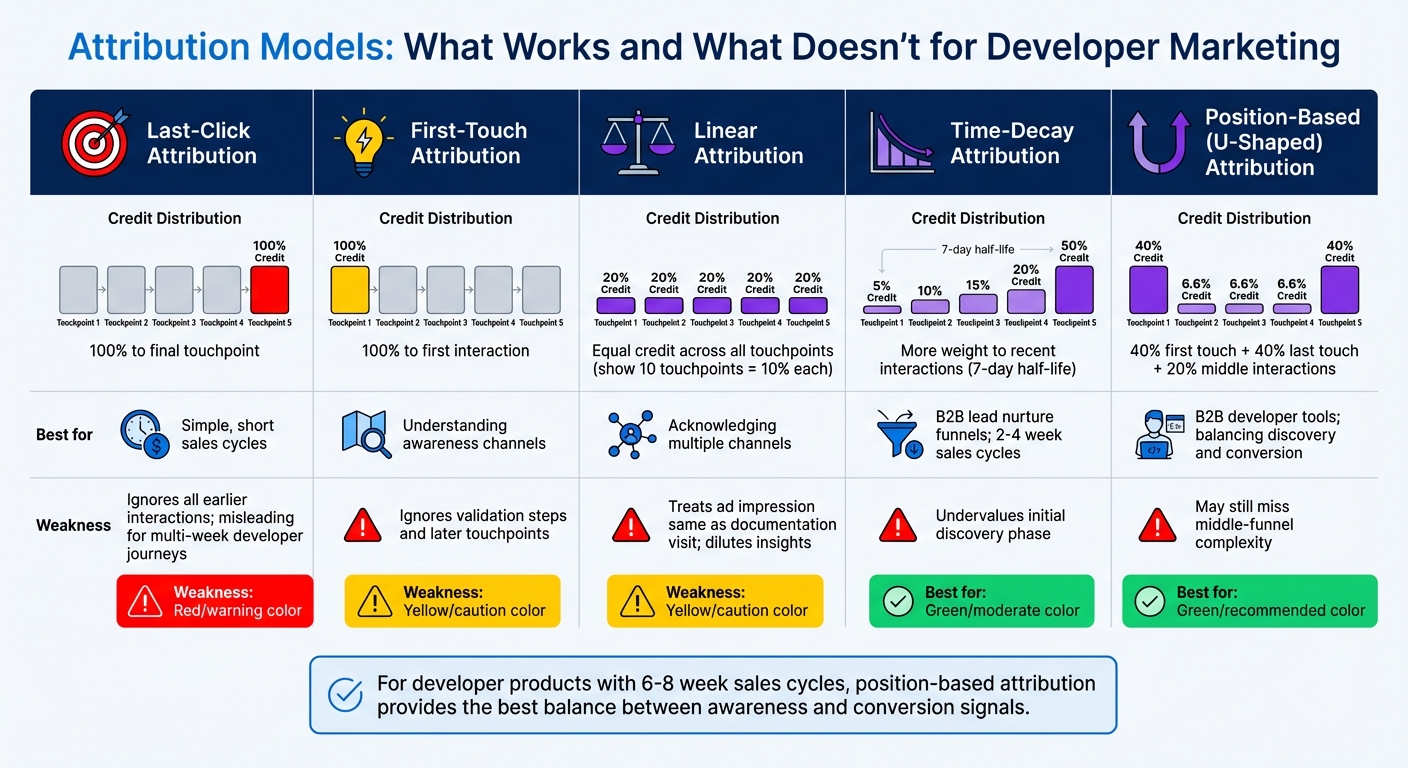 {Marketing Attribution Models Comparison for Developer Products}
Navigating the complexities of tracking multi-touch developer journeys is no small feat. Picking the right attribution model is critical to allocating your marketing budget wisely. As Andreas Hatlem puts it:
"Pick the wrong attribution model, and you'll scale your worst channel while cutting your best one."
The problem? Many traditional models are designed for short, straightforward sales cycles, not the multi-week, detail-heavy evaluations developers often undertake.
Why Last-Click Attribution Falls Short
Last-click attribution assigns 100% of the credit to the final interaction before a conversion - often a branded search or direct visit. This approach can be incredibly misleading. Imagine a developer spending weeks diving into technical blogs, participating in GitHub discussions, and exploring documentation, only to convert after searching for your product by name. Last-click attribution would credit that branded search entirely, making your SEO and content efforts seem irrelevant. For developer journeys that span forums, documentation, and community discussions, last-click attribution oversimplifies the complex path to conversion.
First-Touch Attribution: A Focus on Awareness
First-touch attribution, on the other hand, credits the very first interaction where a developer discovers your product. It’s a helpful model for understanding which channels drive awareness. But it has a major blind spot: it ignores everything that happens after that initial touchpoint. For instance, a developer might click on an ad, then forget about it, only to return weeks later via documentation before converting. In this case, first-touch attribution would credit the ad while disregarding the critical validation steps that ultimately led to the decision.
Linear Attribution: Spreading the Credit
Linear attribution distributes credit equally across all touchpoints in the journey. If a developer interacts with your brand 10 times before converting, each interaction gets 10% of the credit. This model acknowledges that multiple channels contribute to the outcome. However, it doesn’t differentiate between touchpoints. For example, a brief ad impression is treated the same as an in-depth engagement with technical documentation - even though the latter often signals much stronger intent. In developer-focused cycles, this can dilute the insights you need to fine-tune your strategy.
Time-Decay Attribution: Weighting Recent Interactions
Time-decay attribution gives more credit to touchpoints closer to the conversion, typically using a 7-day half-life. This means a touchpoint from a week ago gets about half the credit of one that happened today. It reflects the reality that recent interactions often play a pivotal role in driving decisions. This model works well for B2B cycles and is particularly effective in optimizing lead nurture funnels. However, it tends to undervalue the initial discovery phase. To get a well-rounded perspective, compare time-decay results with first-touch or position-based models to ensure top-of-funnel efforts aren’t overlooked.
Up next, we’ll look at how these attribution strategies can be applied to track the entire developer journey - from first engagement with your content to the final conversion.
Tracking the Developer Journey: Content to Conversion
Understanding the full developer journey - from initial content interaction to trial sign-up and conversion - is essential for effective tracking. By connecting content engagement to conversion events, you can refine your attribution models and gain deeper insights into developer behavior.
Measuring Content Engagement and Awareness
It's not enough to rely on vanity metrics like impressions. As Milica Maksimović, Co-founder and COO of literally.dev, explains:
"Impressions are the worst vanity metric you can think of. Someone scrolling past your social media post without properly noticing it still counts as an impression."
Instead, focus on tracking where developers go after engaging with your content. Are they moving from a blog post to your homepage, product page, or documentation? This navigation flow provides more meaningful insights. To ensure accurate tracking, capture UTM parameters during the first visit and store them server-side, tied to a persistent visitor ID. This approach helps overcome limitations like Safari's Intelligent Tracking Prevention, which can restrict cookies to as little as 24 hours .
Server-side tracking also avoids issues caused by ad blockers that interfere with JavaScript pixels and cookies. Tools like Meta's Conversions API and Google's Measurement Protocol allow you to maintain a more complete dataset. As Andreas Hatlem, Developer, puts it:
"A mediocre model with complete data beats a perfect model with 40% data loss."
Documentation Visits as Intent Signals
When it comes to identifying purchase intent, documentation visits are one of the most telling indicators. Developers often spend significant time reviewing technical documentation before committing to a trial. These visits carry much more weight than generic page views .
Using session replay tools on documentation pages can reveal interaction patterns and pinpoint where users drop off . Tracking the "next page" a developer visits, such as moving from a blog post to documentation or from documentation to a product page, provides valuable insights into their journey .
A weighted attribution model can help quantify the importance of these actions. For example, you might assign 30% credit to documentation visits, 30% to local development testing, and 20% to the final conversion event. This framework underscores the critical role documentation plays in guiding developers toward trials and conversions .
From Trial Sign-Ups to Paid Conversions
The final step is linking trial sign-ups to paid conversions. To do this effectively, use server-side event tracking to bypass ad blockers .
Store first-touch data in localStorage and pass it into hidden fields during trial sign-ups, connecting initial content discovery to specific leads in your CRM . Identity resolution tools can link anonymous documentation sessions to individual developer profiles, enabling a more complete view of their journey .
Track high-intent actions such as demo requests, trial sign-ups, and API documentation interactions with custom events, rather than relying solely on generic page views . Integrating your CRM (e.g., HubSpot or Salesforce) with this data ensures you capture offline interactions like sales calls or referrals, which digital tracking might miss. Given that B2B SaaS sales cycles for developer products often span 6–8 weeks, it's crucial to set attribution windows long enough to capture the entire journey .
The Dark Funnel: What You Can't Track and How to Work Around It
What the Dark Funnel Means for Developer Marketing
The "dark funnel" refers to all the untracked conversations, recommendations, and research that influence decisions but remain invisible to analytics tools. For developer-focused products, this includes spaces like private Slack groups, Discord servers, Reddit discussions, GitHub threads, and local testing environments - places where developers often explore and decide.
The challenge is clear. Milica Maksimović, Co-founder and COO of literally.dev, highlights this issue:
"Developers block ads. And if they're blocking ads, they're also blocking your analytics. At minimum, 30% of your audience is invisible to tools like Google Analytics."
Adding to this, Apple's App Tracking Transparency framework has led to only about 25% of users opting into cross-app tracking . The result? A significant portion of what appears as "direct" traffic is actually developers manually entering your URL after discovering it in private, untrackable spaces where UTM tags can’t follow.
To address this blind spot, you’ll need to rely on alternative methods to gauge hidden influence.
Using Proxy Metrics to Estimate Hidden Influence
To adapt to the limitations of the dark funnel, it’s essential to focus on indirect signals that can provide insights into its effects. For instance, monitoring GitHub activity - such as stars, issues, and pull requests - can help identify early interest in your product, often before formal sign-ups occur . Similarly, branded search volume spikes can hint at word-of-mouth buzz originating from spaces that your analytics tools can’t track.
Adding a simple "How did you hear about us?" field to your sign-up forms can also help bridge attribution gaps. Drew Madore, Founder & CEO of Synergist Digital Media, shares a practical tip:
"Train your sales team to ask, 'How did you hear about us?' It's not scientific, but it catches attribution gaps your digital tracking misses."
One study revealed that 30% of high-quality leads stem from referrals driven by content marketing . You can also analyze assisted conversions in your analytics data to identify channels that play a supporting role in conversion paths, even if they don’t get last-click credit . Running incrementality tests - temporarily pausing certain channels to observe changes in conversions - can further help estimate the impact of untrackable activities .
Here's a quick breakdown of some proxy metrics to watch:
| Proxy Metric | What It Indicates | How to Track |
|---|---|---|
| GitHub Stars/PRs | Early interest and community trust | GitHub API |
| Branded Search Spikes | Word-of-mouth and mentions in hidden spaces | Google Search Console |
| Direct Traffic Spikes | Recall from untrackable channels | GA4 / Server logs |
| Self-Reported Sources | Referrals and private community mentions | Sign-up form field |
Setting Up Attribution for Developer Ad Campaigns
Once you've established your attribution models, the next move is to align your ad campaigns with these insights.
Selecting Attribution Tools for Developer Marketing
You’ll need to decide whether to build your own attribution system or invest in a platform designed specifically for developer marketing . Building an in-house solution can take anywhere from 3 to 6 months to create a minimum viable product. This includes setting up event pipelines and resolving identities. For smaller teams (fewer than 50 people), purchasing a platform is often the smarter choice .
Look for tools that go beyond tracking basic metrics like page views. Instead, focus on developer-specific touchpoints such as GitHub activity (stars, issues, pull requests), documentation engagement, and API usage patterns . These metrics provide the groundwork for a more accurate and unified attribution system across all your campaign channels.
Don’t skip server-side tracking - it’s essential for bypassing ad blockers and browser restrictions . Once you have the right tools, integrate them into every campaign channel to ensure you’re capturing all relevant developer interactions.
Connecting Attribution Across All Campaign Channels
Start by auditing all external links to confirm they include complete UTM parameters: utm_source, utm_medium, utm_campaign, utm_content, and utm_term. When users arrive, capture these parameters, store them server-side with a session ID, and set first-party cookies using HttpOnly and Secure flags .
To unify your data, implement identity resolution. This lets you link anonymous sessions to a known user profile once a developer signs up. It’s a critical step for creating a cohesive view across devices and platforms, especially given the multi-device, multi-touch journeys typical in developer campaigns .
For attribution modeling, a position-based (U-shaped) model is a solid starting point for B2B developer tools. This approach assigns 40% of the credit to the first touch, 40% to the last touch, and 20% to interactions in the middle . Lastly, make sure your attribution window aligns with your sales cycle. For example, if developers usually convert within 30 days, a shorter 7-day window might overlook key interactions .
Advanced Attribution Metrics for Developer Tools
First-Touch Metrics for Awareness Campaigns
First-touch attribution assigns credit to the very first interaction a developer has with your brand . This approach highlights which channels are driving initial awareness, making it particularly helpful for justifying investments in strategies like SEO and content marketing. However, it tends to overemphasize early interactions while ignoring the role of later touchpoints .
For instance, imagine a developer discovers your brand through a technical blog post but only converts three weeks later after clicking on a retargeting ad. In this case, a last-click attribution model would give all the credit to the ad, completely overlooking the blog post's role in creating initial interest. For early-stage startups aiming to figure out which channels are generating awareness, first-touch attribution uncovers insights that other models might miss.
To get a fuller picture, you might want to pair this with metrics that also account for recent interactions, balancing early awareness with conversion-focused signals.
Time-Decay Metrics for Conversion Analysis
Time-decay attribution prioritizes interactions that happen closer to the point of conversion, often using a 7-day half-life to assign weight . This model operates on the assumption that the most recent touchpoints are the most influential - an idea that aligns well with the typical 2–4 week sales cycles of B2B developer tools . It’s particularly useful for identifying the final actions that prompt a conversion, such as attending a webinar or visiting a pricing page. However, it tends to undervalue the earlier stages of discovery .
For companies with lower conversion volumes, time-decay offers a straightforward alternative. Just ensure your attribution window aligns with your actual sales cycle. For example, if most developers convert within 30 days, using a 7-day window could overlook key interactions that happened earlier in the process .
How daily.dev Ads Connects Ad Impressions to Developer Actions
Tracking from Ad Impressions to Developer Engagement
daily.dev Ads bridges the gap between ad impressions and meaningful developer actions through detailed tracking. The platform monitors a sequence of interactions - from ad views and clicks to content engagement, documentation visits, trial sign-ups, and even paid conversions. By leveraging unique identifiers that remain effective even in the absence of cookies, daily.dev captures about 70% of off-platform developer engagements. Each action is tied back to its corresponding campaign, offering a clear picture of how developers transition from awareness to action.
Here’s a real-world example of how this works:
In September 2024, a daily.dev Ads campaign recorded 25,000 impressions. These impressions led to 1,200 content interactions, 300 trial sign-ups (a 12% conversion rate), and 45 paid upgrades (15% of trials converted). The platform attributed 62% of these actions directly to ad exposure.
With this robust tracking system, the daily.dev Ads reporting dashboard provides real-time insights into the developer journey. It doesn’t just count clicks - it uncovers which tech stacks, job roles, and interests lead to higher-quality engagement. For instance, while ads aimed at DevOps engineers may generate fewer clicks compared to those targeting frontend developers, the DevOps audience might show a much higher conversion rate from trials to paid subscriptions.
Using daily.dev Ads Reporting to Improve Campaigns
daily.dev Ads integrates with tools like Google Analytics and Segment, enabling cross-channel attribution. This setup helps you understand how daily.dev impressions contribute to your overall funnel performance. Features like UTM parameters and pixel tracking in the dashboard allow you to connect ad impressions to key developer metrics, such as trial-to-paid conversion rates.
The reporting tools also help identify which developer segments are most engaged, enabling you to fine-tune your targeting. For example, if Kubernetes enthusiasts show higher conversion rates, you can allocate more budget to that audience. By comparing ad-driven impressions to organic engagement spikes, you can measure the lift in awareness and validate the platform’s impact.
In Q1 2025, Cal.com, an open-source scheduling tool for developers, ran a daily.dev Ads campaign targeting Node.js users. The ads generated 12,000 impressions, resulting in 450 site visits (a 3.75% rate), 120 trial sign-ups (27% of visits), and 18 paid conversions, leading to a $4,500 increase in monthly recurring revenue (MRR). Insights from the dashboard helped optimize the campaign by focusing on high-performing engagement signals.
The dashboard also sheds light on which messaging strategies yield the best results. For instance, ads highlighting specific challenges like "scale your API faster" might drive more documentation visits than broader product-focused messaging, even if click-through rates are comparable. Over time, tracking these trends can guide you in refining your creative approach and ensuring your budget is spent effectively.
Conclusion
Marketing attribution for developer-focused products operates on a completely different playing field than traditional B2B tracking. A journey from a GitHub discussion to a paid conversion can stretch over weeks or even months, often weaving through channels that standard analytics tools simply can’t capture. Relying on last-click attribution can lead to misleading insights, overemphasizing branded search while ignoring the critical early steps like in-depth documentation reviews or community interactions.
Tracking challenges are real - conversations on platforms such as Reddit or Discord often remain invisible to your analytics. To navigate this, focus on measuring what truly matters. For example, visits to documentation pages or API engagement are far more telling of intent than simple marketing page views. Additionally, server-side tracking can help overcome browser restrictions, while proxy metrics provide a glimpse into the elusive "dark funnel."
Given these constraints, it’s essential to adopt attribution models that reflect the full customer journey. A position-based model - allocating 40% to the first and last touches and 20% to the middle interactions - strikes a reasonable balance between discovery and conversion signals. As Andreas Hatlem wisely points out:
"A mediocre model with complete data beats a perfect model with 40% data loss" .
To make the most of your data, ensure complete UTM coverage and set up robust server-side tracking. Regularly audit external links to apply consistent UTM parameters and capture key technical touchpoints. Track meaningful developer signals like GitHub stars, documentation usage, and local testing activity. And don’t forget to align your attribution windows with the realities of your sales cycle.
The goal isn’t perfect measurement - it’s about creating a system that gathers enough data to guide informed decisions. Accept that some gaps will always exist, but focus your efforts on the channels and activities that genuinely drive developer adoption. By taking these practical steps, you’ll be better equipped to optimize your developer marketing strategy, even with the inevitable tracking limitations.
FAQs
What’s the best attribution model for developer tools?
The most effective attribution model for developer tools is a custom, multi-touch framework designed to reflect the unique, non-linear path developers take. This approach should account for critical touchpoints such as GitHub activity, visits to documentation, and direct product engagement. Traditional models often fail to consider these specific interactions, making a custom setup essential for accurately capturing how developers connect with and use your product.
How can I track developers across devices without cookies?
Tracking developers across devices has become tricky with privacy restrictions and the decline of third-party cookies. To navigate this, focus on behavioral data and alternative identifiers. For example, analyze how developers interact with tutorials, code samples, or documentation.
You can also use custom attribution models that emphasize critical touchpoints, such as GitHub activity or API usage. By combining first-party data with behavioral signals, it's possible to piece together interactions over time - all while staying mindful of privacy guidelines.
Which developer intent signals should I measure beyond clicks?
To truly understand how developers are engaging with your platform, it’s important to look beyond just clicks. Pay attention to developer intent signals like:
- API call frequency: How often developers are interacting with your APIs.
- Documentation views: The level of interest in your technical resources.
- SDK downloads: A clear indicator of developers integrating your tools.
- Sandbox sign-ups: A sign of hands-on experimentation with your platform.
- GitHub activity: Contributions, stars, or forks that show active involvement.
- Time spent on tutorials or content: Reflects how much effort developers are putting into learning your platform.
These metrics paint a clearer picture of engagement and technical adoption, offering valuable insights into the developer journey.