

Developers are hard to reach with ads, but newsletters can work. Why? Newsletters are trusted sources of information, and developers actively engage with them to learn about tools and trends. Sponsoring a newsletter places your product in a context developers already value - without feeling intrusive.
Here’s what you need to know:
- Find the right newsletters: Use resources like GitHub repositories (
jackbridger/developer-newsletters) or platforms like Paved to explore options. Look for niche newsletters that align with your product, such as JavaScript Weekly or PyCoder's Weekly. - Craft effective messaging: Focus on solving developer pain points. Be technical, concise, and actionable. Avoid vague claims; instead, highlight specific benefits like reduced deployment times or seamless API integration.
- Measure performance: Track metrics like click-through rates (2%-5% is solid), API key requests, and SDK downloads. Use UTM parameters to connect engagement data to ROI.
- Combine with other channels: Pair newsletter sponsorships with targeted ads on platforms like daily.dev for better reach and reinforcement.
Developers value clear, technical content that respects their workflow. By choosing the right newsletters, writing targeted messages, and tracking results, you can turn sponsorships into an effective marketing channel.
How to Find the Right Developer Newsletters
::: @figure 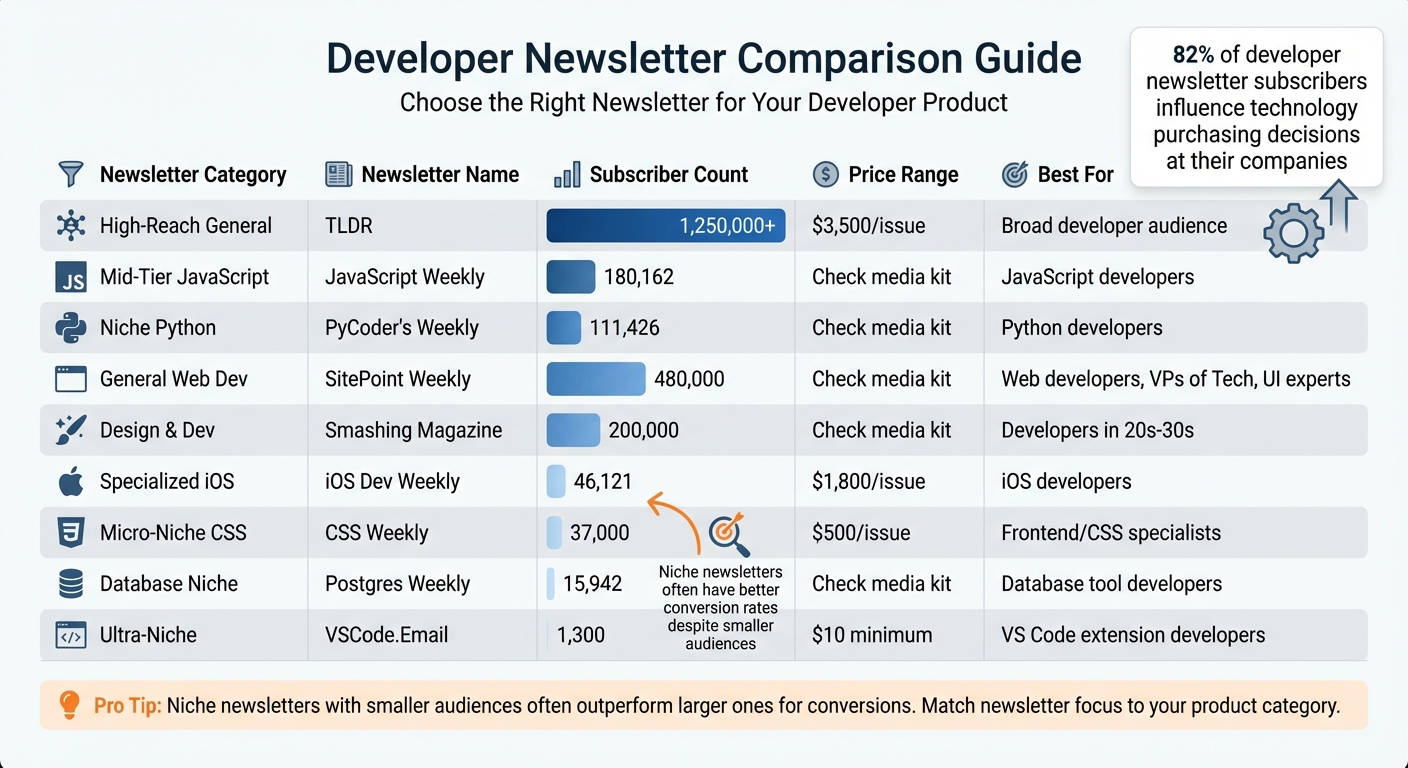 {Developer Newsletter Sponsorship Options: Reach, Pricing, and Audience Comparison}
Where to Search for Developer Newsletters
If you're looking for curated developer newsletters, GitHub is a great place to start. For instance, the repository jackbridger/developer-newsletters offers a collection of over 140 newsletters, complete with sponsorship details . Another helpful resource is mpron/awesome-newsletters, which is part of the popular "Awesome" list format often trusted by developers .
Publisher networks can also simplify your search by connecting you with multiple niche newsletters under one umbrella. For example, Cooper Press publishes newsletters like JavaScript Weekly, Ruby Weekly, and Postgres Weekly . Similarly, Bonobo Press manages Programming Digest, C# Digest, and React Digest . These networks offer the convenience of a single point of contact for managing sponsorships across multiple newsletters.
To evaluate newsletter performance, consider using marketplaces like Paved, NewsletterMetrics, or SponsorMyTribe . Tools such as SponsorSignals can also provide insights into where developer tools are currently advertising, helping you identify newsletters with strong ROI. For instance, in the 30 days leading up to March 2026, 86% of tracked developer newsletters featured active sponsorships .
Once you've identified potential options, it's essential to dig deeper to ensure they align with your target audience and marketing goals.
How to Evaluate Newsletter Quality and Fit
After compiling a list of potential newsletters, take time to assess their audience and sponsorship patterns. Understanding the audience composition is crucial to ensure the newsletter reaches the right decision-makers. For instance, SitePoint Weekly boasts 480,000 subscribers, including web developers, VPs of Technology, and UI experts . If your focus is on Python developers, PyCoder's Weekly specifically targets this group with 111,426 subscribers .
Another key indicator of quality is repeat sponsorship. As Paved explains, "When an advertiser shows up more than once, it's a clear indicator that an audience is buying" . This pattern suggests that the newsletter's audience is engaging with the advertised products or services.
Consider the purchasing influence of the newsletter's readership as well. For example, 82% of SitePoint Weekly's subscribers influence technology purchasing decisions at their companies . Similarly, Smashing Magazine reaches 200,000 subscribers, with a majority of readers being male and in their 20s and 30s . These details can help you tailor your messaging and allocate your budget effectively.
"Developers are always skeptical, but especially with advertising. Look for where developers are already learning and getting their development news. If your sponsorship can feel as naturally helpful as other content from that source, you'll be doing well."
– Adam Duvander
By focusing on these criteria, you can ensure your sponsorship resonates with the audience and aligns with your goals.
How to Choose Newsletters That Deliver Results
Niche newsletters often outperform broader tech-focused ones when it comes to conversions. For instance, Postgres Weekly may have a modest 15,942 subscribers, but its focused audience makes it an excellent choice for promoting database tools . Similarly, VSCode.Email, with just 1,300 subscribers, charges a minimum of $10 due to the high level of engagement among its readers .
Consistency is another factor to consider. Newsletters like JavaScript Weekly, which follow a regular weekly schedule, maintain steady reader engagement.
It's also important to ensure that sponsored content integrates seamlessly with editorial content. Ads that feel like a natural extension of the newsletter are more likely to resonate with readers . Requesting sample issues before committing to a sponsorship can help you gauge this balance.
Finally, match the newsletter category to your product's focus for the best results. Here's a quick overview of some options:
| Newsletter Category | Sample | Subscriber Count | Price Range |
|---|---|---|---|
| High-Reach General | TLDR | 1,250,000+ | $3,500/issue |
| Mid-Tier JavaScript | JavaScript Weekly | 180,162 | Check media kit |
| Niche Python | PyCoder's Weekly | 111,426 | Check media kit |
| Specialized iOS | iOS Dev Weekly | 46,121 | $1,800/issue |
| Micro-Niche CSS | CSS Weekly | 37,000 | $500/issue |
sbb-itb-e54ba74
How to Create Effective Sponsorship Campaigns
To create sponsorship campaigns that resonate with developers, start by focusing on their specific technical needs. Once you've chosen the right newsletters to target, the next step is to craft messages that address real-world challenges developers face.
How to Address Developer Challenges in Your Message
Developers prefer clear, solution-focused messaging over generic sales pitches. Instead of highlighting broad features, zero in on specific pain points - like cutting deployment times or streamlining API integration.
Your message should clearly show how your tool fits into their workflows. For instance, if you're promoting a CI/CD tool, explain how it reduces build times or integrates seamlessly with tools like GitHub Actions. Avoid vague claims like "boosting productivity" and focus on actionable, technical solutions.
It’s also important to consider the purchasing influence of your audience. A significant 82% of subscribers to developer-focused newsletters, such as SitePoint Weekly, play a role in technology purchasing decisions at their companies . This means your message should address both the individual developer's needs and broader organizational concerns, such as scalability, security, and team efficiency.
Once you’ve addressed these challenges, the next step is crafting sponsorship content that speaks the developer's technical language.
How to Write Clear Sponsorship Content
When writing sponsorship content for developers, use straightforward and technical language. Avoid over-the-top designs or marketing jargon - developers appreciate concise, information-dense content that gets straight to the point. Including short code snippets can be especially effective, as they demonstrate your product’s capabilities and build technical credibility.
Make your calls-to-action simple and low-friction, directing developers to useful resources like documentation, sandbox environments, or free trials. Developers prefer to explore tools independently before making decisions, so make it easy for them to test your product right away.
Provide direct links to technical resources such as API references or GitHub repositories. This allows developers to quickly evaluate the technical merits of your product.
"If your sponsorship can feel as naturally helpful as other content from that source, you'll be doing well."
– Adam Duvander
After crafting your content, the final step is testing and refining your messaging to ensure it resonates effectively.
How to Test and Improve Your Sponsorship Messages
Experiment with different approaches, such as linking to sandbox environments versus documentation, and track developer-specific metrics like sign-ups, API calls, or SDK downloads. These metrics provide a clearer picture of genuine engagement beyond just clicks.
Adjust the level of technical detail in your content based on your audience. Some may prefer a high-level overview, while others want in-depth implementation examples.
Keep an eye on organic traction outside of your direct metrics. If developers begin discussing your tool in forums or sharing it with colleagues after encountering your sponsorship, it’s a strong indicator that your message is hitting the mark. Refine your content by replacing vague statements with precise, detailed information that addresses developers’ actual pain points. The goal is to present your tool as a natural solution, not a hard sell.
How to Measure Newsletter Sponsorship Performance
Measuring the performance of your newsletter sponsorship is essential to understanding its impact. By tracking the right metrics, you can determine if your campaign is delivering results or if adjustments are needed to avoid wasting your budget.
How to Track Engagement Data
Start by adding unique UTM parameters to every sponsorship link. These snippets help you pinpoint which newsletter, placement, or call-to-action is driving traffic to your site . Among the key metrics, click-through rate (CTR) should be your primary focus. For most developer newsletters, a CTR between 2% and 5% indicates solid engagement . While open rates can provide some insight (a rate above 30% is generally good ), they’ve become less reliable due to Apple's Mail Privacy Protection and image blockers .
Beyond basic engagement, track developer-specific actions like API key requests, SDK downloads, sandbox signups, or documentation visits. These metrics reveal deeper interest and intent, going beyond simple page views. To get a full picture, connect your email tracking to your CRM or sales system. This integration allows you to follow the entire journey - from the initial click to a potential customer .
"Gathering accurate data is the backbone of connecting your campaign spending to measurable results." – Bruce Pinchbeck, Co-founder and Head of Marketing, Letterhead
Once you’ve collected engagement data, the next step is to evaluate the financial performance of your sponsorship.
How to Calculate Sponsorship ROI
With engagement metrics in hand, shift your focus to financial returns. ROI can be calculated using this formula: (Total Gain – Total Spend) / Total Spend. Total spend includes expenses like sponsorship fees, content creation costs, and team time. Total gain is determined by multiplying the number of conversions (e.g., signups, purchases, or leads) by their average value.
For developer-focused products with longer sales cycles, tracking Customer Lifetime Value (CLV) is crucial. A campaign with lower open rates can still yield a better ROI if it reaches a high-intent audience that converts effectively . To ensure accuracy, use multi-touch attribution models. These models account for the multiple interactions developers typically have - like reading documentation, testing APIs, or discussing tools - before making a purchase. This approach ensures credit is distributed across all touchpoints rather than attributing everything to the last click .
| Metric | What It Measures | Success Benchmark |
|---|---|---|
| CTR | Percentage of recipients who clicked | 2%–5% |
| Open Rate | Percentage of recipients who opened | Above 30% |
| Conversion Rate | Percentage of clickers who took action | Varies by goal |
| Cost Per Acquisition | Total cost divided by new customers | Should be lower than CLV |
How to Use Real-Time Data for Campaign Adjustments
Real-time dashboards are invaluable for tracking clicks, conversions, and ROI while your campaign is running . This real-time visibility allows you to make adjustments to creative elements, targeting, or budget allocation without waiting until the campaign ends.
Instead of focusing on isolated data points, monitor weekly engagement trends . For example, if CTR drops significantly, consider testing new technical angles or tweaking the depth of detail in your messaging. On the other hand, if conversions are low despite strong click numbers, evaluate your landing page experience or identify friction points in the signup process.
Pay attention to unsubscribe rates as well. If your unsubscribe rate surpasses 0.3% (compared to the industry average of 1.2% ), it may signal that your message is too promotional or not aligned with the audience. To wrap up your campaign, request a detailed report within a week, covering opens, clicks, and conversions. This ensures you have all the data needed to refine future campaigns.
How to Combine Newsletter Sponsorships with daily.dev Ads
Why Multi-Channel Campaigns Work Better
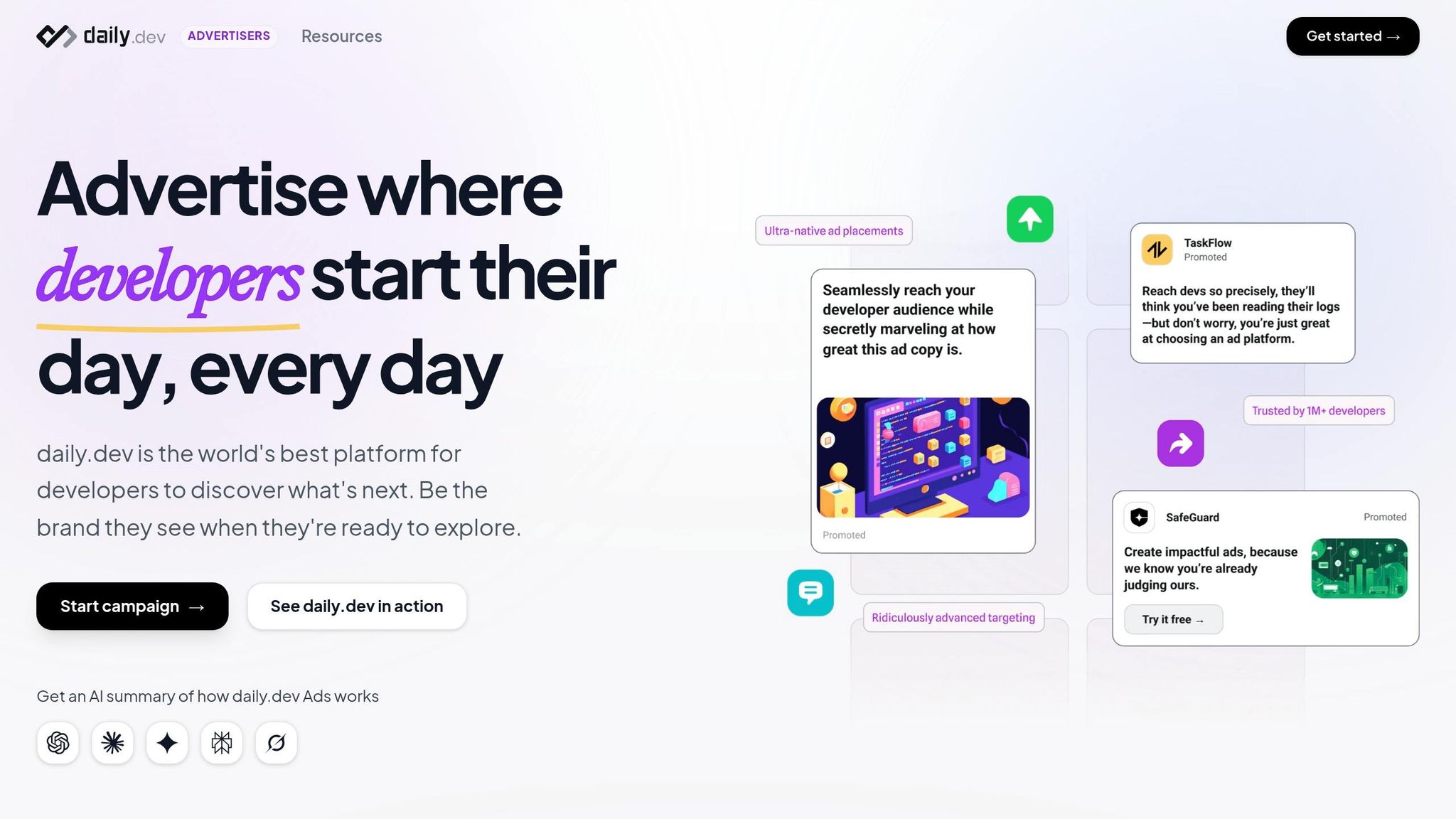
Pairing newsletter sponsorships with daily.dev Ads creates multiple opportunities to reinforce your message. Imagine this: a developer reads about your tool in a morning newsletter, then later encounters a related ad while browsing daily.dev for technical updates. This repetition helps build familiarity and trust much faster than relying on just one channel.
With creator ad spending projected to hit $43.9 billion by 2026 (an 18% year-over-year increase) , multi-channel strategies clearly play a key role in effective marketing. These campaigns succeed because they use behavioral targeting. For example, daily.dev tracks tool usage and content engagement, allowing you to serve ads that align with the intent sparked by your newsletter. Instead of hoping for impact from a single touchpoint, you create a coordinated experience that meets developers where they already spend their time. This approach naturally leads into more precise ad targeting, which we’ll dive into next.
How to Use daily.dev's Targeting Options
daily.dev offers powerful targeting options that let you align your ads with the niche audience of your sponsored newsletter. You can target developers based on programming languages, specific tools, or seniority levels. For instance, if your newsletter sponsorship focuses on Python, you can configure your daily.dev campaign to reach users interested in Python and its libraries. This ensures your messaging remains consistent across both channels.
The platform also uses behavioral data to help you time your ads for when developers are most engaged. daily.dev tracks when users are actively exploring new tools or consuming particular types of content, so you can serve ads at the moments they're most likely to respond. Additionally, you can tailor your ads by seniority level - sharing architecture-focused content with senior engineers and beginner-friendly resources with junior developers.
How to Track Combined Campaign Results
Once your targeting is set, tracking is critical to understanding how your combined campaigns perform. Multi-touch attribution is key here, as it helps you see how newsletter sponsorships and daily.dev ads work together. Use unique UTM parameters for each channel to differentiate their impact. For example, utm_source=newsletter&utm_campaign=spring2026 versus utm_source=dailydev&utm_campaign=spring2026 makes it easy to identify which channel drives initial engagement and which boosts conversions.
Focus on developer-specific KPIs, such as API key requests, SDK downloads, or visits to your documentation. If your newsletter generates high click-through rates but conversions lag, check whether your daily.dev ads are effectively retargeting those users with a clearer call-to-action. With daily.dev’s real-time tracking, you can tweak targeting, creative, or budget as needed to improve results. Finally, calculate the cost per acquisition (CPA) across both channels to get a full picture of your campaign’s efficiency and overall impact.
Conclusion
Combine newsletter sponsorships with targeted ads to connect with developers across multiple channels. To make this work, focus on three key steps: identifying the right newsletters, writing for developers without the fluff, and closely tracking performance. Pairing these sponsorships with daily.dev Ads can boost both awareness and trust.
This approach ensures your content hits the mark across platforms. As Alex Carter from daily.dev explains, "Developers prefer native, privacy-first ads that blend into their workflow" . This insight applies equally to newsletter sponsorships and targeted ads. Both are most effective when they prioritize technical depth over flashy marketing and respect how developers engage with content. Your messaging should center on practical solutions and clear, actionable documentation.
The developer landscape is evolving quickly with AI advancements, making it essential to refine your targeting beyond traditional engineering roles . Use detailed filters - like tech stack, seniority, and real-time behavior - to reach the right audience at the right moment. Launch early to build momentum, and rely on multi-touch attribution to see how newsletter clicks and ad impressions work together to drive conversions. Aligning your targeting and timing strengthens the overall impact of your campaigns.
Brands that focus on educating developers see better adoption rates. Whether it’s a sponsored tutorial in a newsletter or a native ad linking to in-depth documentation, the goal is to create content that addresses real challenges. With over 1,000,000 developers actively searching for tools and resources, there’s a huge opportunity to make an impact .
Keep an eye on key metrics like API requests, SDK downloads, and documentation visits, and adjust your strategy as needed. By combining precise technical messaging with real-time performance data, you can drive meaningful product adoption.
FAQs
How much should I budget for my first developer newsletter sponsorship?
If you're planning your first sponsorship for a developer newsletter, it's wise to set aside at least $5,000. Why? This budget gives you access to precise targeting options - like filtering by programming language or developer seniority - which ensures your campaign reaches a highly engaged, niche audience. It's a solid starting point to make sure your efforts land effectively with the right people.
What should my landing page offer after a sponsored newsletter click?
When creating a landing page for developers, the key is to focus on what truly matters to them: technical depth, practical solutions, and transparency. Developers appreciate content that gets straight to the point and provides real, actionable value.
Here’s how you can meet those expectations:
Include detailed technical information: Break down how your product works with clear, concise explanations. Highlight the specific problems it solves and why it’s a better solution than alternatives.
Provide code samples: Developers love seeing things in action. Share snippets of code that demonstrate how to use your product, preferably in real-world scenarios. This not only showcases functionality but also helps them understand implementation right away.
Offer educational resources: Tutorials, guides, and thorough documentation are gold for developers. These resources not only educate but also show that you’re invested in helping them succeed.
Avoid hype and fluff: Developers tend to shy away from overly promotional language. Instead, focus on delivering authentic value through content that’s straightforward and relevant.
By aligning your landing page with these principles, you’ll build trust and credibility with your developer audience, showing them that your product isn’t just another tool - it’s a solution they can rely on.
How do I attribute signups to newsletters vs daily.dev Ads?
To measure signups effectively, use tools like unique referral codes, UTM parameters, or dedicated landing pages tailored for newsletters. When running daily.dev Ads, rely on platform-specific analytics or tracking pixels to monitor performance. By comparing data from both channels during campaigns, you can better understand their impact. Consistently reviewing these metrics will give you a clearer picture of each channel's performance and help fine-tune your marketing strategies.