

Open source software (OSS) is more than just free code - it’s a marketing tool and business strategy. Companies like HashiCorp, Supabase, and PostHog have proven that OSS can build trust, grow user communities, and generate revenue. Here’s how it works:
- Trust Through Transparency: Developers can inspect the code, ensuring reliability and reducing skepticism.
- Community-Driven Growth: OSS thrives on word-of-mouth, GitHub stars, and contributions, creating organic adoption.
- Revenue Potential: While most users don’t pay, a small percentage opt for enterprise features or managed services, driving profits.
Key Business Models:
- Fully Open Source: Revenue from support/services (e.g., Red Hat).
- Open Core: Free core with paid enterprise features (e.g., HashiCorp).
- Source Available: Restricts commercial use (e.g., HashiCorp post-2023 license change).
- Freemium: Free basic version with paid upgrades.
Growth Tactics:
- Documentation: Clear, actionable guides attract users.
- Community Building: Recognize and support contributors to maintain engagement.
- Conversion Funnel: Transition users from free to paid tiers via managed services or enterprise plans.
OSS isn’t just about coding - it’s about creating a transparent, scalable approach to marketing and revenue generation.
Companies That Grew Through Open Source
Three companies stand out for their success with open source: HashiCorp, Supabase, and PostHog. Each took a different path - building trust, fostering community, and refining products - but all leveraged open source to scale their businesses and connect with users.
HashiCorp: Earning Trust with Fully Open Source Tools
HashiCorp embraced full transparency by making its tools completely open source, which built trust and created a sustainable business model. The journey began with Vagrant, a tool designed to solve development challenges. Over time, the company expanded its offerings with tools like Terraform, Vault, Consul, and Nomad, all following a consistent design philosophy. This made it easier for developers to transition between tools once they mastered one.
By March 2025, Terraform alone hit over 100 million downloads and earned 44,900 GitHub stars . HashiCorp’s strategy was simple: keep core technical features free for individual developers, but charge for enterprise-level features like SSO and governance tools. As Marc Holmes, the company’s CMO, put it:
"No one minds paying for things like team collaboration features, SSO, and enterprise capabilities to get over compliance and governance hurdles."
This approach paid off. By the time of its IPO in 2021, HashiCorp was valued at $14 billion and had been adopted by more than 3,500 enterprises, including over half of the Fortune 500 . Big names like Adobe and Starbucks used HashiCorp Vault for secrets management between 2016 and 2018, while Capital One standardized on Terraform across AWS, Azure, and GCP in 2020, slashing deployment times from weeks to hours .
Supabase: Building a Community Around an Open Source Firebase Alternative
Supabase took a community-first approach, positioning itself as an open source alternative to Firebase. By building on PostgreSQL, they avoided vendor lock-in and leaned into transparency as their competitive edge. This approach resonated with developers, fueling rapid growth. Between 2024 and 2025, Supabase’s user base jumped from 1 million to over 4.5 million developers, and the project earned 73,000 GitHub stars .
In April 2025, Supabase hit a $2 billion valuation after raising $200 million in a Series D round. Even James Tamplin, Firebase’s co-founder, became an early angel investor . Aaron Cort from Craft Ventures highlighted their success:
"Devs have a high bar for community. Supabase proved that authenticity, open-source ethos, and developer-first culture aren't just nice-to-haves - they're moats."
Supabase’s traction with startups was undeniable: by 2025, 55% of the latest Y Combinator batch used Supabase, totaling over 1,000 YC companies . Revenue followed suit, climbing from $1 million in 2021 to $16 million in 2024, with projections of $27 million for 2025 .
PostHog: Shaping Products with Community Feedback
PostHog’s success came from listening to its users. The company maintains a public roadmap, allowing users to vote on features and share priorities. This feedback loop directly shaped their development process. For example, while working on an A/B testing feature in 2022, community feedback revealed flaws in the initial design. Instead of pushing forward, the team reworked the user experience into a three-stage flow. As Software Engineer Neil Kakkar noted:
"Identifying design flaws before development accelerates progress."
This iterative approach helped PostHog grow to over 100,000 users and achieve a $1.4 billion valuation, all without a traditional sales team . About 97% of their early growth came from word-of-mouth within the developer community .
PostHog also encourages direct contributions from its community. Developers submit new documentation pages and feature updates, and the company rewards these efforts with $20–$40 gift cards to its merch store . Transparency is a cornerstone of their strategy, as they openly share internal practices and lessons learned. Ian Vanagas, PostHog’s Technical Content Marketer, summed it up:
"PostHog wouldn't be here now if it wasn't open source. It's that core to our success, and has been since day one."
sbb-itb-e54ba74
How Open Source Drives Awareness and Trust
Open source projects have a unique way of building awareness and trust without relying on traditional advertising or massive sales efforts. Instead, they leverage the openness of their code and the strength of their communities to grow organically, particularly among developers.
Creating Awareness Through Developer Advocacy
Open source software removes many of the barriers that typically slow down adoption. Developers can download, try, and deploy tools without worrying about procurement processes or licensing fees . This ease of access turns platforms like GitHub into powerful marketing tools. Elements like READMEs, detailed documentation, and active responses to issues demonstrate the project's capabilities and invite engagement .
Community-driven growth is a hallmark of open source success. Take Vagrant, for example. Mitchell Hashimoto launched it in 2010 to address the "works on my machine" challenge. By 2012, the project gained traction purely through word-of-mouth, eventually laying the groundwork for HashiCorp's $14 billion IPO in 2021 . Similarly, Sid Sijbrandij's 2012 Hacker News post about GitLab attracted hundreds of beta users, helping the project grow to 1 million users by 2016 .
This momentum is fueled by developers who become advocates after solving real-world problems with these tools. GitLab, for instance, saw over 300 code contributions in its first year as an open source project. By 2021, its community had grown to include more than 2,700 code contributors and 25,000 forum members. These contributions not only improved the product but also created a network of passionate advocates .
Building Trust Through Code Transparency
While advocacy helps spread the word, transparency in open source projects builds trust in a way that traditional marketing cannot. When developers can inspect, fork, and modify the source code, they gain confidence in the tool's reliability and functionality. This direct access serves as proof that the software delivers on its promises, accelerating the path to commercial adoption .
Transparency also addresses concerns about vendor lock-in. Enterprise buyers value the flexibility of knowing they aren't tied to a single vendor's proprietary roadmap, as they can always rely on the community-supported version . Ashley Kramer, GitLab's CMO, put it succinctly:
"Our community is our best marketing asset, our best product incubator, and a giant competitive advantage."
Some companies take transparency even further by sharing internal processes. GitLab, for example, made its 6,000-page internal handbook public and committed to a fixed monthly release schedule. This openness fostered a community of over 2,700 contributors and helped the company achieve an $11 billion valuation by 2021, with more than half of the Fortune 100 as customers .
In successful open source models, the majority of users - over 90% - use the free version of the software. However, the remaining users who opt for enterprise features, such as single sign-on or compliance tools, generate profit margins comparable to those of SaaS companies . The trust built through transparency plays a key role in converting these users into paying customers.
4 Open Source Business Models
::: @figure 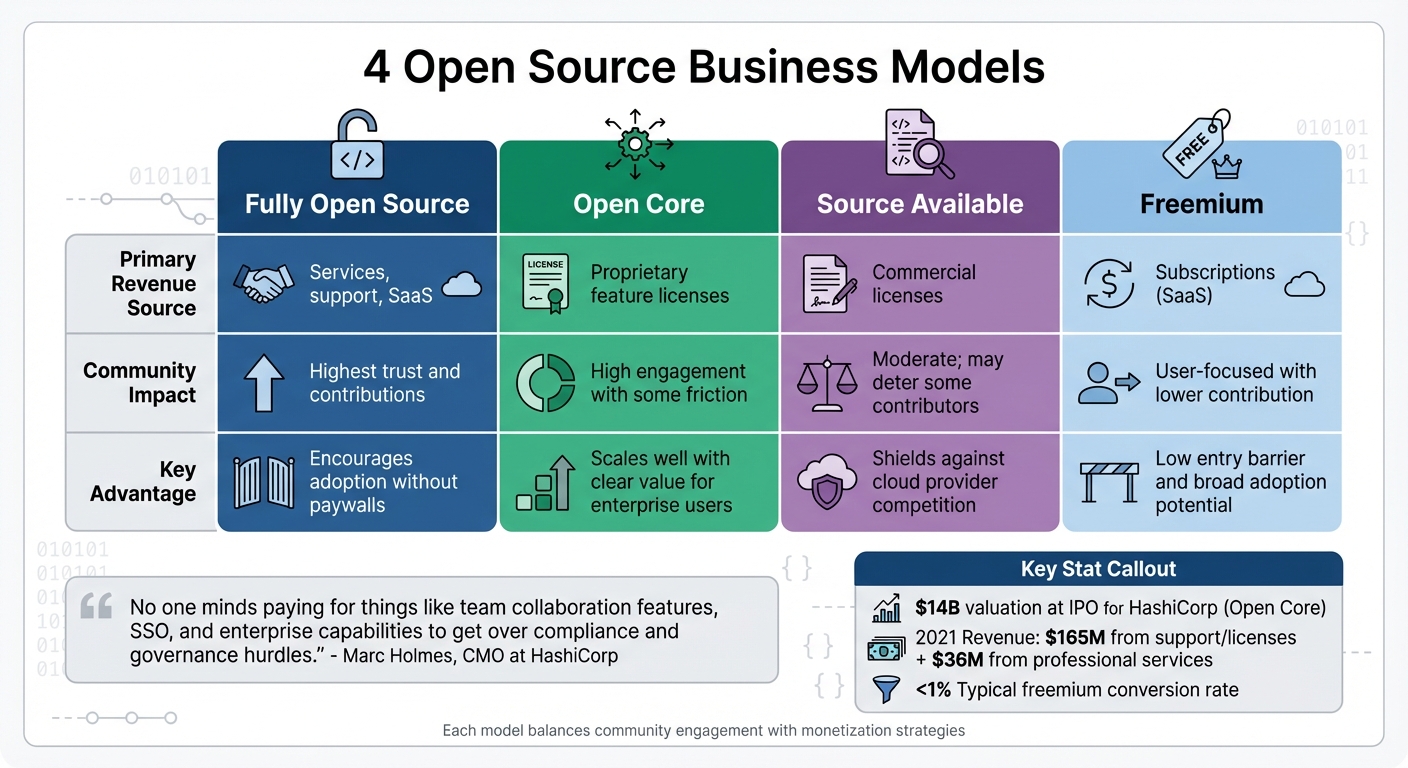 {4 Open Source Business Models Comparison: Revenue Sources and Community Impact}
Choosing the right business model is crucial for balancing community growth with revenue goals. The four main approaches - fully open source, open core, source available, and freemium - each create unique relationships between free users and paying customers.
Fully open source means all code is shared under permissive or copyleft licenses. Companies like Red Hat make money through services like support contracts, consulting, and managed hosting, rather than charging license fees . This approach fosters trust and attracts contributors, but turning users into paying customers relies on selling expertise or convenience instead of features.
Open core offers a free, open foundation while charging for premium features. HashiCorp, for example, followed this model and reached a $14 billion valuation at IPO. In 2021, their revenue included $165 million from support and license sales and $36 million from professional services . This model allows rapid scaling by layering enterprise features on top of a free core. However, keeping a unified codebase can be tricky .
Source available lets users view and modify the code but restricts commercial use, especially to prevent cloud providers from reselling the software as a service. In 2023, HashiCorp transitioned from the Mozilla Public License to the Business Source License to protect their work from being repackaged by competitors. Despite this shift, they retained their large community of over 100,000 members while safeguarding their business interests . This approach offers transparency without exposing the project to "fork-and-sell" risks.
Freemium combines free access with paid upgrades, often paired with open core or SaaS models. It provides a basic version at no cost but charges for advanced features or higher usage limits. However, conversion rates for open source companies are typically under 1% . To succeed, the free version must attract a massive user base. By giving away the core product, this model makes it tough for competitors to compete on price .
| Model | Primary Revenue Source | Community Impact | Key Advantage |
|---|---|---|---|
| Fully Open Source | Services, support, SaaS | Highest trust and contributions | Encourages adoption without paywalls |
| Open Core | Proprietary feature licenses | High engagement with some friction | Scales well with clear value for enterprise users |
| Source Available | Commercial licenses | Moderate; may deter some contributors | Shields against cloud provider competition |
| Freemium | Subscriptions (SaaS) | User-focused with lower contribution | Low entry barrier and broad adoption potential |
Each model balances community engagement with monetization, showing how open source software (OSS) can double as a marketing powerhouse. Features tied to business outcomes are best reserved for paid tiers . While individuals enjoy free tools, businesses are willing to pay for solutions addressing compliance, security, and risk management. As Marc Holmes, CMO at HashiCorp, explains:
"No one minds paying for things like team collaboration features, SSO, and enterprise capabilities to get over compliance and governance hurdles."
These models serve as a foundation for exploring strategies to grow communities and convert users into paying customers.
Building Community Around Your Open Source Project
In any open source growth strategy, building an engaged and active community is key. A thriving developer community relies on clear processes, open governance, and recognizing contributors in meaningful ways.
Creating Clear Contribution Guidelines
Disorganized or incomplete documentation can discourage developers from contributing . Your contribution guide should be simple to follow and address three key questions: Why should developers contribute? What can they work on? How do they submit their work?
Take GitLab as an example. They streamlined their process for "Wider Community Contributions" by eliminating common "stumbling blocks" - those frustrating barriers that deter participation . They also broadened their guidelines to include non-code contributions, such as design ideas, documentation updates, issue triaging, and community support roles . This approach acknowledges that not all valuable contributions come in the form of code.
Developers often contribute to gain experience, showcase their skills, or tackle technical problems relevant to their work . By clearly outlining these benefits in your documentation, you can attract contributors whose goals align with your project's mission. Once your guidelines are in place, the next step is to establish governance structures to keep things running smoothly.
Setting Up Project Governance
As your project grows, governance structures help maintain a healthy and collaborative environment. GitLab, for instance, differentiated between their "Core Team" (internal employees) and the "Wider Community" (external contributors) to clarify who makes decisions. They also introduced "Merge Request Coaches" to guide external contributors through reviews and help them navigate the codebase . This system contributed to their growth, with over 2,700 code contributors and 15,000 meetup participants by 2021 .
GitLab’s transparency extended to documenting internal workflows, making decision-making processes accessible to everyone. They also pledged that once a feature is open-sourced, it would never be moved to a paid tier . These efforts demonstrate how structured governance fosters trust and encourages ongoing contributions.
To further reduce friction, GitLab monitored the "Open Community MR Age" (OCMA), ensuring contributors received timely feedback. This simple act of respecting contributors' time strengthens community ties .
Recognizing Contributors
Acknowledging contributors is crucial for encouraging continued involvement and turning occasional participants into long-term advocates. GitLab implemented a tiered recognition system that included 96 "GitLab Heroes" by 2021. These recognized contributors received perks like early access to features and direct contact with leadership, which motivated them to stay engaged .
Replit provides another great example. Their "Bounty Marketplace" allowed developers to earn money for completing specific projects, fueling their growth to a $1 billion valuation. Their Discord community surpassed 100,000 members, with activity-driven channels like #showcase and #bounties fostering interaction .
Timely reviews also go a long way in showing contributors their efforts are valued . Adding gamification elements like badges and levels can further enhance this recognition. These strategies not only reward contributors but also help build a vibrant community that supports your project's growth and success.
Converting Open Source Users to Paying Customers
Turning free users into paying customers is the next big step after fostering a thriving open source community. This process - from free, self-hosted versions to managed cloud services and eventually enterprise plans - is at the heart of a solid OSS marketing strategy. The reality is that over 90% of your open source users won't ever pay . Your focus should be on identifying the small fraction of users who need more than the free version offers and guiding them through a clear upgrade path.
The most successful open source companies focus on selling outcomes, not just features. Instead of emphasizing premium functionalities, highlight what paying customers truly value: certainty, reduced risk, and freedom from manual work. Typically, the conversion journey unfolds across three levels, each designed to address specific needs and pain points.
Self-Hosted Free Tier
The self-hosted free tier is where users start their journey. It lowers the entry barrier for developers who want to test the software without needing a budget or procurement approval. This version should allow users to get started and meet basic needs while naturally encouraging upgrades as their requirements grow .
You’ll need to set clear boundaries for the free tier - enough to meet basic needs but with visible limitations for advanced use cases . For instance, the community version might include the core engine, basic CLI/UI, and main integrations but exclude advanced features like policy-as-code, centralized management, or audit logging .
To identify users ready to upgrade, track telemetry and download data. This can help pinpoint production-ready users, potentially boosting leads by 18.75% . For example, if a user asks about "scaling to 10 million requests" in your documentation, they’re signaling readiness for a commercial conversation .
Once users outgrow the free tier, many naturally progress to managed cloud solutions.
Managed Cloud Services
The managed cloud tier focuses on simplicity. While developers may prefer self-hosting for control and privacy, businesses often choose to pay for reduced operational overhead, automatic updates, and guaranteed uptime . This tier appeals to users who’ve validated your tool and now want to focus on their core business instead of managing infrastructure.
The transition from self-hosted to managed cloud should be seamless. A strong tech stack (such as Stripe for billing and reliable database systems) can make this move effortless . Position this tier around what it eliminates - manual updates, security vulnerabilities, backup management, and the stress of maintaining uptime.
Conversion rates vary depending on the model. The average free-to-paid conversion rate for B2B software is 8%, with freemium models seeing "good" rates at 3–5% and "great" rates at 8–12% . Free trials requiring a credit card upfront achieve a 30% conversion rate, significantly higher than trials without this requirement . However, freemium models often result in more signups overall (with a 9% website-to-signup rate compared to 4.5% for trials), meaning they can deliver higher total customer numbers despite lower individual conversion percentages .
For users with more complex needs, enterprise plans are the next step.
Enterprise Plans
Enterprise plans are designed to address organizational challenges. This is where you can monetize features that cater to compliance, security, and governance needs, such as SSO/SAML, role-based access control (RBAC), audit logs, SOC 2 compliance, and dedicated support with SLAs .
Marc Holmes, CMO at HashiCorp, puts it simply:
"No one minds paying for things like team collaboration features, SSO, and enterprise capabilities to get over compliance and governance hurdles."
For businesses relying on critical infrastructure, paid subscriptions are seen as risk insurance, not just another expense .
Start with annual contracts between $5,000 and $25,000 to stay below high-level procurement thresholds while offering hands-on customer support . GitLab found that adding even one extra product stage to a user's workflow tripled their conversion rates from free to paid . Focus your onboarding efforts on the "leading indicator of retention" - actions like integrating with an incident response system - that signal a user is likely to stay and upgrade .
To bridge the gap, target production users who already trust your product and are ready to invest . For early paying customers, offer personalized migration support to validate the features they prioritize before automating the process .
These strategies round out the open source marketing approach, showing how OSS can not only build a strong community but also generate meaningful revenue.
Marketing Your Open Source Project
After building a solid open source product and setting up a conversion funnel, the next step is getting it noticed by developers. Marketing an open source project is all about building trust and credibility through openness. Your GitHub repository, documentation, and community-driven content become your primary tools for spreading the word - often outperforming traditional advertising. Here’s how you can effectively boost your project’s online presence.
Optimizing Your GitHub Repository
Think of your GitHub repository as your project's homepage. The README file, in particular, acts as a first impression. It should clearly communicate your project's value, offer social proof, and make it easy for new users to get started. Keep it concise - under 500 words is ideal - and include helpful elements like badges (e.g., npm version or CI/CD build status) and a one-line installation command to streamline the onboarding process.
Beyond just looking polished, active maintenance plays a huge role in building trust. Developers notice things like how quickly issues are addressed and how often updates are released. These details show how engaged you are and give insight into your project's roadmap and transparency regarding known issues. And don’t forget: clear, easy-to-follow documentation is essential for guiding users through setup and usage.
Creating Quality Documentation
Great documentation does more than explain your project - it addresses developer pain points directly. It’s a cornerstone of your open source strategy and often attracts more attention than direct marketing campaigns. In fact, clear and actionable guides frequently serve as the entry point for new users.
Andy Vandervell, Head of Content at PostHog, suggests creating "Setup for X" guides. These guides should walk users through integrating your project with specific technologies like React or Nuxt. Stick to a step-by-step format under 1,000 words, covering prerequisites, installation steps (with code examples), and quick functionality tests.
"Your content should act as a bridge, helping developers successfully implement your solution regardless of their experience level."
– Andy Vandervell, Head of Content, PostHog
It’s also a good idea to track documentation views. This can help you identify which companies are evaluating your project and highlight potential high-intent leads.
Promoting Through Events and Content
Once you’ve nailed your GitHub presence and documentation, you can amplify your reach with strategic content. Content marketing works best when you focus on topics that developers are already searching for. For example, articles like "Alternatives to X" tend to perform well because they target developers actively looking for new tools. A great example is PostHog’s listicle, "The 12 best open source analytics tools", which not only showcased their offering but also captured high-intent search traffic.
When it comes to distribution, LinkedIn often outperforms Twitter for technical content, especially when shared through personal profiles rather than company pages. Industry newsletters also tend to drive more engagement than broad social media posts.
Cal.com (formerly Calendso) is a great case study in this space. They initially grew by leveraging GitHub stars as an open source alternative to Calendly. Later, they shifted their messaging to focus on outcomes - like independence for small teams, control for enterprises, and embeddable scheduling for developers. This pivot helped them grow from zero revenue to millions in ARR.
For paid promotion, platforms like daily.dev let you target developers based on their seniority, preferred programming languages, and tools they use. Native ads in developer feeds can be a highly effective way to get your project in front of the right audience.
Measuring Open Source Marketing Performance
Tracking the right metrics can mean the difference between a thriving open source marketing strategy and a project that simply racks up GitHub stars. The reality is that GitHub stars don’t translate directly into revenue, downloads don’t guarantee user retention, and contributors don’t always become paying customers. To create a well-rounded strategy, you need to focus on three key areas: awareness, engagement, and commercial conversion.
Tracking Awareness and Engagement Metrics
Let’s start with the basics. Metrics like GitHub stars and documentation views are top-of-funnel indicators - they’re helpful, but they don’t tell the full story. For instance, while a healthy project may see at least 10% month-over-month growth in stars, what’s more important is identifying which companies are engaging with your project. Tools like Scarf can help pinpoint which organizations are downloading your packages or checking out your documentation.
When it comes to contributors, retention matters more than sheer numbers. Aim for at least 30% repeat contributors and keep the momentum going by reviewing pull requests promptly. A great example of this is PostHog, which grew to over 100,000 users without a traditional sales team. They achieved this by building a "Product for Engineers" newsletter with over 75,000 subscribers and maintaining radical transparency through public handbooks.
| Metric Category | Key Metrics | Target Benchmark |
|---|---|---|
| Awareness | GitHub Stars Growth, Doc Views, Social Mentions | +10% month-over-month stars |
| Engagement | Active Contributors, Issue Activity, Slack/Discord Members | 30%+ repeat contributors |
| Conversion | Demo CTR, Newsletter Signups, Sales Conversations | >5% demo CTR |
| Revenue | Lead-to-Customer Rate, ARR, Net Revenue Retention | 2-3% lead-to-customer |
Measuring Commercial Conversion Rates
Once you’ve established awareness and engagement, it’s time to focus on commercial conversion. Think of your funnel in three stages: Interest (browsing documentation), Investigation (testing or installing the product), and Evaluation (integrating actively or engaging with sales). A strong indicator of upgrade intent might be when users integrate with an incident response system or schedule their first automated job.
Supabase offers a great case study here. Launched in 2020, they hit 10,000 GitHub stars in just six months. By October 2021 - 16 months after their start - they secured $30 million in Series A funding by proving product-market fit through adoption metrics. Fast forward to November 2025, and they’ve reached 81,000 stars and over $500 million in total funding. For context, developer-focused SaaS businesses typically see lead-to-customer conversion rates of 2-3%. Interestingly, in successful open source businesses, more than 90% of users never pay - but the few who do often generate SaaS-like margins.
In the early stages, you can track these metrics manually using a spreadsheet until you secure at least 20 paying customers. Afterward, integrate these insights into your CRM to connect anonymous usage data with sales opportunities.
Using daily.dev Ads to Accelerate Open Source Adoption
Growing an open source project through GitHub stars and word-of-mouth is effective but often takes time. While earlier sections explored organic strategies, daily.dev Ads provides a faster way to reach developers who are already engaged with technical content. Paid ads on developer-focused platforms can help you connect directly with the right audience and speed up adoption.
Targeting Developers by Skills and Interests
With daily.dev Ads, you can fine-tune your targeting to reach developers based on their skills, seniority, and technology preferences. For instance, you can focus on backend engineers working with Kubernetes or frontend developers proficient in React - those most likely to align with your project's technologies. This level of precision is crucial, as Daniela Villegas from Scarf explains:
"A company casually skimming your marketing site isn't the same as one testing your open source project in production" .
This approach ensures you're engaging with developers who are actively evaluating or testing solutions, making them more likely to download, experiment with, and adopt your project .
Getting Visibility Through Native Ad Placements
Native ads on daily.dev blend seamlessly into a developer's content feed. Your project can appear as in-feed ads or post page placements, sitting alongside technical articles. This creates visibility without disrupting the user experience .
To measure how effective these ads are, use UTM parameters to track user behavior on your site. You’ll see if visitors are exploring your documentation, clicking install buttons, or even booking demos. For open source projects targeting businesses, knowing which companies are engaging with your content can be more impactful than just tracking visitor numbers. Adding tracking pixels to your documentation pages and syncing high-intent users into your CRM can further improve conversion rates .
This form of targeted advertising complements the organic growth strategies discussed earlier, giving your project the best of both worlds.
Challenges and Tradeoffs of Open Source Marketing
Open source marketing comes with its own set of hurdles and costs. One major challenge is managing community expectations. Developers often worry about revenue-focused changes, vendor lock-in, or free features being moved behind paywalls. To address these concerns, GitLab has made a clear public commitment:
"When a feature is open source, we won't move that feature to a paid tier" .
Another significant challenge is the burden of support and maintenance. While it might seem like "free help" from contributors would lighten the load, the reality is different. Reviewing submitted code, ensuring that contributions align with the project's roadmap, and managing pull requests demand significant engineering resources. GitLab, for instance, employs engineers specifically to streamline and manage community contributions .
Licensing changes also pose risks to community trust. A notable example is HashiCorp's decision in August 2023 to shift its product suite from the Mozilla Public License to the Business Source License (BSL) v1.1. This move aimed to prevent cloud providers from commoditizing their software and set the stage for IBM's $6.4 billion acquisition of the company in February 2025. However, such decisions can lead to backlash and even competitive forks. Elastic faced a similar situation when AWS created "OpenSearch", a fork of Elasticsearch, after Elastic changed its license to restrict AWS from offering a managed service without contributing back .
Even with impressive user metrics, revenue generation can remain elusive. In many open source businesses, over 90% of users never pay for the software . This means that having thousands of users running your code can become a financial strain unless they contribute revenue or actionable feedback. Using telemetry to pinpoint companies testing your software in production can help focus sales efforts on high-value accounts instead of chasing vanity metrics .
Releasing code publicly also limits strategic control. Your roadmap becomes a shared discussion, requiring you to justify decisions rather than focusing on innovation. Establishing clear boundaries about what your project will and won’t support is crucial. It’s often better to decline certain community requests than to overextend and risk burnout .
Balancing these challenges is essential for sustaining an open source growth strategy and achieving commercial success.
Conclusion
Open source isn't just about offering free software - it’s a powerful engine for acquiring customers. Instead of relying on upfront license fees, it shifts revenue generation to ongoing services like hosting, support, security, and enterprise features. As Matt Mullenweg put it:
"Open source does not kill revenue. It moves where the revenue shows up on the P&L."
However, success in open source goes beyond surface-level metrics like GitHub stars or download counts. These numbers alone don’t build a sales pipeline. A great example is GitLab, which achieved an $11 billion valuation by focusing on company-level engagement and adopting a "Dual Flywheel Strategy." This approach balanced contributions from the community with reinvestments in R&D . They also discovered that when companies added just one additional product stage, their conversion rates tripled .
To turn engagement into real business value, you need to take deliberate steps. Start by implementing tracking tools early on. Use methods like tracking pixels and package monitoring to identify which companies are evaluating your software, and feed that data into your CRM. Clearly define what features remain free (core "run" functions) versus what requires payment (enterprise "operate" tools like SSO, audit logs, and compliance controls). Build trust with your audience through transparency and by sticking to a consistent release schedule.
Incorporating open source into your marketing strategy requires focus and clarity. The key lies in combining clear monetization strategies, disciplined community engagement, and a long-term, data-driven approach. If millions of downloads aren’t translating into revenue, the problem likely stems from how your product is packaged and priced. Open source marketing works best when supported by a thoughtful, strategic plan that aligns community growth with sustainable monetization.
FAQs
When should my product be open source?
Making your product open source can be a game-changer, particularly in developer-focused markets. It’s a great way to build trust, foster a community, and boost awareness. But timing and strategy are key.
Open sourcing works best when your product is mature, stable, and stands out from the competition. At this stage, users are more likely to contribute and advocate for your product, creating a ripple effect of growth and visibility.
That said, having a plan to turn free users into paying customers is essential for long-term success. Consider offering cloud-managed services or enterprise-level solutions as premium options to sustain your business while still benefiting from an open-source model.
What should stay free vs paid in OSS?
In the world of open source software (OSS), the line between free and paid features depends largely on the project's business model. Typically, the core features or codebase are offered for free. This approach encourages community involvement and widespread adoption.
On the other hand, paid offerings often include things like advanced functionalities, enterprise-grade tools, or managed services. This setup creates a balance: the free OSS builds trust and engagement, while the premium solutions provide a revenue stream. Together, these elements help sustain the project and support its growth.
How do I measure OSS-to-revenue impact?
To understand how open-source software (OSS) contributes to revenue, keep an eye on key metrics such as community growth, contributions, forks, stars, and overall engagement. These indicators reveal the health and reach of your OSS project.
Dig deeper into how open-source adoption translates into revenue by analyzing the OSS-to-commercial pipeline. This includes tracking the journey of self-hosted free users, cloud-managed customers, and enterprise clients. Each stage plays a role in driving revenue growth, so it’s essential to assess how they align with your broader business objectives.