

Performance marketing ensures you only pay for specific actions - like clicks, sign-ups, or sales - making it ideal for marketing developer tools. Developers value clear, practical solutions and prefer to evaluate products on their own terms. Traditional ads often fail with this audience, but targeted, data-driven strategies can drive real results.
Key takeaways:
- Developers demand precision: Ads must focus on specific tools, frameworks, or pain points.
- Native ads work best: Ads integrated into trusted platforms like GitHub or daily.dev see higher engagement.
- Track key metrics: Focus on metrics like cost-per-acquisition (CPA), return on ad spend (ROAS), and micro-conversions (e.g., SDK downloads).
- Leverage real-time analytics: Use data to optimize campaigns dynamically.
- daily.dev Ads: A platform tailored for developers, offering targeted placements and real-time performance tracking.
To succeed, combine precise targeting, authentic messaging, and continuous optimization. Developers respond to ads that respect their time and provide immediate value.
::: @figure 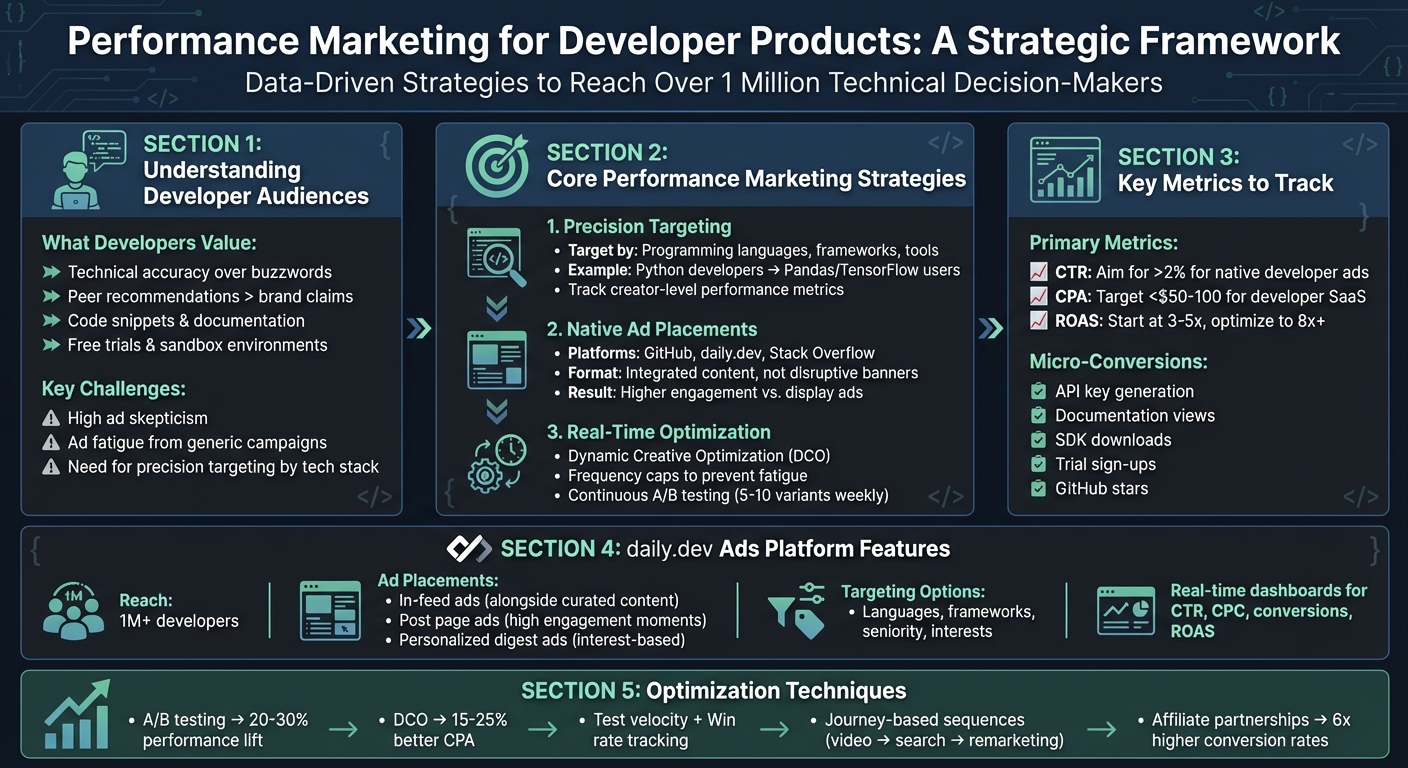 {Performance Marketing Strategy Framework for Developer Products}
Understanding the Developer Audience
Developers are not your average marketing audience. They’re critical thinkers, trained to sift through fluff and evaluate solutions based on their technical merits rather than flashy marketing. This makes them a tough crowd to win over - but if you do, the payoff can be immense.
What Developers Value in Marketing
For developers, technical accuracy is non-negotiable. They want clear, no-nonsense messaging that tackles their specific challenges and offers real solutions. Buzzwords like "revolutionary" or "game-changing" don’t impress them - they raise red flags. What resonates instead? Code snippets that showcase functionality, easy access to documentation, and tools they can test themselves through free trials or sandbox environments.
Developers also place a high premium on peer recommendations over traditional marketing. A genuine endorsement from a trusted colleague or community member carries far more weight than any brand claim. Sponsored content works best when it feels authentic, giving creators the freedom to speak in their own voice rather than following a corporate script.
Challenges in Targeting Developers
The very traits that make developers discerning also make them a tough audience to reach. Ad fatigue and skepticism are major hurdles. Overly polished marketing often comes across as superficial, leading developers to assume the product prioritizes style over substance. Anything resembling a hard sell is likely to be ignored.
To connect with developers, precision is key. Their needs are highly specialized - a React frontend developer won’t have the same concerns as a DevOps engineer managing Kubernetes. Broad, generic campaigns don’t cut it. Instead, success lies in deeply understanding their tools, their pain points, and the platforms they frequent. Whether it’s daily.dev, GitHub, or Stack Overflow, meeting developers where they naturally explore and learn is far more effective than interrupting their flow with intrusive ads.
sbb-itb-e54ba74
Performance Marketing Strategies for Developer Products
To effectively market to developers, it’s essential to focus on strategies that are measurable, precise, and resonate with their technical mindset. Performance marketing for developer products thrives on data-driven decisions, authenticity, and targeted optimization. The key lies in combining technical targeting with trusted platforms while carefully tracking your spend and results.
Precision Targeting by Skills, Tools, and Interests
When targeting developers, technical precision is non-negotiable. Build campaigns around specific programming languages, frameworks, and tools. For instance, if you’re promoting a Python-based analytics tool, aim your ads at developers working with Python, as well as those using frameworks like Pandas or TensorFlow. This level of targeting ensures your ads feel relevant, reducing wasted spend and increasing engagement. Developers are far more likely to respond to ads that directly address their tech stack and challenges.
To refine your targeting, track metrics like creator-level performance and payback periods. These insights help you determine which technical segments yield the best results. For example, campaigns targeting React developers may perform differently than those aimed at Vue.js users. By testing and optimizing these segments, you can allocate your budget where it will have the greatest impact.
Once your technical targeting is in place, pair it with native ad placements to further boost engagement.
Using Native Ad Placements for Higher Engagement
Developers are quick to dismiss traditional banner ads - they’re trained to ignore anything that disrupts their workflow. Native ad placements, on the other hand, integrate seamlessly into platforms developers already trust and use. Ads that appear naturally within technical blogs, developer newsletters, or community platforms often see significantly higher engagement rates compared to standard display ads.
The secret to success here is trust. Native ads should feel like a helpful resource, not a sales pitch. Sponsored posts in newsletters, curated recommendations on technical platforms, or featured content in developer communities work well because they align with how developers organically discover new tools and solutions. When ads respect the environment they’re in, developers are more likely to engage.
Optimizing Campaigns with Real-Time Analytics
Data is the backbone of performance marketing. Real-time analytics allow you to monitor key metrics - click-through rates, conversions, cost per acquisition (CAC), and return on ad spend (ROAS) - while campaigns are live. This enables quick adjustments based on performance trends.
Using dynamic creative optimization (DCO) can further enhance results. DCO assembles ads dynamically, tailoring them to specific developer contexts. For instance, a Kubernetes user might see messaging about container orchestration, while someone working with PostgreSQL gets ads highlighting database-specific benefits.
To avoid overexposure, implement frequency caps and audience exclusions. This minimizes ad fatigue and prevents your budget from being wasted on irrelevant impressions. Striking the right balance between automated optimization and strategic oversight ensures your product is positioned effectively.
Using daily.dev Ads for Developer Campaigns
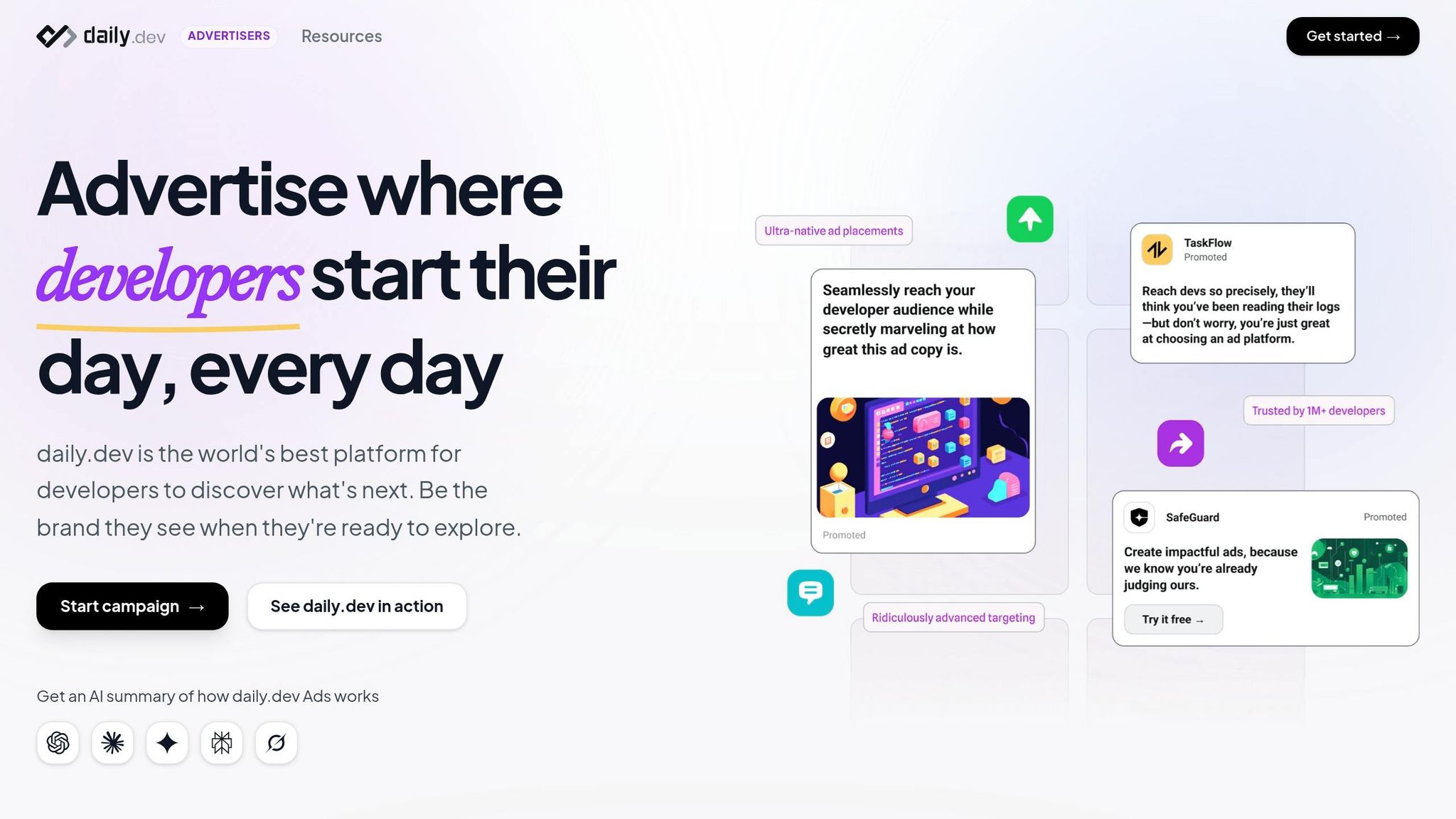
daily.dev Ads is a platform tailored to connect with over 1 million developers in an environment they already trust. Designed specifically for technical audiences, these ads appear where developers naturally go to discover tools, stay informed about industry trends, and solve coding challenges. This integration enhances performance marketing strategies by blending precise targeting with a trusted space for developers. By leveraging these tools, you can create impactful campaigns for developer-focused products. Let’s explore the key features that make daily.dev Ads a powerful tool for targeting developers effectively.
Features and Benefits of daily.dev Ads
daily.dev Ads offers native ad placements that fit seamlessly into the developer’s browsing experience. Ads are placed in three key areas:
- In-feed ads: These appear alongside curated technical content, ensuring they feel relevant and non-intrusive.
- Post page ads: These are displayed as developers engage with specific articles, reaching them at moments of high engagement.
- Personalized digest ads: These deliver targeted messages directly to developers based on their interests.
This native approach ensures your ads are seen as helpful recommendations rather than disruptive distractions.
The platform also provides advanced targeting options tailored to developers. You can filter by programming languages (like Python, JavaScript, or Go), frameworks (such as React, Django, or Kubernetes), seniority levels, and technical interests. For instance, if you’re promoting a CI/CD tool, you can target DevOps engineers who use Docker and are interested in automation. This precision minimizes wasted ad spend and ensures your message reaches the right audience.
Additionally, daily.dev Ads includes real-time performance dashboards to track developer-specific metrics. You can monitor key indicators like click-through rates (CTR), cost per click (CPC), conversion rates, and return on ad spend (ROAS). Developer-focused metrics, such as API key generation, documentation views, and trial sign-ups, provide deeper insights. For native developer ads, aim for a CTR exceeding 2% and use automation tools to optimize campaigns as they run.
Best Practices for Campaign Success on daily.dev
To succeed with daily.dev Ads, start with developer-friendly creative. Use clear, technical language and avoid excessive graphics. Developers appreciate concise messaging that directly addresses their needs. Including code snippets can showcase functionality, and linking to technical documentation, sandbox environments, or free trials allows developers to evaluate your product immediately.
When targeting, begin broadly - such as by programming language or tool - then narrow your focus using real-time data. Exclude irrelevant audiences with negative targeting (e.g., exclude junior developers if promoting an enterprise security tool) and layer interests to enhance relevance. For example, combine "DevOps" with "CI/CD" to zero in on the right audience. Use frequency caps to prevent overexposure.
A/B testing is crucial for refining your campaigns. Experiment with different headlines, visuals, and calls-to-action to identify the most effective combinations. Once you find what works, gradually expand your targeting to include related tools or developer communities. Allocate about 20% of your budget to test new segments while scaling successful ones.
Finally, track micro-conversions to measure genuine developer interest. Metrics like documentation views, GitHub stars, SDK downloads, and trial account sign-ups provide valuable insight into the developer journey. Focusing on these actions helps you optimize for long-term product adoption rather than just immediate clicks.
Metrics and Optimization Techniques
Metrics to Track Campaign Performance
When it comes to performance marketing for developer products, tracking the right metrics is essential to demonstrate ROI and improve each campaign. Start with click-through rate (CTR) to gauge how well your ads connect with developers. Pair that with cost-per-click (CPC) to see how efficiently you're reaching them, though CPC only holds value when combined with conversion data.
For deeper insights, focus on cost-per-acquisition (CPA) - this tells you how much it costs to acquire a qualified lead, such as an API key registration or a trial sign-up. For developer SaaS tools, aim for a CPA below $50-100, adjusting based on your customer lifetime value. Since developer products often involve longer sales cycles, tracking micro-conversions like demo requests or documentation views can help you map the full customer journey. A low CPA indicates that your targeting and messaging are hitting the mark.
Another key metric is return on ad spend (ROAS), which measures how much revenue you generate for every dollar spent. For example, a 4:1 ROAS means $4 earned for every $1 invested. Start with a 3-5x ROAS goal and work toward 8x or higher as you refine your campaigns. Products with subscription models, common in developer tools, often benefit from high lifetime value and word-of-mouth referrals, which can further boost ROAS. Pair this with multi-touch attribution to give proper credit to technical content that influences developers early in their decision-making process.
These metrics aren’t just numbers - they’re tools to help you fine-tune your campaigns for better performance.
Techniques for Continuous Campaign Optimization
Once your metrics are in place, use them to drive ongoing improvements. A/B testing should be a constant practice, not just something you do at launch. For example, test headlines like "Boost API Speed by 40%" against "Seamless React Integration" to see which performs better in terms of CTR and CPA. Aim to run 5-10 test variants weekly using platform automation, experimenting with elements like visuals (e.g., code snippets vs. performance benchmarks). By doing this, you can identify high-performing creatives and add them to evergreen libraries. This method can lead to a 20-30% performance lift compared to static campaigns.
Take things further with dynamic creative optimization (DCO), which uses automation to mix and match ad components and find the best-performing combinations. For developer-focused campaigns, feeding in product data like performance benchmarks can help tailor messaging. DCO often delivers 15-25% better CPA than static ads by personalizing content for technical audiences. Treat DCO as an ongoing experiment - regularly introduce fresh ideas and retire ads that no longer perform well.
Targeting is another area where real performance data can guide you. Keep an eye on which programming languages, frameworks, or seniority levels convert most effectively, then refine your audience filters accordingly. To avoid wasting ad spend, set frequency caps and exclude irrelevant audiences. Establish "fail-fast" criteria to quickly pause underperforming segments. Finally, track metrics like test velocity, win rates, and overall campaign lift to measure how well your optimizations are working.
Scaling Campaigns for Maximum ROI
Balancing Growth and Budget Efficiency
Scaling campaigns aimed at developers requires a thoughtful mix of automation and hands-on management. Platform automation can handle tasks like testing ad creatives, optimizing budgets, and making real-time adjustments. However, it’s essential to set clear boundaries to avoid overspending. For instance, use frequency caps to limit how often an individual developer sees your ads. This helps reduce ad fatigue and avoids wasting impressions. Similarly, apply audience exclusions to filter out segments that consistently underperform, such as developers using tools or frameworks that rarely align with your product.
To measure success, keep an eye on metrics like test velocity (how many experiments you run monthly), win rate (the percentage of tests outperforming your control), and cumulative lift (the overall improvement from automated and manual optimizations). These metrics help you stay on track and identify which strategies are actually effective. When a winning ad emerges, add it to an evergreen library to keep costs in check. This method allows you to scale efficiently without driving up your cost-per-acquisition.
Instead of focusing solely on individual channels, consider designing journey-based sequences. For example, upper-funnel video ads can introduce your developer tool, followed by search ads targeting developers actively researching solutions, and finally remarketing ads to close the deal when they’re ready to sign up. This multi-touch strategy ensures you’re maximizing ROI at every stage of the developer’s journey. Incorporate multi-touch attribution to properly credit early-stage efforts, which can justify allocating more budget to upper-funnel activities - even if they don’t lead to immediate conversions.
These techniques create a solid foundation for scaling your campaigns while keeping them relevant and cost-effective.
Expanding Targeting Without Losing Relevance
Once your budget and campaigns are optimized, you can focus on reaching a broader audience without sacrificing the technical precision of your messaging. Start by building a modular asset library that includes pre-approved headlines, benefit-driven bullet points, and product visuals tailored to specific developer pain points. Connect these assets to data feeds, enabling dynamic creative optimization (DCO) to generate personalized ads in real time based on each developer’s context. Platforms will automatically test combinations and prioritize the most effective ones, helping you expand your reach without losing technical authenticity.
In addition to automation, strategic partnerships can enhance your campaign’s credibility. For example, collaborate with developer influencers through performance-based partnerships. Instead of paying flat fees, consider CPA or revenue-sharing agreements with trackable links. According to data from Adobe Analytics, influencers and affiliate marketers were responsible for about 20% of Cyber Monday e-commerce revenue in 2024, with affiliate-linked products being 6× more likely to convert than non-affiliate content. Start small by testing micro-influencers in niche developer communities, such as backend specialists or mobile developers. Scale the successful ones through paid amplification and retargeting.
As you broaden your efforts, gather continuous feedback from developers using surveys or community discussions. Ask them if your ads feel relevant and helpful, and use their input to fine-tune your messaging. This approach not only builds trust but can also lead to organic peer recommendations, amplifying the impact of your paid campaigns. Treat expansion as an ongoing experiment - keep testing new segments while staying true to the technical expertise that developers value.
Conclusion
Marketing to developers requires a different mindset compared to traditional B2B strategies. Developers prioritize technical accuracy over exaggerated claims and place a high value on peer recommendations and hands-on experience before adopting any tool. Successful campaigns must focus on delivering immediate value - whether through free trials, detailed documentation, or engaging developers in the spaces they already frequent.
This guide outlines strategies like precise targeting based on skills and tools, dynamic creative optimization, and multi-touch attribution to help achieve measurable results. For example, data from Adobe Analytics reveals that affiliate-linked products convert six times more often than non-affiliate ones. While this insight comes from e-commerce, it highlights a key takeaway for developer marketing: clear, technical messaging combined with trusted channels leads to better ROI.
Platforms like daily.dev Ads align perfectly with these principles. Their native placements seamlessly integrate into developers' daily routines, reaching over 1 million developers worldwide. With targeting options based on seniority, programming languages, and tools, plus real-time performance tracking, you can ensure your budget is spent reaching engaged, high-intent audiences rather than wasting resources on generic impressions.
Start small by tracking key metrics like API calls or SDK downloads. Use these insights to scale successful strategies, refine assets based on direct developer feedback, and maintain a balance between growth and technical credibility. By following this iterative, data-driven approach, you can effectively navigate the unique challenges of performance marketing for developers while achieving sustainable results.
FAQs
Which developer segments should I target first?
When deciding which developers to focus on first, it’s smart to align with those whose interests and habits naturally connect with your product. A great starting point? Early-career developers who are hungry to learn and advance their skills. Another option is targeting specialists - whether they’re frontend or backend developers - who appreciate deep technical expertise.
You can take it a step further by creating custom audiences tailored to specific skills, programming languages, or tools. This approach not only sharpens your focus but also helps maximize your ROI.
What micro-conversions matter most for dev tools?
For developer tools, micro-conversions often signal deeper engagement and technical adoption. These might include API call frequency, documentation views, SDK implementation rates, feature activation, and onboarding completion.
Other indicators, like GitHub activity, code sample usage, and participation in technical discussions, can reveal genuine interest and trust in the product. Monitoring these actions allows teams to fine-tune campaigns, zeroing in on the factors that boost retention and encourage long-term adoption.
How do I set up multi-touch attribution for long cycles?
To implement multi-touch attribution for lengthy sales cycles, consider using models like linear, time decay, or position-based. These models help distribute credit across various touchpoints over time, ensuring a more balanced view of your customer interactions. Use analytics tools to monitor and assign value to each touchpoint, and incorporate behavioral data - such as API calls or documentation views - for greater precision. Periodically revisit and refine your attribution model to ensure it accurately represents the entire customer journey.