

Want to scale your developer tool from free users to enterprise clients? Product-led growth (PLG) is the strategy to focus on. It prioritizes the product as the main driver for acquiring, activating, and retaining users - especially developers who prefer hands-on testing over sales pitches.
Here’s the core idea:
- Developers discover tools via organic channels like blogs, communities, and SEO.
- They quickly test the tool (ideally hitting their first value milestone in under 10 minutes).
- Individual users expand usage to their teams, eventually leading to enterprise adoption.
PLG works best for products with lower complexity and an average contract value (ACV) under $5,000. For higher-value contracts or complex sales, a hybrid approach - combining PLG with sales - can close deals faster.
Key takeaways:
- Self-service onboarding is critical to success. Developers want quick wins without friction.
- Product-Qualified Leads (PQLs) - users who’ve experienced product value - convert at 15–30%, far higher than traditional Marketing-Qualified Leads (MQLs).
- Paid ads on platforms like daily.dev can accelerate growth by targeting high-intent developers.
PLG isn’t about eliminating marketing or sales - it’s about aligning them to amplify the product’s strengths. The result? Scalable growth from individual users to enterprise-level clients.
Why PLG Works for Developer Tools (And When It Doesn't)
Why Developers Prefer Self-Service and Hands-On Testing
Developers rely on hands-on experience to build trust. Instead of sitting through a sales pitch, they'd rather spend 10 minutes diving into API documentation to see how things work for themselves. In fact, 75% of B2B buyers prefer to self-educate rather than engage with a sales representative . Developers form their understanding of a tool by testing it directly, ensuring it solves their problem instead of just taking promises at face value. Jakub Czakon, CMO at Neptune.ai, sums it up perfectly:
Developers want to be educated, enabled, and inspired, NOT persuaded .
No amount of marketing copy can replace the value of solving a problem firsthand . This preference for self-reliance is evident in the fact that fewer than 5% of technical users reach out to customer support right away when encountering an issue . For developers, high-quality documentation isn't just a nice-to-have - it's a critical sales tool. Take GitHub as an example: when it made core features free in 2020 (including unlimited private repositories), its developer community grew from 40 million to 83 million users by 2022 .
While self-service is key to adoption, it has its limits - especially when decisions involve more than just the developer.
When PLG Needs Help from Sales and Marketing
PLG can hit roadblocks when the person using your tool isn't the one making the final purchase decision. For example, a developer might love your API monitoring tool, but scaling that enthusiasm into an enterprise contract often requires navigating procurement processes, security checks, and budget approvals - tasks that go beyond a self-service model .
Complexity is another challenge. If your product requires custom configurations, caters to multiple user types, or operates in highly regulated industries like healthcare or finance, a purely PLG approach may not be enough to close deals .
PLG tends to shine for products with an Average Contract Value (ACV) under $5,000, but when ACV exceeds $25,000, traditional sales-led strategies are often necessary . For products that fall in between, many companies adopt a hybrid Product-Led Sales (PLS) model. In this approach, the product identifies product-qualified leads (PQLs) based on usage data, and sales teams step in to turn those leads into larger enterprise accounts .
sbb-itb-e54ba74
The PLG Funnel: Discover > Try > Adopt > Expand > Procure
The PLG (Product-Led Growth) funnel maps the journey from discovering a product to becoming a paying customer. Unlike traditional sales funnels that depend on demos and sales calls, this approach is developer-focused and self-service at every step. By understanding each phase, you can pinpoint where users drop off and decide where to prioritize your efforts.
Discovery: Where Developers Find New Tools
Developers typically don't engage with cold emails or sales pitches. Instead, they find tools while actively searching for solutions to their problems. This phase relies on "pull" strategies, where your product naturally draws users in through organic channels . For most developers, search engines are the starting point, making SEO and targeted landing pages for specific use cases essential .
Key discovery channels include:
- Technical blogs featuring code examples
- Detailed API documentation
- Open-source contributions
- Developer communities like Stack Overflow, Reddit, Discord, and dev.to
Some products also benefit from built-in virality, where users unintentionally market the tool by sharing its outputs. Think about Calendly links, Figma prototypes, or Zoom invites - these not only serve their primary purpose but also introduce the product to new users .
Slack is a great example of product-led discovery. With 285,000 users in its first year and no marketing spend at launch, Slack grew because its product naturally invited new users - every message or channel invite brought others into the platform . PLG companies often enjoy lower customer acquisition costs, with a median CAC payback period of 10 months compared to 18 months for sales-led companies .
Adoption and Expansion: From Solo Users to Teamwide Growth
Adoption begins when a developer experiences the "aha moment" - that first realization of the product's value, like saving their first file or successfully making an API call. But the real magic happens when these individual users bring the product to their teams. This shift often hinges on collaboration features, shared workspaces, and usage limits like storage or seat restrictions .
Products with built-in network effects make expansion easier. When one developer invites teammates to join a project, the tool becomes a core part of the team's workflow. The best PLG companies see Net Revenue Retention (NRR) rates between 120% and 140%, meaning their existing customers are expanding usage faster than others churn . The goal is to make collaboration seamless - every invite or shared feature is a chance to grow.
Procurement: Turning Free Users into Paying Customers
The final step is converting users from free plans to paid ones. While individual developers might stick with a free tier, teams and enterprises often need advanced features like SSO, admin controls, security compliance, or dedicated support . These premium features naturally lead to procurement discussions.
Top PLG companies rely on Product Qualified Leads (PQLs) to identify free users who are ready to upgrade. Instead of funneling all signups to sales, they track specific behaviors that signal readiness to buy - like Slack's threshold of "2,000 team messages sent" . A strong PQL-to-paid conversion rate falls between 20% and 30% in a PLG model . This approach ensures sales teams focus on users already seeing value, instead of chasing cold leads who haven’t engaged with the product.
Marketing's Role in PLG (It's Not Zero Marketing)
While Product-Led Growth (PLG) thrives on self-service, the idea that it eliminates the need for marketing is a myth. Marketing doesn’t disappear in PLG - it transforms. Instead of relying on tactics like cold emails or gated whitepapers, marketing works to enhance the product experience and create awareness around self-service entry points . By 2026, 91% of B2B SaaS companies are expected to adopt PLG strategies . This evolution in approach emphasizes tapping into organic channels and using paid strategies to amplify reach.
The focus shifts from persuasion to enablement. Traditional marketing often measures success through MQLs (Marketing Qualified Leads) generated by content downloads or webinar sign-ups. PLG marketing, on the other hand, prioritizes Product Qualified Leads (PQLs) - users who have already experienced the product's value firsthand . This means the goal of marketing in PLG is to make it easier for users to engage with the product quickly and realize its benefits without unnecessary friction.
Why Technical Depth Matters
In PLG, substance outweighs fluff. For example, developers - who are often key users in PLG models - tend to avoid traditional sales pitches and block ads. However, they’ll invest significant time exploring high-quality resources like documentation, API specs, and code examples . This makes well-crafted documentation more than just a support tool; it becomes a powerful marketing asset. By providing clear, detailed, and accessible resources, you can build trust and encourage adoption.
Metrics That Matter
The metrics for success in PLG marketing look very different from traditional approaches. Instead of focusing on lead generation, the spotlight is on the activation rate - the percentage of signups who reach the product’s core value . Marketing efforts in PLG aim to reduce the time it takes for users to experience this value. Tools like onboarding guides, "Hello World" tutorials, and educational content play a key role in removing obstacles. It's no surprise that PLG companies often enjoy a median CAC payback period of 10 months, compared to 18 months for sales-led companies .
Comparing Traditional and PLG Marketing
| Aspect | Traditional Marketing | PLG Marketing |
|---|---|---|
| Primary Goal | Generate MQLs for the sales team | Drive product adoption and PQLs |
| Content Type | Gated whitepapers, webinars | Documentation, tutorials, open guides |
| User Entry | Sales demo or consultation | Free trial or freemium tier |
| Sales Motion | "Let me show you why this is valuable" | "You're already getting value, let me help you scale" |
These shifts in strategy enable PLG companies to excel at organic acquisition and accelerate growth by meeting users where they are and empowering them to succeed. Marketing in this context isn’t about convincing - it’s about helping users unlock the product’s potential.
Organic Acquisition Channels That Fuel Developer PLG
In a product-led growth (PLG) model, developers take the reins, steering clear of traditional sales methods. Instead of responding to cold outreach or gated content, they actively search for solutions, consult peers, and experiment with tools firsthand. This behavior shapes which organic channels work best for attracting developers to PLG tools.
The key to success lies in meeting developers where they already are and offering immediate value without unnecessary barriers. This makes organic channels a cornerstone for PLG strategies targeting developers.
Content Marketing: Technical Blogs, Tutorials, and Case Studies
Technical content forms the backbone of developer acquisition. When a developer searches for something like a "code review checklist" or guidance on setting up a CI/CD pipeline, they’re looking for actionable answers - not a sales pitch. High-quality technical blogs that address these needs build trust and naturally position your tool as a credible solution.
Documentation is especially powerful in this space. As Draft.dev aptly notes:
Devs raving about your docs to other devs is a fantastic vehicle for product-led growth .
By leveraging detailed technical documentation, content marketing enhances discoverability. In fact, 91% of B2B SaaS companies using PLG strategies have prioritized this approach .
Tutorials and case studies further enrich your content strategy by showcasing what developers can achieve with your tool. Including ready-to-use code snippets, interactive sandboxes, and practical examples can inspire users to explore your product for their own projects.
Developer Communities and Events
Developers value peer opinions far more than vendor claims. Active participation in forums like Stack Overflow, dev.to, Reddit, Discord, and Slack channels helps establish credibility. The key is to genuinely assist - answer technical questions thoroughly, be transparent about your role as a vendor, and focus on solving problems first .
This approach takes time. Community engagement doesn’t lead to immediate conversions, but it builds a reputation. When developers eventually need a tool in your category, they’ll recall the helpful insights you shared.
Events, whether in-person or virtual, offer another way to connect. Conferences and meetups are most effective once your product has gained some traction and you can share real-world use cases. For early-stage tools, online communities often offer a better return on investment, requiring time rather than financial sponsorships.
Marketplace Listings and Integration Directories
Developers frequently discover tools while searching for specific integrations or functionalities. Platforms like GitHub Marketplace, RapidAPI, and APIdeck provide exposure to users actively seeking solutions within established ecosystems.
Timing matters here. Wait until your product is stable, and your APIs are robust enough to handle integration demands. A poor integration experience can hurt your reputation more than not being listed at all. Once ready, optimize your marketplace listings with keywords tied to specific use cases, such as "Slack notification API" or "payment processing integration", to increase visibility.
Here’s a summary of key organic channels, their objectives, and when to focus on them:
| Channel | Primary Goal | Best Timing |
|---|---|---|
| Content Marketing | Build trust through technical depth | Begin immediately |
| SEO | Capture search intent for solutions | Start early; scale after content is established |
| Communities | Drive word-of-mouth and gather feedback | Engage early |
| Marketplaces | Expand reach via integrations | Once product and APIs are proven |
| Conferences | Build relationships face-to-face | After achieving initial traction |
These channels work together to create a continuous discovery cycle. A developer might find your technical blog through a search, dive into your detailed documentation, ask questions in your Discord community, and discover your tool in a marketplace - all without ever interacting with a sales team. That’s the beauty of organic acquisition in a PLG framework.
The 10-Minute Rule for Developer Onboarding
Developers make snap judgments about your tool, often within seconds. In the first 60 seconds, they start forming opinions; if they don’t see progress quickly, initial curiosity can shift to skepticism . This is known as the "Intent Cliff", where attention drops fast if there’s no immediate payoff.
The 10-minute rule is simple: developers should hit their first "aha moment" within ten minutes of signing up. Leading tools aim even faster, delivering value in five minutes or less . Why does this matter? Developers who make their first API call within ten minutes are three to four times more likely to convert to paid plans compared to those who take longer . Any delay beyond this window increases the risk of friction, which can derail adoption.
Technical friction is a bigger adoption killer than pricing. A staggering 68% of developers cite "too much setup time" as the main reason they abandon trials, while only 12% point to pricing . Long signup forms, delayed emails, or complex configurations only speed up abandonment. In fact, PLG (product-led growth) tools lose 60–80% of signups before activation even happens .
So, how do you keep developers engaged? Start with a streamlined, code-first onboarding experience. Skip the lengthy forms and verification steps. Instead, let developers jump right in by copying a code snippet and running it immediately with pre-generated sandbox keys . For CLI-based tools, use a simple three-command setup (e.g., init → cd → dev) to get developers up and running in under 90 seconds . And never leave them staring at an empty screen - pre-populate sandbox accounts with sample data or offer a one-click "seed database" to show what’s possible right away . This instant feedback keeps them moving through the PLG funnel.
Ditch mandatory product tours in favor of contextual tooltips that appear when users engage with specific features for the first time . During signup, only ask for the bare essentials, like an email address, and gather additional details (e.g., role, tech stack) later with progressive profiling . The key is simple: show value before asking for effort. When developers see results quickly, they’re far more likely to stick around and convert.
Expansion: Turning Individual Developers into Team Accounts
Once a developer reaches their "aha moment" and starts using your tool consistently, the next big step is bringing their teammates into the fold. This shift from individual users to team accounts is where Product-Led Growth (PLG) companies see the most revenue growth. High-performing PLG companies often achieve Net Revenue Retention (NRR) rates between 120% and 140%, showing how existing users significantly increase their usage over time .
To make this transition seamless, focus on building collaboration features that naturally encourage team participation. Features like role-based access control (RBAC) are essential for professional teams. Developers often require roles such as Reader (view only), Writer (edit/run), Admin (manage members), and Owner (billing/deletion) to work efficiently as a team . Shared workspaces are another key feature, allowing teams to track progress and collaborate on projects without sharing individual logins . These tools remove friction when teammates need access to shared projects.
One of the strongest drivers of team expansion is inherent virality. Tools like Figma, Loom, and Calendly have grown rapidly because their shared outputs - like prototypes, video links, or scheduling pages - act as organic ads every time they're shared . For developer tools, this could look like a shared API dashboard, collaborative code reviews, or public documentation links. GitHub's success shows how offering core collaborative features for free can fuel community growth, which eventually feeds into the procurement stage of the PLG funnel.
Keep an eye on signals that indicate it's time to upsell. These could include users hitting storage limits, inviting teammates, or exploring advanced features like Single Sign-On (SSO) and SAML support . Slack’s Product-Qualified Lead (PQL) metric is a great example of how tracking active collaboration patterns can reveal when teams are ready to upgrade to paid plans . Including tools like a "seat meter" (e.g., "3 of 5 seats used") can also nudge teams toward natural upsells as they approach capacity .
As teams grow, administrative needs like centralized billing, member management, and enterprise-grade security features become priorities . This is where Product-Led Sales (PLS) comes into play. Sales teams can use product usage data to identify accounts with multiple active users and pitch an enterprise-wide deployment based on the team's success . PLG companies often see a median Customer Acquisition Cost (CAC) payback period of 10 months, compared to 18 months for traditional sales-led companies, making this model highly efficient . This structured approach to expansion highlights how PLG strategies can drive growth at an enterprise level.
Using Paid Advertising to Accelerate PLG
Product-Led Growth (PLG) doesn’t mean cutting out marketing expenses entirely - it’s about spending smarter. While your product takes care of activation and retention, paid advertising speeds up growth by bringing in high-intent developers at the top of your funnel. These ads direct users to self-serve onboarding, where the product can immediately showcase its value.
The aim isn’t just to rack up signups - it’s to attract developers who quickly see the product’s worth and transition into Product Qualified Leads (PQLs).
Targeting Developers with daily.dev Ads
When it comes to reaching developers, precision is everything. Generic ad platforms often waste money on irrelevant audiences. That’s where daily.dev Ads stands out. This platform allows you to zero in on specific developer segments based on factors like programming languages, tools, and experience levels. For instance, you can target backend engineers who use Python, frontend developers working with React, or DevOps teams exploring Kubernetes - all within a trusted ecosystem of over 1 million active developers.
daily.dev Ads offer native placements that integrate seamlessly into the content developers consume daily. You’ll find:
- In-feed ads that appear alongside curated technical articles.
- Post page ads designed to grab attention during focused reading sessions.
- Personalized digest ads that reach developers during their most engaged moments.
With real-time tracking, you can identify which segments convert to PQLs and fine-tune your campaigns to ensure your budget reaches the right audience.
Case Study: How Paid Ads Accelerate Developer Adoption
The effectiveness of paid advertising in PLG becomes evident when you focus on the right metrics. Instead of chasing vanity stats, track product usage milestones. For example, measure how quickly users from ad-driven traffic achieve PQL status. The formula for calculating your PQL Rate is:
(New signups from ads achieving PQL status / Total new signups from ads) × 100 .
You should also compare how quickly ad-driven users reach their first value milestone versus organic users. If paid traffic takes longer to activate, it could mean your ad messaging is off-target, or your landing page isn’t optimized for quick onboarding. The most successful campaigns guide users to landing pages designed to help them hit their "aha moment" within minutes.
"In 2026, PLG has matured beyond simple freemium models... incorporating AI-driven personalization and sophisticated Product Qualified Lead (PQL) scoring." – Zylos Research
Ultimately, the key metric for ROI is how many PQLs convert into paying customers and expand their usage over time. Tools like PostHog, Amplitude, or Mixpanel can help you connect ad spend to in-product behavior. This data-driven strategy reinforces how paid advertising fuels PLG growth.
Metrics: Product-Qualified Leads (PQLs) vs. Marketing-Qualified Leads (MQLs)
::: @figure 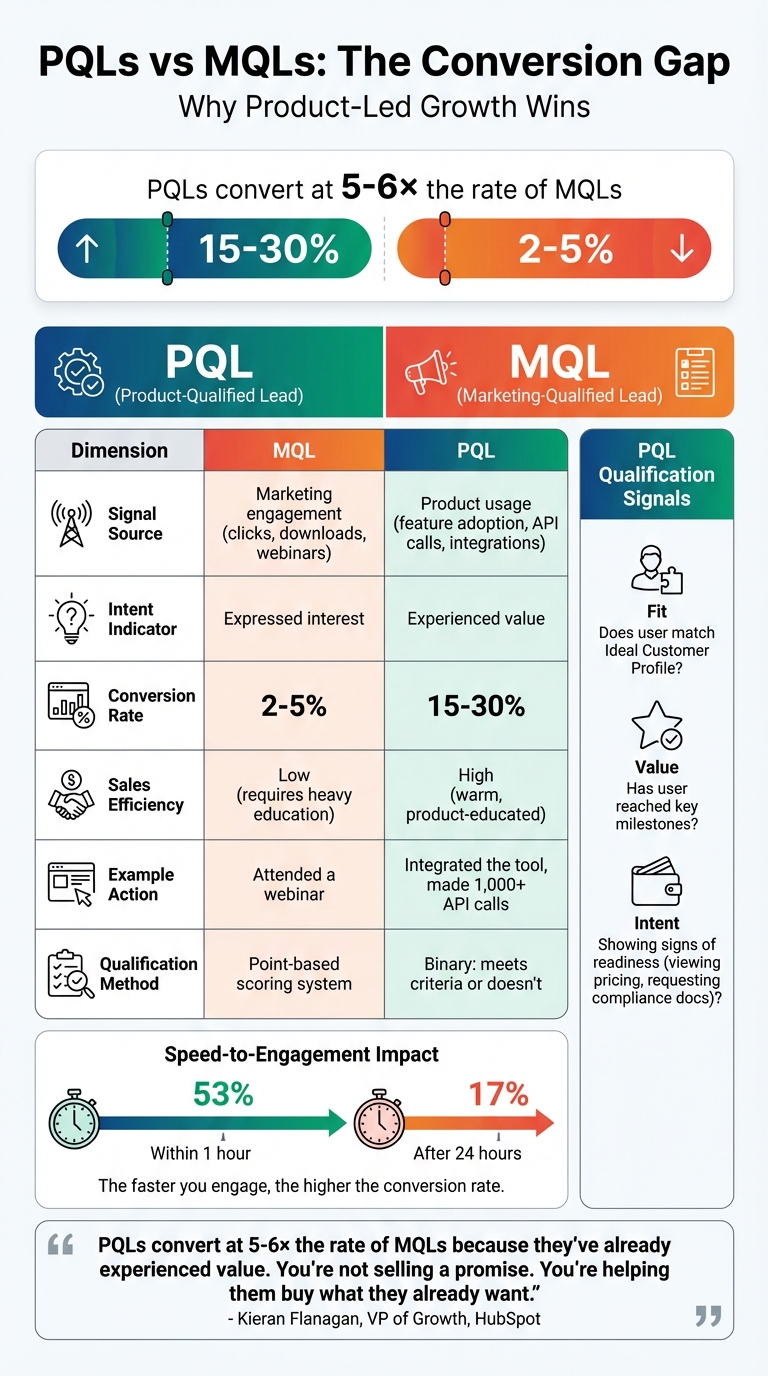 {Product-Qualified Leads vs Marketing-Qualified Leads: Conversion Rates and Key Differences}
When it comes to tracking success in a product-led growth (PLG) strategy, understanding the difference between Product-Qualified Leads (PQLs) and Marketing-Qualified Leads (MQLs) is essential. The key distinction lies in how the lead interacts with your business. MQLs are individuals who show interest in your marketing efforts - they may download an ebook, attend a webinar, or click on an ad - but they haven’t used your product yet. On the other hand, PQLs are users who have already engaged with your product and experienced its value firsthand, such as developers actively working with your tool .
Why does this distinction matter? Because PQLs are far more likely to convert. While MQLs typically convert at a rate of 2–5%, PQLs boast a conversion rate of 15–30% - a massive 5–6× improvement . When a developer integrates your API, completes their first project, or hits a usage threshold, they’ve already validated your product’s value. At this point, they’re not just interested - they’re ready to buy.
"PQLs convert at 5–6× the rate of MQLs because they've already experienced value. You're not selling a promise. You're helping them buy what they already want."
– Kieran Flanagan, VP of Growth, HubSpot
To effectively identify PQLs, focus on three critical signals:
- Fit: Does the user align with your Ideal Customer Profile? This could be based on factors like company size or their tech stack.
- Value: Has the user reached key milestones, such as surpassing 1,000 API calls or completing a significant action within the product?
- Intent: Are they showing signs of readiness to convert, such as viewing pricing pages or requesting documentation for security or compliance?
Unlike MQLs, which often rely on point-based scoring systems, PQLs are typically qualified in a straightforward, binary manner: either they meet the criteria, or they don’t . Speed is also crucial. Engaging a PQL within one hour can yield a 53% conversion rate, but waiting over 24 hours can drop that to just 17% . Automated alerts can help your sales team act quickly when users hit important milestones, ensuring you engage them while they’re still exploring your product.
For developer-focused tools, the most valuable PQLs are often those who run into technical challenges - like needing help with security reviews or custom integrations for enterprise use cases. These users are primed for a conversation about upgrading or expanding their usage .
| Dimension | Marketing-Qualified Lead (MQL) | Product-Qualified Lead (PQL) |
|---|---|---|
| Signal Source | Marketing engagement (e.g., clicks, downloads) | Product usage (e.g., feature adoption, usage limits) |
| Intent Indicator | Expressed interest | Experienced value |
| Conversion Rate | 2–5% | 15–30% |
| Sales Efficiency | Low (requires heavy education) | High (warm, product-educated) |
| Example Action | Attended a webinar | Integrated the tool |
Conclusion
The PLG funnel - from discovery to procurement - functions as a powerful framework when fueled by both organic and paid strategies working in tandem.
Product-led growth isn’t about slashing marketing budgets. Instead, it’s about aligning marketing and sales efforts to enhance what the product already excels at. Successful developer tools combine seamless self-service onboarding with well-executed marketing initiatives to boost discovery, activation, and expansion. With 91% of B2B SaaS companies already adopting PLG strategies, the clear winners are those that leverage marketing as a tool to amplify their product’s value - not replace it .
"In a product-led company, the product is the primary driver of acquisition, activation, retention, and expansion. Marketing and sales do not disappear, but they amplify the product instead of replacing it."
The journey from free tiers to enterprise accounts hinges on building trust through technical content, thorough documentation, and active community engagement. Organic efforts like these resonate with developers who want transparency and proof of value. However, relying solely on organic growth can limit scalability. Paid advertising on platforms like daily.dev helps position your tool in front of developers actively searching for solutions, feeding your PLG funnel with users ready to experience your product.
Metrics consistently show how a hybrid PLG strategy transforms hands-on engagement into scalable growth. By optimizing time-to-value, identifying Product Qualified Leads (PQLs) based on meaningful usage milestones, and running precise paid campaigns, you create a system that scales effortlessly from individual developers to enterprise clients. Fast onboarding and clear PQL definitions are essential for sustaining this momentum.
The future of developer tools lies in blending product-led and sales-led approaches. In this hybrid model, the product builds trust through direct engagement, while marketing and sales strategically expand reach and drive enterprise adoption. Nail the product experience first, then leverage organic and paid strategies to connect with the developers who need your solution most.
FAQs
What should my first “aha moment” be for a dev tool?
When it comes to dev tools, that first "aha moment" should hit fast. The onboarding process needs to be smooth and intuitive, showing developers the tool's value almost instantly. Ideally, within 10 minutes or less, users should clearly understand how the tool can make their work easier or more efficient. This quick win is what drives adoption and fuels growth - letting the tool speak for itself.
How do I define a PQL for my product?
A Product Qualified Lead (PQL) is someone who demonstrates high potential for conversion based on their interaction with your product. This is often determined by analyzing user engagement and identifying moments where they experience value - like hitting a milestone or reaching that "aha moment" when the product's benefits click.
By tracking key in-product actions, you can uncover behaviors that signal a strong intent to upgrade or purchase. Analytics play a crucial role here, helping you connect specific user activities to higher likelihoods of conversion.
When should I add sales to a PLG motion?
When your product is gaining traction and you're ready to go after larger enterprise accounts, it's time to bring sales into your product-led growth (PLG) strategy. PLG shines for deals under $5,000 in annual contract value (ACV), but once you start targeting deals over $25,000 ACV, a dedicated sales team becomes crucial. They can manage complex negotiations and provide the tailored support that enterprise clients expect.