

Programmatic advertising can work for developer audiences, but it requires a different approach. Developers are privacy-conscious, use ad blockers, and frequent niche platforms like Stack Overflow and GitHub. Traditional methods relying on third-party cookies and open exchanges often fail, wasting 30–50% of budgets on irrelevant impressions.
Here’s how to make programmatic advertising effective for developers:
- Focus on Private Marketplaces (PMPs) and Direct Deals: These ensure high-quality inventory on verified developer platforms, reducing fraud and irrelevant placements.
- Use Contextual Targeting: Instead of behavioral data, target based on tech stack, programming languages, and project types.
- Leverage Native Ads: Developers prefer ads that blend into their workflow, such as sponsored content or tools recommendations.
- Optimize Budgets and Bids: Allocate 60–70% to awareness campaigns and 30–40% to conversion-focused efforts. Use dynamic bid strategies to prioritize high-value impressions.
For platforms like daily.dev Ads, direct access offers guaranteed placements at fixed prices, ensuring your ads reach the right audience with minimal waste.
Key Takeaway: Reaching developers isn’t about scale - it’s about precision, quality, and aligning with their technical preferences.
How Programmatic Advertising Works for Developer Audiences
Programmatic Advertising Basics
Programmatic advertising simplifies the process of buying and selling digital ad space by using algorithms and real-time bidding. Instead of managing insertion orders manually, advertisers rely on Demand-Side Platforms (DSPs) to define campaign parameters like targeting, budgets, and bid amounts. On the other side, publishers use Supply-Side Platforms (SSPs) to list their inventory with minimum floor prices. When a user visits a webpage, an ad exchange conducts an auction in milliseconds, awarding the ad spot to the highest valid bidder.
This approach is highly effective for large-scale consumer campaigns. It combines efficiency with reach, allowing marketers to target users based on demographics, browsing habits, and interests while optimizing campaigns in real time. Automation removes the need for manual negotiations, enabling ads to run seamlessly across various formats like web, mobile, video, and connected TV. For campaigns aiming to reach millions of consumers, it’s a powerful tool that balances precision with scale.
However, this same system faces hurdles when targeting developers. While the core technology remains the same, developers often engage on niche platforms like Stack Overflow and GitHub, where ad inventory is either scarce or available solely through private arrangements. Additionally, the behavioral data that fuels programmatic advertising isn’t as readily available for technical audiences. Let’s dive into why this automated approach struggles to connect with developers.
Why Developers Are Harder to Reach Programmatically
Targeting developers through programmatic advertising introduces unique challenges. Developers tend to use ad blockers far more than the average user, disable third-party cookies, and adopt privacy-focused browsers that strip tracking scripts. Their technical expertise often translates into an active effort to maintain privacy, leaving programmatic advertisers with limited data to work with.
The platforms developers frequent - like coding forums, technical documentation sites, and developer tools - offer a much smaller pool of ad inventory compared to mainstream consumer websites. This inventory is often restricted to private marketplaces or direct deals rather than being available on open exchanges. Even when programmatic campaigns do secure placements on developer-focused platforms, the lack of robust targeting data leads to lower match rates. For instance, a campaign targeting "software developers interested in cloud infrastructure" might reach some relevant users but often ends up serving ads to non-technical audiences or in low-quality spaces.
| Targeting Approach | General Audiences | Developer Audiences |
|---|---|---|
| Primary Method | Behavioral (cookies, browsing history) | Contextual (tech stack, programming languages) |
| Ad Tolerance | Moderate; standard banners work | Low; frequent ad-block use and banner blindness |
| Inventory Source | Open exchanges and broad networks | Niche communities, technical sites, private marketplaces |
| Content Style | Emotional or benefit-driven | Straightforward, technical, and focused on utility |
| Privacy Stance | Passive about tracking | Actively blocks tracking scripts and protects data |
The gap is clear: programmatic advertising thrives on scale, but developer marketing requires precision. To connect with developers effectively, marketers need to embrace smaller, more specialized inventory pools, prioritize private marketplaces, and shift to contextual targeting based on the technical content developers engage with - rather than relying on the behavioral data they’ve intentionally obscured.
sbb-itb-e54ba74
Why Open Exchanges Waste Budget on Developer Campaigns
Ad Fraud and Low-Quality Inventory Problems
Open exchanges can quickly drain advertising budgets, especially when targeting niche audiences like developers. One major culprit is domain spoofing, where fraudsters mimic reputable tech publishers. Instead of appearing on trusted sites, ads end up on fake pages, offering zero real value.
Then there’s click fraud and bot traffic, which inflate engagement metrics without delivering genuine interest. Bots are programmed to imitate developer behavior - clicking ads or scrolling through technical content - making it hard to distinguish between real users and automated activity. Tactics like pixel stuffing (hiding ads inside invisible 1x1 pixels) and ad stacking (layering multiple ads so only the top one is visible) further distort impressions, making advertisers pay for interactions that don’t exist.
The financial toll of these fraudulent practices is staggering. By 2025, global programmatic ad fraud is expected to cost brands over $80 billion annually . For campaigns targeting developers, where every impression matters, this waste is especially damaging. Invalid traffic from sources like data centers, malware-infected devices, and hijacked machines only adds to the problem.
"At Power Digital, our programmatic team focuses on trusted inventory, brand-safety controls, and continuous performance monitoring to protect your brand and your budget." – Adrian Livengood, Senior Performance Analyst, Programmatic Media
Why Precision Targeting Matters for Developer Campaigns
Developer campaigns can’t afford inefficiency. Unlike broad consumer campaigns where some waste is tolerable, developer marketing operates within a smaller, highly specific audience. Every impression needs to count, but open exchanges prioritize volume over accuracy, often placing ads far from relevant technical content.
The better approach? Shift your focus to private marketplaces and direct deals with verified developer-centric publishers. These methods ensure your ads appear in the right context. Use whitelists to approve trusted domains, deploy fraud detection tools like DoubleVerify or IAS to block suspicious activity in real time, and lean on contextual targeting to align ads with genuine technical content. When budgets are tight and audiences are niche, prioritizing quality inventory over broad reach is essential.
Private Marketplaces and Direct Deals for Developer Inventory
::: @figure 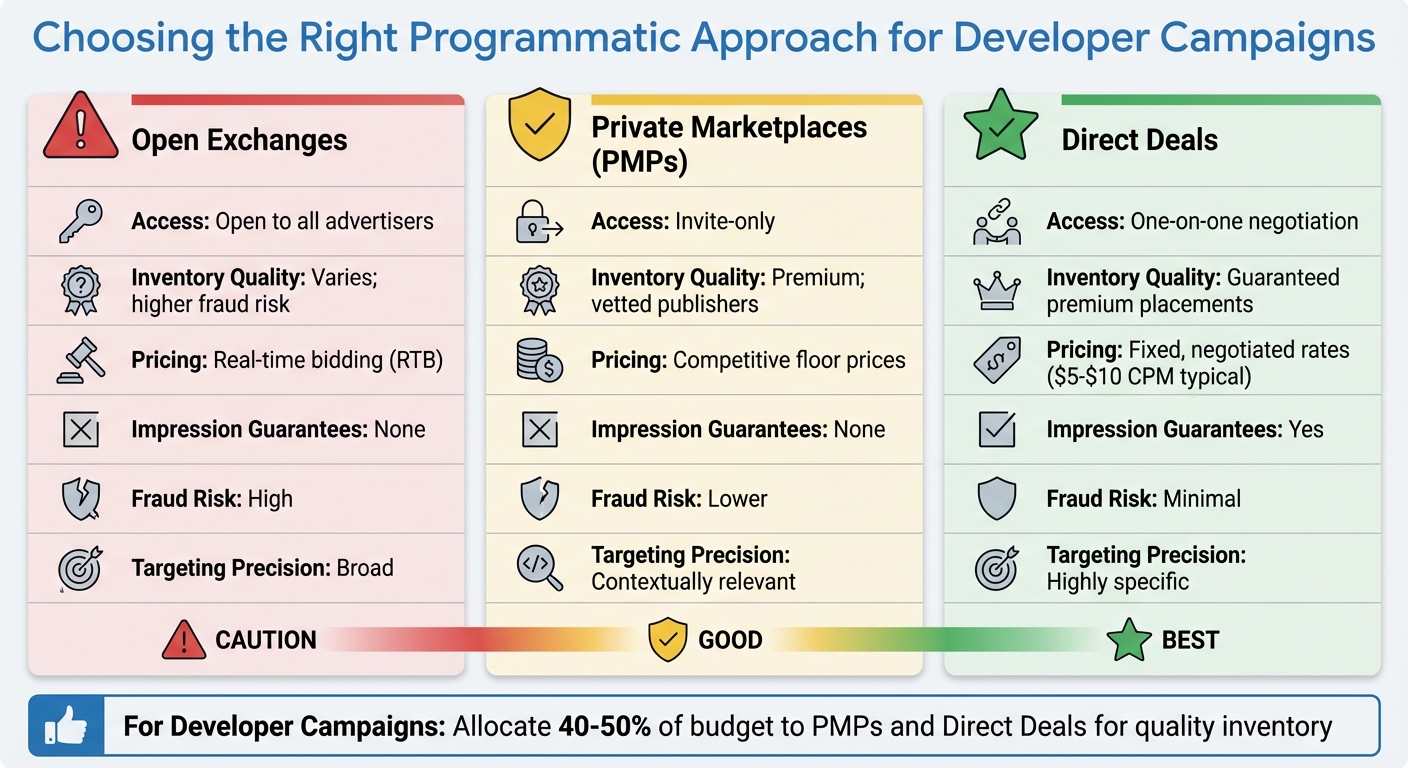 {Programmatic Advertising Approaches for Developer Campaigns: Open Exchanges vs PMPs vs Direct Deals}
What Private Marketplaces and Direct Deals Are
Private marketplaces (PMPs) are exclusive, invite-only auctions where publishers offer select ad inventory to advertisers through platforms like supply-side platforms (SSPs) and demand-side platforms (DSPs). Unlike open exchanges, where anyone can bid on ad space, PMPs allow only pre-approved advertisers to compete for premium inventory. This setup ensures a controlled environment tailored to quality and relevance, particularly for developer-focused campaigns .
Direct deals, also known as programmatic direct or programmatic guaranteed, involve pre-negotiated agreements between advertisers and publishers. These deals secure fixed pricing and guaranteed impressions, with automation handled by platforms like Google Ad Manager. Advertisers agree on key terms upfront - such as CPM rates, impression volumes, and creative requirements - while the platform ensures smooth delivery .
The main distinction lies in how inventory is accessed. PMPs still rely on real-time bidding (RTB), where invited buyers compete above a set floor price, but without guarantees on impressions. On the other hand, direct deals lock in both price and impression volumes, offering a structure more akin to traditional media buying but with the added benefit of automation . Both methods are designed to avoid the unpredictability of open exchanges, which often suffer from low-quality inventory and fraudulent activity. By focusing on these approaches, advertisers can secure better inventory and achieve more precise targeting for developer campaigns.
Benefits of Private Marketplaces for Developer Campaigns
Private marketplaces offer a way to access premium developer-focused inventory, ensuring your ads are served on high-quality sites that align with your audience. This is especially useful when targeting specific tech niches, such as particular programming languages or frameworks .
Another major advantage is lower fraud rates. Since PMPs involve verified publishers and vetted inventory, they significantly reduce risks like domain spoofing and bot traffic - issues that are rampant in open exchanges. For developer-focused campaigns, where every impression carries weight, this level of quality control is critical. Additionally, PMPs provide access to brand-safe placements, predictable costs through floor pricing, and higher ad viewability, all of which resonate with technical audiences .
Direct deals, meanwhile, take this a step further by offering guaranteed access to premium inventory. There’s no need to compete in auctions, which eliminates uncertainties tied to real-time bidding. For example, you could negotiate to display ads on pages dedicated to specific programming topics or technical documentation, ensuring your message reaches developers actively seeking solutions or information .
Here’s a quick comparison of open exchanges, PMPs, and direct deals:
| Feature | Open Exchanges | Private Marketplaces (PMPs) | Direct Deals |
|---|---|---|---|
| Access | Open to all | Invite-only | One-on-one negotiation |
| Inventory Quality | Varies; higher fraud risk | Premium; vetted publishers | Guaranteed premium placements |
| Pricing | Real-time bidding | Competitive floor prices | Fixed, negotiated rates |
| Impression Guarantees | None | None | Yes |
| Fraud Risk | High | Lower | Minimal |
| Targeting Precision | Broad | Contextually relevant | Highly specific |
To use PMPs or direct deals effectively, start by identifying publishers who focus on developer audiences. Request invitations to their private marketplaces or negotiate fixed-price deals directly. Define your targeting criteria - such as programming languages or developer seniority - allocate budgets, and upload creatives. Platforms that leverage first-party developer data can improve targeting precision by 15–25%, giving you an edge in reaching niche audiences .
Targeting Options for Developer Campaigns
Tech Stack and Programming Language Targeting
Refining developer campaigns often hinges on targeting the technologies developers actively use. Programmatic platforms offer a way to zero in on developers based on their tech stack, including programming languages like JavaScript, Python, Rust, or Go, and frameworks like React, Node.js, or Django. You can also focus on those working with cloud providers such as AWS, Azure, or GCP or tools like Docker and Kubernetes. These insights come from a mix of first-party data and third-party segments, tracking behaviors like visits to specific tutorials or monitoring activity on platforms like Stack Overflow.
In a demand-side platform (DSP), you might define segments like "users interested in Kubernetes" and layer in other signals, such as Docker usage combined with job titles, to specifically target roles like DevOps engineers. Data management platforms (DMPs) further enhance these efforts by collecting signals from developer hubs - think GitHub activity or npm downloads - and using them to optimize bids in real time.
For example, targeting developers who use Python has been shown to double or even quadruple click-through rates, while also cutting cost-per-acquisition by 35% . However, a common challenge is that many developers rely on privacy tools, which can limit data availability. To address this, private marketplaces with first-party developer data and lookalike modeling can help. These methods often deliver 20–30% better precision compared to open exchanges .
Seniority and Project Type Targeting
Another way to fine-tune developer targeting is by focusing on their experience level and the types of projects they work on. Developers can be segmented by seniority - junior, mid-level, senior, or lead/architect - using data from professional networks or inferred from the complexity of their projects.
Project type targeting is equally valuable. Whether developers are focused on web development, mobile apps (iOS/Android), AI/ML, or cloud infrastructure, platforms can identify contextual indicators like visits to Flutter documentation or engagement with full-stack e-commerce projects.
Combining these criteria can yield highly precise campaigns. For instance, targeting senior developers working on blockchain projects ensures relevance while maintaining scale. Messaging can also be tailored: a junior developer might respond well to educational content and quick-start guides, while an architect may prioritize information on system integration, scalability, and long-term ROI. By blending persona-based targeting with intent signals - like content consumption on React.js or senior-level cloud projects - you can refine campaigns further. Adjusting strategies based on performance data ensures your budget focuses on high-engagement segments.
These advanced targeting methods create a strong foundation for optimizing creative formats and bid strategies in developer campaigns.
Creative Formats That Perform for Developer Audiences
Why Native Ads Outperform Display Ads for Developers
Traditional banner ads often fall flat with developers. Why? Because developers are particularly adept at tuning out anything that resembles a flashy ad. This "banner blindness" is especially common among technical audiences who spend their time immersed in documentation, code repositories, and developer tools. Native ads, however, bypass this issue by blending seamlessly into the content developers are already engaging with.
Native ads boast click-through rates (CTR) that are up to three times higher than display banners when targeting developers. For instance, a StackAdapt study revealed that native ads in tech verticals delivered 65% higher CTRs compared to display formats . The difference is even more striking when it comes to viewability: native ads consistently achieve over 80% viewability, while display ads often languish at 40–50% .
But it’s not just about numbers - it’s about trust. When an ad appears as a sponsored tool recommendation or as part of an in-feed content card, developers perceive it as a helpful resource rather than a distraction. Native ads integrate seamlessly into the platforms developers frequent, using the same layouts, fonts, and design elements they encounter daily. This approach ensures the ad feels more like a natural part of their workflow, delivering value without breaking their focus.
Examples of Effective Ad Formats for Developers
Building on the success of native ads, certain creative formats stand out for their ability to engage developers. The key? Offering direct, technical utility while steering clear of overt marketing.
- Sponsored native content: Articles like “Top 5 VS Code Extensions for React Devs” or in-feed cards featuring code snippets and API previews provide developers with immediate, practical value - no hard sell required.
- Technical, concise messaging: Developers prefer straightforward, quantifiable claims over marketing fluff. Instead of saying, “The world’s best debugging tool,” opt for something like, “Reduce load time by 40%” or use code-inspired phrasing such as,
npm install efficiency. - Developer-friendly CTAs: Calls-to-action tailored to developer habits work best. Options like “Read the docs,” “Try the sandbox,” or “Star on GitHub” outperform high-friction alternatives like “Book a demo” or “Contact Sales.” Ads that link to technical blog posts, live code examples, or documentation see up to a 25% boost in conversion rates compared to generic campaigns .
Even the visual design matters. Ads that mimic the tools developers use - think monospaced fonts, terminal-style interfaces, architecture diagrams, and dark-mode–friendly layouts - feel less intrusive. When ads mirror the environments developers are already comfortable with, they come across as part of the content stream rather than an interruption.
Bid Strategies and Budget Allocation for Developer Campaigns
Optimizing Bids for Niche Technical Audiences
Advertising to developers is a unique challenge. Unlike general consumer campaigns, low bids on open exchanges often lead to poor results - low-quality inventory or irrelevant, non-technical content that drains your budget. Developers tend to frequent specific, technical platforms, meaning the competition for these premium spaces is intense.
To get the most out of your bids, focus on relevance over reach. Instead of spreading your budget thin with low bids, concentrate on high-quality placements where developers actually spend their time. Experts suggest starting with base bids that are 20–30% lower than general audience campaigns and adjusting them as performance data becomes available using machine learning tools .
Dynamic bid multipliers can also be a game-changer. For instance, increase your bids when contextual signals - like users browsing GitHub or reading technical documentation - indicate higher intent. Pair this with behavioral data from your DMP to target impressions from high-value users, such as senior developers engaging with technical content .
For niche, high-value segments, consider stepping away from the unpredictability of real-time bidding. Programmatic Guaranteed deals offer fixed CPMs, usually around US$5–US$10, ensuring predictable costs and avoiding bidding wars . Allocating about 40–50% of your budget to private marketplaces can help secure the premium inventory you need for these audiences.
These strategies ensure your bids are aligned with your campaign goals and set the foundation for effective budget allocation.
Splitting Budget Between Awareness and Conversion Goals
Once your bids are optimized, the next step is dividing your budget to address both awareness and conversion objectives. A good rule of thumb is to allocate 60–70% of your budget to awareness campaigns and 30–40% to conversion-focused efforts. For example, with a US$100,000 monthly budget, you might spend US$60,000 on upper-funnel, CPM-driven placements like native ads .
Awareness campaigns are crucial for reaching developers early in their journey, but conversion budgets should focus on moments of intent. When a developer interacts with technical content, explores documentation, or tests an API sandbox, they’re signaling a higher likelihood of converting. Directly negotiated placements on premium platforms are ideal for capturing these opportunities.
To measure success, track developer-specific metrics like low bounce rates and longer time-on-site to confirm that your placements are resonating with the audience . Additionally, use your DSP's attribution models to evaluate how awareness campaigns contribute to conversions over time. This data allows you to fine-tune your budget allocation as the campaign progresses, rather than sticking to static estimates.
daily.dev Ads: Direct vs Programmatic Access
Why daily.dev Ads Offers Quality Developer Inventory
daily.dev Ads connects with over 1 million developers who engage with technical content during their workday. Unlike SEO-driven platforms where users leave after finding a quick solution, daily.dev users visit to explore new tools and trends, making them naturally open to relevant ads.
What sets this platform apart is its desktop-first approach. Developers spend most of their workday coding, testing, and deploying on desktops, and daily.dev sessions align with these workflows. Ads served during these work hours hit developers when they're most likely to install or evaluate tools - timing that’s critical for promoting technical products.
The platform leverages first-party behavioral data based on actual user activity. Instead of targeting broad categories like "tech professionals", you can reach developers who follow specific frameworks like Cypress or Jest. You can even tailor messages by seniority, distinguishing between junior developers and senior Site Reliability Engineers. Ads are integrated as native content within the developer's feed, helping reduce the skepticism developers often have toward ads. With this high-quality inventory in place, the next step is deciding how to access it.
Direct Access vs Programmatic: Comparing the Options
Once you've decided to advertise on daily.dev Ads, the next choice is how to access its verified developer-focused placements. The choice between direct and programmatic access boils down to control versus scale.
With direct access - often called Programmatic Direct - you secure premium placements at fixed prices. This method guarantees inventory at negotiated rates, sidestepping the auction process common in open exchanges. It also gives you maximum transparency about where your ads appear, ensuring they reach a verified developer audience.
Programmatic access, on the other hand, uses Real-Time Bidding to deliver broader reach. Here, you're bidding on individual impressions in real-time, which can help scale campaigns quickly. However, this approach comes with risks like fraud or lower-quality inventory. As George Witt explains, "Programmatic advertising is the real-time algorithmic purchase and sale of advertising space... allowing marketers to target specific audiences... with unprecedented precision and efficiency" . That said, the effectiveness of programmatic campaigns depends heavily on the quality of the inventory.
For campaigns targeting developers, direct access offers clear advantages. Fixed pricing, verified placements, and access to publisher-first-party data significantly reduce risks like fraud and wasted spend. It's the better choice for promoting niche tools or reaching specific technical roles. Programmatic access, while offering scale and flexibility, works best for testing multiple placements or expanding reach - but it demands careful oversight and strict brand safety measures to maintain quality.
Conclusion
Programmatic advertising can effectively support developer campaigns, but only when quality takes precedence over scale. Open exchanges often lead to wasted budgets due to ad fraud and poor-quality placements. Instead, prioritizing private marketplaces and direct deals ensures access to verified developer inventory, where precision targeting delivers the most impact.
By honing in on specifics like tech stack, programming languages, seniority, and project types, you can connect with developers at critical moments - such as when they're evaluating tools rather than casually browsing. Pairing this precise targeting with native ad formats drives engagement levels that traditional display ads simply can't match.
When crafting your bid strategy, it's essential to consider the niche nature of developer audiences. For instance, allocating 60–70% of your budget to private marketplaces can secure better-quality conversions, while using open exchanges sparingly for broader awareness. Additionally, adjusting CPMs to reflect the value of senior developers - spending $10–$20 instead of $5 for generalized targeting - helps ensure you're reaching influential decision-makers. This approach naturally ties into the importance of selecting the right platform.
Choosing the right platform is crucial. For example, daily.dev Ads provides direct access to over 1 million developers, offering guaranteed placements and fixed pricing. This eliminates the unpredictability of auction-based systems. While programmatic access offers scale, it requires careful management to maintain both quality and relevance.
FAQs
How do I buy real developer ad inventory without wasting spend?
To make the most of your budget, concentrate on platforms that offer high-quality inventory specifically aimed at developers. Open exchanges can often result in issues like fraud and poor-quality placements, so it's smarter to focus on private marketplaces or direct deals instead.
Leverage native ad formats, such as in-feed ads, to connect with developers in a way that feels natural and engaging. Additionally, using contextual targeting helps deliver ads that are relevant while respecting developers' privacy preferences. This approach not only improves campaign performance but also minimizes wasted spending.
What targeting works for developers without third-party cookies?
Targeting developers without relying on third-party cookies involves a few effective strategies:
- Behavioral targeting: Focus on their actions, such as the tools they use or the technologies they explore.
- Contextual targeting: Analyze the content they interact with, like specific programming tutorials or forums.
- First-party data: Use insights from browsing history, tool usage, preferred programming languages, and community participation.
These approaches allow for creating tailored and relevant audiences while keeping privacy top of mind.
How do I measure success for programmatic ads to developers?
To measure success, focus on key metrics like click-through rates (CTR), unique impressions, and the quality of leads or sign-ups. Assess how effectively your ads connect with developers by examining factors like technical relevance, authenticity, and the engagement quality they generate. Additionally, track conversions - whether it's product adoption or event participation - to ensure your campaign delivers meaningful content to the right audience.