

Programmatic advertising for developers is challenging but essential for B2B marketers targeting this unique audience. Here's why and how you can succeed:
- Ad blockers are a hurdle: 67% of developers use ad blockers, making it difficult to reach them via standard digital ads.
- High costs and fraud risks: Developer-focused ads command CPMs of $25–$50+, and 15–25% of ad spend is wasted on fraud, like bot traffic and low-quality inventory.
- Generic targeting fails: Developers are diverse, and campaigns must reflect their specific tools, languages, and needs to connect effectively.
- Open exchanges waste budgets: Fraud and poor targeting on open ad exchanges lead to wasted impressions and low engagement.
Key Solutions:
- Private Marketplaces (PMPs): Access premium inventory, like Stack Overflow or IDEs, to ensure ads reach real developers.
- Direct Deals: Negotiate directly with publishers for high-performing placements that bypass ad blockers and offer better targeting.
- Precise Targeting: Focus on tech stacks, programming languages, seniority, and project types for better engagement.
- Native Ads: Outperform display ads by blending into developer-friendly platforms like daily.dev, driving up to 2.3x higher engagement.
- Budget Allocation: Spend 70–80% on PMPs and direct deals, with a focus on weekdays during work hours for maximum ROI.
By prioritizing quality over quantity and leveraging targeted strategies, you can effectively reach and engage developers while minimizing wasted ad spend.
How Programmatic Advertising Works for Developers
Programmatic Advertising Basics
Programmatic advertising uses software and algorithms to streamline the buying and selling of digital ad inventory, eliminating the need for manual negotiations like RFPs and insertion orders . Here’s how it works: when a developer visits a webpage, a Real-Time Bidding (RTB) auction kicks in, evaluating and purchasing ad impressions in just milliseconds - usually around 200 milliseconds . This process relies on real-time data to decide which advertiser’s content gets displayed.
This automated system has replaced the slower, manual methods of the past. Now, marketers simply set targeting parameters, and the software takes care of the rest. By 2024, programmatic advertising represented 80% of all digital ad spending in the U.S., with global spending surpassing a staggering $594 billion .
Unlike fixed pricing, programmatic advertising uses a dynamic pricing model, where costs - measured in CPM (cost per 1,000 impressions) - fluctuate based on demand and competition in the auction . This competitive pricing structure ensures advertisers vie for the same audience, which is particularly important when targeting developers, as their needs are highly specific.
Why Developers Require a Different Approach
Developers are an audience that demands precision. They’re quick to disengage from irrelevant or poorly targeted ads. In fact, 49% of users report being inaccurately targeted by online ads, and of those, 42% will immediately unsubscribe from the brand’s marketing content . For developers, a single misstep in targeting can seriously damage a brand’s credibility.
The challenge lies in the diversity of the developer community. Treating all developers as one category - like labeling them simply as "software engineers" - is a mistake. Developers specialize in different areas, and their needs vary significantly. For example, a Python data scientist faces entirely different challenges than a Rust systems programmer or a React frontend developer. Ads that fail to address their specific tools, languages, or project types often go unnoticed.
Developers are also adept at spotting superficial marketing. They respond best to content that respects their expertise, offers genuine value, and tackles real-world technical problems. As Matt Luscombe, former COO at IHG, explained:
By using advanced targeting capabilities through programmatic, we are able to find a broader range of people looking for accommodation and target them with our book-direct message .
For developers, this principle is even more critical. Ads must align closely with their technical context to make an impact. This level of precision highlights the need for targeted strategies, such as private marketplaces and direct deals, to engage this discerning audience effectively.
sbb-itb-e54ba74
Why Open Exchanges Waste Budget on Developer Campaigns
::: @figure 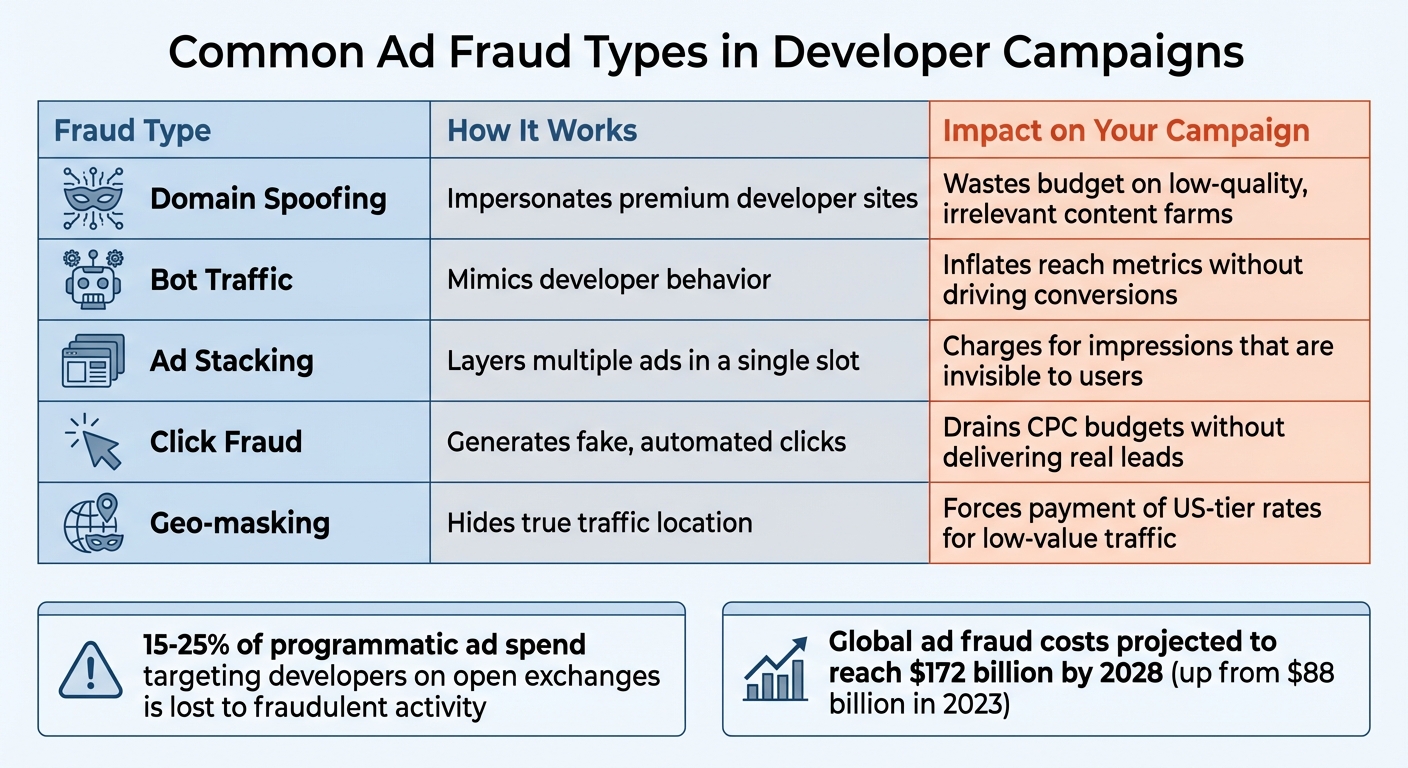 {Ad Fraud Types and Their Impact on Developer Marketing Campaigns}
Ad Fraud and Low-Quality Inventory
Open exchanges are a hotbed for ad fraud, which can drain even the most carefully allocated developer marketing budgets. Fraudsters often use domain spoofing to make low-value websites look like premium developer platforms. This trick leads advertisers to spend $25–$50+ CPMs on placements that provide no real value .
On top of that, bots have become incredibly sophisticated, mimicking developer activity on technical forums and documentation sites. These fake interactions trigger expensive ad impressions, but they don’t translate to actual engagement . Research suggests that 15–25% of programmatic ad spend targeting developers on open exchanges gets lost to such fraudulent activity . To make matters worse, global ad fraud costs are projected to skyrocket - from $88 billion in 2023 to $172 billion by 2028 .
Other sneaky tactics like ad stacking and pixel stuffing further drain budgets. These methods charge advertisers for impressions that are either hidden or layered invisibly on a single page . Meanwhile, click fraud - where automated bots generate fake clicks - eats away at CPC budgets without delivering genuine leads . Even retargeting campaigns aren’t safe; bots simulate high-intent actions like visiting pricing pages, tricking advertisers into wasting budgets on fake leads rather than connecting with real developers .
Fraud is only part of the problem. Open exchanges also suffer from poor targeting, which reduces the effectiveness of campaigns.
The Relevance Problem in Open Exchanges
Another major issue with open exchanges is their inability to deliver precise targeting. While demand-side platforms (DSPs) may identify visitors on tech-related sites, they often fail to distinguish between professional developers and hobbyists . This lack of granularity means impressions are frequently wasted on audiences with little to no conversion potential.
Access to premium developer inventory is another challenge. High-value placements, such as official documentation sites, integrated development environments (IDEs), and professional developer communities, are rarely available on open exchanges . Instead, advertisers often end up on Made-for-Advertising (MFA) sites - low-quality platforms that scrape developer content just to generate ad revenue. This inadvertently funnels ad dollars into content farms, far removed from genuine developer audiences .
The outcome? Advertisers pay top dollar for impressions that either don’t reach real developers or get blocked entirely. These challenges highlight the need for more precise and premium ad placements specifically tailored to developer audiences.
Here’s a quick breakdown of common fraud tactics and their impact on campaigns:
| Fraud Type | How It Works | Impact on Your Campaign |
|---|---|---|
| Domain Spoofing | Impersonates premium developer sites | Wastes budget on low-quality, irrelevant content farms |
| Bot Traffic | Mimics developer behavior | Inflates reach metrics without driving conversions |
| Ad Stacking | Layers multiple ads in a single slot | Charges for impressions that are invisible to users |
| Click Fraud | Generates fake, automated clicks | Drains CPC budgets without delivering real leads |
| Geo-masking | Hides true traffic location | Forces payment of US-tier rates for low-value traffic |
Private Marketplaces and Direct Deals for Developer Inventory
What Private Marketplaces Are
Private Marketplaces (PMPs) are exclusive, invitation-only auctions that give advertisers access to premium ad inventory . Unlike open exchanges, PMPs allow for greater control over where your ads appear. Publishers reserve this premium inventory for select advertisers and may include placements like technical tags on Stack Overflow, sections on documentation pages, or spots within niche developer communities. PMPs also operate with fixed or floor CPM pricing, offering predictable costs instead of the fluctuating rates seen in open auctions . For even more targeted developer campaigns, direct deals take this approach a step further.
Benefits of Direct Deals for Developer Campaigns
While PMPs provide access to premium inventory, direct deals offer even more precision by enabling one-on-one negotiations with publishers. This approach is particularly effective for securing high-intent placements in areas like integrated development environments (IDEs), official documentation sites, and technical newsletters - spaces that are often absent from open exchanges .
"The most effective developer advertising programs use programmatic for broad reach and retargeting while using direct buys for premium placements." - Idlen
The data supports this strategy. For example, in-IDE advertising placements can achieve click-through rates between 2.1% and 3.5%, which is about 10 times higher than traditional display ads .
Direct deals also help overcome the challenge of ad blockers. Since over 67% of developers use ad blockers , standard programmatic ads often fail to reach their audience. Native placements arranged through direct deals, however, frequently bypass these blockers, ensuring your ads are seen by real users. Additionally, publishers involved in these deals typically provide more detailed information about audience demographics and campaign performance compared to the anonymous data available in programmatic auctions .
Another advantage of direct deals is the ability to safeguard your budget. By creating strict allowlists of 50–200 verified developer sites, you can avoid wasting ad spend on low-quality content farms . This level of control not only helps bypass ad blockers but also enables more precise targeting based on factors like tech stack and seniority.
Targeting Options for Developer Audiences
Targeting by Tech Stack and Programming Languages
Platforms like Google DV360 and The Trade Desk enable advertisers to reach developers by focusing on the specific tools and programming languages they use. This is achieved through first-party data integrations or Data Management Platforms (DMPs) that track user interactions with technologies like AWS, Kubernetes, or React. You can also upload custom audiences sourced from developer analytics, such as GitHub repository data, or use lookalike modeling to broaden your reach.
According to Google DV360 data from Q1 2024, campaigns targeting specific tech stacks deliver 3.2x higher engagement rates compared to broad demographic targeting. The Stack Overflow 2023 Developer Survey, which included over 90,000 developers, revealed that JavaScript is the primary language for 68% of developers, followed by Python (48%) and Java (35%).
For example, in Q2 2023, JetBrains ran a campaign via Google Display & Video 360 targeting senior Java developers working on enterprise projects. By combining programming language, seniority, and tech stack targeting, the campaign achieved a 28% CTR and 4.2x ROAS, reaching 1.2 million developers and generating $1.7 million in pipeline. Similarly, a SaaS company targeting React developers through The Trade Desk saw 40% higher conversion rates by leveraging npm package usage signals.
To maximize results, consider layering programming language targeting with job title data. This technique can lead to a 2x ROAS boost. For instance, targeting Python developers often aligns with data scientists, but adding filters like seniority or company size can significantly improve outcomes. While the accuracy of targeting ranges from 70-85% due to cookie deprecation, AI-driven platforms can enhance precision to 90% for tech stack matches.
Beyond technical tools, narrowing your focus with seniority and project type targeting can further refine your approach.
Targeting by Seniority and Project Type
Seniority targeting uses data from LinkedIn (e.g., years of experience), GitHub contribution history, or job titles like "Senior Engineer." Demand-side platforms allow segmentation into junior (0-3 years, often flagged by bootcamp activity), mid-level (3-7 years), and senior (7+ years, often associated with leadership roles). Developers with 5+ years of experience make up 42% of the workforce but influence 65% of tech purchase decisions.
The performance impact is clear: senior developers convert 50% higher on enterprise tools compared to their junior counterparts. Adding salary data or company size to seniority targeting makes campaigns even more effective. Reports from Pathmatics and Nielsen in 2023 show that campaigns using seniority segmentation can increase ROI by 28%.
Project type targeting, on the other hand, categorizes developers by their work focus - such as enterprise software, open source contributions, mobile apps, or web development. Signals like public GitHub repositories often indicate open source work, while enterprise tool usage (e.g., Jira or Azure DevOps) highlights corporate projects. Platforms like MediaMath enable the creation of custom segments based on these behaviors.
For instance, HashiCorp’s H1 2024 campaign on The Trade Desk targeted mid-to-senior Terraform users working on infrastructure projects. This approach, combining tech stack (Terraform), seniority, and project type (infrastructure), resulted in a 35% lower cost per acquisition ($45 compared to a $70 baseline) and generated 150,000 qualified leads from 5 million impressions.
To achieve the best outcomes, combine multiple targeting parameters - like senior Python developers engaged in open source projects - to see up to a 4x increase in qualified leads. However, avoid over-narrowing your audience, as this can reduce reach. Aim for 1-5% audience overlap and use A/B testing in your DSP to strike the right balance between precision and scale.
Creative Formats That Work for Developer Audiences
Native Ads vs. Display Ads
When targeting developers, choosing the right ad format is just as important as precise targeting. Native ads consistently outperform traditional display ads, boasting 53% higher click-through rates across industries. For developer-focused campaigns, this performance can be up to 2.3x better, thanks to the alignment between the ad content and developers’ interests. Why? Developers have become adept at ignoring irrelevant display ads - a phenomenon known as "banner blindness." According to the Stack Overflow Developer Survey 2024, 74% of developers ignore display ads, but 32% engage with native ads that offer technical insights or tools.
The numbers speak for themselves. Native ads deliver 18% higher viewability and 9% lower cost-per-engagement compared to standard display banners, as noted in the Sharethrough Native Advertising Institute's 2023 report. This is because native ads integrate seamlessly into platforms like daily.dev, Stack Overflow, and technical blogs, making them feel more like helpful content rather than intrusive interruptions.
On the other hand, display ads struggle with technical audiences. Click-through rates for display ads in developer campaigns typically range between 0.05–0.1%. Developers tend to consume content differently - they're researching solutions, reviewing documentation, and reading technical articles. In these contexts, banner ads feel out of place, while native in-feed ads align with how developers naturally discover and evaluate tools.
Targeted native ads, especially those tailored to specific tech stacks (e.g., "For Node.js developers"), can boost conversions by 25% on premium platforms. While native ads may have a higher production cost and a narrower reach than display ads, their ability to resonate with developers makes the investment worthwhile. Once the format is chosen, the next challenge is creating content that developers find credible and engaging.
Creating Ad Content That Resonates with Developers
Native formats are only as effective as the content they deliver. For developers, authenticity is everything. Forget polished stock images - use real screenshots, project outputs, or architecture diagrams that demonstrate technical expertise. Developers value substance over style and will respond to content that proves you understand their world.
Your ad copy should focus on technical accuracy and specific use cases, steering clear of generic marketing language. Instead of saying, "The Best DevOps Tool", try something like, "Optimize Your React Builds in 5 Lines". Include elements that developers trust, such as code snippets, GitHub links, performance benchmarks, or integration details. For example, showing how your tool improves performance metrics or integrates with existing tech stacks builds credibility that vague claims cannot.
Developers are quick to spot exaggerated promises. Overhyping your product risks losing their trust entirely. Content created by your company’s engineers, rather than marketing teams, signals genuine expertise and builds trust. Similarly, case studies from well-known companies or projects carry more weight than generic customer testimonials. If you're targeting senior Python developers working on data science, feature a real-world implementation with measurable results, not a broad success story.
Interactive elements like code snippets can significantly boost engagement. Testing has shown that incorporating these into native ads increases interaction and shares. To refine your approach, try a 70/30 split between native and display ads to identify which messages and formats resonate most with your audience. Junior developers often respond to educational content that explains concepts and best practices, while senior developers prefer advanced technical content, such as architectural insights and performance comparisons.
The rise of interactive formats like video-native hybrids and embedded code snippets highlights developers’ preference for hands-on, practical content. Between 2023 and 2025, these formats have grown by 40% year-over-year. To succeed, align your ad format with where developers are in their decision-making process: use broader content for awareness and highly technical material for consideration stages.
Bid Strategies and Budget Allocation for Developer Campaigns
Setting Bids and Budgets
When targeting developers, your bid strategy needs to strike a balance between cost efficiency and visibility. Developers are selective in how they interact with ads, and campaigns often require higher CPMs. To start, set your bids 20–30% below industry averages - typically $2–5 CPM for tech audiences in the US. This initial approach helps you avoid overspending while gathering performance data to refine your strategy.
Automated bidding strategies can make a noticeable difference, often improving ROI by 20–30% compared to manual bidding. These systems use machine learning to pinpoint valuable signals, such as targeting specific tech stacks. For different campaign goals, consider these strategies:
- Target CPA: Ideal for driving conversions.
- Maximize Conversions: Best for sign-ups or downloads.
- CPM Bidding: Focused on brand awareness.
- CPC Bidding: Effective for engagement-driven campaigns.
When allocating your budget, the 70/20/10 model works well. Dedicate:
- 70% to proven tactics, like private marketplaces targeting senior developers.
- 20% to testing creative formats.
- 10% to experimental segments, such as targeting specific project types.
For US-based campaigns, start with daily budgets ranging from $500 to $2,000. This typically delivers over 10,000 impressions. Concentrate about 60% of your spending during peak hours - weekdays from 9 AM to 5 PM EST - when developers are most active.
Frequency capping is another key consideration. Limit impressions to 3–5 per user per day and 15–20 per week. This helps keep your ads relevant without overwhelming your audience. In private marketplaces, be prepared to bid 10–20% higher than in open exchanges - around $8–12 CPM - since the premium inventory often delivers 2–3× better ROAS. Experts suggest allocating roughly 80% of your budget to these premium sources when targeting technical audiences. Once your bids and budgets are in place, consistent performance tracking becomes essential.
Monitoring and Adjusting Campaign Performance
Once your campaign is live, weekly performance reviews are critical. Focus on metrics like:
- Viewability: Aim for above 70%.
- Click-through rate (CTR): Target 0.5–2% for developer audiences.
- Conversion rate: Strive for 1–3% for sign-ups.
- Effective CPM: Keep it under $10.
Keep an eye on fraud indicators, too. Bot traffic should stay below 10%, and your audience match rate for tech stack targeting should exceed 80%.
If CTR dips below 1%, consider reducing bids by 10–15% for underperforming segments, such as non-US traffic or broad inventory. Redirect that budget to higher-performing areas, like targeting React.js or Python developers. A/B testing bid multipliers can also help - for example, increasing bids by 20% for senior developer segments. Pause placements where ROAS falls below 2×; case studies show this can boost ROI by 25% within a week.
Pay special attention to open exchanges. If you notice high fraud rates or low engagement, reduce bids by 25% and reallocate funds to direct deals or private marketplaces. Lastly, aim for a win rate above 50%. This ensures a good balance between reach and cost efficiency without unnecessarily inflating CPMs.
daily.dev as a Premium Developer Inventory Source
Why daily.dev Works for Developer Campaigns
daily.dev connects you to over 1 million monthly active developers who use the platform to stay updated on tech news and trends. This makes it a standout option compared to the generic inventory found in open exchanges. Unlike SEO-driven websites where users often leave after finding a quick answer, daily.dev users come with a discovery mindset - they’re actively exploring new tools, frameworks, and industry updates. This means your ads reach developers during a natural part of their professional flow, not as an unwelcome distraction.
The platform also excels in targeting. By leveraging refined segmentation, daily.dev ensures your message reaches developers who are not just active but also deeply engaged with tech content. This approach results in 3x higher engagement rates, with campaigns averaging click-through rates (CTR) of 0.5–1.2% - well above industry norms.
Another major advantage? daily.dev is a desktop-first platform, meaning developers engage during their work hours. With 92% ad viewability and an average session time of 25 minutes, your ads are seen in an environment designed for meaningful engagement. Native ad formats seamlessly integrate into the content feed, earning 90% more trust from developers compared to traditional display ads. All of these factors create a unique opportunity for advertisers to directly connect with tech professionals.
Direct Deals vs. Programmatic Access on daily.dev
Given the strong engagement on daily.dev, advertisers can choose between two main approaches: direct deals or programmatic access. Each option has its strengths, but direct deals often deliver more predictable and impactful results.
Direct deals secure premium ad placements with fixed CPMs ranging from $10–15. These placements boast 95% viewability and an impressive 1.8% CTR, which is 2.5x higher than programmatic alternatives. Additionally, direct deals come with dedicated account management, offering support for campaign optimization and creative guidance.
Here’s an example: A cloud infrastructure provider targeting senior DevOps engineers through a direct deal achieved a 4.2% CTR and 15% conversion rate for demo sign-ups, with a cost-per-acquisition (CPA) of just $8 - 35% below industry benchmarks. Their native ad, featuring a "How to Scale Kubernetes" guide, drove 12x more engagement compared to standard display ads.
On the other hand, programmatic access via daily.dev's private marketplace (PMP) provides flexibility and scalability. Advertisers participate in real-time auctions, typically with CPMs between $12–20. While these rates are 20–30% higher than direct deals due to competitive bidding, programmatic campaigns still offer 70% less fraud exposure compared to open exchanges. However, the trade-off includes less predictable delivery and higher overall costs. This option works well for testing broader audiences or scaling campaigns without committing to fixed placements.
For most developer-focused campaigns, experts suggest allocating 80% of the budget to direct deals, reserving programmatic access for testing or handling additional inventory needs. Direct deals consistently deliver 40% lower CPAs and 2x better conversion rates, making them the go-to choice when ROI is the priority.
Conclusion
Reaching developers through programmatic advertising demands a tailored strategy - one that's very different from consumer-focused campaigns. Open exchanges often lead to wasted budgets, with ad fraud eating up as much as 20–30% of impressions. Developers also tend to ignore generic ads, responding instead to highly targeted messaging based on factors like their tech stack, programming languages, seniority, and project type. Unfortunately, this level of precision is rarely achievable in open programmatic environments.
Private marketplaces and direct deals provide a solution by offering verified, high-quality ad inventory where developers are actually active. Native ad formats deliver better results than traditional display ads because they present content that feels relevant and useful. For instance, campaigns that target specific tech stacks can boost engagement by about 40%, and direct placements often achieve excellent viewability rates. This level of precise targeting is key to connecting with developers effectively.
A prime example is daily.dev, which offers access to over 1 million monthly active developers who are in a discovery mindset. With direct deals on daily.dev, advertisers benefit from predictable, competitive CPMs in a desktop-first environment and an impressive 92% ad viewability rate - ideal conditions for developer-focused campaigns.
To get the best results, consider allocating 60–70% of your budget to direct deals on platforms like daily.dev. Use programmatic access sparingly, mainly for testing or scaling. Keep a close eye on performance metrics: aim for CTRs between 0.5% and 2% and conversion rates above 2%. Adjust bids strategically during peak developer hours, typically weekdays from 9 AM to 5 PM. By steering clear of open exchanges, you can ensure your campaigns resonate with this technically savvy audience.
The takeaway? Focus on quality over quantity, use precise targeting, and secure direct access to verified developer audiences for maximum impact.
FAQs
How can I reach developers if most use ad blockers?
Many developers use ad blockers, which means traditional ads might not reach them. To work around this, consider native and contextual advertising. These ad formats blend seamlessly with the surrounding content, making them harder to block and less intrusive.
For the best results, aim for developer-friendly placements. Examples include ads on documentation pages or even within IDEs (Integrated Development Environments). Developers value relevance and precision, so make sure your ads are technically accurate and directly tied to their interests or needs. Avoid vague or overly sales-focused messaging - developers are quick to tune that out. By prioritizing trust and relevance, you can engage effectively, even when ad blockers are in play.
How do I reduce ad fraud in developer programmatic campaigns?
To cut down on ad fraud in programmatic campaigns aimed at developers, steer clear of open exchanges that often come with low-quality inventory and higher fraud risks. Instead, prioritize private marketplaces and direct deals, which offer more dependable inventory.
Combining contextual targeting with native ads is another effective approach. By analyzing how developers interact with content, you can ensure ads are relevant without relying on intrusive tracking methods. Together, these strategies not only enhance ad quality but also lower the chances of fraud in campaigns targeting developer audiences.
What’s the fastest way to target developers by tech stack?
If you're looking to reach developers effectively, the fastest approach is to group them by the tools and programming languages they use - think Python, Docker, or similar technologies. Platforms like daily.dev are designed to help with this, offering targeted audience options specifically crafted for connecting with developer communities.