

Reaching developers through ads is tough. 60%-70% use ad-blockers, and many ignore ads altogether. Developers prefer content with technical value or peer insights. This makes choosing the right advertising channel critical, especially since their buying journeys often last 3–6 months and involve 7–15 touchpoints.
Here's a breakdown of six ad channels for developers: daily.dev Ads, Google Ads, LinkedIn, Reddit, Dev Newsletters, and Carbon Ads/BuySellAds. Each is evaluated based on reach, targeting, cost, trust, and purchase intent.
Quick Comparison
| Channel | Strength | Weakness | Trust Level | Targeting Precision | Cost (CPC) |
|---|---|---|---|---|---|
| daily.dev Ads | Integrated into developer tools | Niche audience | High | Tech stack & interests | $2–$4 |
| Google Ads | Broad reach, high intent | Expensive, lower trust | Low | Keyword-based | $20+ |
| Targets decision-makers | Expensive, formal tone | Moderate | Job title & company | $6–$15 | |
| Engages niche communities | Risk of user backlash | Low/Fragile | Subreddit-level | $1.50–$5 | |
| Dev Newsletters | High engagement, niche focus | Limited scalability | Very High | Topic-specific | $3–$10 |
| Carbon Ads | Trusted environments | Ad-blocker challenges | Medium-High | Site-level | $2–$8 |
Key Takeaways:
- daily.dev Ads and Dev Newsletters are great for building trust and awareness.
- Google Ads works best for bottom-funnel conversions but is costly.
- LinkedIn targets decision-makers but is less effective for technical evaluations.
- Reddit is cost-effective but requires careful messaging to avoid backlash.
- Carbon Ads works for brand awareness but struggles with low visibility due to ad blockers.
For success, match your channel to the developer journey stage - awareness, consideration, or activation - and extend attribution windows to capture long buying cycles.
::: @figure 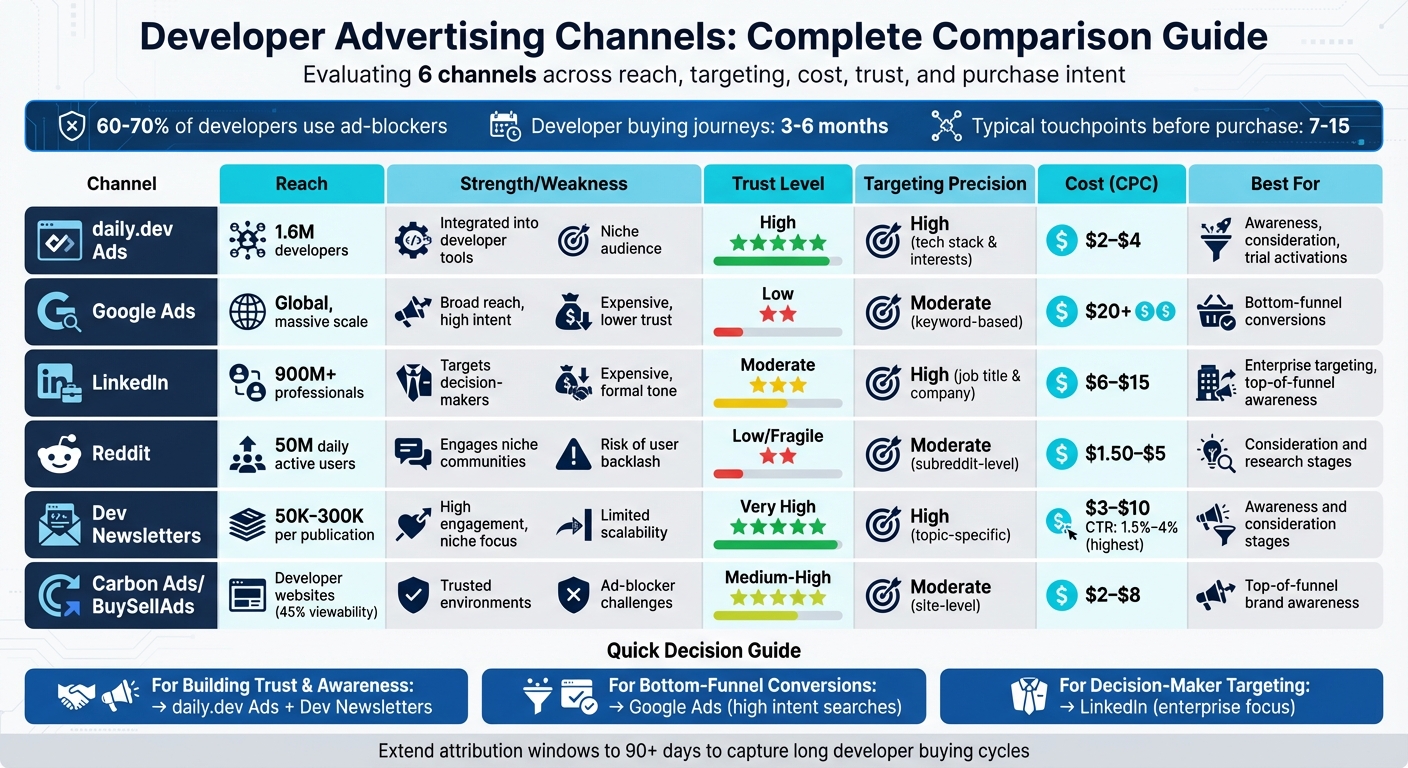 {Developer Advertising Channels Comparison: Costs, Trust Levels, and Targeting Precision}
1. daily.dev Ads
Audience Reach
daily.dev Ads connects with 1.6 million developers who are actively engaged. These developers are in a discovery mindset - reading articles, exploring tools, and keeping up with tech trends. This sets daily.dev apart from search-based platforms, where users often already know what they’re looking for.
Targeting Options
With daily.dev Ads, you can target developers based on their specific tech stacks. For example, you could focus on "Python developers using AWS", reaching beyond basic demographic filters. The platform also picks up on high-intent signals, such as when developers are troubleshooting or evaluating tools in real time.
Cost Effectiveness
The platform offers a competitive CPM range of $4–$6, providing precise targeting at a reasonable cost. Beyond just clicks, you can track activation rates and trial-to-paid conversions, giving you a clear picture of your return on investment. Ads are seamlessly integrated into the platform, making them feel like a natural part of the user experience.
Trust Level
Ads on daily.dev appear in native formats - like in-feed placements, post pages, and personalized digests. These placements are less intrusive, building trust with developers who rely on the platform for their daily professional updates. This approach helps avoid the fatigue that often comes with generic or overly pushy ads.
Best Funnel Stage
daily.dev Ads excel at building brand awareness, aiding consideration during tool evaluations, and encouraging trial activations. Its discovery-driven environment is perfect for reaching developers who might not yet be actively searching for your solution but fit your target audience profile.
2. Google Ads
Audience Reach
Google Ads offers access to a massive global audience, making it a powerful tool for reaching developers exactly when they’re searching for solutions. With 65.7% of developers turning to Stack Overflow for learning, many of their searches begin on Google. This means you can tap into high-intent traffic across a wide range of experience levels, tech stacks, and locations.
Targeting Options
Google Ads allows you to target developers using keyword-based campaigns paired with demographic filters. For instance, you could bid on terms like "best API monitoring tool" or "Python deployment platform comparison." The platform also supports display network targeting based on browsing behavior and interests. However, its targeting options lack the precision of tech-specific filters, relying more on search behavior and basic demographics rather than the specific technologies developers use daily.
Cost Effectiveness
Running Google Ads can be pricey, with CPCs often exceeding $20 for competitive developer-related keywords. Keywords tied to bottom-funnel intent, such as "buy", "pricing", or "vs [competitor]", tend to push costs even higher. Given the $843 billion global digital ad market, competition for prime search placements is fierce, which can strain budgets. To justify these premium clicks, you’ll need to ensure your campaigns drive strong conversion rates.
Trust Level
Developers often perceive Google Ads as intrusive, leading to ad fatigue. Since ads are clearly marked and separated from organic results, they can feel less credible compared to content on community-driven or curated platforms. Generic targeting can also result in irrelevant ads, which further diminishes trust among developers who value precision and relevance. This dynamic makes trust a key consideration when deciding how Google Ads fits into your overall strategy.
Best Funnel Stage
Google Ads shines when it comes to bottom-funnel conversions. It’s ideal for capturing developers who are already aware of their needs and actively comparing solutions. High-intent searches at this stage often translate into sign-ups, demos, or trials. However, for awareness or early-stage consideration, the platform’s high costs and lower trust levels make it less effective than channels designed for discovery.
3. LinkedIn
Audience Reach
LinkedIn provides access to over 900 million professionals, making it a prime platform for connecting with developers through their professional profiles. It’s particularly strong at targeting individuals based on job titles like "Senior Backend Engineer", years of experience, and work history. However, keep in mind that LinkedIn engages developers in a professional, career-focused context rather than during moments of technical problem-solving. This broad professional audience allows for highly refined targeting.
Targeting Options
When it comes to precision, LinkedIn stands out among social media platforms for reaching specific developer groups . It enables you to filter by job title, industry, company size, and seniority - perfect for zeroing in on decision-makers like Engineering Managers or CTOs. That said, job titles don’t always reveal technical specifics. For instance, a "Full Stack Developer" might work with a wide range of languages and frameworks, so targeting by title alone might not always align with specific tech stacks.
Cost Effectiveness
LinkedIn operates as a premium advertising channel, and its costs reflect that. CPCs typically range between $6 and $15, while CPMs fall between $30 and $80 . Conversion rates average around 2% to 5%, with a return on ad spend (ROAS) usually between 2x and 4x . These higher costs highlight the importance of thoughtful budget planning and well-targeted campaigns to maximize returns.
Trust Level
Because LinkedIn is built around professional networking, ads can sometimes blend into the mix of career updates and industry news. To stand out, avoid overly corporate messaging. Instead, focus on themes like career advancement and professional growth to resonate more effectively with the audience.
Best Funnel Stage
LinkedIn shines in enterprise-level targeting and is particularly effective for top-of-funnel awareness campaigns . It’s a great fit for promoting developer tools aimed at enterprises, especially when professional demographics matter more than technical details. The platform excels at reaching decision-makers who influence purchases, even if they aren’t hands-on developers. However, it’s less effective for campaigns that require in-depth technical evaluations, such as those promoting detailed documentation or hands-on trials. For tools with longer sales cycles, extending attribution windows to at least 90 days can help capture the full, often non-linear, buying journey.
4. Reddit
Audience Reach
Reddit attracts a massive audience, with 50 million daily active users, including thriving developer communities like r/programming, r/webdev, r/javascript, and r/devops. These spaces are buzzing with discussions about specific technologies and tools, making Reddit a go-to platform for developers seeking peer insights to validate their choices. This dynamic positions Reddit as a key player in the "dark funnel", where organic mentions can subtly influence purchasing decisions .
Targeting Options
Reddit's targeting system focuses on subreddits rather than broad demographic categories. This allows advertisers to zero in on niche developer groups by aligning campaigns with the specific technical interests of each subreddit. It’s a tailored approach, ideal for connecting with highly engaged audiences .
Cost Effectiveness
Advertising on Reddit is surprisingly budget-friendly. Cost-per-clicks (CPCs) typically range between $1.50 and $5, while cost-per-mille (CPM) averages $8 to $25. Click-through rates (CTR) hover between 0.3% and 0.8%, and conversion rates fall in the 1% to 4% range. These affordable rates make Reddit a practical choice for running test campaigns, even with limited budgets .
Trust Level
Reddit's developer communities are famously skeptical of traditional advertising. Many users turn to the platform for genuine, peer-driven advice, so overly promotional content can quickly backfire. However, when your messaging feels honest and aligns with the tone and culture of the subreddit, it has the potential to build real trust. Tracking organic mentions of your brand on Reddit can also provide early insights into how well your campaigns are resonating .
Best Funnel Stage
Given its cost efficiency and precise targeting, Reddit excels during the consideration and research stages of the marketing funnel. Developers often encounter tool recommendations while exploring their options, making the platform ideal for raising awareness and driving authentic engagement. When integrated into a multi-channel strategy, Reddit can play a powerful role in the research phase of the developer journey. That said, be mindful of community dynamics - content that feels too sales-driven may invite backlash or moderation challenges .
sbb-itb-e54ba74
5. Dev Newsletters
Audience Reach
Developer newsletters are a go-to resource for staying updated on specific technologies, boasting opt-in subscriber bases ranging from 50,000 to 300,000 readers per publication. Some well-known examples include JavaScript Weekly, Go Weekly, Ruby Weekly, and Node Weekly. These newsletters cater to niche audiences focused on particular programming languages or technologies, making them an ideal way to connect with highly engaged developers who are already invested in their tech stack.
Targeting Options
Unlike broader demographic advertising, newsletters allow for technology-specific targeting. For instance, sponsoring a JavaScript-focused newsletter ensures your message reaches front-end developers, while a DevOps newsletter connects you with infrastructure engineers. This laser-focused approach ensures your product or tool is introduced to the right audience, making every dollar spent more impactful.
Cost Effectiveness
Sponsoring a developer newsletter is a smart move when it comes to cost efficiency. Here are the typical metrics:
- CPM: $30 to $80
- CPC: $3 to $10
- CTR: 1.5% to 4%
- Conversion rates: 3% to 8%
On average, sponsorships yield a return on ad spend (ROAS) of 3x to 5x and a customer acquisition cost (CAC) of about $240 for developer tools . These figures highlight the channel's ability to deliver measurable results.
Trust Level
Trust plays a big role in the effectiveness of developer newsletters. These publications are curated by respected experts, and their recommendations carry significant weight. Sponsorship placements benefit from this built-in credibility, leading to higher engagement and conversion rates. This is especially important given that 60% to 70% of developers use ad blockers . Unlike traditional ads, tools featured in trusted newsletters are seen as credible endorsements, which encourages developers to explore them further.
Best Funnel Stage
Developer newsletters shine during the awareness and consideration stages of the funnel. They’re excellent for introducing your brand to a niche audience and building credibility through expert-backed recommendations. While newsletters are great for generating initial awareness, their true power lies in the consideration phase, where developers evaluate tools and look for deeper insights . Keep in mind that many conversions may happen later via direct visits or searches, so tracking assisted conversions can help you understand the full impact of this channel.
6. Carbon Ads/BuySellAds
Audience Reach
Carbon Ads and BuySellAds are display networks that focus on placing ads across websites and publications aimed at developers. However, there's a significant hurdle: 60% to 70% of developers use ad blockers . This drastically reduces the actual audience your ads can reach, making impression counts somewhat misleading. Essentially, a large portion of your target audience may never even see your ads.
On top of that, the average viewability rate is only 45% . Many developer sites feature lengthy technical articles, and ads are often placed below the fold, where they’re less likely to be seen. Combined with ad blockers, this results in an even smaller effective reach.
Targeting Options
These networks offer site-level targeting rather than focusing on specific developer attributes. You can choose which technical sites or developer publications display your ads, but the targeting relies on broad assumptions rather than precise data. For example, if you want to target Python developers or those using specific frameworks, these platforms can’t guarantee accurate delivery .
This limitation becomes even more apparent when compared to platforms that use real usage data. Advertising on a JavaScript-focused site doesn’t ensure that all visitors are actively working with JavaScript or are at the right point in their decision-making process.
Cost Effectiveness
At first glance, the costs seem reasonable, with CPMs ranging from $20–$40 and CPCs from $2–$8. However, with low click-through rates (0.25%–0.80%) and conversion rates of just 1%–2%, the numbers don’t always add up . The typical ROAS (Return on Ad Spend) falls between 1.5x and 2.5x, which often falls short of the 3x benchmark many marketing teams aim for .
The real challenge lies in the hidden costs. While the CPMs may appear affordable, low conversion rates and the long attribution windows required for awareness-stage campaigns can make these ads more expensive than they initially seem.
That said, these ads do carry some value by appearing in trusted environments, which can help strengthen brand awareness.
Trust Level
Ads placed through these networks benefit from being embedded in trusted developer-focused environments. For example, when your ad appears on a respected technical blog or documentation site, it gains credibility simply by association. This can help counteract the "banner blindness" that often affects display ads .
However, this trust advantage has its limits. Even on credible sites, display ads are still recognized as paid content, which means they don’t carry the same weight as editorial recommendations or newsletter sponsorships.
Best Funnel Stage
These networks are most effective for top-of-funnel brand awareness campaigns . If your goal is to introduce your brand to developers who are browsing technical content, this can be a viable option. Over time, display ads can help build familiarity. However, compared to other developer marketing channels, they are less efficient for driving direct conversions .
To make the most of these campaigns, it’s important to track viewability alongside impressions and extend your attribution windows to at least 90 days. Developers often have a long and non-linear buying journey, so conversions may occur weeks or even months after the initial ad exposure, often through organic searches or direct visits rather than immediate clicks. This extended timeline is key to measuring the true impact of your awareness efforts.
Strengths and Weaknesses by Channel
Each advertising channel comes with its own set of trade-offs that impact factors like reach, cost, trust, and targeting. Here's a quick overview to help identify which channels align best with your marketing goals and budget.
The table below summarizes key aspects for each channel, including strengths, weaknesses, trust levels, targeting capabilities, and cost-per-click (CPC) range:
| Channel | Primary Strength | Primary Weakness | Trust Level | Targeting Precision | Cost Range (CPC) |
|---|---|---|---|---|---|
| daily.dev Ads | Seamlessly integrated into developer workflows | Limited to a specialized audience | High | High (tech stack & interests) | $2–$4 |
| Google Ads | Broad reach with intent-driven searches | Lower trust due to ad-blockers | Low | Moderate (keyword-based) | $20+ |
| Directly connects with decision-makers | Expensive and formal in tone | Moderate | High (job title & company) | $6–$15 | |
| Engages authentically within communities | Risk of negative reception from users | Low/Fragile | Moderate (subreddit-level) | $1.50–$5 | |
| Dev Newsletters | High trust and engagement | Hard to scale effectively | Very High | High (topic-specific) | $3–$10 |
| Carbon Ads/BuySellAds | Contextual and non-intrusive placements | Limited targeting with ad-blocker challenges | Medium-High | Moderate (site-wide only) | $2–$8 |
High ad-blocker usage continues to pose challenges, making trust and native integration crucial for success. Channels that integrate naturally into a developer's daily workflow are better equipped to bypass ad-blockers and avoid "banner blindness", which often plagues more traditional display ads.
Cost differences also play a significant role in channel selection. For example, LinkedIn offers precise targeting by job title but comes with a steep CPC of $6–$15, making it less suitable for top-of-funnel campaigns. On the other hand, Reddit's lower CPC of $1.50–$5 is appealing but carries the risk of being perceived as inauthentic, which could harm brand reputation within its outspoken developer communities.
Developer newsletters stand out with click-through rates (CTR) of 1.5%–4%, far surpassing display ads (0.25%–0.80% CTR) and even LinkedIn (0.4%–0.8% CTR) . This performance is a testament to the trust developers place in curated content from respected sources. However, scaling newsletter campaigns or making quick adjustments based on performance can be a challenge.
This breakdown provides a foundation for aligning your advertising strategy with your specific campaign goals and audience needs.
Conclusion
No single channel fully addresses every stage of the developer buying journey. Developers typically engage with 7–15 touchpoints before making a decision, making a multi-touch strategy - combining awareness, trust, and activation - essential for success .
Each phase of the developer journey requires a specific focus. For awareness, prioritize channels with broad reach and seamless integration. Display ads and social platforms help expand visibility, while developer newsletters foster trust. During the consideration phase, emphasize trusted spaces like technical publications and community platforms, where developers actively seek solutions. At the activation stage, contextual ads perform significantly better, with conversion rates between 5–15%, compared to 1–2% for standard display ads .
It's also important to extend attribution windows to at least 90 days to account for the typical 90–180 day evaluation cycle for enterprise tools . Avoid relying on last-touch attribution models, as they often undervalue awareness efforts. Instead, opt for position-based (U-shaped) attribution, which better captures the interplay between discovery and conversion throughout the journey.
Lastly, focus on tracking activation milestones - not just signups - to measure the true ROI of your channels. Platforms that align naturally with developer workflows consistently outperform traditional display ads in both engagement and visibility.
FAQs
How do I choose the right channel for each funnel stage?
To connect with your audience effectively, it’s crucial to align your channels with their intent at different stages of the funnel:
Awareness: Focus on platforms that help people discover your brand. Think newsletters, community forums, or other spaces where trust-building is key. These channels are perfect for introducing your brand and sparking interest.
Consideration: At this stage, your audience is evaluating options. Use high-intent channels like search engines or targeted content to provide the information they need to make informed decisions.
Activation: When it’s time to convert interest into action, retargeting campaigns and in-feed native ads are your best bet. These tools are great for encouraging trials or other initial steps.
By combining these approaches thoughtfully, you can guide your audience through the funnel. Don’t forget to track your efforts using multi-touch attribution models and ROI analysis to see what’s working.
What budget should I start with to reach developers?
Starting with a budget of about $5,000 is a good idea for daily.dev Ads. This budget allows for precise targeting and leverages native ad formats tailored to effectively connect with the developer audience.
How can I measure ROI with 90+ day buying cycles?
To gauge ROI in a buying cycle that spans over 90 days, it's crucial to look beyond surface-level metrics. Start by using multi-touch attribution to understand how each touchpoint contributes to the customer journey. Pair this with cohort analysis to track how users move from initial engagement (like clicks or signups) through activation, retention, and eventually, revenue generation.
In addition, A/B testing can help you determine how much incremental impact your efforts are making. Keep an eye on critical metrics such as:
- Impressions and clicks
- Signups and activated users
- Cost-per-activation
- Retention rates
- Lifetime value (LTV)
The key here is to focus on long-term performance. By evaluating outcomes over the entire buying cycle, you'll get a clearer picture of what’s working and where adjustments are needed.