

Developers are privacy-savvy and quick to spot intrusive ad tactics. Traditional retargeting methods - like tracking pixels and third-party cookies - are not only ineffective with this audience but can also harm your brand's trust. By 2026, stricter privacy laws and the end of third-party cookies demand new strategies to engage developers ethically.
Here’s how to retarget developers while respecting their privacy:
- Use First-Party Data: Collect consent-driven data directly through interactions like email signups, API usage, or website visits. Offer something useful in return, such as technical guides or tools.
- Adopt Contextual Targeting: Show ads based on the content developers are engaging with (e.g., Kubernetes articles trigger container tool ads) instead of tracking their online behavior.
- Cap Ad Frequency: Limit impressions to 1–2 per day and 5–7 per week to avoid overwhelming or irritating developers.
- Provide Value-Driven Ads: Focus on sharing tutorials, documentation, or case studies instead of hard sales pitches. Tailor content to their role and where they are in their journey.
- Sync Across Platforms: Coordinate retargeting efforts across channels like LinkedIn, email, and developer platforms to avoid overexposure.
The goal is to build trust by being transparent, respecting privacy, and delivering meaningful resources - not by following developers around the internet.
::: @figure 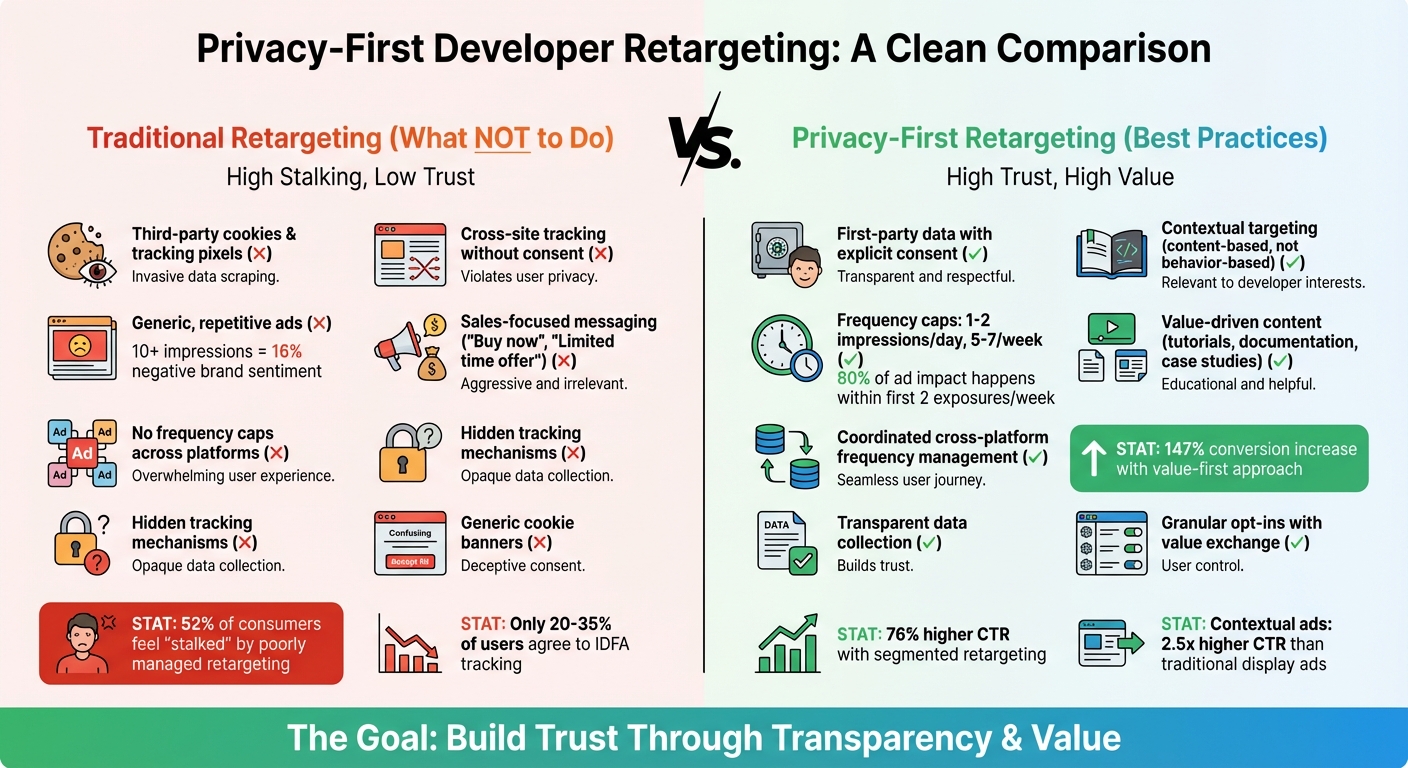 {Privacy-First Developer Retargeting: Best Practices vs Bad Practices Comparison}
Why Developers Hate Bad Retargeting
Developers Understand How Ad Tracking Works
Developers don’t just see ads - they understand the nuts and bolts behind them. When a retargeting pixel fires or a third-party cookie gets dropped into their browser, they know exactly what’s happening. They’re fully aware of how these tracking mechanisms work to build a profile of their online behavior by connecting data across multiple sites . This technical insight makes them far more aware - and often more critical - of tracking practices that might fly under the radar for most people.
After Apple’s App Tracking Transparency update, the percentage of ID-enabled traffic on iOS dropped sharply from 90% to around 54% . Today, only 20% to 35% of users agree to IDFA tracking when prompted . Developers aren’t just part of this shift - they’re often leading the charge, scrutinizing tracking practices with a sharp eye.
What really irritates developers is hidden tracking - when they’re followed across websites without their explicit consent . Methods like cross-site identification using device identifiers such as IDFA or GAID feel invasive when there’s no clear opt-in . As Tom Wilkinson points out:
"The GDPR, CCPA, and other privacy regulations are designed to restrict invisible, nonconsented tracking, not the legitimate use of data users willingly provide" .
Developers expect this line to be respected. Their awareness of these practices and their demand for transparency make unethical tracking a serious breach of trust.
How Bad Retargeting Damages Your Brand with Developers
Because developers are so attuned to tracking tactics, poorly executed retargeting can destroy trust faster than you might think. To earn and keep their trust in today’s privacy-conscious world, retargeting efforts need to be transparent, consent-driven, and genuinely valuable.
When retargeting feels intrusive or offers no clear benefit, developers lose confidence in your brand. Ads that follow them relentlessly - without delivering any meaningful value - raise serious doubts about your ethics and technical credibility. Developers may even wonder, “If this company doesn’t respect basic privacy boundaries, can they be trusted with my data?”
Another red flag? Asking developers to share their data, like through account signups or email captures, without giving them something worthwhile in return. Whether it’s technical documentation, a useful tool, or an exclusive resource, developers expect a fair exchange . Brian Altman, Director of Sales at Dataseat, puts it plainly:
"What value am I providing the user by showing them this ad? It can be as simple as a nudge for a user that forgot they downloaded the app, to informing the user of new app features, to giving the user an exclusive offer" .
Repetitive and irrelevant ads only make things worse. Developers are also quick to notice when platforms take credit for conversions that likely would’ve happened on their own . This doesn’t just hurt your advertising strategy - it undermines the way developers view your entire approach to customer relationships.
sbb-itb-e54ba74
Privacy-First Retargeting Stack for 2026
By 2026, third-party cookies are a thing of the past. To stay effective, your retargeting stack must operate without relying on them. Instead of using invisible pixel tracking, focus on building audience segments from direct interactions with your website, documentation, email campaigns, and CRM systems .
The backbone of this updated stack includes several key elements. A consent management platform (CMP) ensures you capture explicit opt-ins for specific data uses. Server-side tracking helps bypass ad blockers, while hashed identifiers, such as SHA-256 encrypted emails, allow you to match users across platforms without exposing their personal information. By integrating your CRM, marketing tools, and website analytics, you can create unified audience profiles .
Transparency is non-negotiable. Developers need to know what data you're collecting and why. When they understand the benefits - like receiving targeted technical resources instead of irrelevant ads - they're more likely to give their consent. A privacy-by-design approach builds the trust necessary for retargeting to work effectively.
Next, let’s explore how explicit user consent forms the foundation of this new system.
First-Party Data Collection with User Consent
Securing explicit consent from developers is critical. Move away from generic cookie banners and adopt granular opt-ins that let developers decide what data they share and how it’s used. Use straightforward language to explain how their data enhances their experience.
A value exchange model works best here. Developers are often willing to share details like their email, tech stack preferences, or job role if they gain access to something they find useful - such as in-depth technical guides, specialized tools, or a personalized content feed . A preference center can further improve this process, letting users select topics of interest and set communication preferences. This not only gives them control but also provides you with zero-party data - information they willingly share because they see its benefits.
Your first-party data should come from a variety of sources, including CRM purchase history, website behavior tracked via GA4 pixels, email engagement stats, and interactions with your documentation or API . When these data points are combined, you can create detailed audience segments, like webinar attendees from the past month, demo page visitors who haven’t converted, or developers who downloaded your CLI tool but haven’t activated it . Importantly, every piece of data must come with explicit consent, ensuring compliance with GDPR, CCPA, and similar privacy laws.
With this consent-first foundation in place, let’s look at how progressive profiling can deepen your understanding of developer audiences.
Progressive Profiling for Developer Audiences
Progressive profiling offers a solution to a common problem: developers abandoning lengthy forms. Instead of overwhelming them with too many questions at once, gather details gradually through multiple interactions . For instance, start by asking for just an email in exchange for something valuable, like an ROI calculator or industry analysis. On their next visit, request their primary programming language. Later, when they’re further along in the funnel, inquire about their company size or budget.
This step-by-step approach builds detailed, accurate profiles over time while keeping the initial barrier to entry low. Use smart forms that recognize returning users, hide previously completed fields, and present only the next question. Tailor your questions to match the user’s journey: early-stage questions like "What’s your role?" work well on blog posts, while later-stage questions like "What’s your budget for CI/CD tools?" are better suited for pricing pages.
Pair progressive profiling with time-based segmentation for even better results. Group your audience by recency: Recent (0–14 days) for demo or consultation offers, Warm (30–90 days) for product updates and helpful content, and Cold (90+ days) for thought leadership pieces and case studies . This ensures your retargeting efforts align with where developers are in their decision-making process, making your messaging feel relevant and timely instead of intrusive. Together, these strategies form a cohesive, privacy-first retargeting framework.
Contextual Retargeting: Target What Developers Read, Not Who They Are
Contextual targeting zeroes in on the content developers are engaging with, rather than tracking their online behavior. For instance, if a developer is reading an article about Kubernetes deployment strategies, they might see an ad for a container orchestration tool - not because their browsing history was monitored, but because the content of the page itself signals its relevance to the ad .
This method avoids cross-site tracking, personal profiling, or storing user data. Instead, ads are triggered in real time based on page-level signals like tags, keywords, and topics. For example, a developer reading about React hooks might encounter an ad for a state management library, while someone diving into DevOps tutorials could see a promotion for a CI/CD platform. All of this happens without the use of tracking pixels.
AI and natural language processing play a crucial role by categorizing content in real time, ensuring ads align with the topics developers are exploring. A 2025 IAB report highlights that contextual ads deliver 2.5 times higher click-through rates compared to traditional display ads . Meanwhile, a 2025 Google Marketing Platform study revealed that 68% of marketers reported better engagement with contextual targeting due to its improved relevance and privacy-first design .
Developers tend to value ads that provide helpful tools during their problem-solving process, rather than intrusive or irrelevant interruptions.
daily.dev Ads is a great example of this privacy-first, context-driven strategy.
How daily.dev Ads Uses Contextual Targeting
daily.dev Ads relies on a proprietary tagging system to categorize thousands of developer articles every day. Ads are displayed based exclusively on technical tags (like "AWS" or "Web3"), with AI ensuring promotions align with the content. For instance, a database ad might appear alongside an article on SQL optimization .
This approach does away with tracking pixels entirely, eliminating the need for additional tracking code. The ads naturally integrate into the reading experience, showing developers relevant promotions - like ML tools appearing near AI-related articles - without collecting any personal data. By using native placements, daily.dev Ads maintains user trust while still delivering ads that resonate with both developers and advertisers.
Frequency Capping: How Many Impressions Before You're Spam
Bombarding users with the same ad repeatedly doesn’t just waste your ad spend - it can actively harm your brand’s reputation. Studies reveal that 80% of an ad’s total impact happens within the first two exposures per week. After that, instead of building awareness, you might just be building irritation.
Developers, in particular, are highly sensitive to ad frequency. Overexposure often feels intrusive to them, and repeated ad views can come across as invasive tracking. Here’s the kicker: negative brand sentiment jumps 16% after a user sees the same ad 10 or more times. Even more alarming, 52% of consumers report feeling "stalked" by retargeting ads that lack proper frequency control.
When targeting developers, the sweet spot lies in 1–2 impressions per day and no more than 5–7 impressions per week. Exceeding these limits can lead to ad fatigue, where click-through rates plummet by up to 50%. At that point, extra impressions don’t just go unnoticed - they actively hurt your campaign.
"Frequency capping isn't about showing fewer ads. It's about showing the right number of ads to each person - and not one more." - AdBid
Optimizing Frequency with a Recency-Based Decay Model
A smarter approach involves using a recency-based decay model. This means serving three ads per day during the first three days after a visit - when interest is at its peak - and then gradually scaling back. By day 30, you should only display one ad per week. This strategy ensures you’re reinforcing your message when it matters most while avoiding overexposure as user interest wanes.
Recommended Impression Limits for Developer Campaigns
Your campaign goals should dictate how often your ads appear. For retargeting campaigns, where developers already recognize your brand, sticking to strict limits is essential for maintaining trust.
| Campaign Objective | Daily Cap | Weekly Cap | Monthly Cap |
|---|---|---|---|
| Retargeting | 1–2 impressions | 5–7 impressions | 20–25 impressions |
| Brand Awareness | N/A | 3–5 impressions | 12–20 impressions |
| Conversion-Focused | 2–3 impressions | 5–8 impressions | Exclude after conversion |
Avoiding Cross-Platform Overexposure
One of the biggest pitfalls in ad frequency management is failing to coordinate across platforms. If a developer sees your ad five times on one platform and another five times elsewhere, the combined effect can easily exceed acceptable limits. Unfortunately, 44% of advertisers don’t coordinate frequency across platforms, which can lead to overexposure and the perception of aggressive tracking.
Keep Creative Fresh
To combat banner blindness, switch up your creative assets every 2–4 weeks. Seeing the same visuals repeatedly can cause developers to tune out entirely. Use a mix of static images, carousels, and videos to keep your ads engaging and prevent them from feeling repetitive. This simple adjustment can extend your campaign’s impact without increasing frequency.
Creative Strategies: Retarget with Value, Not Just Sales Pitches
Developers tend to push back against aggressive sales tactics. If someone who’s browsed your API documentation starts seeing pushy sales ads, you’re not sparking interest - you’re planting frustration.
To align with a consent-driven approach, shift your focus from hard-sell pitches to offering genuine value. Instead of showcasing pricing or standard demos, share actionable insights. For example, a case study showing how a similar company benefits from your solution can resonate far more effectively. Segmented retargeting, when done right, can boost click-through rates by 76% and conversions by 147% compared to generic display ads .
Let’s say a developer downloads your SDK. Instead of bombarding them with promotional messages, follow up with ads featuring advanced integration guides or performance benchmarks. If they attended a webinar, share the recorded session or dive deeper into related technical topics . This type of follow-up shows respect for their expertise and acknowledges where they are in their journey.
Another effective approach? Sequential storytelling. Start by highlighting a problem, back it up with evidence, and then present a solution. This method ensures each interaction builds trust and feels relevant .
| Strategy | Sales-Driven Retargeting | Value-First Retargeting |
|---|---|---|
| Primary Goal | Immediate conversion/sign-up | Building trust and providing utility |
| Messaging | "Buy now", "Limited time offer" | "Here’s how to solve [Problem X]" |
| Content Type | Product landing pages, pricing | Tutorials, docs, open-source tools |
| Developer Perception | Intrusive, "creepy", annoying | Helpful, relevant, professional |
Tailored Messaging for Different Developer Needs
Taking value-first strategies a step further, tailoring your content to specific developer roles can significantly boost engagement. Generic retargeting not only wastes your budget but can also hurt your credibility. A junior developer exploring React has very different needs compared to a senior architect evaluating enterprise solutions. Segment your audience based on their technical roles, skill levels, and behaviors, then create content that speaks directly to them.
Time-based segmentation is just as important. For example:
- Recent visitors (0–14 days): Show them demos or consultations while their interest is still fresh.
- Warm prospects (30–90 days): Share product updates or technical guides to maintain engagement.
- Cold leads (90+ days): Use thought leadership pieces or case studies to reignite their interest .
Behavioral signals are another goldmine. A developer who visits your pricing page shows higher intent than someone reading blog posts. Tailor your messaging accordingly - address pricing concerns for the first group, and offer educational resources to the second . If a developer spends time on your security documentation, retarget them with compliance certifications or penetration test results rather than generic feature lists.
| Developer Persona | Content | Value |
|---|---|---|
| Junior/Student | Step-by-step tutorials, basic guides, "Getting Started" videos | Learning and career growth |
| Senior/Architect | Deep-dive documentation, benchmarks, architectural diagrams | Scalability, performance, technical fit |
| DevOps/SRE | CLI tools, automation scripts, security whitepapers, uptime data | Reliability, security, automation |
| Frontend/UI | Component libraries, design-to-code tools, performance tips | UX quality and development speed |
| Manager/Lead | Case studies, ROI calculators, security compliance docs | Team productivity and business impact |
Continuously A/B test your creative variations. Experiment with headlines, calls-to-action, and value propositions. For instance, compare offering free documentation to requesting a sales call. Use the data to fine-tune your strategy for engagement, not just impressions . The goal isn’t to bombard developers with ads - it’s to deliver the right message to the right person at the right time.
These strategies naturally align with a privacy-first mindset, ensuring trust is built at every interaction with developers.
Retargeting Across Developer Touchpoints
To truly engage developers, retargeting efforts need to span multiple channels while prioritizing privacy and avoiding overexposure. Developers interact with various platforms - feeds, emails, webinars - and retargeting should seamlessly integrate across these without feeling intrusive.
The key lies in syncing first-party CRM data (like email opens, event registrations, and feed interactions) with retargeting platforms such as LinkedIn, Meta, Reddit, and Google. This allows you to target not just individual developers but entire buying committees. For instance, you could retarget a webinar attendee with LinkedIn ads featuring case studies within 30 days, and later follow up with an email offering technical guides once they engage.
Timing is everything. Use time-based segmentation to align your messaging with how recently a developer interacted with your content. At the same time, coordinate exclusion lists across channels to avoid bombarding users with repetitive ads. Tailor content to the specific touchpoint - like sharing educational tutorials on feeds or offering hands-on demos via email to recent event participants.
By aligning retargeting across all these touchpoints, you not only amplify engagement but also reinforce your commitment to privacy-first practices, building trust along the way.
Using Native Placements in Developer Platforms
Native placements on developer-focused platforms, such as daily.dev, seamlessly integrate ads into content feeds, making them feel like a natural part of the browsing experience. These sponsored posts, designed to mimic surrounding articles, can generate 2–3x higher engagement compared to standard display ads. Importantly, they rely on contextual signals - what developers are actively reading - rather than invasive tracking methods. For example, if a developer is exploring a React tutorial, a related ad for a testing framework could appear naturally within the feed.
This approach also enables sequential storytelling, where each interaction builds on the last. Start by addressing a common pain point, such as API rate limiting. Follow up with case studies or benchmarks that provide deeper context, and finally, present your solution. This gradual progression fosters trust without coming across as overly promotional.
Transparency is critical to maintaining trust. Include a "Why am I seeing this?" link to explain how the ad relates to the user’s interests or past activity. To prevent ad fatigue, limit impressions to 3–5 per week per user. When executed thoughtfully, native placements transform retargeting into a discovery tool that feels helpful rather than invasive.
Wrapping It Up
Retargeting developers isn’t about following their every move - it’s about respecting their skills and earning their trust. Developers know how ad tech works, and they’re quick to spot invasive tactics. The move toward privacy-first retargeting in 2026 is all about fostering genuine relationships.
Here’s the bottom line: use first-party data with clear consent, focus on what developers are engaging with instead of who they are, and limit impressions to 5–7 per week to avoid overwhelming them . When your ads offer tutorials, documentation, or tools rather than hard sales pitches, they stop being interruptions and start becoming helpful resources. Segmented retargeting, for instance, has been shown to increase click-through rates by 76% and conversions by 147% .
Take a cue from daily.dev Ads, which uses contextual targeting instead of invasive pixel tracking to stay relevant. Syncing CRM data across platforms like feeds, email, and events allows you to meet developers where they’re already active. Keep in mind that 97% of first-time visitors don’t convert , making thoughtful retargeting a must. The goal is to offer value without crossing into intrusive territory. These strategies help lay the groundwork for long-term trust.
Developers are highly attuned to privacy concerns and notice any breach of trust. Opt for transparency, consent, and value-driven interactions. Not only will this approach improve your ROI, but it will also enhance your reputation. For more insights on connecting with technical audiences, explore our guides on ethical data use and bridging the trust gap.
FAQs
What can I use instead of third-party cookies for retargeting developers?
Instead of relying on third-party cookies, consider using contextual targeting. This approach delivers ads based on the content developers interact with - such as articles, tools, or resources - without tracking their behavior. Another option is to tap into first-party data. By focusing on developers' direct interactions, like browsing patterns or engagement with tutorials, you can create consent-driven campaigns. These cookieless, privacy-focused methods help maintain ad relevance while fostering trust.
How can I collect first-party developer data while respecting privacy laws?
To gather first-party developer data while staying compliant with privacy laws, it's crucial to adopt a privacy-first strategy. Start by prioritizing user consent and maintaining transparency about how data is collected and used.
Instead of relying on third-party cookies or intrusive tracking methods, use first-party analytics endpoints. This approach not only respects user privacy but also helps you avoid potential legal pitfalls.
Make sure to regularly audit your setup to confirm it aligns with current privacy regulations. Incorporate a data layer with consent tracking, ensuring that users’ preferences are respected at every step. Finally, empower users by giving them control over their data preferences, which fosters trust and demonstrates your commitment to privacy.
By following these steps, you can responsibly collect data while keeping up with changing privacy standards.
How can I cap ad frequency across channels to avoid overexposure?
To keep your ads from becoming overwhelming, consider using frequency capping. This strategy limits how often developers encounter your ads within a specific timeframe, like per day or session. For example, you could set a cap of 3–5 impressions per day. By using tools to enforce these limits, you create a balance between visibility and respect for developers' preferences. This approach helps you avoid spamming, maintain relevance, and build trust, all while prioritizing privacy.