

Developers are a unique audience - they understand how tracking works and actively avoid invasive ads. To effectively engage them, you need a privacy-first, respectful approach. Here's what works:
- Avoid invasive tracking: Developers block ads, use VPNs, and reject excessive retargeting (e.g., cross-site tracking).
- Use consent-based tracking: Implement server-side tools and consent-driven pixels to comply with privacy laws like GDPR.
- Switch to cookieless solutions: Use tools like Google’s Privacy Sandbox or contextual targeting to maintain relevance.
- Focus on content, not individuals: Show ads based on the page’s context (e.g., Kubernetes guides) instead of tracking users.
- Limit ad frequency: Cap impressions to 3–5 per week to avoid overwhelming developers.
- Offer value-first ads: Share tutorials, code snippets, or tools instead of hard sales pitches.
- Leverage multi-channel retargeting: Use feeds, email, and event follow-ups to engage developers across their journey.
How Developers View Retargeting
Why Developers Understand and Reject Invasive Tracking
Developers are uniquely positioned to understand how tracking systems work. They often dig into their browser consoles, where they can identify third-party scripts, cookies, and network requests. This hands-on knowledge shapes their strong opinions on privacy. According to surveys, 68% of developers block ads for privacy reasons, 75% stop supporting brands after experiencing unwanted cross-device retargeting, and 82% prefer contextual ads over behavioral ones. For many developers, invasive tracking isn't just irritating - it feels like a direct violation of privacy principles. These numbers highlight why certain retargeting tactics are seen as crossing the line.
Retargeting Mistakes That Alienate Developers
Some retargeting strategies are particularly frustrating to developers. For instance, ads that follow users excessively - appearing 20 or more times a day across different sites - often lead to immediate ad blocking. Similarly, cross-site tracking, such as following a user from GitHub to Stack Overflow and then to their personal blog, typically results in developers blocking the entire tracking domain.
Recent examples illustrate these challenges. In 2022, a cloud provider faced backlash after using pixel tracking on GitHub visitors, sparking a 25% negative response on Twitter and widespread domain blocks. Another case involved a tool vendor employing fingerprinting to track users to personal blogs, which led to developer communities rallying against the brand by creating open-source alternatives. These missteps not only alienate customers but also tarnish reputations, often causing engagement to drop by 30% or more as negative word-of-mouth spreads.
These examples show why privacy-first approaches aren't just ethical - they're necessary for earning and keeping developer trust.
sbb-itb-e54ba74
Building a Privacy-First Retargeting System for 2026
Creating a privacy-first retargeting system is no longer optional - it's essential. With regulations like GDPR, CCPA/CPRA, and emerging U.S. privacy laws requiring explicit user consent, businesses must adapt. A privacy-first strategy doesn't just ensure compliance; it can maintain up to 80–90% of retargeting performance while building trust with developers . This ties back to the growing emphasis on ethical, privacy-focused practices.
Setting Up Consent-Driven Pixels and Server-Side Tracking
Transparency is key, especially for developers. To achieve this, start by implementing consent-driven pixels alongside server-side tracking. Use a consent management platform (CMP) such as OneTrust or Cookiebot to display opt-in banners. These banners ensure tracking pixels are only activated after users provide explicit consent. GDPR statistics show that consent rates for personalized ads typically range between 20–40%, but with the right approach, they can exceed 50% .
Once consent is secured, switch to server-side tracking tools like Google Tag Manager Server-Side or Tealium. These tools process client events, validate consent, and forward anonymized data via APIs. This method is particularly effective since it avoids the issues caused by ad blockers, which are used by over 40% of developers. By relying on first-party domains instead of third-party scripts, you can reduce client-side script blocking and improve overall performance .
After establishing consent-driven tracking, the next step is to embrace cookieless solutions to ensure long-term privacy and effectiveness.
Moving to Cookieless Identity Solutions
With Chrome set to phase out cookies by 2026, transitioning to cookieless identity solutions is essential. Options like Google's Privacy Sandbox (which includes the Topics API and Protected Audience API), UID2 from The Trade Desk, and LiveRamp's RampID offer alternatives. These solutions leverage hashed emails or contextual signals for targeting, eliminating the need for third-party cookies .
To prepare, review and update your existing pixels, integrate a data clean room like Snowflake for managing consented first-party data, and experiment with probabilistic matching techniques. Early adopters of cookieless IDs have reported 70–85% targeting accuracy, while platforms like The Trade Desk have seen a 20–30% boost in developer engagement compared to traditional cookie-based campaigns .
For instance, GitHub's 2025 campaign combined server-side tracking with UID2 to retarget consented visitors using tutorial ads. The result? A 4.2× return on ad spend, proving that privacy-first strategies can deliver excellent outcomes .
Contextual Retargeting: Target Content, Not People
Contextual retargeting focuses on aligning ads with the content developers engage with, rather than tracking individuals across the web. This privacy-friendly approach ensures ads are shown based on the context of the page a developer is reading - like tutorials, documentation, or technical articles. For example, a developer exploring Kubernetes deployment guides might see ads for container orchestration tools. Similarly, someone browsing API documentation might encounter promotions for integration platforms. The targeting here happens at the page level, not the individual level.
This method respects privacy while staying relevant. Considering that over 70% of developers use ad blockers to avoid intrusive tracking, traditional pixel-based retargeting often falls short. By focusing on content context rather than user profiles or browsing history, contextual retargeting bypasses ad blockers entirely. It also fits seamlessly into a privacy-first framework, laying the groundwork for leveraging developer content signals to refine ad targeting.
Using Developer Content Signals for Targeting
Developer content signals allow precise ad targeting while safeguarding privacy. These signals reflect a developer's intent based on the content they consume. For instance, someone reading an article titled "Node.js Deployment Best Practices" is likely interested in backend infrastructure. Similarly, an article comparing "GraphQL vs. REST APIs" suggests the reader is evaluating API architectures. These content-based signals enable highly relevant targeting without needing to track the individual behind the screen.
To make this work, start by mapping content themes to developer needs. For example:
- Awareness-stage content: Articles like "Introduction to Microservices" indicate readers exploring new concepts, making them ideal candidates for educational resources or free trials.
- Decision-stage content: Topics like "Production Monitoring Tools Comparison" suggest purchase intent, making ads for product demos or case studies a better fit.
A real-world example? A SaaS monitoring tool provider placed ads on pages discussing "error logging in production" and saw a 35% boost in conversions compared to traditional behavioral retargeting campaigns.
To implement this strategy, audit the platforms your audience frequents and identify high-engagement content like tutorials, tool comparisons, or documentation. Use keyword clustering to define targeting signals - keywords like "Docker" or "container deployment" can trigger ads for infrastructure tools, while terms like "React hooks" or "component optimization" can promote frontend solutions. Test placements and aim for a click-through rate of at least 2% to validate relevance.
How daily.dev Ads Replaces Pixel Tracking with Contextual Targeting
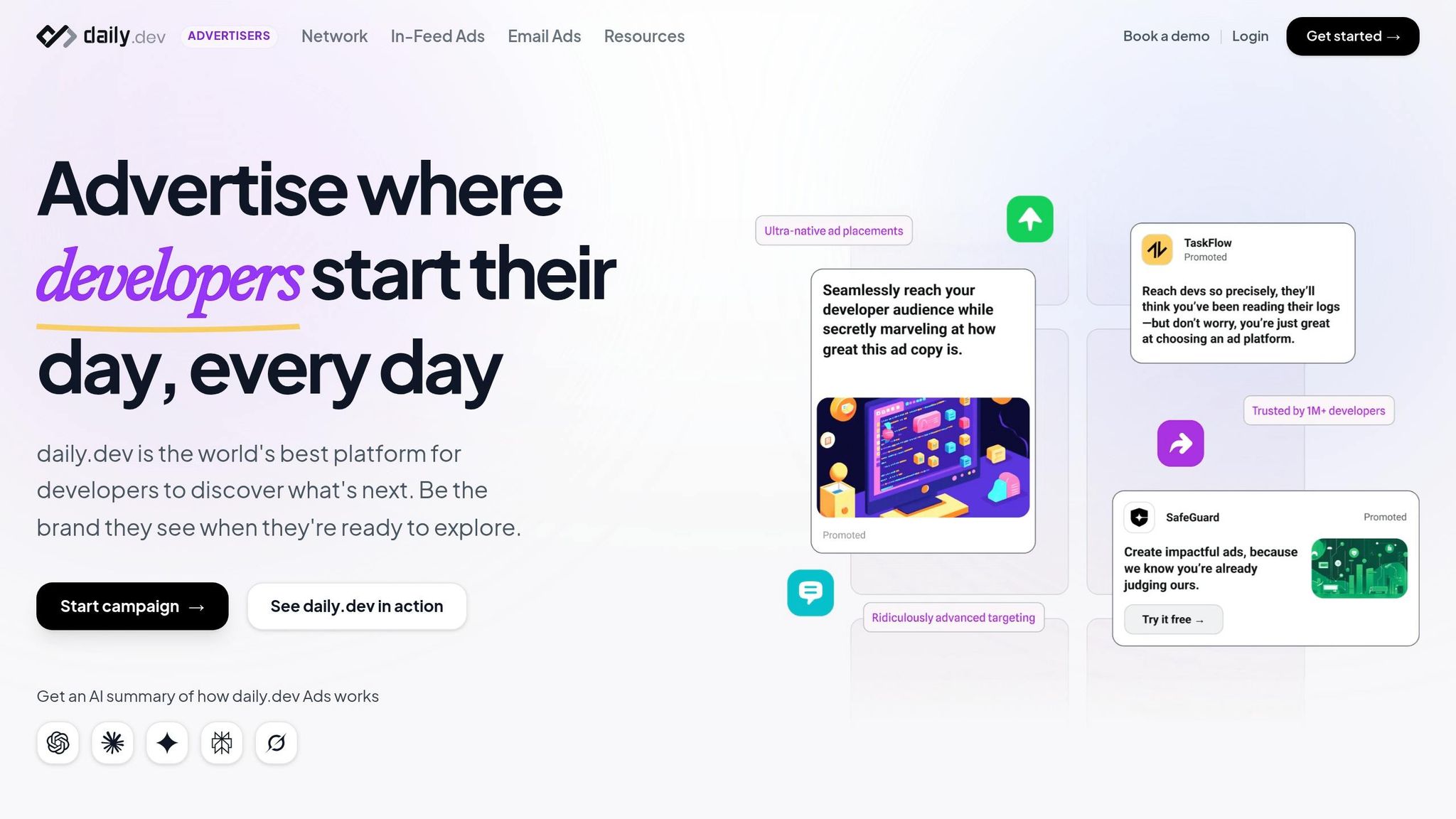
With its privacy-first approach, daily.dev Ads eliminates the need for invasive pixel tracking by using contextual signals instead. The platform acts as a contextual engine, analyzing articles in real time - whether they cover DevOps, cloud architecture, or frontend frameworks - and matches ads to the content being consumed. For example, a developer reading an AWS migration guide might see ads for cloud services, while someone exploring CI/CD tutorials could encounter promotions for deployment tools. This is all achieved without third-party cookies or collecting personal data.
The system relies on natural language processing to categorize content in the daily.dev feed and match it with relevant advertisers. Targeting is based on first-party content signals, allowing advertisers to focus on programming languages, tools, seniority levels, and specific topics. This approach not only respects privacy but also delivers results - 2× higher click-through rates compared to traditional behavioral retargeting. Plus, it avoids interference from ad blockers, meeting developers' privacy expectations while maintaining strong ad performance.
Frequency Capping: How Many Ads Before You're Spam
::: @figure 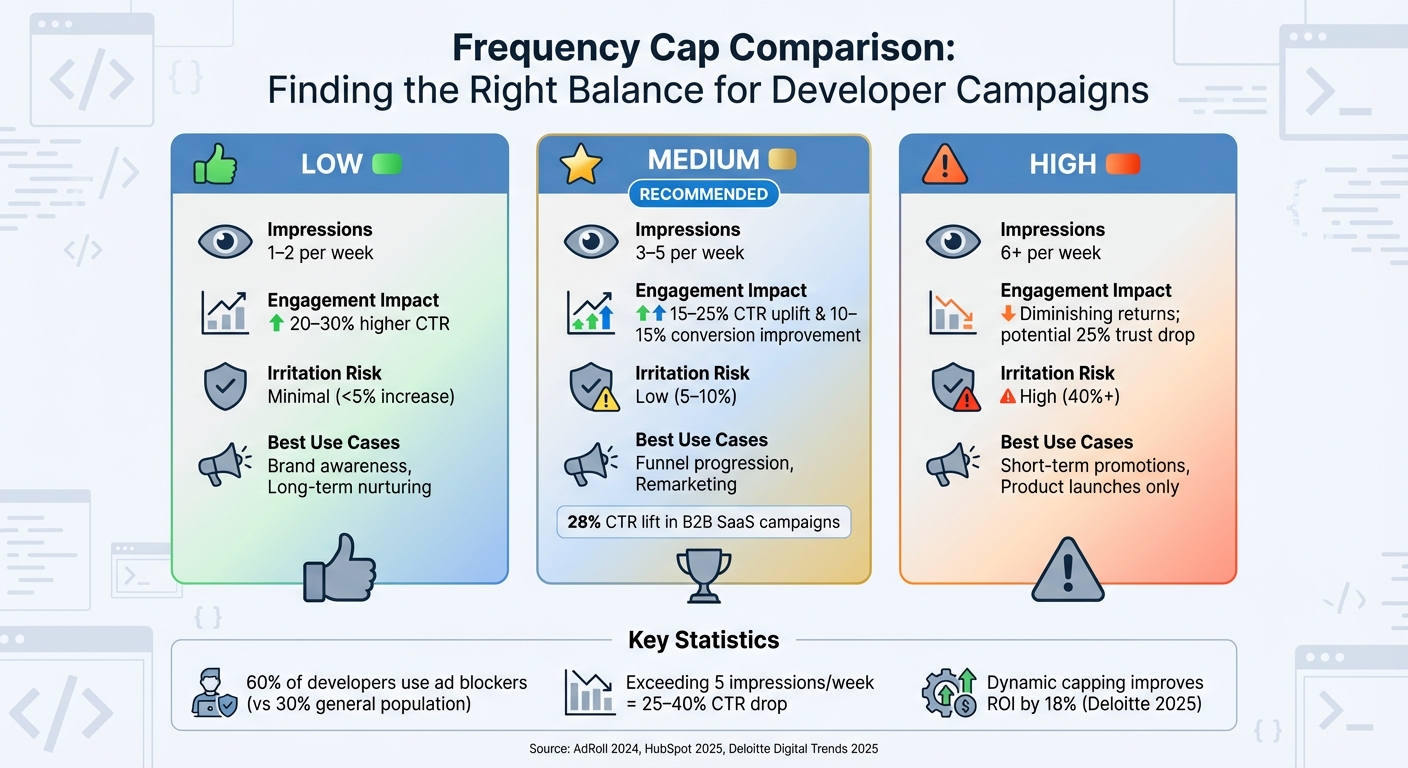 {Ad Frequency Capping Strategy Comparison for Developer Campaigns}
Too many ads can quickly turn from helpful reminders to outright annoyance. Developers, in particular, are highly sensitive to over-targeting. With 60% of developers using ad blockers, compared to 30% of the general population, they’re quick to tune out or avoid brands that bombard them with ads. For this audience, the tolerance for ad fatigue is much lower, making it essential to find the right balance for ad frequency.
To avoid crossing that line, aim to cap your ad impressions at 3–5 per week. This range keeps your brand visible without overwhelming your audience. Studies show that exceeding this threshold can lead to a 25–40% drop in click-through rates (CTR). According to a 2024 AdRoll report, campaigns capped at this level saw 20% higher engagement and 15% lower cost-per-acquisition. Developers, who spend 4–6 hours daily consuming technical content, will appreciate this respectful approach to their attention span.
If your CTR stays above 2% and ad blocker usage remains steady, you might cautiously increase to five weekly impressions. However, if your CTR drops by 10–20% or you notice more negative feedback, it’s a sign to scale back. Tools like dynamic capping, which adjust limits in real time based on engagement, can further enhance your ROI - Deloitte’s 2025 Digital Trends report notes an average 18% improvement when using this approach.
Recommended Frequency Caps for Developer Campaigns
To avoid overexposure, set frequency caps tailored to each platform. Here’s what works best for developer-focused campaigns:
- Google Display Ads: Stick to 3–5 impressions per week.
- LinkedIn Ads: Limit to 2–4 weekly impressions. A 2025 HubSpot report found that going beyond four impressions can cause a 28% drop in positive sentiment among B2B developers.
- Facebook and Instagram: Cap at 1–3 impressions per day. These platforms tend to cause higher visual fatigue.
To ensure consistency across channels, use cross-channel capping tools like Google Campaign Manager. Without unified tracking, developers might see your ad multiple times across different platforms, potentially encountering six or more impressions in a single week - even when you intended far fewer. Keep an eye on metrics like bounce rates (a 15%+ increase is a red flag) or declining CTRs, and adjust your strategy as needed.
Frequency Cap Comparison: Low, Medium, and High
Different frequency cap strategies serve different goals. Here’s how they stack up:
Low Capping (1–2 impressions per week): Focused on quality, this approach builds familiarity without being intrusive. It’s ideal for long-term brand awareness campaigns, delivering 20–30% higher CTRs while keeping ad blocker usage minimal (less than a 5% increase).
Medium Capping (3–5 impressions per week): Strikes a balance between visibility and engagement. Campaigns in this range see a 15–25% CTR boost and a 10–15% improvement in conversion rates. Perfect for guiding developers through the sales funnel.
Example: A B2B SaaS campaign that capped ads at four impressions per week across feeds and email saw a 28% CTR lift and 12% lower churn compared to an uncapped strategy.
- High Capping (6+ impressions per week): Best reserved for short-term promotions like product launches, this approach comes with risks. Overuse can lead to a 40%+ irritation spike and a 25% drop in trust.
| Frequency Cap | Impressions per Week | Engagement Impact | Irritation Risk | Best Use Cases |
|---|---|---|---|---|
| Low | 1–2 | 20–30% higher CTR | Minimal (<5% increase) | Brand awareness, long-term nurturing |
| Medium | 3–5 | 15–25% CTR uplift & 10–15% conversion improvement | Low (5–10%) | Funnel progression, remarketing |
| High | 6+ | Diminishing returns; potential 25% trust drop | High (40%+) | Short-term promotions, product launches |
Creative Strategies: Retarget with Value, Not Sales Pitches
Once you've fine-tuned your targeting, it's time to focus on delivering ads that developers actually care about. Forget the hard sales pitches - developers tune those out. Instead, offer content that provides real, immediate value. Think cheat sheets, code snippets, or tutorials. For example, GitHub successfully retargeted developers by promoting "Sponsor Open Source Projects" ads that linked directly to contributor tools. This approach prioritized utility over pushing conversions. Similarly, Vercel saw a 40% boost in engagement by running ads like "Deploy Your Next.js App in 60 Seconds", which featured live demos and tutorials rather than purchase-focused messaging .
The secret lies in aligning your ads with where developers are in their journey. Early-stage ads should focus on education. For instance, an infographic titled "5 Ways to Optimize CI/CD Pipelines" can introduce a problem and hint at a solution. Mid-stage creatives can go deeper with interactive demos or tutorials linked to GitHub. By the decision stage, it's okay to include offers like "Test Our Monitoring Tool on Your Repo – No Card Needed", but make sure these are paired with something practical, like performance benchmarks or anonymized case studies.
Stripe nailed this strategy by retargeting developers with ads that previewed API documentation. The result? A 25% increase in trial sign-ups. These ads focused on helping developers understand integration flows rather than pressuring them to buy .
Sequencing Ad Creatives Through the Developer Funnel
Start with awareness-focused content. For example, a 1-minute debugging tip or a carousel debunking myths about React Hooks can introduce your solution without coming across as pushy. As developers move into the consideration stage, offer more in-depth resources. This could mean step-by-step guides like "Explore Our SDK with Sample Code for Authentication Flows" or gated webinars on integration testing. By the decision stage, highlight real-world results - case studies with actual code examples or personalized benchmarks, like "30% Faster Builds with Our Config." Keep your calls-to-action low-pressure. A phrase like "Start Free POC" feels far more approachable than "Buy Now."
To avoid overwhelming your audience, use frequency caps - 1–2 impressions for awareness content and 2–3 for consideration stage ads. Rotate creative sets weekly to keep things fresh. This kind of thoughtful sequencing ensures developers see content that’s relevant and helpful at each stage of their journey.
Tailoring Ads to Developer Needs at Each Stage
The key to engaging developers is understanding their priorities at each stage. At the awareness stage, focus on content like cheat sheets or myth-busting carousels that address common challenges. During the consideration phase, share open-source code snippets or previews of your documentation to let developers interact with your solution directly. By the decision stage, showcase anonymized case studies or offer free tool trials to demonstrate real-world impact without requiring upfront commitment.
Design matters, too. Use visuals like terminal screenshots or syntax-highlighted snippets, and stick to straightforward, developer-friendly language. For example, an ad saying "Fix Your Latency Issues – Here's the Snippet" feels much more authentic than one loaded with marketing buzzwords. Subtle social proof, such as GitHub star counts or contributor numbers, can also build credibility. Developers are more likely to trust content that feels like it’s created by peers rather than a sales team.
Finally, track developer-specific metrics - time spent on landing pages, code snippet downloads, or demo sign-ups. Set measurable goals, like increasing qualified developer leads by 20% within 90 days. Use A/B testing to refine your approach. If tutorial ads outperform product demos in driving engagement, double down on educational content. This approach not only meets developers' needs but also builds long-term trust by respecting their preferences and privacy.
Retargeting Across Developer Touchpoints
Developers effortlessly navigate between platforms like daily.dev, Stack Overflow newsletters, and events such as GitHub Universe. To effectively engage them, retargeting efforts need to align with their preferences while avoiding intrusive tracking. Multi-channel retargeting, when carefully executed, can meet developers where they are most active.
This approach works because developers frequently switch contexts. Picture this: they might read a Kubernetes article during lunch, check their Dev.to newsletter after work, and attend a webinar over the weekend. By reaching them across feeds, emails, and events, engagement rates can increase up to threefold compared to using a single channel.
In Q4 2024, Vercel retargeted attendees of their Next.js Conf using a mix of email campaigns and daily.dev ads. Personalized emails with session recaps, paired with contextual feed ads, led to a 35% boost in free tier sign-ups - jumping from 12,000 to 16,200 in just 30 days. This effort also contributed to a $1.2 million ARR increase, all while adhering to strict privacy practices.
The secret lies in managing frequency across channels. For example:
- Limit feed ads to 2–3 impressions per week.
- Send email retargeting messages no more than 1–2 times per month.
- Follow up on events with 1–2 touchpoints over 30 days.
To respect privacy, use server-side tracking for feeds, opt-in mechanisms for email, and cookieless solutions like QR codes for events.
In March 2025, JetBrains used multi-channel retargeting to promote IntelliJ IDEA. Their campaign spanned Stack Overflow newsletters, Reddit feeds, and follow-ups from PyCon, driving a 28% increase in trial downloads (from 45,000 to 57,600) over 45 days. With an 18% paid conversion rate, the campaign maintained strict privacy compliance.
Multi-Channel Retargeting: Feeds, Email, and Events
Understanding the developer journey is crucial when planning multi-channel retargeting. Each touchpoint plays a unique role:
- Feeds: Ads in personalized feeds, such as daily.dev, are ideal for creating awareness. These platforms are perfect for sharing quick tips or code snippets, as developers often browse them daily.
- Email: Retargeting through email works well for nurturing interest. Deliver tutorials, demos, or other in-depth content to subscribers who’ve opted in.
- Events: Follow up with event attendees within 48 hours through platforms like LinkedIn or Marketo. This is the stage to connect with high-intent developers who are more likely to engage with live demos or free trials.
The key is to use consent-driven, zero-party data collected from event sign-ups or newsletter subscriptions. For example, if a developer attends a webinar on CI/CD optimization, follow up with an email offering a free pipeline audit tool. Then, reinforce the message with a contextual ad on daily.dev while they browse related articles. Personalized email campaigns - tailored to recent GitHub activity or forum discussions - see 25% higher open rates. Additionally, retargeting developers after events can result in a 40% boost in conversions, with 62% of developers acting on ads after webinars or conferences.
Using Native Placements in Developer Ecosystems
Native placements on platforms like daily.dev integrate seamlessly into the user experience, leveraging first-party, cookieless signals to deliver ads that resonate with developers. For instance, sponsored posts appear alongside relevant articles, making them feel more like curated recommendations than intrusive ads. This is important because developers are quick to block disruptive formats like pop-ups - 40% more often than the average user.
By relying on contextual signals, such as recent Stack Overflow activity or daily.dev article views, native placements respect privacy while remaining relevant. For example, a developer who frequently reads about AI/ML frameworks might see ads for machine learning tools or tutorials. This method can deliver 25% higher click-through rates compared to traditional banners. In fact, platforms like daily.dev report that native placements achieved 2.5× better click-through rates than banners in 2024–2025.
To maximize engagement, match ads to the topics developers are reading. For example, show Kubernetes-related tools to those exploring container orchestration content. By focusing on relevance and consent, these strategies maintain trust and enhance every interaction with developers.
Conclusion: Key Principles for Developer Retargeting
Developer retargeting hinges on four main principles that help establish trust. A privacy-first approach ensures tracking is based on explicit consent and prioritizes privacy-focused methods. Contextual targeting zeroes in on the content developers actively engage with - whether it's Kubernetes guides or React tutorials - aligning ads with their interests and current challenges. Together, these create a framework that respects developers' preferences while remaining effective in today's landscape.
Integrating these principles into a developer-focused strategy also includes frequency discipline. Avoid ad fatigue by keeping weekly impressions between 2–7, depending on the campaign stage. This is far less aggressive than the 15–20+ impressions often seen in typical B2B SaaS campaigns. Keep an eye on unsubscribe rates and ad-blocker usage, as they can signal when frequency is becoming excessive.
Another key aspect is value-driven creative. Ads should prioritize offering useful resources - like tutorials, documentation, tools, or case studies - over hard sales tactics. Tutorials, for example, should stand on their own as helpful content, even if they don't directly lead to conversions. This approach respects developers' intelligence and their awareness of tracking practices.
The future of developer marketing lies in intent-based targeting. Focus on developers' demonstrated interests and the problems they're actively working to solve. Platforms such as daily.dev make this possible by using contextual signals within developer ecosystems, moving away from invasive tracking methods like pixels.
Organizations that adopt these principles early can gain an edge by earning the trust of privacy-conscious developers before competitors are forced to adapt. While transitioning to cookieless solutions might initially result in a 10–20% efficiency dip, this stabilizes as first-party data grows. The long-term benefit? A retargeting strategy that developers respect rather than block. By embracing these practices, you can ensure lasting connections with developers who value privacy and relevance.
FAQs
What’s the least-creepy way to retarget developers in 2026?
The most developer-friendly way to approach retargeting in 2026 is by focusing on privacy and relevance. One effective strategy is contextual retargeting. This method displays ads based on the content developers interact with - think technical guides, tutorials, or coding resources - rather than relying on personal data tracking.
By adopting a cookieless, consent-first approach and offering ads that provide real value, such as useful tools or educational content, you can build trust. This approach respects developers' preferences for transparency and avoids intrusive advertising tactics, ensuring your outreach feels helpful rather than invasive.
How can I measure retargeting without third-party cookies?
To gauge the success of retargeting efforts without relying on third-party cookies, shift to contextual targeting. This method centers on the type of content users interact with - such as tutorials, documentation, or tools - instead of their personal information. By monitoring these interactions, you can align ads more effectively and assess their performance.
You can also analyze behavioral data like browsing patterns and engagement trends. Use metrics such as engagement rates, conversions, and content interactions to fine-tune your targeting strategy. This approach not only improves precision but also ensures a commitment to privacy.
What should I run when developers don’t want “Buy now” ads?
When marketing to developers, skip the aggressive "Buy now" approach. Instead, focus on value-driven content that resonates with their technical needs and interests. Share tutorials, detailed documentation, or free tools that genuinely help solve their challenges. Leverage contextual targeting to display ads relevant to the content they’re already engaging with - this avoids the pitfalls of invasive tracking. The key is to prioritize solving real-world problems with useful technical resources, ensuring your ads come across as helpful rather than pushy.