

If you want your developer tool to succeed, you need to rethink SEO. Developers don’t search like regular buyers - they look for specific solutions, error fixes, or code examples, often on platforms like GitHub, Stack Overflow, or AI tools such as ChatGPT. Here’s what you need to know:
- Developers value specifics: They search for detailed queries like "OAuth2 authentication with [tool]" or "[error code 429] fix", not vague terms like "best API platform."
- AI tools are changing search behavior: By 2026, 65% of developers use AI tools weekly, relying on synthesized answers rather than traditional search results.
- Community platforms matter: GitHub READMEs, Stack Overflow threads, and Reddit discussions often outperform polished product pages.
- Content structure is key: Use clear headings, concise answers, and structured data like JSON-LD to make your content accessible to both humans and AI crawlers.
- Programmatic SEO scales visibility: Templates for integrations, comparisons, and troubleshooting guides can help you rank for thousands of long-tail queries.
To stand out, focus on practical content that solves developer problems, optimize for AI-driven platforms, and engage in developer communities. Combining SEO with targeted paid campaigns ensures your tool is visible where developers are actively searching.
How Developers Search for Tools
::: @figure 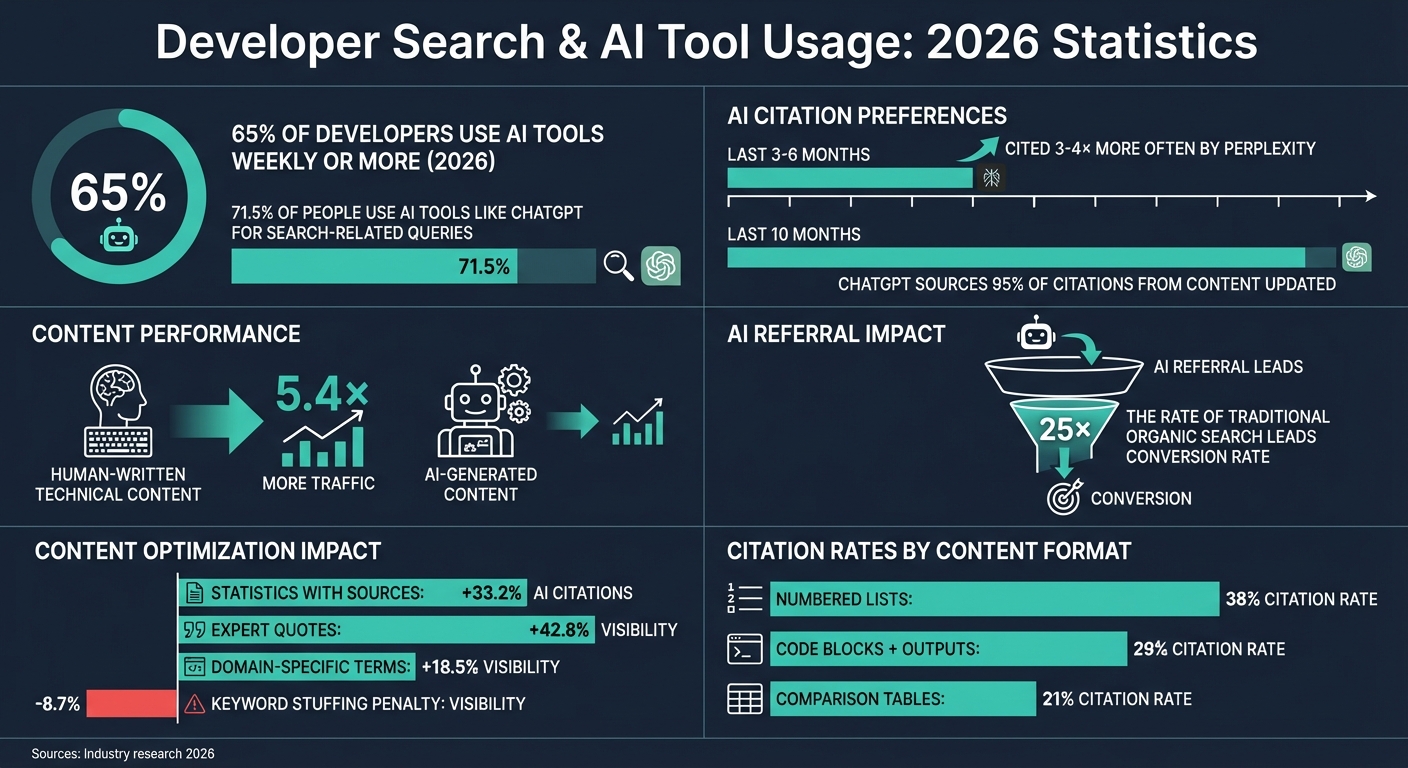 {Developer Search Behavior and AI Tool Adoption Statistics 2026}
Developers approach tool discovery differently from the average buyer. Instead of starting with broad searches like "best API platform", they dive into specialized resources where they can evaluate tools through code examples, peer reviews, and practical use cases. This means your sleek product page might not even make it onto their radar.
By early 2026, a notable trend is emerging: 65% of developers use AI tools weekly for their work. Platforms like Stack Overflow and GitHub remain pivotal in this ecosystem, offering not just peer insights but actionable examples and context. Stack Overflow's immense monthly traffic underscores its importance, while GitHub repositories frequently outrank official product pages, making these platforms essential for reaching developers. Let’s break down the key channels shaping this unique search behavior.
AI Assistants and Direct Answer Search
AI assistants like ChatGPT, Perplexity, and Claude are redefining how developers find information. Instead of sifting through search results, they receive direct, synthesized answers - complete with code snippets and tool suggestions - via chat interfaces. A staggering 71.5% of people already use AI tools like ChatGPT for search-related queries, and developers are leading this shift.
The game-changer here? AI assistants don’t just surface your content; they blend it with information from other sources. For instance, your documentation could be referenced in a response about "handling race conditions in Redis", but the developer might never visit your site. This shift renders traditional SEO metrics, like click-through rates, less relevant. Instead, mentions and citations in AI-generated responses become the new benchmarks for visibility. Beyond AI, developer communities continue to play a critical role in validating these recommendations.
Community Platforms as Primary Search Channels
Developers heavily rely on their peers for trusted advice. Platforms like Stack Overflow, Reddit, Hacker News, and GitHub dominate as discovery hubs because they offer unfiltered discussions about real-world technical challenges. For example, a developer searching for "how to handle authentication in Next.js" is more likely to trust a detailed Stack Overflow thread than a vendor’s official blog post.
Among these platforms, GitHub stands out. As Sarah Dayan, Staff Engineer at Algolia, explains:
"We treat the GitHub README as our alt-homepage. It's often the first thing developers read. So we write it like we're onboarding someone right there".
A well-crafted README - with clear installation instructions, feature highlights, and active contributions - often outshines traditional landing pages in terms of visibility and effectiveness. This kind of community-driven validation ties directly into the technical content strategies we’ll explore in the next sections.
sbb-itb-e54ba74
Keyword Research for Developer Products
When it comes to developer tools, traditional keyword research methods often fall short. Tools like Google Keyword Planner frequently report zero search volume for the technical terms developers actually use. Nate Matherson, Co-founder & CEO of Positional, highlights this limitation:
"Developers are often the smallest sample population in these tools. So often, the keyword tool, I don't even care if it says zero traffic. I'm like, I know for a fact this gets searched a bunch."
The key to overcoming this? Start with real developer conversations before relying on keyword tools. Dig into customer support tickets to uncover recurring technical questions, and review sales call transcripts to understand how developers describe their challenges. Google Search Console is another goldmine - look for question-based queries already driving traffic to your site . These sources reveal the exact problems developers are searching for, helping you focus on long-tail keywords that resonate with their needs.
Targeting Long-Tail Developer Queries
Developers don’t search for general terms - they look for specific solutions. Instead of something broad like "API platform", they’ll type queries like "how to authenticate with [API name] using OAuth2" or "[error code 429] rate limit fix." While these long-tail queries may have lower individual search volumes, their collective "traffic potential" can be substantial .
To effectively target these queries, focus on five key keyword categories that reflect how developers search:
- DX Resources: Examples include "{company} API" or "{company} authentication."
- Complementary Tools: Phrases like "{company} + Docker" or "{company} + Kubernetes."
- Competition: Keywords such as "{company} vs {competitor}."
- Use Cases: Searches like "how to use {company}" or "{company} tutorial."
- Pricing: Terms like "{company} free tier" .
For newer sites, aim for keywords with a Keyword Difficulty under 30 and a minimum of 100 monthly searches to build authority early on . And don’t dismiss keywords that appear to have zero search volume in tools - dedicate about 25% of your content resources to these "hidden gems" that show up in places like Stack Overflow, GitHub issues, or Reddit threads but don’t register in traditional SEO tools .
Keep in mind, creating content for technical keywords requires subject matter expertise and often costs 3–4 times more than consumer-focused content. However, the payoff is clear: human-written technical content generates 5.4× more traffic than AI-generated alternatives .
Matching Keywords to Content Formats
Different types of keywords align with specific content formats. For example:
- Documentation queries: Searches like "[tool] REST API" or "[error code] fix" are best addressed with API references and troubleshooting guides.
- Comparison searches: Phrases such as "[tool] vs [competitor]" or "[tool] alternatives" work well as honest comparison tables. Developers value transparency and prefer objective decision-making frameworks .
- Integration keywords: Queries like "[tool] + AWS" or "[tool] GitHub action" call for step-by-step integration guides that include code samples.
To align with developer search intent, map keywords to the different stages of their journey:
- Awareness-stage searches: These require tutorials or introductory guides.
- Consideration-stage queries: These benefit from detailed comparisons.
- Decision-stage searches: These demand in-depth setup guides .
Technical Content That Ranks
Using semantic HTML structure helps search engine crawlers understand your content better by creating a clear content tree. To stand out in search results, implement FAQPage and HowTo JSON-LD schema, which can unlock rich snippets and boost visibility .
| AEO-Friendly Element | Citation Impact | Implementation |
|---|---|---|
| TL;DR Summary | Frequently picked up by LLMs | Include 1–2 concise sentences at the top of the page |
| Code Blocks + Outputs | 29% citation rate | Add repository links and expected results |
| Comparison Tables | 21% citation rate | Highlight features, trade-offs, and ideal use cases |
| Numbered Lists | 38% citation rate | Use for step-by-step process breakdowns |
In addition to structuring your content effectively, keeping it fresh is equally important. Displaying "Updated" dates prominently and revisiting top tutorials every quarter ensures your content stays relevant. Avoid clickbait headlines and unnecessary filler - AI models and Google Discover favor recently updated content over older, even highly authoritative pages . Notably, Google's 2026 update targets excessive padding, rewarding original insights and quantified data instead .
These strategies reflect what developers value most: clear, precise, and up-to-date resources. Next, we’ll dive into programmatic SEO techniques that complement these practices.
Programmatic SEO for Developer Tools
Developer tools are a perfect match for programmatic SEO because they cater to a wide range of languages, frameworks, and integrations. This approach not only scales content production but also aligns with the way developers search online. Instead of creating individual guides manually, you can use templates and structured data to generate pages tailored to specific needs. A great example? Zapier used this strategy to create over 50,000 integration landing pages, leading to 16.2 million organic visitors monthly and ranking for 1.3 million keywords .
Generating Content for Specific Use Cases
At the heart of programmatic SEO is recognizing patterns in developer search behavior. Developers often search using combinations like [Tool] + [Language] (e.g., "Stripe with Python"), [Tool A] vs [Tool B] comparisons, or [Tool] + [Platform] integrations (e.g., "Sentry on AWS Lambda"). Each of these combinations can be turned into a dedicated page using a reusable template filled with structured data .
Next.js 15 is a standout choice for developer SEO. It efficiently handles thousands of pages through Static Site Generation (SSG) and Incremental Static Regeneration (ISR) . Its Metadata API takes care of generating meta tags and JSON-LD schema, while built-in sitemap support ensures search engines can easily discover your content. For teams without engineering support, Webflow offers a low-code solution that maps CMS collections to URL patterns . The key to success lies in creating consistent templates, which help maintain quality as your content scales.
When designing URLs, keep them clean and easy to read, such as /integrations/salesforce/ or /compare/hubspot-vs-marketo/. Avoid using query parameters like ?tool=python - these are harder for search engines to crawl and don’t clearly convey hierarchy. Each page should include at least one unique data point that enhances the user experience. Liam Dunne from Discovered Labs puts it well:
"If the data point doesn't change the user value, don't make a new page" .
Start small by testing with 50–200 pages. Monitor your indexing rate in Google Search Console over 4–6 weeks. If you achieve an indexation rate above 80%, you can confidently expand to thousands of pages. This phased approach allows you to address template issues, internal linking gaps, or thin content before scaling up .
Keeping Quality High While Scaling
Scaling programmatic SEO comes with a risk: producing pages that feel like "mad-libs" - where only a single word changes without adding real value . Maintaining quality is essential, as Robin Da Silva, founder of Nest Content, explains:
"Programmatic SEO handles the data layer and the distribution layer. It doesn't handle the expertise layer" .
Templates should be built in modular blocks of 200–400 words with clear headings. This structure is effective for both traditional search engines and AI assistants using Retrieval-Augmented Generation (RAG) . Start with a "Bottom Line Up Front" (BLUF) section that directly answers the core question. Follow this with sections like code examples (with expected outputs), comparison tables highlighting trade-offs, and FAQ blocks addressing common concerns .
Internal linking is also vital. Templates should automatically generate links between parent and child pages (e.g., main integrations page to specific tools), sibling pages (e.g., related integrations), and pillar pages (e.g., core documentation) . Using SoftwareApplication JSON-LD schema on every page helps search engines and AI models understand your tool, including details like operatingSystem and applicationCategory .
Since developer tools evolve rapidly, set up automated systems to monitor data accuracy. Outdated API versions, pricing information, or deprecated code examples can undermine trust if not updated promptly . Include "Updated" dates on your pages and review top templates every quarter to ensure they remain accurate. With Google’s February 2026 update, authority is now assessed by subject area - each programmatic vertical must demonstrate depth on its own, rather than relying solely on domain-level trust . Balancing scalability with quality is the key to long-term success in developer-focused SEO.
Optimizing for AI Assistants
By 2026, nearly 65% of developers are using AI tools weekly or more in their workflows . To ensure your content stands out, focus on Answer Engine Optimization (AEO). This approach ensures that AI assistants can extract and recommend your tool effectively when developers seek solutions.
Here's why this matters: AI referral leads convert at an astounding 25× the rate of traditional organic search leads. But there's a catch - AI models penalize keyword stuffing, reducing visibility by 8.7% . Instead, they prioritize content that is clear, up-to-date, and backed by credible sources.
Creating Content AI Models Reference
AI assistants don't "read" like humans. They scan for straightforward answers, structured data, and reliable sources. To align with this, use answer capsules - 40–60 word blocks placed right after every H2 heading. These concise answers address the main question of the section and match developers' expectations for quick, actionable insights, similar to what they find in community forums and technical documentation .
As Rand Fishkin explains:
"AI systems don't just want answers - they want answers they can trace back to authoritative sources. The age of unsourced content marketing is over."
To improve your chances of being cited, use structured formats like numbered lists, code snippets, and comparison tables. Ensure every API endpoint has a unique URL, a clear H1 tag, and consistent URL patterns to help AI models index specific functions . Incorporate schema markup such as FAQPage, HowTo, and Organization to clarify content structure and relationships .
Keep your content fresh. AI tools favor recent updates: Perplexity cites content updated within the last 3–6 months up to 3–4× more often . Similarly, ChatGPT sources 95% of its citations from content refreshed in the last 10 months . Include visible "Last Updated" dates on your pages, as AI systems use these timestamps to gauge relevance. Audit your technical guides quarterly, updating them with the latest API versions, pricing details, and code examples.
Adding statistics with sources can boost AI citations by 33.2% . Aim to include at least five sourced data points per 2,000 words, ensuring you list the source name, year, and sample size (e.g., "Gartner, 2026"). Expert quotes further enhance visibility, increasing it by 42.8% . Using precise, domain-specific terms like "retrieval-augmented generation" or "vector search" also signals expertise, improving visibility by 18.5% .
Monitor your server logs for activity from AI crawlers like OAI-SearchBot (ChatGPT), ClaudeBot (Claude), and PerplexityBot. If these bots aren't indexing your pages, review your robots.txt file and consider adding an llms.txt file to explicitly allow AI crawlers .
Once your content is optimized for AI extraction, the next step is to amplify your brand's presence across key developer platforms.
Increasing Brand Mentions on Developer Platforms
AI assistants don't just rely on your website - they cross-check your brand's presence across the web to establish entity authority. This means platforms like Wikipedia, Crunchbase, LinkedIn, and GitHub play a critical role in how AI models validate and recommend your tool . Positive mentions on trusted developer platforms greatly influence AI recommendations.
This marks a shift in priorities: brand mentions now outweigh traditional backlinks for AI citation . When developers talk about your tool on platforms like Reddit, Dev.to, Stack Overflow, or in technical newsletters, AI models use these discussions to gauge your tool's reputation and use cases. Following Google's February 2026 Discover Core Update, authority is now assessed by subject area rather than domain-wide . This makes it crucial to build depth in specific areas rather than spreading efforts too broadly.
To strengthen your presence, actively engage in developer communities where your audience gathers. Answer questions on Stack Overflow, participate in Reddit programming discussions, and contribute guest posts to technical blogs. Each mention serves as a verifiable signal that AI models use for entity recognition . Use the sameAs property in your Organization schema to link to authoritative profiles across these platforms - this helps AI systems confirm your brand identity .
The focus isn't just on being mentioned but being mentioned in context. When developers share how your tool solved a specific problem, it helps AI models understand when to recommend you. These external signals complement your on-site AEO efforts, creating a well-rounded foundation of trust. As discovery shifts from link-based ranking to context-aware recommendations, AI synthesizes data to provide personalized tool suggestions . Your goal? Ensure that data includes accurate, positive mentions of your tool solving real-world developer challenges.
Link Building in Developer Communities
Traditional link-building approaches often fall flat with developers. They’re quick to dismiss mass outreach or anything that feels insincere. Instead, success lies in earning trust by demonstrating technical expertise and actively participating in the spaces where developers naturally gather.
When developers mention your tool in forums, include it in tutorials, or star your GitHub repository, these actions serve as credibility boosters - not just for your audience but also for search engines and AI models. Building on this, let’s look at how open-source contributions can help establish your authority.
Getting Links from Open Source Projects
Your GitHub repository isn’t just a place to host code - it’s a platform for discovery and trust-building . Since most GitHub users arrive via Google, optimizing your repository is critical for visibility . When developers search for solutions, they’ll often find your GitHub page before they even land on your official site.
Think of your README file as a secondary homepage. Sarah Dayan, Staff Engineer at Algolia, puts it perfectly:
"We treat the GitHub README as our alt-homepage. It's often the first thing developers read. So we write it like we're onboarding someone right there - what it does, how to install it, how to get help."
To maximize visibility, include at least six semantic topic tags in your repository metadata. This helps your project appear on GitHub topic pages, which are prime real estate for both Google and ChatGPT rankings . Choose descriptive repository names, such as "ai-chatbot-framework", to align with high-intent search queries .
Another effective strategy? Release open-source SDKs or tools that address specific technical challenges. These resources naturally encourage links to your documentation or paid solutions while offering real value . GitHub stars, a strong indicator of project popularity (correlation coefficient of 0.925), also act as trust signals for search engines and AI models .
Maintaining your repository is equally important. Regular commits and updated documentation signal that your project is active and reliable . Beyond GitHub, contributing to technical publications can further amplify your credibility.
Working with Technical Blogs and Developer Sites
When targeting developer-focused publications, accuracy beats marketing fluff. Andrew Romanyuk, CMO at Pynest, emphasizes this point:
"One of the key things we've learned... is that ranking technical content relies on authentic, precise language that mirrors developers' descriptions."
Focus on content that genuinely solves problems - think tutorials, benchmarks, and integration guides. Data shows that human-written technical content drives 5.4× more traffic than AI-generated material , and long-form articles over 3,000 words attract 3.5× more backlinks than shorter pieces .
If you syndicate your content on platforms like Dev.to or Hashnode, use canonical tags to ensure SEO value flows back to your site . These platforms are great for distribution, but you’ll want your site to benefit from the SEO gains.
To uncover link opportunities, try competitor intersect analysis. This involves identifying sites that link to multiple competitors but not to your tool . These domains are already open to referencing products in your space. When reaching out, skip the sales pitch. Instead, highlight how your content solves a specific technical challenge .
Guest posting remains a reliable tactic - 38.9% of marketers still use it as a primary link-building method . Aim for respected technical sites like Smashing Magazine or InfoQ. Collaborate on original research or benchmarks, as proprietary data is highly shareable and often cited by contributors themselves .
Finally, engage authentically in developer communities like Reddit and Hacker News. Provide genuine value before sharing links, and avoid low-effort promotions that could harm your reputation . When you do share, ensure your content directly contributes to the conversation. Pairing this approach with technical precision and optimized content creates a well-rounded strategy for building links in developer circles.
Combining SEO with Paid Campaigns
Pairing organic SEO efforts with paid campaigns creates a well-rounded strategy that covers the entire funnel. While SEO builds long-term trust through technical content that developers actively search for, it’s not always quick enough to capture developers at critical stages, like during their evaluation process. This is where paid campaigns step in, offering immediate visibility for product launches, feature updates, or competitive positioning.
The magic happens when these two approaches work together. SEO keyword research uncovers the exact technical challenges developers face - things like troubleshooting error messages, solving integration problems, or navigating framework-specific issues. This data can then shape your paid ad messaging to ensure it resonates with your audience.
"Doing SEO in the dev docs is very important for the developer journey, and much more versatile to increase your visibility (for PPC and ABM too) than many people would believe" .
By installing tracking pixels on your documentation pages, you can retarget developers who have already engaged with your content, helping to reduce acquisition costs. This mix of long-term SEO with the immediacy of paid campaigns creates a targeting strategy that’s both precise and data-driven.
Using daily.dev Ads to Reach Developers
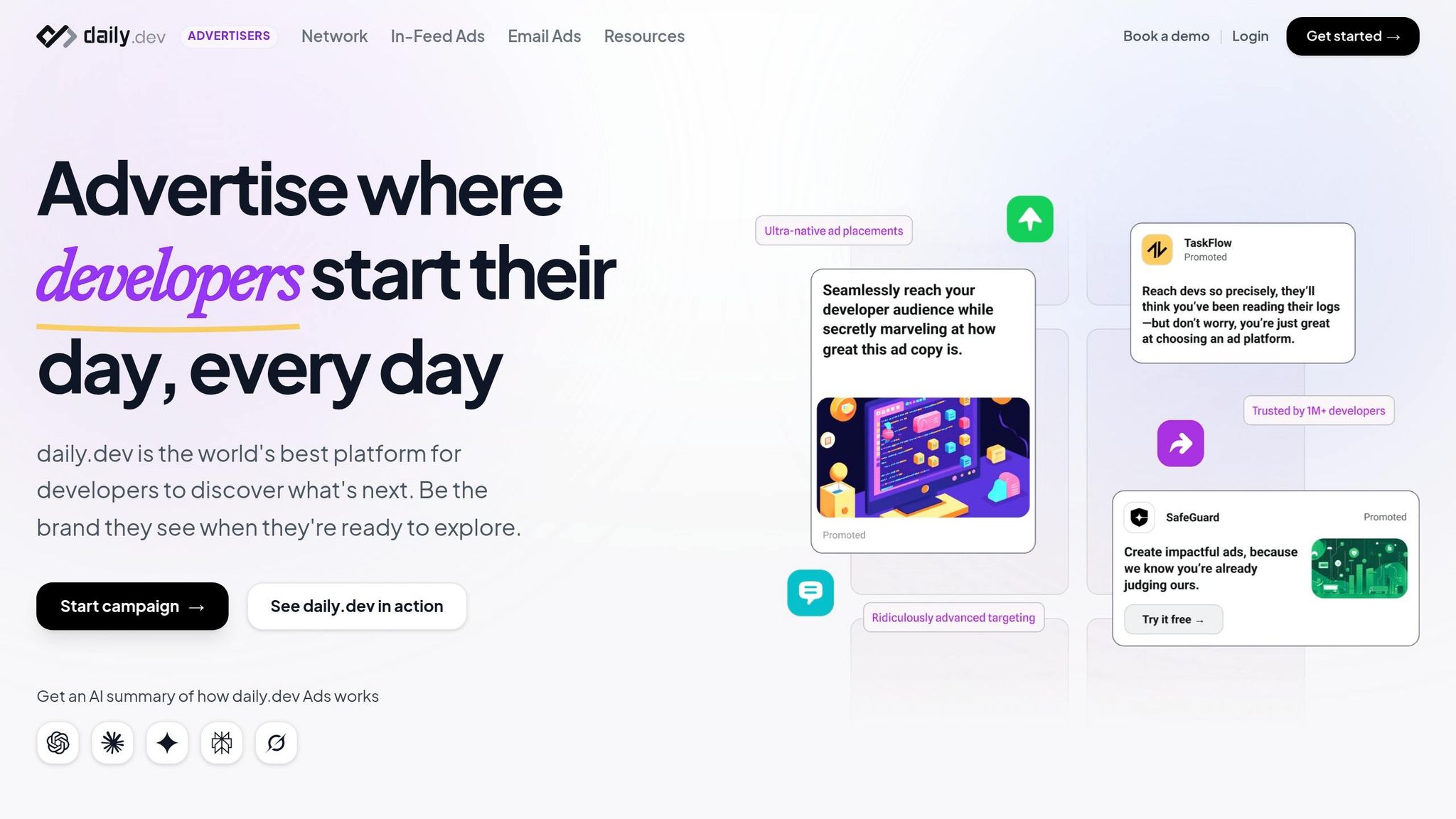
daily.dev Ads offers a unique way to connect with developers based on their seniority, preferred programming languages, and specific technology interests. For example, while your SEO content might draw developers searching for terms like "how to stream logs from Kubernetes" or "Next.js auth with JWT", daily.dev campaigns can target senior architects exploring DevOps tools or frontend engineers focused on particular frameworks.
What sets daily.dev apart is how its native ad placements - like in-feed ads, post page ads, and personalized digest ads - blend naturally into developers’ regular reading routines. These ads feel more like part of the content they trust rather than disruptive banners. By leveraging these precise audience segments, you can fine-tune your ad messaging for even better results.
Applying SEO Data to Paid Ad Strategy
Your SEO data is a goldmine for understanding where developers are in their buying journey. Map this data to stages like Awareness, Consideration, and Decision to ensure your ad messaging aligns with their intent.
For example, if your keyword research shows developers frequently pairing your tool with technologies like Docker, AWS, or Python, you can target these specific interests in your daily.dev campaigns. This ecosystem-focused strategy ensures your ads reach developers already working within your tool’s natural environment.
When developers search for terms like "[Your Tool] alternatives" or explore pricing-related queries such as "free tier" or "enterprise pricing", they’re signaling they’re ready to make a decision. Use this insight to craft ad copy that highlights transparent pricing, free trials, or other conversion-friendly features.
Additionally, keep an eye on which of your technical pages are being referenced by AI tools like ChatGPT or Perplexity.
"Brand mentions seem to weigh more heavily than backlinks... content mentioning your brand positively across a variety of platforms is key to showing up more often in LLMs" .
Incorporating these insights into your ad copy can help build credibility with a developer audience that’s naturally skeptical of marketing.
Your technical content - whether it’s tutorials, API documentation, or other resources - should serve as landing pages for your ads. These pages not only reinforce your credibility but also bridge the gap between your organic and paid efforts. With 51% of developer tool companies planning to increase their investment in SEO and content marketing by 2026 , combining these strategies is no longer optional - it’s essential for staying competitive and covering the full funnel effectively.
Conclusion
To rank effectively for developers, it's time to rethink traditional SEO. Developers often turn to GitHub READMEs and AI assistants for answers, not the typical marketing-heavy content. Your strategy needs to meet them in these technical spaces, focusing on accuracy and relevance rather than flashy language.
Address real developer challenges, structure your content in a way that's easy for AI tools to parse, and keep your documentation up-to-date. Search engine authority is no longer about your entire domain but about your expertise in specific areas. This means you need to build depth in targeted niches .
"You can't outsource technical credibility. If your SEO strategy doesn't involve the people building and using the product, you'll miss what developers actually search for."
– Phil Leggetter, former Head of DevRel, Ably
The best strategy combines organic SEO with carefully targeted paid campaigns. Use keyword research to pinpoint the exact terms developers are searching for and apply those insights to fine-tune your ad targeting and messaging. With more developer tool companies increasing their SEO budgets , this dual approach is essential for staying competitive at every stage of the customer journey.
To stand out, optimize key assets like CLI documentation, status pages, and GitHub READMEs - these are often the first places developers look. Then, amplify your presence with paid ads on platforms like daily.dev Ads to reach developers when they're evaluating tools. Whether they're searching, scrolling, or consulting an AI assistant, this combination ensures your product is visible at the right moments, driving both awareness and conversions.
FAQs
How do I get my docs cited by AI assistants?
To boost the likelihood of AI assistants like ChatGPT referencing your documentation, focus on crafting content that's well-organized, credible, and current. Here are some key tips:
- Structure matters: Use clear and logical formatting, such as FAQs, comparison tables, and concise headings, to make your content easier to process.
- Stay relevant: Include the latest statistics, citing reputable sources to back up your claims.
- Show expertise: Make your content authoritative by demonstrating deep knowledge of the subject.
Consistency is also key. Regularly update your documentation - ideally every 3-6 months - to keep it fresh. Additionally, engage with developer communities to build visibility. The more your content is mentioned and shared, the more likely AI tools will incorporate it into their responses.
Which developer keywords should I target first?
When creating content for developers, it's crucial to target technical queries that mirror their search habits. Focus on areas like API documentation, error messages, integration guides, and comparison-based searches (e.g., "best developer tools for [specific use case]"). These types of high-intent keywords resonate with how developers typically search, helping to attract the right audience and generate meaningful traffic to your content.
How can I scale programmatic SEO without creating thin pages?
To grow programmatic SEO without creating thin pages, prioritize indexation controls like noindex tags to keep low-quality content out of search results. Use structured templates for pages such as directories, comparisons, or location-specific content, making sure each page answers a distinct query. Roll out pages in smaller groups - typically 50 to 200 at a time - and ensure content uniqueness by including 3-5 key elements that set each page apart. These approaches help balance scalability with maintaining high-quality standards.